- Base Value(2026): 3.3 Bn
- Estimated Value(2026): 3.3 Bn
- Forecast Value (2036): 8.4 Bn
- CAGR (2026 - 2036): 9.8%
Molecular Allergy Diagnostics Market Forecast and Outlook 2026 to 2036
The molecular allergy diagnostics market stands at USD 3.3 billion in 2026 and moves to USD 8.4 billion by 2036, which reflects a 9.80% CAGR.
Molecular Allergy Diagnostics Market Key Takeaways
- Molecular Allergy Diagnostics Market Value (2026): USD 3.3 billion
- Molecular Allergy Diagnostics Market Forecast Value (2036): USD 8.4 billion
- Molecular Allergy Diagnostics Market Forecast CAGR: 9.8%
- Leading Type in Molecular Allergy Diagnostics Market: Multiplex microarray panels
- Key Growth Regions in Molecular Allergy Diagnostics Market: North America, Europe, Asia Pacific, Latin America, Middle East & Africa
- Top Players in Molecular Allergy Diagnostics Market: Thermo Fisher Scientific, Siemens Healthineers, EUROIMMUN (Revvity), Danaher (Beckman Coulter), bioMérieux
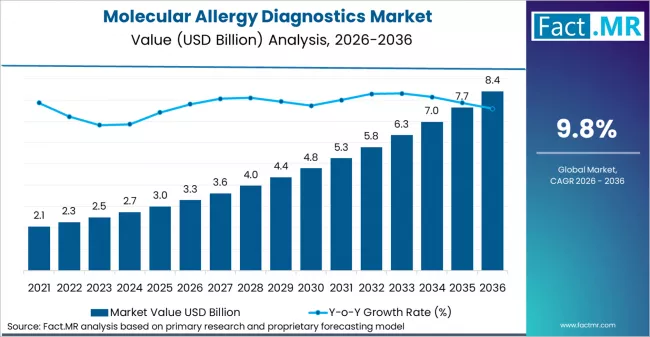
Molecular Allergy Diagnostics Market Market Value Analysis | Source: Fact.MR
This field focuses on identifying specific allergen components rather than relying only on broad category testing, which changes how clinicians assess risk and plan long-term management. Laboratories use these methods to improve result precision, support targeted avoidance strategies, and guide immunotherapy decisions.
Daily operations depend on stable test panels, consistent reagent supply, and reporting formats that fit existing laboratory information systems. Once a testing menu is adopted, revisions are made carefully since they affect validation records, staff training, and comparison with earlier results. Purchasing priorities center on result reliability, turnaround time, and smooth integration into routine workflows. Expansion follows wider use in specialist clinics, earlier placement in diagnostic pathways, and gradual replacement of less specific testing methods rather than abrupt changes in laboratory practice.
Molecular Allergy Diagnostics Market
| Metric | Value |
|---|---|
| Market Value (2026) | USD 3.3 billion |
| Forecast Value (2036) | USD 8.4 billion |
| Forecast CAGR 2026 to 2036 | 9.8% |
Source: Fact.MR analysis. Updated Jan 28, 2026
Category
| Category | Segments |
|---|---|
| Platforms | Multiplex microarray panels; Singleplex component sIgE assays; Extract-based immunoassays; Sample preparation controls and reagents; Software |
| Application Areas | Food allergy component profiling; Respiratory allergy; Drug allergic reactions; Venom allergy; Complex polysensitization |
| End User or Channel | Reference laboratories; Hospital laboratories; Specialty allergy clinics; IVD kits manufacturers; Research institutions |
| Region | North America; Europe; Asia Pacific; Latin America; Middle East & Africa |
Source: Fact.MR analysis. Updated Jan 28, 2026
Molecular Allergy Diagnostics Market Segmental Analysis
Why Do Multiplex Microarray Panels Serve as The Primary Platform for Molecular Allergy Testing Programs?
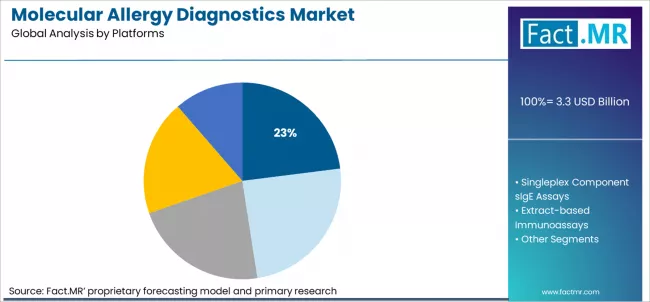
Molecular Allergy Diagnostics Market Analysis By Platforms | Source: Fact.MR
Multiplex microarray panels account for 23% of platform usage in the molecular allergy diagnostics market. Laboratories use these systems to assess multiple allergen components from a single patient sample within one run. This approach fits clinical pathways where broad sensitization mapping is needed at the first diagnostic step. Workflow design benefits from reduced sample handling and consolidated reporting formats. Clinicians also receive structured profiles that support interpretation across food, respiratory, and venom panels without ordering separate tests. Budget planning in reference labs often allocates capacity to these platforms to manage mixed caseloads. Singleplex assays and extract tests remain important. Initial diagnostic workups still rely most often on multiplex formats that provide wide coverage in one procedure.
Why Does Food Allergy Component Profiling Generate the Largest Share of Test Demand?
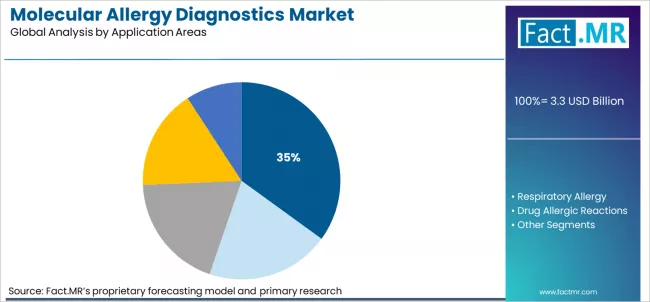
Molecular Allergy Diagnostics Market Analysis By Application Areas | Source: Fact.MR
Food allergy component profiling represents 35% of application area activity in this market. Pediatric and adult clinics see a steady flow of patients with suspected reactions that require precise identification of triggering proteins. Dietary management plans depend on distinguishing true sensitization from cross-reactivity, which raises testing frequency. Follow-up testing also occurs when diets change or when tolerance development is assessed. Referral patterns from primary care and emergency departments add further volume to this category. Respiratory, drug, and venom testing remain active areas. The direct link between results and daily food choices keeps component profiling for food allergy as the most common reason molecular tests are ordered.
What are the Drivers, Restraints, and Key Trends of the Molecular Allergy Diagnostics Market?
- Drivers: Adoption of molecular-level testing that identifies specific allergen proteins and IgE responses supports precise diagnosis and personalized management plans, increasing use of advanced diagnostics in clinical and specialized allergy practices.
- Restraint: High costs of molecular diagnostic assays, limited reimbursement coverage in some regions, and the need for specialized laboratory infrastructure restrict widespread implementation outside major healthcare centers.
- Trend 1: Expansion of multi-allergen panels that assess sensitivity to a broad range of proteins in a single assay, reducing time to diagnosis and improving clinical insight.
- Trend 2: Growing integration of molecular test results with patient management platforms and electronic records to support targeted treatment choices and longitudinal tracking.
Analysis of the Molecular Allergy Diagnostics Market by Key Country
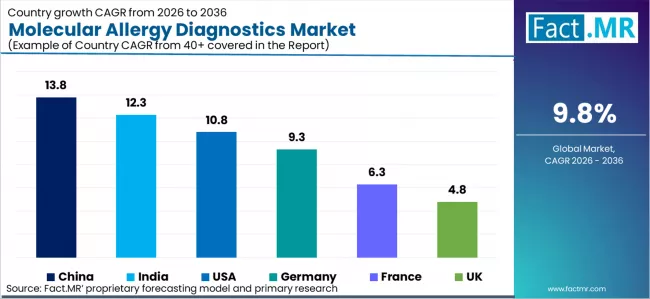
Molecular Allergy Diagnostics Market Cagr Analysis By Country | Source: Fact.MR
| Country | CAGR 2026 to 2036 |
|---|---|
| USA | 10.8% |
| China | 13.8% |
| India | 12.3% |
| Germany | 9.3% |
| France | 6.3% |
| UK | 4.8% |
Source: Fact.MR analysis. Updated Jan 28, 2026
The report covers an in-depth analysis of 40+ countries; top-performing countries are highlighted below.
How Are Laboratory Networks and Clinical Pathways Shaping the Molecular Allergy Diagnostics Market in USA?
At roughly 10.8% per year through 2036, the molecular allergy diagnostics market in USA is being shaped by consolidation of reference laboratories and wider use of component level testing. Clinical protocols increasingly specify structured test panels rather than broad screening. Demand centers on assay reliability, interpretation support, and integration into routine allergy workflows. Providers focus on turnaround time and reimbursement alignment. Purchasing decisions follow health system contracts and network standardization programs. Volume growth tracks rising diagnosis rates across pediatric and adult care. The Molecular Allergy Diagnostics Market in USA remains driven by protocol adoption and laboratory integration rather than consumer initiated testing behavior.
Why Does Hospital Expansion Matter for the Molecular Allergy Diagnostics Market in China?
With an expansion rate near 13.8% per year through 2036, the molecular allergy diagnostics market in China is moving in step with growth of tertiary hospitals and regional diagnostic centers. Capacity additions support wider access to component resolved testing. Demand focuses on high throughput systems, stable reagent supply, and workflow standardization. Providers prioritize scale and operational efficiency. Procurement strategies favor suppliers with national service coverage and training capability. Volume growth follows hospital network expansion and rising clinician awareness. The Molecular Allergy Diagnostics Market in China develops through infrastructure buildout and service normalization rather than private self referral testing models.
What Is Driving Formal Adoption in the Molecular Allergy Diagnostics Market in India?
Growth near 12.3% per year through 2036 places the molecular allergy diagnostics market in India on a path defined by expansion of private hospitals and organized diagnostic chains. Allergy testing is shifting from occasional use to structured clinical pathways. Demand centers on reliable assays, clinician education, and consistent reporting standards. Providers focus on referral network development and test menu standardization. Purchasing decisions reflect group level procurement policies. Volume growth follows expansion of organized diagnostics and higher awareness among specialists. The Molecular Allergy Diagnostics Market in India advances through system building rather than litigation driven testing or consumer promotion.
How Do Evidence Based Guidelines Influence the Molecular Allergy Diagnostics Market in Germany?
Running close to 9.3% per year through 2036, the molecular allergy diagnostics market in Germany reflects strong reliance on documented clinical pathways. Hospitals and specialist clinics integrate component based testing into structured diagnostic sequences. Demand focuses on test accuracy, interpretation quality, and guideline compliance. Providers emphasize documentation and audit readiness. Procurement decisions remain conservative and contract based. Volume growth follows gradual increases in specialist capacity and updated recommendations. The molecular allergy diagnostics market in Germany remains shaped by institutional planning and professional consensus rather than rapid shifts toward direct access testing or decentralized purchasing.
Why Do Public Health Frameworks Shape the Molecular Allergy Diagnostics Market in France?
At about 6.3% per year through 2036, the molecular allergy diagnostics market in France expands within centralized reimbursement and care planning structures. Diagnostic services are added through approved hospital and laboratory pathways. Demand centers on validated assays, standardized reporting, and clinician training. Providers focus on compliance and cost control. Procurement decisions follow public system approvals and budget cycles. Volume growth follows slow increases in specialist activity and test coverage. The molecular allergy diagnostics market in France develops through public healthcare planning rather than private laboratory competition or rapid expansion of self-referral diagnostic services.
How Are Capacity Limits Affecting the Molecular Allergy Diagnostics Market in UK?
An annual pace near 4.8% through 2036 leaves the molecular allergy diagnostics market in UK closely tied to public health service capacity and staffing levels. Allergy testing is prioritized for defined clinical indications. Demand focuses on essential test panels and clear clinical utility. Providers emphasize triage and pathway discipline. Purchasing decisions follow centralized procurement frameworks. Volume growth tracks incremental increases in laboratory and clinic capacity. The molecular allergy diagnostics market in UK remains constrained by funding and workforce pressures rather than broad based rollout of advanced testing across all care settings.
How Do Laboratory Standardization and Platform Integration Shape Competition in the Molecular Allergy Diagnostics Market?
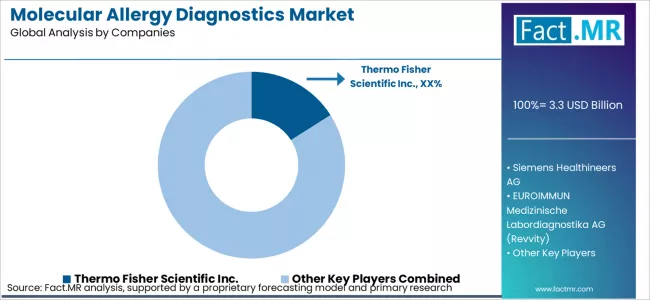
Molecular Allergy Diagnostics Market Analysis By Company | Source: Fact.MR
Adoption in the molecular allergy diagnostics market is driven by laboratory standardization policies and analyzer platform alignment rather than by menu breadth alone. Hospital and reference labs first define throughput targets, automation levels, and reporting formats, then select assays that fit existing workflows. Thermo Fisher and Siemens Healthineers anchor positions where integrated analyzers and informatics reduce hands on time and simplify quality control. EUROIMMUN under Revvity and Beckman Coulter under Danaher compete through assay panels that extend menu coverage while staying within validated operating windows. bioMérieux participates where regional service support and instrument placement agreements influence capital planning. Buyers compare suppliers using calibration stability, lot to lot concordance, external quality assessment performance, and middleware compatibility. Contract decisions also weigh reagent supply security and upgrade paths over multi-year horizons. Once a platform is embedded, switching costs are material because staff training, method validation, and LIS mappings must be repeated. Volume growth follows test algorithm updates and guideline driven expansion of component resolved diagnostics rather than tender cycles. Competitive shifts usually occur after analyzer refresh programs or changes in laboratory network strategy.
Key Players in Molecular Allergy Diagnostics Market
- Thermo Fisher Scientific Inc.
- Siemens Healthineers AG
- EUROIMMUN Medizinische Labordiagnostika AG (Revvity)
- Danaher Corporation (Beckman Coulter)
- bioMérieux SA
References
- Medical Device Coordination Group. (2023). MDCG 2023-1: Guidance on the clinical evidence needed for medical devices and in vitro diagnostic medical devices under Regulations (EU) 2017/745 and (EU) 2017/746. European Commission.
- U.S. Food and Drug Administration. (2023). In vitro diagnostic (IVD) device studies-Frequently asked questions. U.S. Department of Health and Human Services.
- European Commission. (2023). Regulation (EU) 2023/607 amending Regulations (EU) 2017/745 and (EU) 2017/746 as regards transitional provisions for certain medical devices and in vitro diagnostic medical devices. European Commission.
- World Health Organization. (2023). WHO global benchmarking tool for medical devices and in vitro diagnostic medical devices (2nd ed.). World Health Organization.
- European Commission. (2023). Commission Implementing Regulation (EU) 2023/2197 establishing European Union reference laboratories for in vitro diagnostic medical devices under Regulation (EU) 2017/746. European Commission.
Segmentation
Scope of the Report
| Items | Values |
|---|---|
| Quantitative Units (2026) | USD billion |
| Platforms | Multiplex microarray panels, singleplex component sIgE assays, extract-based immunoassays, sample preparation controls and reagents, software |
| Application Areas | Food allergy component profiling, respiratory allergy, drug allergic reactions, venom allergy, complex polysensitization |
| End User or Channel | Reference laboratories, hospital laboratories, specialty allergy clinics, IVD kits manufacturers, research institutions |
| Regions Covered | Asia Pacific, Europe, North America, Latin America, Middle East & Africa |
| Countries Covered | United States, Canada, Mexico, Germany, United Kingdom, France, Italy, Spain, China, Japan, South Korea, India, Australia & New Zealand, ASEAN, Brazil, Chile, Saudi Arabia, Turkey, South Africa, and other regional markets |
| Key Companies Profiled | Thermo Fisher Scientific, Siemens Healthineers, EUROIMMUN (Revvity), Danaher (Beckman Coulter), bioMérieux |
| Additional Attributes | Dollar by sales by platform, application area, and end user; focus on component resolved testing, LIS integration, and laboratory standardization; demand driven by guideline adoption and expansion of specialist diagnostics |
Source: Fact.MR analysis. Updated Jan 28, 2026
Molecular Allergy Diagnostics Market Segmentation
-
Platforms :
- Multiplex Microarray Panels
- Singleplex Component sIgE Assays
- Extract-based Immunoassays
- Sample Preparation Controls & Reagents
- Software
-
Application Areas :
- Food Allergy Component Profiling
- Respiratory Allergy
- Drug Allergic Reactions
- Venom Allergy
- Complex Polysensitization
-
End User or Channel :
- Reference Laboratories
- Hospital Laboratories
- Specialty Allergy Clinics
- IVD Kits Manufacturers
- Research Institutions
-
Region :
- Asia Pacific
- China
- Japan
- South Korea
- India
- Australia & New Zealand
- ASEAN
- Rest of Asia Pacific
- Europe
- Germany
- United Kingdom
- France
- Italy
- Spain
- Nordic
- BENELUX
- Rest of Europe
- North America
- United States
- Canada
- Mexico
- Latin America
- Brazil
- Chile
- Rest of Latin America
- Middle East & Africa
- Kingdom of Saudi Arabia
- Other GCC Countries
- Turkey
- South Africa
- Other African Union
- Rest of Middle East & Africa
- Asia Pacific
Frequently Asked Questions
How big is the molecular allergy diagnostics market in 2026?
What will be the size of molecular allergy diagnostics market in 2036?
How much will be the molecular allergy diagnostics market growth between 2026 and 2036?
What are the key product types in the molecular allergy diagnostics market?
Which application areas segment to contribute significant share in the molecular allergy diagnostics market in 2026?
Who worked on this report


Preview the report firsthand - request a free sample
Free SampleGet the brochure for pricing and purchase details
Download PDF