- Market Value (2025): USD 143.4 Mn
- Estimated Value (2026): USD 163 Mn
- Forecast Value (2036): USD 590 Mn
- CAGR (2026-2036): 13.7%
What is the Selective Coating Robots Market forecast to be worth by 2036?
USD 163 million in 2026 to USD 590 million by 2036, at 13.7% CAGR.
- The selective coating robots market crossed a valuation of USD 143.4 million in 2025.
- Demand is projected to increase from USD 163 million in 2026 to USD 590 million by 2036.
- The market is forecast to record a 13.7% CAGR from 2026 to 2036 as electronics manufacturers automate selective conformal coating, curing and dispensing work.
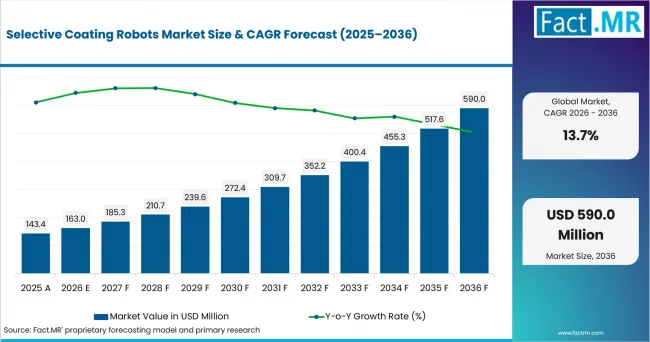
Selective Coating Robots Market Value Analysis | Source: Fact.MR
What are the defining numbers behind Selective Coating Robots Market growth?
USD 427 million absolute opportunity by 2036, led by Gantry/Cartesian robots, UV inline curing and automotive electronics.
- Demand Drivers in the Market
- IPC reported on March 31, 2025 that February 2025 North American PCB shipments rose 11.3% year over year and bookings rose 17.8%. PVA states that its Delta 8 uses a three-axis motion platform and closed-loop process control to support consistent selective-coating and dispensing results.
- Rehm states that conformal coating protects electronic assemblies from environmental influences including moisture, corrosion, chemicals, dust and vibration, and identifies automotive electronics among relevant applications. SIA reported on February 6, 2026 that global semiconductor sales reached USD 791.7 billion in 2025, up 25.6% from 2024.
- PVA states that PathMaster software provides offline programming, area-coat programming, skew correction and optimized selective-coating functionality for faster programming and improved throughput. BEA reported that foreign direct investors spent USD 2.0 billion in 2025 to establish new U.S. businesses or expand existing foreign-owned businesses in computers and electronic products manufacturing.
- Key Segments Analyzed
- By Robot Configuration: Gantry/Cartesian is expected to hold 44.0% share in 2026, supported by stable overhead motion on panelized PCB assemblies.
- By Applicator Type: Film-coat nozzle is projected to account for 37.0% share in 2026 due to clean edge control on repeatable coating paths.
- By Curing Integration: UV inline is anticipated to capture 41.0% share in 2026 owing to shorter post-coat handling and compact line flow.
- By End User: Automotive electronics is estimated to represent 36.0% share in 2026, shaped by rising electronics content in electric and connected vehicles.
- Analyst Opinion at Fact.MR
- Shambhu Nath Jha, Principal Consultant at Fact.MR, states, "Selective coating robots are drawing attention because coating quality is now tied to production records and board-level reliability. Demand is expected to move toward systems that combine repeatable motion, valve control and cure routing in one process. Suppliers that document recipe transfer and service support are better placed with automotive accounts."
- Strategic Implications
- Robot suppliers should document repeatability, edge control and recipe portability. Nordson introduced the ASYMTEK Select Coat SL-1040 Ultrasonic Cleaning Station in February 2025 to keep nozzles and needles clean during production.
- Valve specialists should connect film-coat, atomizing spray and needle dispense options to material viscosity and board geometry.
- Curing-system providers should show how inline UV routing reduces handling time without weakening coating performance on qualified materials.
- Contract manufacturers should link coating automation to inspection data so customers are able to audit process quality after shipment.
Japan is forecast to post 16.8% CAGR through 2036 through electronics-device output. The USA is expected to record 15.2% CAGR as PCB activity and electronics investment support automation. The UK is projected at 12.1% CAGR, while South Korea is anticipated at 11.0% CAGR. Germany is estimated at 9.6% CAGR through EV production and electro-digital exports.
How does the Selective Coating Robots Market break down by segment?
Gantry/Cartesian leads Robot Configuration at 44.0%; UV inline leads Curing Integration at 41.0%.
Which Robot Configuration dominates?
Gantry/Cartesian holds 44.0% share in 2026.
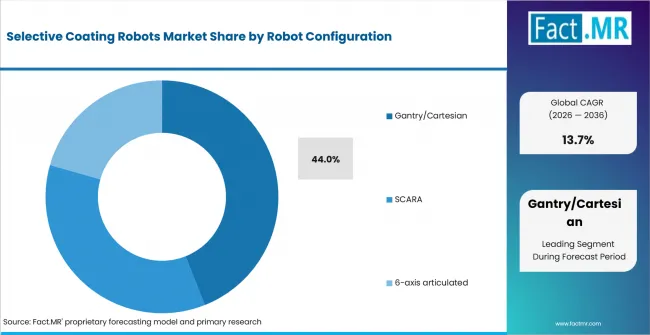
Selective Coating Robots Market Analysis By Robot Configuration | Source: Fact.MR
Gantry/Cartesian systems lead because selective coating needs stable X-Y-Z motion across panelized boards. PVA states that Delta 8 is a flexible robotic conformal coating and dispensing system for selective coating, potting and meter-mix dispensing.
What leads the Applicator Type segment?
Film-coat nozzle accounts for 37.0% share in 2026.
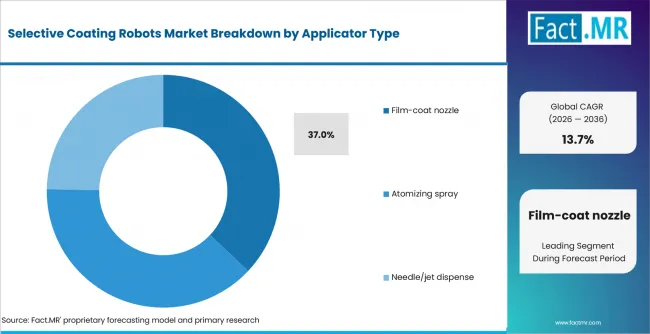
Selective Coating Robots Market Analysis By Applicator Type | Source: Fact.MR
Film-coat nozzles lead because they form controlled coating bands around keep-out areas. Nordson ASYMTEK states that the Select Coat SL-1040 pairs the SC-450 PreciseCoat Jet with EasyCoat 6 software for high-volume production.
How does Curing Integration shape demand?
UV inline captures 41.0% share in 2026.
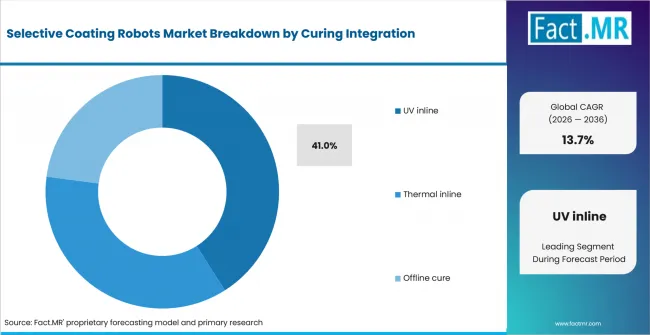
Selective Coating Robots Market Analysis By Curing Integration | Source: Fact.MR
UV inline curing leads because coated assemblies need quick handling after application. Dymax announced on March 5, 2025 that it would exhibit UV/LED light-curing solutions for the electronics industry at IPC APEX 2025, including conformal coatings and PCB-protection materials.
What supports Automotive electronics within End User?
Automotive electronics represents 36.0% share in 2026.
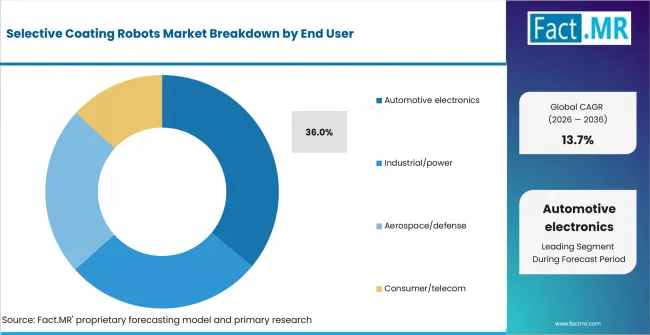
Selective Coating Robots Market Analysis By End User | Source: Fact.MR
Automotive electronics leads because vehicles carry more boards for battery control and sensing. VDA reported in February 2026 that Germany produced 1.67 million electric passenger cars in 2025, up 23%.
What is accelerating Selective Coating Robots Market adoption, and what is holding it back?
Electronics reliability drives it; capital cost and qualification work restrain it.
| Driver | (~) % Impact on CAGR | Geographic Relevance | Impact Timeline |
|---|---|---|---|
| Automotive electronics qualification | +1.6% | North America, East Asia, Europe | Short term (<= 2 years) |
| PCB booking and production recovery | +1.3% | USA, South Korea, Japan | Short term (<= 2 years) |
| Inline data and recipe control | +1.0% | Global | Medium term (2-4 years) |
| UV cure integration | +0.8% | Europe, North America | Medium term (2-4 years) |
- Automotive electronics qualification: Automotive modules need coating that survives moisture and vibration.
- PCB booking and production recovery: Rising board demand gives assemblers a reason to add coating throughput.
- UV cure integration: UV inline curing reduces dwell time after coating. Dow lists DOWSIL CC-8036 as a UV and dual moisture cure conformal coating for PCB assemblies.
| Opportunity | (~) % Impact on CAGR | Geographic Relevance | Impact Timeline |
|---|---|---|---|
| High-mix contract manufacturing | +1.2% | USA, UK, Germany | Medium term (2-4 years) |
| Power electronics and battery control boards | +1.1% | Japan, Germany, South Korea | Long term (>= 4 years) |
| Robots with multi-valve applicator packages | +0.9% | Global | Short term (<= 2 years) |
- High-mix contract manufacturing: Contract manufacturers use selective coating robots to reduce masking time across short runs.
- Power electronics and battery control boards: Battery and inverter boards need protection without blocking service points.
- Robots with multi-valve applicator packages: PVA states that conformal coatings use atomized spray, airless film, needle dispense and jetting. Multi-valve robots are expected to cover more board designs.
| Restraint | (~) % Impact on CAGR | Geographic Relevance | Impact Timeline |
|---|---|---|---|
| Capital cost and payback proof | -0.8% | Global | Short term (<= 2 years) |
| Coating-material qualification time | -0.6% | North America, Europe, Japan | Medium term (2-4 years) |
| Programming and maintenance skill gaps | -0.5% | Global | Medium term (2-4 years) |
- Capital cost and payback proof: Selective coating robots compete with manual spray booths and subcontract coating.
- Coating-material qualification time: UL 746E was revised on June 26, 2025 and covers evaluation procedures for industrial laminates and materials used in fabricating printed wiring boards.
- Programming and maintenance skill gaps: Robots need fixture design, valve setup and maintenance.
Which countries are scaling Selective Coating Robots Market fastest?
- The country comparison spans 7.2 percentage points across the five profiled markets through 2036.
- Japan remains 1.6 percentage points above the USA as electronics-device output and high-reliability board protection support selective coating automation.
- The USA remains 3.1 percentage points above the UK through PCB demand, electronics manufacturing investment and MES-connected coating systems.
- The UK remains 1.1 percentage points above South Korea as specialized electronics, aerospace programs and automotive electrification support programmable coating cells.
- South Korea remains 1.4 percentage points above Germany through ICT exports, EV electronics and demand for recipe-controlled production systems.
- Germany closes the displayed range as EV production and electro-digital exports support coating automation, while qualification requirements and payback discipline moderate growth.
Comparable CAGRs can create different entry conditions due to electronics-production scale, coating qualification requirements, automation maturity and local engineering capability. Full report coverage includes North America, Latin America, Western Europe, Eastern Europe, East Asia, South Asia and Pacific, and Middle East and Africa.
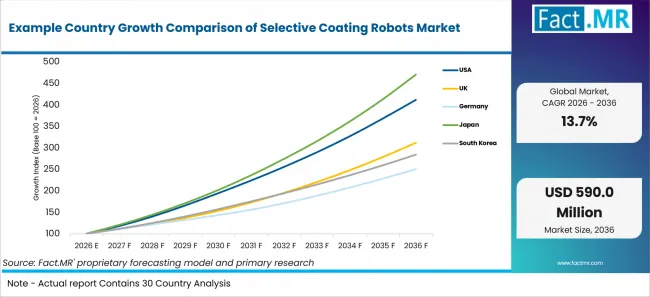
Example Country Growth Comparison Of Selective Coating Robots Market | Source: Fact.MR
| Country | CAGR (2026-2036) |
|---|---|
| Japan | 16.8% |
| USA | 15.2% |
| UK | 12.1% |
| South Korea | 11.0% |
| Germany | 9.6% |
What supports Japan adoption?
16.8% CAGR through 2036, supported by electronics-device output and high-reliability board protection.
Japan’s growth is supported by strong electronics-device production and demand for reliable board protection. JEITA, citing METI’s Production Dynamic Statistics, reported that Japan’s electronic components and devices output reached JPY 7,932,994 million in 2025, up 4.9% year over year, while the Ministry of Finance listed JPY 8,809.3 billion for FY2026 Defense Buildup Program expenditure. Gantry cells and UV inline curing suit dense assemblies requiring repeatable coating paths and compact line layouts.
What supports USA adoption?
15.2% CAGR through 2036, led by PCB demand and electronics manufacturing investment.
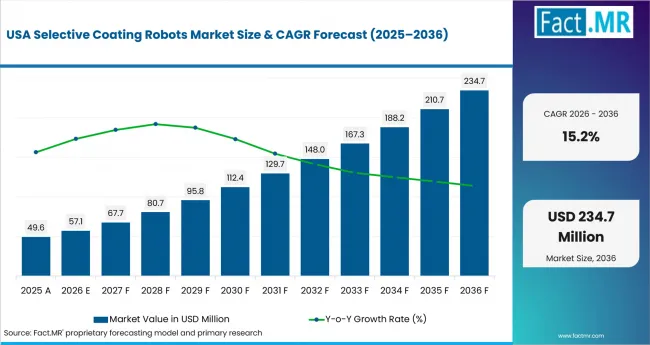
Selective Coating Robots Market Country Value Analysis | Source: Fact.MR
The USA’s growth is supported by improving PCB activity and new electronics manufacturing investment. IPC reported that North American PCB shipments increased 11.3% year over year in February 2025, while BEA reported USD 2.0 billion in 2025 greenfield spending for computers and electronic products manufacturing. Automotive and contract manufacturers are expected to use selective coating around battery boards, connectors and sensor modules while linking recipes with MES systems.
What supports UK adoption?
12.1% CAGR through 2036, driven by electronics output and automotive-electrification programs.
The UK’s growth reflects improving manufacturing activity and continued electrification of vehicle production. ONS reported that manufacturing output increased 1.6% in the three months to May 2026, while SMMT reported first-half 2025 electrified car production of 160,107 units, representing 41.5% of total car output. Aerospace, defense and short-run electronics programs are expected to favor programmable selective coating cells.
What supports South Korea adoption?
11.0% CAGR through 2036, backed by ICT exports and electric-vehicle electronics.
South Korea’s growth is supported by its large ICT manufacturing base and increasing electronics content in electric vehicles. MOTIR and MSIT reported that Korea’s ICT exports reached USD 264.3 billion in 2025, up 12.4%, while first-half 2026 ICT exports reached USD 253.9 billion. Battery-management and power-control boards are expected to increase demand for selective connector protection and recipe-controlled coating systems.
What supports Germany adoption?
9.6% CAGR through 2036, led by EV production and electro-digital exports.
Germany’s growth is supported by electric-vehicle manufacturing and a large electro-digital export base. VDA reported production of 1.67 million electric passenger cars in 2025, up 23%, while ZVEI reported electro-digital exports of EUR 257.5 billion. German factories are expected to integrate selective coating robots with established SMT automation and board-traceability systems for control boards and power modules.
Who leads the Selective Coating Robots Market?
Nordson ASYMTEK and PVA offer dedicated automated conformal-coating systems, while Rehm Thermal Systems and GPD Global also offer selective conformal-coating equipment.
Rehm Thermal Systems competes through Protecto coating systems for selective conformal coating. GPD Global serves medium and low-volume users through SimpleCoat equipment. SCH Technologies Limited supports coating equipment, process training and application services.
Which companies are profiled?
Key companies include Nordson ASYMTEK, PVA, Rehm Thermal Systems GmbH, GPD Global, SCH Technologies Limited.
- Nordson ASYMTEK
- PVA
- Rehm Thermal Systems GmbH
- GPD Global
- SCH Technologies Limited
Bibliography
- U.S. Bureau of Economic Analysis. (2026, June 10). New foreign direct investment in the United States, 2025.
- Dymax Corporation. (2025, March 5). See Dymax advanced light-curing technologies for electronics assembly at IPC APEX.
- Federal Statistical Office (Destatis). (2026, March 9). Production in January 2026: -0.5% on the previous month; December 2025 revised to -1.0%.
- IPC International, Inc. (2025, March 31). North American PCB industry sales up 11.3 percent in February.
- Ministry of Finance, Japan. (2025, December 26). Highlights of the Draft FY2026 Budget.
- Ministry of Trade, Industry and Resources, & Ministry of Science and ICT. (2026, January 15). ICT exports post record annual performance in 2025.
- Ministry of Trade, Industry and Resources, & Ministry of Science and ICT. (2026, July 14). Korea’s ICT exports reach record $253.9 billion in first half of 2026.
- Nordson Electronics Solutions. (2025, February 7). Nordson Electronics Solutions introduces the ASYMTEK Select Coat SL-1040 Ultrasonic Cleaning Station for maintaining conformal coating equipment during electronics manufacturing.
- Office for National Statistics. (2026, July 16). GDP monthly estimate, UK: May 2026.
- PVA. (2025, January 24). PVA to showcase Delta 8 conformal coating/dispensing system at Southern Manufacturing & Electronics.
- Semiconductor Industry Association. (2026, February 6). Global annual semiconductor sales increase 25.6% to $791.7 billion in 2025.
- Society of Motor Manufacturers and Traders. (2025, July 23). UK vehicle production falls but foundations set for recovery.
- Society of Motor Manufacturers and Traders. (2026, January 29). Tough year for auto but new models and Industrial Strategy can deliver growth.
- UL Standards & Engagement. (2025, June 26). UL 746E: Polymeric materials - Industrial laminates, filament wound tubing, vulcanized fibre, and materials used in printed wiring boards [Revision].
This Report Answers
- The report explains where selective coating robots are used across robot configuration and applicator type.
- Segmentation analysis identifies Gantry/Cartesian robots and UV inline curing as the leading subsegments.
- Country analysis examines Japan, the USA, the UK, South Korea and Germany through electronics and automotive indicators.
- Competitive analysis reviews Nordson ASYMTEK, PVA, Rehm Thermal Systems, GPD Global and SCH Technologies Limited.
- Application analysis assesses coating repeatability, cure routing, process records and line-integration requirements.
What does the Selective Coating Robots Market cover?
Gantry, SCARA and articulated robots used for selective protective coating on electronic assemblies.
The Selective Coating Robots Market covers automated systems that apply electronic conformal coatings to selected board areas. It includes robots, coating valves, dispensing heads and conveyor-ready cells used in electronic assembly lines.
The assessment covers coating robots sold for production use, not manual spray booths or chemicals sold without automation. Adjacent markets include automotive electronics conformal coatings, industrial robotics and robot control systems.
What is included in the scope?
Selective coating robot systems used in PCB assembly and electronics manufacturing.
The scope includes gantry, SCARA and six-axis robots configured for conformal coating, selective dispensing and coating-path automation. It includes applicators, conveyors, recipes and integrated curing where the equipment is sold as a coating cell. The scope also connects to robot arms, assembly robot platforms and smart factory programs when these systems are configured for electronics coating work.
What is excluded from the scope?
Manual spray booths and coating materials sold without robotic application equipment are outside the scope.
The scope excludes standalone coating chemicals, hand-held spray tools, dip tanks and general dispensing machines not configured for selective board coating. Broader electronics categories such as automotive printed circuit board demand are used only as adjacent context, not as revenue inside this market.
How Was the Analysis Built?
120+ sources, 35+ company portfolios, 25+ countries and more than 20 interviews.
- Primary Research: Primary research includes discussions with electronics manufacturers, coating-service providers, automation distributors, process engineers, quality managers, procurement teams and subject-matter experts.
- Desk Research: Desk research covers government statistics, PCB industry releases, automotive production data, standards references, company product pages and official equipment portfolios.
- Market Sizing and Forecasting: Market estimates combine historical performance, country-level CAGRs, segment shares, robot pricing, applicator mix, curing-route adoption and provider participation.
- Data Validation and Update Cycle: Findings are validated against public data, company portfolios, technical interviews, standards updates and changes in automotive and electronics production patterns.
What is the report’s scope and coverage?
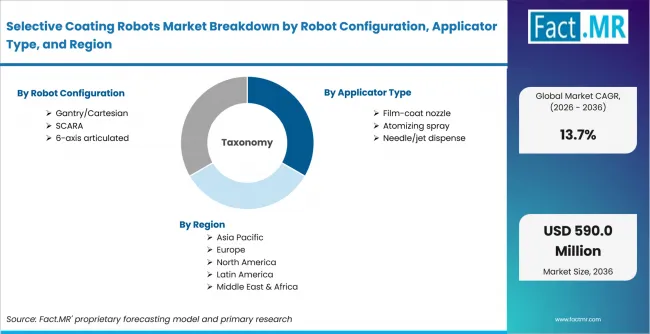
Selective Coating Robots Market Breakdown By Robot Configuration, Applicator Type, And Region | Source: Fact.MR
| Attribute | Details |
|---|---|
| Quantitative Units | USD million in 2026 to USD million by 2036 at a CAGR |
| Market Definition | Robotic systems used to apply conformal coating or protective liquid films to selected areas of printed circuit boards and electronic assemblies. |
| Robot Configuration | Gantry/Cartesian; SCARA; 6-axis articulated |
| Applicator Type | Film-coat nozzle; Atomizing spray; Needle/jet dispense |
| Curing Integration | UV inline; Thermal inline; Offline cure |
| End User | Automotive electronics; Industrial/power; Aerospace/defense; Consumer/telecom |
| Regions Covered | North America; Latin America; Western Europe; Eastern Europe; East Asia; South Asia and Pacific; Middle East and Africa |
| Countries Covered | USA; UK; Germany; Japan; South Korea |
| Key Companies Profiled | Nordson ASYMTEK, PVA, Rehm Thermal Systems GmbH, GPD Global, SCH Technologies Limited |
| Forecast Period | 2026 to 2036 |
| Approach | Hybrid top-down and bottom-up approach using electronics assembly demand, coating robot portfolios, applicator mix, curing-route adoption and country-level growth indicators. |
How is the market segmented?
-
By Robot Configuration
- Gantry/Cartesian
- SCARA
- 6-axis articulated
-
By Applicator Type
- Film-coat nozzle
- Atomizing spray
- Needle/jet dispense
-
By Curing Integration
- UV inline
- Thermal inline
- Offline cure
-
By End User
- Automotive electronics
- Industrial/power
- Aerospace/defense
- Consumer/telecom
-
By Region
- North America
- Latin America
- Western Europe
- Eastern Europe
- East Asia
- South Asia and Pacific
- Middle East and Africa