- Market Value (2025): USD 12.0 Bn
- Estimated Value (2026): USD 12.8 Bn
- Forecast Value (2036): USD 23.6 Bn
- CAGR (2026-2036): 6.3%
What is the Automotive Printed Circuit Board PCB Market forecast to be worth by 2036?
USD 12.8 billion in 2026 to USD 23.6 billion by 2036, at 6.3% CAGR.
- Demand is projected to increase from USD 12.8 billion in 2026 to USD 23.6 billion by 2036.
- The market is forecast to record a 6.3% CAGR from 2026 to 2036 as vehicle platforms add electronic control, power conversion, driver assistance, lighting, digital cockpit, and connectivity functions.
- Purchasing decisions are expected to favor suppliers that connect stack-up design, material selection, microvia reliability, thermal management, automotive qualification, traceability, and multi-site production support instead of treating the PCB as a commodity drawing.
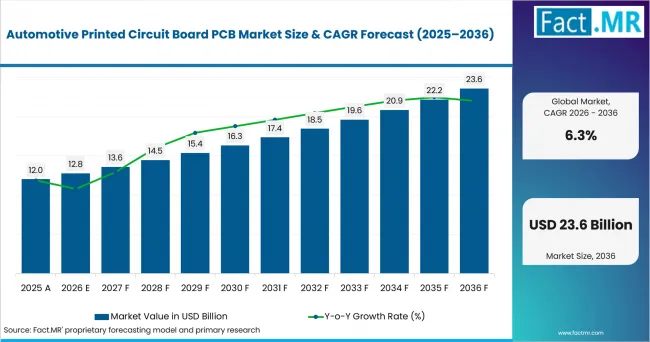
Automotive Printed Circuit Board Pcb Market Value Analysis | Source: Fact.MR
What are the defining numbers behind Automotive Printed Circuit Board PCB Market growth?
USD 10.8 billion absolute opportunity by 2036.
- Demand Drivers in the Market
- Vehicle manufacturers need more circuit boards across engine and transmission control, battery and charging systems, domain controllers, safety sensing, lighting, digital clusters, and telematics because electronics content now spans nearly every vehicle function.
- Electric vehicle engineering teams need boards that carry control signals while tolerating higher current, voltage, heat, and switching activity around inverters, onboard chargers, battery management, and electric drive systems.
- Key Segments Analyzed
- By PCB Category: Multilayer Printed Circuit Boards are expected to hold 44% share in 2026 supported by their broad use across control units and electronic modules that require several routing and reference-plane layers.
- By Vehicle Application: Powertrain Electronics are projected to account for 39% share in 2026 owing to engine control units, transmission control modules, electrified power conversion, and battery-related control requirements.
- By Vehicle Category: Passenger Cars are anticipated to capture 63% share in 2026 because hatchback and sedan volumes provide the largest recurring base for electronic module design, qualification, and production.
- By End User: Automotive Original Equipment Manufacturers are estimated to represent 69% share in 2026 as vehicle makers retain authority over electrical architecture, module specifications, validation, supplier approval, and warranty responsibility.
- By PCB Technology: High Density Interconnect PCB is forecast to account for 41% share in 2026 driven by microvia and laser-drilled structures that place more connections and functions inside smaller automotive modules.
- Analyst Opinion at Fact.MR
- Shambhu Nath Jha, Sr. Consultant at Fact.MR, states: "Automotive PCB procurement is becoming an architecture and validation decision rather than a board-price comparison. A supplier must prove that layer structure, via design, thermal behavior, signal integrity, surface finish, traceability, and production transfer remain stable through the vehicle program. Fact.MR opines that suppliers with credible automotive quality systems and early design support will gain the strongest positions in powertrain, ADAS, lighting, and connected cockpit platforms."
- Strategic Implications
- Automotive original equipment manufacturers should define electrical, thermal, mechanical, chemical, and lifetime requirements before approving the PCB stack-up because late material or via changes can reopen module validation.
- PCB manufacturers should qualify high-current copper, low-loss laminates, microvias, rigid-flex transitions, metal cores, and surface finishes within controlled automotive process windows rather than market each capability as a separate option.
How does the Automotive Printed Circuit Board PCB Market break down by segment?
Multilayer Printed Circuit Boards lead at 44%, Powertrain Electronics lead at 39%, Passenger Cars lead at 63%, Automotive Original Equipment Manufacturers lead at 69%, and High Density Interconnect PCB leads at 41% in 2026.
Why do Multilayer Printed Circuit Boards lead PCB Category?
Multilayer Printed Circuit Boards hold 44% share in 2026.
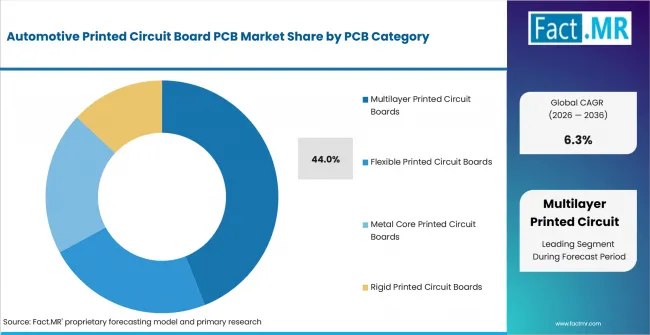
Automotive Printed Circuit Board Pcb Market Analysis By Pcb Category | Source: Fact.MR
IPC-6012EA adds automotive-specific requirements to the rigid-board qualification framework to ensure boards survive automotive interconnect environments, which explains why the category is evaluated through reliability evidence rather than layer count alone. Flexible Printed Circuit Boards remain important for space-constrained routing and moving or shaped assemblies. Metal Core Printed Circuit Boards provide aluminum or copper thermal paths for lighting and power applications. Rigid Printed Circuit Boards continue to serve high-reliability and high-temperature modules where mechanical support and stable geometry are essential.
Why does Powertrain Electronics lead Vehicle Application?
Powertrain Electronics hold 39% share in 2026.
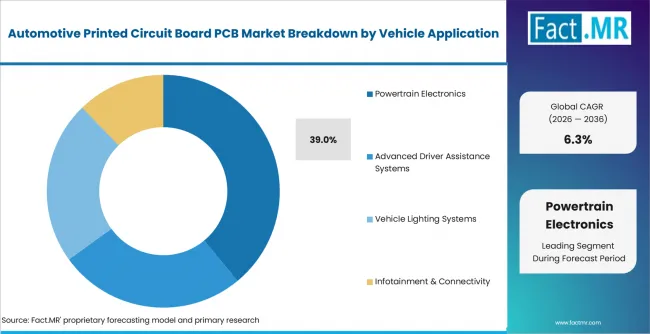
Automotive Printed Circuit Board Pcb Market Analysis By Vehicle Application | Source: Fact.MR
The U.S. Department of Energy describes the inverter as both the DC-to-AC conversion stage and a motor controller, while its electric-vehicle overview identifies the power electronics controller and onboard charger as active energy-management systems. These functions raise the value of high-current copper, thermal vias, metal-core structures, isolation spacing, and control-board reliability. Advanced Driver Assistance Systems follow through Collision Avoidance Systems and Lane Keeping Assistance, where high-frequency and high-speed routing becomes more important. Vehicle Lighting Systems use boards in LED headlamps and adaptive lighting. Infotainment & Connectivity adds Digital Instrument Clusters and Telematics Control Units that place data, display, wireless, and vehicle-network interfaces inside compact modules.
Why do Passenger Cars lead Vehicle Category?
Passenger Cars hold 63% share in 2026.
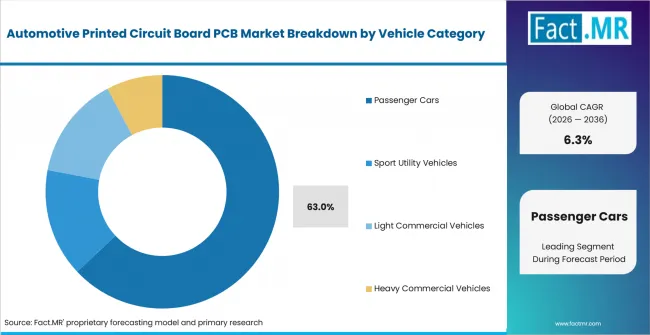
Automotive Printed Circuit Board Pcb Market Analysis By Vehicle Category | Source: Fact.MR
NHTSA's automatic emergency braking rule illustrates how a safety function depends on sensors and electronic control before a brake command is issued, reinforcing the broad PCB opportunity created when passenger-car features move from optional packages toward standard platform content.
Why do Automotive Original Equipment Manufacturers lead End User?
Automotive Original Equipment Manufacturers hold 69% share in 2026.
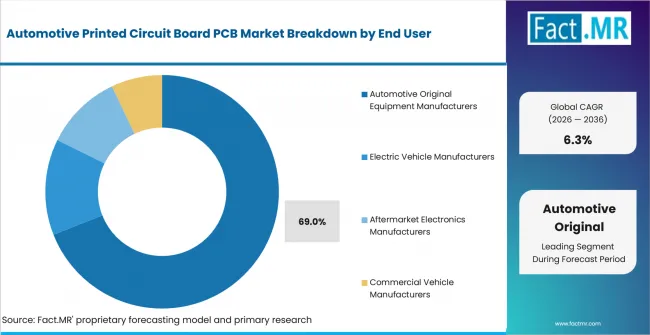
Automotive Printed Circuit Board Pcb Market Analysis By End User | Source: Fact.MR
Automotive Original Equipment Manufacturers are estimated to represent 69% share in 2026 because vehicle makers define the electrical architecture, module boundaries, functional targets, environmental profiles, approved materials, diagnostic behavior, and production-change rules. Global Vehicle Manufacturers may buy through Tier 1 Automotive Suppliers, but the board specification remains tied to vehicle-level performance and warranty responsibility.
Why does High Density Interconnect PCB lead PCB Technology?
High Density Interconnect PCB holds 41% share in 2026.
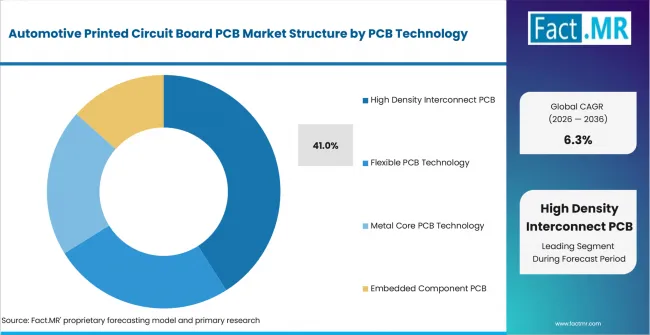
Automotive Printed Circuit Board Pcb Market Analysis By Pcb Technology | Source: Fact.MR
High Density Interconnect PCB is forecast to account for 41% share in 2026 because Microvia Technology and Laser Drilled Via Technology increase connection density while reducing routing distance and module area. HDI becomes especially valuable when processors, memory, network interfaces, power management, and sensor inputs compete for space inside domain controllers, radar units, digital clusters, and telematics modules.
What is accelerating Automotive Printed Circuit Board PCB Market adoption, and what is holding it back?
Electrification, ADAS, cockpit digitization, and higher electronic integration support adoption, while qualification time, harsh-environment reliability, material continuity, and late design changes restrain suppliers that cannot control the complete automotive process.
Drivers Impact Analysis
| DRIVER | %Impact on CAGR | GEOGRAPHIC RELEVANCE | IMPACT TIMELINE |
|---|---|---|---|
| Electrified powertrain and charging content | +1.7% | China, USA, Germany, South Korea, Japan | Current forecast period |
| ADAS sensing and domain control | +1.8% | China, Japan, Germany, USA, South Korea | Short to medium term |
| Digital cockpit and vehicle connectivity | +1.3% | Global passenger-vehicle platforms | Current forecast period |
| Automotive quality and traceability requirements | +1.9% | All vehicle manufacturing markets | Current forecast period |
| Commercial vehicle electronics expansion | +2.3% | India, Mexico, USA, and other fleet markets | Medium to long term |
Source: Fact.MR analysis. Updated Aug 5, 2026
- Electrification and power electronics: Electric drive systems add inverter, battery, charging, and thermal-control functions that require more than ordinary signal routing. Board suppliers gain value when they can combine heavy copper, isolation, heat spreading, stable materials, and design-for-manufacture support without forcing the module maker to manage several disconnected technology partners.
- ADAS and digital integration: Radar, cameras, collision avoidance, lane support, digital clusters, and telematics increase data rate and packaging density. The opportunity grows when a supplier can move a design from prototype through automotive qualification and volume production while preserving impedance, via quality, surface finish, and traceability.
Opportunity Impact Analysis
| OPPORTUNITY | COMMERCIAL EFFECT | GEOGRAPHIC RELEVANCE | IMPACT TIMELINE |
|---|---|---|---|
| HDI boards for domain and zonal controllers | Concentrates processing, networking, and interface functions in smaller modules | China, USA, Germany, Japan, South Korea | Short to medium term |
| Metal-core and heavy-copper power boards | Creates higher-value thermal and current-carrying solutions for lighting and electrified power systems | China, Germany, USA, India | Current forecast period |
| Rigid-flex and flexible interconnect replacement | Reduces connectors, wiring volume, and assembly steps in constrained vehicle packaging | Japan, South Korea, China, Europe | Medium term |
| Localized engineering and production transfer | Shortens launch response and improves continuity near vehicle and module plants | Mexico, India, China, USA, Europe | Medium to long term |
| Embedded component and advanced finish integration | Supports miniaturization and shorter electrical paths in selected high-value modules | Established automotive electronics hubs | Medium to long term |
Source: Fact.MR analysis. Updated Aug 5, 2026
- Domain and zonal controllers: Vehicle architectures are consolidating functions that were previously distributed across separate electronic control units. This creates room for high-layer-count and HDI boards, but the winning design must manage processor escape routing, power integrity, thermal concentration, connectors, shielding, and software-related hardware revisions within one released module.
- Flexible and thermal interconnect: Nippon Mektron describes automotive FPC use in battery monitoring, lighting, infotainment, sensors, and heaters, while TTM and Kinwong present heavy-copper and thermal-management capabilities for power applications. Suppliers can therefore compete through fit-for-purpose interconnect portfolios rather than pushing one PCB construction across every vehicle function.
Restraints Impact Analysis
| RESTRAINT | COMMERCIAL EFFECT | GEOGRAPHIC RELEVANCE | IMPACT TIMELINE |
|---|---|---|---|
| Long qualification and vehicle-specific validation | Extends sales cycles and limits late substitution after module release | All automotive manufacturing markets | Current forecast period |
| Thermal cycling, vibration, moisture, and chemical exposure | Raises material, via, finish, coating, and test requirements | Global harsh-environment applications | Current forecast period |
| Laminate, copper, chemistry, and capacity continuity | Creates change-control and supply-risk exposure across long vehicle programs | Global PCB supply chains | Short to medium term |
| Late electrical or mechanical design changes | Triggers re-layout, tooling, testing, and possible module requalification | New vehicle and electronics launches | Short to medium term |
| Low-volume replacement and compatibility requirements | Raises unit cost and documentation burden in aftermarket and legacy programs | Mature vehicle-parc markets | Medium to long term |
Source: Fact.MR analysis. Updated Aug 5, 2026
- Qualification and reliability burden: Automotive boards must remain stable through temperature cycles, vibration, humidity, contamination, electrical load, and long field exposure. IPC's automotive addendum exists because general rigid-board criteria alone do not address every vehicle environment. This burden rewards proven process capability but slows supplier replacement once the module and vehicle have been released.
- Change and continuity risk: A laminate, copper foil, plating chemistry, surface finish, or production-site change can affect impedance, adhesion, solderability, thermal behavior, and life testing. Vehicle programs therefore require disciplined notifications, approved alternatives, and traceable material history. Suppliers without controlled transfer methods may lose business even when their nominal fabrication capability appears competitive.
Which countries are scaling Automotive Printed Circuit Board PCB Market fastest?
USA 6.8%, Japan 6.5%, Germany 6.1%, South Korea 5.8%, and Mexico 5.2% through 2036.
Regional analysis covers North America, Europe, Asia Pacific, Central & South America, and the Middle East & Africa. Country commentary below is limited to the five markets with approved growth rates.
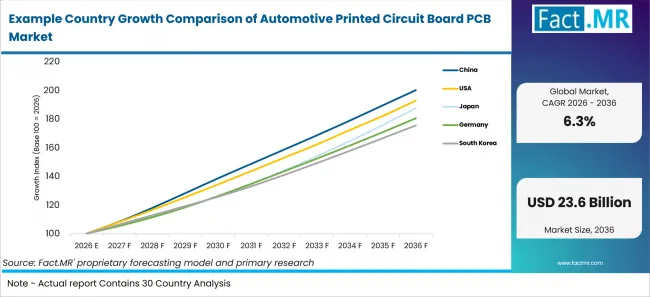
Example Country Growth Comparison Of Automotive Printed Circuit Board Pcb Market | Source: Fact.MR
| COUNTRY | CAGR (2026-2036) |
|---|---|
| USA | 6.8% |
| Japan | 6.5% |
| Germany | 6.1% |
| South Korea | 5.8% |
| Mexico | 5.2% |
Source: Fact.MR analysis. Updated Aug 5, 2026
How is the USA scaling Automotive Printed Circuit Board PCB demand?
6.8% CAGR through 2036.
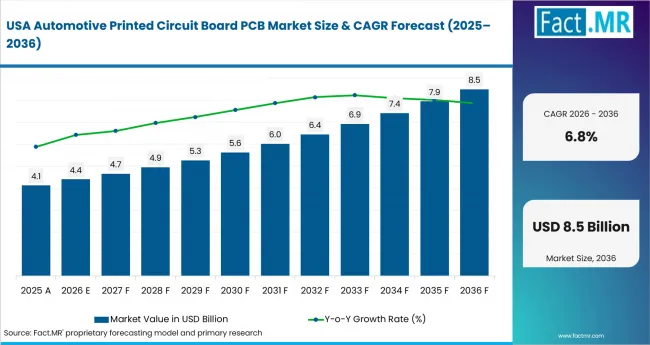
Automotive Printed Circuit Board Pcb Market Country Value Analysis | Source: Fact.MR
The USA combines a large light-vehicle market with engineering demand across electric powertrains, pickup trucks, sport utility vehicles, safety systems, telematics, and connected cockpit platforms. The Federal Reserve Bank of St. Louis reported total motor vehicle assemblies at a seasonally adjusted annual rate of 10.9612 million units in June 2026. NHTSA's FMVSS No. 127 also creates a national automatic emergency braking baseline that depends on sensing, processing, communication, and brake-command electronics. Demand is projected to expand at a 6.8% CAGR through 2036.
What supports Japan's outlook?
6.5% CAGR through 2036.
Japan retains a deep automotive and electronic-components ecosystem that places high weight on process stability, defect prevention, material control, and long-term supplier performance. The Japan Automobile Manufacturers Association reported motor vehicle production of 8.23 million units in 2024, including 7.14 million passenger cars. That manufacturing base supports recurring PCB work across engine and transmission controllers, hybrid and electric powertrains, lighting, cameras, radar, infotainment, and battery monitoring. The market is anticipated to grow at a 6.5% CAGR through 2036.
What underpins Germany's growth?
6.1% CAGR through 2036, attributable to export-oriented vehicle engineering, premium electronic content, and stringent program validation.
Germany's automotive PCB demand is shaped by premium and export vehicle programs that combine powertrain control, active safety, high-speed networking, digital cockpit, lighting, and electrification. The Federal Statistical Office reported that approximately 3.4 million new cars worth EUR 135.0 billion were exported from Germany in 2024. Export exposure requires the same controller and interconnect platform to meet several customer, climate, electromagnetic, regulatory, and service conditions. The market is estimated to record a 6.1% CAGR through 2036.
How is South Korea developing Automotive PCB demand?
5.8% CAGR through 2036.
South Korea combines major vehicle groups with battery, electronics, semiconductor, materials, and component suppliers, allowing PCB requirements to be developed alongside electric powertrain, display, connectivity, and driver-assistance systems. The Ministry of Trade, Industry and Resources reported record automobile exports of USD 72.0 billion in 2025, including USD 25.8 billion of eco-friendly vehicle exports, while domestic production remained above 4.0 million units. This export profile increases the need for board designs that can support multiple homologation markets without losing traceability or process control. Demand is forecast to advance at a 5.8% CAGR through 2036.
What shapes Mexico's market outlook?
5.2% CAGR through 2036.
Mexico is integrated into North American passenger-car, sport utility vehicle, pickup truck, and component supply chains, giving PCB suppliers a route into export programs with tightly controlled launch and delivery schedules. INEGI reported production of 354,221 light vehicles and exports of 301,009 units in June 2026. The market is expected to grow at a 5.2% CAGR through 2036.
Who leads the Automotive Printed Circuit Board PCB Market?
TTM Technologies, Inc. and Meiko Electronics, Unimicron, Tripod, AT&S, Compeq, Kinwong, Shennan Circuits, Nippon Mektron, PCBWay, and Sumitomo Electric compete through multilayer, HDI, flexible, rigid-flex, thermal, high-current, and high-frequency capabilities.
TTM Technologies, Inc. is an active provider. Its automotive portfolio covers high-reliability PCBs, advanced HDI, flex and rigid-flex, radar and LiDAR development, heavy copper, controlled impedance, high-layer-count boards, and thermal-management solutions. This breadth supports participation from prototype and design-for-manufacture work through qualified volume production. Meiko Electronics Co., Ltd. adds multilayer, AnyLayer HDI, heavy-copper, heat-dissipation, embedded-device, rigid-flex, flexible, and millimeter-wave radar boards. AT&S Austria Technologie & Systemtechnik AG contributes high-frequency automotive radar, substrate-like PCB, fine-line, and HDI Anylayer capability and links development with automotive-certified plants.
Which companies are the key providers?
TTM Technologies, Inc. is the active provider. Meiko Electronics, Unimicron, Tripod, AT&S, Compeq, Kinwong, Shennan Circuits, Nippon Mektron, PCBWay, and Sumitomo Electric complete the approved provider set.
- TTM Technologies, Inc.
- Meiko Electronics Co., Ltd.
- Unimicron Technology Corporation
- Tripod Technology Corporation
- AT&S Austria Technologie & Systemtechnik AG
- Compeq Manufacturing Co., Ltd.
- Kinwong Electronic Co., Ltd.
- Shennan Circuits Co., Ltd.
- Nippon Mektron, Ltd.
- PCBWay
- Sumitomo Electric Industries, Ltd.
Bibliography
- AT&S Austria Technologie & Systemtechnik AG. (n.d.). Printed circuit boards for the automotive industry.
- Compeq Manufacturing Co., Ltd. (n.d.). Product types: High-layer-count boards, rigid-flex boards, flexible circuits, and high-density circuit boards.
- Federal Reserve Bank of St. Louis. (2026, July 17). Motor Vehicle Assemblies: Total Motor Vehicle Assemblies (MVATOTASSS). FRED.
- Federal Statistical Office of Germany. (2025, March 20). 3.4 million new cars exported from Germany in 2024. Destatis.
- IPC. (2021, October). Automotive Applications Addendum to IPC-6012E, Qualification and Performance Specification for Rigid Printed Boards.
- IPC. (2023, October 18). IPC releases IPC-6012F, Qualification and Performance Specification for Rigid Printed Boards.
- Instituto Nacional de Estadistica y Geografia. (2026, July 7). Administrative record of the light vehicle automotive industry: June 2026. INEGI.
- Japan Automobile Manufacturers Association. (2025, September). The Motor Industry of Japan 2025.
- Kinwong Electronic Co., Ltd. (n.d.). Automotive printed circuit board technologies and quality systems.
- Meiko Electronics Co., Ltd. (n.d.). Our business: Printed circuit board design and manufacturing.
- Meiko Electronics Co., Ltd. (n.d.). Millimeter Wave Radar PCBs.
- Ministry of Trade, Industry and Resources, Republic of Korea. (2026, January 15). Automobile exports hit record high of USD 72 billion in 2025.
- National Bureau of Statistics of China. (2026, February 28). Statistical Communique of the People's Republic of China on the 2025 National Economic and Social Development.
- National Highway Traffic Safety Administration. (2024, April 29). NHTSA finalizes rule on automatic emergency braking. U.S. Department of Transportation.
- Nippon Mektron, Ltd. (2024, March 26). Nippon Mektron receives orders to supply FPC for Volkswagen ID.2. MEKTEC Corporation.
- PCBWay. (n.d.). High-quality PCB design services for automotive electronics.
- Press Information Bureau, Government of India. (2026, February 10). Status of Heavy Industries Sector. Ministry of Heavy Industries.
- Shennan Circuits Co., Ltd. (n.d.). PCB products for automotive cameras and collision-avoidance radar.
- Sumitomo Electric Industries, Ltd. (n.d.). Sumitomo Electric Printed Circuits, Inc.: Development and manufacturing of flexible printed circuits.
- Sumitomo Electric Industries, Ltd. (n.d.). Great challenges toward improving automotive value and battery-pack space efficiency.
- Tripod Technology Corporation. (n.d.). Research and development projects for automotive rigid-flex, thermal-dissipation, high-current, and radar PCBs.
- TTM Technologies, Inc. (n.d.). Automotive electronics and car PCB manufacturing.
- TTM Technologies, Inc. (2024). Automotive Overview.
- TTM Technologies, Inc. (n.d.). Automotive capabilities.
- U.S. Department of Energy. (n.d.). How do all-electric cars work? Alternative Fuels Data Center.
- U.S. Department of Energy. (2026, June 17). Power Electronics Research and Development.
This Report Answers
- The report provides strategic intelligence on Automotive Printed Circuit Board PCB across PCB Category and Vehicle Application choices that shape vehicle electronics architecture and module sourcing.
- Segment analysis covers Multilayer Printed Circuit Boards and Powertrain Electronics as the approved share leaders within the 2026 market structure.
- Vehicle and buyer analysis evaluates Passenger Cars and Automotive Original Equipment Manufacturers while discussing alternative categories without assigning unsupported shares.
- Regional outlook evaluates USA, Japan, Germany, South Korea, and Mexico using the approved country growth rates presented in this report.
- Competitive analysis evaluates TTM Technologies, Inc. and reviews ten additional approved providers.
- Technology assessment covers High Density Interconnect PCB, Flexible PCB Technology, Metal Core PCB Technology, and Embedded Component PCB across miniaturization, signal integrity, thermal control, reliability, and production requirements.
What does the Automotive Printed Circuit Board PCB Market cover?
Multilayer, flexible, metal-core, rigid, high-density interconnect, and embedded-component printed circuit boards used in qualified automotive electronic modules.
The Automotive Printed Circuit Board PCB Market covers bare and finished printed circuit boards whose principal commercial function is to interconnect and support components inside vehicle electronic systems. Coverage includes boards used in powertrain controllers, advanced driver assistance, vehicle lighting, digital instrument clusters, telematics, battery-related systems, high-voltage auxiliaries, and other qualifying automotive modules across the approved PCB Category, Vehicle Application, Vehicle Category, End User, and PCB Technology framework.
The market differs from the broader automotive electronics market because value must be tied to the PCB or a directly qualified interconnect product rather than the complete electronic control unit. It also differs from the general PCB market because the board must be designed, manufactured, qualified, or sold for an automotive application with relevant environmental, quality, traceability, and program-support requirements.
What is included in the scope?
Automotive PCB fabrication, qualified interconnect technology, and associated design and validation content supplied within the defined category and application boundaries.
The scope includes Standard Multilayer PCB and High Layer Count PCB; Single-sided Flexible PCB and Double-sided Flexible PCB; Aluminum Core PCB and Copper Core PCB; High Reliability PCB and High Temperature PCB. It covers Microvia Technology, Laser Drilled Via Technology, Polyimide Flexible Circuits, Rigid-flex PCB Technology, High Thermal Conductivity PCB, Heavy Copper PCB Technology, Embedded Passive Technology, and Advanced Surface Finish Technology when commercial value is attached to a qualifying automotive board.
Design-for-manufacture review, stack-up engineering, impedance control, material qualification, thermal-path design, tooling, inspection, electrical test, traceability, failure analysis, engineering change support, and production transfer are included when they form part of the PCB supply package. The scope also includes boards purchased by automotive original equipment manufacturers, electric vehicle manufacturers, aftermarket electronics manufacturers, commercial vehicle manufacturers, Tier 1 suppliers, electronics manufacturing service providers, and other approved subsegments.
What is excluded from the scope?
Finished vehicles, complete electronic modules, standalone components, wiring systems, and non-automotive printed circuit boards are outside the core boundary.
The scope excludes finished passenger and commercial vehicle revenue. It excludes complete engine control units, transmission control modules, radar assemblies, cameras, headlamps, instrument clusters, telematics units, battery packs, inverters, and chargers when their value cannot be separated from the PCB. Standalone semiconductors, passive components, sensors, connectors, wire harnesses, cables, enclosures, thermal interface materials, coatings, solder, and assembly equipment are excluded unless their value is incorporated into a qualifying PCB or directly supplied as part of the covered interconnect product.
Printed circuit boards used principally in consumer electronics, telecommunications, industrial equipment, aerospace, defense, medical devices, computing, appliances, or other non-automotive markets are excluded. Generic prototype and assembly services are outside the boundary unless the purchased work is tied to an automotive board included in the approved segmentation.
How Was the Analysis Built?
120+ sources, 40+ company portfolios, 25+ countries, 20+ interviews.
- Primary Research: Primary research includes interviews with automotive PCB manufacturers, vehicle manufacturers, Tier 1 electronics suppliers, electronics manufacturing service providers, module designers, material suppliers, test specialists, quality managers, procurement teams, and aftermarket participants. Discussions test board category, layer structure, technology choice, module application, automotive qualification, pricing, program timing, launch support, yield, traceability, production transfer, warranty exposure, and supplier-selection criteria.
- Desk Research: Desk research reviews official vehicle production and trade data, automotive safety rules, electric-drive system descriptions, PCB qualification standards, company filings, automotive product portfolios, technical product pages, quality certifications, and evidence of multilayer, HDI, flexible, rigid-flex, metal-core, high-current, radar, and thermal applications. Research separates automotive PCB value from complete module, component, and finished-vehicle revenue.
- Market-Sizing and Forecasting: Market sizing combines the approved 2026 and 2036 values with vehicle production, electronic-module attachment, board count and value by application, multilayer and technology mix, passenger and commercial vehicle demand, original-equipment and aftermarket purchasing, electrification, ADAS, lighting, infotainment, connectivity, and country growth rates. Forecasting also considers qualification time, architecture consolidation, localized production, material continuity, and average board complexity.
- Data Validation and Update Cycle: The analysis combines primary interviews with structured review of public company disclosures, official statistics, regulatory material, and sector publications. Forecast interpretation considers market conditions, adoption requirements, competitive positioning, and regional operating context.
Segmentation
What is the report's scope and coverage?
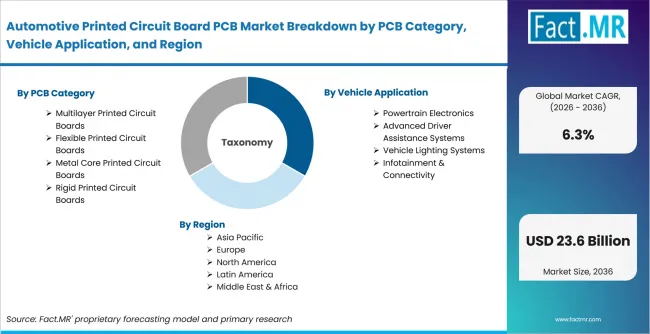
Automotive Printed Circuit Board Pcb Market Breakdown By Pcb Category, Vehicle Application, And Region | Source: Fact.MR
| Attribute | Details |
|---|---|
| Quantitative Units | USD 12.8 Billion in 2026 to USD 23.6 Billion by 2036 at 6.3% CAGR |
| Market Definition | Printed circuit boards and qualified automotive interconnect products whose commercial value is tied to vehicle control, sensing, power conversion, lighting, infotainment, connectivity, and electronic module integration |
| PCB Category | Multilayer Printed Circuit Boards; Flexible Printed Circuit Boards; Metal Core Printed Circuit Boards; Rigid Printed Circuit Boards |
| Vehicle Application | Powertrain Electronics; Advanced Driver Assistance Systems; Vehicle Lighting Systems; Infotainment & Connectivity |
| Vehicle Category | Passenger Cars; Sport Utility Vehicles; Light Commercial Vehicles; Heavy Commercial Vehicles |
| End User | Automotive Original Equipment Manufacturers; Electric Vehicle Manufacturers; Aftermarket Electronics Manufacturers; Commercial Vehicle Manufacturers |
| PCB Technology | High Density Interconnect PCB; Flexible PCB Technology; Metal Core PCB Technology; Embedded Component PCB |
| Regions Covered | North America; Europe; Asia Pacific; Central & South America; Middle East & Africa |
| Countries Covered | China; USA; Japan; Germany; South Korea; India; Mexico |
| Key Companies Profiled | TTM Technologies, Inc.; Meiko Electronics Co., Ltd.; Unimicron Technology Corporation; Tripod Technology Corporation; AT&S Austria Technologie & Systemtechnik AG; Compeq Manufacturing Co., Ltd.; Kinwong Electronic Co., Ltd.; Shennan Circuits Co., Ltd.; Nippon Mektron, Ltd.; PCBWay; Sumitomo Electric Industries, Ltd. |
| Forecast Period | 2026 to 2036 |
| Approach | Hybrid top-down and bottom-up assessment using vehicle production; automotive electronics content; PCB attachment by module; PCB category and technology mix; powertrain, ADAS, lighting, and connectivity demand; buyer responsibility; country growth rates; average board value; supplier portfolio mapping and validation |
Source: Fact.MR analysis. Updated Aug 5, 2026
How is the market segmented?
-
By PCB Category:
- Multilayer Printed Circuit Boards
- Standard Multilayer PCB
- High Layer Count PCB
- Flexible Printed Circuit Boards
- Single-sided Flexible PCB
- Double-sided Flexible PCB
- Metal Core Printed Circuit Boards
- Aluminum Core PCB
- Copper Core PCB
- Rigid Printed Circuit Boards
- High Reliability PCB
- High Temperature PCB
- Multilayer Printed Circuit Boards
-
By Vehicle Application:
- Powertrain Electronics
- Engine Control Units
- Transmission Control Modules
- Advanced Driver Assistance Systems
- Collision Avoidance Systems
- Lane Keeping Assistance
- Vehicle Lighting Systems
- LED Headlamps
- Adaptive Lighting Systems
- Infotainment & Connectivity
- Digital Instrument Clusters
- Telematics Control Units
- Powertrain Electronics
-
By Vehicle Category:
- Passenger Cars
- Hatchbacks
- Sedans
- Sport Utility Vehicles
- Battery Electric Vehicles
- Plug-in Hybrid Vehicles
- Light Commercial Vehicles
- Delivery Vans
- Pick-up Trucks
- Heavy Commercial Vehicles
- Trucks
- Buses
- Passenger Cars
-
By End User:
- Automotive Original Equipment Manufacturers
- Global Vehicle Manufacturers
- Tier 1 Automotive Suppliers
- Electric Vehicle Manufacturers
- Electronics Manufacturing Service Providers
- Automotive Electronics Suppliers
- Aftermarket Electronics Manufacturers
- Replacement Parts Suppliers
- Custom Electronics Manufacturers
- Commercial Vehicle Manufacturers
- Fleet Technology Integrators
- Bus Manufacturers
- Automotive Original Equipment Manufacturers
-
By PCB Technology:
- High Density Interconnect PCB
- Microvia Technology
- Laser Drilled Via Technology
- Flexible PCB Technology
- Polyimide Flexible Circuits
- Rigid-flex PCB Technology
- Metal Core PCB Technology
- High Thermal Conductivity PCB
- Heavy Copper PCB Technology
- Embedded Component PCB
- Embedded Passive Technology
- Advanced Surface Finish Technology
- High Density Interconnect PCB
-
By Region:
- North America
- USA
- Canada
- Europe
- Germany
- United Kingdom
- France
- Italy
- Spain
- Asia Pacific
- Japan
- South Korea
- Australia
- Central & South America
- Mexico
- Brazil
- Argentina
- Chile
- Middle East & Africa
- UAE
- Saudi Arabia
- South Africa
- North America
Frequently Asked Questions
Which PCB Category leads the Automotive Printed Circuit Board PCB Market?
Which Vehicle Application leads the market?
Which Vehicle Category leads the market?
Which End User leads the market?
Which PCB Technology leads the market?
Which companies are active in the market?
Which country records the highest CAGR?
How does the USA perform in the market?
How does Japan perform in the market?
How does Germany perform in the market?
How does South Korea perform in the market?
How does India perform in the market?
How does Mexico perform in the market?
Who worked on this report


Preview the report firsthand - request a free sample
Free SampleGet the brochure for pricing and purchase details
Download PDF