- Market Value (2025): USD 1.6 Bn
- Estimated Value (2026): USD 1.7 Bn
- Forecast Value (2036): USD 3.4 Bn
- CAGR (2026-2036): 7.3%
What is the Semiconductor Relay Switches Market forecast to be worth by 2036?
USD 1.7 Billion in 2026 to USD 3.4 Billion by 2036 at a 7.3% CAGR.
- The Semiconductor Relay Switches Market reached USD 1.6 Billion in 2025.
- Demand is projected to increase from USD 1.7 Billion in 2026 to USD 3.4 Billion by 2036.
- The market is forecast to record 7.3% CAGR from 2026 to 2036, supported by industrial automation, DC control and PCB-mounted switching.
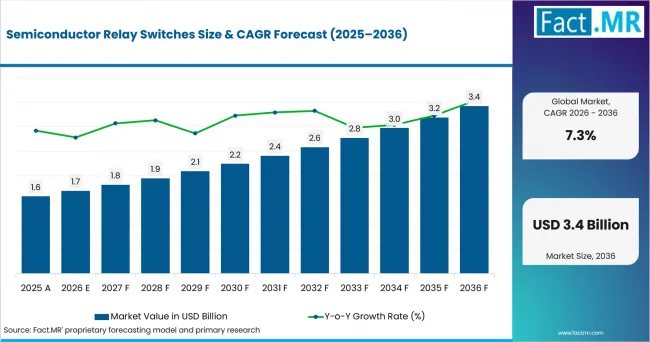
Semiconductor Relay Switches Value Analysis | Source: Fact.MR
What are the defining numbers behind Semiconductor Relay Switches Market growth?
USD 1.7 Billion absolute opportunity by 2036, led by MOSFET solid-state relays, PCB mount packages and industrial automation.
- Demand Drivers in the Market
- Automation-equipment teams need contactless switching that handles repeated control cycles without contact wear inside PLC and machine-control boards.
- Test engineers need compact relay matrices for semiconductor testers, burn-in boards and measurement systems where switching repeatability affects yield checks.
- EV battery designers need isolated signal switching for monitoring, pre-charge and protection paths in higher-voltage vehicle platforms.
- Appliance and building-control manufacturers need quiet semiconductor switching in boards where mechanical relays add noise and height.
- Key Segments Analyzed
- By Relay Type: MOSFET solid-state relays are expected to hold 42.0% share in 2026, owing to AC and DC load flexibility in compact control boards.
- By Load Type: DC resistive is projected to account for 29.0% share in 2026, supported by battery, instrumentation and low-voltage control circuits.
- By End-use: Industrial automation is anticipated to capture 31.0% share in 2026, driven by machine control and high-cycle switching needs.
- By Package: PCB mount is estimated to represent 46.0% share in 2026, led by direct board assembly across compact electronics.
- Analyst Opinion at Fact.MR
- Shambhu Nath Jha, Principal Consultant at Fact.MR, states, “The commercial test for this market goes beyond current rating. Engineering teams compare isolation, leakage, heat and package height before a relay enters a board layout. Suppliers are expected to gain repeat selection when device breadth comes with proof of safe performance inside the final control circuit.”
- Strategic Implications
- Relay suppliers should publish derating curves, leakage values and isolation data in formats that design engineers compare quickly.
- Power-equipment teams should review relay heat behavior alongside board limits so semiconductor relay selection accounts for current flow and enclosure temperature.
- Automation OEMs should qualify second sources early where relay packages carry long approval cycles inside control boards.
- Vehicle electronics teams should align photorelay selection with battery-voltage architecture and creepage requirements before layout freeze.
The USA is projected to record 8.5% CAGR through 2036, supported by electronics investment and data-center power control needs. Germany is estimated to post 8.2% CAGR, reinforced by electrical equipment orders and renewable power integration. South Korea is anticipated to advance at 7.4% CAGR, driven by semiconductor exports and EV battery electronics. Japan is forecast to hold 5.9% CAGR, owing to electronic components output and precision test equipment. The UK is projected to record 5.2% CAGR, shaped by electrical equipment sales and EV charging infrastructure.
How does the Semiconductor Relay Switches Market break down by segment?
MOSFET solid-state relays lead Relay Type at 42.0%; PCB mount leads Package at 46.0%.
Which Relay Type dominates?
MOSFET solid-state relays hold 42.0% share in 2026.
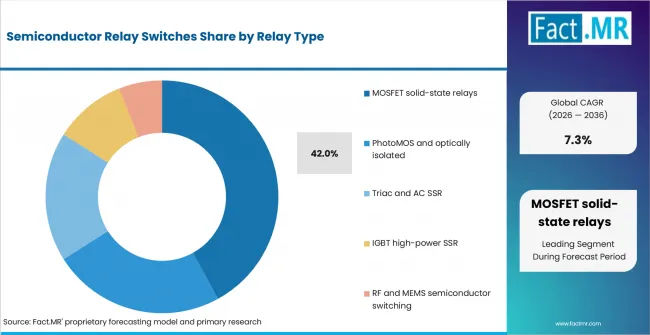
Semiconductor Relay Switches Analysis By Relay Type | Source: Fact.MR
MOSFET solid-state relays lead since they switch AC and DC loads without a moving contact. Panasonic Industry describes PhotoMOS as semiconductor devices using MOSFETs in the output element for AC and DC load control.
Their share is reinforced by board designers that need compact isolation and fast switching. Littelfuse positions OptoMOS® relays as fast, bounce-free solid-state replacements for electromechanical relays, with optically coupled MOSFET technology supporting relay-replacement applications.
What leads the Load Type segment?
DC resistive accounts for 29.0% share in 2026.
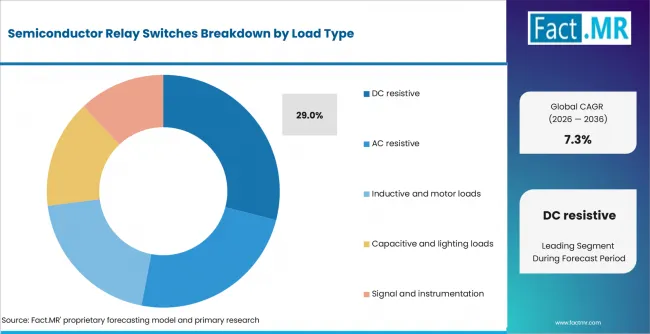
Semiconductor Relay Switches Analysis By Load Type | Source: Fact.MR
DC resistive loads lead the load mix because battery systems and instrumentation circuits need clean on-off control at predictable current levels. The profile suits MOSFET relay behavior in test channels and low-voltage boards.
Electric vehicle electronics add a second use case. Toshiba released the TLX9165T automotive photorelay in July 2025 with 1800 V output withstand voltage for battery monitoring systems in 800 V vehicle platforms.
How does End-use shape demand?
Industrial automation represents 31.0% share in 2026.
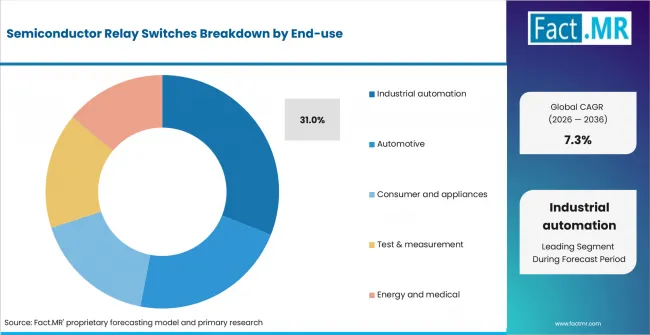
Semiconductor Relay Switches Analysis By End Use | Source: Fact.MR
Industrial automation leads end use since machines depend on frequent switching across sensors, actuators and control interfaces. The International Federation of Robotics reported on September 25, 2025, that annual industrial robot installations topped 500,000 units for the fourth consecutive year.
That installed base supports relay devices that handle repeated cycles and fit inside dense control electronics. Semiconductor relay switches help automation OEMs reduce mechanical wear and improve response consistency in inspection systems.
What supports PCB mount packages?
PCB mount leads with 46.0% share in 2026.
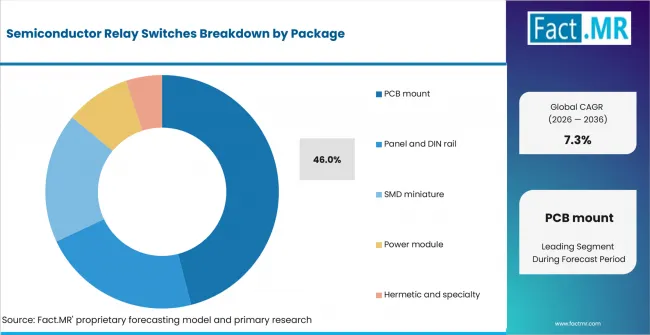
Semiconductor Relay Switches Analysis By Package | Source: Fact.MR
PCB mount packages lead as relay functions move closer to the control board. Aratas Corporation, which succeeded OMRON’s Device & Module Solutions business in July 2026, lists voltage-driven G3VM MOSFET relays in ultra-compact S-VSON(L) packages, with selected models supporting ambient operating temperatures up to 125°C for high-density equipment designs.
Package choice affects sourcing as much as current rating because relay height, pad layout and thermal margin shape how quickly a part enters a board design.
What is accelerating Semiconductor Relay Switches Market adoption, and what is holding it back?
Demand is expected to rise through contactless switching needs and board-level power control. Growth is constrained by derating, qualification work and cost premiums.
Drivers Impact Analysis
| DRIVER | (~) % IMPACT ON CAGR | GEOGRAPHIC RELEVANCE | IMPACT TIMELINE |
|---|---|---|---|
| Electromechanical relay replacement in compact control boards | +1.1% | Global | Short term (<= 2 years) |
| EV battery monitoring and isolated DC switching | +0.9% | North America, East Asia | Medium term (2-4 years) |
| Factory automation and test-equipment switching density | +0.8% | East Asia, Europe | Medium term (2-4 years) |
| PCB space pressure in appliance and instrumentation designs | +0.6% | Global | Long term (>= 4 years) |
- Electromechanical relay replacement: Control-board designers increasingly consider semiconductor relays where silent operation, low drive requirements, compact form factors, and long switching life can justify replacing mechanical relays. These characteristics support use across control electronics that require reliable, repeatable switching.
- EV battery monitoring: Higher-voltage battery systems require isolated switching points for measurement, monitoring, and protection functions. Relay suppliers can support battery-management electronics by focusing on low leakage, electrical isolation, creepage performance, and dependable operation across demanding automotive environments.
- Factory automation and test equipment: Test racks, automation panels, and electronic testers often require frequent switching across compact control boards. Solid-state relays can support these applications where small package size, stable response, switching endurance, and low maintenance are important.
Opportunity Impact Analysis
| OPPORTUNITY | (~) % IMPACT ON CAGR | GEOGRAPHIC RELEVANCE | IMPACT TIMELINE |
|---|---|---|---|
| Medical and test-grade isolated switching | +0.5% | USA, Japan, Germany | Medium term (2-4 years) |
| Miniature SMD relays for dense instrument boards | +0.4% | Global | Short term (<= 2 years) |
| High-voltage battery and energy-storage monitoring | +0.4% | East Asia, Europe, USA | Long term (>= 4 years) |
- Medical and test-grade switching: Medical and test equipment create opportunities for semiconductor relays where low leakage, strong isolation, and repeatable switching performance are important. Suppliers can strengthen design wins by providing clear technical documentation for measurement, insulation-detection, and other regulated applications.
- Miniature SMD relays: Smaller surface-mount relay packages support higher component density in measurement equipment, control interfaces, and compact electronic assemblies. Miniaturized photorelays can help designers save board space while maintaining reliable switching performance in demanding operating environments.
- High-voltage monitoring: Energy-storage and electric-vehicle electronics create opportunities for photorelays that meet demanding creepage, isolation, and withstand-voltage requirements. These devices are particularly relevant for battery-monitoring and protection circuits where compact, contactless switching and electrical separation are essential.
Restraints Impact Analysis
| RESTRAINT | (~) % IMPACT ON CAGR | GEOGRAPHIC RELEVANCE | IMPACT TIMELINE |
|---|---|---|---|
| Heat and derating at higher current levels | -0.4% | Global | Short term (<= 2 years) |
| Qualification time for safety-critical boards | -0.3% | Automotive, medical, industrial | Medium term (2-4 years) |
| Cost premium over electromechanical relays | -0.2% | Cost-sensitive regions | Long term (>= 4 years) |
- Heat and derating: Semiconductor relay resistance can generate heat under load, making thermal margin and derating important during design. Continuous operation at high load may affect reliability, so engineers need to evaluate current, temperature, and duty-cycle conditions before replacing mechanical relays.
- Qualification time: Automotive and medical control boards require detailed validation before relay substitutions are approved. Designers must assess isolation, creepage, withstand voltage, thermal behavior, and circuit compatibility, which can lengthen qualification cycles for battery-monitoring and regulated electronic systems.
- Cost premium: Electromechanical relays can remain attractive in low-cycle applications where noise, size, and contact wear are less critical. Semiconductor relays are therefore more concentrated in compact, high-frequency, high-cycle, and maintenance-sensitive applications where their performance advantages justify the higher device cost.
Which countries are scaling the Semiconductor Relay Switches Market through 2036?
- The country comparison spans 3.30 percentage points and forms three practical growth bands across the forecast period.
- The USA remains 0.37 percentage point above Germany owing to electronics investment and data-center power control needs.
- Germany remains 0.79 percentage point above South Korea through renewable inverter use and electrical equipment orders.
- South Korea remains 1.49 percentage points above Japan due to semiconductor export growth and battery-electronics demand.
- Japan remains 0.65 percentage point above the UK with precision electronics and test-equipment strengths.
- The UK closes the displayed range through electrical equipment sales and EV charging buildout.
Comparable CAGRs create different entry conditions due to electronics production, factory automation, EV infrastructure and power-network design. Full report coverage includes North America, Latin America, Western Europe, Eastern Europe, East Asia, South Asia & Pacific, Middle East & Africa.
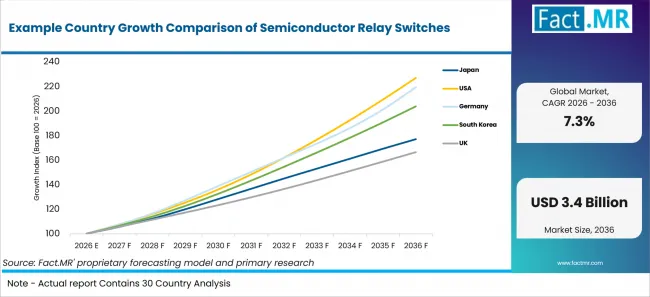
Example Country Growth Comparison Of Semiconductor Relay Switches | Source: Fact.MR
| Country | CAGR (2026-2036) |
|---|---|
| USA | 8.5% |
| Germany | 8.2% |
| South Korea | 7.4% |
| Japan | 5.9% |
| UK | 5.2% |
What supports USA adoption?
8.5% CAGR, supported by electronics investment and data-center power control.
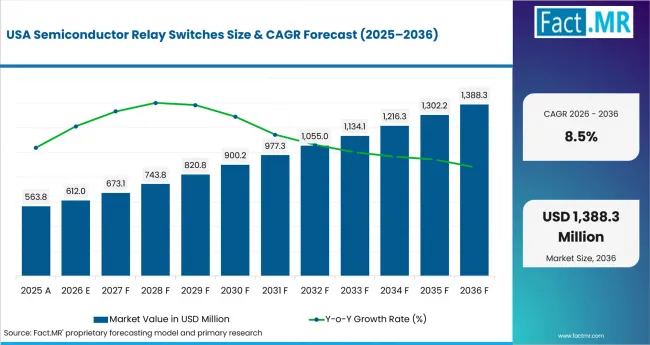
Semiconductor Relay Switches Country Value Analysis | Source: Fact.MR
U.S. electronics investment gives relay suppliers a large base of board-level design work. The Bureau of Economic Analysis reported in June 2026 that greenfield investment expenditures in computers and electronics products manufacturing reached USD 2.0 billion in 2025. Data-center expansion provides an additional application context for power-control and interface electronics, with Lawrence Berkeley National Laboratory estimating in June 2026 that data centers could account for 11.8% of total U.S. electricity use by 2030.
What is supporting Germany’s adoption?
8.2% CAGR, supported by renewable integration and industrial electronics.
Germany’s relay demand is tied to industrial controls and power electronics. The Bundesnetzagentur reported in January 2026 that Germany’s installed solar capacity reached 117 GW at the end of 2025. Destatis reported in February 2026 that real new orders in electrical equipment manufacturing rose 9.8% month on month in December 2025, based on provisional seasonally and calendar-adjusted data. Together, Germany’s expanding solar base and electrical-equipment activity provide a relevant application environment for relay technologies used in inverters, control boards and power-management systems.
How is South Korea scaling demand?
7.4% CAGR, driven by semiconductors, EVs and battery electronics.
South Korea combines semiconductor exports with vehicle battery electronics. MOTIR and MSIT reported in January 2026 that Korea’s ICT exports reached USD 264.3 billion in 2025, with semiconductor exports rising 22.1% from 2024. The Ministry of Climate, Energy and Environment reported in April 2026 that Korea had 981,321 registered electric vehicles at the end of March 2026, providing a growing application base for isolated switching and monitoring technologies used in high-voltage battery-management and automotive control electronics.
How does Japan perform?
5.9% CAGR, led by precision electronics and test-equipment demand.
Japan’s position is shaped by precision electronics and test equipment. JEITA’s December 2025 electronics production statistics, based on METI data, reported JPY 523,884 million in electric measuring instrumentation output for 2025. The IEA reported in Global EV Outlook 2026 that Japanese electric-car sales remained just above 100,000 units in 2025, while the country’s substantial instrumentation and industrial electronics activity provides an important application context for relay and switching technologies.
What supports the United Kingdom’s growth?
5.2% CAGR, backed by electrical equipment output and charging infrastructure.
The UK growth route is centered on electrical equipment output and charging infrastructure. ONS reported in July 2026 that UK manufacture of electrical equipment recorded sales of GBP 17,876.9 million in 2025. GOV.UK reported in July 2025 that the United Kingdom had 82,002 publicly available EV charging devices, providing a growing application base for control, switching and power-distribution electronics.
Who leads the Semiconductor Relay Switches Market?
Panasonic Industry is active through PhotoMOS and solid-state relay product lines. Its PhotoMOS devices use MOSFET output elements for AC and DC load control, with applications spanning measuring and testing equipment, security systems, insulation detection and industrial controls where compact electrical isolation is important.
Aratas Corporation supplies G3VM MOSFET relays across compact board-level packages, including high-temperature models designed for dense mounting environments. Vishay participates through industrial and automotive solid-state relays for industrial controls, battery management and energy-storage applications.
Toshiba Electronic Devices competes through automotive and compact-package photorelays for isolated switching applications. Littelfuse participates through OptoMOS solid-state relays and AC power relay products, while Broadcom offers Photo MOSFET solid-state relay devices for industrial and general-purpose switching applications.
Which companies are the key providers?
Key companies include Panasonic Industry; Aratas Corporation (formerly OMRON Device & Module Solutions); Vishay; Toshiba Electronic Devices; Littelfuse; and Broadcom.
- Panasonic Industry
- Aratas Corporation (formerly OMRON Device & Module Solutions)
- Vishay
- Toshiba Electronic Devices
- Littelfuse
- Broadcom
Bibliography
- International Federation of Robotics. (2025, September 25). World Robotics 2025 report – INDUSTRIAL ROBOTS – released by IFR.
- Semiconductor Industry Association. (2026, August 6). Global semiconductor sales increase 35.1% from Q1 2026 to Q2 2026.
- Smith, S. J., Hubbard, A., Newkirk, A., Ganeshalingam, M., Holecek, B., Sartor, D. A., Mills, M., & Shehabi, A. (2026, June). United States data center energy usage report: 2025 update. Lawrence Berkeley National Laboratory.
- U.S. Bureau of Economic Analysis. (2026, June 10). New foreign direct investment in the United States, 2025.
- Bundesnetzagentur. (2026, January 8). Growth in renewable energy in 2025.
- Federal Statistical Office (Destatis). (2026, February 5). New orders in manufacturing in December 2025: +7.8% on the previous month.
- Ministry of Trade, Industry and Resources, & Ministry of Science and ICT. (2026, January 15). ICT exports post record annual performance in 2025.
- International Energy Agency. (2026). Trends in electric cars. In Global EV Outlook 2026.
- Office for National Statistics. (2026, August 13). UKProdTO: 27 – Manufacture of Electrical Equipment TOTAL (£m).
- Department for Transport. (2025, July 24). Electric vehicle public charging infrastructure statistics: July 2025.
- OMRON Electronic Components. (2025, December). G3VM-31QV2H/61QV3H/61QV4H/61QV3L: MOSFET relays S-VSON(L), voltage driven type.
- OMRON Corporation. (2026, July 1). Notice regarding the effectiveness of absorption-type company split of the Device & Module Solutions Business and change of trade name to Aratas Corporation.
- Vishay Intertechnology, Inc. (2025, April 30). Vishay Intertechnology 1 Form A solid-state relays offer continuous load current to 5 A in compact SOP-4 package.
- Vishay Intertechnology, Inc. (2025, November 25). Vishay Intertechnology releases 1500 V 1 Form A solid-state relay in 4-pin SMD-8 package for 800 V battery monitoring systems.
- Toshiba Electronic Devices & Storage Corporation. (2025, July 17). Toshiba releases automotive photorelay with 1800V output withstand voltage.
- Toshiba Electronic Devices & Storage Corporation. (2026, February 25). Toshiba releases small photorelays with 135°C rating for high-temperature equipment operation.
This Report Answers
- The report explains where semiconductor relay switches are used across relay type, load type, end-use and package formats.
- Segment analysis identifies the leading subsegments and the design reasons engineering teams select them.
- Country analysis examines the listed markets and the electronics, automation or vehicle trends shaping demand.
- Competitive analysis reviews current providers across PhotoMOS, MOSFET relay, IGBT and optically isolated relay portfolios.
- Application analysis assesses how isolation, leakage, heat and package size influence design decisions.
What does the Semiconductor Relay Switches Market cover?
The Semiconductor Relay Switches Market covers solid-state devices that replace or complement electromechanical relays in electronic control circuits.
The assessment covers semiconductor switches used in industrial control boards, vehicle electronics, instruments, appliances and energy systems. Adjacent automotive relay systems show how mechanical and semiconductor relays coexist inside vehicle electrical architectures.
What is included in the scope?
The scope includes PCB-mounted PhotoMOS, MOSFET solid-state relays, triac AC SSRs, IGBT relay modules and specialty semiconductor switches used for load or signal control. Related relay boxes and junction blocks coverage is relevant where semiconductor relays form part of managed distribution assemblies.
It includes relays used with control cabinets, machine interfaces, instruments, chargers, battery systems and protected power circuits. Adjacent switchgear equipment and safety sensors and switches help frame downstream equipment using solid-state switching.
What is excluded from the scope?
The scope excludes standalone electromechanical relays, passive fuses, raw semiconductor wafers and complete switchgear assemblies sold without a semiconductor relay function. Related motor protection devices coverage is outside the scope unless the device includes semiconductor relay switching.
General power electronics are excluded when the component performs conversion rather than relay-like switching or isolation. Adjacent digital power conversion, 3D power modules, gallium nitride semiconductor devices and solid-state transformer systems connect through power-control design, while separate market totals apply.
How Was the Analysis Built?
The analysis draws on 120+ sources, 35+ company portfolios, 25+ countries, and more than 20 industry interviews.
- Primary Research: Primary research includes discussions with manufacturers, service providers, technology developers, distributors, end users, and subject-matter experts. These conversations examine purchasing priorities, product adoption, operational challenges, approval requirements, competitive positioning, and the factors that influence wider market acceptance.
- Desk Research: Desk research covers government statistics, regulatory publications, company filings, trade data, technical studies, industry associations, standards, public policy, and other authoritative sources. Every source used in the analysis is documented in the bibliography.
- Market Sizing and Forecasting: Market estimates combine historical performance, demand indicators, pricing and volume trends, segment shares, company participation, country-level growth, adoption patterns, investment activity, and barriers to market expansion.
- Data Validation and Update Cycle: Findings are validated by comparing primary interviews with public data, company activity, regulatory changes, trade patterns, and industry developments. Regular updates review new product launches, capacity changes, partnerships, approvals, and shifts in commercial adoption.
What is the report’s scope and coverage?
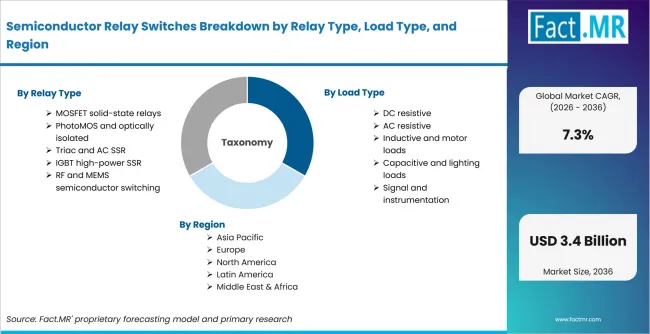
Semiconductor Relay Switches Breakdown By Relay Type, Load Type, And Region | Source: Fact.MR
| Attribute | Details |
|---|---|
| Quantitative Units | USD Billion |
| Market Definition | Semiconductor relay switches are solid-state devices that use semiconductor output elements to switch AC, DC, signal or high-power loads without mechanical contacts. |
| Relay Type | MOSFET solid-state relays; PhotoMOS and optically isolated; Triac and AC SSR; IGBT high-power SSR; RF and MEMS semiconductor switching |
| Load Type | DC resistive; AC resistive; Inductive and motor loads; Capacitive and lighting loads; Signal and instrumentation |
| End-use | Industrial automation; Automotive; Consumer and appliances; Test & measurement; Energy and medical |
| Package | PCB mount; Panel and DIN rail; SMD miniature; Power module; Hermetic and specialty |
| Regions Covered | North America; Latin America; Western Europe; Eastern Europe; East Asia; South Asia & Pacific; Middle East & Africa |
| Countries Covered | USA; Germany; South Korea; Japan; UK |
| Key Companies Profiled | Panasonic Industry; Aratas Corporation (formerly OMRON Device & Module Solutions); Vishay; Toshiba Electronic Devices; Littelfuse; Broadcom |
| Forecast Period | 2026 to 2036 |
| Approach | Hybrid top-down and bottom-up approach using relay type, load category, end-use adoption, package mix, country demand and provider portfolio review. |
How is the market segmented?
-
By Relay Type
- MOSFET solid-state relays
- PhotoMOS and optically isolated
- Triac and AC SSR
- IGBT high-power SSR
- RF and MEMS semiconductor switching
-
By Load Type
- DC resistive
- AC resistive
- Inductive and motor loads
- Capacitive and lighting loads
- Signal and instrumentation
-
By End-use
- Industrial automation
- Automotive
- Consumer and appliances
- Test & measurement
- Energy and medical
-
By Package
- PCB mount
- Panel and DIN rail
- SMD miniature
- Power module
- Hermetic and specialty
-
By Region
- North America
- Latin America
- Western Europe
- Eastern Europe
- East Asia
- South Asia & Pacific
- Middle East & Africa