- Market Value (2025): USD 240.4 Mn
- Estimated Value (2026): USD 251.4 Mn
- Forecast Value (2036): USD 393.1 Mn
- CAGR (2026-2036): 4.6%
What is the Shark Liver Oils Market forecast to be worth by 2036?
USD 251.4 million in 2026 to USD 393.1 million by 2036 at a 4.6% CAGR.
- As per Fact.MR analysis, the shark liver oils market reached USD 240.4 million in 2025.
- Demand will increase from USD 251.4 million in 2026 to USD 393.1 million by 2036.
- The shark liver oils market will record 4.6% CAGR from 2026 to 2036.
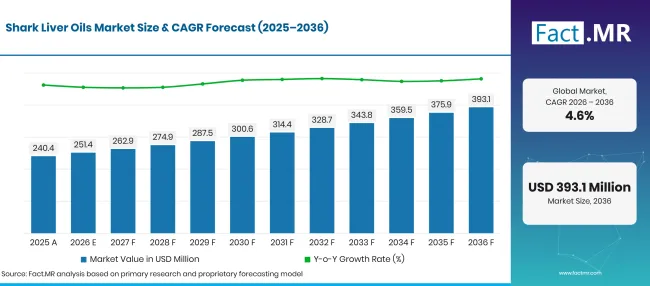
Factmr Shark Liver Oils Market Forecast Global | Source: Fact.MR
| Year | Basis | Market value (USD Million) |
|---|---|---|
| 2025 | Actual | 240.4 |
| 2026 | Estimate | 251.4 |
| 2036 | Forecast | 393.1 |
| CAGR 2026 to 2036 | Forecast period | 4.6% |
Source: Fact.MR analysis. Updated Oct 14, 2026
What are the defining numbers behind Shark Liver Oils Market growth?
An absolute opportunity of USD 141.7 million will be created between 2026 and 2036.
- Demand Drivers in the Market
- Personal care brands are expanding the use of squalene and squalane in moisturizers, serums and hair care. Formulators will favor these ingredients for their light texture and skin compatibility.
- Dietary supplement makers are adding marine-derived oils to wellness ranges. Consumer preference for natural ingredients will sustain this shift.
- Online retail is improving the visibility and comparison of specialty beauty and wellness products. Wider access will support repeat purchases across the listed countries.
- Pharmaceutical and healthcare users are retaining squalene in selected formulations. These buyers will provide steady, quality-driven volumes.
- Key Segments Analyzed
- By Product Type: Squalene is projected to command 52.3% share in 2026, as it is the main active fraction recovered from shark liver oil.
- By Application: Cosmetics is expected to claim 39.6% share in 2026, supported by wide use in skincare and personal care formulations.
- By Distribution Channel: Online Retail is anticipated to secure 31.0% share in 2026, owing to easy access to specialty and imported products.
- By End-User: Personal Care is set to garner 41.6% share in 2026, given steady formulation demand from beauty and grooming brands.
- Analyst Opinion at Fact.MR
- Shambhu Nath Jha, Principal Consultant at Fact.MR, states, “Shark liver oils are now bought as a defined ingredient with documented purity and traceable origin. Buyers will favor suppliers with consistent squalene content and clear sourcing records. Suppliers that pair certified quality with refining capability will gain the most from personal care brands and supplement makers.”
- Strategic Implications
- Ingredient suppliers should disclose squalene and squalane purity and origin data, since buyers weigh shark-derived products against plant-derived alternatives on both specification and sourcing.
- Refiners should strengthen purification and quality control, so that batch-to-batch consistency is maintained across end-use applications.
- Brands selling through online retail should supply clear ingredient information and certifications, given that online shoppers evaluate formulations and prices across competing sellers.
Germany will lead at 5.7% CAGR on strong demand for personal care and supplement products. The United States will follow at 5.0% on a large supplement and cosmetics market. Brazil will record 4.5% as its beauty and personal care sector expands. Japan will post 4.0% on a long tradition of shark liver oil use. The United Kingdom will close at 3.3% in a mature market with close attention to sourcing.
How does the Shark Liver Oils Market break down by segment?
Squalene will lead Product Type at 52.3%; Cosmetics will lead Application at 39.6%; Online Retail will lead Distribution Channel at 31.0%; Personal Care will lead End-User at 41.6%.
Which Product Type dominates?
Squalene will hold 52.3% share in 2026.
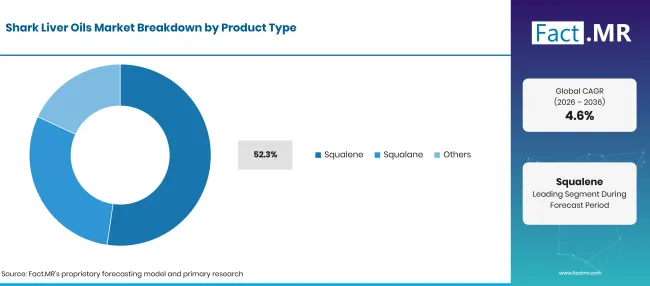
Factmr Shark Liver Oils Market Breakdown Product Type | Source: Fact.MR
| Product Type | Share (2026) |
|---|---|
| Squalene (Leading segment) | 52.3% |
| Other segments combined | 47.7% |
| Total | 100.0% |
Source: Fact.MR analysis. Updated Oct 14, 2026
Squalene is projected to head since it is the primary compound recovered from shark liver oil and is supplied directly to cosmetic, pharmaceutical and supplement manufacturers. High purity and skin compatibility are keeping it the preferred input for formulators. Squalane serves buyers who need a more stable, hydrogenated form of squalene. It is gaining use as an emollient in skincare, although plant-derived options are competing for the same formulations. Other products, including crude and semi-refined shark liver oils, will continue to serve supplement and industrial buyers.
What supports Cosmetics within Application?
Cosmetics is expected to claim 39.6% share in 2026.
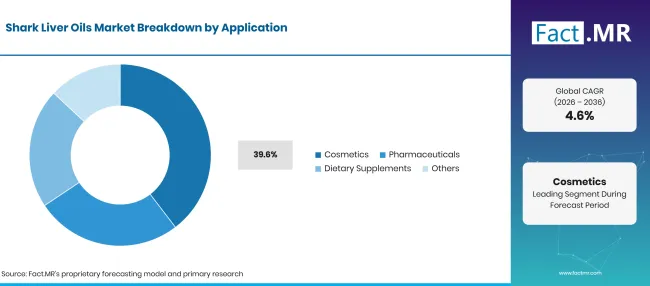
Factmr Shark Liver Oils Market Breakdown Application | Source: Fact.MR
| Application | Share (2026) |
|---|---|
| Cosmetics (leading segment) | 39.6% |
| Other segments combined | 60.4% |
| Total | 100.0% |
Source: Fact.MR analysis. Updated Oct 14, 2026
Cosmetics is estimated to lead since squalene and squalane are being specified for hydration, softness and skin barrier support. Skincare, hair care and lip product makers are including them across mass and premium ranges. Pharmaceutical manufacturers are retaining squalene in selected formulations that call for a high-purity lipid. Supplement brands will rely on the natural oil to support wellness positioning. Other applications will remain narrower in scope.
What leads the Distribution Channel segment?
Online Retail will capture 31.0% share in 2026.
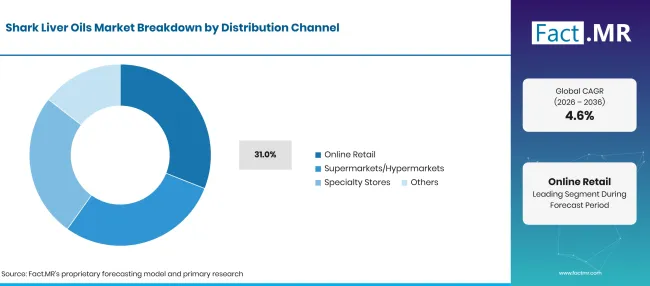
Factmr Shark Liver Oils Market Breakdown Distribution Channel | Source: Fact.MR
| Distribution Channel | Share (2026) |
|---|---|
| Online Retail (leading segment) | 31.0% |
| Other segments combined | 69.0% |
| Total | 100.0% |
Source: Fact.MR analysis. Updated Oct 14, 2026
Online retail is forecast to spearhead since buyers are evaluating ingredients, brands and pricing on a single platform and are sourcing products that local outlets rarely carry. Direct-to-consumer brands are using digital channels to build reach among beauty and wellness consumers. Supermarkets and hypermarkets will keep supplying mass-market personal care and supplement products to routine shoppers. Specialty stores are serving buyers who want product guidance and premium, differentiated ranges.
How does End-User shape demand?
Personal Care will represent 41.6% share in 2026.
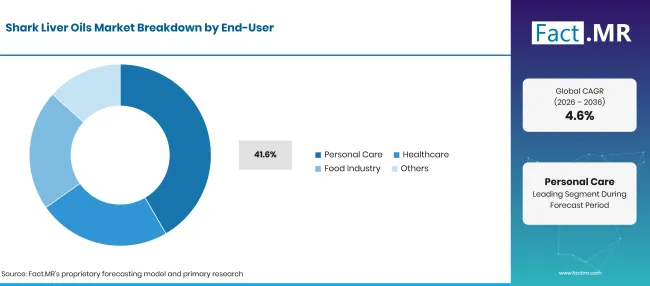
Factmr Shark Liver Oils Market Breakdown End User | Source: Fact.MR
| End-User | Share (2026) |
|---|---|
| Personal Care (leading segment) | 41.6% |
| Other segments combined | 58.4% |
| Total | 100.0% |
Source: Fact.MR analysis. Updated Oct 14, 2026
Personal care will lead since beauty and grooming brands are incorporating squalene and squalane across multiple product lines and are refreshing formulations frequently. Healthcare buyers will follow, with purchasing linked to pharmaceutical and wellness products. Food manufacturers are applying the oil in a narrower set of functional and fortified products. Remaining end-users will contribute the balance of volumes.
What is accelerating Shark Liver Oils Market adoption, and what is holding it back?
Demand will rise through personal care growth, supplement use and online retail expansion. Growth is held back by sustainability concerns, plant-derived alternatives and raw material supply limits.
Drivers Impact Analysis
| DRIVER | (~) % IMPACT ON CAGR | GEOGRAPHIC RELEVANCE | IMPACT TIMELINE |
|---|---|---|---|
| Rising incorporation of squalene and squalane in skincare and personal care formulations | +1.2% | Global | Short term (<= 2 years) |
| Expanding use of marine-derived oils in dietary supplements | +0.9% | Global | Medium term (2-4 years) |
| Growing online retail penetration for beauty and wellness products | +0.7% | United States, Germany, Brazil | Short term (<= 2 years) |
| Sustained use of squalene in pharmaceutical and healthcare formulations | +0.5% | Global | Long term (>= 4 years) |
Source: Fact.MR analysis. Updated Oct 14, 2026
Opportunity Impact Analysis
| OPPORTUNITY | (~) % IMPACT ON CAGR | GEOGRAPHIC RELEVANCE | IMPACT TIMELINE |
|---|---|---|---|
| Advanced purification and refining of squalene and squalane | +0.7% | Global | Medium term (2-4 years) |
| Traceable and certified sourcing of marine raw materials | +0.5% | Germany, United Kingdom, United States | Medium term (2-4 years) |
| Premium and clean-label skincare formulations | +0.3% | Global | Long term (>= 4 years) |
| Functional food and nutraceutical product development | +0.2% | Japan, United States | Long term (>= 4 years) |
Source: Fact.MR analysis. Updated Oct 14, 2026
Restraints Impact Analysis
| RESTRAINT | (~) % IMPACT ON CAGR | GEOGRAPHIC RELEVANCE | IMPACT TIMELINE |
|---|---|---|---|
| Sustainability and animal welfare concerns over shark sourcing | -0.5% | Global | Short term (<= 2 years) |
| Competition from plant-derived squalane | -0.3% | Global | Medium term (2-4 years) |
| Fishing restrictions and variable raw material supply | -0.2% | Global | Long term (>= 4 years) |
Source: Fact.MR analysis. Updated Oct 14, 2026
Which countries are scaling the Shark Liver Oils Market through 2036?
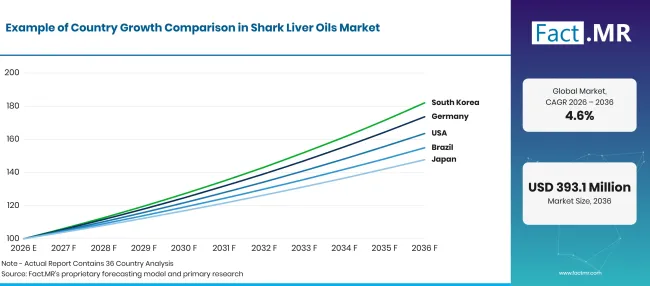
Factmr Shark Liver Oils Market Growth Index | Source: Fact.MR
| Country | CAGR (2026-2036) |
|---|---|
| Germany | 5.7% |
| United States | 5.0% |
| Brazil | 4.5% |
| Japan | 4.0% |
| United Kingdom | 3.3% |
Source: Fact.MR analysis. Updated Oct 14, 2026
What supports Germany adoption?
5.7% CAGR, supported by strong personal care and supplement demand.
Germany is expected to lead the group as cosmetic and supplement buyers favor high-quality, well-documented ingredients. Formulators will continue to use squalene and squalane in skincare, while buyers will press suppliers for clear sourcing information. Germany is one of Europe’s largest cosmetics markets, and the EU Cosmetics Regulation requires a documented safety assessment for every product. Suppliers that provide purity data and traceable origin are well positioned with domestic skincare brands.
What supports United States adoption?
5.0% CAGR, supported by supplement and cosmetics demand.
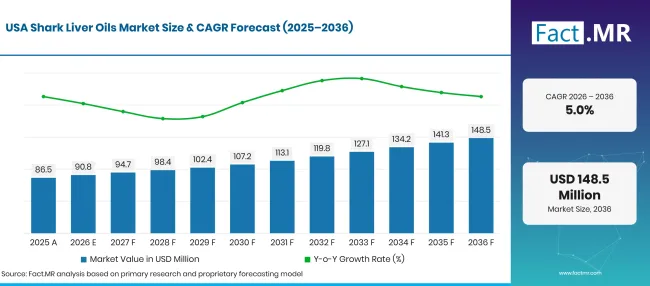
Factmr Shark Liver Oils Market Forecast Usa | Source: Fact.MR
The United States combines a large dietary supplement market with an active cosmetics industry and well-developed online retail. These features give suppliers several routes to reach consumers. The Dietary Supplement Health and Education Act of 1994 places responsibility for product safety and labeling accuracy on manufacturers. Suppliers with documented quality systems are therefore well positioned with supplement brands.
How is Brazil scaling demand?
4.5% CAGR, driven by a growing beauty and personal care sector.
Brazil has a large and active beauty market, and personal care brands there continue to launch new skincare and hair care products. Online retail is also widening access to specialty ingredients and finished products. Direct selling is a major route to consumers in Brazil, and ANVISA oversees cosmetic registration, so suppliers with compliant documentation will find it easier to serve local brands.
How is Japan developing demand?
4.0% CAGR, backed by a long tradition of shark liver oil use.
Japan has a long history of using shark liver oil in health and beauty products. Domestic producers and established consumer habits will keep demand steady, although growth is moderate in a mature market. Japan’s Foods with Function Claims system, introduced in 2015, lets companies notify science-based health claims on food and supplement products. This framework is supporting new nutraceutical launches, while familiarity with shark-derived ingredients is likely to favor domestic suppliers.
How does the United Kingdom perform?
3.3% CAGR, shaped by a mature market and close attention to sourcing.
The United Kingdom is a developed personal care and supplement market where consumers and retailers look closely at ingredient origin. Demand for plant-derived alternatives limits the pace of growth for shark-derived products. The UK Cosmetics Regulation requires a UK-based responsible person and product notification before sale, which keeps documentation standards high and favors suppliers with complete ingredient records.
Who leads the Shark Liver Oils Market?
Competition centers on raw material access, purification capability, product consistency and sourcing credentials. Suppliers include marine oil producers and specialist extract companies. Lýsi hf supplies cod liver oil, shark liver oil and omega-3 fish oils in bulk and consumer-packaged forms. Norwegian Fish Oil AS markets omega-3 products in capsule and other formats. Kishimoto Special Liver Oil Co., Ltd. is linked to shark-derived squalane for cosmetic use. Arbee Biomarine Extracts Pvt Ltd supplies shark liver oil and squalene oil, while Bawa Fishmeal & Oil Co. exports fish oil, fishmeal and squalene shark liver oil. EGAO Co. Ltd., Arista Industries and Medikonda Nutrients also compete in the market. Quality documentation, traceability and the ability to supply consistent squalene content will decide competition through 2036
Which companies are the key providers?
Key companies include Lýsi hf; Norwegian Fish Oil AS; Kishimoto Special Liver Oil Co., Ltd.; Arbee Biomarine Extracts Pvt Ltd; Bawa Fishmeal & Oil Co.; EGAO Co. Ltd.; Arista Industries; and Medikonda Nutrients.
- Lýsi hf
- Norwegian Fish Oil AS
- Kishimoto Special Liver Oil Co., Ltd.
- Arbee Biomarine Extracts Pvt Ltd
- Bawa Fishmeal & Oil Co.
- EGAO Co. Ltd.
- Arista Industries
- Medikonda Nutrients
Bibliography
- [1] Convention on International Trade in Endangered Species of Wild Fauna and Flora. (2025). Annex 1: CoP20 proposal concerning shark species.
- [2] European Commission. (2025, May 12). Commission Regulation (EU) 2025/877 of 12 May 2025 amending Regulation (EC) No 1223/2009 of the European Parliament and of the Council as regards the use in cosmetic products of certain substances classified as carcinogenic, mutagenic or toxic for reproduction.
- [3] World Organisation for Animal Health. (2025, May 24). Less antimicrobial use in animals: A win for everyone.
- [4] Food and Agriculture Organization of the United Nations. (2025, July 15). OECD-FAO Agricultural Outlook 2025–2034: Emerging economies will drive growth in animal source food consumption and production.
- [5] European Commission. (2026, June 4). Commission Implementing Regulation (EU) 2026/1189 amending Implementing Regulation (EU) 2021/405 as regards the application of the restrictions on the use of certain antimicrobial medicinal products and repealing Implementing Regulation (EU) 2024/2598.
This Report Answers
- The report explains how shark liver oils are used by product type, application, distribution channel and end-user.
- Segment analysis identifies the sub-segment that leads each segment and the buyer needs behind its 2026 share.
- Country analysis compares the five listed countries through personal care demand, supplement use and sourcing attitudes.
- Competitive analysis reviews marine oil producers and specialist extract suppliers.
- Sustainability analysis tracks sourcing concerns and the effect of plant-derived alternatives on demand.
What does the Shark Liver Oils Market cover?
The Shark Liver Oils Market covers oil extracted from the livers of sharks and its main derivatives. Squalene is the principal active fraction, and squalane is its hydrogenated form. Both are used as ingredients in cosmetics, pharmaceuticals and dietary supplements.
The assessment tracks crude, refined and fractionated shark liver oils, together with squalene and squalane produced from them, sold to manufacturers and consumers across the listed distribution channels.
What is included in the scope?
The scope includes shark liver oil, squalene and squalane derived from shark liver, in bulk ingredient form and in finished products sold for personal care, healthcare and food uses.
Combination products are included when shark liver oil or its derivatives make up the active base. Products that blend shark-derived ingredients with other lipids count only for their shark-derived value.
What is excluded from the scope?
The scope excludes plant-derived and biosynthetic squalene and squalane, such as those sourced from olive, sugarcane or fermentation. Other marine oils, including cod liver oil and fish body oils, are also excluded.
Products that do not contain shark liver oil or its derivatives fall outside the revenue boundary.
How Was the Analysis Built?
The analysis draws on primary interviews, company portfolio reviews, country-level assessments and published industry sources.
- Primary Research: Primary research includes discussions with manufacturers, service providers, technology developers, distributors, end users, and subject-matter experts. These conversations examine purchasing priorities, product adoption, operational challenges, approval requirements, competitive positioning, and the factors that influence wider market acceptance.
- Desk Research: Desk research covers government statistics, regulatory publications, company filings, trade data, technical studies, industry associations, standards, public policy, and other authoritative sources. Every source used in the analysis is documented in the bibliography.
- Market Sizing and Forecasting: Market estimates combine historical performance, demand indicators, pricing and volume trends, segment shares, company participation, country-level growth, adoption patterns, investment activity, and barriers to market expansion.
- Data Validation and Update Cycle: Findings are validated by comparing primary interviews with public data, company activity, regulatory changes, trade patterns, and industry developments. Regular updates review new product launches, capacity changes, sourcing and fishing regulations, partnerships, certifications, and shifts in commercial adoption.
Segmentation
What is the report’s scope and coverage?
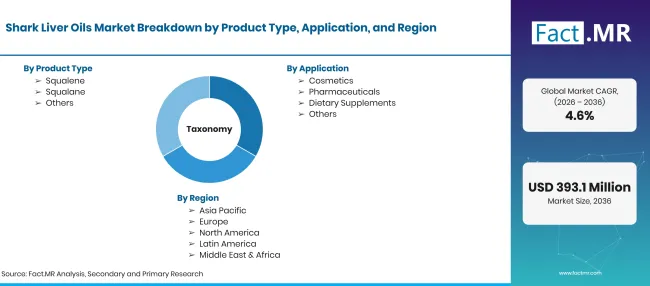
Factmr Shark Liver Oils Market Taxonomy | Source: Fact.MR
| Attribute | Details |
|---|---|
| Quantitative Units | USD 251.4 million in 2026 to USD 393.1 million by 2036 at a 4.6% CAGR |
| Market Definition | Shark liver oils and their principal derivatives, squalene and squalane, used in cosmetics, pharmaceuticals, dietary supplements and other applications. |
| Product Type | Squalene; Squalane; Others |
| Application | Cosmetics; Pharmaceuticals; Dietary Supplements; Others |
| Distribution Channel | Online Retail; Supermarkets/Hypermarkets; Specialty Stores; Others |
| End-User | Personal Care; Healthcare; Food Industry; Others |
| Countries Covered | Germany; United States; Brazil; Japan; United Kingdom |
| Key Companies Profiled | Lýsi hf; Norwegian Fish Oil AS; Kishimoto Special Liver Oil Co., Ltd.; Arbee Biomarine Extracts Pvt Ltd; Bawa Fishmeal & Oil Co.; EGAO Co. Ltd.; Arista Industries; Medikonda Nutrients |
| Forecast Period | 2026 to 2036 |
| Approach | Hybrid top-down and bottom-up approach using raw material supply; squalene and squalane demand by application; distribution channel mix; end-user demand; country growth; and supplier portfolio review. |
Source: Fact.MR analysis. Updated Oct 14, 2026
How is the market segmented?
-
By Product Type
- Squalene
- Squalane
- Others
-
By Application
- Cosmetics
- Pharmaceuticals
- Dietary Supplements
- Others
-
By Distribution Channel
- Online Retail
- Supermarkets/Hypermarkets
- Specialty Stores
- Others
-
By End-User
- Personal Care
- Healthcare
- Food Industry
- Others
-
By Country
- Germany
- United States
- Brazil
- Japan
- United Kingdom
Frequently Asked Questions
• How big is the shark liver oils market in 2026?
• What is the CAGR of the shark liver oils market from 2026 to 2036?
Which product type leads the shark liver oils market?
Which application leads the shark liver oils market?
Which distribution channel leads the shark liver oils market?
Which end-user leads the shark liver oils market?
Which country will grow the most in the shark liver oils market?
Who are the main companies in the shark liver oils market?
Who worked on this report


Preview the report firsthand - request a free sample
Free SampleGet the brochure for pricing and purchase details
Download PDF