- Market Value (2025): USD 3.9 Bn
- Estimated Value (2026): USD 4.2 Bn
- Forecast Value (2036): USD 9.6 Bn
- CAGR (2026-2036): 8.6%
What is the Ship Automation Suites Market forecast to be worth by 2036?
USD 4.2 billion in 2026 to USD 9.6 billion by 2036 at an 8.6% CAGR.
- 2025 market value: USD 3.9 billion.
- 2026 to 2036 value progression: USD 4.2 billion to USD 9.6 billion.
- 2026 to 2036 CAGR: 8.6%.
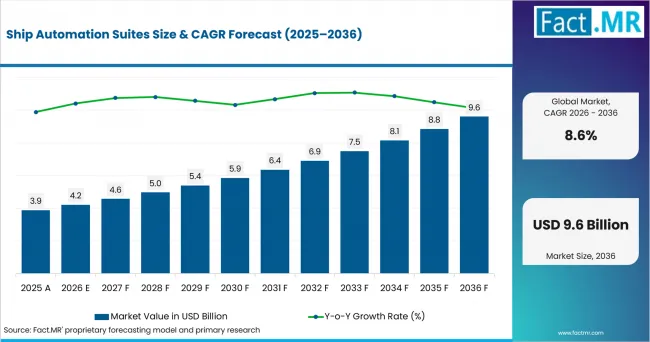
Ship Automation Suites Value Analysis | Source: Fact.MR
What are the defining numbers behind Ship Automation Suites Market growth?
The market is expected to create an absolute opportunity of USD 5.4 billion between 2026 and 2036.
- Demand Drivers in the Market
- Autonomous and remote-operation rules are moving from trial guidance toward defined safety requirements. The International Maritime Organization adopted the non-mandatory MASS Code in May 2026, effective from 1 July 2026, covering areas such as navigation, connectivity, remote operations and cybersecurity. This gives shipyards and operators a clearer basis for specifying integrated control, monitoring and shore-connectivity functions on vessels that use remote or autonomous capabilities.
- Maritime digitalization is also increasing the amount of operational data that must move between onboard systems and shore teams. IMO approved a maritime digitalization strategy in March 2026 focused on interoperability, standardization, data sharing and governance. That direction supports demand for integrated suites that can consolidate data across bridge, machinery and fleet systems, while the adjacent connected ship category expands the communications layer needed for remote diagnostics and fleet oversight.
- Energy-efficiency compliance creates another procurement trigger. IMO requirements for EEXI and CII put technical and operational efficiency under continuing review, and the 2023 IMO GHG Strategy calls for lower carbon intensity and greater use of zero or near-zero GHG energy sources. Shipowners therefore need automation that can coordinate power generation, propulsion demand, energy storage, fuel systems and voyage decisions instead of monitoring each subsystem in isolation.
- Cyber assurance is becoming part of system architecture. IACS Unified Requirements E26 and E27 apply to new ships contracted for construction on and after 1 July 2024 and address cyber resilience at both ship and onboard-system level. This shifts buyer preference toward automation platforms with documented segmentation, secure interfaces, controlled access and recoverability rather than loosely connected subsystem networks.
- Key Segments Analyzed
- Suite Layer: Integrated bridge systems account for 28.0% in 2026 because navigation, conning, alerting and vessel-control functions benefit from a common operational interface and verified system integration.
- Vessel Type: Merchant cargo accounts for 34.0% in 2026, supported by international-voyage requirements, recurring port calls and fleet pressure to coordinate navigation, machinery performance and compliance data.
- Automation Level: Centralized monitoring accounts for 30.0% in 2026 as operators seek one supervisory view across machinery, alarms, power and safety functions while retaining human decision authority.
- Deployment: Newbuild accounts for 57.0% in 2026 because automation networks, sensors, control cabinets, bridge layouts and cybersecurity zones can be engineered into the vessel from the design stage.
- Analyst Opinion at Fact.MR
- “The commercial value of ship automation is moving toward system coordination. Shipowners are managing more propulsion choices, more digital reporting and more shore-side oversight, while safety and cyber requirements constrain how those functions can be connected. Suppliers that can integrate bridge, machinery, energy and remote-support functions into an auditable vessel architecture are better aligned with how new ships are now being specified,” says Shambhu Nath Jha, Principal Consultant, Fact.MR.
- Strategic Implications
- Shipyards should treat automation architecture as an early design decision because network topology, redundancy, cyber zones and human-machine interfaces affect equipment selection across the vessel. Early coordination reduces the risk of late-stage interface changes between navigation, machinery and power systems during commissioning.
- Automation suppliers should design around interoperability and lifecycle upgrades. Buyers increasingly need a platform that can accept new sensors, software and energy-control functions without replacing the complete control environment. This is especially relevant as electric ships and alternative-fuel vessels add batteries, converters, fuel-handling controls and new safety logic to onboard systems.
- Fleet operators should separate high-value retrofit targets from vessels where integration cost is difficult to recover. Vessels with fragmented legacy controls may require interface engineering, network segmentation and additional class approval before centralized monitoring or remote-operation functions can be added. That makes asset age, remaining service life and planned dry-dock timing central to the investment decision.
How does the Ship Automation Suites Market break down by segment?
The market is segmented by Suite Layer, Vessel Type, Automation Level and Deployment.
Why do Integrated bridge systems lead Suite Layer?
Integrated bridge systems account for 28.0% of Suite Layer in 2026.
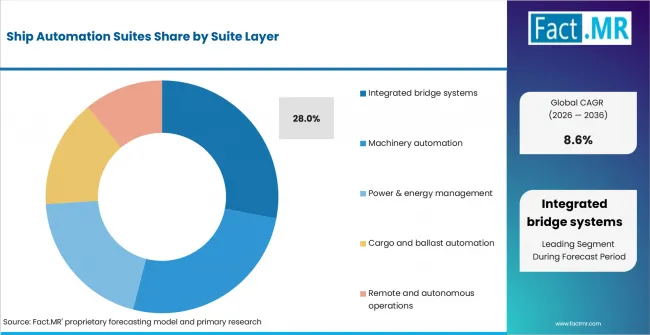
Ship Automation Suites Analysis By Suite Layer | Source: Fact.MR
Their position reflects the concentration of navigation, route planning, radar, electronic charting, conning, alarms and manoeuvring information at the bridge, where operators need coordinated information and consistent controls.
IEC 61924-2:2021 specifies minimum requirements for the design, integration and testing of integrated navigation systems. That standards framework makes integration a procurement requirement rather than a cosmetic interface choice. Vessel builders and owners therefore buy bridge systems as coordinated configurations with defined interfaces, redundancy and performance verification.
The bridge also acts as a natural integration point for vessel identity, positioning and traffic data. This connects suite demand with automatic identification systems, which feed vessel and traffic information into the wider navigation environment. The result is continued demand for bridge suites that reduce display fragmentation while preserving approved subsystem functions.
Why does Merchant cargo lead Vessel Type?
Merchant cargo accounts for 34.0% of Vessel Type in 2026.
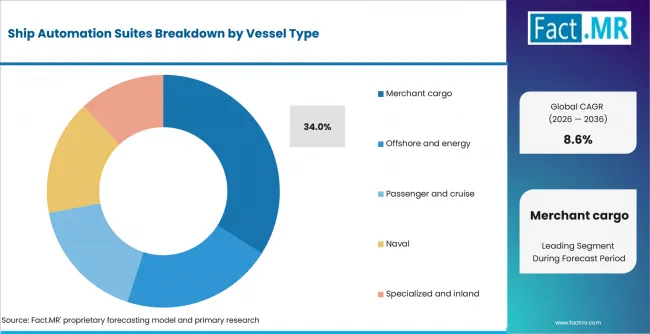
Ship Automation Suites Analysis By Vessel Type | Source: Fact.MR
Cargo vessels operate across international routes, interact repeatedly with port and customs systems and face continuing requirements for navigation safety, machinery availability, fuel efficiency and emissions reporting. Those operational demands create multiple points where automation can reduce manual coordination.
The 2026 IMO MASS Code applies to cargo ships covered by SOLAS Chapter I and introduces requirements around navigation, connectivity, remote operations and risk assessment for applicable autonomous or remotely operated ships. Even where a cargo vessel remains conventionally crewed, the regulatory direction encourages system architectures that can support decision assistance, secure connectivity and structured operational modes.
Merchant fleets also benefit from standardization across sister vessels. Common automation environments can simplify crew familiarization, shore support, spares planning and software maintenance across a fleet, which improves the purchasing case for suite-level solutions over isolated controls.
Why does Centralized monitoring lead Automation Level?
Centralized monitoring accounts for 30.0% of Automation Level in 2026.
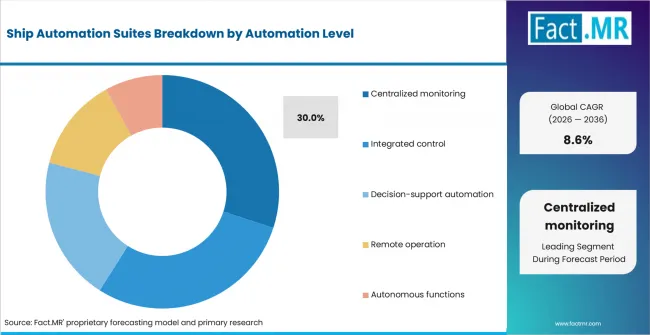
Ship Automation Suites Analysis By Automation Level | Source: Fact.MR
It provides a practical balance between integration and human control by consolidating alarms, machinery status, power data and safety information while leaving operational authority with onboard personnel.
IEC 60092-504:2026 covers automation, control, monitoring, alert, safety and protection systems for essential ship services and includes updated power and energy-management provisions. As the number of monitored signals rises, operators require consistent data quality and alarm handling across the vessel. Demand therefore extends to the marine sensors layer that supplies reliable inputs to the centralized control environment.
Centralized monitoring is also easier to apply across conventional vessels than higher autonomy levels because it does not require every operational decision to be delegated to software or shore personnel. This broadens its addressable vessel base across cargo, passenger, offshore and naval applications.
Why does Newbuild lead Deployment?
Newbuild accounts for 57.0% of Deployment in 2026.
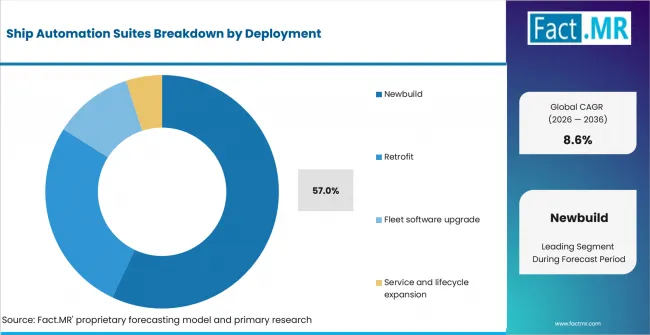
Ship Automation Suites Analysis By Deployment | Source: Fact.MR
A new vessel allows the automation suite to be engineered together with cabling, cabinets, bridge consoles, machinery controls, power management, cybersecurity zones and redundancy requirements before construction and commissioning.
IACS UR E26 and E27 reinforce this design-stage advantage because the requirements apply to new ships contracted for construction on and after 1 July 2024. Compliance requires cyber resilience to be considered across the ship and onboard systems, making planned integration easier than retrofitting a mixed installed base with undocumented interfaces.
Newbuild projects also allow shipyards to align automation with electrification, alternative fuels and remote-operation readiness from the outset. Retrofit demand remains relevant, but it must absorb interface engineering, downtime and certification work that can materially change project economics.
What is accelerating Ship Automation Suites Market adoption, and what is holding it back?
Adoption is being accelerated by three linked changes: formal rules for autonomous and remotely operated ships, stronger digital interoperability requirements and pressure to manage vessel energy use more actively. These changes increase the value of integrated bridge, machinery and power-control environments because vessel functions can no longer be treated as independent islands when data, alarms and operating decisions move across systems.
The main restraint is legacy integration. Existing vessels may combine controls from different generations, proprietary protocols and hardware with limited software support. Adding centralized monitoring or remote functions can therefore require interface gateways, network redesign, class review and additional cybersecurity controls before the operational benefit is realized.
Cybersecurity and crew adaptation add further cost. IMO cyber-risk management requirements and IACS ship-system rules increase the engineering discipline required for connected automation, while crews and shore teams need training to operate new interfaces and escalation procedures. These are necessary safeguards, but they can lengthen procurement and commissioning cycles.
Drivers Impact Analysis
| Factor | (~) % Impact on CAGR | Geographic Relevance | Impact Timeline |
|---|---|---|---|
| MASS and remote-operation regulatory formalization | +1.5% | East Asia, Northern Europe, USA | Near to Mid term (2026-2032) |
| Energy-efficiency and emissions-management requirements | +1.3% | Global merchant fleets | Near to Long term (2026-2036) |
| Cybersecure integrated vessel architectures | +0.9% | Newbuild hubs and regulated fleets | Near to Mid term (2026-2032) |
Opportunity Impact Analysis
| Factor | (~) % Impact on CAGR | Geographic Relevance | Impact Timeline |
|---|---|---|---|
| Newbuild integration of bridge, machinery and power control | +1.1% | South Korea, Japan, Norway | Near to Mid term (2026-2032) |
| Fleet software and shore-control upgrades | +0.8% | USA, UK, Northern Europe | Mid term (2029-2032) |
| Electrification and alternative fuels increase control complexity | +0.7% | Europe and East Asia | Mid to Long term (2029-2036) |
Restraints Impact Analysis
| Factor | (~) % Impact on CAGR | Geographic Relevance | Impact Timeline |
|---|---|---|---|
| Integration with heterogeneous legacy systems | -0.8% | Mature fleets globally | Near to Mid term (2026-2032) |
| Certification and cyber-assurance overhead | -0.6% | Global newbuild and retrofit programs | Near term (2026-2028) |
| Crew training and operational change burden | -0.4% | Global operators | Near to Mid term (2026-2032) |
Which countries are scaling the Ship Automation Suites Market through 2036?
- South Korea: Government-backed autonomous-ship demonstrations are combining intelligent navigation, engine automation, cybersecurity and operational technology on commercial vessels, creating a direct test environment for integrated automation suites.
- Japan: Maritime authorities have developed safety standards, inspection methods and operating frameworks for autonomous ships, supporting structured commercialization of systems that divide tasks between crews and automation.
- Norway: The Norwegian Maritime Authority supports certification pathways for automated and remotely operated vessels and continues work on remote-operation-centre governance, giving suppliers and operators a defined environment for advanced vessel-control projects.
- USA: U.S. Coast Guard guidance issued in June 2026 gives Captains of the Port and marine inspectors a formal process for evaluating unmanned, autonomous and remote-control operations, improving regulatory clarity for deployments and trials.
- UK: Maritime 2050 established a policy direction for smart shipping and maritime autonomy, while the 2025 maritime decarbonisation strategy increases the need for digital energy and voyage management across commercial fleets.
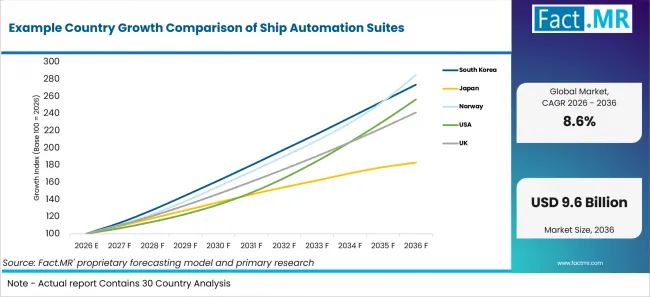
Example Country Growth Comparison Of Ship Automation Suites | Source: Fact.MR
Country CAGR (2026-2036)
| Country | CAGR (2026-2036) |
|---|---|
| South Korea | 10.6% |
| Japan | 6.2% |
| Norway | 11.0% |
| USA | 9.9% |
| UK | 9.2% |
What is driving South Korea's growth through 2036?
South Korea is projected to expand at a 10.6% CAGR through 2036.
Its growth mechanism is closely tied to the domestic shipbuilding base and government-backed validation of autonomous navigation systems on commercial vessels. In September 2024, the Ministry of Oceans and Fisheries and the Ministry of Trade, Industry and Energy launched a public-private demonstration using a 1,800 TEU container ship on the Korea-Southeast Asia route.
The demonstration combines intelligent navigation, engine automation, cybersecurity and operational technology. That system-level test structure supports demand for integrated automation rather than isolated navigation software because the vessel must coordinate bridge decisions with machinery and secure communications under real operating conditions.
South Korea also benefits from the wider digitalization of ports and ship-port data exchange. As vessel systems become more connected to shore operations, integration with smart ports increases the value of standardized onboard data and automation interfaces.
What is driving Japan's growth through 2036?
Japan is projected to expand at a 6.2% CAGR through 2036.
The Ministry of Land, Infrastructure, Transport and Tourism has been working on commercialization frameworks for autonomous ships, including safety standards, inspection methods, division of roles between systems and people and crew training requirements.
This approach favors automation suites that can demonstrate controlled functionality rather than simply adding more software to the bridge. Japanese operators and shipbuilders need clear evidence of how an automated function behaves, how it fails safely and how the crew retains operational authority, which supports demand for integrated monitoring and validated control architectures.
What is driving Norway's growth through 2036?
Norway is projected to expand at an 11.0% CAGR through 2036.
The Norwegian Maritime Authority has maintained guidance for vessels using automated functionality and continues to work on legal and certification issues surrounding remote operations. In March 2026, it published work on jurisdiction for Remote Operation Centres as cross-border autonomous operations move closer to commercial use.
Norway also has operating experience with autonomous and remotely controlled vessel projects. That experience creates demand for control suites that connect navigation, engineering and safety functions with shore-side supervision while preserving traceable responsibility and class approval.
DNV’s AROS class notations reinforce this ecosystem by defining functional requirements across navigation, engineering, operational and safety functions, with different modes of remote control and autonomy. This gives Norwegian projects a technical framework for specifying automation depth function by function.
What is driving USA's growth through 2036?
The USA is projected to expand at a 9.9% CAGR through 2036.
In June 2026, the U.S. Coast Guard published guidance for oversight of unmanned, autonomous and remote-control operations within the Marine Transportation System. The instruction gives Captains of the Port and Officers in Charge, Marine Inspection a common basis for evaluating proposed operations.
For automation suppliers, this matters because commercial testing and deployment depend on a defined approval path. Systems used in U.S. waters must support safe supervision, operational limits and reliable communications, which favors platforms that can document their operating modes and provide clear interfaces between vessel controls and remote personnel.
What is driving UK's growth through 2036?
The UK is projected to expand at a 9.2% CAGR through 2036.
Maritime 2050 set a long-term direction for smart shipping and domestic regulation of maritime autonomy, while government guidance for defence maritime autonomous systems has formalized assurance processes for public-sector applications.
The UK’s 2025 maritime decarbonisation strategy adds a second demand channel. Future fuels, electrification and tighter emissions targets increase the number of parameters that crews and shore teams must monitor across propulsion, energy and voyage operations. Automation suites can turn these inputs into a coordinated operating picture and support continuous performance management.
Who Leads the Ship Automation Suites Market?
Key players in the Ship Automation Suites Market include Kongsberg Maritime, Wärtsilä, ABB Marine & Ports, Siemens, Emerson and Honeywell. Competition is shaped by the ability to integrate bridge and machinery functions, support multiple vessel types, meet class and cyber requirements and provide lifecycle service across geographically dispersed fleets.
Kongsberg Maritime became a stand-alone listed company in April 2026 and continues to offer bridge, remote, automation, energy-control and digital vessel systems. ABB completed its acquisition of Høglund on 1 September 2026, adding an integrated automation platform installed on more than 600 ships to ABB Marine & Ports. These moves show that suppliers are concentrating on broader system integration and global service capability rather than single subsystem sales.
Siemens Energy markets SISHIP automation and monitoring systems for commercial and naval vessels. Emerson offers integrated control and monitoring across cargo, ballast, fuel and propulsion functions, while Honeywell supplies marine automation and tank-gauging integration. Wärtsilä divested its Automation, Navigation and Control Systems business in 2025, but it continues to market marine navigation, fleet optimisation and propulsion-control products, so its current role is more focused than the former ANCS portfolio.
Which companies are the key providers?
Key providers include Kongsberg Maritime, Wärtsilä, ABB Marine & Ports, Siemens, Emerson and Honeywell.
- Kongsberg Maritime
- Wärtsilä
- ABB Marine & Ports
- Siemens
- Emerson
- Honeywell
Bibliography
- International Maritime Organization. (2026, May 22). IMO adopts first global Code for autonomous ships. International Maritime Organization.
- International Maritime Organization. (2026, March 31). Facilitation Committee approves digitalization strategy and cyber security measures. International Maritime Organization.
- International Maritime Organization. (2023). 2023 IMO Strategy on Reduction of GHG Emissions from Ships. International Maritime Organization.
- International Maritime Organization. (2023). EEXI and CII - ship carbon intensity and rating system. International Maritime Organization.
- International Association of Classification Societies. (2023). Addressing cyber resilience of ships: UR E26 and UR E27. IACS.
- International Electrotechnical Commission. (2026). IEC 60092-504:2026, Electrical installations in ships - Part 504: Automation, control and instrumentation. IEC.
- International Electrotechnical Commission. (2021). IEC 61924-2:2021, Maritime navigation and radiocommunication equipment and systems - Integrated navigation systems - Part 2. IEC.
- DNV. (2026). AROS Class Notations: Autonomous and remotely-operated ships. DNV.
- Ministry of Oceans and Fisheries, Republic of Korea. (2024, September 30). Public-Private Joint Demonstration of Korean Model for Autonomous Ship. Government of the Republic of Korea.
- Ministry of Land, Infrastructure, Transport and Tourism, Japan. (2025). Autonomous Ship Committee and safety-standard development. Government of Japan.
- Norwegian Maritime Authority. (2026, March 30). Study on jurisdiction for Remote Operation Centres. Norwegian Maritime Authority.
- Norwegian Maritime Authority. (2025, May 16). Invitation to a professional event in London: autonomous ships and MASS regulation. Norwegian Maritime Authority.
- United States Coast Guard. (2026, June 5). Guidance on Oversight of Unmanned, Autonomous and Remote-Control Operations. U.S. Coast Guard.
- UK Department for Transport. (2019). Maritime 2050: Navigating the Future. Government of the United Kingdom.
- UK Department for Transport. (2025, March 25). Course charted for carbon free shipping by 2050. Government of the United Kingdom.
- ABB. (2026, September 2). ABB completes acquisition of Høglund to expand marine automation offering. ABB.
- Kongsberg Maritime. (2026). Products: bridge systems, vessel automation, electrical power systems and digital solutions. Kongsberg Maritime ASA.
- Siemens Energy. (2026). Automation and Control: solutions for vessel operation. Siemens Energy.
- Emerson. (2026). Integrated Control and Monitoring Systems. Emerson.
- Honeywell. (2026). Marine Automation Systems. Honeywell.
- Wärtsilä. (2026). Products and solutions for marine applications. Wärtsilä.
This Report Answers
- How are shipowners prioritizing bridge, machinery and energy-system integration?
- Which vessel types generate the clearest demand for suite-level automation?
- How do centralized monitoring and higher autonomy levels change system requirements?
- Why do newbuild programs offer different automation economics from retrofits?
- How are cyber-resilience rules changing procurement and system architecture?
- Which country-level regulatory and demonstration programs are shaping adoption through 2036?
What does the Ship Automation Suites Market cover?
The market covers commercial shipboard automation suites that integrate two or more vessel-control or monitoring functions into a coordinated operating environment. Revenue includes integrated bridge systems, machinery automation, power and energy management, cargo and ballast automation and remote or autonomous-operation layers supplied as part of vessel automation projects.
The market includes software, control hardware and system-integration elements when they are sold as part of the automation suite. It covers installations across merchant cargo, offshore and energy vessels, passenger and cruise ships, naval vessels and specialized or inland vessels, with deployments spanning newbuilds, retrofits, fleet software upgrades and service-led lifecycle expansion.
What is included in the scope?
Included offerings are integrated bridge systems, machinery automation, power and energy management, cargo and ballast automation and remote or autonomous-operation suites. The analysis covers centralized monitoring, integrated control, decision-support automation, remote operation and autonomous functions across the vessel types and deployment models defined in the segmentation.
What is excluded from the scope?
Standalone marine engines, propulsion equipment sold without an automation suite, individual sensors or gauges sold without control-system integration, port-only automation platforms, shipyard production software and shore logistics systems are excluded. Satellite connectivity sold as a communications service is also excluded unless it is embedded within the commercial automation-suite offering.
How Was the Analysis Built?
- Primary Research:Primary interviews focus on shipyard automation engineers, fleet technical managers, vessel operators, marine electrical integrators, bridge-system specialists, classification and compliance professionals, equipment suppliers and service teams responsible for newbuild commissioning or retrofit programs.
- Desk Research:Desk research uses IMO regulations and committee decisions, IACS unified requirements, IEC maritime standards, national maritime-authority guidance, classification-society rules, government autonomous-shipping programs and current first-party company disclosures.
- Market Sizing and Forecasting:Market sizing evaluates vessel newbuild activity, installed fleet upgrade potential, automation content per vessel, suite complexity by vessel type, newbuild versus retrofit mix, replacement and lifecycle upgrade cycles, software expansion and supplier revenue exposure to bridge, machinery, power and remote-operation systems.
- Data Validation and Update Cycle:Forecasts are reviewed against changes in shipbuilding activity, maritime safety and cyber rules, autonomous-vessel approval pathways, power and energy-management requirements, supplier portfolio changes and evidence from commercial vessel demonstrations.
What is the report's scope and coverage?
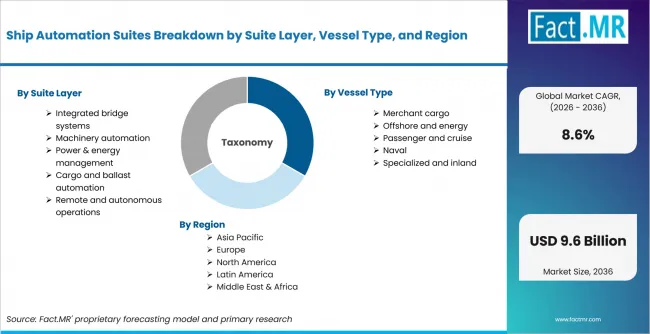
Ship Automation Suites Breakdown By Suite Layer, Vessel Type, And Region | Source: Fact.MR
| Parameter | Details |
|---|---|
| Quantitative Units | USD billion, market value and CAGR |
| Market Definition | Integrated shipboard automation suites coordinating bridge, machinery, energy, cargo, monitoring and remote-operation functions |
| Segments Covered | Suite Layer; Vessel Type; Automation Level; Deployment |
| Regions Covered | Global |
| Countries Covered | South Korea; Japan; Norway; USA; UK |
| Key Companies | Kongsberg Maritime; Wärtsilä; ABB Marine & Ports; Siemens; Emerson; Honeywell |
| Forecast Period | 2026 to 2036 |
| Base Year | 2026 |
| Market Value, 2026 | USD 4.2 billion |
| Market Value, 2036 | USD 9.6 billion |
| CAGR, 2026-2036 | 8.6% |
| Absolute Opportunity | USD 5.4 billion |
| Approach | Hybrid vessel-fleet, newbuild, retrofit, system-content and supplier-revenue assessment |
How is the market segmented?
-
By Suite Layer
- Integrated bridge systems
- Machinery automation
- Power & energy management
- Cargo and ballast automation
- Remote and autonomous operations
-
By Vessel Type
- Merchant cargo
- Offshore and energy
- Passenger and cruise
- Naval
- Specialized and inland
-
By Automation Level
- Centralized monitoring
- Integrated control
- Decision-support automation
- Remote operation
- Autonomous functions
-
By Deployment
- Newbuild
- Retrofit
- Fleet software upgrade
- Service and lifecycle expansion