- Base Value(2025): 320.0 Mn
- Estimated Value(2026): 343.0 Mn
- Forecast Value (2036): 687.5 Mn
- CAGR (2026 - 2036): 7.2%
Automatic Identification System Market Forecast and Outlook By Fact. MR
In 2025, the automatic identification system market (AIS) was valued at USD 320.0 million. Based on Fact.MR analysis, demand for automatic identification systems is estimated to grow to USD 343.0 million in 2026 and USD 687.5 million by 2036. FACT.MR projects a CAGR of 7.2% during the forecast period.
The market is expected to generate USD 367.5 million in incremental revenue during the forecast period. Growth is underpinned by regulatory compliance, port modernisation investments, and the expansion of satellite-based AIS data services. Structural constraints include cybersecurity vulnerabilities in AIS transponder networks, signal congestion in high-density maritime corridors, and high integration costs for legacy port infrastructure.
Country demand reflects maritime digitalisation, vessel tracking compliance, regulatory monitoring, and fleet analytics investment. South Korea leads with 9.0% CAGR, supported by advanced port digitalisation and smart shipping initiatives. The European Union grows at 8.9%, driven by maritime monitoring and emissions regulation enforcement. The United Kingdom records 8.6% with strong coastal surveillance upgrades. The United States posts 7.0%, supported by fleet monitoring and maritime security systems. Japan reaches 6.0%, reflecting mature maritime infrastructure and steady vessel tracking adoption.
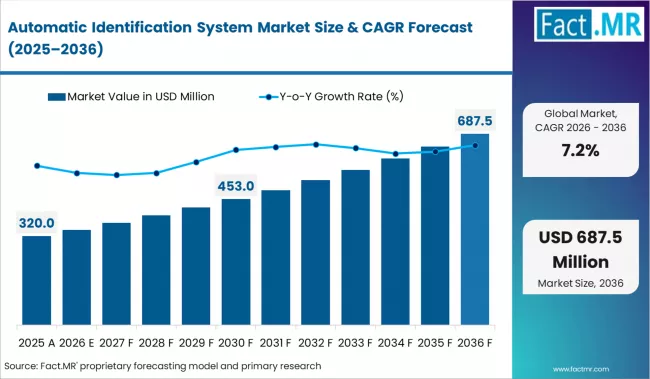
Automatic Identification System Market Market Value Analysis | Source: Fact.MR
| Metric | Value |
|---|---|
| Estimated Value in 2026 | USD 343.0 million |
| Forecast Value in 2036 | USD 687.5 million |
| Forecast CAGR (2026 to 2036) | 7.2% |
Automatic Identification System Market Definition
Automatic identification systems are maritime transponders operating on VHF bands to transmit vessel identity, position, speed, and course data. They enable ship-to-ship and ship-to-shore communication for navigation and monitoring. AIS supports collision avoidance, vessel traffic management, maritime security, and regulatory tracking for commercial shipping, naval fleets, and port authorities.
Market Inclusions
Global and regional forecasts from 2026–2036. Coverage includes Class A and Class B transponders, shore AIS base stations, and satellite AIS data services. Applications include fleet management, vessel tracking, maritime security, and port monitoring across North America, Europe, Asia Pacific, Latin America, and MEA.
Market Exclusions
Radar and ECDIS systems unless bundled with AIS navigation solutions. Standalone LRIT systems and AIS-independent VHF communication equipment. Naval electronic warfare systems unrelated to commercial vessel tracking.
Research Methodology
- Primary Research
- Interviews with port authority buyers, maritime technology vendors, satellite AIS operators, shipping fleet managers, and coast guard system integrators.
- Coverage across Europe, Asia Pacific, and North America.
- Desk Research
- Sources include International Maritime Organization SOLAS data, European Maritime Safety Agency AIS contracts, EU ETS maritime policy documents, United States Coast Guard deployment records, and Japan Coast Guard procurement data.
- Company filings from 2024–2025 were also reviewed.
- Market Sizing and Forecasting
- Hybrid top-down and bottom-up modelling approach.
- Based on transponder shipments, satellite AIS data revenues, port infrastructure investment, and application-level spending.
- Data Validation and Update Cycle
- Forecasts validated using manufacturer disclosures, regulatory procurement data, satellite operator filings, and industry expert interviews.
Summary of Automatic Identification System Market
- Market Definition
- Automatic identification systems are real-time vessel tracking transponders used in commercial shipping, naval operations, and port monitoring for navigation safety and compliance.
- Demand Drivers
- International Maritime Organization SOLAS mandates require AIS on vessels above 300 gross tonnage, creating consistent equipment demand.
- EU ETS maritime expansion requires AIS-verified voyage data for emissions compliance.
- Smart port initiatives in South Korea and Japan are increasing deployment of AIS base stations and AI-enabled vessel monitoring systems.
- Key Segments Analyzed
- By Category: Vessel-based AIS holds about 60% share in 2026 due to SOLAS carriage requirements and growing Class B adoption.
- By Application: Vessel tracking leads with around 37% share due to compliance monitoring and satellite AIS subscriptions.
- By Region: Europe leads due to EMSA satellite AIS contracts, EU ETS rules, and smart port investments.
- Analyst Opinion at FACT.MR
- Shambhu Nath Jha notes that future growth is shifting from hardware to satellite AIS analytics, AI vessel behaviour monitoring, and emissions-tracking data services.
- Strategic Implications
- AIS hardware vendors should expand into satellite analytics and AI vessel intelligence platforms.
- Companies should develop EU ETS and IMO decarbonisation-compatible AIS data services.
- Manufacturers should invest in VDES (AIS 2.0) technologies for next-generation maritime communication.
- Methodology
- Market sizing uses transponder shipment data, satellite AIS subscription revenues, and port infrastructure investment analysis.
- Regulatory sources include IMO, EMSA, USCG, EU ETS, and Japan Coast Guard datasets.
- Forecasts validated through manufacturer revenue disclosures, AIS service contracts, and industry interviews.
Segmental Analysis
Automatic Identification System Market Analysis by Category
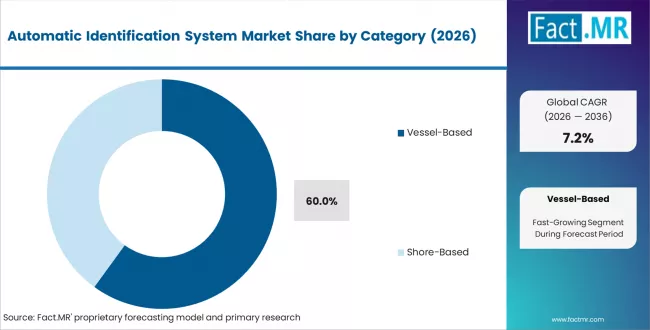
Automatic Identification System Market Analysis By Category | Source: Fact.MR
Based on FACT.MR analysis, vessel-based AIS systems hold about 60% market share in 2026. SOLAS carriage mandates, expansion of Class B installations, and new ship deliveries from Asian shipyards support vessel-based dominance over shore infrastructure systems.
- Kongsberg Port of London VTS Delivery: In December 2025, Kongsberg Gruppen deployed a Vessel Traffic Service system for the Port of London Authority. The platform integrates AIS, radar, CCTV, and sensors to monitor vessel traffic along the Thames. [4]
- EMSA Satellite AIS Contract: In February 2024, Spire Global secured two satellite AIS framework contracts from the European Maritime Safety Agency with a combined value of about USD 9 million for EU ship monitoring services. [5]
- Kpler Satellite AIS Consolidation: In April 2025, Kpler completed the USD 241 million acquisition of Spire Maritime’s AIS data unit. The deal integrated satellite tracking with Kpler’s network of over 13,000 terrestrial AIS receivers. [3]
Automatic Identification System Market Analysis by Application
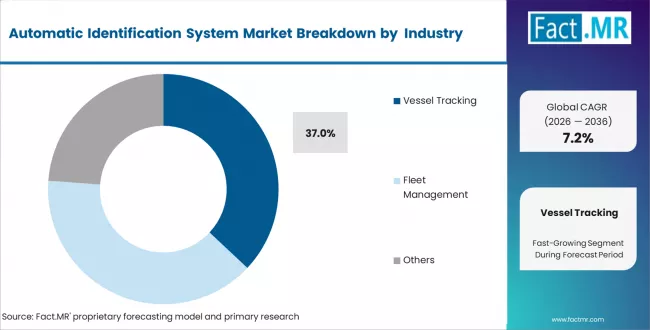
Automatic Identification System Market Analysis By Application | Source: Fact.MR
FACT.MR estimates vessel tracking applications will hold around 37% share in 2026. These systems support SOLAS compliance, port call optimisation, and subscription-based satellite AIS data services.
- EU ETS AIS Compliance Demand: The EU ETS maritime expansion in January 2024 requires AIS-verified voyage data for emissions reporting by vessels above 5,000 GT calling at EU ports. By January 2025, about 89% of EU-owned vessels had registered Maritime Operator Holding Accounts for compliance reporting. [2]
- Japan Shield AI V-BAT AIS Integration: In January 2025, Japan selected Shield AI V-BAT unmanned aircraft as its first AIS-integrated maritime ISR platform. The procurement includes six systems valued at USD 25.4 million. [6]
- Maritime Security Adoption Growth: Proposed updates to the EU Port State Control Directive supported by European Maritime Safety Agency expand AIS use for risk-based vessel inspection and environmental compliance monitoring. [7]
Drivers, Restraints, and Opportunities
FACT.MR analysts note the AIS market is shifting from hardware-led demand to data-driven maritime intelligence platforms. Regulatory mandates maintain baseline transponder demand, while growth is increasingly driven by satellite AIS services, AI-based vessel analytics, and emissions-compliance integrations. The global fleet installed base created under SOLAS Convention requirements is now being upgraded with satellite connectivity and AI-enabled monitoring capabilities.
Transponder shipment volumes remain stable due to fleet replacement cycles and new vessel deliveries. However, revenue expansion is concentrated in satellite AIS data subscriptions, vessel behaviour analytics, and vessel traffic service (VTS) system upgrades. The EU ETS maritime expansion has increased demand for AIS-based voyage verification for emissions compliance across European trading routes.
- IMO SOLAS Compliance Mandate: International Maritime Organization Resolution MSC.74(69) requires Class A AIS on vessels above 300 gross tonnage on international voyages. This rule sustains structural hardware demand. Fleet renewals, new shipbuilding in Asia, and Class B adoption in fishing vessels support steady volume growth. [1]
- EU ETS Maritime Emissions Compliance: The European Union Emissions Trading System expanded to maritime shipping in January 2024. Vessels above 5,000 GT calling at EU ports must submit emissions reports supported by AIS voyage data. This requirement increases demand for high-accuracy satellite and terrestrial AIS tracking services. [2]
- Satellite AIS and AI Analytics Growth: Satellite AIS has become a core global tracking layer. In April 2025, Kpler acquired Spire Maritime AIS assets for about USD 241 million. AI-based analytics for dark ship detection, spoofing monitoring, and predictive routing are expanding service revenue beyond hardware sales. [3]
Regional Analysis
The AIS market is analysed across North America, Europe, Asia Pacific, Latin America, and Middle East and Africa, covering 40+ country-level demand profiles shaped by IMO regulatory mandates, satellite AIS adoption rates, smart port investment programmes, and naval maritime security requirements. The full report offers market attractiveness analysis based on regulatory compliance deployment timelines, port modernisation investment pipelines, and fleet renewal data.
.webp "Top Country Growth Comparison Automatic Identification System Market Cagr (2026 2036)")
Top Country Growth Comparison Automatic Identification System Market Cagr (2026 2036) | Source: Fact.MR
| Country | CAGR (2026 to 2036) |
|---|---|
| South Korea | 9.0% |
| European Union | 8.9% |
| UK | 8.6% |
| USA | 7.0% |
| Japan | 6.0% |
Source: Fact.MR (FACT.MR) analysis, based on proprietary forecasting model and primary research Europe AIS Market Analysis
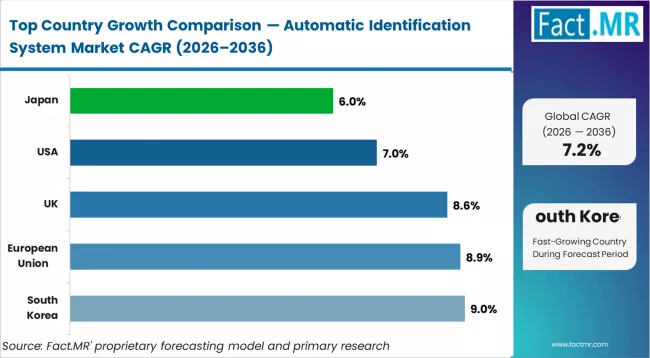
Automatic Identification System Market Cagr Analysis By Country | Source: Fact.MR
Europe represents the regulatory centre for AIS adoption, supported by emissions compliance rules, satellite monitoring programmes, and port traffic management upgrades. European Maritime Safety Agency satellite AIS contracts and EU smart port investments continue to expand regional demand. Companies such as Kongsberg Gruppen and Saab AB lead VTS infrastructure development, while Kpler dominates satellite AIS analytics after acquiring Spire Maritime assets.
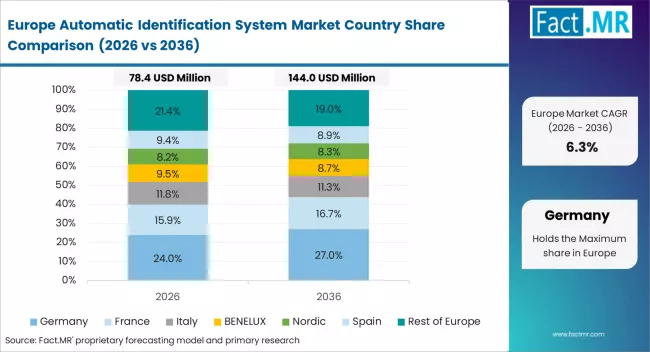
Automatic Identification System Market Europe Country Market Share Analysis 2026 & 2036 | Source: Fact.MR
- European Union: Regulatory-driven monitoring systems across the EU are projected to grow at 8.9% CAGR through 2036. The European Union Emissions Trading System expansion from January 2024 requires AIS-verified voyage data for vessels above 5,000 GT visiting EU ports. The Vessel Monitoring Directive amendment in April 2025 extended AIS reporting obligations to vessels transiting EU waters. Implementing Regulation 2025/1533 updated AIS equipment certification standards.
- United Kingdom: Maritime traffic monitoring systems in the UK are forecast to expand at 8.6% CAGR through 2036. In December 2025, Kongsberg Gruppen deployed a Vessel Traffic Service platform for the Port of London Authority integrating AIS, radar, and sensor networks along the Thames. The Maritime and Coastguard Agency expanded AIS reporting rules for vessels operating in UK waters. Smart port upgrades at Felixstowe, Tilbury, and Southampton integrate AIS-based analytics to optimise vessel traffic and berth allocation.
FACT.MR analysis for Europe includes Germany, France, the United Kingdom, Spain, Italy, Nordic countries, BENELUX, Eastern Europe, and Russia. The report provides EU ETS compliance analysis, EMSA AIS service contracts, and VTS infrastructure investment benchmarks. Asia Pacific AIS Market Analysis Asia Pacific is the fastest-growing AIS region, supported by strong shipbuilding activity, smart port development, and maritime security investment. Major suppliers such as Furuno Electric and Japan Radio Company dominate transponder production, while South Korean shipyards integrate AIS into new vessels delivered globally.
- South Korea: Shipbuilding-driven AIS deployment in South Korea is projected at 9.0% CAGR through 2036. Leading shipbuilders Samsung Heavy Industries and Hyundai Heavy Industries install Class A AIS units on most new vessels. The government’s maritime digital transformation initiative launched in 2024 integrates AIS analytics into national vessel traffic services. Smart port programmes in Busan and Incheon also deploy AI-enhanced AIS monitoring systems for autonomous vessel testing.
- Japan: Technology-driven maritime monitoring expansion in Japan is expected to grow at 6.0% CAGR through 2036. Domestic suppliers such as Furuno Electric and Japan Radio Company export AIS transponders globally. In January 2025, Japan deployed AIS-integrated V-BAT unmanned aircraft system for maritime surveillance on patrol vessels. The Japan Coast Guard continues expanding AIS base stations along remote coastal and island routes.
FACT.MR analysis for Asia Pacific includes Japan, South Korea, China, India, ASEAN, Australia and New Zealand, and Rest of Asia Pacific. The report provides smart port investment data, shipbuilding integration trends, and maritime security procurement benchmarks. North America AIS Market Analysis North America represents the largest AIS revenue market, supported by maritime surveillance infrastructure and coastal monitoring networks. The United States Coast Guard operates a nationwide AIS base station system, while technology companies supply vessel-based equipment and satellite data services. ORBCOMM and Garmin lead AIS equipment supply, and L3Harris Technologies provides AIS-integrated naval systems.
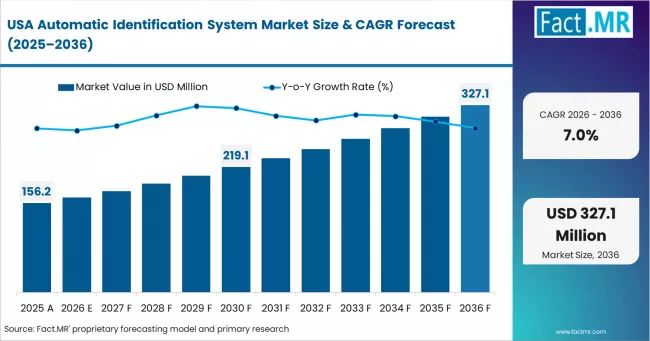
Automatic Identification System Market Country Value Analysis | Source: Fact.MR
- USA: National maritime monitoring infrastructure in the United States is projected to expand at 7.0% CAGR through 2036. The US Coast Guard maintains AIS coverage across ports, coastal waters, and inland waterways while using satellite AIS for offshore surveillance. ORBCOMM holds long-term contracts supporting AIS-based navigation safety monitoring. The U.S. National Defense Authorization Act 2025 increased maritime domain awareness funding integrating AIS with radar and satellite systems. West Coast port authorities are also deploying AIS-based emissions monitoring under EPA Clean Air Action Plan initiatives.
FACT.MR analysis for North America includes the United States, Canada, and Mexico. The report provides USCG AIS procurement data, maritime security investment benchmarks, port authority adoption trends, and regional forecasts by category and application.
Competitive Aligners for Market Players
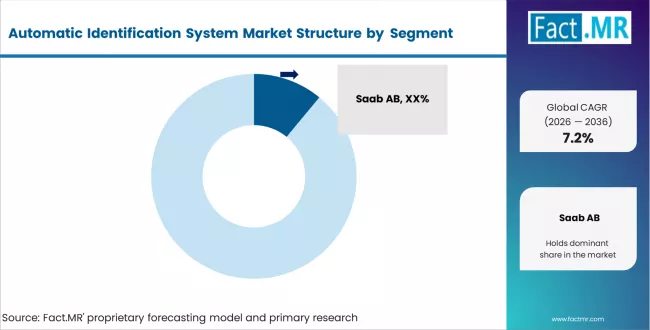
Automatic Identification System Market Analysis By Company | Source: Fact.MR
The AIS market is moderately concentrated, with companies like Saab AB, Furuno Electric, Kongsberg Gruppen, ORBCOMM, and Garmin leading hardware and infrastructure segments. No single firm dominates globally because revenue is split across transponders, shore infrastructure, and satellite data services.
Hardware competition depends on regulatory certification, navigation system integration, and regional compliance standards. Saab AB is strong in AIS-integrated vessel traffic systems, while Furuno Electric and Japan Radio Company supply transponders widely to Asian shipbuilders. Kongsberg Norcontrol leads VTS and AIS infrastructure integration across Europe and the Middle East.
Large port authorities and coast guards hold strong negotiating power since AIS infrastructure is typically purchased through long-term government tenders. Satellite AIS customers such as commodity traders, maritime insurers, and defence agencies often rely on multiple providers to combine satellite and terrestrial tracking data. This multi-provider sourcing strategy limits pricing power for individual AIS data service providers while maintaining competition across the market.
Key Players
- Saab AB
- Orbcomm Inc.
- exactEarth Ltd.
- Furuno Electric Co., Ltd.
- Garmin Ltd.
- L3Harris Technologies, Inc.
- Spire Global, Inc.
- Kongsberg Gruppen ASA
- Japan Radio Company Ltd. (JRC)
- Weatherdock AG
Bibliography
- [1] International Maritime Organization. (2024). SOLAS Chapter V: Safety of Navigation – AIS Carriage Requirements for Ships on International Voyages Above 300 Gross Tonnage and Updated MSC Circular Guidance on AIS Data Quality Management. July 2024. imo.org
- [2] European Commission, Directorate-General for Mobility and Transport. (2025). Delegated Directive Amending Annex I of Directive 2002/59/EC Vessel Monitoring System: Mandatory Ship Reporting System Extension to Vessels Transiting EU Waters. April 2025. transport.ec.europa.eu
- [3] Spire Global, Inc. / Kpler Holding SA. (2025). SEC Filing Exhibit 99.2: Completion of Maritime Business Divestiture to Kpler for USD 233.5 Million Purchase Price – Pro Forma Financial Statements. April 2025. sec.gov
- [4] Kongsberg Norcontrol. (2025). Press Release: Delivery of Vessel Traffic Service System to Port of London Authority on Foresight Platform Integrating AIS, Radar and CCTV Data Across 95 Miles of Tidal Thames. December 2025. kongsberg.com
- [5] Spire Global, Inc. (2024). Press Release: Award of Two EMSA Framework Contracts for Satellite-Based AIS Ship Tracking Data Services with Maximum Combined Budget of USD 9 Million for Four-Year Period. February 2024. spire.com
- [6] Japan Ministry of Defense / Shield AI. (2025). Procurement Announcement: Selection of V-BAT Unmanned Aircraft System as Japan's First Maritime ISR Platform with AIS Integration for Japan Maritime Self-Defense Force Patrol Vessels. January 2025. mod.go.jp
- [7] European Maritime Safety Agency. (2024). EMSA Annual Report 2024: AIS Data Services Programme Update, Satellite AIS Coverage Metrics, and EU Port State Control AIS Risk Profiling Integration. December 2024. emsa.europa.eu
- [8] DNV / European Commission. (2025). EU Implementing Regulation 2025/1533 Amending the Marine Equipment Directive: Updated Type-Approval Requirements for Universal Automatic Identification System Equipment (MED/4.32). September 2025. dnv.com / eur-lex.europa.eu
This Report Addresses
- Strategic intelligence on IMO SOLAS carriage mandates, EU ETS maritime emissions compliance requirements, EMSA satellite AIS contracts, and national maritime surveillance programme impacts on AIS demand and pricing.
- Market forecast from USD 343.0 million in 2026 to USD 687.5 million by 2036 at 7.2% CAGR, covering vessel-based, shore-based, fleet management, vessel tracking, maritime security, and regional segments.
- Growth opportunity mapping across EU ETS compliance data services, South Korean and Japanese smart port VTS deployments, USCG satellite AIS contracting, and naval maritime domain awareness programme investments.
- Country CAGR outlook including South Korea 9.0%, EU 8.9%, UK 8.6%, USA 7.0%, and Japan 6.0%, supported by regulatory compliance pipelines and smart port investment data.
- Competitive analysis of Saab AB, Kongsberg Gruppen, ORBCOMM, Furuno Electric, Kpler/exactEarth, and Garmin based on SOLAS type-approval credentials, satellite AIS capabilities, and VTS contract portfolios.
- Technology tracking covering VDES (AIS 2.0) development, satellite AIS data consolidation, AI vessel behaviour analytics, EU ETS compliance data integration, and Class B expansion in fishing and offshore sectors.
- Regulatory analysis of IMO SOLAS AIS mandates, EU MED type-approval requirements, EU ETS maritime expansion, EMSA service contracts, USCG AIS network standards, and Japan Coast Guard navigation requirements.
- Report delivery includes PDF, Excel datasets, PowerPoint summary, and dashboard tools supported by regulatory procurement databases, satellite AIS service contract data, and primary industry interviews.
Scope of Report
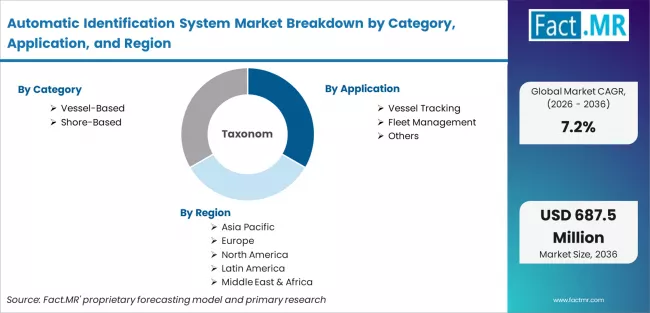
Automatic Identification System Market Breakdown By Category Application And Region | Source: Fact.MR
| Attribute | Details |
|---|---|
| Quantitative Units | USD 343.0 million (2026) to USD 687.5 million (2036), at a CAGR of 7.2% |
| Market Definition | Real-time vessel tracking transponder systems operating on VHF maritime bands for collision avoidance, traffic management, maritime security, and regulatory compliance. |
| Category Segmentation | Vessel-Based, Shore-Based |
| Application Segmentation | Fleet Management, Vessel Tracking, Maritime Security, Others |
| Application Coverage | SOLAS-compliance vessel transponders, port VTS systems, satellite AIS data services, naval maritime domain awareness, emissions-compliance tracking. |
| Regions Covered | North America, Europe, Asia Pacific, Latin America, Middle East and Africa |
| Countries Covered | USA, Canada, Mexico, Germany, UK, France, Italy, Spain, Nordic, BENELUX, Rest of Western Europe, Russia, Poland, Japan, China, South Korea, India, ASEAN, Australia and New Zealand, Brazil, Rest of Latin America, GCC, South Africa, Rest of MEA |
| Key Companies Profiled | Saab AB, Orbcomm, exactEarth, Furuno Electric, Garmin, L3Harris Technologies, Kongsberg Gruppen, Japan Radio Company, Weatherdock AG |
| Forecast Period | 2026 to 2036 |
| Approach | Hybrid top-down and bottom-up model using transponder shipment volumes, satellite AIS service revenues, port infrastructure investment data, and primary interviews. |
Automatic Identification System Market by Segments
-
By Category:
- Vessel-Based
- Shore-Based
-
By Application:
- Fleet Management
- Vessel Tracking
- Maritime Security
- Others
-
By Region:
- North America
- United States
- Canada
- Mexico
- Latin America
- Brazil
- Rest of Latin America
- Western Europe
- Germany
- United Kingdom
- France
- Italy
- Spain
- Nordic
- BENELUX
- Rest of Western Europe
- Eastern Europe
- Russia
- Poland
- Rest of Eastern Europe
- East Asia
- China
- Japan
- South Korea
- South Asia and Pacific
- India
- ASEAN
- Australia and New Zealand
- Rest of South Asia and Pacific
- Middle East and Africa
- GCC Countries
- South Africa
- Rest of Middle East and Africa
- North America