- Estimated Value(2026): 246.8 Mn
- Forecast Value (2036): 4085 Mn
- CAGR (2026 - 2036): 32.4%
Silicon-Graphene Composites Market Overview, Growth Outlook, and Forecast by Fact.MR
- According to Fact.MR estimates, the silicon-graphene composites market stood at USD 186.4 million in 2025.
- The market is projected to reach USD 246.8 million in 2026 and climb to USD 4,085 million by 2036, progressing at a CAGR of 32.4%.
- Silicon-Dominant Graphene Composites is anticipated to account for nearly 52% share of the material type, while Layered Composites is expected to remain the leading composite structure with around 44% share, driven by rising demand for high-energy-density batteries, fast-charging technologies, silicon-rich anode materials, and next-generation energy storage solutions.
- Global Silicon-Graphene Composites Market revenue stood at USD 186.4 Bn in 2025 and is forecast to reach USD 4,085 Bn by 2036. At a 32.4% CAGR from 2026 to 2036.
- This market is set to expand ~ 16.6X in value, adding USD 3,838 Bn in absolute opportunity.
- This represents a transformational growth trajectory rather than incremental expansion, driven by accelerating investments in silicon-rich anode technologies, high-energy-density lithium-ion batteries, graphene-enabled conductive frameworks, and fast-charging energy storage systems.
- Growth momentum is expected to remain strong due to increasing demand for extended EV driving range, rapid charging capability, battery performance optimization, and next-generation energy storage solutions, although factors such as high material costs, large-scale manufacturing complexity, silicon expansion challenges, and commercialization barriers may moderate adoption across certain applications and regions.
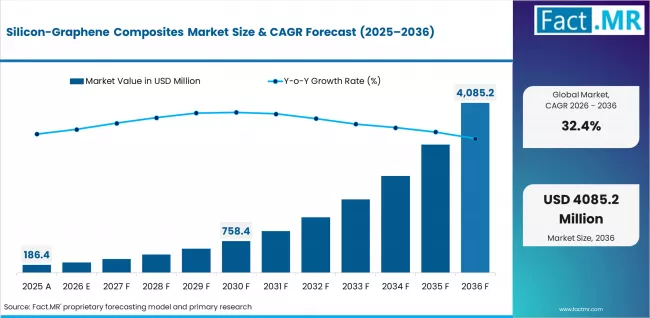
Silicon Graphene Composites Market Value Analysis | Source: Fact.MR
Summary of Silicon-Graphene Composites Market
- Market Snapshot
- Global silicon-graphene composites market revenue stood at USD 186.4 Mn in 2025 and is forecast to reach USD 4,085 Mn by 2036.
- At a 32.4% CAGR from 2026 to 2036, this market is set to expand ~16.6x in value, adding USD 3,838 Mn in absolute opportunity.
- Growth is being driven by increasing adoption of high-performance composite materials for advanced energy storage, semiconductor, and industrial applications.
- Rising demand for next-generation battery technologies, lightweight conductive materials, and high-efficiency electronic components is accelerating deployment of silicon-graphene composite technologies. Integration of advanced nanomaterials and scalable manufacturing processes is further supporting market expansion globally.
- Demand and Growth Drivers
- Increasing demand for high-capacity battery materials and fast-charging energy storage systems across electric vehicles and consumer electronics.
- Growing adoption of graphene-enhanced composite materials to improve conductivity, mechanical strength, and thermal performance.
- Expansion of electric vehicle production and advanced semiconductor manufacturing initiatives globally.
- Rising deployment of silicon-graphene composites in structural and industrial applications requiring lightweight and high-durability materials.
- Need for solutions that provide:
- Higher energy density and battery efficiency
- Enhanced electrical conductivity and thermal management
- Improved structural integrity and lightweight performance
- Advanced material scalability for industrial manufacturing
- Product and Segment View
- Silicon-dominant graphene composites hold 52% of material type share in 2025, emerging as the leading segment driven by increasing deployment in lithium-ion battery anodes and energy storage systems.
- Hybrid silicon-graphene nanocomposites account for 30% share, while graphene-dominant silicon composites represent 18%.
- Layered composites account for 44% of composite structure share in 2025, positioning them as the dominant segment due to superior conductivity and mechanical performance.
- Embedded matrix structures represent 33% share, while 3D architectured composites account for 23%.
- Chemical synthesis methods hold 48% share by manufacturing process, supported by increasing scalability and precision in nanomaterial production.
- Mechanical processing methods account for 27% share, while advanced fabrication technologies represent 25%.
- Energy storage applications hold 64% share, indicating leading adoption concentration in EV batteries, portable electronics, and grid storage systems.
- Electronics & semiconductors account for 21% share, while structural & industrial applications contribute 15%.
- Geography and Competitive Outlook
- Growth is supported across North America, Europe, and Asia Pacific driven by increasing investments in EV batteries, advanced semiconductors, and nanomaterial research.
- Key growth markets and CAGR include: Germany 29.8%, U.S. 30.6%, Japan 31.2%, South Korea 32.1%, India 33.7%, China 35.4%, and ASEAN 36.2%.
- Market expansion is closely tied to:
- Rising adoption of next-generation battery materials
- Expansion of advanced semiconductor and nanotechnology manufacturing
- Increasing investment in lightweight and conductive composite technologies
- Key companies active in this market include Samsung SDI, LG Energy Solution, Amprius Technologies, NanoGraf Corporation, Sila Nanotechnologies, and Group14 Technologies.
- Analyst Opinion
- Shambhu Nath Jha, Principal Consultant at Fact.MR, says, “The silicon-graphene composites market is no longer defined solely by conventional conductive additives and basic composite material applications. Growth is increasingly driven by next-generation battery technologies, rising demand for high-energy-density and lightweight materials, and the shift toward advanced nanostructured composites that enhance electrical conductivity, thermal stability, mechanical strength, and energy efficiency across electric vehicles, semiconductors, and advanced industrial applications
Silicon-Graphene Composites Market— At a Glance
| Attribute | Details |
|---|---|
| Market Value 2025 | USD 186.4 Mn |
| Market Value 2036 | USD 4,085 Mn |
| Absolute Dollar Opportunity 2025–2036 | USD 3,838 Mn |
| Total Growth 2025–2036 | 2,091.7% |
| CAGR 2026–2036 | 32.4% |
| Growth Multiple | ~ 16.6x |
| Key Demand Theme | Increasing adoption of advanced conductive and energy-dense composite materials |
| Leading Segment by Material Type (2026) | Silicon-Dominant Graphene Composites |
| Segment Share (2026) | 52% |
| Leading Segment by Composite Structure (2026) | Layered Composites |
| Segment Share (2026) | 44% |
| Leading Segment by Manufacturing Process (2026) | Chemical Synthesis Methods |
| Segment Share (2026) | 48% |
| Leading Segment by Application (2026) | Energy Storage |
| Segment Share (2026) | 64% |
| Leading Segment by End-use Industry (2026) | Automotive & Electric Vehicles |
| Segment Share (2026) | 58% |
| Key Growth Regions | North America, Europe, Asia Pacific |
| Country CAGRs | Germany 29.8%, U.S. 30.6%, Japan 31.2%, South Korea 32.1%, India 33.7%, China 35.4%, ASEAN 36.2% |
| Top Companies | Samsung SDI, LG Energy Solution, Amprius Technologies, NanoGraf, Sila Nanotechnologies, Group14 Technologies |
| Segmentation by Material Type | Silicon-Dominant Graphene Composites, Graphene-Dominant Silicon Composites, Hybrid Silicon-Graphene Nanocomposites |
| Segmentation by Composite Structure | Layered Composites, Embedded Matrix Structures, 3D Architectured Composites |
| Segmentation by Manufacturing Process | Chemical Synthesis Methods, Mechanical Processing Methods, Advanced Fabrication Technologies |
| Segmentation by Application | Energy Storage, Electronics & Semiconductors, Structural & Industrial Applications |
| Segmentation by End-use Industry | Automotive & Electric Vehicles, Electronics & Semiconductor Industry, Aerospace, Defense & Industrial |
| Segmentation by Region | North America, Latin America, Europe, Asia Pacific, Middle East & Africa |
Source: Fact.MR analysis. Updated May 19, 2026
Key Growth Drivers, Constraints, and Opportunities
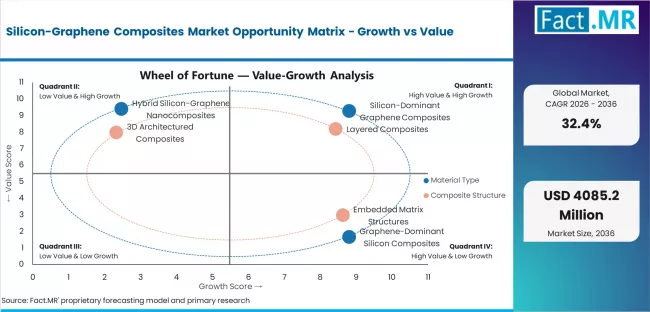
Silicon Graphene Composites Market Opportunity Matrix Growth Vs Value | Source: Fact.MR
Key Factors Driving Growth
- The growing need for high-energy-density lithium-ion batteries, fast charging EVs, and future energy storage technologies will drive global market growth.
- The increasing adoption of high silicon content anode materials, graphene enabled battery structure technology, nanocomposite material innovations, and battery technology advancements will drive the market growth.
- The increased number of gigafactory investments, EV battery manufacturing capacities, premium electronic device needs, and advanced applications such as aerospace batteries will drive the global market.
| Growth Driver | Demand Impact | Time Horizon | Key Impact Area | Fact.MR Insight |
|---|---|---|---|---|
| Rising investments in e-commerce personalization and omnichannel retail ecosystems | High | Short-Mid Term | Digital retail platforms | Increasing focus on customer engagement and conversion optimization is driving demand for AI-powered recommendation engines |
| Growing demand for real-time personalized shopping experiences and predictive merchandising | High | Short-Mid Term | AI-driven retail personalization | Retailers are increasingly adopting AI-powered recommendation platforms to improve customer retention and basket value |
| Expansion of cloud computing, customer data platforms, and retail analytics ecosystems | High | Short-Mid Term | Cloud-based commerce infrastructure | Rising deployment of scalable and data-driven retail infrastructure is accelerating adoption of recommendation technologies |
| Advancements in generative AI, machine learning, and conversational commerce technologies | Medium-High | Mid-Long Term | Intelligent customer engagement | AI-powered recommendation and predictive analytics systems are improving personalization accuracy and revenue optimization |
| Growth in mobile commerce, digital marketplaces, and retail media monetization | Medium | Short-Mid Term | E-commerce & advertising expansion | Increasing digital commerce activity and targeted advertising adoption are boosting deployment of recommendation platforms |
Source: Fact.MR analysis. Updated May 19, 2026
Key Market Constraints
- The costly nature of graphene production, silicon nanomaterial manufacturing, scalability issues, and battery manufacturing technology are some of the key factors that are likely to restrain the growth of the global Silicon-Graphene Composites Market.
- Some of the challenges faced by the manufacturers in terms of silicon anode expansion issues, battery life cycle performance degradation, thermal instability, and current lithium-ion manufacturing processes might impact the growth of the market.
- Some of the restraints associated with a lack of graphene supply chain standardization, low capacity for large scale commercialization, and insufficient battery manufacturing ecosystem in emerging economies could restrain the market.
Key Opportunity Areas
- Silicon-Graphene composites companies will benefit from opportunities in fast charging EV batteries, solid state batteries, aerospace battery technology, and next generation electronic devices.
- The increasing use in electric vehicles, utility scale battery storage systems, defense batteries, wearables, semiconductor industries, and portable devices will open doors for growth.
- The increased investments in battery mega-factories, local battery supply chain, graphene manufacturing techniques, silicon anode technology, and nanomaterial production facilities will enable the market to create value.
Segment-wise Analysis of the Silicon-Graphene Composites Market
- By the year 2026, Energy Storage accounts for a 64% market share of the application segment due to increasing adoption of silicon-rich composite anodes, rising demand for high-energy-density lithium-ion batteries, growing EV battery production, and accelerating investments in fast-charging energy storage technologies.
- Automotive & Electric Vehicles represents a 58% market share of the end-use industry segment by 2026, driven by rising electric vehicle production, increasing commercialization of silicon-graphene composite anodes, growing demand for extended driving range and rapid charging capability, and expanding investments in advanced battery manufacturing ecosystems.
The segmentation of the Silicon-Graphene Composites Market includes material type, composite structure, manufacturing process, application, end-use industry, and region.
Which Material Type Dominates the Silicon-Graphene Composites Market?
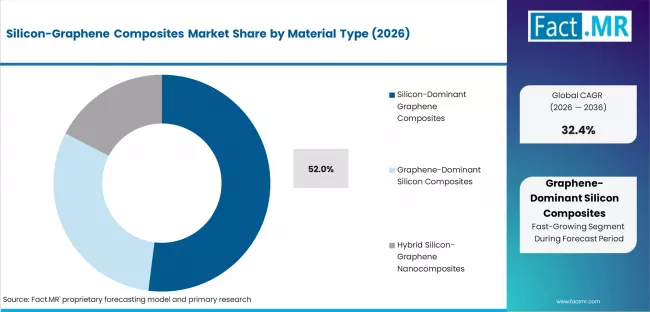
Silicon Graphene Composites Market Analysis By Material Type | Source: Fact.MR
Silicon-Dominant Graphene Composites account for the 52% market share in the Silicon-Graphene Composites Market on account of the increasing use of silicon-anode batteries, high-energy density lithium-ion batteries, fast-charging batteries, and advanced EV energy storage solutions. Growth drivers such as increased need for greater battery life, higher battery conductivity, higher cycle performance, and advanced battery designs continue to drive segment growth.
Which Composite Structure Dominates the Silicon-Graphene Composites Market?
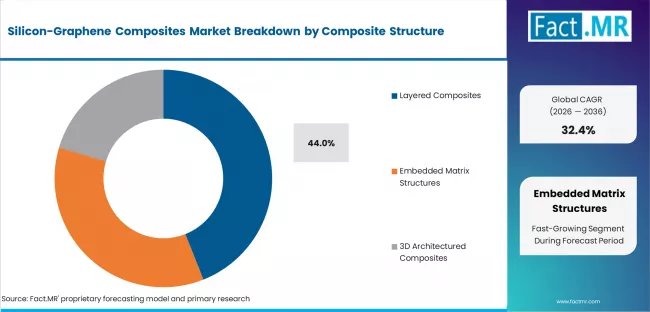
Silicon Graphene Composites Market Analysis By Composite Structure | Source: Fact.MR
Layered Composites account for the 44% market share in the Silicon-Graphene Composites Market on account of their high electrical conductivity, stability, enhanced lithium ion mobility, and silicon expansion management. Increased application of layered structures in EVs, consumer electronic devices, and semiconductor systems drives segment growth.
Which Manufacturing Process Dominates the Silicon-Graphene Composites Market?
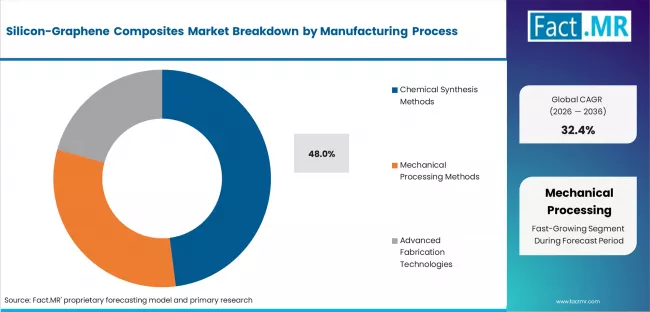
Silicon Graphene Composites Market Analysis By Manufacturing Process | Source: Fact.MR
Chemical Synthesis Methods account for the 48% market share in the Silicon-Graphene Composites Market on account of the increasing adoption of methods such as hydrothermal synthesis, CVD, sol-gel techniques, and fabrication of engineered nanostructures. The capability of these methods in providing high purity graphene composites, scalable manufacturing of composites, and high electrochemical performance drives segment growth.
Which Application Dominates the Silicon-Graphene Composites Market?
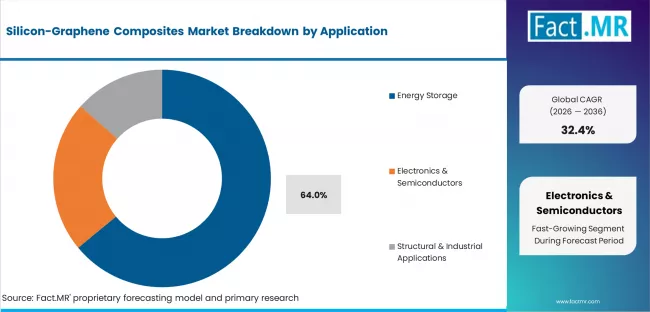
Silicon Graphene Composites Market Analysis By Application | Source: Fact.MR
Energy Storage accounts for the 64% market share in the Silicon-Graphene Composites Market on account of rapid growth in EV battery production, increased demand for high-capacity lithium-ion batteries, rising installation of fast charging facilities, and development of next generation energy storage technologies. The commercial availability of silicon composite anode materials drives segment growth.
Which End-use Industry Dominates the Silicon-Graphene Composites Market?
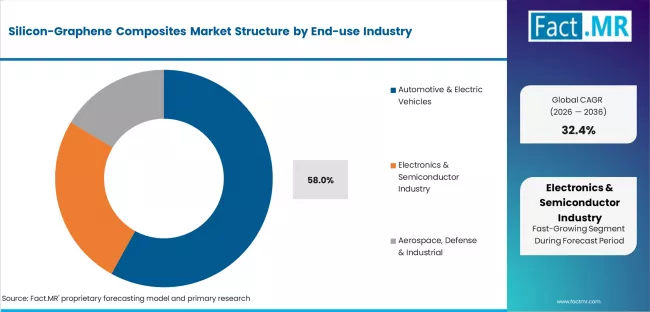
Silicon Graphene Composites Market Analysis By End Use Industry | Source: Fact.MR
Automotive & Electric Vehicles account for the 58% market share in the Silicon-Graphene Composites Market on account of rapidly increasing usage of EVs, accelerated growth in EV battery manufacturing capacities, rising demand for long battery range, and increased commercialization of silicon-graphene anodes.
Regional Outlook Across Key Markets
The market analysis covers key global regions, including South Asia and Pacific, Middle East & Africa, North America, Latin America, Western Europe, and Eastern Europe. It is segmented geographically, with specific market dynamics for each region. The full report provides a detailed market attractiveness analysis.
.webp "Top Country Growth Comparison Silicon Graphene Composites Market Cagr (2026 2036)")
Top Country Growth Comparison Silicon Graphene Composites Market Cagr (2026 2036) | Source: Fact.MR
CAGR Table
| Country | CAGR (%) |
|---|---|
| Germany | 29.8% |
| U.S. | 30.6% |
| Japan | 31.2% |
| South Korea | 32.1% |
| India | 33.7% |
| China | 35.4% |
| ASEAN | 36.2% |
Source: Fact.MR analysis. Updated May 19, 2026
Source: Fact.MR (FMR) analysis, based on proprietary forecasting model and primary research.
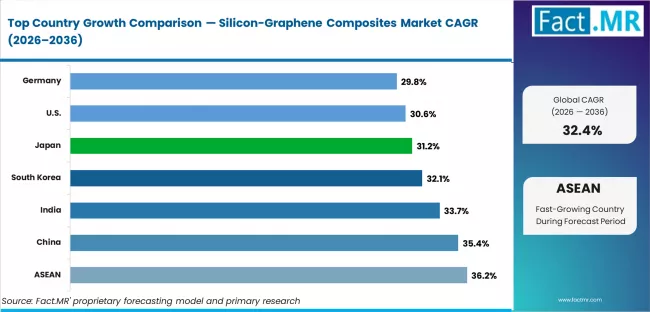
Silicon Graphene Composites Market Cagr Analysis By Country | Source: Fact.MR
North America
North America represents the global commercialization hub for silicon-graphene composite anode technologies, supported by strong venture capital activity, EV battery localization policies, and advanced battery innovation ecosystems. Major players including Sila Nanotechnologies, Group14 Technologies, and Amprius Technologies are strengthening the region’s competitive position through pilot-scale expansion and automotive battery partnerships. Government incentives under battery manufacturing and clean-energy programs continue to accelerate commercialization of silicon-rich anode materials across the regional EV supply chain.
U.S. - Demand for silicon-graphene composites in the U.S. is projected to rise at 30.6% CAGR through 2036. Growth is primarily supported by aggressive domestic battery manufacturing expansion and federal clean-energy incentives. Additionally, the U.S. Department of Energy strengthened battery-material funding programs under advanced energy storage initiatives during 2025 to localize next-generation battery material supply chains [1].
Western Europe
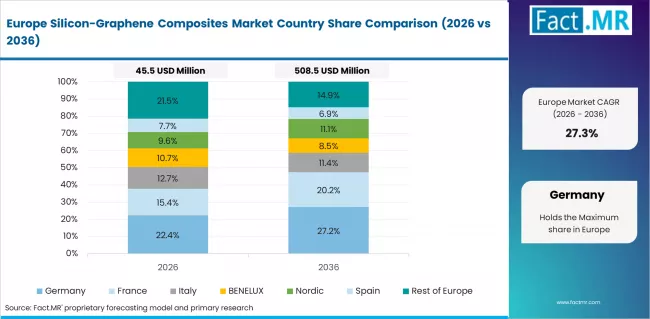
Silicon Graphene Composites Market Europe Country Market Share Analysis, 2026 & 2036 | Source: Fact.MR
Western Europe acts as the global regulatory and sustainability-driven battery innovation center, supported by stringent decarbonization targets, EV electrification policies, and regional battery manufacturing alliances. Companies such as Nexeon Limited and Toray Industries Europe continue strengthening regional battery material innovation capabilities. The European Union’s strategic push toward localized battery supply chains and reduced dependence on imported battery materials is accelerating investments in silicon-rich anode technologies and graphene-enabled composite materials.
Germany - Demand for silicon-graphene composites in Germany is projected to rise at 29.8% CAGR through 2036. Germany’s growth is strongly linked to EV manufacturing leadership and battery localization investments. In March 2025, Germany continued supporting battery innovation under the European Battery Alliance framework to expand advanced battery material manufacturing capacity [2]. Automotive OEMs including Volkswagen and Mercedes-Benz also expanded investments in high-energy-density battery technologies during 2025 to strengthen EV competitiveness.
East Asia
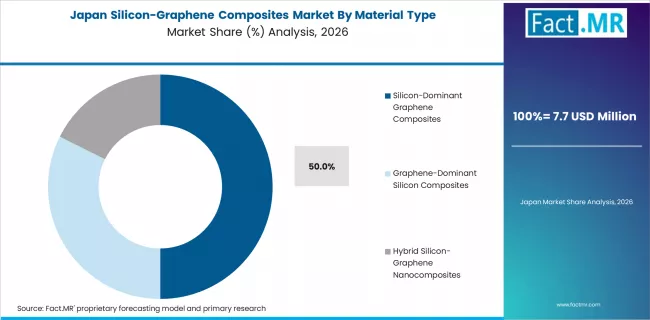
Silicon Graphene Composites Market Japan Market Share Analysis By Material Type | Source: Fact.MR
East Asia remains the global production epicenter for silicon-graphene composites due to its dominance in lithium-ion battery manufacturing, electronics supply chains, and advanced materials processing infrastructure. Leading companies including Samsung SDI, Panasonic Energy, and BTR New Material Group maintain strong positions across silicon-anode and graphene-enabled battery material commercialization. Regional governments continue supporting battery independence, semiconductor leadership, and EV expansion through strategic industrial investments and advanced manufacturing programs.
- China - Demand for silicon-graphene composites in China is projected to rise at 35.4% CAGR through 2036. China’s rapid growth is supported by its dominant global battery supply chain and large-scale EV production ecosystem. In February 2025, leading battery material manufacturers including BTR New Material Group expanded silicon-carbon anode material production capacities to support EV battery demand [3]. China also continued implementing battery industry development policies under its broader new-energy vehicle strategy during 2025.
- Japan - Demand for silicon-graphene composites in Japan is projected to rise at 31.2% CAGR through 2036. Japan’s market growth is supported by strong battery technology innovation and advanced materials engineering capabilities. In 2025, Panasonic Energy continued development activities related to next-generation high-energy-density battery technologies [4]. Japan’s Ministry of Economy, Trade and Industry also maintained strategic support for domestic battery material competitiveness during 2025 to strengthen supply chain resilience.
South Asia & Pacific
South Asia & Pacific is emerging as a high-growth battery manufacturing and EV ecosystem development region, supported by rising industrial electrification and clean-energy investments. Expanding automotive production bases and government-backed localization policies are improving long-term opportunities for advanced battery materials. Companies investing in battery supply chain partnerships and localized manufacturing continue strengthening the region’s strategic role in next-generation energy storage markets.
- India - Demand for silicon-graphene composites in India is projected to rise at 33.7% CAGR through 2036. India’s growth is being driven by rapid EV adoption and battery localization initiatives. In 2025, the Indian government continued supporting advanced battery manufacturing under its Production Linked Incentive (PLI) framework for ACC battery storage. Additionally, domestic companies including Himadri Speciality Chemical advanced commercialization activities related to silicon-carbon anode materials during 2025 [5].
Fact.MR’s analysis of the global silicon-graphene composites market provides region-wise and country-wise assessment across North America, Western Europe, East Asia, South Asia & Pacific, Eastern Europe, Latin America, and the Middle East & Africa. Readers can find detailed insights on EV battery manufacturing trends, silicon-anode commercialization, graphene supply chain expansion, advanced battery material investments, regulatory initiatives, and next-generation energy storage adoption shaping long-term regional market dynamics.
Competitive Benchmarking and Company Positioning
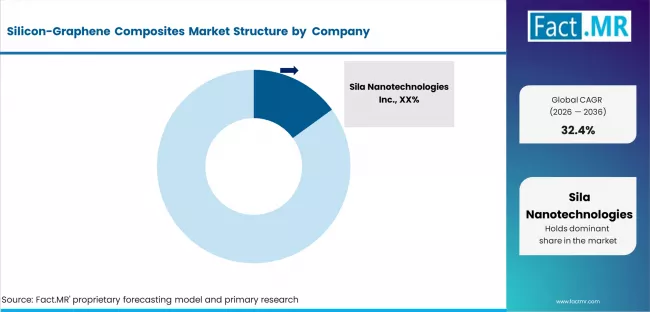
Silicon Graphene Composites Market Analysis By Company | Source: Fact.MR
Leading Companies Shaping the Silicon-Graphene Composites Market
The market for silicon-graphene composites is fairly consolidated with major players being Sila Nanotechnologies Inc., Group14 Technologies, Inc., NanoGraf Corporation, LG Energy Solution, and Panasonic Holdings. The competitive dynamics are largely determined by energy density enhancement, faster charging capability, cycle life performance, and ability to work with existing lithium-ion battery production equipment. Players with unique silicon anode technology, an integrated battery ecosystem, and connections in the automotive industry have inherent strengths. EV battery manufacturers of large scale prefer sourcing from multiple suppliers in order to avoid reliance on single sources.
Key Players of the Silicon-Graphene Composites Market
- Sila Nanotechnologies Inc.
- Group14 Technologies, Inc.
- NanoGraf Corporation
- Amprius Technologies
- Enovix Corporation
- Enevate Corporation
- Nexeon
- GDI
- Global Graphene Group, Inc
- OCSiAl
- LG Energy Solution
- Panasonic Holdings
Recent Industry Developments
- Sila Nanotechnologies begins commissioning of Moses Lake silicon-anode plant (April 2025): Sila Nanotechnologies Inc. announced the commissioning of its Moses Lake manufacturing facility to support large-scale production of Titan Silicon™ anode materials for EV batteries. The company confirmed that material production remains on schedule for the second half of 2025.
- Group14 Technologies achieves major SCC55® silicon battery performance milestone (June 2025): Group14 Technologies, Inc. announced that its SCC55® silicon battery material enabled more than 1,500 charge cycles with improved charging speed and higher energy density across multiple battery applications.
- BASF and Group14 Technologies collaborate on silicon-dominant battery materials (May 2025): Group14 Technologies, Inc. and BASF announced a collaboration to develop drop-in-ready silicon-dominant battery solutions with faster charging, improved energy density, and enhanced durability for advanced lithium-ion batteries.
Sources and Research References
- [1] U.S. Department of Energy, “DOE Announces Funding to Accelerate Next-Generation Battery Materials and Domestic Supply Chains,” 2025.
- [2] European Battery Alliance, “European Battery Alliance Continues Support for Regional Battery Innovation and Manufacturing Expansion,” March 2025.
- [3] BTR New Material Group, “BTR Expands Silicon-Carbon Anode Material Production Capacity for EV Battery Applications,” February 2025.
- [4] Panasonic Energy, “Panasonic Energy Advances Development of Next-Generation High-Energy-Density Battery Technologies,” 2025.
- [5] Himadri Speciality Chemical Ltd., “Himadri Advances Commercialization of Silicon-Carbon Anode Materials for Lithium-Ion Batteries,” 2025.
- [6] Sila Nanotechnologies, “Sila Begins the Commissioning of its Moses Lake Plant, a Major Milestone on the Path to Becoming Fully Operational in 2025,” April 2025.
- [7] Group14 Technologies, “SCC55® Resets Benchmark for Silicon Battery Performance,” June 2025.
- [8] BASF, “BASF and Group14 Collaborate on Market-Ready Silicon Anode Solution that is Highly Durable at Extreme Temperatures,” May 2025.
Silicon-Graphene Composites Market Definition
The silicon-graphene composites market encompasses sophisticated engineered materials that are made using silicon and graphene to offer better conductivity, toughness, and energy density. These materials are widely employed in lithium-ion batteries, semiconductors, and advanced industrial parts. The principal function of these materials within industries is their capability to improve the performance of lithium-ion batteries, thermal stability, toughness, and reduce the weight of materials.
Silicon-Graphene Composites Market Inclusions
This market research report provides estimates of the size of the global and regional market for silicon-graphene composites up until 2036. This report analyzes adoption trends and forecasts for silicon-graphene composites in terms of material types, composite structure, manufacturing process, applications, and end-user industries. This report provides insights into market competition, pricing trends, manufacturing technologies, and growth drivers impacting market expansion.
Silicon-Graphene Composites Market Exclusions
The scope does not cover graphene, silicon anode materials without graphene, conventional carbon composites that are not a part of silicon-graphene composite structures. Moreover, the scope does not include downstream products made from silicon-graphene composite materials such as EV battery pack, semiconductor chips, and consumer electronic devices.
Silicon-Graphene Composites Market Research Methodology
- Primary Research
- Conversations with manufacturers of battery material, developers of graphene technology, suppliers of semiconductor components, producers of EV batteries, research organizations, and key decision-makers along the silicon graphene composites value chain were done as a part of primary research. Feedback from product managers, experts in R&D, procurement heads, and industry experts was used to establish the demand, technology, and pricing trends.
- Desk Research
- The report relied on published resources, including company annual reports, investor presentation, scientific journals, patent literature, government publications, trade statistics, reports on the semiconductor industry, information on EV battery installations, and nanomaterials industry research papers. Publications by industry associations and databases were used to understand production trends and commercialization.
- Market-Sizing and Forecasting
- The study employed a combination of bottom-up analysis of manufacturer revenue and market demand with top-down evaluation of the market for battery materials and advanced composites. Market forecasts were made after taking into account such factors as pricing trends, rate of adoption, technology penetration, manufacturing growth geographically, and investments in energy storage and semiconductors.
- Data Validation and Update Cycle
- All estimates of the market size were cross-verified using a triangulation method that included primary conversations, supply-side analysis, demand modeling, and benchmarking against past performance of the industry. The forecasted values were continuously updated considering technological advancements, commercialization, regulatory environment, and global supply chain dynamics in the semiconductors and EV sectors.
Segmentation
Scope of Analysis
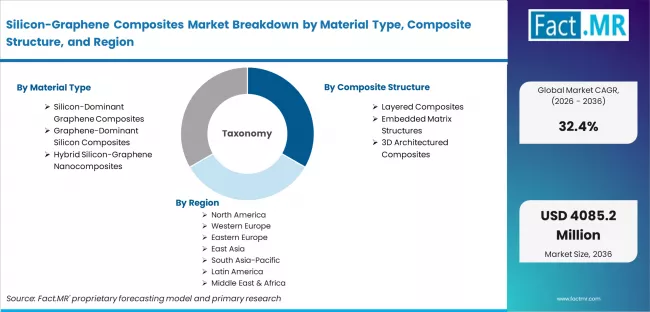
Silicon Graphene Composites Market Breakdown By Material Type, Composite Structure, And Region | Source: Fact.MR
| Parameter | Details |
|---|---|
| Quantitative Units | USD 186.4 million in 2025 to USD 4,085million in 2036, at a CAGR of 32.4% |
| Market Definition | The Silicon-Graphene Composites Market comprises advanced nanocomposite materials combining silicon and graphene to enhance battery energy density, conductivity, charging performance, and structural stability across energy storage, electronics, and industrial applications. |
| Regions Covered | North America, Latin America, Europe, East Asia, South Asia and Pacific, MiddleEastand Africa |
| Countries Covered | USA, Canada, UK, Germany, China, India, 30 plus countries |
| Key Companies | Sila Nanotechnologies Inc., Group14 Technologies, Inc., NanoGraf Corporation Amprius Technologies, Enovix Corporation, Enevate Corporation, Nexeon, GDI, Global Graphene Group, Inc, OCSiAl, LG Energy Solution, Panasonic Holdings |
| Forecast Period | 2026 to 2036 |
| Approach | Hybrid demand-side and top-downmethodologybuilt on country-level application demand, product benchmarking, pricing analysis, shipment validation, and primary interviews across manufacturers, distributors, retailers, and end users |
Source: Fact.MR analysis. Updated May 19, 2026
Analysis by Material Type, by Composite Structure, by Manufacturing Process, by Application, by End-use Industry and by Region
-
Silicon-Graphene Composites Market by Material Type
- Silicon-Dominant Graphene Composites
- Silicon Nanoparticle–Graphene Composites
- Silicon Oxide–Graphene Composites
- Porous Silicon–Graphene Composites
- Graphene-Dominant Silicon Composites
- Graphene Nanosheet-Silicon Composites
- Reduced Graphene Oxide (rGO)-Silicon Composites
- Graphene Foam-Silicon Structures
- Hybrid Silicon-Graphene Nanocomposites
- Polymer Reinforced Hybrid Composites
- Metal Matrix Hybrid Composites
- Ceramic Matrix Hybrid Composites
- Silicon-Dominant Graphene Composites
-
Silicon-Graphene Composites Market by Composite Structure
- Layered Composites
- Sandwich Structures
- Multilayer Thin Films
- Coated Silicon Structures
- Embedded Matrix Structures
- Silicon Embedded in Graphene Matrix
- Graphene Embedded in Silicon Matrix
- Nano-dispersed Structures
- 3D Architectured Composites
- Porous 3D Networks
- Foam-Based Architectures
- Aerogel Structures
- Layered Composites
-
Silicon-Graphene Composites Market by Manufacturing Process
- Chemical Synthesis Methods
- Chemical Vapor Deposition (CVD)
- Sol-Gel Processing
- Hydrothermal Synthesis
- Mechanical Processing Methods
- Ball Milling
- Mechanical Exfoliation
- Compression Molding
- Advanced Fabrication Technologies
- 3D Printing/Additive Manufacturing
- Plasma Processing
- Laser-Assisted Fabrication
- Chemical Synthesis Methods
-
Silicon-Graphene Composites Market by Application
- Energy Storage
- Lithium-Ion Battery Anodes
- Solid-State Batteries
- Supercapacitors
- Electronics & Semiconductors
- Flexible Electronics
- Sensors & MEMS Devices
- Semiconductor Components
- Structural & Industrial Applications
- Aerospace Structures
- Automotive Components
- Industrial Coatings & Thermal Systems
- Energy Storage
-
Silicon-Graphene Composites Market by End-use Industry
- Automotive & Electric Vehicles
- EV Battery Manufacturers
- Automotive Electronics Suppliers
- Lightweight Structural Component Producers
- Electronics & Semiconductor Industry
- Consumer Electronics
- Semiconductor Fabrication
- Industrial Electronics
- Aerospace, Defense & Industrial
- Aircraft Component Manufacturers
- Defense Equipment Suppliers
- Industrial Energy Storage System Integrators
- Automotive & Electric Vehicles
-
Silicon-Graphene Composites Market by Region
- North America
- USA
- Canada
- Mexico
- Latin America
- Brazil
- Chile
- Rest of LATAM
- East Asia
- China
- Japan
- South Korea
- Western Europe
- Germany
- Italy
- France
- U.K.
- Spain
- BENELUX
- Nordic
- Rest of W. Europe
- Eastern Europe
- Russia
- Hungary
- Poland
- Balkan & Baltics
- Rest of E. Europe
- South Asia & Pacific
- India
- ASEAN
- ANZ
- Rest of SAP
- Middle East and Africa
- Kingdom of Saudi Arabia
- United Arab Emirates
- South Africa
- Rest of Middle East and Africa
- North America
Who worked on this report


Preview the report firsthand - request a free sample
Free SampleGet the brochure for pricing and purchase details
Download PDF