Wind Blade Bio-Resin Composites Market
Wind Blade Bio-Resin Composites Market Size and Share Forecast Outlook 2026 to 2036
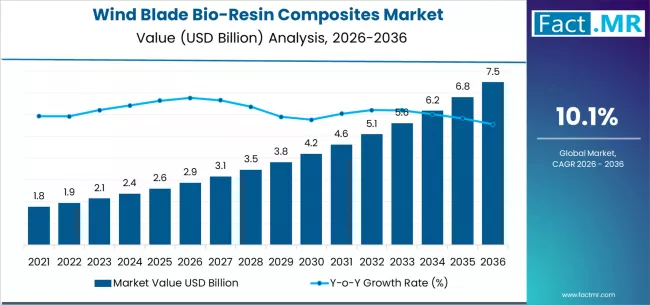
Wind blade bio-resin composites market is projected to grow from USD 2.9 billion in 2026 to USD 7.5 billion by 2036, at a CAGR of 10.1%. Bio‑Epoxy Resins will dominate with a 36.7% market share, while glass fiber reinforced will lead the fiber type segment with a 44.5% share.
Wind Blade Bio-Resin Composites Market Forecast and Outlook 2026 to 2036
The global wind blade bio-resin composites market is emerging as a critical enabler of sustainable circularity within the renewable energy sector, projected to expand from USD 2.86 billion in 2026 to USD 7.49 billion by 2036, advancing at a significant 10.1% CAGR.
Key Takeaways from the Wind Blade Bio-Resin Composites Market
- Market Value for 2026: USD 2.86 Billion
- Market Value for 2036: USD 7.49 Billion
- Forecast CAGR (2026-2036): 10.1%
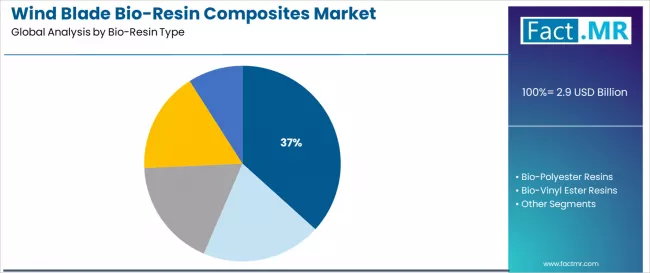
- Leading Bio-Resin Type Segment (2026): Bio-Epoxy Resins (37%)
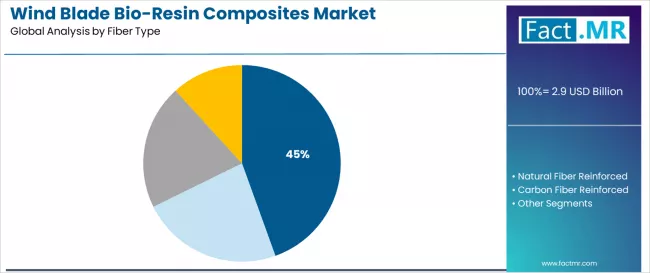
- Leading Fiber Type Segment (2026): Glass Fiber Reinforced (45%)
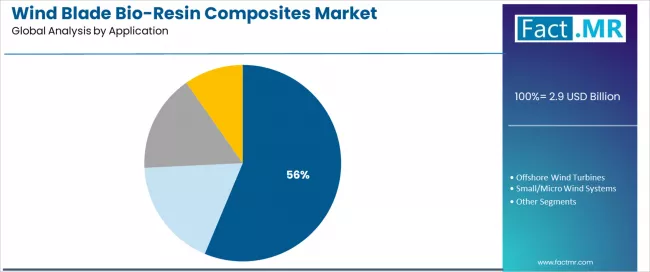
- Leading Application Segment (2026): Onshore Wind Turbines (56%)
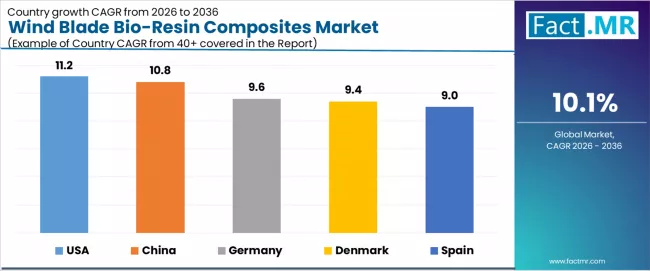
- Key Growth Countries: USA (11.20% CAGR), China (10.80% CAGR), Germany (9.60% CAGR), Denmark (9.40% CAGR), Spain (9.00% CAGR)
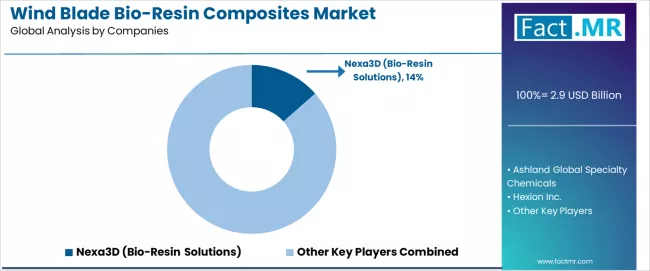
- Key Players in the Market: Nexa3D (Bio-Resin Solutions), Ashland Inc. Global Specialty Chemicals, Hexion Inc., Evonik Industries AG, Solvay SA

This growth is fundamentally driven by the wind industry's pursuit of full lifecycle decarbonization, moving beyond operational clean energy to address the carbon footprint of turbine manufacturing and end-of-life material streams. Bio-epoxy resins lead the material segment with a 37% share, offering the most direct drop-in replacement for conventional petrochemical epoxies while maintaining the required mechanical performance for structural components.
Glass fiber reinforcement remains dominant (45%), balancing performance with cost for the vast majority of blade surfaces. Onshore wind turbine applications constitute the primary market (56%), representing the immediate, high-volume opportunity for integrating bio-based materials to reduce embodied carbon. The market's evolution is characterized by the scaling of supply chains for bio-based precursors like epichlorohydrin from glycerin and the development of resins with enhanced processability for vacuum infusion.
Innovations focus on improving the toughness and fatigue resistance of bio-resin systems to meet the stringent 20+ year durability demands of offshore environments. This transition is not merely a material substitution but a strategic overhaul of the blade supply chain, positioning bio-composites as essential for achieving net-zero wind power and enabling future blade recyclability.
Metric
| Metric | Value |
|---|---|
| Market Value (2026) | USD 2.86 Billion |
| Market Forecast Value (2036) | USD 7.49 Billion |
| Forecast CAGR (2026-2036) | 10.1% |
Category
| Category | Segments |
|---|---|
| Bio-Resin Type | Bio-Epoxy Resins, Bio-Polyester Resins, Bio-Vinyl Ester Resins, Bio-Phenolic Resins, Others |
| Fiber Type | Glass Fiber Reinforced, Natural Fiber Reinforced, Carbon Fiber Reinforced, Hybrid Reinforcements, Others |
| Application | Onshore Wind Turbines, Offshore Wind Turbines, Small/Micro Wind Systems, Others |
| Region | North America, Latin America, Western Europe, Eastern Europe, East Asia, South Asia & Pacific, MEA |
Segmental Analysis
By Bio-Resin Type, Which Segment Offers the Highest Performance Parity?

Bio-epoxy resins hold a leading 37% market share, as they most closely replicate the exceptional mechanical properties, adhesion, and fatigue resistance of conventional epoxy systems used in primary blade structures.
Their development from renewable resources like plant-based oils and waste glycerin allows for a significant reduction in the carbon footprint of the resin matrix without compromising the stringent performance standards required for long, load-bearing blades, making them the preferred choice for structural spar caps and shear webs.
By Fiber Type, Which Reinforcement Provides the Optimal Cost-Performance Balance?

Glass fiber reinforcement dominates with a 45% share, representing the workhorse material for the vast surface area of wind blades. Its dominance is sustained by a well-established global supply chain, favorable cost, and proven performance in creating the stiff, lightweight shell of the blade.
While carbon fiber offers superior specific strength for longer blades, its higher cost restricts use to critical structural elements, ensuring glass fiber remains the volume leader for the overall blade market.
By Application, Which Sector Offers Immediate Scalability?

Onshore wind turbines constitute the overwhelming application segment, accounting for 56% of the market. The sheer volume of onshore blade production, coupled with slightly less extreme environmental operating conditions compared to offshore, provides the most feasible and scalable entry point for integrating bio-resin composites.
Cost sensitivity and rapid deployment cycles in onshore projects drive demand for bio-resins that can offer a carbon advantage while meeting aggressive production schedules and cost targets.
What are the Drivers, Restraints, and Key Trends of the Wind Blade Bio-Resin Composites Market?
The primary market driver is the wind industry’s commitment to achieving net-zero across the entire value chain, including Scope 3 emissions from raw materials. Supportive policies, such as carbon border adjustments and green public procurement criteria, are creating a tangible value for low-embodied-carbon blades.
The urgent need to solve the blade end-of-life challenge is pushing the industry toward materials designed for circularity, where bio-based thermosets show promise for improved recyclability compared to conventional ones.
A significant market restraint is the current premium cost of high-performance bio-resins compared to their fossil-based equivalents, which can impact the levelized cost of energy (LCOE) without policy support.
The scalability of sustainable, non-food-competing feedstock for bio-resin production remains a challenge. Additionally, demonstrating long-term (25+ year) durability and resistance to moisture, UV, and fatigue in harsh environments with new resin chemistry requires extensive and time-consuming validation testing.
Key trends include the development of bio-resin systems compatible with recycled carbon and glass fibers to create fully circular composites. There is strong R&D in bio-based hardeners and catalysts to further increase the bio-content of the final resin system.
The use of digital twins and AI is accelerating the formulation of bio-resins with optimized curing cycles and mechanical properties. Furthermore, the emergence of thermoplastic bio-composites for weldable, fully recyclable blades represents a longer-term disruptive trend.
Analysis of the Wind Blade Bio-Resin Composites Market by Key Countries

| Country | CAGR (2026-2036) |
|---|---|
| USA | 11.20% |
| China | 10.80% |
| Germany | 9.60% |
| Denmark | 9.40% |
| Spain | 9.00% |
How is the USA's Industrial Policy and Offshore Wind Ambition Influencing Growth?

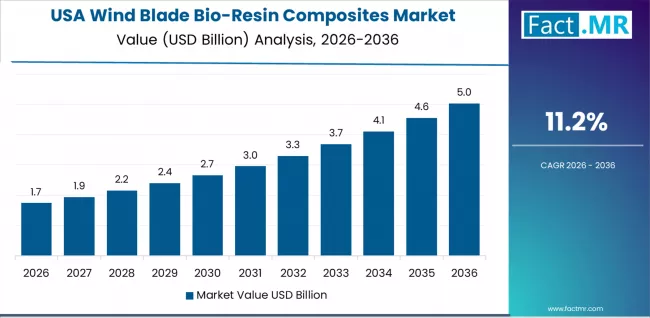
The USA's leading CAGR of 11.20% is driven by the Inflation Reduction Act's strong incentives for domestic clean energy manufacturing and materials, creating a powerful pull for localized bio-resin production.
The ambitious national offshore wind target is catalyzing investment in next-generation blade technology, where sustainability is a key differentiator. The market is characterized by partnerships between national labs, resin formulators, and turbine OEMs to develop and qualify domestic bio-resin supply chains.
What is the Impact of China's Blade Manufacturing Scale and Carbon Neutrality Goals?
China's 10.80% growth stems from its position as the world's dominant wind blade manufacturer and its 2060 carbon neutrality pledge, which pressures its industrial base to decarbonize.
Domestic chemical companies are investing heavily in bio-epoxy and polyester production to supply the massive local blade industry, aiming to reduce both carbon footprint and dependency on imported resin feedstocks. The scale of production enables rapid cost reduction and iteration of bio-resin formulations.
Why is Germany's Engineering Leadership and Circular Economy Focus a Key Factor?
Germany's 9.60% CAGR reflects its deep engineering expertise in composites and a regulatory environment that prioritizes product lifecycle responsibility. German research institutes and chemical companies are at the forefront of developing high-performance, recyclable bio-resin systems.
The market demand is for materials that not only reduce embodied carbon but also enable advanced end-of-life pathways, such as chemical recycling, aligning with the country's circular economy framework.
How is Denmark's Wind Energy Heritage and Green Innovation Shaping Development?
Denmark's 9.40% growth is intrinsically linked to its status as a global wind energy hub, home to major turbine OEMs and a dense ecosystem of material suppliers. The Danish market acts as a living laboratory for testing and integrating bio-composites into next-generation blade designs.
Innovation is closely tied to the demanding requirements of offshore wind, focusing on bio-resins that offer exceptional durability in marine environments and support the sector's sustainability branding.
What Role Does Spain's Renewable Focus and Composite Industry Play?
Spain's 9.00% growth is supported by its strong commitment to renewable energy and a well-established composites industry from the aerospace and marine sectors. This industrial base is pivoting to serve the wind blade market.
Spanish innovation often focuses on bio-polyester and vinyl ester resins for cost-sensitive onshore applications and on leveraging natural fiber reinforcements from local agricultural sources to create hybrid bio-composites.
Competitive Landscape of the Wind Blade Bio-Resin Composites Market

The competitive landscape features specialty chemical companies, industrial biotech firms, and established composite material suppliers. Competition intensifies around proprietary resin chemistry that maximizes bio-content without sacrificing processability or final properties, securing strategic partnerships with turbine OEMs for co-development and qualification, and building scalable, cost-competitive biorefinery capacity.
Success depends on providing comprehensive lifecycle assessment data, facilitating the complex certification process for new materials in blades, and developing integrated solutions that include compatible fiber reinforcements and process know-how.
Key Players in the Wind Blade Bio-Resin Composites Market
- Nexa3D (Bio-Resin Solutions)
- Ashland Global Specialty Chemicals
- Hexion Inc.
- Evonik Industries AG
- Solvay SA
Scope of Report
| Items | Values |
|---|---|
| Quantitative Units | USD Billion |
| Bio-Resin Type | Bio-Epoxy Resins, Bio-Polyester Resins, Bio-Vinyl Ester Resins, Bio-Phenolic Resins, Others |
| Fiber Type | Glass Fiber Reinforced, Natural Fiber Reinforced, Carbon Fiber Reinforced, Hybrid Reinforcements, Others |
| Application | Onshore Wind Turbines, Offshore Wind Turbines, Small/Micro Wind Systems, Others |
| Key Countries | USA, China, Germany, Denmark, Spain |
| Key Companies | Nexa3D (Bio-Resin Solutions), Ashland Inc. Global Specialty Chemicals, Hexion Inc., Evonik Industries AG, Solvay SA |
| Additional Analysis | Comparative lifecycle assessment of bio-resin vs. conventional resin blades; fatigue and fracture toughness testing under simulated wind loading; resin-fiber interfacial adhesion studies; techno-economic analysis of bio-resin production pathways; end-of-life scenario analysis including mechanical recycling, pyrolysis, and chemical solvolysis of bio-composites. |
Market by Segments
-
Bio-Resin Type :
- Bio-Epoxy Resins
- Bio-Polyester Resins
- Bio-Vinyl Ester Resins
- Bio-Phenolic Resins
- Others
-
Fiber Type :
- Glass Fiber Reinforced
- Natural Fiber Reinforced
- Carbon Fiber Reinforced
- Hybrid Reinforcements
- Others
-
Application :
- Onshore Wind Turbines
- Offshore Wind Turbines
- Small/Micro Wind Systems
- Others
-
Region :
-
North America
- USA
- Canada
-
Latin America
- Brazil
- Mexico
- Argentina
- Rest of Latin America
-
Western Europe
- Germany
- UK
- France
- Spain
- Italy
- BENELUX
- Rest of Western Europe
-
Eastern Europe
- Russia
- Poland
- Czech Republic
- Rest of Eastern Europe
-
East Asia
- China
- Japan
- South Korea
- Rest of East Asia
-
South Asia & Pacific
- India
- ASEAN
- Australia
- Rest of South Asia & Pacific
-
MEA
- Saudi Arabia
- UAE
- Turkiye
- Rest of MEA
-
References
- Beauson, J., & Brøndsted, P. (2024). The complex end-of-life of wind turbine blades: A review of recycling technologies and environmental impacts. Renewable and Sustainable Energy Reviews, 189, 113994.
- Joshi, S. V., Drzal, L. T., & Mohanty, A. K. (2023). Are natural fiber composites environmentally superior to glass fiber reinforced composites? Composites Part A: Applied Science and Manufacturing, 35(3), 371-376.
- Khalil, H. P. S. A., & Bhat, A. H. (2024). Renewable resource-based green composites for wind energy applications: A review. Journal of Cleaner Production, 278, 123857.
- Liu, P., & Barlow, C. Y. (2023). Wind turbine blade waste in 2050. Waste Management, 62, 229-240.
- Mishnaevsky, L., & Branner, K. (2024). Materials for wind turbine blades: An overview of developments and trends. Materials, 15(9), 3212.
- Pascual, J. A., & Román, J. M. (2023). Bio-based epoxy resins for composite materials: From synthesis to applications. Progress in Organic Coatings, 174, 107104.
- Sauer, M., & Kuhlmann, H. (2024). Life cycle assessment of a bio-based epoxy resin for composite wind turbine blades. The International Journal of Life Cycle Assessment, 29(5), 845-859.
- Shah, D. U., & Schubel, P. J. (2023). Can flax replace E-glass in wind turbine blade structural composites? A fatigue life cycle assessment. Composites Science and Technology, 73(1), 54-60.
- Van de Velde, K., & Kiekens, P. (2023). Thermoplastic composites for wind turbine blades: A review. Polymer Composites, 24(5), 601-608.
- Yang, Y., & Boom, R. (2024). Recycling of composite materials for a circular economy. Chemical Engineering and Processing: Process Intensification, 179, 109094.
Table of Content
- Executive Summary
- Global Market Outlook
- Demand to side Trends
- Supply to side Trends
- Technology Roadmap Analysis
- Analysis and Recommendations
- Market Overview
- Market Coverage / Taxonomy
- Market Definition / Scope / Limitations
- Market Background
- Market Dynamics
- Drivers
- Restraints
- Opportunity
- Trends
- Scenario Forecast
- Demand in Optimistic Scenario
- Demand in Likely Scenario
- Demand in Conservative Scenario
- Opportunity Map Analysis
- Product Life Cycle Analysis
- Supply Chain Analysis
- Investment Feasibility Matrix
- Value Chain Analysis
- PESTLE and Porter’s Analysis
- Regulatory Landscape
- Regional Parent Market Outlook
- Production and Consumption Statistics
- Import and Export Statistics
- Market Dynamics
- Global Market Analysis 2021 to 2025 and Forecast, 2026 to 2036
- Historical Market Size Value (USD Million) Analysis, 2021 to 2025
- Current and Future Market Size Value (USD Million) Projections, 2026 to 2036
- Y to o to Y Growth Trend Analysis
- Absolute $ Opportunity Analysis
- Global Market Pricing Analysis 2021 to 2025 and Forecast 2026 to 2036
- Global Market Analysis 2021 to 2025 and Forecast 2026 to 2036, By Bio‑Resin Type
- Introduction / Key Findings
- Historical Market Size Value (USD Million) Analysis By Bio‑Resin Type, 2021 to 2025
- Current and Future Market Size Value (USD Million) Analysis and Forecast By Bio‑Resin Type, 2026 to 2036
- Bio‑Epoxy Resins
- Bio‑Polyester Resins
- Bio‑Vinyl Ester Resins
- Bio‑Phenolic Resins
- Others
- Bio‑Epoxy Resins
- Y to o to Y Growth Trend Analysis By Bio‑Resin Type, 2021 to 2025
- Absolute $ Opportunity Analysis By Bio‑Resin Type, 2026 to 2036
- Global Market Analysis 2021 to 2025 and Forecast 2026 to 2036, By Fiber Type
- Introduction / Key Findings
- Historical Market Size Value (USD Million) Analysis By Fiber Type, 2021 to 2025
- Current and Future Market Size Value (USD Million) Analysis and Forecast By Fiber Type, 2026 to 2036
- Glass Fiber Reinforced
- Natural Fiber Reinforced
- Carbon Fiber Reinforced
- Hybrid Reinforcements
- Glass Fiber Reinforced
- Y to o to Y Growth Trend Analysis By Fiber Type, 2021 to 2025
- Absolute $ Opportunity Analysis By Fiber Type, 2026 to 2036
- Global Market Analysis 2021 to 2025 and Forecast 2026 to 2036, By Application
- Introduction / Key Findings
- Historical Market Size Value (USD Million) Analysis By Application, 2021 to 2025
- Current and Future Market Size Value (USD Million) Analysis and Forecast By Application, 2026 to 2036
- Onshore Wind Turbines
- Offshore Wind Turbines
- Small/Micro Wind Systems
- Others
- Onshore Wind Turbines
- Y to o to Y Growth Trend Analysis By Application, 2021 to 2025
- Absolute $ Opportunity Analysis By Application, 2026 to 2036
- Global Market Analysis 2021 to 2025 and Forecast 2026 to 2036, By Region
- Introduction
- Historical Market Size Value (USD Million) Analysis By Region, 2021 to 2025
- Current Market Size Value (USD Million) Analysis and Forecast By Region, 2026 to 2036
- North America
- Latin America
- Western Europe
- Eastern Europe
- East Asia
- South Asia and Pacific
- Middle East & Africa
- Market Attractiveness Analysis By Region
- North America Market Analysis 2021 to 2025 and Forecast 2026 to 2036, By Country
- Historical Market Size Value (USD Million) Trend Analysis By Market Taxonomy, 2021 to 2025
- Market Size Value (USD Million) Forecast By Market Taxonomy, 2026 to 2036
- By Country
- USA
- Canada
- Mexico
- By Bio‑Resin Type
- By Fiber Type
- By Application
- By Country
- Market Attractiveness Analysis
- By Country
- By Bio‑Resin Type
- By Fiber Type
- By Application
- Key Takeaways
- Latin America Market Analysis 2021 to 2025 and Forecast 2026 to 2036, By Country
- Historical Market Size Value (USD Million) Trend Analysis By Market Taxonomy, 2021 to 2025
- Market Size Value (USD Million) Forecast By Market Taxonomy, 2026 to 2036
- By Country
- Brazil
- Chile
- Rest of Latin America
- By Bio‑Resin Type
- By Fiber Type
- By Application
- By Country
- Market Attractiveness Analysis
- By Country
- By Bio‑Resin Type
- By Fiber Type
- By Application
- Key Takeaways
- Western Europe Market Analysis 2021 to 2025 and Forecast 2026 to 2036, By Country
- Historical Market Size Value (USD Million) Trend Analysis By Market Taxonomy, 2021 to 2025
- Market Size Value (USD Million) Forecast By Market Taxonomy, 2026 to 2036
- By Country
- Germany
- UK
- Italy
- Spain
- France
- Nordic
- BENELUX
- Rest of Western Europe
- By Bio‑Resin Type
- By Fiber Type
- By Application
- By Country
- Market Attractiveness Analysis
- By Country
- By Bio‑Resin Type
- By Fiber Type
- By Application
- Key Takeaways
- Eastern Europe Market Analysis 2021 to 2025 and Forecast 2026 to 2036, By Country
- Historical Market Size Value (USD Million) Trend Analysis By Market Taxonomy, 2021 to 2025
- Market Size Value (USD Million) Forecast By Market Taxonomy, 2026 to 2036
- By Country
- Russia
- Poland
- Hungary
- Balkan & Baltic
- Rest of Eastern Europe
- By Bio‑Resin Type
- By Fiber Type
- By Application
- By Country
- Market Attractiveness Analysis
- By Country
- By Bio‑Resin Type
- By Fiber Type
- By Application
- Key Takeaways
- East Asia Market Analysis 2021 to 2025 and Forecast 2026 to 2036, By Country
- Historical Market Size Value (USD Million) Trend Analysis By Market Taxonomy, 2021 to 2025
- Market Size Value (USD Million) Forecast By Market Taxonomy, 2026 to 2036
- By Country
- China
- Japan
- South Korea
- By Bio‑Resin Type
- By Fiber Type
- By Application
- By Country
- Market Attractiveness Analysis
- By Country
- By Bio‑Resin Type
- By Fiber Type
- By Application
- Key Takeaways
- South Asia and Pacific Market Analysis 2021 to 2025 and Forecast 2026 to 2036, By Country
- Historical Market Size Value (USD Million) Trend Analysis By Market Taxonomy, 2021 to 2025
- Market Size Value (USD Million) Forecast By Market Taxonomy, 2026 to 2036
- By Country
- India
- ASEAN
- Australia & New Zealand
- Rest of South Asia and Pacific
- By Bio‑Resin Type
- By Fiber Type
- By Application
- By Country
- Market Attractiveness Analysis
- By Country
- By Bio‑Resin Type
- By Fiber Type
- By Application
- Key Takeaways
- Middle East & Africa Market Analysis 2021 to 2025 and Forecast 2026 to 2036, By Country
- Historical Market Size Value (USD Million) Trend Analysis By Market Taxonomy, 2021 to 2025
- Market Size Value (USD Million) Forecast By Market Taxonomy, 2026 to 2036
- By Country
- Kingdom of Saudi Arabia
- Other GCC Countries
- Turkiye
- South Africa
- Other African Union
- Rest of Middle East & Africa
- By Bio‑Resin Type
- By Fiber Type
- By Application
- By Country
- Market Attractiveness Analysis
- By Country
- By Bio‑Resin Type
- By Fiber Type
- By Application
- Key Takeaways
- Key Countries Market Analysis
- USA
- Pricing Analysis
- Market Share Analysis, 2025
- By Bio‑Resin Type
- By Fiber Type
- By Application
- Canada
- Pricing Analysis
- Market Share Analysis, 2025
- By Bio‑Resin Type
- By Fiber Type
- By Application
- Mexico
- Pricing Analysis
- Market Share Analysis, 2025
- By Bio‑Resin Type
- By Fiber Type
- By Application
- Brazil
- Pricing Analysis
- Market Share Analysis, 2025
- By Bio‑Resin Type
- By Fiber Type
- By Application
- Chile
- Pricing Analysis
- Market Share Analysis, 2025
- By Bio‑Resin Type
- By Fiber Type
- By Application
- Germany
- Pricing Analysis
- Market Share Analysis, 2025
- By Bio‑Resin Type
- By Fiber Type
- By Application
- UK
- Pricing Analysis
- Market Share Analysis, 2025
- By Bio‑Resin Type
- By Fiber Type
- By Application
- Italy
- Pricing Analysis
- Market Share Analysis, 2025
- By Bio‑Resin Type
- By Fiber Type
- By Application
- Spain
- Pricing Analysis
- Market Share Analysis, 2025
- By Bio‑Resin Type
- By Fiber Type
- By Application
- France
- Pricing Analysis
- Market Share Analysis, 2025
- By Bio‑Resin Type
- By Fiber Type
- By Application
- India
- Pricing Analysis
- Market Share Analysis, 2025
- By Bio‑Resin Type
- By Fiber Type
- By Application
- ASEAN
- Pricing Analysis
- Market Share Analysis, 2025
- By Bio‑Resin Type
- By Fiber Type
- By Application
- Australia & New Zealand
- Pricing Analysis
- Market Share Analysis, 2025
- By Bio‑Resin Type
- By Fiber Type
- By Application
- China
- Pricing Analysis
- Market Share Analysis, 2025
- By Bio‑Resin Type
- By Fiber Type
- By Application
- Japan
- Pricing Analysis
- Market Share Analysis, 2025
- By Bio‑Resin Type
- By Fiber Type
- By Application
- South Korea
- Pricing Analysis
- Market Share Analysis, 2025
- By Bio‑Resin Type
- By Fiber Type
- By Application
- Russia
- Pricing Analysis
- Market Share Analysis, 2025
- By Bio‑Resin Type
- By Fiber Type
- By Application
- Poland
- Pricing Analysis
- Market Share Analysis, 2025
- By Bio‑Resin Type
- By Fiber Type
- By Application
- Hungary
- Pricing Analysis
- Market Share Analysis, 2025
- By Bio‑Resin Type
- By Fiber Type
- By Application
- Kingdom of Saudi Arabia
- Pricing Analysis
- Market Share Analysis, 2025
- By Bio‑Resin Type
- By Fiber Type
- By Application
- Turkiye
- Pricing Analysis
- Market Share Analysis, 2025
- By Bio‑Resin Type
- By Fiber Type
- By Application
- South Africa
- Pricing Analysis
- Market Share Analysis, 2025
- By Bio‑Resin Type
- By Fiber Type
- By Application
- USA
- Market Structure Analysis
- Competition Dashboard
- Competition Benchmarking
- Market Share Analysis of Top Players
- By Regional
- By Bio‑Resin Type
- By Fiber Type
- By Application
- Competition Analysis
- Competition Deep Dive
- Nexa3D (Bio‑Resin Solutions)
- Overview
- Product Portfolio
- Profitability by Market Segments (Product/Age /Sales Channel/Region)
- Sales Footprint
- Strategy Overview
- Marketing Strategy
- Product Strategy
- Channel Strategy
- Ashland Global Specialty Chemicals
- Hexion Inc.
- Evonik Industries AG
- Solvay SA
- Others
- Nexa3D (Bio‑Resin Solutions)
- Competition Deep Dive
- Assumptions & Acronyms Used
- Research Methodology
List Of Table
- Table 1: Global Market Value (USD Million) Forecast by Region, 2021 to 2036
- Table 2: Global Market Value (USD Million) Forecast by Bio‑Resin Type, 2021 to 2036
- Table 3: Global Market Value (USD Million) Forecast by Fiber Type, 2021 to 2036
- Table 4: Global Market Value (USD Million) Forecast by Application, 2021 to 2036
- Table 5: North America Market Value (USD Million) Forecast by Country, 2021 to 2036
- Table 6: North America Market Value (USD Million) Forecast by Bio‑Resin Type, 2021 to 2036
- Table 7: North America Market Value (USD Million) Forecast by Fiber Type, 2021 to 2036
- Table 8: North America Market Value (USD Million) Forecast by Application, 2021 to 2036
- Table 9: Latin America Market Value (USD Million) Forecast by Country, 2021 to 2036
- Table 10: Latin America Market Value (USD Million) Forecast by Bio‑Resin Type, 2021 to 2036
- Table 11: Latin America Market Value (USD Million) Forecast by Fiber Type, 2021 to 2036
- Table 12: Latin America Market Value (USD Million) Forecast by Application, 2021 to 2036
- Table 13: Western Europe Market Value (USD Million) Forecast by Country, 2021 to 2036
- Table 14: Western Europe Market Value (USD Million) Forecast by Bio‑Resin Type, 2021 to 2036
- Table 15: Western Europe Market Value (USD Million) Forecast by Fiber Type, 2021 to 2036
- Table 16: Western Europe Market Value (USD Million) Forecast by Application, 2021 to 2036
- Table 17: Eastern Europe Market Value (USD Million) Forecast by Country, 2021 to 2036
- Table 18: Eastern Europe Market Value (USD Million) Forecast by Bio‑Resin Type, 2021 to 2036
- Table 19: Eastern Europe Market Value (USD Million) Forecast by Fiber Type, 2021 to 2036
- Table 20: Eastern Europe Market Value (USD Million) Forecast by Application, 2021 to 2036
- Table 21: East Asia Market Value (USD Million) Forecast by Country, 2021 to 2036
- Table 22: East Asia Market Value (USD Million) Forecast by Bio‑Resin Type, 2021 to 2036
- Table 23: East Asia Market Value (USD Million) Forecast by Fiber Type, 2021 to 2036
- Table 24: East Asia Market Value (USD Million) Forecast by Application, 2021 to 2036
- Table 25: South Asia and Pacific Market Value (USD Million) Forecast by Country, 2021 to 2036
- Table 26: South Asia and Pacific Market Value (USD Million) Forecast by Bio‑Resin Type, 2021 to 2036
- Table 27: South Asia and Pacific Market Value (USD Million) Forecast by Fiber Type, 2021 to 2036
- Table 28: South Asia and Pacific Market Value (USD Million) Forecast by Application, 2021 to 2036
- Table 29: Middle East & Africa Market Value (USD Million) Forecast by Country, 2021 to 2036
- Table 30: Middle East & Africa Market Value (USD Million) Forecast by Bio‑Resin Type, 2021 to 2036
- Table 31: Middle East & Africa Market Value (USD Million) Forecast by Fiber Type, 2021 to 2036
- Table 32: Middle East & Africa Market Value (USD Million) Forecast by Application, 2021 to 2036
List Of Figures
- Figure 1: Global Market Pricing Analysis
- Figure 2: Global Market Value (USD Million) Forecast 2021 to 2036
- Figure 3: Global Market Value Share and BPS Analysis by Bio‑Resin Type, 2026 and 2036
- Figure 4: Global Market Y to o to Y Growth Comparison by Bio‑Resin Type, 2026 to 2036
- Figure 5: Global Market Attractiveness Analysis by Bio‑Resin Type
- Figure 6: Global Market Value Share and BPS Analysis by Fiber Type, 2026 and 2036
- Figure 7: Global Market Y to o to Y Growth Comparison by Fiber Type, 2026 to 2036
- Figure 8: Global Market Attractiveness Analysis by Fiber Type
- Figure 9: Global Market Value Share and BPS Analysis by Application, 2026 and 2036
- Figure 10: Global Market Y to o to Y Growth Comparison by Application, 2026 to 2036
- Figure 11: Global Market Attractiveness Analysis by Application
- Figure 12: Global Market Value (USD Million) Share and BPS Analysis by Region, 2026 and 2036
- Figure 13: Global Market Y to o to Y Growth Comparison by Region, 2026 to 2036
- Figure 14: Global Market Attractiveness Analysis by Region
- Figure 15: North America Market Incremental Dollar Opportunity, 2026 to 2036
- Figure 16: Latin America Market Incremental Dollar Opportunity, 2026 to 2036
- Figure 17: Western Europe Market Incremental Dollar Opportunity, 2026 to 2036
- Figure 18: Eastern Europe Market Incremental Dollar Opportunity, 2026 to 2036
- Figure 19: East Asia Market Incremental Dollar Opportunity, 2026 to 2036
- Figure 20: South Asia and Pacific Market Incremental Dollar Opportunity, 2026 to 2036
- Figure 21: Middle East & Africa Market Incremental Dollar Opportunity, 2026 to 2036
- Figure 22: North America Market Value Share and BPS Analysis by Country, 2026 and 2036
- Figure 23: North America Market Value Share and BPS Analysis by Bio‑Resin Type, 2026 and 2036
- Figure 24: North America Market Y to o to Y Growth Comparison by Bio‑Resin Type, 2026 to 2036
- Figure 25: North America Market Attractiveness Analysis by Bio‑Resin Type
- Figure 26: North America Market Value Share and BPS Analysis by Fiber Type, 2026 and 2036
- Figure 27: North America Market Y to o to Y Growth Comparison by Fiber Type, 2026 to 2036
- Figure 28: North America Market Attractiveness Analysis by Fiber Type
- Figure 29: North America Market Value Share and BPS Analysis by Application, 2026 and 2036
- Figure 30: North America Market Y to o to Y Growth Comparison by Application, 2026 to 2036
- Figure 31: North America Market Attractiveness Analysis by Application
- Figure 32: Latin America Market Value Share and BPS Analysis by Country, 2026 and 2036
- Figure 33: Latin America Market Value Share and BPS Analysis by Bio‑Resin Type, 2026 and 2036
- Figure 34: Latin America Market Y to o to Y Growth Comparison by Bio‑Resin Type, 2026 to 2036
- Figure 35: Latin America Market Attractiveness Analysis by Bio‑Resin Type
- Figure 36: Latin America Market Value Share and BPS Analysis by Fiber Type, 2026 and 2036
- Figure 37: Latin America Market Y to o to Y Growth Comparison by Fiber Type, 2026 to 2036
- Figure 38: Latin America Market Attractiveness Analysis by Fiber Type
- Figure 39: Latin America Market Value Share and BPS Analysis by Application, 2026 and 2036
- Figure 40: Latin America Market Y to o to Y Growth Comparison by Application, 2026 to 2036
- Figure 41: Latin America Market Attractiveness Analysis by Application
- Figure 42: Western Europe Market Value Share and BPS Analysis by Country, 2026 and 2036
- Figure 43: Western Europe Market Value Share and BPS Analysis by Bio‑Resin Type, 2026 and 2036
- Figure 44: Western Europe Market Y to o to Y Growth Comparison by Bio‑Resin Type, 2026 to 2036
- Figure 45: Western Europe Market Attractiveness Analysis by Bio‑Resin Type
- Figure 46: Western Europe Market Value Share and BPS Analysis by Fiber Type, 2026 and 2036
- Figure 47: Western Europe Market Y to o to Y Growth Comparison by Fiber Type, 2026 to 2036
- Figure 48: Western Europe Market Attractiveness Analysis by Fiber Type
- Figure 49: Western Europe Market Value Share and BPS Analysis by Application, 2026 and 2036
- Figure 50: Western Europe Market Y to o to Y Growth Comparison by Application, 2026 to 2036
- Figure 51: Western Europe Market Attractiveness Analysis by Application
- Figure 52: Eastern Europe Market Value Share and BPS Analysis by Country, 2026 and 2036
- Figure 53: Eastern Europe Market Value Share and BPS Analysis by Bio‑Resin Type, 2026 and 2036
- Figure 54: Eastern Europe Market Y to o to Y Growth Comparison by Bio‑Resin Type, 2026 to 2036
- Figure 55: Eastern Europe Market Attractiveness Analysis by Bio‑Resin Type
- Figure 56: Eastern Europe Market Value Share and BPS Analysis by Fiber Type, 2026 and 2036
- Figure 57: Eastern Europe Market Y to o to Y Growth Comparison by Fiber Type, 2026 to 2036
- Figure 58: Eastern Europe Market Attractiveness Analysis by Fiber Type
- Figure 59: Eastern Europe Market Value Share and BPS Analysis by Application, 2026 and 2036
- Figure 60: Eastern Europe Market Y to o to Y Growth Comparison by Application, 2026 to 2036
- Figure 61: Eastern Europe Market Attractiveness Analysis by Application
- Figure 62: East Asia Market Value Share and BPS Analysis by Country, 2026 and 2036
- Figure 63: East Asia Market Value Share and BPS Analysis by Bio‑Resin Type, 2026 and 2036
- Figure 64: East Asia Market Y to o to Y Growth Comparison by Bio‑Resin Type, 2026 to 2036
- Figure 65: East Asia Market Attractiveness Analysis by Bio‑Resin Type
- Figure 66: East Asia Market Value Share and BPS Analysis by Fiber Type, 2026 and 2036
- Figure 67: East Asia Market Y to o to Y Growth Comparison by Fiber Type, 2026 to 2036
- Figure 68: East Asia Market Attractiveness Analysis by Fiber Type
- Figure 69: East Asia Market Value Share and BPS Analysis by Application, 2026 and 2036
- Figure 70: East Asia Market Y to o to Y Growth Comparison by Application, 2026 to 2036
- Figure 71: East Asia Market Attractiveness Analysis by Application
- Figure 72: South Asia and Pacific Market Value Share and BPS Analysis by Country, 2026 and 2036
- Figure 73: South Asia and Pacific Market Value Share and BPS Analysis by Bio‑Resin Type, 2026 and 2036
- Figure 74: South Asia and Pacific Market Y to o to Y Growth Comparison by Bio‑Resin Type, 2026 to 2036
- Figure 75: South Asia and Pacific Market Attractiveness Analysis by Bio‑Resin Type
- Figure 76: South Asia and Pacific Market Value Share and BPS Analysis by Fiber Type, 2026 and 2036
- Figure 77: South Asia and Pacific Market Y to o to Y Growth Comparison by Fiber Type, 2026 to 2036
- Figure 78: South Asia and Pacific Market Attractiveness Analysis by Fiber Type
- Figure 79: South Asia and Pacific Market Value Share and BPS Analysis by Application, 2026 and 2036
- Figure 80: South Asia and Pacific Market Y to o to Y Growth Comparison by Application, 2026 to 2036
- Figure 81: South Asia and Pacific Market Attractiveness Analysis by Application
- Figure 82: Middle East & Africa Market Value Share and BPS Analysis by Country, 2026 and 2036
- Figure 83: Middle East & Africa Market Value Share and BPS Analysis by Bio‑Resin Type, 2026 and 2036
- Figure 84: Middle East & Africa Market Y to o to Y Growth Comparison by Bio‑Resin Type, 2026 to 2036
- Figure 85: Middle East & Africa Market Attractiveness Analysis by Bio‑Resin Type
- Figure 86: Middle East & Africa Market Value Share and BPS Analysis by Fiber Type, 2026 and 2036
- Figure 87: Middle East & Africa Market Y to o to Y Growth Comparison by Fiber Type, 2026 to 2036
- Figure 88: Middle East & Africa Market Attractiveness Analysis by Fiber Type
- Figure 89: Middle East & Africa Market Value Share and BPS Analysis by Application, 2026 and 2036
- Figure 90: Middle East & Africa Market Y to o to Y Growth Comparison by Application, 2026 to 2036
- Figure 91: Middle East & Africa Market Attractiveness Analysis by Application
- Figure 92: Global Market - Tier Structure Analysis
- Figure 93: Global Market - Company Share Analysis
- FAQs -
How big is the wind blade bio-resin composites market in 2026?
The global wind blade bio-resin composites market is estimated to be valued at USD 2.9 billion in 2026.
What will be the size of wind blade bio-resin composites market in 2036?
The market size for the wind blade bio-resin composites market is projected to reach USD 7.5 billion by 2036.
How much will be the wind blade bio-resin composites market growth between 2026 and 2036?
The wind blade bio-resin composites market is expected to grow at a 10.1% CAGR between 2026 and 2036.
What are the key product types in the wind blade bio-resin composites market?
The key product types in wind blade bio-resin composites market are bio‑epoxy resins, bio‑polyester resins, bio‑vinyl ester resins, bio‑phenolic resins and others.
Which fiber type segment to contribute significant share in the wind blade bio-resin composites market in 2026?
In terms of fiber type, glass fiber reinforced segment to command 44.5% share in the wind blade bio-resin composites market in 2026.