- Market Value (2025): USD 1.2 Bn
- Estimated Value (2026): USD 1.3 Bn
- Forecast Value (2036): USD 2.6 Bn
- CAGR (2026-2036): 7.2%
What is the Silicone-Based Film Processing Aids Market forecast to be worth by 2036?
USD 1.3 billion in 2026 to USD 2.6 billion by 2036 at a 7.2% CAGR.
- The Silicone-Based Film Processing Aids Market was valued at USD 1.2 billion in 2025.
- Demand is projected to increase from USD 1.3 billion in 2026 to USD 2.6 billion by 2036.
- The market is forecast to record a 7.2% CAGR from 2026 to 2036.
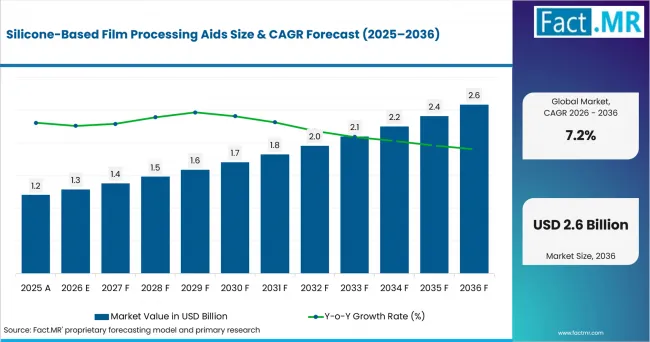
Silicone Based Film Processing Aids Value Analysis | Source: Fact.MR
What are the defining numbers behind Silicone-Based Film Processing Aids Market growth?
Absolute opportunity of USD 1.3 billion between 2026 and 2036.
- Demand Drivers in the Market
- Processors are studying non-fluoropolymer options as PFAS rules receive more attention. Packaging and food-contact requirements are adding to this review.
- Silicone masterbatch offers a pellet form that is easy to feed. Converters can meter it into existing extrusion lines without a separate liquid system.
- Polyethylene remains a key substrate for blown and flexible film. These lines combine high output with strict needs for optics and sealing. Stable processing helps maintain surface quality during long runs.
- Key Segments Analyzed
- By Processing Aid Chemistry: Silicone masterbatch is expected to hold 34.0% share in 2026.
- By Processing Function: Melt-fracture reduction is projected to account for 31.0% share in 2026.
- By Polymer Substrate: Polyethylene is anticipated to represent 36.0% share in 2026.
- By Application: Blown film is estimated to capture 29.0% share in 2026.
- Analyst Opinion at Fact.MR
- Shambhu Nath Jha, Principal Consultant at Fact.MR, states, “A silicone processing aid must deliver a cleaner die and a smoother film without making the line harder to run. Interest is rising as converters review non-fluorinated options. Suppliers can support qualification with clear resin guidance and measured extrusion results.”
- Strategic Implications
- Additive producers should report melt-fracture control and die cleanliness by resin grade. This gives converters clearer evidence than broad processing-aid claims.
- Masterbatch formulators should state which carrier works with each resin. This helps film makers match the concentrate with the right polymer family. Polyethylene and polypropylene need different checks from engineering polymers.
- Film converters should test processing aids at actual line speeds and die conditions. A laboratory flow result may change when the material moves to a full production line.
- Packaging developers should check additive choices against current packaging rules. The European Commission states that Regulation (EU) 2025/40 applies from 12 August 2026. It also sets PFAS limits for food-contact packaging.
France and the USA are each forecast to record 7.4% CAGR through 2036. China and Germany are projected at 7.2% while Japan is anticipated to post 6.1%. The spread is narrow. Country conditions still differ because extrusion capacity and packaging rules shape how processors evaluate silicone-based aids.
How does the Silicone-Based Film Processing Aids Market break down by segment?
Polyethylene is projected to lead Polymer Substrate at 36.0% share in 2026. Silicone masterbatch leads Processing Aid Chemistry at 34.0%.
Which Processing Aid Chemistry dominates?
Silicone masterbatch is expected to hold 34.0% share in 2026.
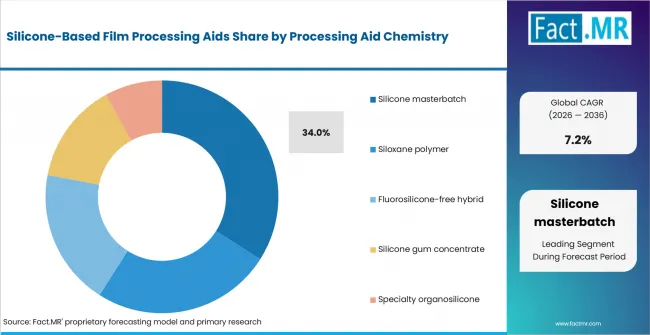
Silicone Based Film Processing Aids Analysis By Processing Aid Chemistry | Source: Fact.MR
Silicone masterbatch combines silicone with a plastic carrier in pellet form. The pellets are easy to feed and can spread well at low use levels. Siloxane polymers and silicone gum offer other loading choices. Specialty organosilicones and fluorosilicone-free hybrids provide options for resin-specific trials.
What leads the Processing Function segment?
Melt-fracture reduction is projected to account for 31.0% share in 2026.
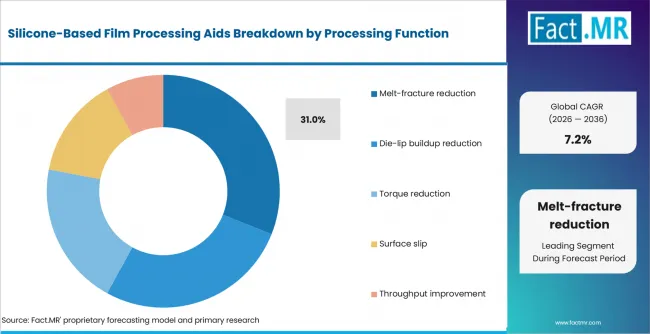
Silicone Based Film Processing Aids Analysis By Processing Function | Source: Fact.MR
Melt-fracture reduction leads because high shear can distort a film surface at the die. Processing aids can help the melt exit more evenly at useful line speeds. They can also limit die-lip deposits that cause defects and cleaning stops. Other functions include lower torque, better surface slip, and higher throughput.
How does Polymer Substrate shape demand?
Polyethylene is expected to hold 36.0% share in 2026.
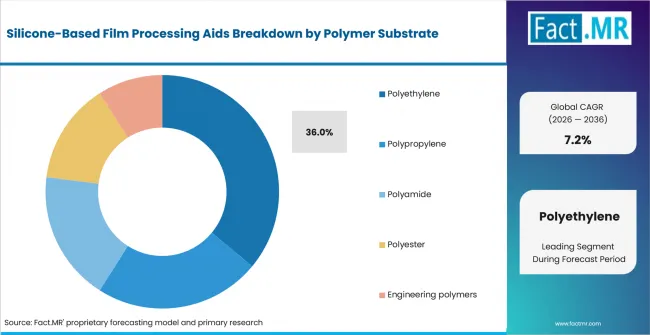
Silicone Based Film Processing Aids Analysis By Polymer Substrate | Source: Fact.MR
Polyethylene is expected to lead because it is widely used in blown and flexible film. Surface defects and die deposits can reduce usable output on these lines. Polypropylene follows in cast and oriented film structures. Polyamide, polyester, and engineering polymers need closer additive matching because their process conditions differ.
What supports Blown film within Application?
Blown film is estimated to capture 29.0% share in 2026.
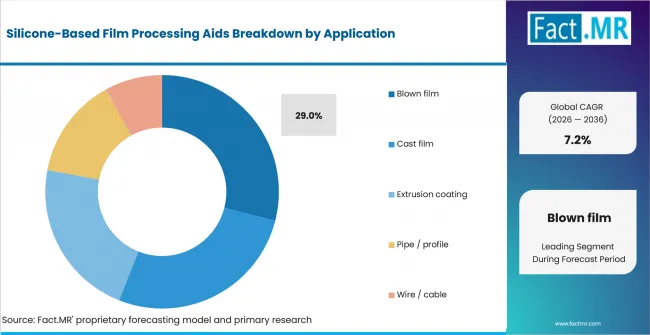
Silicone Based Film Processing Aids Analysis By Application | Source: Fact.MR
Blown film is expected to remain the main application because process changes are easy to see on the film bubble. Melt fracture, haze, gauge variation, and die deposits can affect long runs. Cast film uses a different cooling route, while extrusion coating adds adhesion and web-handling needs.
What is accelerating Silicone-Based Film Processing Aids Market adoption, and what is holding it back?
Demand for good film quality and non-fluorinated options supports market use. Longer test cycles and resin-fit issues can slow wider adoption.
Drivers Impact Analysis
| DRIVER | (~) % IMPACT ON CAGR | GEOGRAPHIC RELEVANCE | IMPACT TIMELINE |
|---|---|---|---|
| Non-fluoropolymer processing-aid substitution | +1.2% | North America, Europe | Short term (<= 2 years) |
| Melt-fracture and die-buildup control | +1.0% | Global | Short term (<= 2 years) |
| Blown-film output and line-efficiency focus | +0.8% | North America, East Asia | Medium term (2-4 years) |
| Packaging recyclability and material scrutiny | +0.6% | Europe | Medium term (2-4 years) |
Opportunity Impact Analysis
| OPPORTUNITY | (~) % IMPACT ON CAGR | GEOGRAPHIC RELEVANCE | IMPACT TIMELINE |
|---|---|---|---|
| PFAS-free processing-aid conversion programs | +0.9% | North America, Europe | Short term (<= 2 years) |
| High-output polyethylene film lines | +0.7% | Global | Medium term (2-4 years) |
| Resin-specific masterbatch development | +0.5% | East Asia, Europe | Medium term (2-4 years) |
Restraints Impact Analysis
| RESTRAINT | (~) % IMPACT ON CAGR | GEOGRAPHIC RELEVANCE | IMPACT TIMELINE |
|---|---|---|---|
| Resin and carrier compatibility limits | -0.5% | Global | Short term (<= 2 years) |
| Qualification time on commercial film lines | -0.4% | Global | Medium term (2-4 years) |
| Potential effects on printing, sealing, or slip balance | -0.3% | Packaging markets | Medium term (2-4 years) |
Which countries are scaling the Silicone-Based Film Processing Aids Market through 2036?
- The country comparison spans 1.3 percentage points over the forecast period.
- France is 0.2 percentage point above China at 7.4% CAGR. Packaging rules keep additive performance under review.
- The USA matches France at 7.4% CAGR. Active film-conversion lines support continued processing-aid trials.
- China matches Germany at 7.2% CAGR. Rubber and plastic product manufacturing supports a large conversion base.
- Germany remains 1.1 percentage points above Japan. Packaging recycling rules link film design with process efficiency.
- Japan closes the displayed range at 6.1% CAGR. Its established plastics industry supports a stable film-conversion base.
Similar CAGRs can still lead to different qualification needs. Each country has its own polymer mix, rules, and film-output profile. Full coverage includes North America, Latin America, Western Europe, Eastern Europe, East Asia, South Asia & Pacific, and Middle East & Africa.
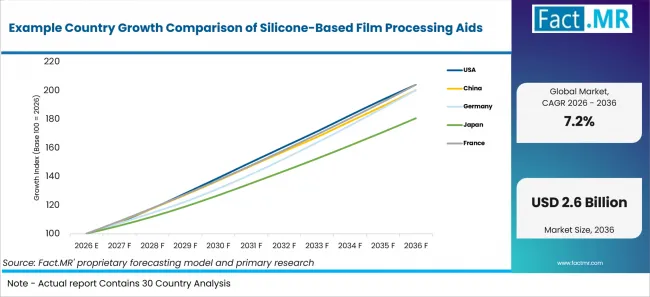
Example Country Growth Comparison Of Silicone Based Film Processing Aids | Source: Fact.MR
| Country | CAGR (2026-2036) |
|---|---|
| France | 7.4% |
| United States | 7.4% |
| China | 7.2% |
| Germany | 7.2% |
| Japan | 6.1% |
What supports USA adoption?
7.4% CAGR, supported by an established plastics base and active film-line investment.
U.S. converters work within a large plastics and rubber manufacturing base. The U.S. Bureau of Economic Analysis reported USD 19.0 billion in new foreign direct investment expenditures for U.S. plastics and rubber products manufacturing in 2025. That scale supports trials focused on melt stability, die cleanliness, and film quality before wider plant use.
How is China scaling demand?
7.2% CAGR, led by growth in rubber and plastic product output.
China has a large polymer-processing base and continued growth in rubber and plastic products. China’s National Bureau of Statistics reported that value added in the manufacture of rubber and plastic products increased 6.1% year over year from January through August 2026. Film processors are expected to keep testing aids that support stable extrusion and surface quality. Repeatable output remains important on high-volume polyethylene and polypropylene lines.
What supports Germany’s adoption?
7.2% CAGR, backed by packaging recycling rules and an established film industry.
Germany links film processing with packaging collection and recycling. The German Environment Agency reported that around 5.5 million tonnes of dual-system packaging waste were recycled in 2024. Film makers therefore need clean extrusion as they adjust structures for recycling. They also need steady surface quality on commercial lines.
How does Japan perform?
6.1% CAGR, shaped by a mature plastics base and steady factory output.
Japan has a mature polymer-conversion base that values repeatable process control. Plastic products were among the industries that contributed to the increase. This base supports measured trials of silicone processing aids.
What supports France’s growth?
7.4% CAGR, driven by active plastics output and changes in packaging materials.
France has an active rubber and plastics sector and ongoing work on packaging circularity. INSEE reported a business-climate index of 101 for rubber and plastic products in May 2026, above the long-term average of 100. This setting supports controlled trials as converters balance stable extrusion with changes in film design.
Who leads the Silicone-Based Film Processing Aids Market?
Dow, Wacker Chemie, Momentive, Evonik, DuPont, and SILIKE form a relevant supplier set for silicone- and siloxane-based polymer processing technologies used in film extrusion and related thermoplastic applications. Their portfolios include silicone masterbatches and siloxane-based processing aids designed to address extrusion efficiency, melt behavior, die buildup, surface properties, and film performance. Competitive differentiation is expected to depend on resin compatibility, recommended dosage, processing stability, and technical application support.
Film-processing evaluations can consider melt fracture, die buildup, extrusion pressure, throughput, haze, gloss, and coefficient of friction. Depending on the application, converters may also assess whether the additive affects downstream printing, sealing, or other converting operations. Supplier documentation from Dow, Evonik, DuPont, Momentive, and other providers specifically addresses several of these processing and downstream-performance factors.
Supplier differences can also appear in compatible resin systems, recommended addition levels, and incorporation methods. Several suppliers provide silicone or siloxane additives that can be introduced through conventional extrusion and compounding processes. Commercial selection may therefore depend on line trials that confirm processing benefits while maintaining the film properties required for subsequent converting operations.
Which companies are the key providers?
Key companies include Dow; Wacker Chemie; Momentive; Evonik; DuPont; and SILIKE.
- Dow
- Wacker Chemie
- DuPont
- Momentive
- Evonik
- SILIKE
Bibliography
- Board of Governors of the Federal Reserve System. (2026, January 16). Industrial production and capacity utilization—G.17: Table 7. Capacity utilization.
- Dow. (2025, September 23). Dow unveils an alternative to fluoropolymer-based polymer processing aids for film packaging.
- Directorate-General for Environment. (2026, August 11). New EU packaging rules start to apply, including restrictions on PFAS in food-contact packaging. European Commission.
- German Environment Agency, & Central Agency Packaging Register. (2026, January 27). Facts against myths: Packaging waste recycling in Germany is working.
- Institut national de la statistique et des études économiques. (2026, May 22). In May 2026, the business climate in manufacturing industry has brightened again.
- Ministère de la Transition écologique. (2026, June 18). Plan plastique : 12 leviers pour réduire, réemployer et recycler les emballages plastiques.
- Ministry of Economy, Trade and Industry. (2026, February 27). Indices of industrial production: Preliminary report for January 2026.
- National Bureau of Statistics of China. (2026, September 16). Industrial production operation in August 2026.
- U.S. Bureau of Economic Analysis. (2026, June 10). New foreign direct investment in the United States, 2025.
This Report Answers
- The report explains where silicone-based film processing aids are used across Processing Aid Chemistry and Processing Function. It also covers Polymer Substrate and Application together with regional demand.
- Segment analysis identifies the leading subsegments and the operational reasons converters prioritize silicone masterbatch, melt-fracture reduction, polyethylene substrates, and blown-film applications.
- Country analysis examines the United States, China, Germany, Japan, and France together with plastics production, film-conversion activity, packaging rules, and recycling conditions supporting processing-aid adoption.
- Competitive analysis reviews current providers across silicone masterbatches, siloxane-based processing aids, extrusion-performance additives, and related polymer-processing technologies. It also considers resin compatibility, dosage guidance, and technical application support.
- Application analysis assesses how melt fracture, die buildup, torque, surface slip, and throughput influence processing-aid selection. It also considers downstream printing, sealing, film optics, and commercial-line stability.
What does the Silicone-Based Film Processing Aids Market cover?
The market covers silicone-containing additives used to improve polymer extrusion. These products can reduce melt fracture and die-lip buildup. Some products also lower torque or improve surface slip when these functions are part of the processing-aid offer.
The assessment covers film-focused systems and nearby extrusion uses. It includes polyethylene, polypropylene, polyamide, polyester, and engineering polymers. Related coverage also looks at process aids where stable lines and good surface quality matter.
What is included in the scope?
The scope includes silicone masterbatch, siloxane polymer, fluorosilicone-free hybrids, silicone gum concentrates, and specialty organosilicone aids.
It covers blown film, cast film, extrusion coating, pipe/profile, and wire/cable. Nearby film additives are discussed only when they help explain extrusion performance.
What is excluded from the scope?
The scope excludes base silicone polymers with no processing-aid role. It also excludes general release coatings, non-silicone lubricants, and finished films with no separate aid value.
Nearby context includes other polymer aids and specialty film materials. Coating wet-out technologies remain outside the melt-processing scope.
How Was the Analysis Built?
The analysis draws on 120+ sources, 35+ company portfolios, 25+ countries, and more than 20 industry interviews.
- Primary Research: Primary research includes discussions with manufacturers, service providers, technology developers, distributors, end users, and subject-matter experts. These conversations examine purchasing priorities, product adoption, operational challenges, approval requirements, competitive positioning, and the factors that influence wider market acceptance.
- Desk Research: Desk research covers government statistics, regulatory publications, company filings, trade data, technical studies, industry associations, standards, public policy, and other authoritative sources. Every source used in the analysis is documented in the bibliography.
- Market Sizing and Forecasting: Market estimates combine historical performance, demand indicators, pricing and volume trends, segment shares, company participation, country-level growth, adoption patterns, investment activity, and barriers to market expansion.
- Data Validation and Update Cycle: Findings are validated by comparing primary interviews with public data, company activity, regulatory changes, trade patterns, and industry developments. Regular updates review new product launches, capacity changes, partnerships, approvals, and shifts in commercial adoption.
What is the report’s scope and coverage?
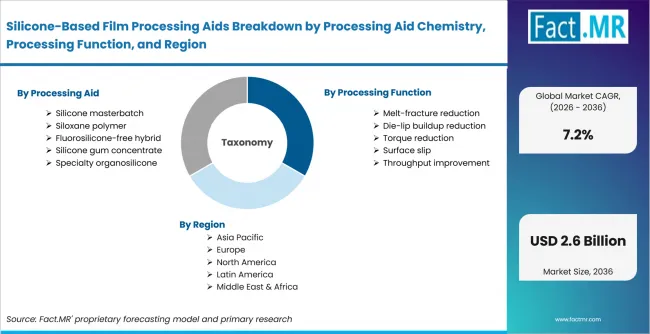
Silicone Based Film Processing Aids Breakdown By Processing Aid Chemistry, Processing Function, And Region | Source: Fact.MR
| Attribute | Details |
|---|---|
| Quantitative Units | USD Billion |
| Market Definition | Silicone-based additives and masterbatches used to improve thermoplastic extrusion behavior, with emphasis on film processing, melt-fracture control, die cleanliness, torque, slip, and throughput. |
| Processing Aid Chemistry | Silicone masterbatch; Siloxane polymer; Fluorosilicone-free hybrid; Silicone gum concentrate; Specialty organosilicone |
| Processing Function | Melt-fracture reduction; Die-lip buildup reduction; Torque reduction; Surface slip; Throughput improvement |
| Polymer Substrate | Polyethylene; Polypropylene; Polyamide; Polyester; Engineering polymers |
| Application | Blown film; Cast film; Extrusion coating; Pipe / profile; Wire / cable |
| Regions Covered | North America; Latin America; Western Europe; Eastern Europe; East Asia; South Asia & Pacific; Middle East & Africa |
| Countries Covered | United States; China; Germany; Japan; France |
| Key Companies Profiled | Dow; Wacker Chemie; Shin-Etsu Chemical; Momentive; Evonik; Mitsubishi Chemical Group |
| Forecast Period | 2026 to 2036 |
| Approach | Hybrid top-down and bottom-up approach using film-conversion activity, additive function, substrate mix, country indicators, and provider portfolio review. |
How is the market segmented?
-
By Processing Aid Chemistry:
- Silicone masterbatch
- Siloxane polymer
- Fluorosilicone-free hybrid
- Silicone gum concentrate
- Specialty organosilicone
-
By Processing Function:
- Melt-fracture reduction
- Die-lip buildup reduction
- Torque reduction
- Surface slip
- Throughput improvement
-
By Polymer Substrate:
- Polyethylene
- Polypropylene
- Polyamide
- Polyester
- Engineering polymers
-
By Application:
- Blown film
- Cast film
- Extrusion coating
- Pipe / profile
- Wire / cable
-
By Region:
- North America
- Latin America
- Western Europe
- Eastern Europe
- East Asia
- South Asia & Pacific
- Middle East & Africa