Biofilm-Breaking Fungicide Adjuvant Market
Biofilm-Breaking Fungicide Adjuvant Market Size and Share Forecast Outlook 2026 to 2036
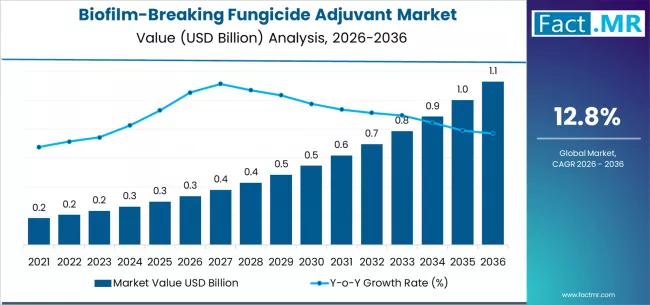
Biofilm-breaking fungicide adjuvant market is projected to grow from USD 0.3 billion in 2026 to USD 1.1 billion by 2036, at a CAGR of 12.8%. Biofilm Disruptors & Penetration Enhancers will dominate with a 36.0% market share, while systemic fungicides will lead the fungicide compatibility segment with a 41.0% share.
Biofilm-Breaking Fungicide Adjuvant Market Forecast and Outlook 2026 to 2036
The global biofilm-breaking fungicide adjuvant market is projected to reach USD 1.13 Billion by 2036. The market is valued at USD 0.34 Billion in 2026 and is set to rise at a CAGR of 12.8% during the assessment period. By adjuvant function type, biofilm disruptors & penetration enhancers hold a leading 36% share. Compatibility with systemic fungicides represents a dominant 41.0% segment, while the fruits & vegetables crop type accounts for 44% market share.
Key Takeaways from the Biofilm-Breaking Fungicide Adjuvant Market
- Market Value for 2026: USD 0.34 Billion
- Market Value for 2036: USD 1.13 Billion
- Forecast CAGR (2026-2036): 12.8%
- Leading Adjuvant Function Type Share (2026): Biofilm Disruptors & Penetration Enhancers (36%)
- Leading Fungicide Compatibility Share (2026): Systemic Fungicides (41.0%)
- Leading Crop Type Share (2026): Fruits & Vegetables (44%)
- Key Players in the Market: BASF SE, Bayer CropScience, Syngenta Group, Corteva Agriscience, Clariant AG
A key trend is the integration of multi-mode adjuvant systems that combine wetting, penetration, and targeted biofilm degradation. Research is accelerating into enzyme-activated formulations that offer precise breakdown of fungal extracellular matrices. The push for resistance management is driving demand for adjuvants that restore the efficacy of established fungicide chemistries, particularly in high-value perennial crops.
Evolving regulatory views on adjuvant safety and claims substantiation are shaping product development. Guidelines encouraging reduced fungicide volumes through enhanced efficacy support market growth. Policies aimed at sustainable intensification indirectly promote these adjuvant technologies by maximizing the performance of existing crop protection inputs.
Biofilm-Breaking Fungicide Adjuvant Market
| Metric | Value |
|---|---|
| Market Value (2026) | USD 0.34 Billion |
| Market Forecast Value (2036) | USD 1.13 Billion |
| Forecast CAGR (2026-2036) | 12.8% |
Category
| Category | Segments |
|---|---|
| Adjuvant Function Type | Biofilm Disruptors & Penetration Enhancers, Surfactant-Chelator Blends, Enzyme-Activated Biofilm Degraders, Polymer-Based Wetting & Spreading Agents, Others |
| Fungicide Compatibility | Systemic Fungicides, Contact Fungicides, Biological Fungicides, Copper & Sulfur-Based Products, Others |
| Crop Type | Fruits & Vegetables, Vineyards, Plantation & Specialty Crops, Cereals & Grains, Others |
| Region | North America, Latin America, Western Europe, Eastern Europe, East Asia, South Asia & Pacific, MEA |
Segmental Analysis
By Adjuvant Function, Which Mechanism Addresses Core Efficacy Challenges?
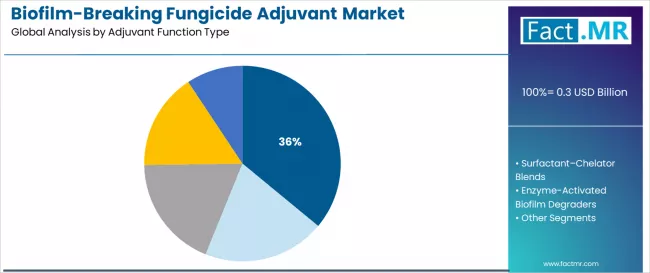
Biofilm disruptors & penetration enhancers lead the segment with a 36% share. This dominance stems from their direct action against the physical barrier formed by fungal pathogens, which is a primary cause of fungicide failure. These adjuvants improve active ingredient uptake and translocation, offering a solution to declining product performance and strengthening integrated disease management programs for growers.
By Fungicide Compatibility, Which Chemistry Pairing is Most Critical?
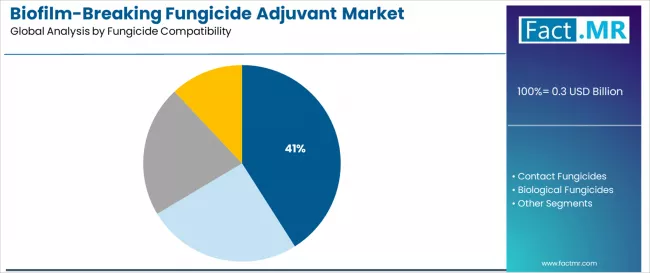
Compatibility with systemic fungicides holds the largest share at 41.0%. Systemic actives are foundational to modern disease control but are highly vulnerable to biofilm-mediated resistance. Adjuvants that enhance their uptake and distribution within the plant are essential for protecting this valuable chemistry class and extending its commercial lifecycle in key markets.
By Crop Type, Where is the Economic Imperative for Enhanced Control Greatest?
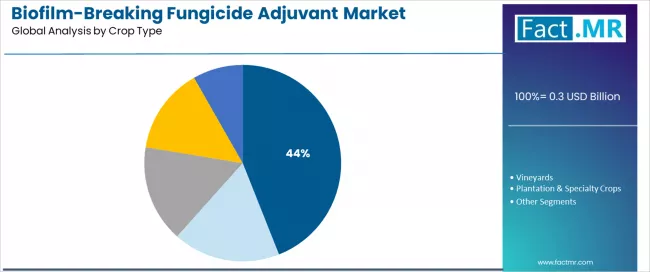
The fruits and vegetables segment commands a 44% share. The high economic value of these crops, combined with severe market penalties for cosmetic defects caused by diseases like powdery mildew and botrytis, creates a strong incentive for investment. Growers utilize these adjuvants to ensure robust fungicide performance, protect yield quality, and meet stringent residue standards for fresh produce.
What are the Drivers, Restraints, and Key Trends of the Biofilm-Breaking Fungicide Adjuvant Market?
Market growth is driven by the escalating challenge of fungicide resistance, which compels growers to seek solutions that improve existing product efficacy. The rising adoption of biological fungicides, which often struggle with delivery and persistence, further fuels demand for performance-enhancing adjuvants. A growing focus on spray application efficiency and droplet retention supports adoption.
A significant restraint is the complexity of registration for adjuvant claims related to biofilm disruption in many regions. Grower education on proper mixing and application protocols remains a hurdle for consistent results. The niche, technical positioning of these products can also limit broad-acre adoption compared to conventional surfactants.
Key trends include the formulation of adjuvant-fungicide pre-mixes for user convenience. Development of green adjuvant chemistries derived from biological sources is gaining momentum. Digital tools for adjuvant selection based on pathogen, crop, and tank-mix partners are emerging to guide grower decisions.
Analysis of the Biofilm-Breaking Fungicide Adjuvant Market by Key Countries
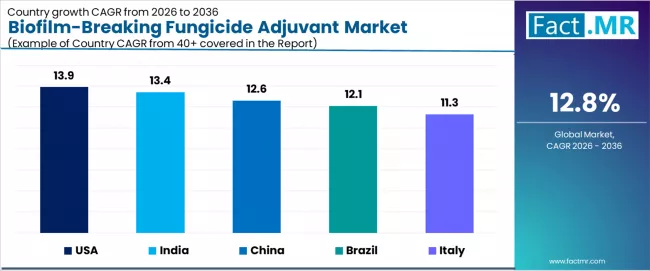
| Country | CAGR (2026-2036) |
|---|---|
| USA | 13.90% |
| India | 13.40% |
| China | 12.60% |
| Brazil | 12.10% |
| Italy | 11.30% |
How does the USA Drive Adoption through Advanced Resistance Management?
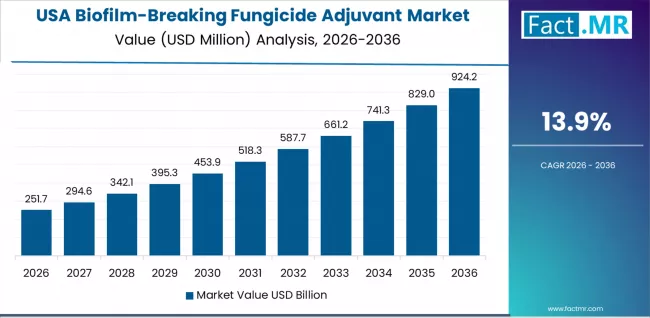
The USA leads with a 13.90% CAGR, driven by sophisticated resistance management programs in high-value specialty crops. Growers in states like California, Florida, and Washington face intense pressure from resistant fungal strains in vineyards, orchards, and vegetable fields. The well-developed network of crop advisors actively promotes adjuvant use as a tactical tool within anti-resistance strategies, supporting steady market integration.
Why does India Present High-Growth Potential in a Diverse Agricultural Sector?
India's 13.40% growth is linked to its vast and diverse horticulture sector, where fungal diseases cause substantial pre- and post-harvest losses. Increasing commercial cultivation of fruits and vegetables under contract farming models is driving demand for advanced crop protection inputs. The need to maximize the efficacy of every fungicide application in a cost-conscious market underpins adjuvant adoption.
What Factors Support China's Steady Growth in Precision Agriculture?
China's 12.60% CAGR reflects the expansion of protected cultivation and large-scale fruit production, where disease control is critical. Government emphasis on reducing chemical pesticide loads per unit area creates a favorable environment for efficacy-enhancing adjuvants. Domestic adjuvant manufacturers are increasingly developing and promoting specialized products compatible with commonly used systemic fungicides.
How is Brazil's Large-Scale Agriculture Leveraging Adjuvant Technology?
Brazil's 12.10% growth is anchored in its massive soybean, sugarcane, and citrus sectors, where fungal pressure is high. The scale of farming operations makes even marginal improvements in fungicide performance highly valuable. Adjuvants are increasingly viewed as essential components in spray programs to overcome challenging application conditions and improve canopy penetration in dense crops.
What Role Does Italy's Specialized Viticulture and Horticulture Play?
Italy's 11.30% growth, though the most modest among key countries, is sustained by its premium wine grape and high-value vegetable production. Fungicide resistance in powdery and downy mildews is a persistent concern. Quality-focused growers are early adopters of adjuvant technologies that protect the efficacy of critical fungicides, ensuring crop health and meeting export quality standards for grapes and processed tomatoes.
Competitive Landscape of the Biofilm-Breaking Fungicide Adjuvant Market
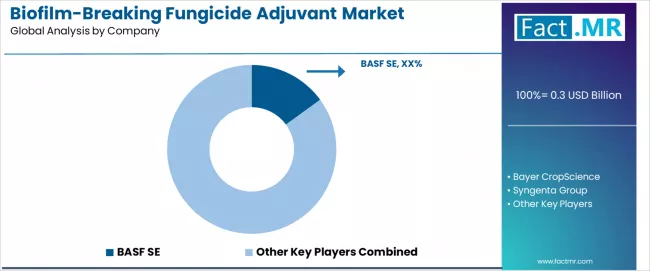
The market features established agrochemical giants and specialty chemical firms. Companies like BASF SE, Bayer CropScience, and Syngenta Group leverage their deep understanding of fungicide modes of action to develop tailored adjuvant systems, often bundling them with proprietary fungicides. Corteva Agriscience competes with a strong portfolio focused on integration with its crop protection products.
Specialty chemical players like Clariant AG focus on innovative surfactant and polymer chemistries designed for specific biofilm challenges. Competition centers on technical differentiation, proven field data across multiple crops and pathogens, and securing compatibility listings with major fungicide brands. Success depends on demonstrating a clear return on investment through improved disease control and resistance management for growers.
Key Players in the Biofilm-Breaking Fungicide Adjuvant Market
- BASF SE
- Bayer CropScience
- Syngenta Group
- Corteva Agriscience
- Clariant AG
Scope of Report
| Items | Values |
|---|---|
| Quantitative Units | USD Billion |
| Adjuvant Function Type | Biofilm Disruptors & Penetration Enhancers, Surfactant-Chelator Blends, Enzyme-Activated Biofilm Degraders, Polymer-Based Wetting & Spreading Agents, Others |
| Fungicide Compatibility | Systemic Fungicides, Contact Fungicides, Biological Fungicides, Copper & Sulfur-Based Products, Others |
| Crop Type | Fruits & Vegetables, Vineyards, Plantation & Specialty Crops, Cereals & Grains, Others |
| Key Countries | USA, India, China, Brazil, Italy |
| Key Companies | BASF SE, Bayer CropScience, Syngenta Group, Corteva Agriscience, Clariant AG |
| Additional Analysis | Analysis of adjuvant-fungicide interaction data, regulatory landscape for efficacy claims, resistance management integration strategies, application technology synergy, and cost-benefit adoption modeling. |
Biofilm-Breaking Fungicide Adjuvant Market by Segments
-
Adjuvant Function Type :
- Biofilm Disruptors & Penetration Enhancers
- Surfactant-Chelator Blends
- Enzyme-Activated Biofilm Degraders
- Polymer-Based Wetting & Spreading Agents
- Others
-
Fungicide Compatibility :
- Systemic Fungicides
- Contact Fungicides
- Biological Fungicides
- Copper & Sulfur-Based Products
- Others
-
Crop Type :
- Fruits & Vegetables
- Vineyards
- Plantation & Specialty Crops
- Cereals & Grains
- Others
-
Region :
-
North America
- USA
- Canada
-
Latin America
- Brazil
- Mexico
- Argentina
- Rest of Latin America
-
Western Europe
- Germany
- UK
- France
- Spain
- Italy
- BENELUX
- Rest of Western Europe
-
Eastern Europe
- Czech Republic
- Poland
- Russia
- Rest of Eastern Europe
-
East Asia
- China
- Japan
- South Korea
- Rest of East Asia
-
South Asia & Pacific
- India
- Indonesia
- Australia
- Rest of South Asia & Pacific
-
MEA
- GCC Countries
- Turkiye
- Saudi Arabia
- Rest of MEA
-
Table of Content
- Executive Summary
- Global Market Outlook
- Demand to side Trends
- Supply to side Trends
- Technology Roadmap Analysis
- Analysis and Recommendations
- Market Overview
- Market Coverage / Taxonomy
- Market Definition / Scope / Limitations
- Market Background
- Market Dynamics
- Drivers
- Restraints
- Opportunity
- Trends
- Scenario Forecast
- Demand in Optimistic Scenario
- Demand in Likely Scenario
- Demand in Conservative Scenario
- Opportunity Map Analysis
- Product Life Cycle Analysis
- Supply Chain Analysis
- Investment Feasibility Matrix
- Value Chain Analysis
- PESTLE and Porter’s Analysis
- Regulatory Landscape
- Regional Parent Market Outlook
- Production and Consumption Statistics
- Import and Export Statistics
- Market Dynamics
- Global Market Analysis 2021 to 2025 and Forecast, 2026 to 2036
- Historical Market Size Value (USD Million) Analysis, 2021 to 2025
- Current and Future Market Size Value (USD Million) Projections, 2026 to 2036
- Y to o to Y Growth Trend Analysis
- Absolute $ Opportunity Analysis
- Global Market Pricing Analysis 2021 to 2025 and Forecast 2026 to 2036
- Global Market Analysis 2021 to 2025 and Forecast 2026 to 2036, By Adjuvant Function Type
- Introduction / Key Findings
- Historical Market Size Value (USD Million) Analysis By Adjuvant Function Type, 2021 to 2025
- Current and Future Market Size Value (USD Million) Analysis and Forecast By Adjuvant Function Type, 2026 to 2036
- Biofilm Disruptors & Penetration Enhancers
- Surfactant-Chelator Blends
- Enzyme-Activated Biofilm Degraders
- Polymer-Based Wetting & Spreading Agents
- Others
- Biofilm Disruptors & Penetration Enhancers
- Y to o to Y Growth Trend Analysis By Adjuvant Function Type, 2021 to 2025
- Absolute $ Opportunity Analysis By Adjuvant Function Type, 2026 to 2036
- Global Market Analysis 2021 to 2025 and Forecast 2026 to 2036, By Fungicide Compatibility
- Introduction / Key Findings
- Historical Market Size Value (USD Million) Analysis By Fungicide Compatibility, 2021 to 2025
- Current and Future Market Size Value (USD Million) Analysis and Forecast By Fungicide Compatibility, 2026 to 2036
- Systemic Fungicides
- Contact Fungicides
- Biological Fungicides
- Copper & Sulfur-Based Products
- Systemic Fungicides
- Y to o to Y Growth Trend Analysis By Fungicide Compatibility, 2021 to 2025
- Absolute $ Opportunity Analysis By Fungicide Compatibility, 2026 to 2036
- Global Market Analysis 2021 to 2025 and Forecast 2026 to 2036, By Crop Type
- Introduction / Key Findings
- Historical Market Size Value (USD Million) Analysis By Crop Type, 2021 to 2025
- Current and Future Market Size Value (USD Million) Analysis and Forecast By Crop Type, 2026 to 2036
- Fruits & Vegetables
- Vineyards
- Plantation & Specialty Crops
- Cereals & Grains
- Others
- Fruits & Vegetables
- Y to o to Y Growth Trend Analysis By Crop Type, 2021 to 2025
- Absolute $ Opportunity Analysis By Crop Type, 2026 to 2036
- Global Market Analysis 2021 to 2025 and Forecast 2026 to 2036, By Region
- Introduction
- Historical Market Size Value (USD Million) Analysis By Region, 2021 to 2025
- Current Market Size Value (USD Million) Analysis and Forecast By Region, 2026 to 2036
- North America
- Latin America
- Western Europe
- Eastern Europe
- East Asia
- South Asia and Pacific
- Middle East & Africa
- Market Attractiveness Analysis By Region
- North America Market Analysis 2021 to 2025 and Forecast 2026 to 2036, By Country
- Historical Market Size Value (USD Million) Trend Analysis By Market Taxonomy, 2021 to 2025
- Market Size Value (USD Million) Forecast By Market Taxonomy, 2026 to 2036
- By Country
- USA
- Canada
- Mexico
- By Adjuvant Function Type
- By Fungicide Compatibility
- By Crop Type
- By Country
- Market Attractiveness Analysis
- By Country
- By Adjuvant Function Type
- By Fungicide Compatibility
- By Crop Type
- Key Takeaways
- Latin America Market Analysis 2021 to 2025 and Forecast 2026 to 2036, By Country
- Historical Market Size Value (USD Million) Trend Analysis By Market Taxonomy, 2021 to 2025
- Market Size Value (USD Million) Forecast By Market Taxonomy, 2026 to 2036
- By Country
- Brazil
- Chile
- Rest of Latin America
- By Adjuvant Function Type
- By Fungicide Compatibility
- By Crop Type
- By Country
- Market Attractiveness Analysis
- By Country
- By Adjuvant Function Type
- By Fungicide Compatibility
- By Crop Type
- Key Takeaways
- Western Europe Market Analysis 2021 to 2025 and Forecast 2026 to 2036, By Country
- Historical Market Size Value (USD Million) Trend Analysis By Market Taxonomy, 2021 to 2025
- Market Size Value (USD Million) Forecast By Market Taxonomy, 2026 to 2036
- By Country
- Germany
- UK
- Italy
- Spain
- France
- Nordic
- BENELUX
- Rest of Western Europe
- By Adjuvant Function Type
- By Fungicide Compatibility
- By Crop Type
- By Country
- Market Attractiveness Analysis
- By Country
- By Adjuvant Function Type
- By Fungicide Compatibility
- By Crop Type
- Key Takeaways
- Eastern Europe Market Analysis 2021 to 2025 and Forecast 2026 to 2036, By Country
- Historical Market Size Value (USD Million) Trend Analysis By Market Taxonomy, 2021 to 2025
- Market Size Value (USD Million) Forecast By Market Taxonomy, 2026 to 2036
- By Country
- Russia
- Poland
- Hungary
- Balkan & Baltic
- Rest of Eastern Europe
- By Adjuvant Function Type
- By Fungicide Compatibility
- By Crop Type
- By Country
- Market Attractiveness Analysis
- By Country
- By Adjuvant Function Type
- By Fungicide Compatibility
- By Crop Type
- Key Takeaways
- East Asia Market Analysis 2021 to 2025 and Forecast 2026 to 2036, By Country
- Historical Market Size Value (USD Million) Trend Analysis By Market Taxonomy, 2021 to 2025
- Market Size Value (USD Million) Forecast By Market Taxonomy, 2026 to 2036
- By Country
- China
- Japan
- South Korea
- By Adjuvant Function Type
- By Fungicide Compatibility
- By Crop Type
- By Country
- Market Attractiveness Analysis
- By Country
- By Adjuvant Function Type
- By Fungicide Compatibility
- By Crop Type
- Key Takeaways
- South Asia and Pacific Market Analysis 2021 to 2025 and Forecast 2026 to 2036, By Country
- Historical Market Size Value (USD Million) Trend Analysis By Market Taxonomy, 2021 to 2025
- Market Size Value (USD Million) Forecast By Market Taxonomy, 2026 to 2036
- By Country
- India
- ASEAN
- Australia & New Zealand
- Rest of South Asia and Pacific
- By Adjuvant Function Type
- By Fungicide Compatibility
- By Crop Type
- By Country
- Market Attractiveness Analysis
- By Country
- By Adjuvant Function Type
- By Fungicide Compatibility
- By Crop Type
- Key Takeaways
- Middle East & Africa Market Analysis 2021 to 2025 and Forecast 2026 to 2036, By Country
- Historical Market Size Value (USD Million) Trend Analysis By Market Taxonomy, 2021 to 2025
- Market Size Value (USD Million) Forecast By Market Taxonomy, 2026 to 2036
- By Country
- Kingdom of Saudi Arabia
- Other GCC Countries
- Turkiye
- South Africa
- Other African Union
- Rest of Middle East & Africa
- By Adjuvant Function Type
- By Fungicide Compatibility
- By Crop Type
- By Country
- Market Attractiveness Analysis
- By Country
- By Adjuvant Function Type
- By Fungicide Compatibility
- By Crop Type
- Key Takeaways
- Key Countries Market Analysis
- USA
- Pricing Analysis
- Market Share Analysis, 2025
- By Adjuvant Function Type
- By Fungicide Compatibility
- By Crop Type
- Canada
- Pricing Analysis
- Market Share Analysis, 2025
- By Adjuvant Function Type
- By Fungicide Compatibility
- By Crop Type
- Mexico
- Pricing Analysis
- Market Share Analysis, 2025
- By Adjuvant Function Type
- By Fungicide Compatibility
- By Crop Type
- Brazil
- Pricing Analysis
- Market Share Analysis, 2025
- By Adjuvant Function Type
- By Fungicide Compatibility
- By Crop Type
- Chile
- Pricing Analysis
- Market Share Analysis, 2025
- By Adjuvant Function Type
- By Fungicide Compatibility
- By Crop Type
- Germany
- Pricing Analysis
- Market Share Analysis, 2025
- By Adjuvant Function Type
- By Fungicide Compatibility
- By Crop Type
- UK
- Pricing Analysis
- Market Share Analysis, 2025
- By Adjuvant Function Type
- By Fungicide Compatibility
- By Crop Type
- Italy
- Pricing Analysis
- Market Share Analysis, 2025
- By Adjuvant Function Type
- By Fungicide Compatibility
- By Crop Type
- Spain
- Pricing Analysis
- Market Share Analysis, 2025
- By Adjuvant Function Type
- By Fungicide Compatibility
- By Crop Type
- France
- Pricing Analysis
- Market Share Analysis, 2025
- By Adjuvant Function Type
- By Fungicide Compatibility
- By Crop Type
- India
- Pricing Analysis
- Market Share Analysis, 2025
- By Adjuvant Function Type
- By Fungicide Compatibility
- By Crop Type
- ASEAN
- Pricing Analysis
- Market Share Analysis, 2025
- By Adjuvant Function Type
- By Fungicide Compatibility
- By Crop Type
- Australia & New Zealand
- Pricing Analysis
- Market Share Analysis, 2025
- By Adjuvant Function Type
- By Fungicide Compatibility
- By Crop Type
- China
- Pricing Analysis
- Market Share Analysis, 2025
- By Adjuvant Function Type
- By Fungicide Compatibility
- By Crop Type
- Japan
- Pricing Analysis
- Market Share Analysis, 2025
- By Adjuvant Function Type
- By Fungicide Compatibility
- By Crop Type
- South Korea
- Pricing Analysis
- Market Share Analysis, 2025
- By Adjuvant Function Type
- By Fungicide Compatibility
- By Crop Type
- Russia
- Pricing Analysis
- Market Share Analysis, 2025
- By Adjuvant Function Type
- By Fungicide Compatibility
- By Crop Type
- Poland
- Pricing Analysis
- Market Share Analysis, 2025
- By Adjuvant Function Type
- By Fungicide Compatibility
- By Crop Type
- Hungary
- Pricing Analysis
- Market Share Analysis, 2025
- By Adjuvant Function Type
- By Fungicide Compatibility
- By Crop Type
- Kingdom of Saudi Arabia
- Pricing Analysis
- Market Share Analysis, 2025
- By Adjuvant Function Type
- By Fungicide Compatibility
- By Crop Type
- Turkiye
- Pricing Analysis
- Market Share Analysis, 2025
- By Adjuvant Function Type
- By Fungicide Compatibility
- By Crop Type
- South Africa
- Pricing Analysis
- Market Share Analysis, 2025
- By Adjuvant Function Type
- By Fungicide Compatibility
- By Crop Type
- USA
- Market Structure Analysis
- Competition Dashboard
- Competition Benchmarking
- Market Share Analysis of Top Players
- By Regional
- By Adjuvant Function Type
- By Fungicide Compatibility
- By Crop Type
- Competition Analysis
- Competition Deep Dive
- BASF SE
- Overview
- Product Portfolio
- Profitability by Market Segments (Product/Age /Sales Channel/Region)
- Sales Footprint
- Strategy Overview
- Marketing Strategy
- Product Strategy
- Channel Strategy
- Bayer CropScience
- Syngenta Group
- Corteva Agriscience
- Clariant AG
- BASF SE
- Competition Deep Dive
- Assumptions & Acronyms Used
- Research Methodology
List Of Table
- Table 1: Global Market Value (USD Million) Forecast by Region, 2021 to 2036
- Table 2: Global Market Value (USD Million) Forecast by Adjuvant Function Type, 2021 to 2036
- Table 3: Global Market Value (USD Million) Forecast by Fungicide Compatibility, 2021 to 2036
- Table 4: Global Market Value (USD Million) Forecast by Crop Type, 2021 to 2036
- Table 5: North America Market Value (USD Million) Forecast by Country, 2021 to 2036
- Table 6: North America Market Value (USD Million) Forecast by Adjuvant Function Type, 2021 to 2036
- Table 7: North America Market Value (USD Million) Forecast by Fungicide Compatibility, 2021 to 2036
- Table 8: North America Market Value (USD Million) Forecast by Crop Type, 2021 to 2036
- Table 9: Latin America Market Value (USD Million) Forecast by Country, 2021 to 2036
- Table 10: Latin America Market Value (USD Million) Forecast by Adjuvant Function Type, 2021 to 2036
- Table 11: Latin America Market Value (USD Million) Forecast by Fungicide Compatibility, 2021 to 2036
- Table 12: Latin America Market Value (USD Million) Forecast by Crop Type, 2021 to 2036
- Table 13: Western Europe Market Value (USD Million) Forecast by Country, 2021 to 2036
- Table 14: Western Europe Market Value (USD Million) Forecast by Adjuvant Function Type, 2021 to 2036
- Table 15: Western Europe Market Value (USD Million) Forecast by Fungicide Compatibility, 2021 to 2036
- Table 16: Western Europe Market Value (USD Million) Forecast by Crop Type, 2021 to 2036
- Table 17: Eastern Europe Market Value (USD Million) Forecast by Country, 2021 to 2036
- Table 18: Eastern Europe Market Value (USD Million) Forecast by Adjuvant Function Type, 2021 to 2036
- Table 19: Eastern Europe Market Value (USD Million) Forecast by Fungicide Compatibility, 2021 to 2036
- Table 20: Eastern Europe Market Value (USD Million) Forecast by Crop Type, 2021 to 2036
- Table 21: East Asia Market Value (USD Million) Forecast by Country, 2021 to 2036
- Table 22: East Asia Market Value (USD Million) Forecast by Adjuvant Function Type, 2021 to 2036
- Table 23: East Asia Market Value (USD Million) Forecast by Fungicide Compatibility, 2021 to 2036
- Table 24: East Asia Market Value (USD Million) Forecast by Crop Type, 2021 to 2036
- Table 25: South Asia and Pacific Market Value (USD Million) Forecast by Country, 2021 to 2036
- Table 26: South Asia and Pacific Market Value (USD Million) Forecast by Adjuvant Function Type, 2021 to 2036
- Table 27: South Asia and Pacific Market Value (USD Million) Forecast by Fungicide Compatibility, 2021 to 2036
- Table 28: South Asia and Pacific Market Value (USD Million) Forecast by Crop Type, 2021 to 2036
- Table 29: Middle East & Africa Market Value (USD Million) Forecast by Country, 2021 to 2036
- Table 30: Middle East & Africa Market Value (USD Million) Forecast by Adjuvant Function Type, 2021 to 2036
- Table 31: Middle East & Africa Market Value (USD Million) Forecast by Fungicide Compatibility, 2021 to 2036
- Table 32: Middle East & Africa Market Value (USD Million) Forecast by Crop Type, 2021 to 2036
List Of Figures
- Figure 1: Global Market Pricing Analysis
- Figure 2: Global Market Value (USD Million) Forecast 2021 to 2036
- Figure 3: Global Market Value Share and BPS Analysis by Adjuvant Function Type, 2026 and 2036
- Figure 4: Global Market Y to o to Y Growth Comparison by Adjuvant Function Type, 2026 to 2036
- Figure 5: Global Market Attractiveness Analysis by Adjuvant Function Type
- Figure 6: Global Market Value Share and BPS Analysis by Fungicide Compatibility, 2026 and 2036
- Figure 7: Global Market Y to o to Y Growth Comparison by Fungicide Compatibility, 2026 to 2036
- Figure 8: Global Market Attractiveness Analysis by Fungicide Compatibility
- Figure 9: Global Market Value Share and BPS Analysis by Crop Type, 2026 and 2036
- Figure 10: Global Market Y to o to Y Growth Comparison by Crop Type, 2026 to 2036
- Figure 11: Global Market Attractiveness Analysis by Crop Type
- Figure 12: Global Market Value (USD Million) Share and BPS Analysis by Region, 2026 and 2036
- Figure 13: Global Market Y to o to Y Growth Comparison by Region, 2026 to 2036
- Figure 14: Global Market Attractiveness Analysis by Region
- Figure 15: North America Market Incremental Dollar Opportunity, 2026 to 2036
- Figure 16: Latin America Market Incremental Dollar Opportunity, 2026 to 2036
- Figure 17: Western Europe Market Incremental Dollar Opportunity, 2026 to 2036
- Figure 18: Eastern Europe Market Incremental Dollar Opportunity, 2026 to 2036
- Figure 19: East Asia Market Incremental Dollar Opportunity, 2026 to 2036
- Figure 20: South Asia and Pacific Market Incremental Dollar Opportunity, 2026 to 2036
- Figure 21: Middle East & Africa Market Incremental Dollar Opportunity, 2026 to 2036
- Figure 22: North America Market Value Share and BPS Analysis by Country, 2026 and 2036
- Figure 23: North America Market Value Share and BPS Analysis by Adjuvant Function Type, 2026 and 2036
- Figure 24: North America Market Y to o to Y Growth Comparison by Adjuvant Function Type, 2026 to 2036
- Figure 25: North America Market Attractiveness Analysis by Adjuvant Function Type
- Figure 26: North America Market Value Share and BPS Analysis by Fungicide Compatibility, 2026 and 2036
- Figure 27: North America Market Y to o to Y Growth Comparison by Fungicide Compatibility, 2026 to 2036
- Figure 28: North America Market Attractiveness Analysis by Fungicide Compatibility
- Figure 29: North America Market Value Share and BPS Analysis by Crop Type, 2026 and 2036
- Figure 30: North America Market Y to o to Y Growth Comparison by Crop Type, 2026 to 2036
- Figure 31: North America Market Attractiveness Analysis by Crop Type
- Figure 32: Latin America Market Value Share and BPS Analysis by Country, 2026 and 2036
- Figure 33: Latin America Market Value Share and BPS Analysis by Adjuvant Function Type, 2026 and 2036
- Figure 34: Latin America Market Y to o to Y Growth Comparison by Adjuvant Function Type, 2026 to 2036
- Figure 35: Latin America Market Attractiveness Analysis by Adjuvant Function Type
- Figure 36: Latin America Market Value Share and BPS Analysis by Fungicide Compatibility, 2026 and 2036
- Figure 37: Latin America Market Y to o to Y Growth Comparison by Fungicide Compatibility, 2026 to 2036
- Figure 38: Latin America Market Attractiveness Analysis by Fungicide Compatibility
- Figure 39: Latin America Market Value Share and BPS Analysis by Crop Type, 2026 and 2036
- Figure 40: Latin America Market Y to o to Y Growth Comparison by Crop Type, 2026 to 2036
- Figure 41: Latin America Market Attractiveness Analysis by Crop Type
- Figure 42: Western Europe Market Value Share and BPS Analysis by Country, 2026 and 2036
- Figure 43: Western Europe Market Value Share and BPS Analysis by Adjuvant Function Type, 2026 and 2036
- Figure 44: Western Europe Market Y to o to Y Growth Comparison by Adjuvant Function Type, 2026 to 2036
- Figure 45: Western Europe Market Attractiveness Analysis by Adjuvant Function Type
- Figure 46: Western Europe Market Value Share and BPS Analysis by Fungicide Compatibility, 2026 and 2036
- Figure 47: Western Europe Market Y to o to Y Growth Comparison by Fungicide Compatibility, 2026 to 2036
- Figure 48: Western Europe Market Attractiveness Analysis by Fungicide Compatibility
- Figure 49: Western Europe Market Value Share and BPS Analysis by Crop Type, 2026 and 2036
- Figure 50: Western Europe Market Y to o to Y Growth Comparison by Crop Type, 2026 to 2036
- Figure 51: Western Europe Market Attractiveness Analysis by Crop Type
- Figure 52: Eastern Europe Market Value Share and BPS Analysis by Country, 2026 and 2036
- Figure 53: Eastern Europe Market Value Share and BPS Analysis by Adjuvant Function Type, 2026 and 2036
- Figure 54: Eastern Europe Market Y to o to Y Growth Comparison by Adjuvant Function Type, 2026 to 2036
- Figure 55: Eastern Europe Market Attractiveness Analysis by Adjuvant Function Type
- Figure 56: Eastern Europe Market Value Share and BPS Analysis by Fungicide Compatibility, 2026 and 2036
- Figure 57: Eastern Europe Market Y to o to Y Growth Comparison by Fungicide Compatibility, 2026 to 2036
- Figure 58: Eastern Europe Market Attractiveness Analysis by Fungicide Compatibility
- Figure 59: Eastern Europe Market Value Share and BPS Analysis by Crop Type, 2026 and 2036
- Figure 60: Eastern Europe Market Y to o to Y Growth Comparison by Crop Type, 2026 to 2036
- Figure 61: Eastern Europe Market Attractiveness Analysis by Crop Type
- Figure 62: East Asia Market Value Share and BPS Analysis by Country, 2026 and 2036
- Figure 63: East Asia Market Value Share and BPS Analysis by Adjuvant Function Type, 2026 and 2036
- Figure 64: East Asia Market Y to o to Y Growth Comparison by Adjuvant Function Type, 2026 to 2036
- Figure 65: East Asia Market Attractiveness Analysis by Adjuvant Function Type
- Figure 66: East Asia Market Value Share and BPS Analysis by Fungicide Compatibility, 2026 and 2036
- Figure 67: East Asia Market Y to o to Y Growth Comparison by Fungicide Compatibility, 2026 to 2036
- Figure 68: East Asia Market Attractiveness Analysis by Fungicide Compatibility
- Figure 69: East Asia Market Value Share and BPS Analysis by Crop Type, 2026 and 2036
- Figure 70: East Asia Market Y to o to Y Growth Comparison by Crop Type, 2026 to 2036
- Figure 71: East Asia Market Attractiveness Analysis by Crop Type
- Figure 72: South Asia and Pacific Market Value Share and BPS Analysis by Country, 2026 and 2036
- Figure 73: South Asia and Pacific Market Value Share and BPS Analysis by Adjuvant Function Type, 2026 and 2036
- Figure 74: South Asia and Pacific Market Y to o to Y Growth Comparison by Adjuvant Function Type, 2026 to 2036
- Figure 75: South Asia and Pacific Market Attractiveness Analysis by Adjuvant Function Type
- Figure 76: South Asia and Pacific Market Value Share and BPS Analysis by Fungicide Compatibility, 2026 and 2036
- Figure 77: South Asia and Pacific Market Y to o to Y Growth Comparison by Fungicide Compatibility, 2026 to 2036
- Figure 78: South Asia and Pacific Market Attractiveness Analysis by Fungicide Compatibility
- Figure 79: South Asia and Pacific Market Value Share and BPS Analysis by Crop Type, 2026 and 2036
- Figure 80: South Asia and Pacific Market Y to o to Y Growth Comparison by Crop Type, 2026 to 2036
- Figure 81: South Asia and Pacific Market Attractiveness Analysis by Crop Type
- Figure 82: Middle East & Africa Market Value Share and BPS Analysis by Country, 2026 and 2036
- Figure 83: Middle East & Africa Market Value Share and BPS Analysis by Adjuvant Function Type, 2026 and 2036
- Figure 84: Middle East & Africa Market Y to o to Y Growth Comparison by Adjuvant Function Type, 2026 to 2036
- Figure 85: Middle East & Africa Market Attractiveness Analysis by Adjuvant Function Type
- Figure 86: Middle East & Africa Market Value Share and BPS Analysis by Fungicide Compatibility, 2026 and 2036
- Figure 87: Middle East & Africa Market Y to o to Y Growth Comparison by Fungicide Compatibility, 2026 to 2036
- Figure 88: Middle East & Africa Market Attractiveness Analysis by Fungicide Compatibility
- Figure 89: Middle East & Africa Market Value Share and BPS Analysis by Crop Type, 2026 and 2036
- Figure 90: Middle East & Africa Market Y to o to Y Growth Comparison by Crop Type, 2026 to 2036
- Figure 91: Middle East & Africa Market Attractiveness Analysis by Crop Type
- Figure 92: Global Market - Tier Structure Analysis
- Figure 93: Global Market - Company Share Analysis
- FAQs -
How big is the biofilm-breaking fungicide adjuvant market in 2026?
The global biofilm-breaking fungicide adjuvant market is estimated to be valued at USD 0.3 billion in 2026.
What will be the size of biofilm-breaking fungicide adjuvant market in 2036?
The market size for the biofilm-breaking fungicide adjuvant market is projected to reach USD 1.1 billion by 2036.
How much will be the biofilm-breaking fungicide adjuvant market growth between 2026 and 2036?
The biofilm-breaking fungicide adjuvant market is expected to grow at a 12.8% CAGR between 2026 and 2036.
What are the key product types in the biofilm-breaking fungicide adjuvant market?
The key product types in biofilm-breaking fungicide adjuvant market are biofilm disruptors & penetration enhancers, surfactant–chelator blends, enzyme-activated biofilm degraders, polymer-based wetting & spreading agents and others.
Which fungicide compatibility segment to contribute significant share in the biofilm-breaking fungicide adjuvant market in 2026?
In terms of fungicide compatibility, systemic fungicides segment to command 41.0% share in the biofilm-breaking fungicide adjuvant market in 2026.