- Market Value (2025): USD 4.82 Bn
- Estimated Value (2026): USD 5.28 Bn
- Forecast Value (2036): USD 13.1 Bn
- CAGR (2026-2036): 9.5%
What is the Single-Phase Solar Inverter Market forecast to be worth by 2036?
USD 5.3 billion in 2026 to USD 13.1 billion by 2036, at a 9.5% CAGR.
- According to Fact.MR analysis, the single-phase solar inverter market reached USD 4.82 billion in 2025.
- Demand will increase from USD 5.28 billion in 2026 and USD 13.1 billion by 2036.
- The market is forecast to record a 9.5% CAGR during 2026 to 2036 as residential installers and small commercial property owners invest in rooftop solar equipment.
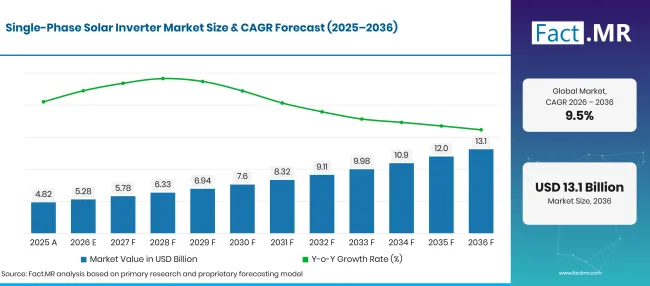
Factmr Single Phase Solar Inverter Market Forecast Global | Source: Fact.MR
| Year | Basis | Market Value (USD billion) |
|---|---|---|
| 2025 | Historical estimate | 4.8 |
| 2026 | Estimate | 5.3 |
| 2036 | Forecast | 13.1 |
| CAGR 2026 to 2036 | Forecast period | 9.5% |
Source: Fact.MR analysis. Updated Oct 21, 2026
What are the defining numbers behind Single-Phase Solar Inverter Market growth?
USD 7.8 billion absolute opportunity from 2026 to 2036, led by string inverters and residential installations.
- Demand Drivers in the Market
- Household solar installers select inverters that match both the property’s single-phase electrical supply and its rooftop panel output. Correct sizing helps the system perform as intended and keeps installation work within the planned design.
- Electrical contractors prefer clear wiring instructions and dependable technical support when installing rooftop systems. Straightforward approval requirements also help them schedule work with fewer delays.
- Homeowners often compare monitoring features and possible battery additions when choosing an inverter for a residential solar system.
- Owners of smaller commercial premises usually choose inverter capacity after reviewing usable roof space and electricity use during working hours.
- Key Segments Analyzed
- By Type: String Inverter account for 54.1% share in 2026, reflecting its use in complete residential rooftop arrays.
- By Application: Residential is expected to represent 58.3% share in 2026, as home systems use compact inverters matched to single-phase connections.
- By Connectivity: Grid-Tied holds 72.4% share in 2026, reflecting installations that export eligible surplus solar electricity.
- By Power Rating: Up to 3 kW is forecast to account for 39.9% share in 2026, serving smaller arrays and lower-capacity connections.
- Analyst Opinion at Fact.MR
- Shambhu Nath Jha, Principal Consultant at Fact.MR, states, “Electrical compatibility is central to choosing a single-phase solar inverter. Installers compare local grid rules, service access and price before recommending a unit. Roof design then helps determine whether a string inverter or panel-level conversion is more suitable.”
- Strategic Implications
- Inverter manufacturers can help installers by making approved grid settings and local connection documents easy to find before a model is selected.
- Distributors can support residential installers by stocking common power ratings and clearly identifying compatible replacement models. Local availability also makes service visits easier to arrange.
- Residential installers compare warranty terms, troubleshooting support and equipment prices together. Access to reliable service often influences the model they recommend.
- Clear monitoring displays help homeowners understand solar output and identify when their system may need attention. Manufacturers can make these functions easier to use without adding unnecessary complexity.
Japan is forecast to record a 12.1% CAGR, while Germany is projected to reach 11.7% through 2036. The USA is anticipated to advance at 10.2% as household solar equipment is installed and replaced. The UK carries a 9.8% outlook, while Brazil is projected to register 8.9% as distributed generation continues to shape solar purchasing.
How does the Single-Phase Solar Inverter Market break down by segment?
String Inverter holds 54.1%; Residential accounts for 58.3%; Grid-Tied leads with 72.4%; Up to 3 kW capture 39.9% in 2026.
Which Type dominates?
String Inverter holds 54.1% share in 2026.
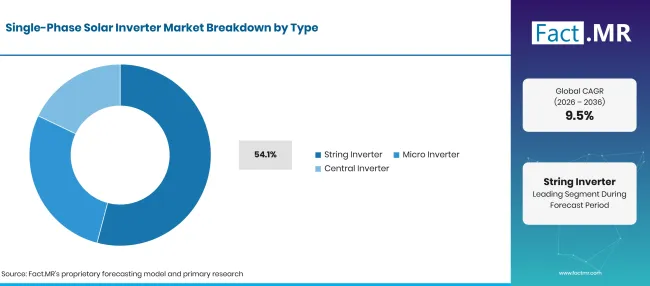
Factmr Single Phase Solar Inverter Market Breakdown Type | Source: Fact.MR
| Type | Share (2026) |
|---|---|
| String Inverter (Leading segment) | 54.1% |
| Other segments combined | 45.9% |
| Total | 100.0% |
Source: Fact.MR analysis. Updated Oct 21, 2026
String inverters connect a series of solar modules to one conversion unit. Installers compare system size with the inverter rating and available wall space. Microinverters instead convert panel output at the module, which suits some complex roof layouts. Central inverter equipment is mainly associated with larger installations and falls outside the typical single-phase residential application.
What leads the Application segment?
Residential accounts for 58.3% share in 2026.
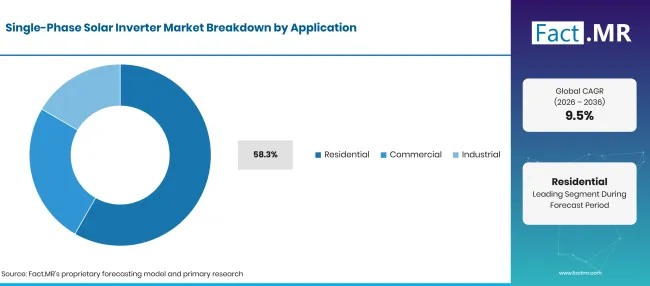
Factmr Single Phase Solar Inverter Market Breakdown Application | Source: Fact.MR
| Application | Share (2026) |
|---|---|
| Residential (Leading segment) | 58.3% |
| Other segments combined | 41.7% |
| Total | 100.0% |
Source: Fact.MR analysis. Updated Oct 21, 2026
Residential sales center on rooftop systems sized for household electricity consumption and local connection limits. Electrical contractors choose equipment that matches the property supply and permits practical cable routing. Commercial premises may also use single-phase equipment for small rooftop systems, although larger sites commonly need other electrical configurations. Industrial users generally evaluate higher-output power conversion where electricity loads exceed smaller single-phase connections.
How does Connectivity shape demand?
Grid-Tied holds 72.4% share in 2026.
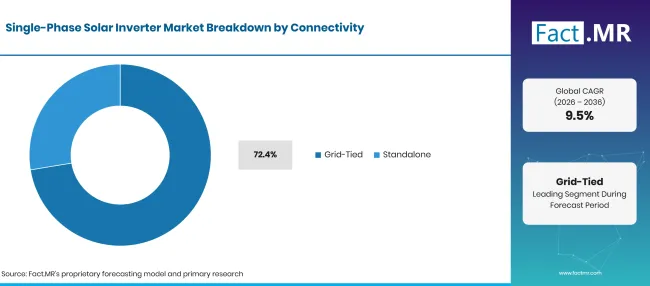
Factmr Single Phase Solar Inverter Market Breakdown Connectivity | Source: Fact.MR
| Connectivity | Share (2026) |
|---|---|
| Grid-Tied (Leading segment) | 72.4% |
| Other segments combined | 27.6% |
| Total | 100.0% |
Source: Fact.MR analysis. Updated Oct 21, 2026
Grid-tied inverters synchronize solar output with the local electrical supply so suitable systems can use or export generated electricity. Installers need to follow the local network operator’s connection requirements. Standalone systems serve sites where electricity must be used without a utility-grid link and generally require more careful coordination with batteries or other equipment. For ordinary homes already connected to the grid, an approved grid-tied model can reduce system complexity.
Which Power Rating serves the broadest base?
Up to 3 kW captures 39.9% share in 2026.
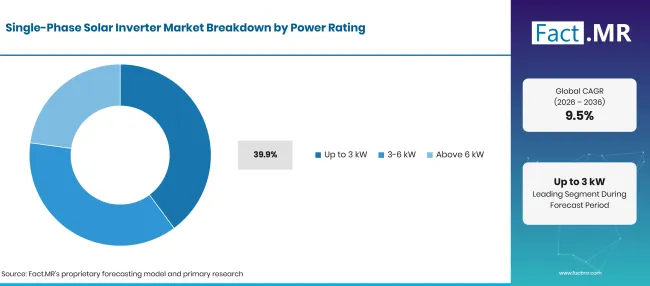
Factmr Single Phase Solar Inverter Market Breakdown Power Rating | Source: Fact.MR
| Power Rating | Share (2026) |
|---|---|
| Up to 3 kW (Leading segment) | 39.9% |
| Other segments combined | 60.1% |
| Total | 100.0% |
Source: Fact.MR analysis. Updated Oct 21, 2026
Inverters rated up to 3 kW suit smaller solar installations where roof area or electricity use limits output requirements. The 3-6 kW category covers bigger domestic arrays and smaller premises needing additional daytime generation. Products above 6 kW need closer examination of connection limits and whether the building uses a single-phase or multi-phase supply. Installers size the inverter against panel capacity and expected output instead of choosing on nominal rating alone.
What is accelerating Single-Phase Solar Inverter Market adoption, and what is holding it back?
Rooftop solar installations create inverter sales, while grid approvals and the initial equipment cost can delay some purchases.
Drivers Impact Analysis
| DRIVER | (~) % IMPACT ON CAGR | GEOGRAPHIC RELEVANCE | IMPACT TIMELINE |
|---|---|---|---|
| Residential rooftop installations | +1.0% | Global | Medium term (2–4 years) |
| Grid-compatible inverter designs | +0.8% | Europe, North America | Short term (<= 2 years) |
| Installer and distributor access | +0.7% | Global | Medium term (2–4 years) |
| Replacement of older conversion units | +0.5% | Europe, North America | Short term (<= 2 years) |
| Monitoring and service access | +0.4% | Global | Medium term (2–4 years) |
Source: Fact.MR analysis. Updated Oct 21, 2026
Opportunity Impact Analysis
| OPPORTUNITY | (~) % IMPACT ON CAGR | GEOGRAPHIC RELEVANCE | IMPACT TIMELINE |
|---|---|---|---|
| Module-level conversion | +0.8% | Global | Medium term (2–4 years) |
| Storage-ready residential upgrades | +0.6% | Europe, North America | Short term (<= 2 years) |
| Compact roof installations | +0.5% | Global | Medium term (2–4 years) |
| Local service partnerships | +0.4% | Europe, North America | Short term (<= 2 years) |
Source: Fact.MR analysis. Updated Oct 21, 2026
Restraints Impact Analysis
| RESTRAINT | (~) % IMPACT ON CAGR | GEOGRAPHIC RELEVANCE | IMPACT TIMELINE |
|---|---|---|---|
| Connection approval delays | -0.8% | Global | Medium term (2–4 years) |
| Upfront system costs | -0.6% | Europe, North America | Short term (<= 2 years) |
| Product compatibility checks | -0.5% | Global | Medium term (2–4 years) |
| Service and warranty delays | -0.4% | Europe, North America | Short term (<= 2 years) |
Source: Fact.MR analysis. Updated Oct 21, 2026
Which countries are scaling the Single-Phase Solar Inverter Market through 2036?
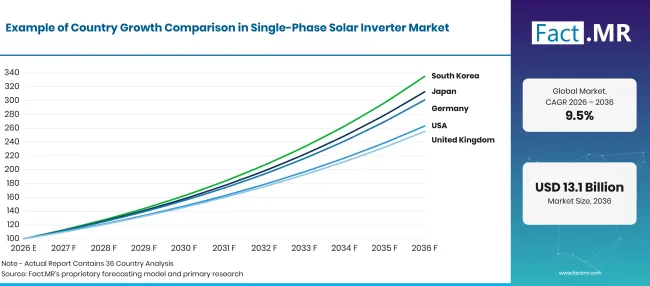
Factmr Single Phase Solar Inverter Market Growth Index | Source: Fact.MR
| Country | CAGR (2026–2036) |
|---|---|
| Japan | 12.1% |
| Germany | 11.7% |
| USA | 10.2% |
| UK | 9.8% |
| Brazil | 8.9% |
Source: Fact.MR analysis. Updated Oct 21, 2026
How does Japan support residential inverter sales?
12.1% CAGR, shaped by compact rooftop systems and household connection standards.
Japan's housing market creates a practical role for small solar conversion systems that work within limited roof space. In March 2025, Japan’s Ministry of Economy, Trade and Industry published renewable energy support arrangements covering residential solar installations below 10 kW [3]. Installers assess panel layouts alongside the household supply before selecting string or microinverter designs. Enphase began production shipments of IQ8 microinverters in Japan in April 2025 through ITOCHU, offering another option for module-level rooftop conversion [4]. Why is Germany an important market for rooftop inverters?
Germany an important market for rooftop inverters?
11.7% CAGR, supported by the established rooftop solar base.
German installers select residential inverter models after checking usable roof area and local network connection requirements. Destatis reported in March 2026 that nearly 4.8 million photovoltaic systems were installed across Germany at the end of 2025 [5]. A large installed base creates opportunities for new household systems and replacement equipment as product needs change. In March 2026 Destatis separately reported 70.1 billion kWh of photovoltaic electricity fed into the grid during 2025 [6].
What shapes household solar inverter purchasing in the USA?
10.2% CAGR, linked to household solar capacity and installer service coverage.
U.S. residential installers compare power rating and electrical compatibility before finalizing a rooftop inverter order. In September 2026 the U.S. Energy Information Administration reported 40,474.8 MW of estimated residential small-scale solar capacity for 2025 [1]. The installed base gives equipment manufacturers a market for residential replacements alongside new installations. Enphase announced software in May 2025 that enables owners of IQ7 systems to expand using IQ8 microinverters [7].
How are UK households adding single-phase solar equipment?
9.8% CAGR, influenced by rooftop installations and export arrangements.
Homeowners in the United Kingdom usually review roof layout and electricity use when choosing the size of a solar inverter. In May 2026 the Department for Energy Security and Net Zero reported 269,000 solar installations completed during 2025 [2]. More household installations give electrical contractors opportunities to supply suitable single-phase equipment. The department's April 2026 release separately reported more than 27,000 solar installations in March 2026 [6].
What supports Brazil’s distributed solar inverter market?
8.9% CAGR, linked to consumer-level generation and installer distribution.
Brazilian rooftop solar installations depend on equipment that matches household electricity connections and local distribution company requirements. The Ministry of Mines and Energy reported in its 2025 annual management report that distributed microgeneration and minigeneration exceeded 43.6 GW of installed capacity during 2025 [8].
Who leads the Single-Phase Solar Inverter Market?
SMA Solar Technology, Fronius and SolarEdge operate in residential inverter equipment where electrical connection rules and after-sales service shape supplier choice. Enphase supplies module-level microinverters for household systems. Sungrow and Huawei have broad inverter portfolios, although product eligibility depends on the model and its target electrical connection.
Delta Electronics serve power conversion and energy management applications. Current product participation must be evaluated at the brand and product-family level. Installers compare supported grid codes, the installation process and warranty administration when selecting a practical residential inverter.
Which companies are the key providers?
Key companies include SMA Solar Technology AG; Huawei Technologies Co., Ltd.; Sungrow Power Supply Co., Ltd.; SolarEdge Technologies Inc.; Fronius International GmbH; Enphase Energy Inc.; and Delta Electronics Inc.
- SMA Solar Technology AG
- Huawei Technologies Co., Ltd.
- Sungrow Power Supply Co., Ltd.
- SolarEdge Technologies Inc.
- Fronius International GmbH
- Enphase Energy Inc.
- Delta Electronics Inc.
Bibliography
- [1] U.S. Energy Information Administration. (2026, September 24). Electric Power Monthly: Table 6.1.B. Estimated net summer solar photovoltaic capacity from small scale facilities by sector. https://www.eia.gov/electricity/monthly/epm_table_grapher.php?t=table_6_01_b
- [2] Department for Energy Security and Net Zero. (2026, May 28). Britain continues to break clean power records. https://www.gov.uk/government/news/britain-continues-to-break-clean-power-records
- [3] Ministry of Economy, Trade and Industry. (2025, March 21). METI sets the surcharge rate for FY2025, renewable energy purchase prices for FY2025 onward, and other details relating to the FIT and FIP schemes. https://www.meti.go.jp/english/press/2025/0321_001.html
- [4] Enphase Energy. (2025, April 28). Enphase Energy enters the solar market in Japan with IQ8 microinverters. https://newsroom.enphase.com/news-releases/news-release-details/enphase-energy-enters-solar-market-japan-iq8-microinverters/
- [5] Statistisches Bundesamt (Destatis). (2026, March 12). 4,8 Millionen Photovoltaikanlagen zum Jahresende 2025 installiert. https://www.destatis.de/DE/Presse/Pressemitteilungen/2026/03/PD26_N017_43.html
- [6] Statistisches Bundesamt (Destatis). (2026, March 6). Stromerzeugung aus Photovoltaik und Erdgas erreicht im Jahr 2025 neue Höchstwerte. https://www.destatis.de/DE/Presse/Pressemitteilungen/2026/03/PD26_073_43312.html
- [7] Enphase Energy. (2025, May 8). Enphase Energy announces easy expansion of IQ7 solar systems with IQ8 microinverters. https://investor.enphase.com/news-releases/news-release-details/enphase-energy-announces-easy-expansion-iq7-solar-systems-iq8
- [8] Ministério de Minas e Energia. (2026). Relatório de Gestão MME 2025. https://www.gov.br/mme/pt-br/acesso-a-informacao/auditorias/prestacao-contas/processo-de-contas-anual-2025/mme_rel-gestao-2025_final.pdf
This Report Answers
- The report compares string inverter and module-level alternatives for residential solar installation.
- Application analysis explains the relevance of household electrical connections to inverter purchases.
- Country analysis considers grid rules and rooftop installations in Germany, Brazil, USA, UK and Japan.
- Competitive coverage distinguishes residential inverter products from wider solar and electrical equipment portfolios.
- Power-rating analysis examines how smaller arrays differ from larger conversion systems.
What does the Single-Phase Solar Inverter Market cover?
The market covers inverter equipment used to convert solar photovoltaic electricity for single-phase electrical loads or approved grid connections. It includes string and module-level designs. Related Fact.MR analysis covers grid-tie inverter systems and bidirectional inverter designs.
What is included in the scope?
The scope includes residential rooftop conversion equipment and suitably rated smaller commercial units where a single-phase electrical connection is used.
Grid-tied systems are included when the inverter is designed to synchronize with the local network. Standalone systems are covered when equipment serves the same single-phase conversion function. Monitoring capability is considered as part of the inverter offering, although separate subscription revenue and unrelated electrical work are outside equipment sales.
What is excluded from the scope?
The scope excludes three-phase central power conversion sold solely for utility-scale installations.
Solar modules, mounting rails and stand-alone batteries are separate product categories unless bundled value is explicitly allocated to the inverter itself. The analysis also excludes grid connection work and broad electrical distribution equipment that does not perform photovoltaic power conversion.
How Was the Analysis Built?
The analysis draws on 120+ sources, 35+ company portfolios, 25+ countries, and more than 20 industry interviews.
- Primary Research: Primary research includes discussions with manufacturers, service providers, technology developers, distributors, end users, and subject-matter experts. These conversations examine purchasing priorities, product adoption, operational challenges, approval requirements, competitive positioning, and the factors that influence wider market acceptance.
- Desk Research: Desk research covers government statistics, regulatory publications, company filings, trade data, technical studies, industry associations, standards, public policy, and other authoritative sources. Every source used in the analysis is documented in the bibliography.
- Market Sizing and Forecasting: Market estimates combine historical performance, demand indicators, pricing and volume trends, segment shares, company participation, country-level growth, adoption patterns, investment activity, and barriers to market expansion.
- Data Validation and Update Cycle: Findings are validated by comparing primary interviews with public data, company activity, regulatory changes, trade patterns, and industry developments. Regular updates review new product launches, capacity changes, partnerships, approvals, and shifts in commercial adoption.
Segmentation
What is the report’s scope and coverage?
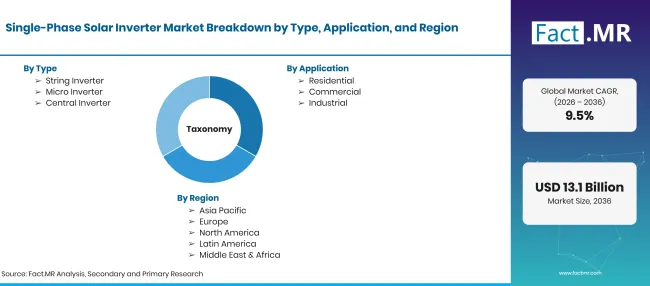
Factmr Single Phase Solar Inverter Market Taxonomy | Source: Fact.MR
| Attribute | Details |
|---|---|
| Quantitative Units | USD billion |
| Market Definition | Power inverters intended for single-phase solar photovoltaic electrical systems. |
| Type | String Inverter; Micro Inverter; Central Inverter |
| Application | Residential; Commercial; Industrial |
| Connectivity | Grid-Tied; Standalone |
| Power Rating | Up to 3 kW; 3-6 kW; Above 6 kW |
| Regions Covered | North America; Latin America; Western Europe; Eastern Europe; East Asia; South Asia & Pacific; Middle East & Africa |
| Countries Covered | Germany; Brazil; United States; United Kingdom; Japan |
| Companies Profiled | SMA Solar Technology AG; Huawei Technologies Co., Ltd.; Sungrow Power Supply Co., Ltd.; SolarEdge Technologies Inc.; Fronius International GmbH; Enphase Energy Inc.; and Delta Electronics Inc. |
| Forecast Period | 2026 to 2036 |
| Approach | Segment review, official solar data, product-function checks and geographic assessment |
Source: Fact.MR analysis. Updated Oct 21, 2026
How is the market segmented?
-
By Type
- String Inverter
- Micro Inverter
- Central Inverter
-
By Application
- Residential
- Commercial
- Industrial
-
By Connectivity
- Grid-Tied
- Standalone
-
By Power Rating
- Up to 3 kW
- 3-6 kW
- Above 6 kW
-
By Region
- North America
- Latin America
- Western Europe
- Eastern Europe
- East Asia
- South Asia & Pacific
- Middle East & Africa
Frequently Asked Questions
How big is the single-phase solar inverter market in 2026?
What CAGR is forecast for 2026 to 2036?
Which inverter type has the largest share?
Which application accounts for the leading share?
Who are the main companies in single phase solar inverter market?
Who worked on this report


Preview the report firsthand - request a free sample
Free SampleGet the brochure for pricing and purchase details
Download PDF