- Market Value (2025): USD 704.9 Mn
- Estimated Value (2026): USD 743.4 Mn
- Forecast Value (2036): USD 1266.3 Mn
- CAGR (2026-2036): 5.5%
What is the Vacuum Quench Furnaces Market forecast to be worth by 2036?
USD 743.4 million in 2026 to USD 1,266.3 million by 2036 at a 5.5% CAGR.
- The vacuum quench furnaces market reached USD 704.9 million in 2025 as industrial plants continued buying and upgrading specialist heat treatment equipment.
- Market value is projected to rise from USD 743.4 million in 2026 to USD 1,266.3 million by 2036 as manufacturers expand qualified processing capacity.
- A 5.5% CAGR is forecast for 2026 to 2036. Aerospace processors and precision component makers are expected to invest where controlled cooling and traceable heat cycles justify equipment spending.
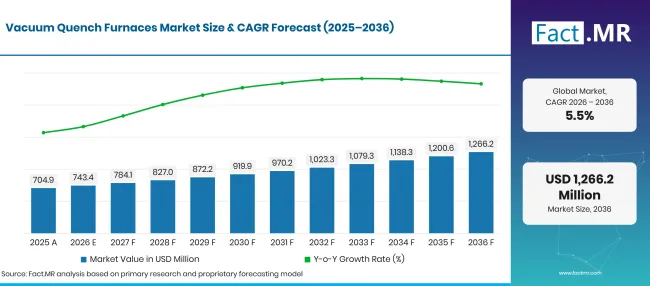
Vacuum Quench Furnaces Market Forecast Global | Source: Fact.MR
| Year | Basis | Market Value (USD million) |
|---|---|---|
| 2025 | Actual | 704.9 |
| 2026 | Estimate | 743.4 |
| 2036 | Forecast | 1,266.3 |
| CAGR 2026 to 2036 | Forecast period | 5.5% |
Source: Fact.MR analysis. Updated Oct 31, 2026
What are the defining numbers behind Vacuum Quench Furnaces Market growth?
USD 522.9 million in additional market value by 2036, with horizontal furnaces and aerospace applications occupying major positions.
- Demand Drivers in the Market
- Aerospace heat treatment teams need reproducible hardening cycles for components that face tight material specifications. Airbus reported 793 commercial aircraft deliveries in 2025 in January 2026 [1].
- Commercial heat treaters compare chamber capacity with actual batch sizes before choosing a new furnace. Larger loads may reduce handling per part, but cooling uniformity and the qualification of dense loads remain important during specification.
- Toolmakers need repeatable hardness and acceptable distortion across high-value dies. A vacuum furnace can help them keep processing under one roof and reduce dependence on outside processing when order patterns justify the investment.
- Key Segments Analyzed
- By Type: Horizontal Vacuum Quench Furnaces are projected to account for 58.5% share in 2026, reflecting accessible loading arrangements for production batches and varied component shapes.
- By Application: Aerospace is forecast to account for 35.2% share in 2026 because controlled thermal cycles are valuable for safety-sensitive machined components.
- By End-User: Manufacturing is anticipated to represent 34.5% share in 2026 as component producers operate dedicated heat treatment lines beside machining and finishing processes.
- Analyst Opinion at Fact.MR
- Shambhu Nath Jha, Principal Consultant at Fact.MR, states, “The ability to demonstrate repeatable cooling performance central to supplier selection. Engineering teams judge a furnace against real parts and their approved process windows, not only the maximum chamber temperature.”
- Strategic Implications
- Furnace makers should document gas-quenching performance under representative production loads so customers can compare achievable results against part specifications before placing orders.
- Heat treatment subcontractors should evaluate total batch cost alongside purchase price, including power demand, cooling gas use and downtime between cycles. Comparable service economics are discussed in Fact.MR’s industrial heat treatment services research.
- Aerospace suppliers should include furnace qualification and traceability requirements in early equipment specifications to reduce delays during production approval.
- Automotive component producers should compare horizontal batch loading with vertical handling arrangements against actual part dimensions and workflow constraints.
Germany is forecast to record 6.6% CAGR from 2026 to 2036, followed by Japan at 6.2%. The USA is projected at 5.6% as aerospace and precision manufacturing influence purchases. Brazil is estimated at 4.5%, while the UK is forecast to grow at 4.1%, reflecting different industrial investment conditions.
How does the Vacuum Quench Furnaces Market break down by segment?
Horizontal vacuum quench furnaces lead Type at 58.5%; Aerospace leads Application at 35.2%; Manufacturing leads End-User at 34.5%.
Which Type dominates?
Horizontal Vacuum Quench Furnaces account for 58.5% of 2026 market value.
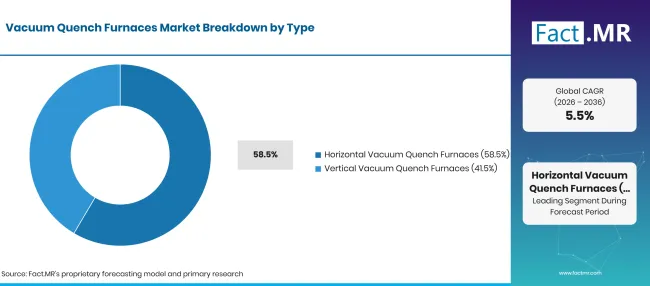
Vacuum Quench Furnaces Market Breakdown Type | Source: Fact.MR
| Type | Share (2026) |
|---|---|
| Horizontal Vacuum Quench Furnaces | 58.5% |
| Vertical Vacuum Quench Furnaces | 41.5% |
| Total | 100.0% |
Source: Fact.MR analysis. Updated Oct 31, 2026
Horizontal furnaces suit trays and baskets that move between machining, loading and heat treatment stations on a shop floor. Their front-loading arrangement is familiar to many batch-processing operations and allows flexible fixture choices. The 58.5% share indicates their importance to general component production. Vertical systems address workpieces that benefit from upright suspension or require careful support during heating and cooling.
What leads the Application segment?
Aerospace is projected to hold 35.2% share in 2026.
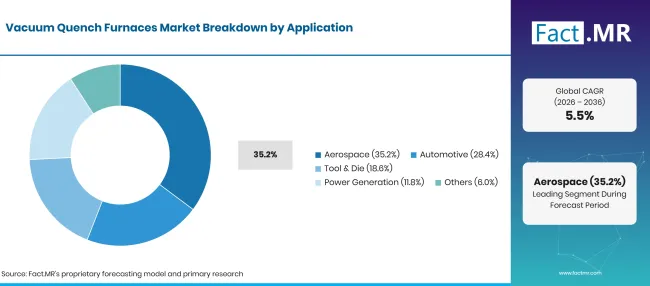
Vacuum Quench Furnaces Market Breakdown Application | Source: Fact.MR
| Application | Share (2026) |
|---|---|
| Aerospace | 35.2% |
| Automotive | 28.4% |
| Tool & Die | 18.6% |
| Power Generation | 11.8% |
| Others | 6.0% |
| Total | 100.0% |
Source: Fact.MR analysis. Updated Oct 31, 2026
Aerospace applications place value on documented treatment conditions and consistent properties from one batch to the next. The 35.2% application share reflects the role of specialist processing for structural and engine-related metal parts. Automotive users account for 28.4% and are more likely to focus on cost per part at sustained throughput. Tool and die producers represent 18.6%, where the useful life of a hardened tool affects the business case for the furnace. Power generation contributes 11.8% through heat treatment of engineered metal components.
How does End-User shape demand?
Manufacturing is projected to represent 34.5% share in 2026.
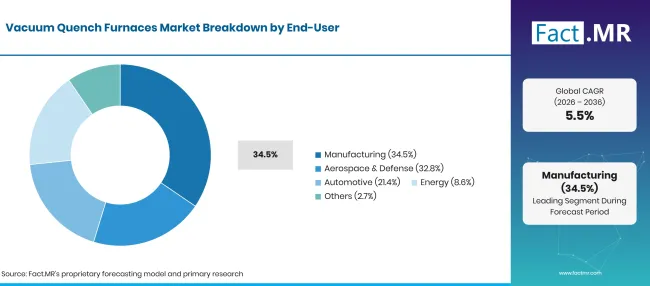
Vacuum Quench Furnaces Market Breakdown End User | Source: Fact.MR
| End-User | Share (2026) |
|---|---|
| Manufacturing | 34.5% |
| Aerospace & Defense | 32.8% |
| Automotive | 21.4% |
| Energy | 8.6% |
| Others | 2.7% |
| Total | 100.0% |
Source: Fact.MR analysis. Updated Oct 31, 2026
Manufacturing plants use vacuum quenching for parts that pass from machining into controlled hardening and final inspection. The 34.5% share covers industrial producers whose heat treatment supports a broader output mix. Aerospace and defense users represent 32.8% because qualification standards influence process records and equipment acceptance. Automotive producers account for 21.4% and typically compare cycle reliability with operating expense. Energy users contribute 8.6% in work involving high-duty metal components. These end-user categories describe the organization purchasing or operating the equipment, while application categories describe the intended part use. The distinction helps avoid counting the same share twice.
What is accelerating Vacuum Quench Furnaces Market adoption, and what is holding it back?
Demand comes from manufacturers that need repeatable heat treatment and controlled gas quenching. The high cost of equipment and the time required to qualify production cycles influence the pace of replacement.
Drivers Impact Analysis
| Driver | (~) % Impact on CAGR | Geographic Relevance | Impact Timeline |
|---|---|---|---|
| Aerospace process qualification | +0.9% | USA, Germany, Japan | Medium term |
| Controlled distortion for precision parts | +0.7% | Global | Short term |
| In-house heat treatment capacity | +0.5% | Asia, Europe | Medium term |
| Replacement of aging batch furnaces | +0.4% | North America, Europe | Long term |
| Traceable electronic process records | +0.3% | Aerospace hubs | Medium term |
Source: Fact.MR analysis. Updated Oct 31, 2026
Opportunity Impact Analysis
| Opportunity | (~) % Impact on CAGR | Geographic Relevance | Impact Timeline |
|---|---|---|---|
| Higher-pressure gas quenching | +0.5% | USA, Japan, Germany | Medium term |
| Modular service and retrofit support | +0.4% | Global | Short term |
| Local furnace assembly and maintenance | +0.3% | Emerging manufacturing hubs | Medium term |
| Tool and die subcontracting capacity | +0.2% | Brazil, Germany | Long term |
Source: Fact.MR analysis. Updated Oct 31, 2026
Restraints Impact Analysis
| Restraint | (~) % Impact on CAGR | Geographic Relevance | Impact Timeline |
|---|---|---|---|
| Capital expense and plant installation | -0.8% | Global | Short term |
| Qualification and validation time | -0.5% | Aerospace hubs | Medium term |
| Power and cooling system requirements | -0.4% | Global | Short term |
| Uneven industrial investment | -0.3% | Brazil, UK | Medium term |
Source: Fact.MR analysis. Updated Oct 31, 2026
Which countries are scaling the Vacuum Quench Furnaces Market through 2036?
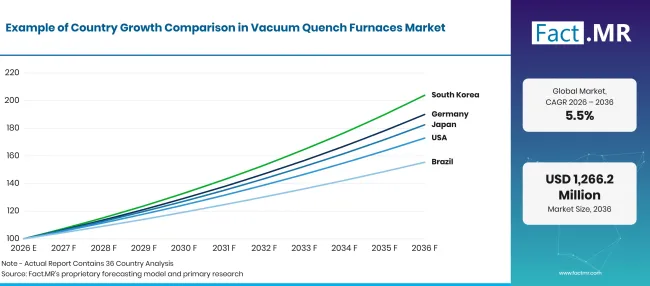
Vacuum Quench Furnaces Market Growth Index | Source: Fact.MR
| Country | CAGR (2026 to 2036) |
|---|---|
| Germany | 6.6% |
| Japan | 6.2% |
| USA | 5.6% |
| Brazil | 4.5% |
| UK | 4.1% |
Source: Fact.MR analysis. Updated Oct 31, 2026
What supports Germany vacuum quench furnace demand?
6.6% CAGR, reflecting precision production and a large automotive component base.
German heat treatment equipment purchasing spans specialist job shops and metal part producers. Many plants work with strict quality specifications and compete on dependable delivery. The case for vacuum quenching rests on repeatable hardness and distortion control during serial production. Automotive parts producers operate within an established manufacturing base. VDA reported about 4.15 million passenger cars produced domestically in 2025 [2].
What supports Japan vacuum quench furnace demand?
6.2% CAGR, associated with specialist manufacturing and strict process consistency.
Japanese engineering firms often design heat treatment around compact production cells and closely controlled process steps. Purchase decisions can depend on load handling and achievable cooling consistency. Vacuum quenching also serves firms making high-value industrial and transport components. Japan’s Ministry of Economy, Trade and Industry published its 2025 production statistics yearbook in June 2026 [4]. In June 2026, SECO/WARWICK announced a single-chamber Vector vacuum furnace with gas quenching for a Japanese metal-treatment business serving gas turbine component production [8].
What supports USA vacuum quench furnace demand?
5.6% CAGR, with aerospace and bearing manufacturing influencing qualified furnace demand.
American manufacturers use vacuum systems for aerospace parts and other precision metal components requiring defined cooling cycles. Plant operators assess gas quench specifications alongside service coverage and batch documentation. Both dedicated manufacturers and commercial heat treaters participate in equipment purchasing. SECO/WARWICK reported two Vector furnace orders from a U.S. bearing producer in December 2025 [3]. The orders show direct customer investment in gas-quenching capacity. American aerospace machining facilities value clear process history during repeated part approvals.
What supports Brazil vacuum quench furnace demand?
4.5% CAGR, linked to automotive tooling and industrial component processing.
Brazilian demand includes metal part producers that serve vehicle plants and general industrial customers. Customers compare the cost of in-house processing with subcontracted heat treatment. Parts mix and furnace utilization have a direct bearing on purchase decisions. Brazilian vehicle production reached 2.644 million units in 2025, according to automaker association Anfavea in January 2026 [5]. The automotive supply chain forms a practical end-use base for heat treatment services.
What supports UK vacuum quench furnace demand?
4.1% CAGR, influenced by aerospace suppliers and established specialist metalworking capacity.
UK furnace orders depend on the workload of specialist component manufacturers and independent heat treatment firms. Aerospace production requires documented metallurgical results. Other buyers balance process performance with the cost of keeping a dedicated vacuum furnace operating. The Office for National Statistics reported UK manufacturers’ product sales of GBP 452.0 billion in 2025 [6]. In September 2026, SECO/WARWICK announced a large Vector vacuum furnace with gas cooling for a British foundry technology centre processing titanium castings [9].
Who leads the Vacuum Quench Furnaces Market?
Furnace suppliers compete on cooling capability, chamber configuration and evidence that an installation can deliver the required metallurgical outcome. SECO/WARWICK markets Vector systems for vacuum processing and gas quenching. Ipsen supplies vacuum heat treatment equipment, while ALD Vacuum Technologies and ECM Technologies work with specialist vacuum thermal-processing solutions. TAV Vacuum Furnaces and Solar Manufacturing offer additional vacuum furnace designs. Service response and engineering support influence equipment ownership costs, particularly for plants running time-sensitive batches.
SECO/WARWICK announced in November 2025 that a Chinese industrial customer had placed contracts covering four Vector single-chamber vacuum furnaces for applications spanning aviation and energy components [7]. The orders included additional systems contracted during 2025. The case illustrates how repeat equipment buying can follow successful qualification of a furnace platform.
Which companies are the key providers?
Key companies include Ipsen International GmbH; ALD Vacuum Technologies GmbH; SECO/WARWICK S.A.; TAV Vacuum Furnaces S.p.A.; ECM Technologies; Solar Manufacturing, Inc.; IHI Machinery and Furnace Co., Ltd.; HHV Thermal Technologies Pvt. Ltd.; VAC AERO International Inc.; Chugai Ro Co., Ltd.
- Ipsen International GmbH
- ALD Vacuum Technologies GmbH
- SECO/WARWICK S.A.
- TAV Vacuum Furnaces S.p.A.
- ECM Technologies
- Solar Manufacturing, Inc.
- IHI Machinery and Furnace Co., Ltd.
- HHV Thermal Technologies Pvt. Ltd.
- VAC AERO International Inc.
- Chugai Ro Co., Ltd.
Bibliography
- [1] Airbus. (2026, January 12). Airbus reports 793 commercial aircraft deliveries in 2025
- [2] German Association of the Automotive Industry. (2026, January 5). Passenger car production in 2025 slightly above previous year’s level.
- [3] SECO/WARWICK. (2025, December 17). LPC furnace order – from SECO/WARWICK – supports U.S. bearing manufacturing expansion.
- [4] Ministry of Economy, Trade and Industry. (2026). Current Survey of Production: 2025 yearbook.
- [5] Associação Nacional dos Fabricantes de Veículos Automotores. (2026, January 15). Produção e venda de autoveículos crescem em 2025 e Anfavea projeta nova alta em 2026
- [6] Office for National Statistics. (2026, July 24). UK manufacturers’ sales by product: 2025.
- [7] SECO/WARWICK. (2025, November 26). Major partner from China invests in SECO/WARWICK vacuum furnaces.
- [8] SECO/WARWICK. (2026, June 24). SECO/WARWICK secures contract for high performance vacuum furnace for Japan’s high-tech industry.
- [9] SECO/WARWICK. (2026, September 23). British foundry technology leader chooses SECO/WARWICK.
This Report Addresses
- The report explains why horizontal and vertical furnace configurations serve different loading and handling needs.
- Application analysis compares aerospace requirements with automotive production and tool hardening workloads.
- Country analysis reviews the distinct industrial conditions behind equipment spending in Germany, Japan, the USA, Brazil and the UK.
- Supplier analysis explains how furnace performance, process records and service coverage shape purchasing decisions.
What does the Vacuum Quench Furnaces Market cover?
The market covers horizontal and vertical vacuum furnaces used to quench metal components. Applications include aerospace, automotive, tool and die, and power generation parts. Related process categories are covered in Fact.MR’s heat treating technologies analysis.
What is included in the scope?
Revenue covers furnace equipment sold to manufacturers and specialist heat treatment operators, including integrated controls and cooling systems.
What is excluded from the scope?
General-purpose ovens and heat treatment equipment without a vacuum quenching function are outside the defined equipment market.
Routine heat treatment service revenue is excluded when it does not represent equipment sales. Vacuum coating systems and unrelated laboratory thermal instruments are also outside this boundary.
How Was the Analysis Built?
The analysis draws on 120+ sources, 35+ company portfolios, 25+ countries, and more than 20 industry interviews.
- Primary Research: Primary research includes discussions with manufacturers, service providers, technology developers, distributors, end users, and subject-matter experts. These conversations examine purchasing priorities, product adoption, operational challenges, approval requirements, competitive positioning, and the factors that influence wider market acceptance.
- Desk Research: Desk research covers government statistics, regulatory publications, company filings, trade data, technical studies, industry associations, standards, public policy, and other authoritative sources. Every source used in the analysis is documented in the bibliography.
- Market Sizing and Forecasting: Market estimates combine historical performance, demand indicators, pricing and volume trends, segment shares, company participation, country-level growth, adoption patterns, investment activity, and barriers to market expansion.
- Data Validation and Update Cycle: Findings are validated by comparing primary interviews with public data, company activity, regulatory changes, trade patterns, and industry developments. Regular updates review new product launches, capacity changes, partnerships, approvals, and shifts in commercial adoption.
Segmentation
What is the report’s scope and coverage?
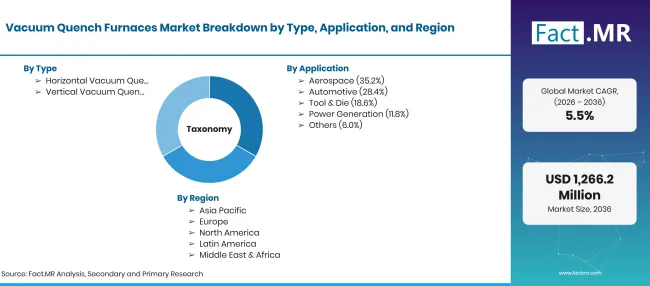
Vacuum Quench Furnaces Market Taxonomy | Source: Fact.MR
| Attribute | Details |
|---|---|
| Quantitative Units | USD million |
| Market Definition | Industrial vacuum furnaces designed to heat metal components and control subsequent quenching under specified process conditions. |
| Type | Horizontal Vacuum Quench Furnaces; Vertical Vacuum Quench Furnaces |
| Application | Aerospace; Automotive; Tool & Die; Power Generation; Others |
| End-User | Manufacturing; Aerospace & Defense; Automotive; Energy; Others |
| Regions Covered | North America; Latin America; Western Europe; Eastern Europe; East Asia; South Asia & Pacific; Middle East & Africa |
| Countries Covered | Germany; Japan; USA; Brazil; UK |
| Companies Profiled | Ipsen International GmbH; ALD Vacuum Technologies GmbH; SECO/WARWICK S.A.; TAV Vacuum Furnaces S.p.A.; ECM Technologies; Solar Manufacturing, Inc.; IHI Machinery and Furnace Co., Ltd.; HHV Thermal Technologies Pvt. Ltd.; VAC AERO International Inc.; Chugai Ro Co., Ltd. |
| Forecast Period | 2026 to 2036 |
| Approach | Application demand assessment, industrial equipment supply review, end-user processing requirements and country-level comparisons |
Source: Fact.MR analysis. Updated Oct 31, 2026
How is the market segmented?
-
By Type
- Horizontal Vacuum Quench Furnaces
- Vertical Vacuum Quench Furnaces
-
By Application
- Aerospace
- Automotive
- Tool & Die
- Power Generation
- Others
-
By End-User
- Manufacturing
- Aerospace & Defense
- Automotive
- Energy
- Others
-
By Region
- North America
- Latin America
- Western Europe
- Eastern Europe
- East Asia
- South Asia & Pacific
- Middle East & Africa
Frequently Asked Questions
How big is the Vacuum Quench Furnaces Market in 2026?
What is the CAGR of the Vacuum Quench Furnaces Market from 2026 to 2036?
Which type leads the Vacuum Quench Furnaces Market?
Which application leads the Vacuum Quench Furnaces Market?
Who are the leading companies in the Vacuum Quench Furnaces Market?
Who worked on this report


Preview the report firsthand - request a free sample
Free SampleGet the brochure for pricing and purchase details
Download PDF