- Market Value (2025): USD 5.6 Bn
- Estimated Value (2026): USD 6.2 Bn
- Forecast Value (2036): USD 16.1 Bn
- CAGR (2026-2036): 10.0%
What is the Smart Cabin Customization Market forecast to be worth by 2036?
USD 16.1 billion by 2036 at a 10.0% CAGR.
- The Smart Cabin Customization Market reached USD 5.6 billion in 2025.
- Demand is projected to increase from USD 6.2 billion in 2026 to USD 16.1 billion by 2036.
- The market is forecast to expand at a 10.0% CAGR from 2026 to 2036.
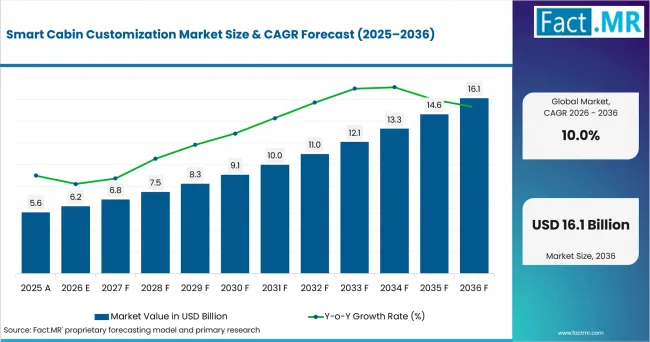
Smart Cabin Customization Market Value Analysis | Source: Fact.MR
What are the defining numbers behind Smart Cabin Customization Market growth?
An absolute opportunity of USD 9.9 billion is expected between 2026 and 2036.
- Demand Drivers in the Market
- Driver profiles are turning cabin personalization into a repeatable software function instead of a one-time physical adjustment. Tesla profiles can store seat, steering, mirror, temperature, navigation, media, and other preferences and synchronize selected settings across supported vehicles. This makes personalization relevant to households with several drivers and to buyers who expect the vehicle to recognize them automatically.
- AI and voice interfaces are increasing the number of cabin functions that can be personalized without adding physical controls. NIO describes its smart cabin and NOMI system as a personalized digital companion that can converse with occupants and coordinate navigation, services, and in-cabin functions. More capable voice interfaces give OEMs a route to package personalization around software, user accounts, and contextual recommendations.
- Ambient lighting is becoming a configurable digital feature rather than fixed decorative hardware. NIO vehicles allow occupants to select lighting themes, colors, brightness, and modes through the center display and save those settings. This gives manufacturers a visible way to differentiate trims and personal modes with relatively limited changes to the underlying cabin architecture.
- OEM software platforms are widening customization beyond infotainment. BMW Operating System X allows drivers to personalize display content, ambient-light colors, background images, and selected driving characteristics through Personal Mode. When these settings are designed into the vehicle platform, the OEM can coordinate display, audio, lighting, and control behavior as one cabin experience.
- Software updates extend the commercial life of smart-cabin functions but raise the need for controlled deployment. UNECE Regulation No. 156 establishes requirements around vehicle software updates and update-management systems, while Regulation No. 155 addresses cybersecurity. These frameworks favor OEM-led architectures in which customization features can be validated, secured, and updated within the approved vehicle system.
- Key Segments Analyzed
- OEM Led Customization accounts for 56.2% of Customization Platform in 2026 because factory integration lets automakers coordinate cabin software, displays, lighting, seating, and user profiles with the vehicle electrical architecture and warranty process.
- Lighting And Mood Systems hold 51.3% of Technology in 2026 as software-controlled ambient lighting gives occupants an immediate visual change without requiring major cabin reconstruction.
- Luxury And Premium Buyers represent 43.2% of Customer Profile in 2026 because these customers are more likely to pay for configurable interfaces, ambient experiences, advanced seating, and personalized digital functions bundled with higher equipment grades.
- Passenger Vehicles account for 58.9% of Vehicle Segment in 2026 due to their production scale and the wider fitment of digital cockpit, lighting, comfort, and connected features across sedans and utility vehicles.
- Analyst Opinion at Fact.MR
- Shambhu Nath Jha, Sr. Consultant at Fact.MR, states, “Smart cabin customization is moving toward a software-and-hardware package designed around the driver profile. Buyers notice lighting, displays, seat settings, voice control, and convenience functions as one experience, while OEMs must manage the underlying cybersecurity, update, and integration burden. Suppliers that make personalization repeatable across vehicle platforms without adding excessive engineering complexity are better placed to win long-cycle OEM programs.”
- Strategic Implications
- Automakers should treat personalization as a platform capability. A shared profile layer can connect lighting, seating, climate, infotainment, and access settings across several models while allowing each brand to differentiate the user experience.
- Tier 1 suppliers should reduce integration effort by offering modular cockpit software, display controllers, lighting interfaces, and validation tools that can be reused across vehicle programs instead of requiring a separate architecture for every model.
- Cabin feature design should account for software-update governance at the start of development. Functions that can change after sale need traceable versions, secure delivery, fallback processes, and validation against the vehicle configuration.
- Aftermarket providers should focus on solutions that preserve vehicle safety functions, electrical compatibility, and warranty expectations. Products that interfere with driver monitoring, displays, or vehicle networks face higher adoption friction than cosmetic or modular upgrades.
- Pricing can shift from individual hardware options toward packages that combine digital themes, connected services, comfort functions, and selected downloadable features, provided customers can understand what remains available after software or ownership changes.
How does the Smart Cabin Customization Market break down by segment?
The market is segmented by Customization Platform, Technology, Customer Profile, and Vehicle Segment.
Why does OEM Led Customization lead Customization Platform?
OEM Led Customization is projected to account for a 56.2% share in 2026.
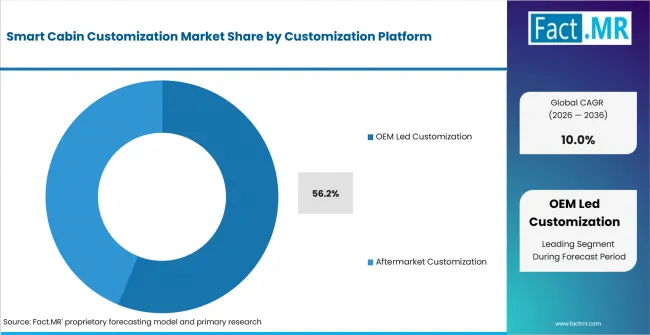
Smart Cabin Customization Market Analysis By Customization Platform | Source: Fact.MR
Factory integration leads because smart-cabin functions depend on vehicle networks, displays, audio, lighting, seats, sensors, and user accounts working together. An automaker can validate the complete system before production and maintain consistent software behavior across trim levels, which reduces compatibility risk for the buyer.
The model also supports personalization after delivery. Tesla stores selected driver preferences in cloud-linked profiles, while BMW is extending Personal Mode across display, lighting, sound, and vehicle settings. These examples show why buyers can receive a customized cabin without replacing factory hardware.
OEM control is especially relevant as the cabin becomes more dependent on automotive software. Cybersecurity and software-update requirements give automakers a commercial reason to keep customization within approved architectures rather than leave core digital functions to unverified aftermarket changes.
Why do Lighting And Mood Systems lead Technology?
Lighting And Mood Systems are projected to account for a 51.3% share in 2026.
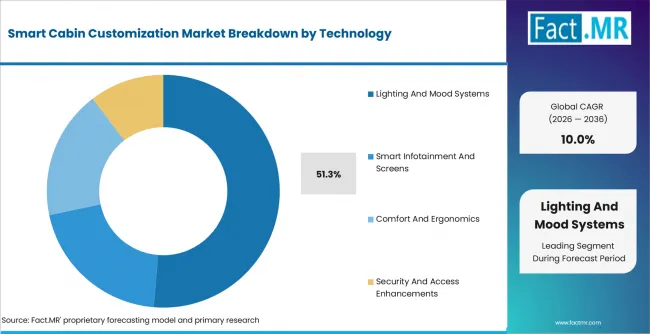
Smart Cabin Customization Market Analysis By Technology | Source: Fact.MR
Lighting and mood systems lead because occupants can see the effect immediately and the same hardware can support many themes through software. Color, brightness, animation, and context-based responses can be changed without redesigning the instrument panel or seat structure.
NIO user documentation shows this operating model in practice: ambient lighting can be configured through the center display, saved with user settings, and linked with events such as door-open warnings. That allows one lighting system to serve personalization and vehicle-status communication.
The segment also benefits from the broader use of interior lighting as part of digital cockpit design. Lighting can be coordinated with drive modes, media, welcome sequences, and safety alerts, increasing its value beyond decoration.
Why do Luxury And Premium Buyers lead Customer Profile?
Luxury And Premium Buyers are projected to account for a 43.2% share in 2026.
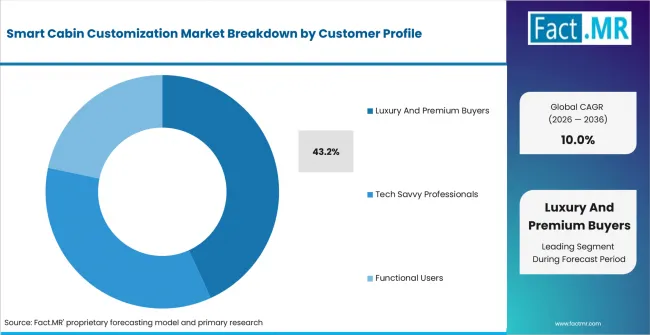
Smart Cabin Customization Market Analysis By Customer Profile | Source: Fact.MR
Premium buyers lead because cabin experience is a visible part of vehicle differentiation at higher price points. These customers are more likely to encounter configurable displays, advanced audio, multi-zone comfort, memory functions, ambient lighting, and branded digital themes as part of the purchase configuration.
BMW Panoramic iDrive illustrates the direction of travel. Its Personal Mode allows users to change display content, ambient-light colors, background images, sound, and selected driving characteristics. BMW has stated that the system will extend across its model range, showing how features introduced in premium programs can become reusable platform functions.
This customer group also creates demand for more integrated smart displays because personalization increasingly happens through central and panoramic screens rather than separate physical switches.
Why do Passenger Vehicles lead Vehicle Segment?
Passenger Vehicles are projected to account for a 58.9% share in 2026.
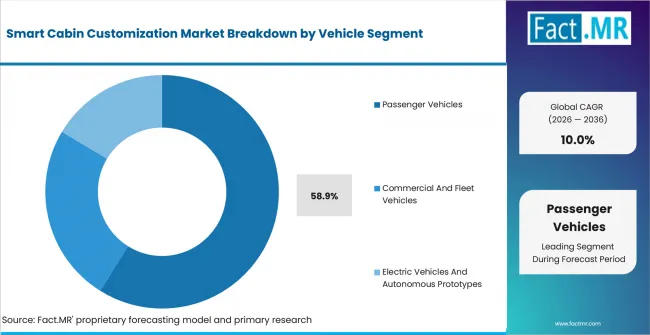
Smart Cabin Customization Market Analysis By Vehicle Segment | Source: Fact.MR
Passenger vehicles lead because smart-cabin features are developed for high-volume consumer platforms where the same digital architecture can be spread across several trims and body styles. Sedans and utility vehicles can share display hardware, software profiles, voice interfaces, and lighting controllers while presenting different cabin themes.
VDA data show more than 80 million passenger-car registrations worldwide in 2025, providing a broad installation base for cabin electronics. The volume allows OEMs and suppliers to amortize software and controller development across large programs rather than relying on low-volume bespoke customization.
The shift is closely connected with wider cockpit electronics adoption, where infotainment, displays, driver information, audio, and cabin controls are increasingly consolidated into integrated computing platforms.
What is accelerating Smart Cabin Customization Market adoption, and what is holding it back?
Growth is being driven by factory-integrated personalization, configurable lighting, and software-defined cockpit functions; opportunities lie in extending premium features across more models and selling updateable cabin experiences, while cybersecurity, integration cost, and driver-distraction controls can slow deployment.
Drivers Impact Analysis
| Factor | (~) % Impact on CAGR | Geographic Relevance | Impact Timeline |
|---|---|---|---|
| Factory-integrated driver profiles and cabin settings | +1.5% | Global | Near term |
| Software-controlled ambient lighting and mood personalization | +1.2% | Germany; USA; U.K.; Japan | Near term |
| AI and voice-based cabin interaction | +1.0% | Germany; USA; Japan | Mid term |
| Over-the-air feature updates and digital configuration | +0.8% | Global | Mid term |
| Premium passenger-vehicle cabin content | +0.6% | Germany; USA; U.K. | Mid term |
Opportunity Impact Analysis
| Factor | (~) % Impact on CAGR | Geographic Relevance | Impact Timeline |
|---|---|---|---|
| Reusable personalization platforms across multiple vehicle models | +0.9% | Global | Mid term |
| Diffusion of premium cabin features into mid-market vehicles | +0.7% | Brazil; USA; U.K. | Mid term |
| Downloadable and subscription-based cabin functions | +0.6% | Germany; USA; Japan | Mid term |
| Wellness and ergonomic personalization packages | +0.5% | Germany; Japan; U.K. | Long term |
Restraints Impact Analysis
| Factor | (~) % Impact on CAGR | Geographic Relevance | Impact Timeline |
|---|---|---|---|
| Cybersecurity and software-update compliance burden | -0.9% | Germany; U.K.; Japan; Global OEM programs | Near term |
| Hardware integration and automotive qualification cost | -0.8% | Global | Near term |
| Driver-distraction limits on interactive cabin functions | -0.6% | Europe; Japan; USA | Mid term |
| Aftermarket compatibility and warranty concerns | -0.4% | Global | Mid term |
Which countries are scaling the Smart Cabin Customization Market through 2036?
- Germany: Germany combines a substantial passenger-car manufacturing base with premium brands that are actively moving personalization into software-defined cockpit platforms. BMW has announced that Panoramic iDrive with Operating System X will extend across its model range, supporting factory-installed cabin customization.
- Brazil: Brazil recorded more than 2.5 million new passenger-car and light-vehicle registrations in 2025. The MOVER automotive policy supports technological development and investment, giving local vehicle programs a framework for adding connected and digitally differentiated cabin features.
- USA: U.S. light-vehicle sales exceeded 16 million units in 2025. Tesla has already normalized cloud-linked driver profiles and stored cabin preferences, giving buyers direct exposure to software-based personalization across seating, climate, navigation, and media.
- U.K.: New car registrations topped two million units in 2025, while battery-electric vehicles represented 23.4% of registrations. A growing mix of digitally intensive electric and premium vehicles gives manufacturers more opportunities to package configurable displays, lighting, comfort, and connected services.
- Japan: Japan recorded about 3.8 million passenger-car registrations in 2025. JAMA continues to track consumer interest in next-generation vehicles and advanced technologies, while domestic automakers provide a broad base for introducing connected cockpit and comfort personalization across local models.
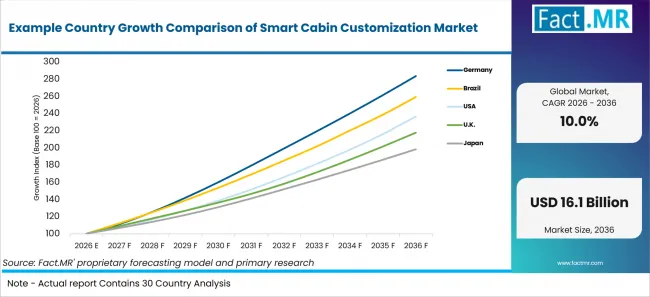
Example Country Growth Comparison Of Smart Cabin Customization Market | Source: Fact.MR
Country CAGR (2026-2036)
| Country | CAGR, 2026-2036 |
|---|---|
| Germany | 11.0% |
| Brazil | 10.0% |
| USA | 9.0% |
| U.K. | 8.1% |
| Japan | 7.1% |
What is driving Germany’s growth through 2036?
Germany is forecast to expand at an 11.0% CAGR from 2026 to 2036.
Domestic passenger-car production reached about 4.15 million units in 2025, while German group brands accounted for nearly 2.0 million new registrations in the home market. This gives cabin-system suppliers access to vehicle programs that can carry common digital architectures across multiple brands and models.
BMW is moving Personal Mode into its new Panoramic iDrive and Operating System X, with personalization spanning displays, ambient lighting, sound, and selected driving characteristics. Factory deployment of these functions supports demand for integrated controls, displays, lighting modules, software, and validation services.
What is driving Brazil’s growth through 2036?
Brazil is forecast to expand at a 10.0% CAGR from 2026 to 2036.
Brazil registered about 2.55 million passenger cars and light vehicles in 2025, giving automakers a meaningful domestic base for connected-cabin features. Competitive pressure from established manufacturers and newer entrants increases the value of visible in-cabin differentiation, particularly in utility vehicles and electrified models.
The MOVER program supports automotive technological development, competitiveness, and research investment. This policy environment can encourage local engineering of displays, connectivity, cabin controls, and software integration instead of relying only on imported finished systems.
What is driving USA’s growth through 2036?
The USA is forecast to expand at a 9.0% CAGR from 2026 to 2036.
U.S. light-vehicle sales reached roughly 16.0 million units in 2025. A large installed base allows automakers to spread cabin software and controller development across high-volume programs while using trim packages and digital options to differentiate individual models.
Tesla has made stored driver profiles part of the everyday vehicle interface, including seat, steering, mirror, climate, navigation, and media preferences. Familiarity with profile-based customization supports buyer expectations that cabin settings should follow the driver and remain available through connected accounts.
What is driving U.K.’s growth through 2036?
The U.K. is forecast to expand at an 8.1% CAGR from 2026 to 2036.
The U.K. new-car market exceeded two million registrations in 2025, and battery-electric vehicles accounted for 23.4% of the market. Electrified vehicles often use newer electrical and cockpit architectures, giving OEMs a practical point at which to introduce panoramic displays, digital profiles, ambient lighting, and connected cabin functions.
The market also has a substantial premium-vehicle presence. Buyers comparing high-specification models can directly experience differences in screen layout, cabin themes, seating controls, and voice interfaces, which supports customization packages that are delivered at the factory rather than through post-sale modification.
What is driving Japan’s growth through 2036?
Japan is forecast to expand at a 7.1% CAGR from 2026 to 2036.
Passenger-car registrations reached about 3.84 million units in 2025. JAMA reported a 71.9% household passenger-car ownership rate in its 2025 consumer survey, creating a broad base of owners for whom comfort and ease of use can influence replacement decisions.
Japanese automakers compete strongly on reliability and human-machine interaction, so customization is likely to be adopted where it can be integrated without increasing operating complexity. Saved seating, display, access, and comfort preferences fit this requirement because they improve convenience while remaining within the validated vehicle system.
Who Leads the Smart Cabin Customization Market?
Tesla, Nio, BYD, Visteon, Honda, BMW, Babes, and other market players.
Tesla combines cabin controls with cloud-linked driver profiles that can retain seat, steering, mirror, temperature, navigation, media, and other preferences. This creates a repeatable personalization layer without requiring a different hardware package for every driver and gives the company a direct relationship between the user account and the vehicle experience.
NIO competes through a smart-cabin architecture built around NOMI, connected services, programmable cabin actions, and configurable ambient lighting. Its approach shows how AI, voice interaction, lighting, comfort, and entertainment can be presented as one personalized cabin system rather than separate options.
Visteon competes as a technology supplier through cockpit domain controllers that consolidate displays, infotainment, driver information, and other functions. This architecture supports the wider shift toward auto infotainment and software-controlled cabin experiences because automakers can manage several interfaces from a common computing platform.
BMW competes through Personal Mode and Panoramic iDrive, while BYD and Honda participate through their vehicle portfolios and integrated cockpit programs. Supplier selection depends on software stability, display integration, response time, cybersecurity, hardware qualification, and the ability to reuse the same cabin platform across several vehicle lines.
Competition increasingly extends beyond physical trim. Companies that can update cabin functions after sale and preserve user settings across ownership or model changes can create longer customer relationships, but those capabilities also increase responsibility for software validation and data security.
Which companies are the key providers?
Key companies profiled include Tesla; Nio; BYD; Visteon; Honda; BMW; Babes; and Others.
- Tesla
- Nio
- BYD
- Visteona
- Honda
- BMW
- Babes
- Others
Bibliography
- Tesla, Inc. (2026). Driver Profiles. Model 3 Owner’s Manual.
- NIO Inc. (2026). NIO Full Stack: Smart Cabin and NOMI Intelligence.
- NIO Inc. (2026). EL8 User Manual: Ambient Lighting and Smart Action.
- BMW Group. (2025). The Next Stage in the Evolution of BMW iDrive.
- BMW Group. (2025). New BMW Panoramic iDrive Revolutionises Vehicle Operation.
- Visteon Corporation. (2026). Cockpit Domain Controller and SmartCore Technology.
- United Nations Economic Commission for Europe. (2026). Reference Documents for UN Regulations Nos. 155 and 156.
- European Commission. (2026). Vehicle Safety and Automated/Connected Vehicles.
- German Association of the Automotive Industry. (2026). Passenger Car Production in 2025.
- German Association of the Automotive Industry. (2026). New Registrations: Annual Figures 2025.
- Ministry of Development, Industry, Trade and Services, Brazil. (2026). Programa Mobilidade Verde e Inovação (MOVER).
- Society of Motor Manufacturers and Traders. (2026). New Car Market Up but ZEV Trajectory Unviable.
- Japan Automobile Manufacturers Association. (2026). 2025 Passenger Car Market Trend Survey.
This Report Answers
- Which customization platforms are becoming central to factory-installed smart cabin design?
- How are lighting, infotainment, seating, access, and in-cabin monitoring being combined into personalized vehicle experiences?
- Which customer profiles are most relevant for configurable cabin technologies?
- How do passenger vehicles, fleet vehicles, electric vehicles, and autonomous prototypes differ in customization requirements?
- What technical and regulatory factors influence the choice between OEM-led and aftermarket customization?
- How are automakers and cockpit-technology suppliers competing through software, displays, lighting, profiles, and integrated cabin computing?
What does the Smart Cabin Customization Market cover?
The Smart Cabin Customization Market covers products and integrated systems that allow vehicle cabins to be configured around occupant preferences. Revenue includes factory-installed and aftermarket customization platforms together with lighting and mood systems, smart infotainment and screens, comfort and ergonomic technologies, security and access enhancements, and related in-cabin controls included within the defined segment structure.
The market includes solutions sold to vehicle manufacturers, authorized aftermarket channels, independent aftermarket providers, and end users where the commercial offering changes cabin appearance, comfort, digital interaction, access, or user-specific settings. Demand is assessed across passenger vehicles, commercial and fleet vehicles, electric vehicles, and autonomous vehicle prototypes.
What is included in the scope?
Included products cover OEM-led factory customization, digital configuration platforms, authorized and independent aftermarket solutions, ambient and mood lighting, connected infotainment, display technology, smart seating, wellness technology, access control, and in-cabin monitoring where these are sold as cabin customization functions.
The scope includes personalization for luxury and premium buyers, technology-oriented users, and functional users. It covers sedans, utility vehicles, fleet vehicles, commercial vehicles, electric vehicles, and autonomous vehicle prototypes across North America, Latin America, Europe, East Asia, South Asia and Pacific, and the Middle East and Africa.
What is excluded from the scope?
The scope excludes exterior vehicle customization, drivetrain tuning, standalone ADAS hardware, propulsion components, charging systems, and general vehicle repair that does not alter the in-cabin experience. Conventional replacement parts are excluded when they simply restore the original cabin specification.
Standalone consumer electronics are outside the market unless integrated and sold as a vehicle-cabin customization solution. General telematics, fleet-management software, and autonomous-driving systems are excluded where their commercial purpose is not cabin personalization, comfort, access, display, or occupant interaction.
How Was the Analysis Built?
The analysis draws on more than 120 sources, over 35 company portfolios and more than 20 industry interviews across at least 25 countries.
- Primary Research
- Primary research includes interviews with vehicle OEMs, cockpit-electronics suppliers, interior-system manufacturers, software providers, lighting suppliers, authorized accessory channels, aftermarket installers, fleet buyers, and automotive technology specialists. Discussions focus on feature fitment, integration cost, customer willingness to pay, qualification requirements, software maintenance, and procurement cycles.
- Desk Research
- Desk research covers vehicle-registration and production statistics, automotive safety and software-update regulations, OEM product documentation, cockpit-technology disclosures, connected-vehicle specifications, industry-association publications, and current company filings. Product evidence is checked against first-party manufacturer material where possible.
- Market Sizing and Forecasting
- Market sizing combines vehicle production and registrations with smart-cabin feature penetration, customization content per vehicle, OEM versus aftermarket mix, technology mix, vehicle-segment mix, average system value, and country-level adoption. Forecast assumptions also consider software-defined vehicle architectures, premium-feature migration, connected cockpit deployment, and replacement or upgrade demand.
- Data Validation and Update Cycle
- Findings are cross-checked against public vehicle data, OEM product activity, supplier program wins, primary interviews, software and safety regulations, and new model launches. Updates account for changes in cockpit architecture, display and lighting fitment, software-update practices, cybersecurity requirements, and vehicle-production patterns.
What is the report's scope and coverage?
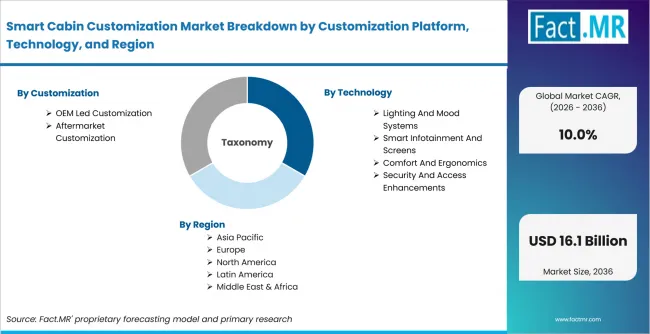
Smart Cabin Customization Market Breakdown By Customization Platform, Technology, And Region | Source: Fact.MR
| Attribute | Details |
|---|---|
| Quantitative Units | USD billion |
| Market Definition | Vehicle-cabin customization platforms and technologies that personalize in-cabin appearance, comfort, digital interaction, access, or user-specific settings |
| Segments Covered | Customization Platform; Technology; Customer Profile; Vehicle Segment |
| Regions Covered | North America; Latin America; Europe; East Asia; South Asia and Pacific; Middle East and Africa |
| Countries Covered | Germany; Brazil; USA; U.K.; Japan |
| Key Companies Profiled | Tesla; Nio; BYD; Visteon; Honda; BMW; Babes; Others |
| Forecast Period | 2026 to 2036 |
| Market Value, 2026 | USD 6.2 billion |
| Market Value, 2036 | USD 16.1 billion |
| CAGR, 2026-2036 | 10.0% |
| Absolute Opportunity | USD 9.9 billion |
| Approach | Hybrid top-down and bottom-up approach using vehicle volumes, customization content, feature penetration, technology mix, customer mix, and country adoption |
How is the market segmented?
-
By Customization Platform:
- OEM Led Customization
- Factory Installed Customization
- Digital Configuration Platforms
- Aftermarket Customization
- Authorized Aftermarket Solutions
- Independent Aftermarket Solutions
- OEM Led Customization
-
By Technology:
- Lighting And Mood Systems
- Ambient Lighting Technology
- Mood Personalization Technology
- Smart Infotainment And Screens
- Connected Infotainment Technology
- Display Technology
- Comfort And Ergonomics
- Smart Seating Technology
- Wellness Technology
- Security And Access Enhancements
- Access Control Technology
- In Cabin Monitoring Technology
- Lighting And Mood Systems
-
By Customer Profile:
- Luxury And Premium Buyers
- Premium Vehicle Owners
- Personalization Focused Buyers
- Tech Savvy Professionals
- Connected Vehicle Users
- Early Technology Adopters
- Functional Users
- Comfort Focused Users
- Practical Buyers
- Luxury And Premium Buyers
-
By Vehicle Segment:
- Passenger Vehicles
- Sedans
- Utility Vehicles
- Commercial And Fleet Vehicles
- Fleet Vehicles
- Commercial Vehicles
- Electric Vehicles And Autonomous Prototypes
- Electric Vehicles
- Autonomous Vehicle Prototypes
- Passenger Vehicles
-
By Region:
- North America
- Latin America
- Western Europe
- Eastern Europe
- East Asia
- South Asia and Pacific
- Middle East & Africa