Smart End-Effector Platforms Market Size, Share, Growth and Forecast (2026 - 2036)
The Smart End-Effector Platforms Market is segmented by Automation Function, by Deployment Model, by End-Use Industry, by Buyer Type and Region. Forecast for 2026 to 2036.
What is the smart end-effector platforms market forecast to be worth by 2036?
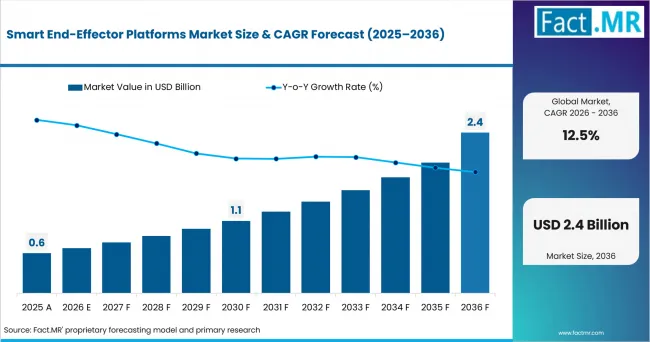
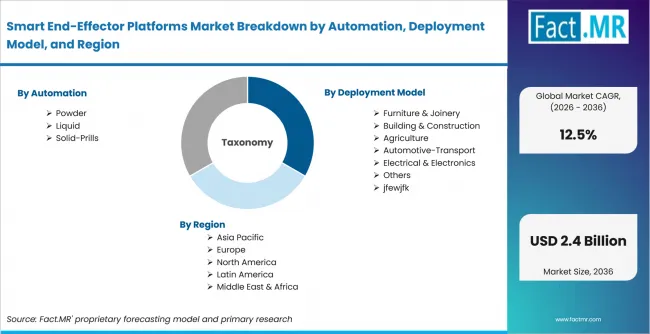
USD 0.7 billion in 2026 to USD 2.4 billion by 2036 at 12.5% CAGR.
- The Smart End-Effector Platforms Market was valued at USD 0.6 billion in 2025 and is projected to reach USD 0.7 billion in 2026.
- The market is forecast to expand to USD 2.4 billion by 2036, reflecting a CAGR of 12.5% during the forecast period.
- Growth is supported by rising industrial automation adoption, expansion of collaborative robotics and increasing deployment of AI-powered manufacturing systems.
What are the defining numbers behind smart end-effector platform growth?
USD 1.7 billion absolute opportunity by 2036 led by China and the United States.
- Demand Drivers in the Market
- Manufacturers are increasing automation investments to improve productivity and labor efficiency.
- Collaborative robots require intelligent end-effectors capable of safe and adaptive operations.
- AI-enabled vision systems are improving robotic accuracy across complex production environments.
- Rising demand for flexible manufacturing is increasing adoption of smart robotic tooling platforms.
- Key Segments Analyzed
- By Automation Function: Adaptive Gripping is expected to hold 26.0% share in 2026 because gripping operations account for the largest proportion of robotic handling tasks.
- By Deployment Model: Industrial Robot EOAT is projected to account for 38.0% share in 2026 due to extensive deployment across automotive and manufacturing facilities.
- By End-Use Industry: Automotive is expected to hold 28.0% share in 2026 as vehicle manufacturers continue expanding factory automation investments.
- By Buyer Type: Large OEMs are projected to account for 41.0% share in 2026 because they represent the largest investors in advanced robotic automation systems.
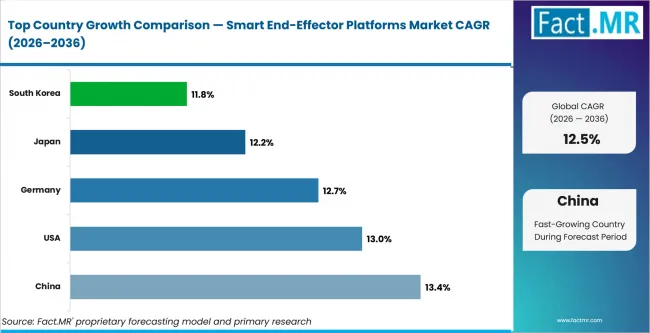
- By Geography: China is projected to record 13.4% CAGR through 2036 as industrial automation adoption continues accelerating across manufacturing sectors.
- Analyst Opinion at Fact.MR
- Shambhu Nath Jha, Senior Analyst at Fact.MR, states, "Smart end-effectors are becoming critical components within next-generation industrial automation systems. The combination of AI, machine vision and advanced sensing technologies is enabling robots to perform increasingly complex tasks while improving operational flexibility and manufacturing efficiency."
- Strategic Implications
- Invest in AI-enabled vision capabilities that improve robotic adaptability across dynamic production environments.
- Expand cloud-connected platforms that support predictive maintenance and remote performance monitoring.
- Develop modular product portfolios that address automotive, electronics, logistics and food processing applications.
Smart end-effector platforms combine gripping technologies, sensors, vision systems and intelligent control software to perform complex handling and assembly tasks. These platforms enable robots to adapt to varying product geometries and operating conditions while improving productivity and quality control.
China remains the largest market due to large-scale industrial automation investments and manufacturing expansion. The United States continues to witness strong adoption across automotive, electronics and logistics industries. Germany benefits from advanced factory automation infrastructure. Japan maintains steady demand through robotics leadership and industrial modernization. South Korea is emerging as a high-growth market supported by semiconductor and electronics manufacturing investments.
How does the smart end-effector platforms market break down by segment?
Adaptive Gripping leads at 26.0%; Automotive leads at 28.0%.
Which automation function dominates?
Adaptive Gripping holds 26.0% share in 2026.
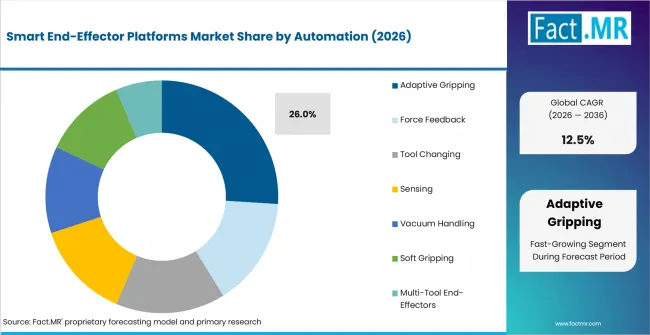
Adaptive gripping leads because manufacturers increasingly require robotic systems capable of handling products with varying shapes, weights and surface characteristics. Traditional gripping systems often struggle in high-mix production environments where product variability is common. Adaptive gripping technologies enable robots to adjust gripping force and positioning automatically, reducing product damage while improving handling efficiency. Festo launched GripperAI, an AI-powered software platform that automatically identifies optimal gripping points and selects the most suitable gripper from available end-effectors. The solution enables robots to handle mixed and previously unseen objects without extensive programming, significantly advancing intelligent end-effector capabilities. [1]
Which deployment model dominates?
Industrial Robot EOAT accounts for 38.0% share in 2026.
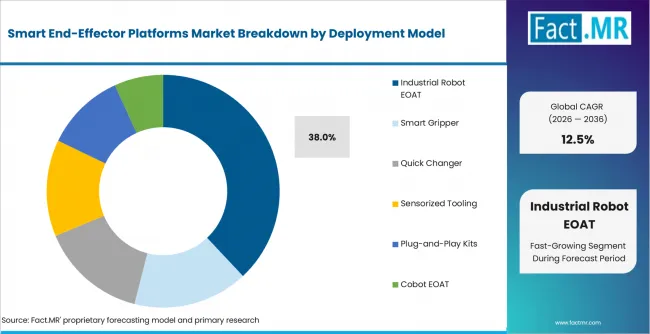
Industrial Robot End-of-Arm Tooling leads because large-scale manufacturing facilities continue to represent the largest users of robotic automation systems. Automotive assembly plants, electronics manufacturing facilities and industrial production lines require highly reliable end-effectors capable of operating continuously in demanding environments. Faraday Future unveiled its industrial-grade EAI mobile manipulator series, FF Faber, as part of its FF EAI Robot World ecosystem at Automate 2026. The launch highlighted advanced robotic manipulation and smart end-effector integration for industrial applications.[2]
Which end-use industry dominates?
Automotive holds 28.0% share in 2026.
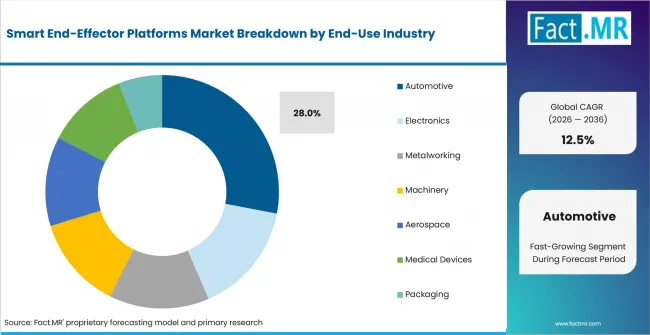
Automotive manufacturers remain the largest users of smart end-effector platforms because vehicle production requires high levels of automation, precision and repeatability. Smart end-effectors support body assembly, component handling, painting, inspection and final assembly operations throughout vehicle manufacturing facilities. At ICRA 2026, TARS introduced its 21-DoF DexHand, a human-scale dexterous robotic hand equipped with micro-cameras and tactile sensors for precision manipulation. The launch targeted next-generation embodied AI and advanced robotic end-effectors. [3]
Which buyer type dominates?
Large OEMs lead with 41.0% share in 2026.
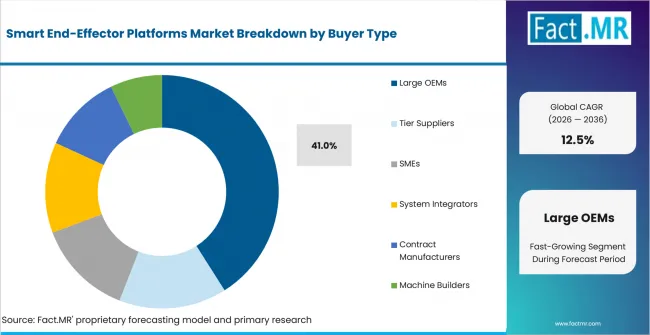
Large OEMs dominate because they possess the capital resources necessary to deploy advanced robotic automation systems at scale. These organizations operate complex manufacturing environments where automation investments generate measurable productivity and efficiency improvements.
What is accelerating smart end-effector platform demand and what is holding it back?
Smart manufacturing investments drive demand while integration complexity restrains adoption.
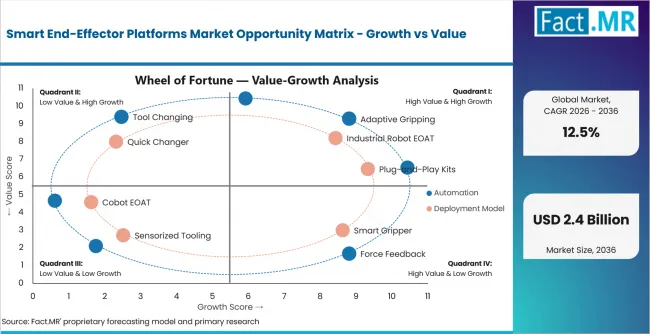
The primary growth driver is increasing investment in factory automation and digital manufacturing technologies. Manufacturers are seeking solutions that improve productivity while enabling greater flexibility across production operations. Smart end-effectors provide adaptive handling capabilities that allow robotic systems to manage increasingly complex manufacturing tasks. Genesis AI unveiled GENE-26.5, accompanied by a proprietary dexterous robotic hand designed to transfer human skills to robots. The company positioned the hand as a core component for achieving human-level physical manipulation capabilities. [4]
Growing adoption of collaborative robots is creating additional demand. Unlike conventional industrial robots, collaborative systems often require intelligent sensing and adaptive tooling capabilities that improve operational safety and performance. As cobot deployments expand, demand for advanced end-of-arm tooling solutions continues to increase. DexRobot showcased its flagship DexHand021 Pro at CES 2026. The dexterous hand features 22 degrees of freedom and a dual-tendon drive system enabling complex 3D manipulation, representing a significant advancement in smart robotic end-effectors. [5]
Where do the biggest smart end-effector opportunities sit?
- Collaborative Robotics Expansion:Collaborative robot deployments continue expanding across manufacturing, logistics and packaging environments. Smart end-effectors designed specifically for human-robot collaboration are expected to create significant growth opportunities.
- AI-Driven Adaptive Automation:Artificial intelligence enables end-effectors to adjust gripping force, positioning and task execution in real time. Manufacturers are increasingly adopting adaptive automation technologies to improve production flexibility.
- Electronics and Semiconductor Manufacturing:Miniaturized components require precise handling and inspection capabilities. Smart end-effectors equipped with advanced sensing systems are becoming increasingly important within semiconductor and electronics production facilities.
- Flexible Manufacturing Systems:Manufacturers are shifting toward production environments capable of handling multiple product variants without extensive reconfiguration. Smart end-effectors support this transition by enabling rapid adaptation to changing production requirements.
- Predictive Maintenance Platforms:Cloud-connected end-effectors capable of monitoring performance and detecting maintenance requirements are creating new service and software revenue opportunities for technology providers.
Which countries are scaling smart end-effector platform adoption fastest?
China 13.4%, United States 13.0%, Germany 12.7%, Japan 12.2%, South Korea 11.8%.
Based on regional analysis, the smart end-effector platforms market is segmented into North America, Western Europe, Asia Pacific, Latin America and Middle East & Africa.
.webp)
| Country | CAGR |
|---|---|
| China | 13.4% |
| United States | 13.0% |
| Germany | 12.7% |
| Japan | 12.2% |
| South Korea | 11.8% |

What is powering China's leadership?
13.4% CAGR, supported by large-scale manufacturing automation investments
China is projected to record 13.4% CAGR as manufacturers continue accelerating industrial automation adoption across automotive, electronics and machinery production facilities. Government support for smart manufacturing initiatives and domestic robotics development is creating favorable conditions for market expansion. The country's position as the world's largest manufacturing hub continues to support demand for advanced robotic tooling solutions. Growing deployment of collaborative robots and AI-enabled automation systems is increasing adoption of sensorized end-effectors across both export-oriented and domestic production facilities.
How is the United States scaling smart end-effector platform demand?
13.0% CAGR, driven by smart factory modernization initiatives
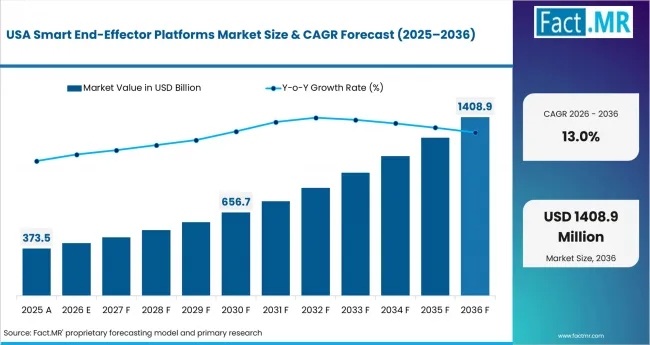
The United States is expected to post 13.0% CAGR through 2036 as manufacturers invest in automation technologies to improve productivity and address labor shortages. Adoption is increasing across automotive assembly plants, aerospace facilities, logistics centers and medical device manufacturing operations. Manufacturers are prioritizing flexible automation systems capable of supporting product customization and shorter production cycles.
What underpins Germany's growth?
12.7% CAGR, supported by Industry 4.0 leadership
Germany is projected to register 12.7% CAGR by 2036 due to strong adoption of Industry 4.0 technologies and advanced factory automation systems. The country's industrial base continues to invest in intelligent manufacturing solutions that improve operational efficiency and production flexibility. Automotive manufacturers, machinery producers and industrial equipment suppliers remain major adopters of smart end-effector technologies. Integration of robotics, machine vision and digital manufacturing platforms is accelerating demand for intelligent end-of-arm tooling.
How does Japan perform?
12.2% CAGR, driven by robotics innovation and manufacturing precision requirements
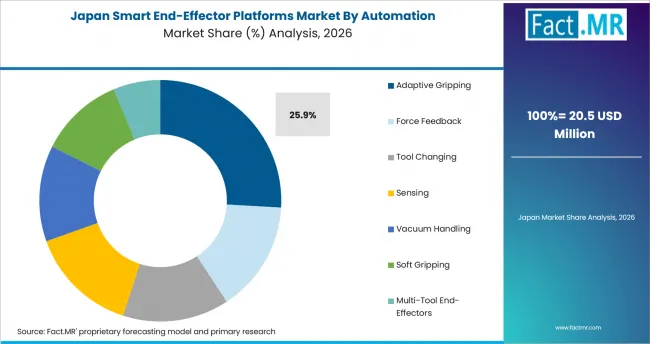
Japan is expected to register 12.2% CAGR due to its strong robotics ecosystem and long-standing focus on manufacturing precision. Industrial manufacturers continue investing in advanced automation systems capable of supporting complex production processes and maintaining high quality standards. Electronics, automotive and industrial machinery sectors remain key users of intelligent robotic tooling technologies.
Why is South Korea important?
11.8% CAGR, supported by semiconductor and electronics manufacturing expansion
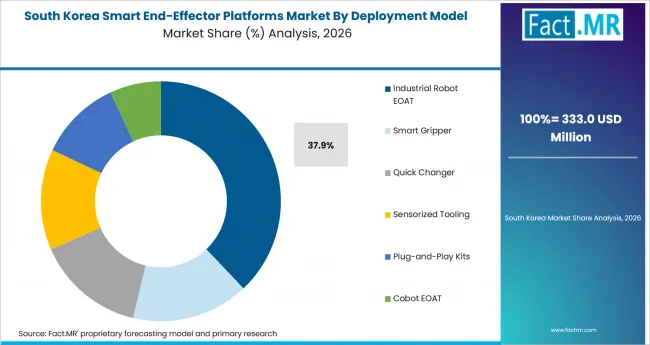
South Korea is forecast to advance at 11.8% CAGR by 2036 as semiconductor fabrication facilities and electronics manufacturers continue increasing automation investments. High production volumes and precision manufacturing requirements create strong demand for intelligent robotic handling systems. Manufacturers are increasingly deploying sensorized end-effectors to improve yield rates and production efficiency.
Who leads the smart end-effector platforms landscape?
Schunk, Zimmer Group, OnRobot, Festo and SMC Corporation lead through intelligent gripping technologies, sensing capabilities and automation platform expertise.
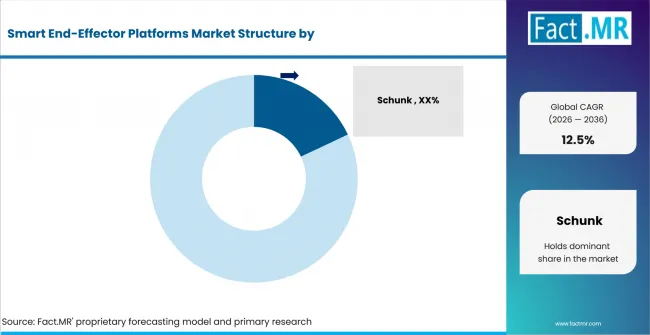
The market is characterized by competition focused on adaptive gripping performance, sensing accuracy and compatibility with industrial and collaborative robotic systems. Suppliers continue investing in AI-enabled control functions, force sensing technologies and modular tooling architectures to strengthen competitive positioning.
Schunk remains a prominent participant due to its broad portfolio of robotic gripping and automation solutions. Zimmer Group benefits from strong expertise in handling technologies and industrial automation systems. OnRobot continues expanding through collaborative robot applications and plug-and-play end-of-arm tooling solutions. Festo and SMC Corporation maintain strong positions through their automation technology portfolios and global industrial customer networks.
Competition through 2036 will depend on intelligent sensing capabilities, software integration and deployment flexibility. Companies that combine adaptive automation technologies with easy system integration will be better positioned to strengthen market share.
Which companies are the key players?
Schunk, Zimmer Group, OnRobot, Festo, SMC Corporation, ATI Industrial Automation, Piab
- Schunk
- Zimmer Group
- OnRobot
- Festo
- SMC Corporation
- ATI Industrial Automation
- Piab
- Destaco
Bibliography
- [1] Festo. (2026). GripperAI software for flexible robot handling. Festo.
- [2] Schunk. (2026). Smart gripping and end-of-arm tooling solutions. Schunk.
- [3] Zimmer Group. (2026). Handling technology and robotic end-effectors. Zimmer Group.
- [4] OnRobot. (2026). End-of-arm tooling for collaborative robot applications. OnRobot.
- [5] SMC Corporation. (2026). Electric grippers and automation components. SMC Corporation.
- [6] ATI Industrial Automation. (2026). Robotic tool changers and force/torque sensors. ATI Industrial Automation.
- [7] Piab. (2026). Vacuum automation and robotic gripping solutions. Piab.
- [8] Robotiq. (2026). Adaptive grippers for collaborative robots. Robotiq.
This Report Addresses
- Strategic intelligence on smart end-effector platforms and intelligent robotic tooling technologies.
- Segment analysis covering automation functions, deployment models, end-use industries and buyer categories.
- Regional outlook covering China, United States, Germany, Japan and South Korea.
- Competitive assessment of Schunk, Zimmer Group, OnRobot, Festo and leading end-of-arm automation providers.
- Analysis of adaptive gripping, force sensing, machine vision and intelligent automation trends.
- Evaluation of collaborative robotics adoption, flexible manufacturing requirements and smart factory investments.
- Primary interviews, company benchmarking and industry validation supporting forecast development.
What does the smart end-effector platforms market cover?
Intelligent robotic end-effectors used for handling, assembly, inspection and material movement.
The market covers integrated hardware and software systems that enable robotic platforms to interact with objects through sensing, gripping, positioning and adaptive control functions.
What is included in the scope?
Smart grippers, robotic tooling systems, machine vision modules and AI-enabled end-effector platforms.
The scope includes electric grippers, vacuum grippers, force sensing devices, vision-guided systems, adaptive tooling solutions and cloud-connected robotic end-effectors.
What is excluded from the scope?
Industrial robots without intelligent end-effectors and conventional mechanical tooling.
The scope excludes robotic arms sold without end-effector systems, manual tooling equipment and non-automated handling solutions.
How was the analysis built?
100+ sources, 45+ company assessments, 25+ countries and industry interviews.
- Primary Research: Interviews with automation vendors, robotics integrators, manufacturing executives and industrial automation consultants.
- Desk Research: Analysis of industrial automation spending, robotics deployments, smart factory investments and AI adoption trends.
- Market Sizing and Forecasting: Estimates based on end-effector shipments, automation investments, manufacturing output and robotics installation trends.
- Data Validation and Update Cycle: Forecasts validated through company benchmarking, distributor assessments and industrial automation adoption analysis.
What is the report's scope and coverage?
| Attribute | Details |
|---|---|
| Quantitative Units | USD Billion in 2026 to USD Billion by 2036 |
| Market Definition | Intelligent robotic end-effectors combining sensing, gripping and adaptive automation technologies |
| Automation Function | Adaptive Gripping, Force Feedback, Tool Changing, Sensing, Vacuum Handling, Soft Gripping, Multi-Tool End-Effectors |
| Deployment Model | Cobot EOAT, Industrial Robot EOAT, Smart Gripper, Quick Changer, Sensorized Tooling, Plug-and-Play Kits |
| End-Use Industry | Automotive, Electronics, Metalworking, Machinery, Aerospace, Medical Devices, Packaging, Consumer Goods |
| Buyer Type | Large OEMs, Tier Suppliers, SMEs, System Integrators, Contract Manufacturers, Machine Builders |
| Regions Covered | North America, Western Europe, Asia Pacific, Latin America, Middle East & Africa |
| Countries Covered | China, United States, Germany, Japan, South Korea |
| Companies Covered | Schunk, Zimmer Group, OnRobot, Festo, SMC Corporation, ATI Industrial Automation, Piab, Destaco, Robotiq, SCHMALZ |
| Forecast Period | 2026 to 2036 |
| Approach | Hybrid top-down and bottom-up approach using robotics installations, automation spending and end-effector deployment trends |
How is market segmented?
-
By Automation Function
- Adaptive Gripping
- Force Feedback
- Tool Changing
- Sensing
- Vacuum Handling
- Soft Gripping
- Multi-Tool End-Effectors
-
By Deployment Model
- Cobot EOAT
- Industrial Robot EOAT
- Smart Gripper
- Quick Changer
- Sensorized Tooling
- Plug-and-Play Kits
-
By End-Use Industry
- Automotive
- Electronics
- Metalworking
- Machinery
- Aerospace
- Medical Devices
- Packaging
- Consumer Goods
-
By Buyer Type
- Large OEMs
- Tier Suppliers
- SMEs
- System Integrators
- Contract Manufacturers
- Machine Builders
-
Region:
- North America
- United States
- Canada
- Europe
- Germany
- United Kingdom
- France
- Italy
- Spain
- Asia Pacific
- China
- Japan
- South Korea
- India
- Singapore
- Latin America
- Brazil
- Mexico
- Argentina
- Middle East & Africa
- GCC Countries
- South Africa
- Israel
- North America
- Frequently Asked Questions -
Which automation function leads the market?
Adaptive gripping leads with 26.0% share due to increasing demand for flexible robotic handling across variable production environments.
Which country leads the Smart End-Effector Platforms Market?
China leads due to extensive manufacturing automation investments and large-scale deployment of industrial robotic systems.
What is driving demand for smart end-effector platforms?
Rising automation adoption, collaborative robot deployments and demand for flexible manufacturing systems are driving market growth.
What is the primary challenge facing the market?
System integration complexity and high implementation costs remain key barriers to broader market adoption.
How is AI influencing smart end-effector platforms?
AI improves object recognition, gripping precision, force control and adaptive decision-making during robotic operations.
What is driving growth in the Smart End-Effector Platforms Market?
Increasing investment in smart factories and digital manufacturing technologies is accelerating deployment of intelligent end-effectors.
Why are manufacturers investing in smart end-effector platforms?
Manufacturers use smart end-effectors to improve productivity, reduce errors and increase automation flexibility.
Which deployment model is most widely adopted?
Industrial Robot EOAT leads because large manufacturing facilities continue deploying robotic automation at scale.
Table of Content
- Key Takeaways
- Market Size and CAGR
- Top Growth Driver
- Fastest Growing Segment
- Leading Region
- Key Companies
- Emerging Opportunities
- Executive Summary
- Global Market Outlook
- Demand-side Trends
- Supply-side Trends
- Technology Roadmap Analysis
- Analysis and Recommendations
- Analyst Perspective (What is happening? Why now? What should investors know?)
- Key Questions Answered
- How large is the market?
- What is the CAGR?
- What are key trends?
- Which region dominates?
- Who are the leaders?
- Market Overview
- Market Coverage / Taxonomy
- Market Definition / Scope / Limitations
- Research Methodology
- Chapter Orientation
- Analytical Lens and Working Hypotheses
- Market Structure, Signals, and Trend Drivers
- Benchmarking and Cross-market Comparability
- Market Sizing, Forecasting, and Opportunity Mapping
- Research Design and Evidence Framework
- Desk Research Programme (Secondary Evidence)
- Expert Input and Fieldwork (Primary Evidence)
- Tooling, Models, and Reference Databases
- Data Engineering and Model Build
- Quality Assurance and Audit Trail
- Market Background
- Market Dynamics (Drivers, Restraints, Opportunity, Trends)
- Scenario Forecast (Optimistic, Likely, Conservative)
- Impact Analysis
- AI Impact
- Sustainability Impact
- Regulatory Impact
- Technology Impact
- Consumer / Buyer Analysis
- Purchase Drivers
- Adoption Barriers
- Buyer Journey
- Opportunity Map Analysis
- Product Life Cycle Analysis
- Supply Chain Analysis
- Investment Feasibility Matrix
- Value Chain Analysis
- PESTLE and Porter's Analysis
- Regulatory Landscape
- Regional Parent Market Outlook
- Production and Consumption Statistics
- Import and Export Statistics
- Global Market Analysis and Forecast, 2021 to 2036
- Historical Market Size Value (USD Billion) Analysis, 2021 to 2025
- Current and Future Market Size Value (USD Billion) Projections, 2026 to 2036
- Y-o-Y Growth Trend Analysis
- Absolute $ Opportunity Analysis
- Global Market Pricing Analysis, 2021 to 2036
- Global Market Analysis and Forecast, By Automation, 2021 to 2036
- Introduction / Key Findings
- Historical Market Size Value (USD Billion) Analysis By Automation, 2021 to 2025
- Current and Future Market Size Value (USD Billion) Analysis and Forecast By Automation, 2026 to 2036
- Adaptive Gripping
- Force Feedback
- Tool Changing
- Sensing
- Vacuum Handling
- Soft Gripping
- Multi-Tool End-Effectors
- Y-o-Y Growth Trend Analysis By Automation, 2021 to 2025
- Absolute $ Opportunity Analysis By Automation, 2026 to 2036
- Global Market Analysis and Forecast, By Deployment Model, 2021 to 2036
- Introduction / Key Findings
- Historical Market Size Value (USD Billion) Analysis By Deployment Model, 2021 to 2025
- Current and Future Market Size Value (USD Billion) Analysis and Forecast By Deployment Model, 2026 to 2036
- Industrial Robot EOAT
- Smart Gripper
- Quick Changer
- Sensorized Tooling
- Plug-and-Play Kits
- Cobot EOAT
- Y-o-Y Growth Trend Analysis By Deployment Model, 2021 to 2025
- Absolute $ Opportunity Analysis By Deployment Model, 2026 to 2036
- Global Market Analysis and Forecast, By End-Use Industry, 2021 to 2036
- Introduction / Key Findings
- Historical Market Size Value (USD Billion) Analysis By End-Use Industry, 2021 to 2025
- Current and Future Market Size Value (USD Billion) Analysis and Forecast By End-Use Industry, 2026 to 2036
- Automotive
- Electronics
- Metalworking
- Machinery
- Aerospace
- Medical Devices
- Packaging
- Consumer Goods
- Y-o-Y Growth Trend Analysis By End-Use Industry, 2021 to 2025
- Absolute $ Opportunity Analysis By End-Use Industry, 2026 to 2036
- Global Market Analysis and Forecast, By Buyer Type, 2021 to 2036
- Introduction / Key Findings
- Historical Market Size Value (USD Billion) Analysis By Buyer Type, 2021 to 2025
- Current and Future Market Size Value (USD Billion) Analysis and Forecast By Buyer Type, 2026 to 2036
- Large OEMs
- Tier Suppliers
- SMEs
- System Integrators
- Contract Manufacturers
- Machine Builders
- Y-o-Y Growth Trend Analysis By Buyer Type, 2021 to 2025
- Absolute $ Opportunity Analysis By Buyer Type, 2026 to 2036
- Global Market Analysis and Forecast, By Region, 2021 to 2036
- Introduction
- Historical Market Size Value (USD Billion) Analysis By Region, 2021 to 2025
- Current Market Size Value (USD Billion) Analysis and Forecast By Region, 2026 to 2036
- North America
- Latin America
- Western Europe
- Eastern Europe
- East Asia
- South Asia and Pacific
- Middle East & Africa
- Market Attractiveness Analysis By Region
- North America Market Analysis and Forecast, By Country, 2021 to 2036
- Historical Market Size Value (USD Billion) Trend Analysis By Market Taxonomy, 2021 to 2025
- Market Size Value (USD Billion) Forecast By Market Taxonomy, 2026 to 2036
- By Country
- USA
- Canada
- Mexico
- By Automation
- By Deployment Model
- By End-Use Industry
- By Buyer Type
- By Country
- Market Attractiveness Analysis
- By Country
- By Automation
- By Deployment Model
- By End-Use Industry
- By Buyer Type
- Key Takeaways
- Latin America Market Analysis and Forecast, By Country
- Historical Market Size Value (USD Billion) Trend Analysis By Market Taxonomy, 2021 to 2025
- Market Size Value (USD Billion) Forecast By Market Taxonomy, 2026 to 2036
- By Country
- Brazil
- Chile
- Rest of Latin America
- By Automation
- By Deployment Model
- By End-Use Industry
- By Buyer Type
- By Country
- Market Attractiveness Analysis
- By Country
- By Automation
- By Deployment Model
- By End-Use Industry
- By Buyer Type
- Key Takeaways
- Western Europe Market Analysis and Forecast, By Country
- Historical Market Size Value (USD Billion) Trend Analysis By Market Taxonomy, 2021 to 2025
- Market Size Value (USD Billion) Forecast By Market Taxonomy, 2026 to 2036
- By Country
- Germany
- UK
- Italy
- Spain
- France
- Nordic
- BENELUX
- Rest of Western Europe
- By Automation
- By Deployment Model
- By End-Use Industry
- By Buyer Type
- By Country
- Market Attractiveness Analysis
- By Country
- By Automation
- By Deployment Model
- By End-Use Industry
- By Buyer Type
- Key Takeaways
- Eastern Europe Market Analysis and Forecast, By Country
- Historical Market Size Value (USD Billion) Trend Analysis By Market Taxonomy, 2021 to 2025
- Market Size Value (USD Billion) Forecast By Market Taxonomy, 2026 to 2036
- By Country
- Russia
- Poland
- Hungary
- Balkan & Baltic
- Rest of Eastern Europe
- By Automation
- By Deployment Model
- By End-Use Industry
- By Buyer Type
- By Country
- Market Attractiveness Analysis
- By Country
- By Automation
- By Deployment Model
- By End-Use Industry
- By Buyer Type
- Key Takeaways
- East Asia Market Analysis and Forecast, By Country
- Historical Market Size Value (USD Billion) Trend Analysis By Market Taxonomy, 2021 to 2025
- Market Size Value (USD Billion) Forecast By Market Taxonomy, 2026 to 2036
- By Country
- China
- Japan
- South Korea
- By Automation
- By Deployment Model
- By End-Use Industry
- By Buyer Type
- By Country
- Market Attractiveness Analysis
- By Country
- By Automation
- By Deployment Model
- By End-Use Industry
- By Buyer Type
- Key Takeaways
- South Asia and Pacific Market Analysis and Forecast, By Country
- Historical Market Size Value (USD Billion) Trend Analysis By Market Taxonomy, 2021 to 2025
- Market Size Value (USD Billion) Forecast By Market Taxonomy, 2026 to 2036
- By Country
- India
- ASEAN
- Australia & New Zealand
- Rest of South Asia and Pacific
- By Automation
- By Deployment Model
- By End-Use Industry
- By Buyer Type
- By Country
- Market Attractiveness Analysis
- By Country
- By Automation
- By Deployment Model
- By End-Use Industry
- By Buyer Type
- Key Takeaways
- Middle East & Africa Market Analysis and Forecast, By Country
- Historical Market Size Value (USD Billion) Trend Analysis By Market Taxonomy, 2021 to 2025
- Market Size Value (USD Billion) Forecast By Market Taxonomy, 2026 to 2036
- By Country
- Kingdom of Saudi Arabia
- Other GCC Countries
- Turkiye
- South Africa
- Other African Union
- Rest of Middle East & Africa
- By Automation
- By Deployment Model
- By End-Use Industry
- By Buyer Type
- By Country
- Market Attractiveness Analysis
- By Country
- By Automation
- By Deployment Model
- By End-Use Industry
- By Buyer Type
- Key Takeaways
- Key Countries Market Analysis
- USA
- Pricing Analysis
- Market Share Analysis, 2025
- By Automation
- By Deployment Model
- By End-Use Industry
- By Buyer Type
- Canada
- Pricing Analysis
- Market Share Analysis, 2025
- By Automation
- By Deployment Model
- By End-Use Industry
- By Buyer Type
- Mexico
- Pricing Analysis
- Market Share Analysis, 2025
- By Automation
- By Deployment Model
- By End-Use Industry
- By Buyer Type
- Brazil
- Pricing Analysis
- Market Share Analysis, 2025
- By Automation
- By Deployment Model
- By End-Use Industry
- By Buyer Type
- Chile
- Pricing Analysis
- Market Share Analysis, 2025
- By Automation
- By Deployment Model
- By End-Use Industry
- By Buyer Type
- Germany
- Pricing Analysis
- Market Share Analysis, 2025
- By Automation
- By Deployment Model
- By End-Use Industry
- By Buyer Type
- UK
- Pricing Analysis
- Market Share Analysis, 2025
- By Automation
- By Deployment Model
- By End-Use Industry
- By Buyer Type
- Italy
- Pricing Analysis
- Market Share Analysis, 2025
- By Automation
- By Deployment Model
- By End-Use Industry
- By Buyer Type
- Spain
- Pricing Analysis
- Market Share Analysis, 2025
- By Automation
- By Deployment Model
- By End-Use Industry
- By Buyer Type
- France
- Pricing Analysis
- Market Share Analysis, 2025
- By Automation
- By Deployment Model
- By End-Use Industry
- By Buyer Type
- India
- Pricing Analysis
- Market Share Analysis, 2025
- By Automation
- By Deployment Model
- By End-Use Industry
- By Buyer Type
- ASEAN
- Pricing Analysis
- Market Share Analysis, 2025
- By Automation
- By Deployment Model
- By End-Use Industry
- By Buyer Type
- Australia & New Zealand
- Pricing Analysis
- Market Share Analysis, 2025
- By Automation
- By Deployment Model
- By End-Use Industry
- By Buyer Type
- China
- Pricing Analysis
- Market Share Analysis, 2025
- By Automation
- By Deployment Model
- By End-Use Industry
- By Buyer Type
- Japan
- Pricing Analysis
- Market Share Analysis, 2025
- By Automation
- By Deployment Model
- By End-Use Industry
- By Buyer Type
- South Korea
- Pricing Analysis
- Market Share Analysis, 2025
- By Automation
- By Deployment Model
- By End-Use Industry
- By Buyer Type
- Russia
- Pricing Analysis
- Market Share Analysis, 2025
- By Automation
- By Deployment Model
- By End-Use Industry
- By Buyer Type
- Poland
- Pricing Analysis
- Market Share Analysis, 2025
- By Automation
- By Deployment Model
- By End-Use Industry
- By Buyer Type
- Hungary
- Pricing Analysis
- Market Share Analysis, 2025
- By Automation
- By Deployment Model
- By End-Use Industry
- By Buyer Type
- Kingdom of Saudi Arabia
- Pricing Analysis
- Market Share Analysis, 2025
- By Automation
- By Deployment Model
- By End-Use Industry
- By Buyer Type
- Turkiye
- Pricing Analysis
- Market Share Analysis, 2025
- By Automation
- By Deployment Model
- By End-Use Industry
- By Buyer Type
- South Africa
- Pricing Analysis
- Market Share Analysis, 2025
- By Automation
- By Deployment Model
- By End-Use Industry
- By Buyer Type
- USA
- Market Structure Analysis
- Competition Dashboard
- Competition Benchmarking
- Market Share Analysis of Top Players
- By Regional
- By Automation
- By Deployment Model
- By End-Use Industry
- By Buyer Type
- Emerging Startups
- Innovation Benchmarking
- Competition Analysis
- Competition Deep Dive
- Schunk
- Overview
- Product Portfolio
- Profitability by Market Segments (Product/Age /Sales Channel/Region)
- Sales Footprint
- Strategy Overview
- Marketing Strategy
- Product Strategy
- Channel Strategy
- Zimmer Group
- OnRobot
- Festo
- SMC Corporation
- ATI Industrial Automation
- Piab
- Destaco
- Schunk
- Competition Deep Dive
- Case Studies
- Success Stories
- Recent Developments
- Assumptions & Acronyms Used
List Of Table
- Table 1: Global Market Value (USD Billion) Forecast by Region, 2021 - 2036
- Table 2: Global Market Value (USD Billion) Forecast by Automation, 2021 - 2036
- Table 3: Global Market Value (USD Billion) Forecast by Deployment Model, 2021 - 2036
- Table 4: Global Market Value (USD Billion) Forecast by End-Use Industry, 2021 - 2036
- Table 5: Global Market Value (USD Billion) Forecast by Buyer Type, 2021 - 2036
- Table 6: North America Market Value (USD Billion) Forecast by Country, 2021 - 2036
- Table 7: North America Market Value (USD Billion) Forecast by Automation, 2021 - 2036
- Table 8: North America Market Value (USD Billion) Forecast by Deployment Model, 2021 - 2036
- Table 9: North America Market Value (USD Billion) Forecast by End-Use Industry, 2021 - 2036
- Table 10: North America Market Value (USD Billion) Forecast by Buyer Type, 2021 - 2036
- Table 11: Latin America Market Value (USD Billion) Forecast by Country, 2021 - 2036
- Table 12: Latin America Market Value (USD Billion) Forecast by Automation, 2021 - 2036
- Table 13: Latin America Market Value (USD Billion) Forecast by Deployment Model, 2021 - 2036
- Table 14: Latin America Market Value (USD Billion) Forecast by End-Use Industry, 2021 - 2036
- Table 15: Latin America Market Value (USD Billion) Forecast by Buyer Type, 2021 - 2036
- Table 16: Western Europe Market Value (USD Billion) Forecast by Country, 2021 - 2036
- Table 17: Western Europe Market Value (USD Billion) Forecast by Automation, 2021 - 2036
- Table 18: Western Europe Market Value (USD Billion) Forecast by Deployment Model, 2021 - 2036
- Table 19: Western Europe Market Value (USD Billion) Forecast by End-Use Industry, 2021 - 2036
- Table 20: Western Europe Market Value (USD Billion) Forecast by Buyer Type, 2021 - 2036
- Table 21: Eastern Europe Market Value (USD Billion) Forecast by Country, 2021 - 2036
- Table 22: Eastern Europe Market Value (USD Billion) Forecast by Automation, 2021 - 2036
- Table 23: Eastern Europe Market Value (USD Billion) Forecast by Deployment Model, 2021 - 2036
- Table 24: Eastern Europe Market Value (USD Billion) Forecast by End-Use Industry, 2021 - 2036
- Table 25: Eastern Europe Market Value (USD Billion) Forecast by Buyer Type, 2021 - 2036
- Table 26: East Asia Market Value (USD Billion) Forecast by Country, 2021 - 2036
- Table 27: East Asia Market Value (USD Billion) Forecast by Automation, 2021 - 2036
- Table 28: East Asia Market Value (USD Billion) Forecast by Deployment Model, 2021 - 2036
- Table 29: East Asia Market Value (USD Billion) Forecast by End-Use Industry, 2021 - 2036
- Table 30: East Asia Market Value (USD Billion) Forecast by Buyer Type, 2021 - 2036
- Table 31: South Asia and Pacific Market Value (USD Billion) Forecast by Country, 2021 - 2036
- Table 32: South Asia and Pacific Market Value (USD Billion) Forecast by Automation, 2021 - 2036
- Table 33: South Asia and Pacific Market Value (USD Billion) Forecast by Deployment Model, 2021 - 2036
- Table 34: South Asia and Pacific Market Value (USD Billion) Forecast by End-Use Industry, 2021 - 2036
- Table 35: South Asia and Pacific Market Value (USD Billion) Forecast by Buyer Type, 2021 - 2036
- Table 36: Middle East & Africa Market Value (USD Billion) Forecast by Country, 2021 - 2036
- Table 37: Middle East & Africa Market Value (USD Billion) Forecast by Automation, 2021 - 2036
- Table 38: Middle East & Africa Market Value (USD Billion) Forecast by Deployment Model, 2021 - 2036
- Table 39: Middle East & Africa Market Value (USD Billion) Forecast by End-Use Industry, 2021 - 2036
- Table 40: Middle East & Africa Market Value (USD Billion) Forecast by Buyer Type, 2021 - 2036
List Of Figures
- Figure 1: Global Market Pricing Analysis
- Figure 2: Global Market Value (USD Billion) Forecast 2021-2036
- Figure 3: Global Market Value Share and BPS Analysis by Automation, 2026 and 2036
- Figure 4: Global Market Y-o-Y Growth Comparison by Automation, 2026-2036
- Figure 5: Global Market Attractiveness Analysis by Automation
- Figure 6: Global Market Value Share and BPS Analysis by Deployment Model, 2026 and 2036
- Figure 7: Global Market Y-o-Y Growth Comparison by Deployment Model, 2026-2036
- Figure 8: Global Market Attractiveness Analysis by Deployment Model
- Figure 9: Global Market Value Share and BPS Analysis by End-Use Industry, 2026 and 2036
- Figure 10: Global Market Y-o-Y Growth Comparison by End-Use Industry, 2026-2036
- Figure 11: Global Market Attractiveness Analysis by End-Use Industry
- Figure 12: Global Market Value Share and BPS Analysis by Buyer Type, 2026 and 2036
- Figure 13: Global Market Y-o-Y Growth Comparison by Buyer Type, 2026-2036
- Figure 14: Global Market Attractiveness Analysis by Buyer Type
- Figure 15: Global Market Value (USD Billion) Share and BPS Analysis by Region, 2026 and 2036
- Figure 16: Global Market Y-o-Y Growth Comparison by Region, 2026-2036
- Figure 17: Global Market Attractiveness Analysis by Region
- Figure 18: North America Market Incremental Dollar Opportunity, 2026-2036
- Figure 19: Latin America Market Incremental Dollar Opportunity, 2026-2036
- Figure 20: Western Europe Market Incremental Dollar Opportunity, 2026-2036
- Figure 21: Eastern Europe Market Incremental Dollar Opportunity, 2026-2036
- Figure 22: East Asia Market Incremental Dollar Opportunity, 2026-2036
- Figure 23: South Asia and Pacific Market Incremental Dollar Opportunity, 2026-2036
- Figure 24: Middle East & Africa Market Incremental Dollar Opportunity, 2026-2036
- Figure 25: North America Market Value Share and BPS Analysis by Country, 2026 and 2036
- Figure 26: North America Market Value Share and BPS Analysis by Automation, 2026 and 2036
- Figure 27: North America Market Y-o-Y Growth Comparison by Automation, 2026-2036
- Figure 28: North America Market Attractiveness Analysis by Automation
- Figure 29: North America Market Value Share and BPS Analysis by Deployment Model, 2026 and 2036
- Figure 30: North America Market Y-o-Y Growth Comparison by Deployment Model, 2026-2036
- Figure 31: North America Market Attractiveness Analysis by Deployment Model
- Figure 32: North America Market Value Share and BPS Analysis by End-Use Industry, 2026 and 2036
- Figure 33: North America Market Y-o-Y Growth Comparison by End-Use Industry, 2026-2036
- Figure 34: North America Market Attractiveness Analysis by End-Use Industry
- Figure 35: North America Market Value Share and BPS Analysis by Buyer Type, 2026 and 2036
- Figure 36: North America Market Y-o-Y Growth Comparison by Buyer Type, 2026-2036
- Figure 37: North America Market Attractiveness Analysis by Buyer Type
- Figure 38: Latin America Market Value Share and BPS Analysis by Country, 2026 and 2036
- Figure 39: Latin America Market Value Share and BPS Analysis by Automation, 2026 and 2036
- Figure 40: Latin America Market Y-o-Y Growth Comparison by Automation, 2026-2036
- Figure 41: Latin America Market Attractiveness Analysis by Automation
- Figure 42: Latin America Market Value Share and BPS Analysis by Deployment Model, 2026 and 2036
- Figure 43: Latin America Market Y-o-Y Growth Comparison by Deployment Model, 2026-2036
- Figure 44: Latin America Market Attractiveness Analysis by Deployment Model
- Figure 45: Latin America Market Value Share and BPS Analysis by End-Use Industry, 2026 and 2036
- Figure 46: Latin America Market Y-o-Y Growth Comparison by End-Use Industry, 2026-2036
- Figure 47: Latin America Market Attractiveness Analysis by End-Use Industry
- Figure 48: Latin America Market Value Share and BPS Analysis by Buyer Type, 2026 and 2036
- Figure 49: Latin America Market Y-o-Y Growth Comparison by Buyer Type, 2026-2036
- Figure 50: Latin America Market Attractiveness Analysis by Buyer Type
- Figure 51: Western Europe Market Value Share and BPS Analysis by Country, 2026 and 2036
- Figure 52: Western Europe Market Value Share and BPS Analysis by Automation, 2026 and 2036
- Figure 53: Western Europe Market Y-o-Y Growth Comparison by Automation, 2026-2036
- Figure 54: Western Europe Market Attractiveness Analysis by Automation
- Figure 55: Western Europe Market Value Share and BPS Analysis by Deployment Model, 2026 and 2036
- Figure 56: Western Europe Market Y-o-Y Growth Comparison by Deployment Model, 2026-2036
- Figure 57: Western Europe Market Attractiveness Analysis by Deployment Model
- Figure 58: Western Europe Market Value Share and BPS Analysis by End-Use Industry, 2026 and 2036
- Figure 59: Western Europe Market Y-o-Y Growth Comparison by End-Use Industry, 2026-2036
- Figure 60: Western Europe Market Attractiveness Analysis by End-Use Industry
- Figure 61: Western Europe Market Value Share and BPS Analysis by Buyer Type, 2026 and 2036
- Figure 62: Western Europe Market Y-o-Y Growth Comparison by Buyer Type, 2026-2036
- Figure 63: Western Europe Market Attractiveness Analysis by Buyer Type
- Figure 64: Eastern Europe Market Value Share and BPS Analysis by Country, 2026 and 2036
- Figure 65: Eastern Europe Market Value Share and BPS Analysis by Automation, 2026 and 2036
- Figure 66: Eastern Europe Market Y-o-Y Growth Comparison by Automation, 2026-2036
- Figure 67: Eastern Europe Market Attractiveness Analysis by Automation
- Figure 68: Eastern Europe Market Value Share and BPS Analysis by Deployment Model, 2026 and 2036
- Figure 69: Eastern Europe Market Y-o-Y Growth Comparison by Deployment Model, 2026-2036
- Figure 70: Eastern Europe Market Attractiveness Analysis by Deployment Model
- Figure 71: Eastern Europe Market Value Share and BPS Analysis by End-Use Industry, 2026 and 2036
- Figure 72: Eastern Europe Market Y-o-Y Growth Comparison by End-Use Industry, 2026-2036
- Figure 73: Eastern Europe Market Attractiveness Analysis by End-Use Industry
- Figure 74: Eastern Europe Market Value Share and BPS Analysis by Buyer Type, 2026 and 2036
- Figure 75: Eastern Europe Market Y-o-Y Growth Comparison by Buyer Type, 2026-2036
- Figure 76: Eastern Europe Market Attractiveness Analysis by Buyer Type
- Figure 77: East Asia Market Value Share and BPS Analysis by Country, 2026 and 2036
- Figure 78: East Asia Market Value Share and BPS Analysis by Automation, 2026 and 2036
- Figure 79: East Asia Market Y-o-Y Growth Comparison by Automation, 2026-2036
- Figure 80: East Asia Market Attractiveness Analysis by Automation
- Figure 81: East Asia Market Value Share and BPS Analysis by Deployment Model, 2026 and 2036
- Figure 82: East Asia Market Y-o-Y Growth Comparison by Deployment Model, 2026-2036
- Figure 83: East Asia Market Attractiveness Analysis by Deployment Model
- Figure 84: East Asia Market Value Share and BPS Analysis by End-Use Industry, 2026 and 2036
- Figure 85: East Asia Market Y-o-Y Growth Comparison by End-Use Industry, 2026-2036
- Figure 86: East Asia Market Attractiveness Analysis by End-Use Industry
- Figure 87: East Asia Market Value Share and BPS Analysis by Buyer Type, 2026 and 2036
- Figure 88: East Asia Market Y-o-Y Growth Comparison by Buyer Type, 2026-2036
- Figure 89: East Asia Market Attractiveness Analysis by Buyer Type
- Figure 90: South Asia and Pacific Market Value Share and BPS Analysis by Country, 2026 and 2036
- Figure 91: South Asia and Pacific Market Value Share and BPS Analysis by Automation, 2026 and 2036
- Figure 92: South Asia and Pacific Market Y-o-Y Growth Comparison by Automation, 2026-2036
- Figure 93: South Asia and Pacific Market Attractiveness Analysis by Automation
- Figure 94: South Asia and Pacific Market Value Share and BPS Analysis by Deployment Model, 2026 and 2036
- Figure 95: South Asia and Pacific Market Y-o-Y Growth Comparison by Deployment Model, 2026-2036
- Figure 96: South Asia and Pacific Market Attractiveness Analysis by Deployment Model
- Figure 97: South Asia and Pacific Market Value Share and BPS Analysis by End-Use Industry, 2026 and 2036
- Figure 98: South Asia and Pacific Market Y-o-Y Growth Comparison by End-Use Industry, 2026-2036
- Figure 99: South Asia and Pacific Market Attractiveness Analysis by End-Use Industry
- Figure 100: South Asia and Pacific Market Value Share and BPS Analysis by Buyer Type, 2026 and 2036
- Figure 101: South Asia and Pacific Market Y-o-Y Growth Comparison by Buyer Type, 2026-2036
- Figure 102: South Asia and Pacific Market Attractiveness Analysis by Buyer Type
- Figure 103: Middle East & Africa Market Value Share and BPS Analysis by Country, 2026 and 2036
- Figure 104: Middle East & Africa Market Value Share and BPS Analysis by Automation, 2026 and 2036
- Figure 105: Middle East & Africa Market Y-o-Y Growth Comparison by Automation, 2026-2036
- Figure 106: Middle East & Africa Market Attractiveness Analysis by Automation
- Figure 107: Middle East & Africa Market Value Share and BPS Analysis by Deployment Model, 2026 and 2036
- Figure 108: Middle East & Africa Market Y-o-Y Growth Comparison by Deployment Model, 2026-2036
- Figure 109: Middle East & Africa Market Attractiveness Analysis by Deployment Model
- Figure 110: Middle East & Africa Market Value Share and BPS Analysis by End-Use Industry, 2026 and 2036
- Figure 111: Middle East & Africa Market Y-o-Y Growth Comparison by End-Use Industry, 2026-2036
- Figure 112: Middle East & Africa Market Attractiveness Analysis by End-Use Industry
- Figure 113: Middle East & Africa Market Value Share and BPS Analysis by Buyer Type, 2026 and 2036
- Figure 114: Middle East & Africa Market Y-o-Y Growth Comparison by Buyer Type, 2026-2036
- Figure 115: Middle East & Africa Market Attractiveness Analysis by Buyer Type
- Figure 116: Global Market - Tier Structure Analysis
- Figure 117: Global Market - Company Share Analysis