- Market Value (2025): USD 1266.8 Mn
- Estimated Value (2026): USD 1417.5 Mn
- Forecast Value (2036): USD 4363.4 Mn
- CAGR (2026-2036): 11.9%
What is the Smart Parcel Locker Market forecast to be worth by 2036?
USD 1,417.5 million in 2026 to USD 4,363.4 million by 2036, at 11.9% CAGR.
- The smart parcel locker market value stood at USD 1,266.8 million in 2025, influenced by automated parcel collection across retail and carrier access points.
- Demand is projected to increase from USD 1,417.5 million in 2026 to USD 4,363.4 million by 2036.
- Industry is forecast to record an 11.9% CAGR from 2026 to 2036 as carriers and property operators use lockers to reduce failed delivery loops.
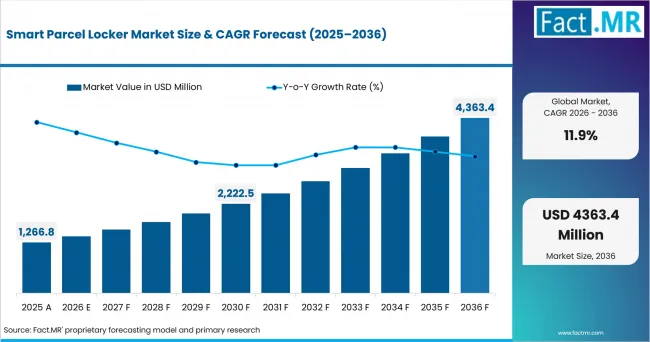
Smart Parcel Locker Market Market Value Analysis | Source: Fact.MR
What are the defining numbers behind Smart Parcel Locker Market growth?
USD 2,945.9 million absolute opportunity by 2036, led by SME operators and cloud alongside BFSI use.
- Demand Drivers in the Market
- Retailers depend on pickup and return points to reduce counter queues and improve order handover across store-linked fulfillment.
- Carriers require fewer repeated delivery attempts by concentrating parcels into planned collection points.
- Facility managers need secure package storage for apartments and offices to reduce staff handling and misplaced deliveries.
- BFSI operators seek controlled document handover using authenticated access logs and auditable parcel release records.
- Key Segments Analyzed
- By Type: Outdoor lockers are projected to hold 54% share in 2026, reflected by outdoor access points and public parcel collection sites.
- By Deployment: Retail & commercial is expected to account for 36% share in 2026, driven by store-linked pickup and return networks.
- By Ownership: Carrier-operated is estimated to capture 41% share in 2026, shaped by delivery network control and parcel handover visibility.
- By End use: E-commerce & Retail is anticipated to represent 47% share in 2026, owing to online order pickup and return automation.
- Analyst Opinion at Fact.MR
- Shambhu Nath Jha, Senior Analyst at Fact.MR, states, “Smart parcel lockers have become a handover-control solution for carriers and site operators. Demand is expected to favor providers proving uptime and parcel-flow discipline. Buyers are expected to compare access reliability and carrier compatibility before expanding locker networks.”
- Strategic Implications
- Locker suppliers are expected to prioritize software uptime and carrier integrations before expanding hardware placement.
- Retailers are likely to connect pickup and return lockers with checkout and order-management systems.
- Property managers are anticipated to use locker access records to reduce staff handling in apartments and offices.
- Carriers should assess locker density and route savings before expanding shared collection networks.
InPost reported in March 2026 its out-of-home network reached 94,500 locations in 2025, with lockers representing 65% of those points, reflecting large-scale parcel handover shifting toward distributed collection infrastructure.
India is projected to post 13.7% CAGR through 2036, reflected by parcel logistics modernization and metro delivery expansion. China is expected to record 13.0% CAGR by 2036, influenced by express parcel density and automated pickup demand. Australia is anticipated to grow at 11.7% CAGR from 2026 to 2036, driven by established locker banks and out-of-home delivery coverage. The United Kingdom is estimated to hold 11.4% CAGR during the study period, shaped by parcel-volume pressure. The U.S. is forecast to record 11.2% CAGR between 2026 and 2036, reinforced by shared-building package storage and carrier cost pressure. Germany is likely to post 10.9% CAGR to 2036 backed by parcel access-point density. Japan is expected to expand at 10.6% CAGR to 2036, supported by redelivery reduction programs.
How does the Smart Parcel Locker Market break down by segment?
Outdoor Lockers are expected to garner 54% share in 2026, E-commerce & Retail is anticipated to represent 47% share in 2026.
What type is expected to lead the market?
Outdoor Lockers are set to represent 54% share in 2026.
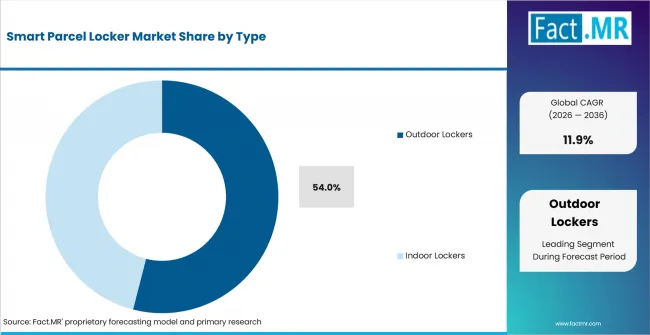
Smart Parcel Locker Market Analysis By Type | Source: Fact.MR
Outdoor Lockers are projected to hold 54% share in 2026, driven by public pickup access and outdoor delivery-site placement. Indoor Lockers follow through apartments and store-linked parcel handling. European Commission reported in February 2026 online buyers reached 78% of EU internet users in 2025, confirming a large parcel-generating buyer base for locker networks.
What is projected to lead the deployment segment?
Retail & commercial is predicted to garner 36% share in 2026.
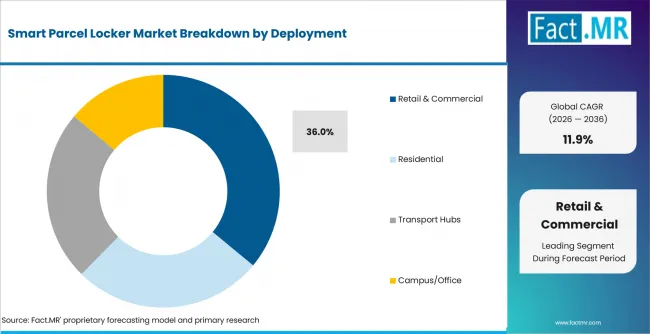
Smart Parcel Locker Market Analysis By Deployment | Source: Fact.MR
Retail & commercial is expected to account for 36% share in 2026, reflected by store-linked pickup and return demand. Residential follows as apartments and shared buildings need secure package storage. Transport Hubs and Campus/Office deployments support parcel access at commuter and institutional sites. Australia Post reported in March 2025 stating 56% of Gen Z shoppers and 45% of Millennials would switch retailers to access out-of-home collection points, supporting locker placement across retail sites.
How is ownership anticipated to shape demand?
Carrier-operated is expected to secure 41% share in 2026.
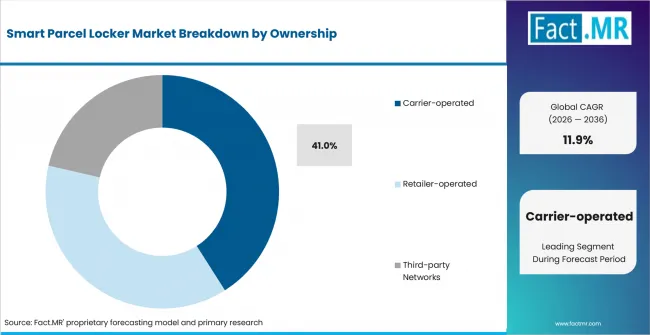
Smart Parcel Locker Market Analysis By Ownership | Source: Fact.MR
Carrier-operated lockers are estimated to capture 41% share in 2026, shaped by delivery network control and parcel handover visibility. Retailer-operated lockers follow through store pickup and return workflows. Third-party Networks support shared access models across multiple retailers and carriers. InPost reported in March 2026 that its out-of-home network reached 94,500 locations in 2025, with lockers representing 65% of those points.
What is set to lead the end use segment?
E-commerce & Retail is estimated to hold 47% share in 2026.
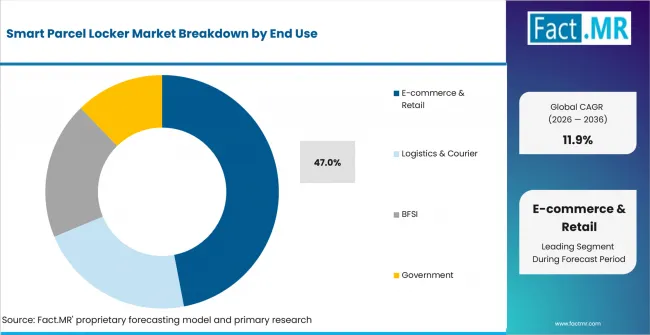
Smart Parcel Locker Market Analysis By End Use | Source: Fact.MR
E-commerce & Retail is anticipated to represent 47% share in 2026, guided by online order pickup and return automation. Logistics & Courier follows as carriers use lockers to reduce repeated delivery attempts. BFSI and Government users apply controlled locker access for documents and public-service handover. Ofcom reported in December 2025 claiming UK parcel volumes to have increased 7.1% to 4.2 billion items in 2024-25, reinforcing automated parcel handover demand.
What is accelerating Smart Parcel Locker Market adoption, and what is holding it back?
Parcel delivery pressure drives it; carrier integration and site limits restrain it.
Drivers Impact Analysis
| Driver | (~) % Impact on CAGR | Geographic Focus | Impact Timeline |
|---|---|---|---|
| Out-of-home parcel collection | +2.1% | Europe, China, Australia | Medium term (2-4 years) |
| Retail pickup and returns | +1.8% | U.S., United Kingdom, India | Short term (<= 2 years) |
| Carrier route consolidation | +1.5% | U.S., Germany, Japan | Medium term (2-4 years) |
| Shared-building package control | +1.2% | North America, Australia, Europh | Short term (<= 2 years) |
| Open locker network expansion | +1.0% | Europe and East Asia | Long term (>= 4 years) |
Source: Fact.MR analysis. Updated Jul 10, 2026
- Out-of-home parcel collection: Locker networks move parcel pickup away from repeated doorstep attempts and into planned access points. Ofcom reported in December 2025 measured UK parcel volumes increased 7.1% to 4.2 billion items in 2024-25, making collection capacity more useful for retailers and carriers handling peak parcel loads. Adoption is expected to expand as locker sites reduce missed handovers and support flexible pickup.
- Retail pickup and returns: Retailers need automated return intake as online order volumes increase store workload. Australia Post reported in March 2025 56% of Gen Z shoppers and 45% of Millennials would switch retailers to access out-of-home collection points. Demand is projected to rise as stores connect checkout and locker deposits.
- Carrier route consolidation: Locker delivery allows carriers to place several parcels at one access point. The U.S. Postal Service reported in February 2026 Shipping and Packages volume declined by 243 million pieces, or 12.1%, in first-quarter fiscal 2026, making route productivity and failed-delivery reduction more central to carrier planning. Locker adoption is anticipated to support denser delivery stops across urban routes.
- Shared-building package control: Apartments and campuses need secure storage without front-desk overload. Luxer One stated in 2026 its locker suite provides 24/7 access and 99.9% uptime, strengthening unattended package rooms and institutional handover points. Demand is estimated to expand as property operators connect locker use with resident and employee access systems.
- Open locker network expansion: Open networks allow several carriers and retailers to use shared locker infrastructure. Quadient announced in October 2025 its Parcel Pending open locker network launch in Italy, creating a shared model for first-mile and last-mile services. Network expansion is forecast to gain attention as operators seek higher utilization across each locker bank.
Opportunity Impact Analysis
| Opportunity | (~) % Impact on CAGR | Geographic Focus | Impact Timeline |
|---|---|---|---|
| Retail-driven open networks | +1.9% | Europe, United Kingdom, Italy | Medium term (2-4 years) |
| Locker software and APIs | +1.6% | Global carriers and retailers | Short term (<= 2 years) |
| Returns automation | +1.1% | U.S., Australia, United Kingdom | Medium term (2-4 years) |
| Multi-size locker optimization | +0.9% | Dense urban parcel markets | Long term (>= 4 years) |
Source: Fact.MR analysis. Updated Jul 10, 2026
- Retail-driven open networks: Retailers gain parcel pickup traffic and carriers gain shared access points. Cleveron reported in September 2025 its partnership with Ingrid built on ICA operations across 150+ stores in Sweden, showing retail sites becoming practical parcel collection nodes. Providers are projected to package locker hardware and software around store-led parcel networks.
- Locker software and APIs: Carrier and retailer systems need access-code exchange and exception records. Australia Post reported in May 2025 its Collection Point Widget and Collection Point API allow retailers to add parcel locker choice at checkout, making software integration central to locker adoption. API-led deployment is expected to gain share as retailers reduce manual address entry.
- Returns automation: Self-service return lockers reduce staff handling and improve return confirmation. Parcel Pending by Quadient reported in January 2025 Royal Mail adopted lockers with built-in label printers, allowing users to ship returns without a pre-printed label. Returns use is anticipated to expand as retailers seek lower counter pressure and faster intake records.
- Multi-size locker optimization: Locker operators need better compartment planning as parcel sizes vary by order mix. Suárez, Deza, and Raviv reported in July 2026 automated parcel locker experiments across two-, three-, and four-size systems, showing capacity design affects rejection cost and locker utilization. Software-led planning is forecast to improve locker assortment before dense rollouts.
Restraints Impact Analysis
| Restraint | (~) % Impact on CAGR | Geographic Focus | Impact Timeline |
|---|---|---|---|
| Carrier integration burden | -1.4% | Multi-carrier networks | Medium term (2-4 years) |
| Site approval and service access | -1.2% | Urban Europe, U.S., Japan | Short term (<= 2 years) |
| Locker capacity imbalance | -1.0% | Dense residential markets | Medium term (2-4 years) |
| User accessibility and adoption limits | -0.8% | Public sites and campuses | Long term (>= 4 years) |
Source: Fact.MR analysis. Updated Jul 10, 2026
- Carrier integration burden: Multi-carrier lockers need software links across exception codes and pickup confirmation. KEBA reported in March 2025 GLS Group locker rollout moved into Italy, Spain, and Portugal, proving multi-country carrier networks need coordinated locker platforms. Adoption is expected to slow at sites lacking clean carrier data links.
- Site approval and service access: Locker banks require suitable user access and maintenance reach. Bundesnetzagentur stated in July 2024 Germany’s postal rules require 95% of letters and parcels to reach recipients within three working days from 2025, making placement and service access sensitive for regulated delivery systems. Deployment is projected to remain staged in constrained urban sites.
- Locker capacity imbalance: Wrong compartment mix increases rejection risk and service exceptions. Sailer, Klein, and Steinhardt reported in September 2024 a parcel locker demand-management method outperformed a myopic benchmark by 13.7% and an industry-inspired policy by 12.6%, showing capacity control affects service performance. Operators are likely to invest in forecasting before expanding locker banks.
- User accessibility and adoption limits: Touchscreen access, QR scanning, and compartment search may create barriers for some users. Guan, Xiong, and Fan reported in February 2024 a locker accessibility study with 12 blind and low-vision participants, showing interface design affects task completion and effort. Public lockers are anticipated to need clearer guidance and recovery support before wider municipal use.
How are country markets expected to scale Smart Parcel Locker Market demand?
India 13.7%; China 13.0%; Australia 11.7%; United Kingdom 11.4%; U.S. 11.2%; Germany 10.9%; Japan 10.6%.
Regional analysis covers North America, Latin America, Europe, East Asia, South Asia and Pacific, and Middle East and Africa.
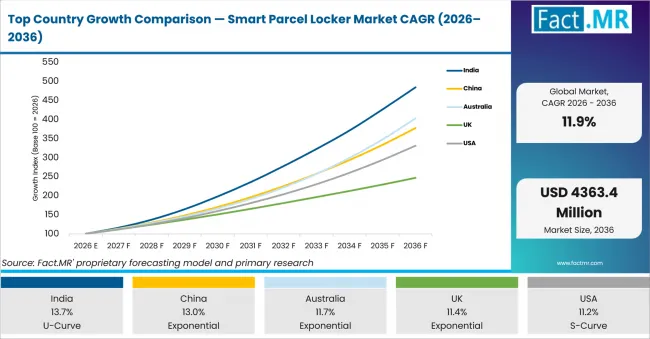
Top Country Growth Comparison Smart Parcel Locker Market Cagr 2026 2036 | Source: Fact.MR
| Country | CAGR |
|---|---|
| India | 13.7% |
| China | 13.0% |
| Australia | 11.7% |
| United Kingdom | 11.4% |
| U.S. | 11.2% |
| Germany | 10.9% |
| Japan | 10.6% |
Source: Fact.MR analysis. Updated Jul 10, 2026
What is driving India’s growth to 2036?
13.7% CAGR by 2036, driven by parcel logistics modernization.
India combines postal modernization and metro parcel density. Industry in India is projected to record 13.7% CAGR through 2036, led by parcel logistics expansion across retail and public delivery networks. Ministry of Communications reported in May 2026 India Post’s parcel and logistics segment registered 70% growth, supporting locker demand through stronger parcel traffic and technology-enabled handover.
How is China scaling smart parcel locker demand?
13.0% CAGR from 2026 to 2036, supported by express parcel density.
China’s express delivery base keeps automated collection close to everyday consumer logistics. Xinhua News Agency reported in July 2026 China’s express delivery volume surpassed 100 billion parcels by end June, nine days earlier than in 2025. Sector in China is expected to record 13.0% CAGR during the study period to 2036, led by dense parcel flows pushing operators toward automated pickup and drop-off points.
What supports the Australia outlook?
11.7% CAGR between 2026 and 2036, owing to established locker use.
Australia remains a practical market for out-of-home collection since locker use is familiar to shoppers and retailers. Australia Post reported in March 2025 56% of Gen Z shoppers and 45% of Millennials would switch retailers for out-of-home collection access, showing buyer preference strengthens locker placement economics. Market in Australia is anticipated to post 11.7% CAGR during the forecast period, driven by checkout integration and parcel pickup convenience.
What underpins United Kingdom demand?
11.4% CAGR through 2036, shaped by parcel-volume pressure.
United Kingdom demand reflects parcel delivery choice and access-point expansion. Ofcom reported in December 2025 total measured parcel volumes increased by 7.1% to 4.2 billion items in 2024-25, creating more need for automated collection and return options. Demand in the United Kingdom is estimated to advance at 11.4% CAGR between 2026 and 2036 as carriers and retailers expand out-of-home handover models.
How does the U.S. market perform?
11.2% CAGR through 2036, reinforced by shared-building package storage.
United States demand is shaped by campus mailrooms and carriers seeking controlled delivery points. The U.S. Postal Service reported in February 2026 Shipping and Packages volume declined by 243 million pieces, supporting tighter route planning and alternative handover economics. Sales in the United States are forecast to record 11.2% CAGR by 2036 since lockers help site owners reduce unattended parcel storage and carrier reattempts.
What shapes Germany’s outlook?
10.9% CAGR to 2036, influenced by parcel access-point density.
Germany’s parcel market is supported by parcel shops and automated pickup options. Bundesnetzagentur reported in April 2025 parcel volume increased by almost 2.54% from 4.25 billion items in 2022 to 4.36 billion items in 2023, reinforcing demand for distributed collection capacity. Demand in Germany is likely to post 10.9% CAGR by 2036 as operators use lockers to absorb urban parcel flows.
How is Japan positioned in smart parcel lockers?
10.6% CAGR during the forecast period, supported by redelivery reduction work.
Japan’s parcel locker demand is shaped by redelivery reduction and recipient-controlled pickup. Japan’s transport ministry reported in December 2025 parcel redelivery rate reached about 8.3% in October 2025, down about 0.7 percentage points from the prior year. Market in Japan is expected to scale at 10.6% CAGR to 2036, helped by member delivery services and pickup-place selection.
Who leads the Smart Parcel Locker Market?
InPost and Quadient lead open-network coverage, and KEBA and Cleveron strengthen locker hardware and software depth.
InPost brings automated parcel machine density and out-of-home network scale across Europe. Quadient adds Parcel Pending lockers and open locker network expansion across European and selected international markets. KEBA supports postal and carrier locker deployment with hardware and operating-system capability.
Cleveron strengthens automated pickup led by robotic parcel lockers and retail-led open network partnerships. Smartbox supports carrier-agnostic locker systems for urban and enterprise use. SwipBox offers smart parcel lockers and delivery tools for last-mile operators. Luxer One adds smart locker systems across apartments and public-service settings.
What companies are the key providers?
InPost and Quadient are key providers. KEBA and Cleveron are also profiled. Smartbox, SwipBox, and Luxer One complete the company set.
- InPost S.A.
- Quadient SA
- KEBA Group AG
- Cleveron AS
- Smartbox Lockers
- SwipBox A/S
- Luxer One
Bibliography
- Australia Post. (2025, March 18). Australia Post eCommerce Report 2025. Australia Post.
- Australia Post. (2025, May 29). Ask me anything about Parcel Lockers. Australia Post.
- Bundesnetzagentur. (2024, July 5). New tasks for the Bundesnetzagentur in the postal sector. Federal Network Agency.
- Bundesnetzagentur. (2025, April 2). Publication of figures for 2023 for the letters and parcels markets. Federal Network Agency.
- Cleveron. (2025, September 17). Cleveron and Ingrid partner to accelerate Retail-Driven Open Networks across Europe. Cleveron.
- European Commission. (2026, February). E-commerce statistics for individuals. Eurostat.
- Guan, Z., Xiong, Z., & Fan, M. (2024, February 24). FetchAid: Making Parcel Lockers More Accessible to Blind and Low Vision People With Deep-learning Enhanced Touchscreen Guidance, Error-Recovery Mechanism, and AR-based Search Support. arXiv.
- InPost S.A. (2026, March 17). InPost Group Integrated Annual Report 2025. InPost S.A.
- Japan Ministry of Land, Infrastructure, Transport and Tourism. (2025, December 26). Parcel redelivery rate in October 2025 is about 8.3%. Government of Japan.
- KEBA Group AG. (2025, March 18). KEBA supports GLS Group’s Southern Europe expansion with new parcel lockers. KEBA Group AG.
- Luxer One. (2026). Smart Package Lockers. Luxer One.
- Ministry of Communications. (2026, May 25). India Post’s revenue surges to ₹15373 crore in FY 2025-26. Press Information Bureau, Government of India.
- Ofcom. (2025, December 3). Post Monitoring Report: Postal services in the financial year 2024-25. Ofcom.
- Parcel Pending by Quadient. (2025, January 8). Royal Mail offers new parcel drop-off and collection experience to consumers by adopting Quadient’s open locker network in the UK. Parcel Pending by Quadient.
- Quadient. (2025, October 24). Quadient expands European open locker network with launch in Italy. Quadient.
- Sailer, D., Klein, R., & Steinhardt, C. (2024, September 8). Dynamic Demand Management for Parcel Lockers. arXiv.
- Smartbox. (2025, October 9). Returns Made Easy: Smart Parcel Lockers Cut Costs & Win Loyalty. Smartbox.
- Suárez, C. A., Deza, A., & Raviv, T. (2026, July 1). Admission and Assortment Optimization for Multi-size Automated Parcel Lockers. arXiv.
- U.S. Postal Service. (2026, February 5). U.S. Postal Service Reports First Quarter Fiscal Year 2026 Results. U.S. Postal Service.
- Xinhua News Agency. (2026, July 6). China’s express delivery volume tops 100 billion parcels by end June. Xinhua News Agency.
This Report Addresses
- The report provides strategic intelligence on smart parcel locker demand across type and deployment choices shaping automated parcel collection.
- Segment analysis also covers Outdoor Lockers and E-commerce & Retail.
- Regional outlook evaluates India and China alongside Australia, the United Kingdom, the U.S., Germany, and Japan.
- Competitive analysis profiles InPost and Quadient alongside KEBA and Cleveron, followed by three additional active smart parcel locker providers.
- Type assessment covers Outdoor Lockers and Indoor Lockers across adoption patterns.
- Deployment and ownership assessment covers Retail & Commercial sites and Carrier-operated systems alongside residential and third-party network models.
- Primary interviews and official source reviews support final validation of segment shares and company inclusion.
What does the Smart Parcel Locker Market cover?
Automated parcel lockers used for secure pickup, returns, drop-off, and controlled handover.
Smart parcel locker market covers electronically managed locker systems used by carriers, retailers, banks, offices, apartments, campuses, and public service operators. Coverage includes hardware compartments, locker control software, access-code systems, notification tools, API links, maintenance services, and workflow automation used for parcel collection.
Market coverage differs from ordinary storage lockers and mailboxes since commercial demand centers on parcel workflow, access control, and system records. Manual storage cabinets, staff-managed package rooms, and conventional mailboxes remain outside scope unless linked directly to automated parcel collection or return processing.
What is included in the scope?
Smart parcel locker systems used across automated collection, return intake, access control, and parcel workflow management.
Scope includes cloud, on-premise, hybrid, ambient, and chilled locker deployments across SME operators, large enterprises, retailers, BFSI users, manufacturers, IT teams, and government facilities. Coverage includes software, services, API/tools, and storage systems supporting workflow automation, analytics, governance, and integration. Commercial assessment also considers locker utilization, carrier compatibility, installation service, uptime evidence, access security, and return-flow automation.
What is excluded from the scope?
Manual lockers, ordinary mailboxes, and unrelated storage cabinets are outside the scope.
Traditional lockers, storage cupboards, manual parcel shelves, and residential mailboxes are excluded unless they include automated access, notification, and parcel workflow control. Warehouse racking, cold storage rooms, and staff-only inventory cabinets are excluded unless used as part of a smart parcel locker system.
How was the analysis built?
120+ sources, 45+ company portfolios, 30+ countries, 20+ interviews.
- Primary Research
- Primary research includes interviews with parcel carriers, locker installers, retail operations teams, facility managers, BFSI operations teams, campus mailroom managers, software integrators, and last-mile delivery planners. It also includes input from property managers, postal service experts, online fulfillment teams, and service technicians involved in smart locker deployment.
- Desk Research
- Desk research reviews official parcel statistics, postal market reports, online buying data, company locker-network announcements, product portfolios, software capability notes, and public delivery performance releases. Postal regulators, statistics agencies, transport ministries, company investor materials, and official locker-provider communications are reviewed to assess demand signals and company activity.
- Market-Sizing and Forecasting
- Forecasting uses parcel-volume indicators, out-of-home delivery adoption, software integration demand, locker utilization patterns, and end-use workflow needs. Forecast models also assess carrier route pressure, return automation, open network rollout, site approval constraints, and country-level parcel handover demand.
- Data Validation and Update Cycle
- Forecasts are validated through country evidence review, and technical interviews. Updates review official parcel statistics, locker-network launches, product releases, carrier partnerships, and company announcements to keep the market view aligned with current operating conditions.
Segmentation
What is the report’s scope and coverage?
| Attribute | Details |
|---|---|
| Quantitative Units | USD million in 2026 to USD million by 2036 at CAGR |
| Market Definition | Automated locker systems used for secure parcel pickup, drop-off, returns, and controlled package handover |
| Type | Outdoor Lockers; Indoor Lockers |
| Deployment | Retail & Commercial; Residential; Transport Hubs; Campus/Office |
| Ownership | Carrier-operated; Retailer-operated; Third-party Networks |
| End Use | E-commerce & Retail; Logistics & Courier; BFSI; Government |
| Regions Covered | North America; Latin America; Europe; East Asia; South Asia and Pacific; Middle East and Africa |
| Countries Covered | India; China; Australia; United Kingdom; U.S.; Germany; Japan |
| Key Companies Profiled | InPost; Quadient; KEBA; Cleveron; Smartbox; SwipBox; Luxer One |
| Forecast Period | 2026 to 2036 |
| Approach | Hybrid top-down and bottom-up approach using official parcel statistics; out-of-home delivery evidence; locker-network announcements; segment shares; country CAGRs; and company portfolio checks |
Source: Fact.MR analysis. Updated Jul 10, 2026
How is the market segmented?
-
By Type
- Outdoor Lockers
- Indoor Lockers
-
By Deployment
- Retail & Commercial
- Residential
- Transport Hubs
- Campus/Office
-
By Ownership
- Carrier-operated
- Retailer-operated
- Third-party Networks
-
By End Use
- E-commerce & Retail
- Logistics & Courier
- BFSI
- Government
-
By Region
- North America
- United States
- Canada
- Brazil
- Mexico
- Chile
- Argentina
- Europe
- Germany
- United Kingdom
- France
- Italy
- Spain
- East Asia
- China
- Japan
- South Korea
- South Asia and Pacific
- India
- Australia
- Indonesia
- Thailand
- Middle East and Africa
- UAE
- Saudi Arabia
- South Africa
- North America
Frequently Asked Questions
What type is expected to lead the smart parcel locker market?
What deployment is anticipated to dominate the smart parcel locker market?
What ownership model is projected to garner the top share in the smart parcel locker market?
What end use is predicted to secure the major share in the Smart Parcel Locker Market?
Why are outdoor lockers important in smart parcel locker demand?
Why are retailers likely to shape smart parcel locker demand?
Who worked on this report


Preview the report firsthand - request a free sample
Free SampleGet the brochure for pricing and purchase details
Download PDF