- Base Value(2026): 0.72 Bn
- Estimated Value(2026): 0.7 Bn
- Forecast Value (2036): 1.9 Bn
- CAGR (2026 - 2036): 9.9%
Smart Returnable Transport Items with Integrated Identification Hardware Market Forecast and Outlook 2026 to 2036
The global smart returnable transport items with integrated identification hardware market is valued at USD 0.72 billion in 2026 and is projected to reach USD 1.85 billion by 2036, expanding at a CAGR of 9.9% over the decade. In 2026, the retail & distribution centres application segment is estimated to hold a 40% share, while RFID/NFC-enabled totes & pallets constitute 45% by packaging format and HDPE/PP + embedded electronics leads material adoption with a 50% share.
Key Takeaways from the Smart Returnable Transport Items with Integrated Identification Hardware Market Report
- Market Value (2026): USD 0.72 Billion
- Market Forecast Value (2036): USD 1.85 Billion
- Forecast CAGR (2026-2036): 9.9%
- Leading Application Segment: Retail & distribution centres (40%)
- Leading Packaging Format/Type: RFID/NFC-enabled totes & pallets (45%)
- Leading Material: HDPE / PP + embedded electronics (50%)
- Leading Technology: IoT modules, long-range RFID, sensor nodes (55%)
- Key Growth Regions: North America, Latin America, Europe, Asia Pacific, MEA
- Key Players: ORBIS Corporation, Cabka N.V., Qingdao Logistics Equipment Makers Co. Ltd., UFLEX Limited, Toyota Industries Corporation (RTI tech), Schoeller Allibert Group B.V., CHEP Limited, SSI Schäfer Group GmbH
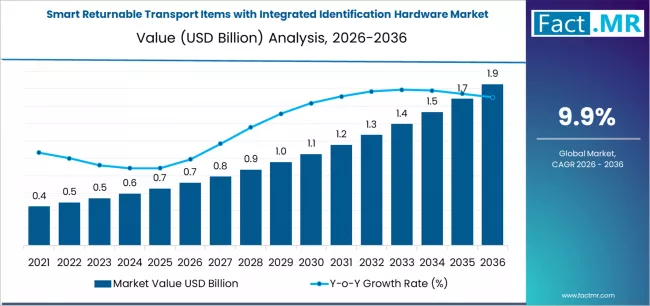
Smart Returnable Transport Items With Integrated Identification Hardware Market Market Value Analysis | Source: Fact.MR
The critical need for supply chain digitization, asset visibility, and the economic imperative of maximizing reusable asset utilization are the primary drivers of market growth. As businesses seek to reduce packaging waste, cut costs, and enhance logistics resilience, smart Returnable Transport Items (RTIs) equipped with IoT hardware provide real-time data on location, condition, and lifecycle. This shift transforms passive containers into intelligent logistics nodes, enabling closed-loop tracking, automated inventory management, and data-driven optimization of pooling networks, directly supporting both sustainability goals and operational efficiency.
Advancements in low-power, rugged IoT hardware are critical to market expansion. Innovations in long-range RFID, energy-efficient sensor nodes, and robust electronics encapsulation allow for the creation of durable RTIs that can withstand harsh logistics environments while continuously transmitting data. These technological enhancements enable predictive maintenance of the assets themselves, optimize routing and washing schedules, and provide irrefutable proof of chain-of-custody, which is vital for high-value or regulated goods.
Smart Returnable Transport Items with Integrated Identification Hardware Market
| Metric | Value |
|---|---|
| Estimated Value in (2026E) | USD 0.72 Billion |
| Forecast Value in (2036F) | USD 1.85 Billion |
| Forecast CAGR (2026 to 2036) | 9.9% |
Source: Fact.MR analysis. Updated Dec 22, 2025
Category
| Category | Segments |
|---|---|
| End-use/Application | Retail & distribution centres, Intra-EU supply chains, E-commerce fulfilment, Retail & warehousing, Food & beverage logistics, Electronics manufacturing, Others |
| Packaging Format/Type | RFID/NFC-enabled totes & pallets, Smart crates & pallets, Trackable totes, Smart bins, Others |
| Material | HDPE / PP + embedded electronics, HDPE/Composite pallets, Recycled HDPE blends, PP / HDPE, Others |
| Technology | IoT modules, long-range RFID, sensor nodes, Serialized RFID inlays, Low-cost RFID systems, QR + RFID hybrids, Others |
| Region | North America, Europe, Asia Pacific, Latin America, MEA |
Source: Fact.MR analysis. Updated Dec 22, 2025
Segmental Analysis
Why do Retail & distribution centres drive the leading Application Segment?
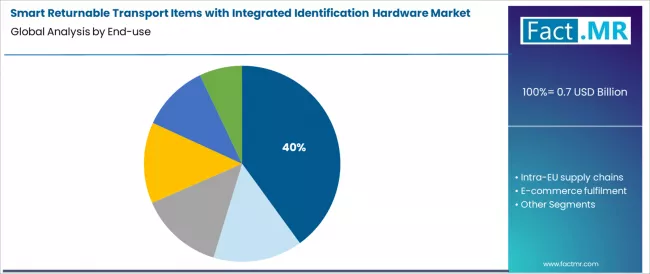
Smart Returnable Transport Items With Integrated Identification Hardware Market Analysis By End Use | Source: Fact.MR
Retail & distribution centres will command a 40% share, as these hubs represent the nexus of modern logistics with extreme pressure on speed, accuracy, and cost. Smart RTIs automate the receiving, put-away, picking, and shipping processes, drastically reducing manual scans and errors. For retailers and logistics providers, the real-time visibility of assets such as totes, pallets, and roll cages, minimizes loss, optimizes asset turns, and ensures that the right reusable container is available at the right time, directly impacting operational throughput and profitability.
- The high volume and constant movement of goods in these facilities generate the maximum return on investment from smart tracking, justifying the upfront hardware costs.
- Integration with Warehouse Management Systems (WMS) allows for fully automated inventory updates and dynamic space optimization based on the real-time location of smart containers.
What establishes RFID/NFC-enabled totes & pallets as the dominant Packaging Format?
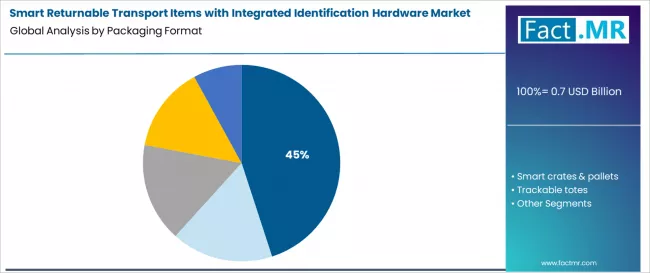
Smart Returnable Transport Items With Integrated Identification Hardware Market Analysis By Packaging Format | Source: Fact.MR
RFID/NFC-enabled totes & pallets hold a 45% share due to their fundamental role as the unit load carriers in virtually all supply chains. Embedding identification hardware directly into these high-durability items allows for bulk scanning without line-of-sight, enabling whole truckloads or pallet racks to be inventoried in seconds. This format is the workhorse of asset tracking, providing the granular data needed to manage large, complex pooling networks efficiently.
- The design prioritizes protecting the embedded electronics from impact, moisture, and extreme temperatures, ensuring functionality over hundreds of trips.
- Innovation focuses on standardizing the communication protocols and data structures on these items to ensure interoperability across different users and geographies within a shared pool.
What solidifies HDPE / PP + embedded electronics as the preferred Material choice?
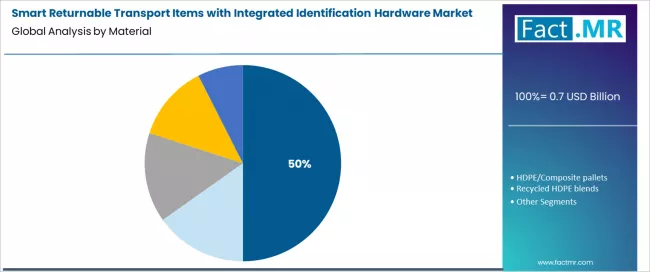
Smart Returnable Transport Items With Integrated Identification Hardware Market Analysis By Material | Source: Fact.MR
HDPE / PP + embedded electronics leads with a 50% share, as High-Density Polyethylene (HDPE) and Polypropylene (PP) offer the ideal combination of strength, impact resistance, chemical resistance, and moldability required for long-life RTIs.
The key innovation is the successful integration and protection of electronic components (RFID tags, sensors, batteries) within the polymer matrix during molding or in a later assembly step, creating a single, rugged unit where the technology is an intrinsic part of the asset.
- This approach ensures the identification hardware cannot be easily removed or damaged during normal use or washing, guaranteeing the persistence of the digital identity.
- Material science is also advancing to allow for the use of recycled HDPE/PP in these smart RTIs, aligning the sustainability of the material with the circular efficiency enabled by the technology.
What are the Drivers, Restraints, and Key Trends in the Smart Returnable Transport Items Market?
The market is driven by the urgent need for supply chain resilience and transparency, exacerbated by recent global disruptions. Corporate sustainability commitments to reduce single-use packaging waste create a strong push for reusable systems, whose economics depend on high asset utilization enabled by smart tracking. The rise of omnichannel retail and e-commerce fulfillment, with its complex reverse logistics, further amplifies the need for intelligent container management.
A primary restraint is the significant capital investment required to establish or convert to a smart RTI pooling system, including the cost of the hardware-enabled assets and the necessary reader infrastructure. Concerns over data ownership, security, and standardization in multi-party logistics networks also pose adoption hurdles.
The market is trending towards multi-sensor integration, adding temperature, humidity, shock, and tilt sensors to RTIs, transforming them from mere trackers to guardians of product quality. AI and machine learning analytics are being applied to the data generated, enabling predictive logistics, dynamic pricing for pooling services, and automated reconciliation of shipments.
Analysis of the Market by Key Countries
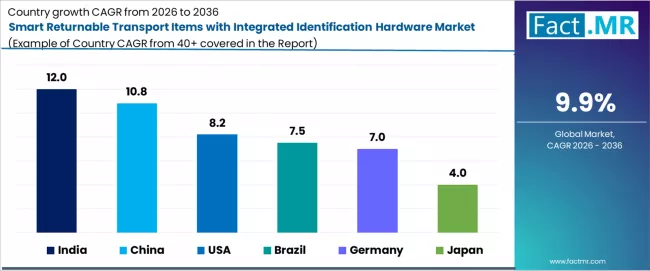
Smart Returnable Transport Items With Integrated Identification Hardware Market CAGR Analysis By Country | Source: Fact.MR
| Country | CAGR (2026-2036) |
|---|---|
| USA | 8.20% |
| Germany | 7.00% |
| China | 10.80% |
| India | 12.00% |
| Brazil | 7.50% |
| Japan | 4.00% |
Source: Fact.MR analysis. Updated Dec 22, 2025
What underpins adoption in the USA's market?
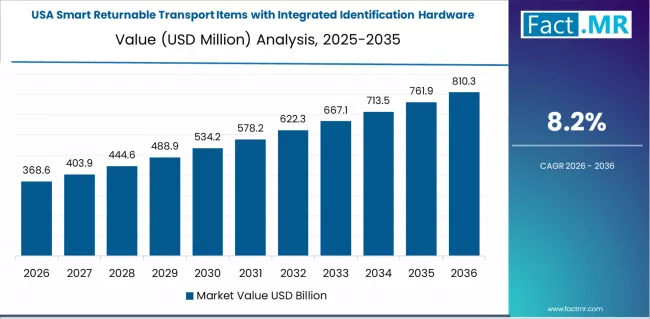
Smart Returnable Transport Items With Integrated Identification Hardware Market Country Value Analysis | Source: Fact.MR
Growth in the USA at an 8.20% CAGR is driven by a massive retail and e-commerce logistics sector, a strong culture of third-party logistics (3PL) and asset pooling, and the need for efficiency in complex domestic supply chains. Investments focus on large-scale, automated fulfillment centres where smart RTIs are essential for throughput.
How does Germany's engineering and logistics focus shape its market?
Germany's 7.00% CAGR reflects its central role in European manufacturing and logistics. The market is characterized by high-value, precision-oriented supply chains (e.g., automotive, pharmaceuticals) that demand the reliability and data integrity offered by smart RTIs. Growth is tied to Industry 4.0 integration and cross-border EU supply chain optimization.
What factors propel China's rapid expansion?
China's 10.80% CAGR is fueled by its dominance in global manufacturing and the rapid, technology-driven modernization of its colossal domestic logistics network. Government support for smart logistics and the growth of e-commerce giants drive massive investment in automated warehouses and connected RTI systems for both export and domestic circulation.
Why does India exhibit the highest growth trajectory?
India leads with a 12.00% CAGR, driven by the explosive growth of organized retail, e-commerce, and a formalizing logistics sector. The need to bring efficiency and visibility to traditionally opaque supply chains creates immense demand. The market focuses on highly cost-optimized, scalable smart tracking solutions to manage the rapid growth in volume.
How does Brazil's market develop?
Brazil's 7.50% CAGR is supported by a large agricultural export sector and a growing domestic consumer market, both requiring efficient bulk material and retail logistics. Adoption is driven by the need to reduce loss and improve asset utilization in extensive national and regional distribution networks.
What Characterizes Japan's Mature Market Approach?
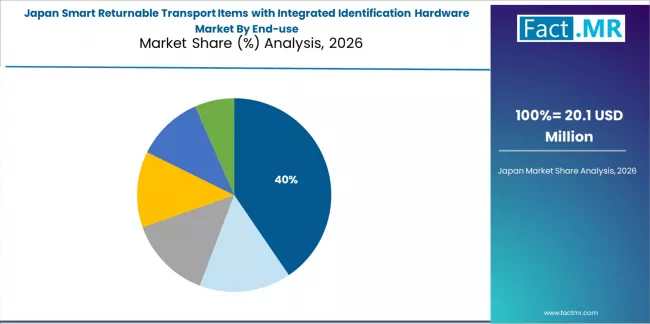
Smart Returnable Transport Items With Integrated Identification Hardware Market Japan Market Share Analysis By End Use | Source: Fact.MR
Japan's mature market grows at a measured 4.00% CAGR, prioritizing ultra-high-efficiency, space-optimized, and clean logistics for sectors like electronics, automotive, and high-end food & beverage. The focus is on precision tracking, integration with robotic systems, and RTIs designed for flawless operation in automated facilities.
Competitive Landscape
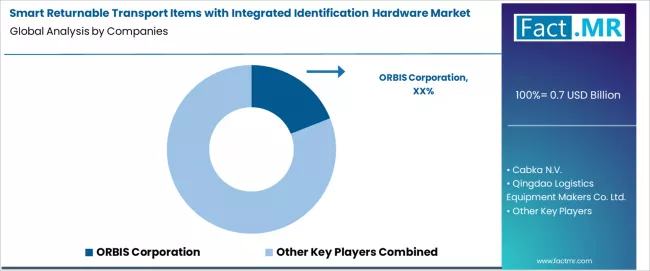
Smart Returnable Transport Items With Integrated Identification Hardware Market Analysis By Company | Source: Fact.MR
Global pooling giants, specialized RTI manufacturers, and technology integrators define the competitive landscape. Pooling leaders like CHEP and ORBIS compete by building vast, smart networks and offering tracking as a core service. Specialized manufacturers like Schoeller Allibert and SSI Schäfer compete on modular, high-performance smart container designs and integration with automated material handling systems.
Technology firms partner with these players to provide the hardware and software backbone. Competition hinges on the density and global reach of the return network, the robustness and data richness of the smart platform, and the ability to provide actionable analytics that drive customer savings.
Key Players Profiled in the Smart Returnable Transport Items with Integrated Identification Hardware Market
- ORBIS Corporation
- Cabka N.V.
- Qingdao Logistics Equipment Makers Co. Ltd.
- UFLEX Limited
- Toyota Industries Corporation (RTI tech)
- Schoeller Allibert Group B.V.
- CHEP Limited
- SSI Schäfer Group GmbH
Segmentation
Scope of the Report
| Items | Values |
|---|---|
| Quantitative Units (2026) | USD 0.72 Billion |
| End-use/Application | Retail & distribution centres, Intra-EU supply chains, E-commerce fulfilment, Retail & warehousing, Food & beverage logistics, Electronics manufacturing, Others |
| Packaging Format/Type | RFID/NFC-enabled totes & pallets, Smart crates & pallets, Trackable totes, Smart bins, Others |
| Material | HDPE / PP + embedded electronics, HDPE/Composite pallets, Recycled HDPE blends, PP / HDPE, Others |
| Technology | IoT modules, long-range RFID, sensor nodes, Serialized RFID inlays, Low-cost RFID systems, QR + RFID hybrids, Others |
| Regions Covered | North America, Europe, Asia Pacific, Latin America, Middle East & Africa |
| Key Companies Profiled | ORBIS Corporation, Cabka N.V., Qingdao Logistics Equipment Makers Co. Ltd., UFLEX Limited, Toyota Industries Corporation (RTI tech), Schoeller Allibert Group B.V., CHEP Limited, SSI Schäfer Group GmbH |
| Additional Attributes | Total Cost of Ownership (TCO) analysis for smart vs. traditional RTIs, data security and platform interoperability analysis, case studies on pooling network ROI, review of sensor technology for condition monitoring. |
Source: Fact.MR analysis. Updated Dec 22, 2025
Smart Returnable Transport Items with Integrated Identification Hardware Market by Segments
-
By End-use/Application :
- Retail & distribution centres
- Intra-EU supply chains
- E-commerce fulfilment
- Retail & warehousing
- Food & beverage logistics
- Electronics manufacturing
- Others
-
By Packaging Format/Type :
- RFID/NFC-enabled totes & pallets
- Smart crates & pallets
- Trackable totes
- Smart bins
- Others
-
By Material :
- HDPE / PP + embedded electronics
- HDPE/Composite pallets
- Recycled HDPE blends
- PP/HDPE
- Others
-
By Technology :
- IoT modules, long-range RFID, sensor nodes
- Serialized RFID inlays
- Low-cost RFID systems
- QR + RFID hybrids
- Others
-
By Region :
-
North America
- USA
- Canada
- Mexico
-
Europe
- Germany
- UK
- France
- Italy
- Spain
- Nordic Countries
- BENELUX
- Rest of Europe
-
Asia Pacific
- China
- India
- Japan
- South Korea
- Australia
- Rest of Asia Pacific
-
Latin America
- Brazil
- Argentina
- Rest of Latin America
-
MEA
- Saudi Arabia
- UAE
- South Africa
- Rest of MEA
-
Frequently Asked Questions
How big is the smart returnable transport items with integrated identification hardware market in 2026?
What will be the size of smart returnable transport items with integrated identification hardware market in 2036?
How much will be the smart returnable transport items with integrated identification hardware market growth between 2026 and 2036?
What are the key product types in the smart returnable transport items with integrated identification hardware market?
Which packaging format segment to contribute significant share in the smart returnable transport items with integrated identification hardware market in 2026?
Who worked on this report


Preview the report firsthand - request a free sample
Free SampleGet the brochure for pricing and purchase details
Download PDF