- Base Value(2026): 451.6 Mn
- Estimated Value(2026): 451.6 Mn
- Forecast Value (2036): 1146.2 Mn
- CAGR (2026 - 2036): 9.8%
Soft Grippers for Food Handling Robots Market Forecast and Outlook By FACT.MR
Valuation of the soft grippers for food handling robots market stood at USD 423.0 million in 2025. According to Fact MR, demand for soft robotic gripping systems used in food processing is expected to reach USD 451.6 million in 2026 and USD 1,146.2 million by 2036. A CAGR of 9.8% is projected for the forecast timeline.
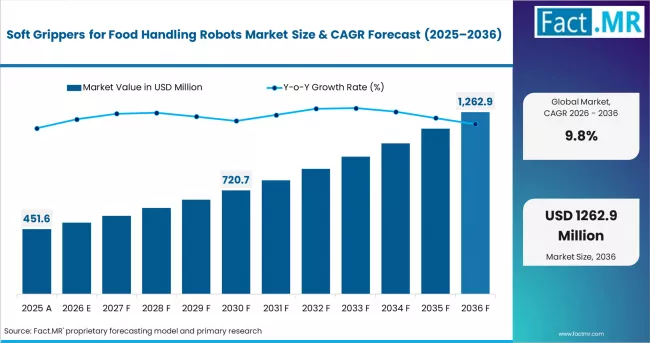
Soft Grippers For Food Handling Robots Market Value Analysis | Source: Fact.MR
Summary of the Soft Grippers for Food Handling Robots Market
- Market Definition
- The market comprises flexible robotic end effectors made from compliant materials enabling gentle gripping, picking, and positioning of delicate or irregular food items across automated food processing, sorting, packaging, and inspection operations requiring hygienic and damage minimizing handling performance.
- Demand Drivers
- Increasing adoption of robotic handling systems supporting reduced product deformation across delicate food processing workflows.
- Rising demand for hygienic automation solutions aligned with food safety compliance requirements.
- Expansion of packaged food production requiring precision pick and place handling consistency.
- Growing requirement for automation capable of handling irregular shaped and fragile food items.
- Increasing focus on waste reduction through controlled gripping pressure minimizing product damage.
- Integration of robotic end effectors supporting consistent placement accuracy across high throughput processing lines.
- Key Segments Analyzed
- Application: Food processing leads with 36% share driven by demand for gentle automated handling performance.
- Material: Silicone leads with 44% share supported by flexibility, hygiene compatibility, and durability characteristics.
- Food Type: Fruits and vegetables and bakery items represent major adoption categories due to fragility of product structure.
- Technology Role: Sorting, pick and place, packaging, and inspection handling support automated food material transfer workflows.
- Geography: Asia Pacific leads adoption driven by food processing automation expansion, while Europe and North America maintain stable value share.
- Analyst Opinion at Fact MR
- Shambhu Nath Jha, Principal Consultant, Fact MR, opines, 'In this updated edition of the Soft Grippers for Food Handling Robots Market report, adoption trends indicate increasing reliance on compliant robotic gripping technologies supporting handling precision and hygiene requirements across food processing environments. Market participants observe stable demand progression aligned with automation integration, product damage reduction objectives, and operational efficiency improvements through 2036.'
- Strategic Implications/Executive Takeaways
- Develop soft gripping materials optimized for flexibility, hygiene compliance, and durability across repeated deformation cycles.
- Focus on silicone based end effectors supporting adaptive gripping across irregular food geometries.
- Strengthen integration compatibility with robotic automation platforms supporting high throughput processing lines.
- Expand modular gripper configurations supporting multi product handling across food categories.
- Improve material resistance to cleaning chemicals supporting long term performance stability.
- Monitor cost optimization strategies supporting broader adoption across mid scale food processing facilities.
- Methodology
- Primary interviews conducted with robotic end effector manufacturers, food processors, automation integrators, and material developers.
- Benchmarked against food processing automation indicators influencing robotic gripping deployment patterns.
- Evaluated demand across sorting, packaging, and pick and place applications involving delicate food handling.
- Hybrid modeling applied combining top down food automation demand assessment with bottom up gripper deployment analysis.
- Validation conducted using supplier shipment data, food safety compliance requirements, and robotic integration trends.
- Peer review applied using Fact MR analytical frameworks linking automation component supply capacity with food processing demand.
Soft Grippers for Food Handling Robots Market
| Metric | Details |
|---|---|
| Industry Size (2026E) | USD 451.6 million |
| Industry Value (2036F) | USD 1,146.2 million |
| CAGR (2026 to 2036) | 9.8% |
Source: Fact.MR analysis. Updated Apr 17, 2026
A CAGR of 9.8% indicates moderate to transformational expansion as food processors adopt robotic handling for delicate and irregular products. Growth is supported by hygiene compliance and waste reduction benefits, while constraints persist due to integration complexity, gripper material durability requirements, and capital cost sensitivity among small and mid-scale processors.
China leads with a projected CAGR of 10.9%, supported by increasing automation of food sorting and packaging operations across high-volume processing facilities. India follows with a CAGR of 10.6%, driven by expanding deployment of robotic handling systems across packaged food production lines. The United Kingdom records a CAGR of 10.3%, reflecting steady adoption of flexible gripping technologies across delicate food handling applications. Germany shows a CAGR of 10.1%, supported by consistent integration of robotic end-effectors across precision food processing equipment. The United States records the slowest growth at 9.8%, reflecting a relatively mature automation environment where demand is largely tied to replacement cycles within existing robotic food handling infrastructure. Mature markets generate a significant share of replacement demand as equipment upgrades remain focused on handling accuracy, contamination control, and operational efficiency across automated food processing systems.
Segmental Analysis
Soft Grippers for Food Handling Robots Market Analysis by Material
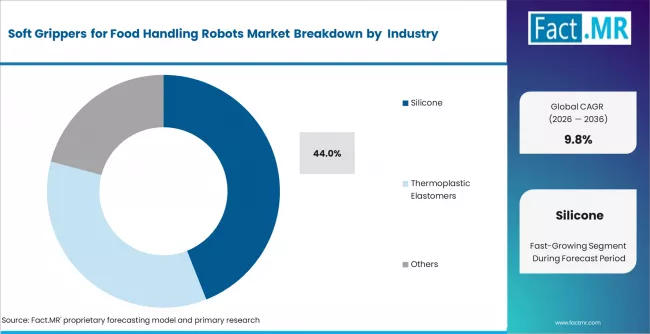
Soft Grippers For Food Handling Robots Market Analysis By Material | Source: Fact.MR
- Market Overview: Based on Fact MR assessment, silicone is projected to account for 44% share of the soft grippers for food handling robots market in 2026. Silicone elastomers are incorporated into robotic end effectors requiring flexibility, hygienic compatibility, and controlled surface compliance across handling of delicate food items. Material structure enables deformation under low gripping force enabling safe manipulation of fruits, bakery products, confectionery items, and protein portions requiring minimized surface damage. Chemical resistance characteristics support repeated cleaning cycles across automated food handling environments requiring stable mechanical performance across high frequency gripping operations.
- Demand Drivers:
- Elastic Compliance Requirements: Silicone material supports adaptive gripping behavior enabling handling of irregular shaped food products requiring controlled contact pressure.
- Hygiene Compatibility Parameters: Silicone elastomers demonstrate resistance to moisture absorption supporting cleaning and sanitation procedures across food processing environments.
- Material Durability Needs: Silicone gripper structures maintain flexibility across repeated deformation cycles supporting operational continuity within automated food handling workflows.
Soft Grippers for Food Handling Robots Market Analysis by Application
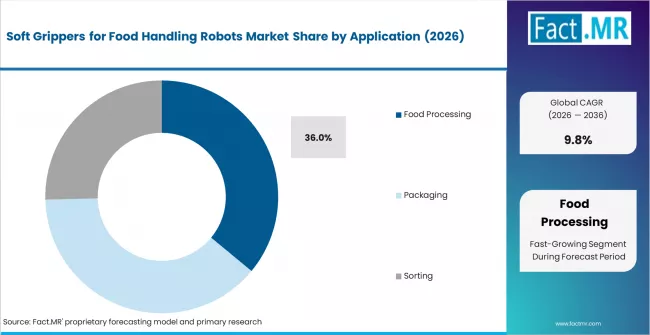
Soft Grippers For Food Handling Robots Market Analysis By Application | Source: Fact.MR
- Market Overview: Food processing is estimated to hold 36% share of the soft grippers for food handling robots market in 2026, supported by deployment across sorting, packaging, and product transfer operations requiring gentle handling performance. Robotic gripping systems are utilized across automated lines processing fresh produce, ready meals, baked goods, and meat products requiring controlled placement accuracy. End effector configurations enable stable gripping of fragile food textures requiring minimized mechanical stress across repetitive pick and place workflows integrated within food production environments.
- Demand Drivers:
- Product Integrity Requirements: Soft gripping systems support reduction of deformation and surface damage across delicate food products requiring controlled handling pressure.
- Automation Workflow Compatibility: Robotic grippers enable integration within conveyor based processing lines supporting continuous product transfer operations.
- Precision Handling Parameters: Soft gripping materials support accurate positioning across packaging and sorting applications requiring repeatable placement consistency.
Key Dynamics
Soft Grippers for Food Handling Robots Market Drivers, Restraints, and Opportunities
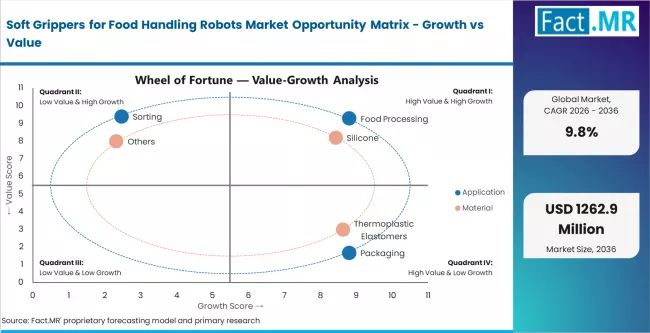
Soft Grippers For Food Handling Robots Market Opportunity Matrix Growth Vs Value | Source: Fact.MR
Fact MR analysis indicates that the soft grippers for food handling robots market developed from soft robotics engineering designed to handle delicate and irregularly shaped food products without causing structural damage. Historically, rigid robotic grippers were optimized for uniform industrial components but showed limitations when applied to fragile food items such as fruits, baked goods, and meat products. The current market valuation reflects adoption of elastomer-based gripping systems that conform to product geometry, enabling automated pick-and-place operations across food processing and packaging lines. Demand persists because soft grippers reduce product damage, improve hygiene compatibility, and enable automation of variable food handling tasks.
A structural shift is occurring as conventional rigid end-of-arm tooling transitions toward compliant gripping technologies designed for variability in food texture, size, and surface characteristics. Mechanical grippers remain widely used in high-speed packaging lines where uniform product geometry supports consistent gripping performance. Soft grippers incorporate silicone, pneumatic actuation, and adaptive gripping structures that enable safe manipulation of fragile products, though these systems involve higher material and integration costs. Even with gradual automation adoption across food processing facilities, higher-value compliant robotic tooling supports steady market value expansion.
- Delicate Product Handling: Food processors deploy soft robotic grippers to reduce deformation and bruising in fruits, confectionery, bakery items, and fresh produce.
- Food Contact Compliance: Standards such as FDA 21 CFR food contact material requirements and EC 1935/2004 food safety regulation influence material selection for hygienic robotic gripping components.
- Europe Food Automation: Germany, Netherlands, and Denmark maintain advanced food processing automation ecosystems adopting flexible robotic end-effectors for packaging and sorting operations.
Regional Analysis
The soft grippers for food handling robots market is assessed across North America, Europe, Asia Pacific, Latin America, and Middle East & Africa, segmented by country-level demand for robotic end effectors, automated food processing systems, and precision handling technologies. Regional demand reflects food safety compliance standards, automation of packaging lines, and robotic material handling efficiency. The full report offers market attractiveness analysis.
.webp "Top Country Growth Comparison Soft Grippers For Food Handling Robots Market Cagr (2026 2036)")
Top Country Growth Comparison Soft Grippers For Food Handling Robots Market Cagr (2026 2036) | Source: Fact.MR
| Country | CAGR (2026–2036) |
|---|---|
| China | 10.9% |
| India | 10.6% |
| United Kingdom | 10.3% |
| Germany | 10.1% |
| United States | 9.8% |
Source: Fact.MR analysis. Updated Apr 17, 2026
Source: Fact MR analysis, based on proprietary forecasting model and primary research
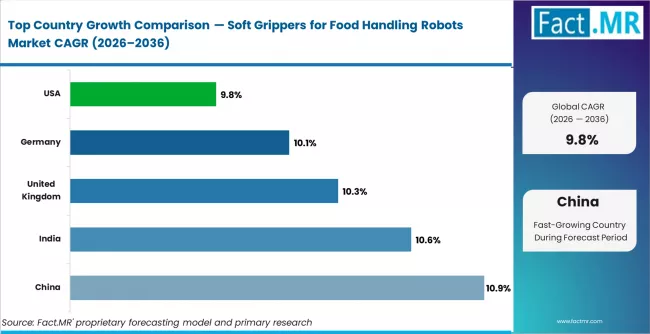
Soft Grippers For Food Handling Robots Market Cagr Analysis By Country | Source: Fact.MR
Asia Pacific
Asia Pacific functions as the food automation integration and robotic end effector manufacturing hub, supported by expanding processed food production capacity and robotic packaging line deployment. FANUC Corporation strengthens robotic food handling integration capabilities. Soft Robotics Inc. expands soft gripping technology portfolio. Yaskawa Electric Corporation supports robotic automation deployment.
- China: Demand for soft grippers for food handling robots in China is projected to rise at 10.9% CAGR through 2036. The Smart Manufacturing Development Plan update (Ministry of Industry and Information Technology, 2021) supports robotic automation adoption. FANUC Corporation expanded robotic end effector deployment capabilities (April 2023), supporting market growth.
- India: Demand for soft grippers for food handling robots in India is projected to rise at 10.6% CAGR through 2036. The Production Linked Incentive Scheme for food processing (Ministry of Food Processing Industries, 2021) supports automated packaging investment. Soft Robotics Inc. expanded soft gripping technology deployment (March 2023), supporting adoption.
Europe
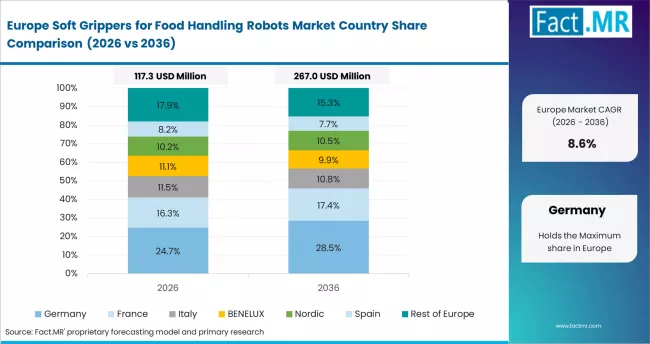
Soft Grippers For Food Handling Robots Market Europe Country Market Share Analysis, 2026 & 2036 | Source: Fact.MR
Europe functions as the food automation regulatory laboratory for hygienic robotic handling technologies, supported by structured food safety compliance frameworks and advanced robotics engineering ecosystems. Schmalz GmbH strengthens vacuum gripping and robotic handling capabilities. KUKA AG expands robotic automation portfolio. Festo SE & Co. KG supports pneumatic soft gripping innovation.
- United Kingdom: Demand for soft grippers for food handling robots in United Kingdom is projected to rise at 10.3% CAGR through 2036. The UK Food Industry Automation Strategy update (Department for Environment, Food and Rural Affairs, 2021) supports robotics adoption in food processing. Festo SE & Co. KG expanded soft gripping technology development initiatives (February 2023), supporting market adoption.
- Germany: Demand for soft grippers for food handling robots in Germany is projected to rise at 10.1% CAGR through 2036. The Industry 4.0 Strategy update (Federal Ministry for Economic Affairs and Climate Action, ongoing) supports robotic automation deployment. Schmalz GmbH expanded robotic gripping solutions (January 2023), supporting supply growth.
North America
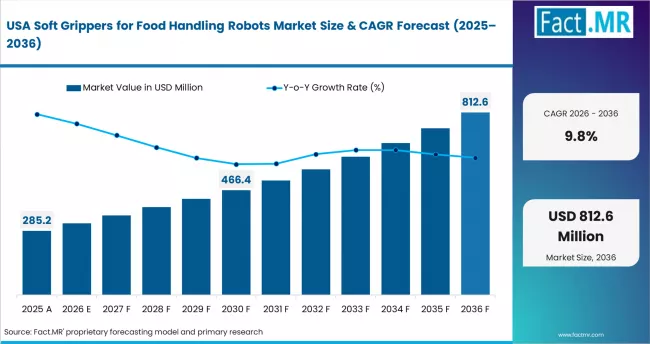
Soft Grippers For Food Handling Robots Market Country Value Analysis | Source: Fact.MR
North America serves as the robotic food handling commercialization and automation technology innovation hub, supported by strong packaged food production capacity and adoption of robotic material handling solutions. Soft Robotics Inc. strengthens soft gripping technology development capabilities. Rockwell Automation, Inc. expands robotic integration solutions portfolio. Teradyne Inc. supports collaborative robotic innovation.
- United States: Demand for soft grippers for food handling robots in United States is projected to rise at 9.8% CAGR through 2036. The Food Safety Modernization Act implementation (U.S. FDA, ongoing) supports hygienic robotic handling technology adoption. Rockwell Automation, Inc. expanded robotic automation solutions (May 2023), supporting market demand.
Fact MR's analysis of soft grippers for food handling robots market in global regions consists of country-wise assessment that includes China, India, United Kingdom, Germany, and United States. Readers can find robotic gripping technology trends, automated food processing developments, regulatory frameworks, and competitive positioning across key markets.
Competitive Landscape
Competitive Structure and Buyer Dynamics in the Soft Grippers for Food Handling Robots Market
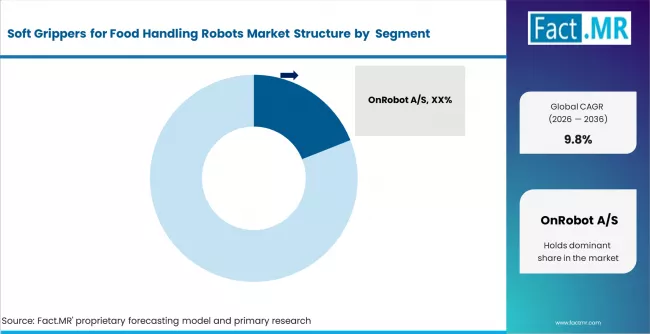
Soft Grippers For Food Handling Robots Market Analysis By Company | Source: Fact.MR
The competitive structure of the Soft Grippers for Food Handling Robots Market is moderately fragmented, with automation component manufacturers and robotic end effector specialists participating across food processing applications. Companies such as Festo SE & Co. KG, Schmalz GmbH, SMC Corporation, Zimmer Group GmbH, Piab AB, and Destaco maintain strong positions through established industrial automation component portfolios and global distribution networks. Additional participants including Soft Robotics Inc., OnRobot A/S, Gimatic Srl, and Robotiq Inc. contribute through specialized soft gripping technologies designed for handling delicate and irregular food products. Competition is primarily influenced by gripping precision, hygiene compliance, material durability, and compatibility with robotic automation platforms.
Several companies maintain structural advantages through proprietary gripping technologies and established relationships with food processing equipment manufacturers and automation integrators. Firms such as Festo SE & Co. KG and Schmalz GmbH benefit from strong expertise in pneumatic and vacuum handling systems supporting flexible automation deployment. Soft Robotics Inc. and OnRobot A/S maintain advantages through innovative soft material gripping solutions designed to reduce product damage. Food manufacturers often adopt multi supplier sourcing strategies to reduce dependence on a single end effector provider and maintain operational flexibility. Procurement decisions evaluate suppliers based on hygienic design standards, system compatibility, and long term performance reliability, moderating supplier pricing leverage across robotic food handling applications.
Key Players of the Soft Grippers for Food Handling Robots Market
- OnRobot A/S
- Schmalz GmbH
- Soft Robotics Inc.
- Festo SE & Co. KG
- Piab AB
- Zimmer Group GmbH
- Gimatic Srl
- Destaco (Dover Corporation)
- SMC Corporation
- Robotiq Inc.
Bibliographies
- [1] International Association of Food Protection. (2024). Soft robotic end-effectors in food contact environments: Guidance on hygienic design, material selection, and cleanability (IAFP Food Automation and Equipment Safety Report 2024-01). International Association of Food Protection.
- [2] U.S. Food and Drug Administration. (2023). Food contact materials and robotics: 2023 update – Silicone and elastomer grippers in automated food processing lines under FSMA compliance. FDA Center for Food Safety and Applied Nutrition.
- [3] Soft Robotics Inc. (2023). Soft grippers for food handling robots: Technical application note on silicone-based vacuum and soft-material grippers for food processing, packaging, and sorting. Soft Robotics Food and Beverage Portfolio.
- [4] Festo SE and Co. KG. (2024). Hygienic soft-gripper systems for food and bakery handling: Technical whitepaper on silicone-elastomer, vacuum-based adaptive grippers in high-speed packaging and sorting lines. Festo Food Automation Solutions.
- [5] Schmalz GmbH. (2023). Robotic soft and vacuum grippers for food and confectionery automation: Application guide for delicate bakery, fresh produce, and meat-handling robots. Schmalz Food and Packaging.
This Report Addresses
- Market size forecasts for 2026 to 2036 based on robotic end effector adoption benchmarks in food automation.
- Opportunity mapping across food processing, packaging, sorting, pick and place, and inspection handling workflows.
- Segment and regional forecasts covering silicone, thermoplastic elastomers, polyurethane, and rubber composite gripper materials.
- Competition assessment based on gripping precision, hygiene compliance, and robotic integration compatibility.
- Regulatory review covering FDA food contact material compliance and hygienic equipment standards.
- Report delivery in PDF, Excel, PPT, and dashboard formats for food automation planning teams.
- Supply chain risk analysis covering elastomer material durability, pneumatic component reliability, and end effector integration dependencies.
Soft Grippers for Food Handling Robots Market Definition
The soft grippers for food handling robots market includes flexible robotic end effectors made from compliant materials such as silicone or elastomers that gently grasp, pick, and move delicate or irregular food items without causing damage during sorting, packaging, and processing operations.
Soft Grippers for Food Handling Robots Market Inclusions
The report includes global and regional market size estimates, forecast analysis, and segmentation by gripper type, actuation technology, payload capacity, application area, end use industry, pricing structure, and integration with robotic automation systems used in food processing environments.
Soft Grippers for Food Handling Robots Market Exclusions
The scope excludes rigid industrial grippers designed for heavy manufacturing, robotic arms without soft gripping components, food processing machinery unrelated to robotic handling, and automation software platforms not directly linked to robotic gripping hardware.
Soft Grippers for Food Handling Robots Market Research Methodology
- Primary Research
- Interviews were conducted with robotics manufacturers, food processing companies, automation integrators, packaging specialists, and material technology developers.
- Desk Research
- Public sources included robotics engineering publications, company technical documentation, patent literature, regulatory standards, and academic studies on soft robotic gripping technologies.
- Market-Sizing and Forecasting
- A hybrid model combining top-down food automation demand evaluation and bottom-up analysis of soft gripper deployment across robotic food handling applications was applied.
- Data Validation and Update Cycle
- Outputs were validated through cross comparison of supplier data, expert consultation, and periodic monitoring of automation adoption trends in food processing environments.
Segmentation
Report Scope
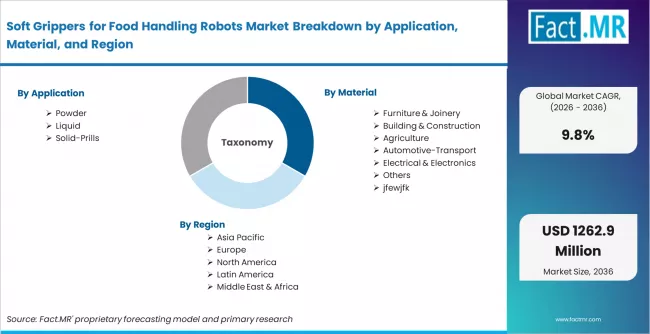
Soft Grippers For Food Handling Robots Market Breakdown By Application, Material, And Region | Source: Fact.MR
| Metric | Value |
|---|---|
| Quantitative Units | USD 451.6 million (2026) to USD 1,146.2 million (2036), at a CAGR of 9.8% |
| Market Definition | The soft grippers for food handling robots market includes robotic end-of-arm tooling designed with flexible materials to enable gentle gripping, handling, sorting, and packaging of delicate food products while maintaining hygiene and minimizing product damage during automated processing operations. |
| Application Segmentation | Food processing, Packaging, Sorting, Pick and place, Inspection handling |
| Material Segmentation | Silicone, Thermoplastic elastomers, Polyurethane, Rubber composites |
| Food Type Segmentation | Fruits and vegetables, Bakery items, Meat and seafood, Dairy products, Confectionery |
| Regions Covered | North America, Latin America, Europe, East Asia, South Asia, Oceania, Middle East and Africa |
| Countries Covered | United States, Canada, Mexico, Germany, France, United Kingdom, Italy, Spain, Netherlands, Denmark, China, Japan, South Korea, India, Singapore, Australia, United Arab Emirates, Saudi Arabia, and 40+ countries |
| Key Companies Profiled | OnRobot A/S, Schmalz GmbH, Soft Robotics Inc., Festo SE & Co. KG, Piab AB, Zimmer Group GmbH, Gimatic Srl, Destaco, SMC Corporation, Robotiq Inc. |
| Forecast Period | 2026 to 2036 |
| Approach | Hybrid top-down and bottom-up market estimation based on robotic automation adoption trends in food processing, end-of-arm tooling demand benchmarking, material flexibility performance requirements, food safety compliance standards, and validation through primary interviews with robotics component manufacturers, food processors, and automation system integrators. |
Source: Fact.MR analysis. Updated Apr 17, 2026
Soft Grippers for Food Handling Robots Market Key Segments
-
Application:
- Food Processing
- Packaging
- Sorting
- Pick and Place
- Inspection Handling
-
Material:
- Silicone
- Thermoplastic Elastomers
- Polyurethane
- Rubber Composites
-
Food Type:
- Fruits and Vegetables
- Bakery Items
- Meat and Seafood
- Dairy Products
- Confectionery
-
Region:
- North America
- USA
- Canada
- Mexico
- Europe
- Germany
- UK
- France
- Italy
- Spain
- Nordic Countries
- BENELUX
- Rest of Europe
- Asia Pacific
- China
- Japan
- South Korea
- India
- Australia
- Rest of Asia Pacific
- Latin America
- Brazil
- Argentina
- Rest of Latin America
- Middle East and Africa
- Kingdom of Saudi Arabia
- United Arab Emirates
- South Africa
- Rest of Middle East and Africa
- Other Regions
- Oceania
- Central Asia
- Other Markets
- North America
Frequently Asked Questions
How large is the demand for Soft Grippers for Food Handling Robots in the global market in 2026?
What will be the market size of Soft Grippers for Food Handling Robots in the global market by 2036?
What is the expected demand growth for Soft Grippers for Food Handling Robots in the global market between 2026 and 2036?
Which company is identified as a leading manufacturer in the Soft Grippers for Food Handling Robots market?
Which material type is projected to dominate soft gripper demand by 2026?
Why are silicone materials widely used in soft robotic grippers for food handling?
What is driving demand for soft grippers for food handling robots in China?
What is the growth outlook for the Soft Grippers for Food Handling Robots market in China?
Why is India an important market for robotic food handling components?
What is the growth outlook for the Soft Grippers for Food Handling Robots market in India?
How is demand for soft grippers evolving in the United Kingdom food automation sector?
What is the growth outlook for the Soft Grippers for Food Handling Robots market in the United Kingdom?
What is the growth outlook for the Soft Grippers for Food Handling Robots market in Germany?
How is the United States positioned in the Soft Grippers for Food Handling Robots market?
What is the growth outlook for the Soft Grippers for Food Handling Robots market in the United States?
What are soft grippers for food handling robots and what are they mainly used for?
What does the Soft Grippers for Food Handling Robots market include in this report?
What applications are included in the scope of the Soft Grippers for Food Handling Robots market?
What is excluded from the scope of the Soft Grippers for Food Handling Robots market report?
What does market forecast mean in the Soft Grippers for Food Handling Robots market report?
How is the Soft Grippers for Food Handling Robots market forecast developed in this report?
What does primary validation indicate in the Soft Grippers for Food Handling Robots market analysis?
Who worked on this report


Preview the report firsthand - request a free sample
Free SampleGet the brochure for pricing and purchase details
Download PDF