- Base Value(2025): 1.4 Bn
- Estimated Value(2025): 1.4 Bn
- Forecast Value (2035): 2.2 Bn
- CAGR (2025 - 2035): 5.0%
Soft Skin Adhesives Market Forecast and Outlook 2025 to 2035
The global soft skin adhesives market is projected to grow from USD 1,350.0 million in 2025 to approximately USD 2,200.0 million by 2035, recording an absolute increase of USD 850.0 million over the forecast period. This translates into a total growth of 62.9%, with the market forecast to expand at a compound annual growth rate (CAGR) of 5.0% between 2025 and 2035.
The overall market size is expected to grow by nearly 1.6X during the same period, supported by increasing demand for comfortable medical adhesives across wound care applications, growing adoption of wearable technology devices, and rising cosmetic patch applications requiring gentle skin attachment solutions.
Quick Stats for Soft Skin Adhesives Market
- Soft Skin Adhesives Market Value (2025): USD 1,350.0 million
- Soft Skin Adhesives Market Forecast Value (2035): USD 2,200.0 million
- Soft Skin Adhesives Market CAGR: 5.0%
- Leading Segment by Type (2025): Acrylic-based (50.0%)
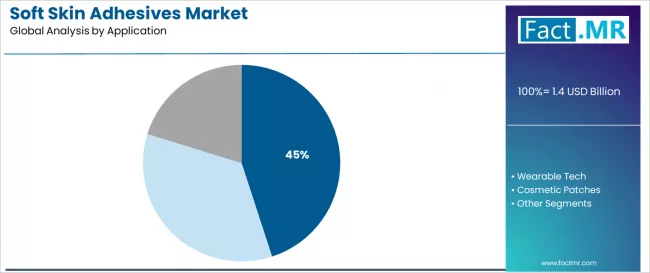
- Leading Segment by Application (2025): Wound Care (45.0%)
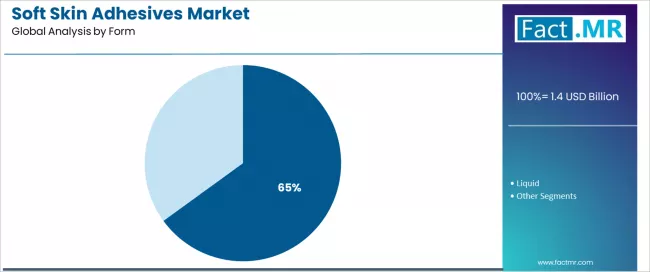
- Leading Segment by Form (2025): Film/Tape (65.0%)
- Key Growth Regions: North America, Europe, and Asia Pacific
- Top Companies by Market Share: 3M, Johnson & Johnson, Nitto Denko
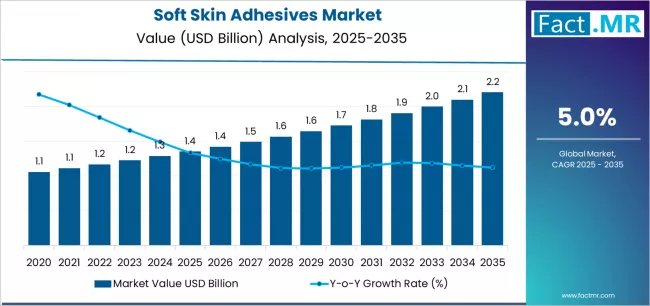
Soft Skin Adhesives Market Market Value Analysis | Source: Fact.MR
The soft skin adhesives market operates within a complex manufacturing environment where biocompatibility testing requirements create significant operational friction between research and development teams and production scheduling departments. Medical device manufacturers face persistent challenges in maintaining consistent adhesive performance across varying skin types and environmental conditions, as formulation chemists struggle to balance gentle removal properties with secure attachment strength. Quality control teams routinely encounter batch-to-batch variations in tack levels and peel strength measurements, forcing frequent recalibration of testing equipment and creating bottlenecks in production release protocols that impact delivery schedules for downstream medical device assembly operations.
Manufacturing facilities encounter substantial technical difficulties when transitioning between different adhesive formulations on shared coating lines, as cross-contamination risks necessitate extensive cleaning validation procedures that can extend changeover times beyond acceptable operational parameters. Production managers frequently clash with regulatory affairs teams over documentation requirements for process changes, particularly when modifying coating thickness or solvent systems to improve skin compatibility. These tensions intensify when engineering departments propose equipment modifications to enhance coating uniformity, as capital expenditure approvals must balance operational improvements against regulatory revalidation costs that can reach hundreds of thousands of dollars for established product lines.
Supply chain dynamics reveal critical vulnerabilities in raw material sourcing, particularly for specialty acrylic monomers and tackifying resins that require pharmaceutical-grade purity levels. Procurement teams face ongoing challenges with supplier qualification processes, as FDA registration requirements for adhesive components can extend vendor approval timelines beyond standard purchasing cycles. Manufacturing operations experience frequent disruptions when primary suppliers implement facility upgrades or address regulatory compliance issues, forcing temporary sourcing from secondary suppliers whose material properties may require process adjustments and additional validation testing.
Converting operations present unique technical challenges as adhesive coating processes must maintain precise web tension control to prevent adhesive migration and ensure consistent coating weight distribution. Maintenance teams struggle with adhesive buildup on coating rollers and drying ovens, requiring specialized cleaning solvents and procedures that create environmental compliance concerns. Production planners encounter scheduling conflicts when maintenance requirements for adhesive coating equipment conflict with high-volume production demands, particularly during peak seasonal periods for wound care and cosmetic patch applications.
Soft Skin Adhesives Market Key Takeaways
| Metric | Value |
|---|---|
| Market Value (2025) | USD 1,350.0 million |
| Market Forecast Value (2035) | USD 2,200.0 million |
| Forecast CAGR (2025-2035) | 5.0% |
Source: Fact.MR analysis. Updated Nov 3, 2025
Why is the Soft Skin Adhesives Market Growing?
| HEALTHCARE ADVANCEMENT | TECHNOLOGICAL INNOVATION | DEMOGRAPHIC DRIVERS |
|---|---|---|
| Medical Device Integration Advanced medical devices requiring comfortable skin attachment driving demand for gentle adhesive solutions with superior biocompatibility. Wound Care Advancement Modern wound management protocols emphasizing patient comfort and healing optimization requiring sophisticated adhesive materials. Cosmetic Applications Expanding cosmetic patch market requiring comfortable adhesive technologies for extended wear applications and aesthetic treatment delivery. | Wearable Technology Growth Growing wearable medical device market creating opportunities for flexible adhesive materials supporting continuous monitoring applications. Material Science Progress Development of advanced adhesive formulations providing enhanced breathability, flexibility, and moisture management capabilities. Processing Innovation Manufacturing improvements enabling production of specialized adhesive formulations with precise performance characteristics for specific applications. | Aging Population Needs Increasing elderly population requiring medical adhesives with reduced trauma during removal and enhanced comfort for extended wear periods. Consumer Preference Evolution Growing preference for gentle medical products driving demand for low-trauma adhesive solutions across healthcare applications. Healthcare Accessibility Increased healthcare access driving demand for medical devices incorporating comfortable adhesive technologies for patient compliance. |
Source: Fact.MR analysis. Updated Nov 3, 2025
DRIVERS
| DRIVERS | RESTRAINTS | KEY TRENDS |
|---|---|---|
| Healthcare Device Growth Expanding medical device market requiring comfortable adhesive solutions driving demand for gentle skin attachment technologies. Aging Demographics Increasing elderly population driving demand for gentle medical adhesives with reduced skin trauma and enhanced comfort characteristics. Cosmetic Market Growth Growing cosmetic patch applications requiring comfortable adhesive technologies for extended wear and aesthetic treatment delivery. | Regulatory Complexity Complex regulatory requirements affecting product development timelines and market entry for innovative adhesive formulations. Manufacturing Costs High production costs for specialized adhesive formulations affecting pricing strategies and market accessibility. Performance Limitations Technical limitations in balancing adhesion strength with gentle removal characteristics across diverse application requirements. | Advanced Material Development Development of advanced adhesive materials with enhanced biocompatibility, breathability, and performance characteristics. Wearable Technology Integration Integration of soft adhesives in wearable medical devices supporting continuous monitoring and therapeutic applications. Customization Capabilities Development of customized adhesive formulations tailored to specific application requirements and performance specifications. |
Source: Fact.MR analysis. Updated Nov 3, 2025
Analysis of Soft Skin Adhesives Market by Key Countries
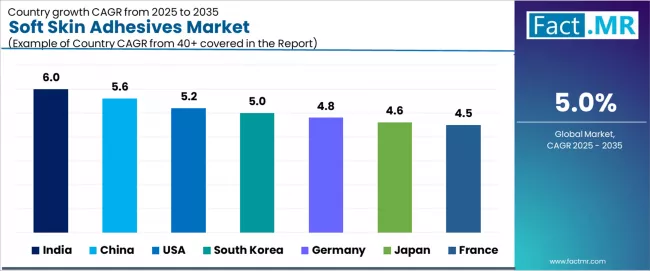
Soft Skin Adhesives Market Cagr Analysis By Country | Source: Fact.MR
| Country | CAGR (2025-2035) |
|---|---|
| India | 6.0% |
| China | 5.6% |
| USA | 5.2% |
| South Korea | 5.0% |
| Germany | 4.8% |
| Japan | 4.6% |
| France | 4.5% |
Source: Fact.MR analysis. Updated Nov 3, 2025
India Leads Global Market Growth with Healthcare Innovation
Revenue from soft skin adhesives market in India is projected to exhibit strong growth driven by expanding healthcare infrastructure and comprehensive medical device innovation creating opportunities for adhesive suppliers across wound care operations, wearable technology applications, and cosmetic device sectors.
The country's developing medical manufacturing tradition and expanding healthcare access capabilities are creating demand for both conventional and advanced adhesive materials. Major medical device companies are establishing local adhesive processing facilities to support manufacturing operations and meet growing demand for comfortable medical solutions.
- Healthcare infrastructure modernization programs are supporting widespread adoption of advanced medical devices across treatment facilities, driving demand for high-quality adhesive materials
- Medical device manufacturing excellence initiatives and specialized product development are creating opportunities for adhesive suppliers requiring reliable performance and cost-effective solutions
- Wound care technology advancement and medical device growth are facilitating adoption of specialized adhesive materials throughout major healthcare regions
China Demonstrates Strong Market Potential with Manufacturing Excellence
Revenue from soft skin adhesives market in China is expanding supported by extensive medical device manufacturing growth and comprehensive healthcare technology development creating demand for reliable adhesive materials across diverse medical categories and wearable technology segments.
The country's dominant manufacturing position and expanding medical device capabilities are driving demand for adhesive solutions that provide consistent performance while supporting cost-effective production requirements. Medical device processors and manufacturers are investing in local production facilities to support growing manufacturing operations and healthcare market demand.
- Medical device manufacturing operations expansion and healthcare technology development are creating opportunities for adhesive materials across diverse manufacturing segments requiring reliable performance and competitive processing costs
- Manufacturing modernization and technology advancement are driving investments in medical supply chains supporting performance requirements throughout major industrial regions
- Healthcare manufacturing growth and specialty medical device development programs are enhancing demand for processing-grade adhesives throughout medical production areas
USA Maintains Strong Position with Medical Innovation
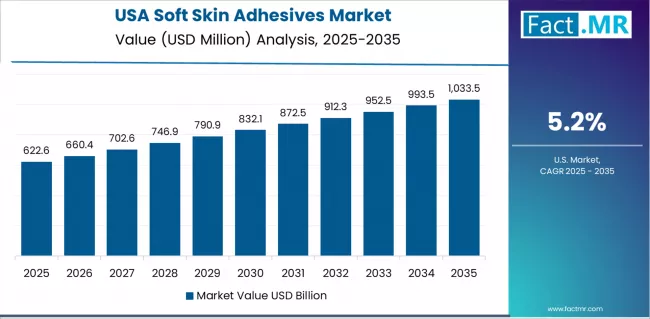
Soft Skin Adhesives Market Country Value Analysis | Source: Fact.MR
Demand for soft skin adhesives in USA is projected to grow supported by the country's expanding medical device manufacturing base and healthcare technologies requiring advanced adhesive systems for wound care applications and wearable medical devices.
American medical companies are implementing processing systems that support advanced manufacturing techniques, operational efficiency, and comprehensive quality protocols. The market is characterized by focus on operational excellence, patient comfort, and compliance with medical device quality standards.
- Medical device industry investments are prioritizing advanced processing technologies that demonstrate superior biocompatibility and performance while meeting American manufacturing standards
- Healthcare innovation leadership programs and operational excellence initiatives are driving adoption of precision-engineered adhesive materials that support advanced medical systems and performance optimization
- Research and development programs for patient comfort enhancement are facilitating adoption of specialized processing techniques throughout major medical centers
South Korea Expands Market with Technology Leadership
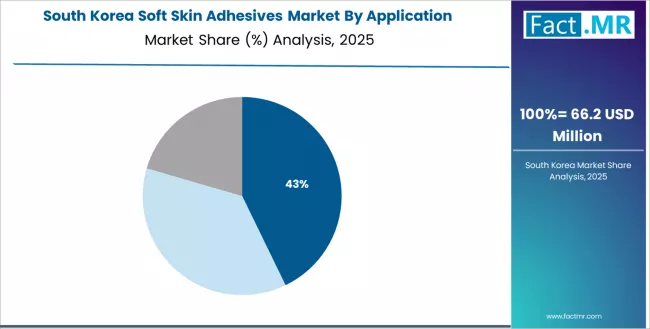
Soft Skin Adhesives Market South Korea Market Share Analysis By Application | Source: Fact.MR
Demand for soft skin adhesives in South Korea is projected to grow driven by advanced medical device manufacturing excellence and specialty adhesive capabilities supporting healthcare development and comprehensive medical applications.
The country's established medical technology tradition and growing healthcare technology market segments are creating demand for high-quality adhesive materials that support operational performance and medical standards.
- Advanced medical device manufacturing and specialty adhesive programs are supporting demand for processing-grade soft skin adhesives that meet contemporary performance and reliability standards
- Healthcare technology development and performance-focused manufacturing programs are creating opportunities for specialized adhesive materials that provide comprehensive medical support
- Manufacturing modernization and medical quality enhancement programs are facilitating adoption of advanced processing capabilities throughout major healthcare regions
Germany Focuses on Medical Manufacturing Excellence
Demand for soft skin adhesives in Germany is projected to grow driven by premium medical device manufacturing excellence and specialty adhesive capabilities supporting advanced healthcare development and comprehensive medical applications.
The country's established medical processing tradition and growing healthcare technology market segments are creating demand for high-quality adhesive materials that support operational performance and medical standards. Medical manufacturers and processing suppliers are maintaining comprehensive development capabilities to support diverse manufacturing requirements.
- Premium medical manufacturing and specialty adhesive programs are supporting demand for processing-grade soft skin adhesives that meet contemporary performance and reliability standards
- Medical device development and performance-focused manufacturing programs are creating opportunities for specialized adhesive materials that provide comprehensive healthcare support
- Manufacturing modernization and medical quality enhancement programs are facilitating adoption of advanced processing capabilities throughout major medical regions
Japan Focuses on Precision Medical Technology
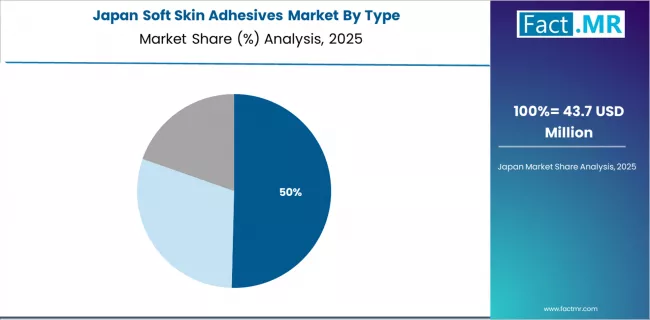
Soft Skin Adhesives Market Japan Market Share Analysis By Type | Source: Fact.MR
Demand for soft skin adhesives in Japan is projected to grow driven by precision medical device manufacturing excellence and specialty adhesive capabilities supporting advanced healthcare development and comprehensive technical applications.
The country's established medical processing tradition and growing healthcare technology market segments are creating demand for high-quality adhesive materials that support operational performance and medical standards.
- Precision medical manufacturing and specialty adhesive programs are supporting demand for processing-grade soft skin adhesives that meet contemporary performance and reliability standards
- Healthcare technology development and performance-focused manufacturing programs are creating opportunities for specialized adhesive materials that provide comprehensive medical support
- Manufacturing modernization and medical quality enhancement programs are facilitating adoption of advanced processing capabilities throughout major healthcare regions
France Maintains Medical Innovation Focus
Demand for soft skin adhesives in France is projected to grow driven by advanced medical device manufacturing and specialty adhesive capabilities supporting healthcare innovation and comprehensive medical applications.
The country's established medical technology tradition and growing healthcare market segments are creating demand for high-quality adhesive materials that support operational performance and medical standards.
- Advanced medical manufacturing and specialty adhesive programs are supporting demand for processing-grade soft skin adhesives that meet contemporary performance and reliability standards
- Medical technology development and performance-focused manufacturing programs are creating opportunities for specialized adhesive materials that provide comprehensive healthcare support
- Manufacturing modernization and medical quality enhancement programs are facilitating adoption of advanced processing capabilities throughout major medical regions
Europe Market Split by Processing Application
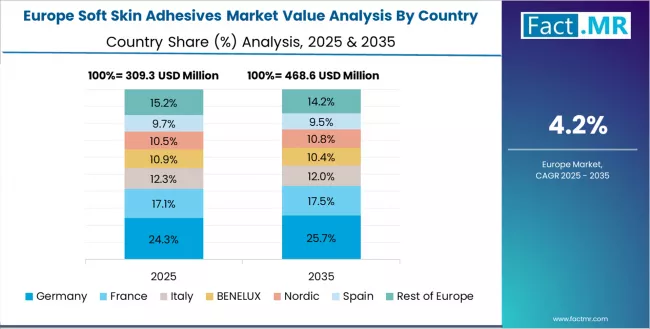
Soft Skin Adhesives Market Europe Country Market Share Analysis, 2025 & 2035 | Source: Fact.MR
The European soft skin adhesives market is defined by a combination of technological sophistication, regulatory compliance, and regional specialization. Germany leads the region with a market size of USD 300.0 million, supported by its advanced manufacturing infrastructure and focus on high-performance medical adhesives used in premium healthcare devices. The UK follows with USD 220.0 million, driven by strong collaborations between processors and medical device manufacturers, enabling tailored solutions that meet stringent clinical and quality standards.
France (USD 180.0 million), Italy (USD 140.0 million), and Spain (USD 120.0 million) emphasize specialized adhesive solutions catering to regional medical device requirements, often targeting niche applications such as wound care, surgical dressings, and wearable medical sensors. The Rest of Europe, including the Netherlands, Belgium, and Scandinavian countries (USD 290.0 million), is gaining momentum through innovation in adhesive formulations, efficient production processes, and strict adherence to EU regulatory frameworks, particularly for medical-grade applications.
Regulatory dynamics significantly shape the market. EU Medical Device Regulation and healthcare directives establish high-quality benchmarks that favor experienced European processors, while posing entry barriers for new material innovations. Brexit has enabled UK-based manufacturers to develop direct supplier partnerships, facilitating faster product development and compliance alignment.
Market consolidation is increasing as processors pursue economies of scale to manage rising energy costs and compliance expenditures. Vertical integration trends are rising, with leading medical device companies acquiring adhesive production facilities to secure supply chains and maintain quality assurance.
Smaller operators are increasingly focusing on niche, high-value applications to remain competitive, as large-scale processors dominate mainstream medical adhesive production for hospitals, clinics, and wearable healthcare devices.
Premium Quality Standards Define Japanese Market Dynamics
Japanese soft skin adhesives operations reflect the country's exacting quality standards and sophisticated medical expectations. Major medical device manufacturers maintain rigorous supplier qualification processes that often exceed international standards, requiring extensive documentation, batch testing, and facility audits that can take 12-18 months to complete. This creates high barriers for new suppliers but ensures consistent quality that supports premium product positioning.
The Japanese market demonstrates unique application preferences with Wound Care accounting for 50.0%, Wearable Tech 25.0%, and Cosmetic Patches 25.0%. Companies require specific adhesion ratios and performance specifications that differ from Western applications, driving demand for customized processing capabilities.
Japanese market demonstrates unique type preferences with Acrylic-based accounting for 55.0%, Silicone-based 25.0%, and Hydrocolloid 20.0%. Companies require specific molecular characteristics and biocompatibility specifications that differ from Western applications, driving demand for customized adhesive capabilities.
Regulatory oversight emphasizes comprehensive medical device management and traceability requirements that surpass most international standards. The medical device registration system requires detailed material sourcing information, creating advantages for suppliers with transparent supply chains and comprehensive documentation systems.
Supply chain management focuses on relationship-based partnerships rather than purely transactional procurement. Japanese companies typically maintain long-term supplier relationships spanning decades, with annual contract negotiations emphasizing quality consistency over price competition. This stability supports investment in specialized processing equipment tailored to Japanese specifications.
Market Dynamics Drive Innovation in South Korea
South Korean soft skin adhesives operations reflect the country's advanced medical device manufacturing sector and technology-oriented business model. Major medical companies drive sophisticated material procurement strategies, establishing direct relationships with global suppliers to secure consistent quality and pricing for their medical device and wearable technology operations targeting both domestic and international markets.
The Korean market demonstrates significant strength in type distribution with Acrylic-based accounting for 55.0%, Silicone-based 25.0%, and Hydrocolloid 20.0%. This technology-focused approach creates demand for specific performance specifications that differ from Western applications, requiring suppliers to adapt adhesive formulations and processing techniques.
Regulatory frameworks emphasize medical device safety and traceability, with Korean health administration standards often exceeding international requirements. This creates barriers for smaller medical suppliers but benefits established processors who can demonstrate compliance capabilities. The regulatory environment particularly favors suppliers with comprehensive certification and documentation systems.
Supply chain efficiency remains critical given Korea's technological leadership and innovation requirements. Companies increasingly pursue long-term contracts with suppliers in United States, Germany, and Japan to ensure reliable access to advanced materials while managing technological development risks. Technical logistics investments support quality preservation during processing and distribution periods.
The market faces pressure from rising technology costs and competition from lower-cost regional manufacturers, driving innovation investments and consolidation among smaller processors. The premium positioning of Korean medical device brands internationally continues to support demand for high-quality adhesive materials that meet stringent technological specifications.
Competitive Landscape of the Soft Skin Adhesives Market
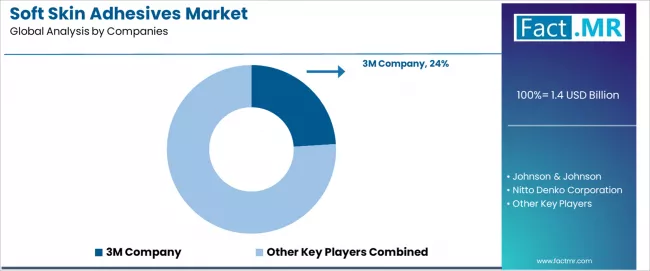
Soft Skin Adhesives Market Analysis By Company | Source: Fact.MR
The soft skin adhesives market is increasingly defined by specialization, scale, and technical sophistication. Profitability is concentrated at both ends of the value chain: upstream in large-scale, efficient adhesive production, and downstream in high-value, application-ready formulations for wound care, wearable devices, cosmetic patches, and other healthcare solutions. In these segments, biocompatibility, consistent performance, and patient comfort drive price premiums and create differentiation from commodity-grade adhesives.
Market participants typically fall into four categories: global medical integrators leveraging scale and proven clinical reliability; multi-application processors capable of serving diverse healthcare and consumer segments; specialty formulation developers with deep medical device expertise; and comfort-focused suppliers targeting premium wearable and healthcare applications. High switching costs-including re-qualification, biocompatibility assessments, and performance validations-favor incumbents, while evolving regulations and technological innovations open pathways for agile, innovative entrants.
Industry trends indicate ongoing consolidation and vertical integration, with digital procurement solutions gaining traction for standard adhesive grades, whereas premium formulations remain relationship driven. Strategic priorities for market players include securing medical device and healthcare supply pipelines through application-specific adhesives and service-level commitments, expanding multi-grade production capabilities, and investing in specialized formulations that enhance comfort, performance, and clinical outcomes. Technical expertise and regulatory compliance continue to define competitive advantage, shaping the long-term evolution of the market.
| Stakeholder Type | Primary Advantage | Repeatable Plays |
|---|---|---|
| Global medical integrators | Scale, production integration, clinical reliability | Long-term contracts, tight specs, co-development with medical devices |
| Multi-application processors | Application diversification, formulation expertise, supply flexibility | Multi-segment serving, technical support, quality assurance across healthcare |
| Specialty adhesive developers | Formulation expertise and medical industry relationships | Custom formulations, biocompatibility science, performance agreements |
| Comfort-focused suppliers | Application-focused demand and specialized service | Clinical comfort claims, specialized formulations, patient-centered innovation |
| Medical distributors & platforms | Technical support for mid-tier manufacturers | Formulation selection, smaller volumes, technical service |
Source: Fact.MR analysis. Updated Nov 3, 2025
Key Players in the Soft Skin Adhesives Market
- 3M Company
- Johnson & Johnson
- Nitto Denko Corporation
- Avery Dennison Corporation
- Scapa Group plc
- Henkel AG & Co. KGaA
- Lohmann GmbH & Co. KG
- Tesa SE
- Berry Global, Inc.
- Adhesives Research, Inc.
- Cardinal Health, Inc.
- Scapa Medical
- Hexpol TPE
Segmentation
Soft Skin Adhesives Market Segmentation
| Category | Segments Covered |
|---|---|
| By Type | Acrylic-based, Silicone-based, Hydrocolloid |
| By Application | Wound Care, Wearable Tech, Cosmetic Patches |
| By Form | Film/Tape, Liquid |
| By Region | North America, Europe, Asia Pacific, Latin America, Middle East & Africa |
Source: Fact.MR analysis. Updated Nov 3, 2025
Soft Skin Adhesives Market Analysis by Type
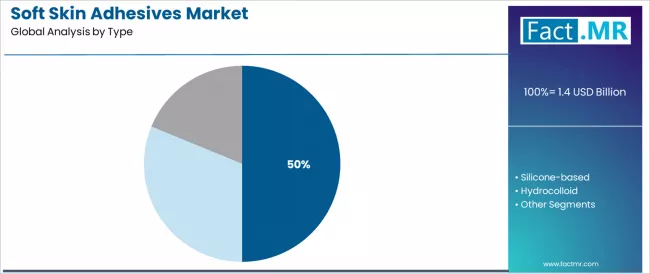
Soft Skin Adhesives Market Analysis By Type | Source: Fact.MR
| Segment | 2025 to 2035 Outlook |
|---|---|
| Acrylic-based | Leader in 2025 with 50.0% market share; maintaining leadership through 2035. Established manufacturing processes, broad application compatibility, cost-effective production. Momentum: steady growth supported by wound care and medical device applications. Watchouts: competition from gentler adhesive technologies. |
| Silicone-based | Premium segment at 30.0% market share benefiting from superior skin compatibility and reduced trauma removal characteristics. Growing adoption in sensitive skin applications and extended wear devices. Momentum: strong growth in wearable technology and pediatric applications. Watchouts: higher production costs affecting price-sensitive markets. |
| Hydrocolloid | Specialized segment at 20.0% market share focused on wound care applications requiring moisture management and absorption properties. Limited to specific applications but maintaining steady performance. Momentum: moderate growth through advanced wound care expansion. Watchouts: application limitations restricting broader market penetration. |
Source: Fact.MR analysis. Updated Nov 3, 2025
Soft Skin Adhesives Market Analysis by Application
Soft Skin Adhesives Market Analysis By Application | Source: Fact.MR
| Segment | 2025 to 2035 Outlook |
|---|---|
| Wound Care | Dominant application segment at 45.0% market share with established protocols and clinical adoption. Mature supply chains supporting diverse wound management applications. Momentum: steady growth driven by aging populations and advanced wound care protocols. Watchouts: regulatory requirements affecting product development timelines. |
| Wearable Tech | High-growth segment at 25.0% market share driven by expanding wearable medical device market and consumer electronics integration. Strong innovation focus and technological advancement. Momentum: strong growth through 2030 supported by healthcare digitization trends. Watchouts: technical requirements for extended wear applications. |
| Cosmetic Patches | Growing segment at 30.0% market share benefiting from aesthetic treatment expansion and consumer wellness trends. Diverse product development opportunities across beauty applications. Momentum: strong growth via cosmetic innovation and consumer preference for gentle application methods. Watchouts: regulatory requirements for cosmetic applications. |
Source: Fact.MR analysis. Updated Nov 3, 2025
Soft Skin Adhesives Market Analysis by Form
Soft Skin Adhesives Market Analysis By Form | Source: Fact.MR
| Form | Status & Outlook 2025-2035 |
|---|---|
| Film/Tape | Dominant form at 65.0% share for medical and wearable applications. Established manufacturing processes, processing advantages, ease of application. Momentum: steady growth driven by manufacturing efficiency and application versatility. Watchouts: competition from liquid formulations in specialized applications. |
| Liquid | Specialized form at 35.0% share for custom applications requiring precise control. Value-add through superior conformability, custom concentrations, specialized processing. Momentum: moderate growth as specialized applications demand enhanced properties. Processing complexity may limit broader market penetration. |
Source: Fact.MR analysis. Updated Nov 3, 2025
Scope of the Report
| Items | Values |
|---|---|
| Quantitative Units (2025) | USD 1,350.0 Million |
| Type | Acrylic-based, Silicone-based, Hydrocolloid |
| Application | Wound Care, Wearable Tech, Cosmetic Patches |
| Form | Film/Tape, Liquid |
| Regions Covered | North America, Europe, Asia Pacific, Latin America, Middle East & Africa |
| Countries Covered | United States, Germany, China, Japan, India, South Korea, France, and other 40+ countries |
| Key Companies Profiled | 3M, Johnson & Johnson, Nitto Denko, Avery Dennison, Scapa, Henkel, Lohmann, Tesa, Berry Global, Adhesives Research, Cardinal Health, Scapa Medical, Hexpol TPE |
| Additional Attributes | Dollar sales by product/application/form, regional demand (NA, EU, APAC), competitive landscape, film/tape vs. liquid adoption, production/processing integration, and advanced processing innovations driving biocompatibility enhancement, comfort optimization, and performance efficiency |
Source: Fact.MR analysis. Updated Nov 3, 2025
Soft Skin Adhesives Market Segmentation
-
By Type :
- Acrylic-based
- Silicone-based
- Hydrocolloid
-
By Application :
- Wound Care
- Wearable Tech
- Cosmetic Patches
-
By Form :
- Film/Tape
- Liquid
-
By Region :
- North America
- Europe
- Asia Pacific
- Latin America
- Middle East & Africa
Frequently Asked Questions
How big is the soft skin adhesives market in 2025?
What will be the size of soft skin adhesives market in 2035?
How much will be the soft skin adhesives market growth between 2025 and 2035?
What are the key product types in the soft skin adhesives market?
Which application segment to contribute significant share in the soft skin adhesives market in 2025?
Who worked on this report


Preview the report firsthand - request a free sample
Free SampleGet the brochure for pricing and purchase details
Download PDF