- Market Value (2025): USD 30.7 Bn
- Estimated Value (2026): USD 32.9 Bn
- Forecast Value (2036): USD 65.9 Bn
- CAGR (2026-2036): 7.2%
What is the Solid Tumor Testing Market forecast to be worth by 2036?
USD 32.9 billion in 2026 to USD 65.9 billion by 2036 at 7.2% CAGR.
- The solid tumor testing market reached USD 30.7 billion in 2025.
- Demand is projected to increase from USD 32.9 billion in 2026 to USD 65.9 billion by 2036.
- The market is forecast to record 7.2% CAGR from 2026 to 2036.
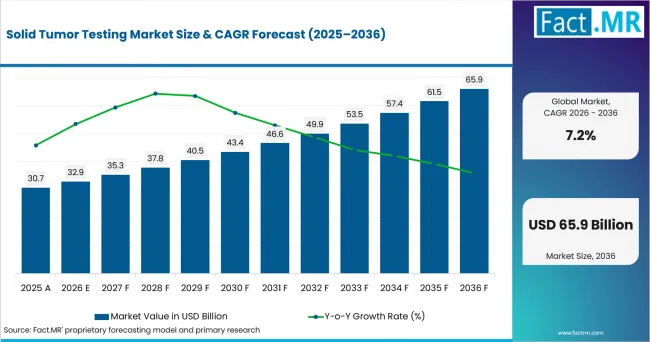
Solid Tumor Testing Market Value Analysis | Source: Fact.MR
What are the defining numbers behind Solid Tumor Testing Market growth?
USD 33.0 billion absolute opportunity is expected by 2036.
- Demand Drivers in the Market
- Genetic testing workflows require assays that connect tumor type and biomarker result with a clear treatment decision.
- Breast cancer testing remains an early approval route since receptor and HER2 results affect routine therapy review.
- Hospital oncology teams are expected to prefer testing partners that reduce sample repeat work and result interpretation delays.
- Key Segments Analyzed
- By Product Type: Genetic Testing is projected to hold 38.1% share in 2026 because tumor genotyping supports treatment selection across many solid tumor types.
- By Application: Breast Cancer is anticipated to account for 27.8% share in 2026 as receptor and mutation testing remain part of routine oncology review.
- By End User: Hospitals are estimated to capture 30.6% share in 2026 due to their direct role in pathology review and treatment planning.
- By Distribution Channel: Direct Sales is forecast to represent 30.0% share in 2026 since laboratories need installation support and clear service ownership.
- By Technology: Next-Generation Sequencing is expected to hold 39.5% share in 2026 as panels combine several biomarkers into one workflow.
- Analyst Opinion at Fact.MR
- Principal Consultant Shambhu Nath Jha at Fact.MR states, “ Solid tumor testing demand depends on whether a result can guide the next clinical decision. Providers that connect assay performance with reimbursement support and clear reporting are expected to win more hospital accounts.”
- Strategic Implications
- Hospitals should match genetic testing menus with treatment pathways before adding new panels.
- Diagnostic providers can strengthen proposals by pairing solid tumor assays with oncology companion diagnostics requirements.
- Investors comparing tissue testing with blood-based approaches should separate one-time diagnosis from repeat monitoring.
South Korea leads at 5.8% CAGR from 2026 to 2036. The USA follows at 9.4%. Australia records 5.1%. Canada posts 6.5%. Germany reaches 7.9%. The UK records 7.2%. Japan follows at 8.6%.
How does the Solid Tumor Testing Market break down by segment?
Genetic Testing is expected to lead Product Type at 38.1% share in 2026. Breast Cancer is projected to lead Application at 27.8% share in 2026.
Why does Genetic Testing lead Product Type?
Genetic Testing is projected to account for 38.1% share in 2026.
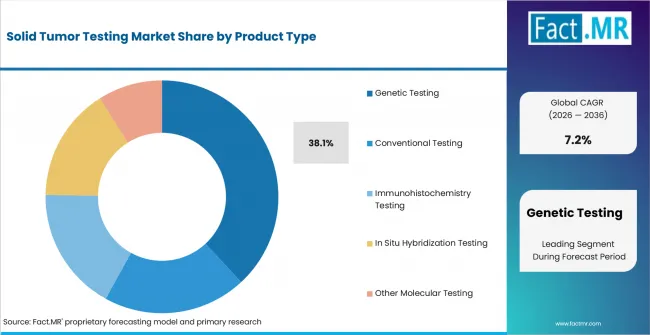
Solid Tumor Testing Market Analysis By Product Type | Source: Fact.MR
Tumor genotyping gives Genetic Testing a leading position because clinicians can connect the result with therapy selection. NGS and PCR remain important where laboratories need narrower choices. Cancer tumor profiling uses the same actionable biomarker reasoning.
Why does Breast Cancer lead Application?
Breast Cancer is anticipated to account for 27.8% share in 2026.
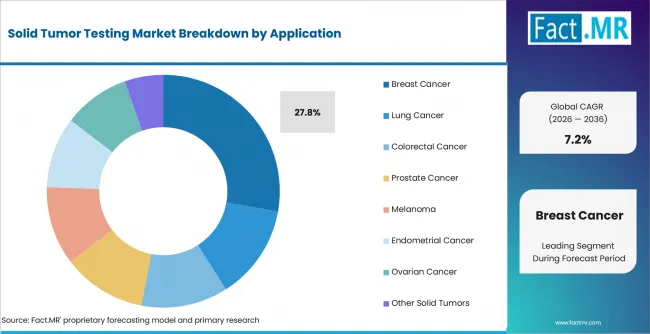
Solid Tumor Testing Market Analysis By Application | Source: Fact.MR
Breast cancer diagnostics need receptor and mutation results during early treatment planning. HER2 testing and hormone receptor testing stay in pathology review. Lung cancer diagnostics add volume when therapy labels require molecular evidence.
What supports Hospitals within End User?
Hospitals are estimated to account for 30.6% share in 2026.
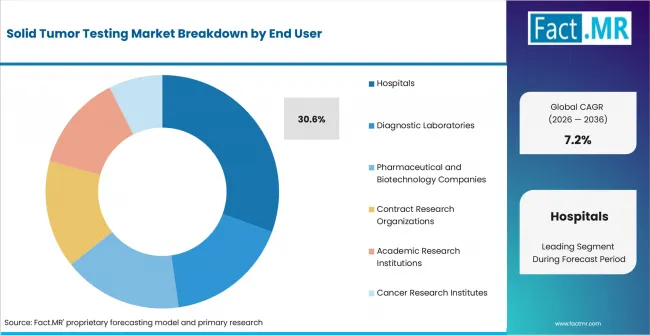
Solid Tumor Testing Market Analysis By End User | Source: Fact.MR
Hospital demand is shaped by the point where pathology review and oncology consultation meet. Internal laboratories need reports that fit tumor boards. Reference laboratories remain important when networks outsource complex molecular diagnostics.
How does Direct Sales shape channel demand?
Direct Sales is forecast to represent 30.0% share in 2026.
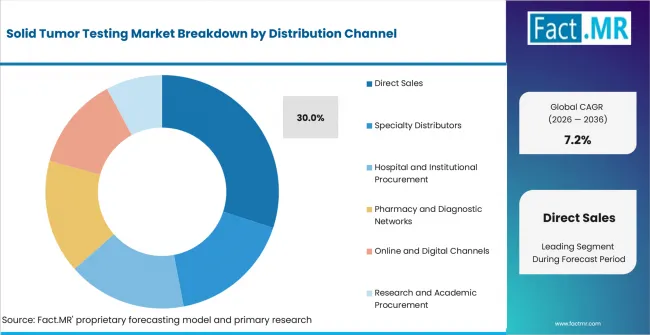
Solid Tumor Testing Market Analysis By Distribution Channel | Source: Fact.MR
Direct Sales leads Distribution Channel because laboratories want one accountable partner during validation. The route is useful when reagent availability and software updates must be coordinated. Specialty distributors remain useful for smaller accounts.
Why does Next-Generation Sequencing lead Technology?
Next-Generation Sequencing is expected to hold 39.5% share in 2026.
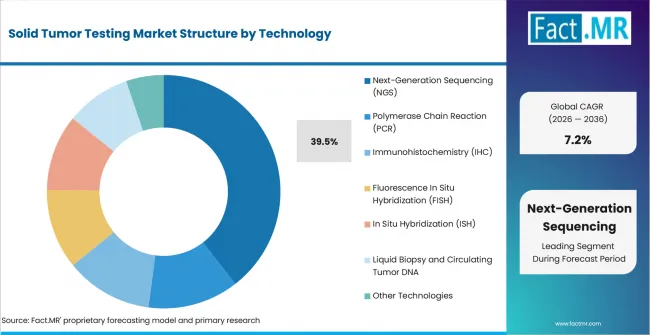
Solid Tumor Testing Market Analysis By Technology | Source: Fact.MR
NGS leads Technology because limited tumor material can answer several biomarker questions in one run. Blood based biomarkers explain repeat testing needs. DNA diagnostics keeps narrower test choices useful where reimbursement limits wider panel use.
What is accelerating Solid Tumor Testing Market adoption, and what is holding it back?
Demand is expected to rise through wider treatment-selection testing and better fit with hospital workflows. Reimbursement checks, poor specimen quality and heavy validation requirements may slow adoption.
Drivers Impact Analysis
| DRIVER | (~) % IMPACT ON CAGR | GEOGRAPHIC RELEVANCE | IMPACT TIMELINE |
|---|---|---|---|
| Genetic testing specification pull | +1.8% | South Korea, USA | Short term (<= 2 years) |
| Breast cancer clinical workflow use | +1.5% | USA; Australia; Canada | Short term (<= 2 years) |
| Hospital oncology menu expansion | +1.2% | South Korea and Germany | Medium term (2-4 years) |
| Direct service and validation support | +0.9% | Canada; UK; Japan | Medium term (2-4 years) |
| NGS panel consolidation | +0.8% | Hospital and reference-lab networks | Long term (>= 4 years) |
Source: Fact.MR analysis. Updated Aug 3, 2026
- Genetic testing specification pull: Assays are expected to gain preference when biomarker results connect with a clear clinical action and a readable report.
- Breast cancer clinical workflow use: Receptor and mutation testing support faster review when pathology teams receive reproducible results.
- Hospital oncology menu expansion: Hospitals are expected to expand testing menus when one provider can support pathology and oncology review.
Opportunity Impact Analysis
| OPPORTUNITY | (~) % IMPACT ON CAGR | GEOGRAPHIC RELEVANCE | IMPACT TIMELINE |
|---|---|---|---|
| Breast cancer workflow packages | +1.1% | South Korea and USA | Medium term (2-4 years) |
| Provider network expansion | +0.9% | Australia and Canada | Medium term (2-4 years) |
| Liquid biopsy add-on menus | +0.7% | USA; Germany; UK | Long term (>= 4 years) |
| Research-to-clinic testing transfer | +0.5% | Japan and academic networks | Long term (>= 4 years) |
Source: Fact.MR analysis. Updated Aug 3, 2026
- Breast cancer workflow packages: Providers that combine HER2 and hormone receptor testing are expected to reduce ordering friction for oncology teams.
- Provider network expansion: Regional networks are expected to use reference-lab relationships when local laboratories cannot justify every assay in house.
- Liquid biopsy add-on menus: Blood-based testing creates opportunity where tissue quantity is limited or repeat monitoring is part of care.
Restraints Impact Analysis
| RESTRAINT | (~) % IMPACT ON CAGR | GEOGRAPHIC RELEVANCE | IMPACT TIMELINE |
|---|---|---|---|
| Reimbursement and coverage review | -1.1% | USA; Germany; UK | Short term (<= 2 years) |
| Specimen quality and tumor fraction limits | -0.9% | Global hospital laboratories | Short term (<= 2 years) |
| Validation and reporting burden | -0.7% | South Korea; Australia; Canada | Medium term (2-4 years) |
| Fragmented ordering pathways | -0.5% | Smaller hospital networks | Long term (>= 4 years) |
Source: Fact.MR analysis. Updated Aug 3, 2026
- Reimbursement and coverage review: Laboratories can delay panel expansion when payment rules do not clearly match the test and therapy pathway.
- Specimen quality and tumor fraction limits: Low tissue quantity or weak tumor signal can force repeat collection and extend reporting time.
- Validation and reporting burden: Complex panels require evidence that the assay and clinical report remain stable in routine use.
Which countries are scaling Solid Tumor Testing Market fastest?
- South Korea leads as hospitals adopt validated genetic testing with strong clinical support. The USA follows because breast and lung cancer treatments often require biomarker evidence.
- Australia and Canada depend more on reference-lab coordination. Germany and the UK grow carefully due to reimbursement and evidence requirements.
- Japan expands at a slower pace because hospitals prioritize quality assurance and established pathology workflows.
The full report provides country-level CAGR analysis across North America; Latin America; Europe; East Asia; South Asia and Oceania; and the Middle East and Africa.
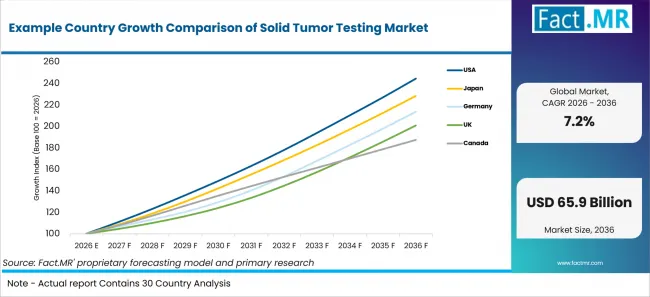
Example Country Growth Comparison Of Solid Tumor Testing Market | Source: Fact.MR
| Country | CAGR (2026-2036) |
|---|---|
| South Korea | 5.8% |
| USA | 9.4% |
| Australia | 5.1% |
| Canada | 6.5% |
| Germany | 7.9% |
| UK | 7.2% |
| Japan | 8.6% |
Source: Fact.MR analysis. Updated Aug 3, 2026
What supports South Korea adoption?
5.8% CAGR, supported by hospital oncology networks and genetic testing readiness.
South Korea adoption is shaped by cancer centers that can connect test ordering with specialist review. Genetic testing demand is expected to benefit from technical service near major care networks. Providers still need to prove local reporting fit and repeat-use reliability.
How is USA scaling demand?
9.4% CAGR, driven by breast cancer testing and therapy-selection pathways.
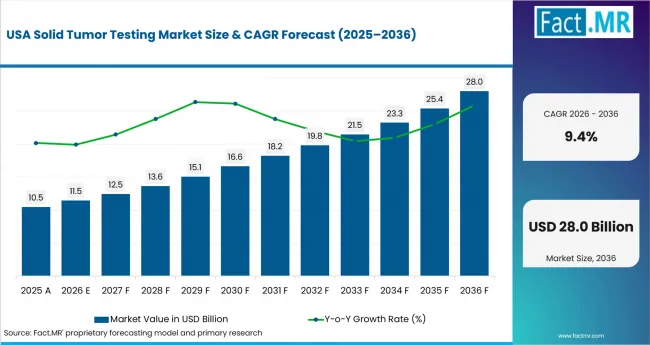
Solid Tumor Testing Market Country Value Analysis | Source: Fact.MR
USA demand is tied to treatment labels. Breast cancer workflows support demand when receptor and mutation findings affect treatment sequencing. Coverage uncertainty can still slow panel adoption for narrow clinical uses.
What is driving Australia’s growth from 2026 to 2036?
5.1% CAGR, backed by hospital testing demand and reference-lab coordination.
Australia demand is shaped by reliable laboratory access across a dispersed care system. Hospitals are expected to favor providers that support sample logistics and clear interpretation. Smaller accounts can delay adoption when full in-house capability is difficult to justify.
How is Canada developing demand?
6.5% CAGR, supported by network-based procurement and centralized testing access.
Canada growth reflects hospital demand for consistent oncology testing across large service areas. Direct sales support helps when laboratories require validation help and dependable reagent availability. Provincial funding decisions can extend approval timelines.
How does Germany perform?
7.9% CAGR, led by evidence review and quality-controlled laboratory adoption.
Germany is expected to favor validated assays that fit pathology quality systems and reimbursement review. NGS panels can gain use where reports support treatment decisions. Adoption remains selective when laboratories must document performance before routine use.
What supports UK growth?
7.2% CAGR, shaped by service access and reimbursement discipline.
The UK reflects clinical interest in targeted therapy pathways and careful review of test funding. Providers need evidence that genetic testing supports treatment selection without raising reporting burden. Wider adoption depends on care-network priorities.
How does Japan perform?
8.6% CAGR, supported by quality assurance and controlled oncology testing expansion.
Japan demand reflects care networks that value precise assays and dependable local support. Hospitals are expected to prefer options that fit established pathology workflows. Expansion can remain slower where customers require stronger evidence before routine ordering.
Who leads the Solid Tumor Testing Market?
Roche and Thermo Fisher Scientific show the strongest relevance, while Illumina strengthens the genomic testing landscape.
Roche supports oncology diagnostics and companion testing. Thermo Fisher adds PCR, NGS and molecular platforms. Illumina contributes sequencing for tumor profiling. QIAGEN, Abbott and Agilent support laboratory workflows. Guardant Health and Foundation Medicine extend competition through liquid biopsy and genomic profiling services.
Which companies are the key providers?
Key companies include F. Hoffmann-La Roche Ltd. Thermo Fisher Scientific Inc., Illumina, Inc., QIAGEN N.V., Abbott Laboratories, Agilent Technologies, Inc., Guardant Health, Inc., Foundation Medicine, Inc.
- F. Hoffmann-La Roche Ltd.
- Thermo Fisher Scientific Inc.
- Illumina, Inc.
- QIAGEN N.V.
- Abbott Laboratories
- Agilent Technologies, Inc.
- Guardant Health, Inc.
- Foundation Medicine, Inc.
Bibliography
- U.S. Food and Drug Administration. (2024). TruSight Oncology Comprehensive—P230011.
- U.S. Food and Drug Administration. (2024, October 10). FDA approves inavolisib with palbociclib and fulvestrant for endocrine-resistant, PIK3CA-mutated, HR-positive, HER2-negative advanced breast cancer.
- NHS England. (2026, April 7). Implementation of circulating tumour DNA testing in the NHS.
This Report Answers
- The report explains Product Type and Application choices that shape solid tumor testing adoption.
- Segment analysis covers Genetic Testing and Breast Cancer as the 2026 share leaders.
- Country outlook evaluates South Korea; USA; Australia; Canada; Germany; the UK; and Japan.
- Competitive analysis profiles F. Hoffmann-La Roche Ltd. and Thermo Fisher Scientific Inc. alongside the wider listed provider group.
- Technology assessment covers NGS; PCR; immunohistochemistry; FISH; and liquid biopsy workflows.
What does the Solid Tumor Testing Market cover?
Solid tumor testing covers tissue-based and blood-based assays used to evaluate tumor signals for diagnosis and treatment selection.
The Solid Tumor Testing Market covers genetic testing and NGS. PCR and histopathology are included. Cytology and immunohistochemistry complete the coverage. In situ hybridization and liquid biopsy remain inside coverage.
What is included in the scope?
Solid tumor testing is used across hospitals and diagnostic laboratories. Drug developers and research organizations are included. Academic institutions and cancer research centers remain included.
The scope covers Product Type and Application. End User and Distribution Channel are included. Technology and Region complete the scope.
What is excluded from the scope?
Blood cancer testing remains outside the scope unless the same product is used for solid tumor workflows.
The scope excludes general imaging systems and surgical devices. Wellness screening and non-oncology tests remain excluded. Broad laboratory automation is excluded unless it directly supports assay validation or reporting.
How Was the Analysis Built?
The analysis draws on 120+ sources, 35+ company portfolios, 25+ countries, and more than 20 interviews.
- Primary Research: Primary research includes discussions with manufacturers and service providers. Technology developers and distributors are included. End users and procurement teams remain covered. These discussions examine purchasing priorities and market acceptance.
- Desk Research: Desk research covers government statistics and regulatory publications. Company filings and trade data are reviewed. Technical studies are included where they support the market boundary. Every source used in the analysis is documented in the bibliography.
- Market Sizing and Forecasting: Market estimates combine historical performance and demand indicators. Pricing trends and segment shares are reviewed. Company participation and country-level growth are then compared.
- Data Validation and Update Cycle: Findings are validated by comparing primary interviews with public data. Company activity and regulatory changes are reviewed. Procurement trends and commercial adoption are checked before revisions are finalized.
Segmentation
What is the report’s scope and coverage?
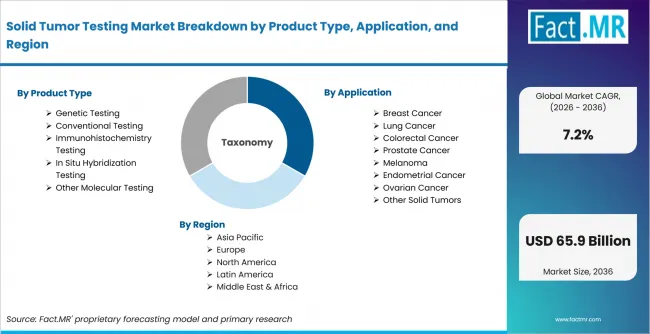
Solid Tumor Testing Market Breakdown By Product Type, Application, And Region | Source: Fact.MR
| Attribute | Details |
|---|---|
| Quantitative Units | USD billion in 2026 to USD billion by 2036 at CAGR |
| Market Definition | Commercial testing products and services used to identify molecular and genomic signals in solid tumors for diagnosis; therapy selection; monitoring; and research workflows |
| Product Type | Genetic Testing; Next-Generation Sequencing (NGS); Polymerase Chain Reaction (PCR); Conventional Testing; Histopathology; Cytology; Immunohistochemistry Testing; Biomarker Immunohistochemistry; Companion Diagnostic Immunohistochemistry; In Situ Hybridization Testing; Fluorescence In Situ Hybridization (FISH); Chromogenic In Situ Hybridization (CISH); Other Molecular Testing; Fragment Analysis; Methylation and Epigenetic Testing |
| Application | Breast Cancer; HER2 Testing; Hormone Receptor Testing; Lung Cancer; Non-Small Cell Lung Cancer Testing; Small Cell Lung Cancer Testing; Colorectal Cancer; Microsatellite Instability Testing; RAS and BRAF Mutation Testing; Prostate Cancer; Androgen Receptor Testing; Genomic Risk Testing; Melanoma; BRAF Mutation Testing; NRAS and KIT Mutation Testing; Endometrial Cancer; Mismatch Repair Testing; Microsatellite Instability Testing; Ovarian Cancer; BRCA Mutation Testing; Homologous Recombination Deficiency Testing; Other Solid Tumors; Thyroid Cancer Testing; Liver and Pancreatic Cancer Testing |
| End User | Hospitals; Hospital Pathology Laboratories; Hospital Oncology Centers; Diagnostic Laboratories; Independent Diagnostic Laboratories; Reference Laboratories; Pharmaceutical and Biotechnology Companies; Drug Development Companies; Companion Diagnostic Developers; Contract Research Organizations; Clinical Research Organizations; Translational Research Organizations; Academic Research Institutions; University Research Centers; Academic Medical Centers; Cancer Research Institutes; Comprehensive Cancer Centers; Independent Cancer Research Institutes |
| Distribution Channel | Direct Sales; Direct Sales to Hospitals; Direct Sales to Diagnostic Laboratories; Specialty Distributors; Molecular Diagnostic Distributors; Oncology Diagnostic Distributors; Hospital and Institutional Procurement; Hospital Procurement Programs; Healthcare Network Procurement; Pharmacy and Diagnostic Networks; Retail Diagnostic Networks; Specialty Oncology Networks; Online and Digital Channels; Digital Diagnostic Ordering Platforms; Online Laboratory Service Platforms; Research and Academic Procurement; University Procurement Programs; Research Institute Procurement |
| Technology | Next-Generation Sequencing (NGS); Targeted NGS Panels; Whole Exome and Comprehensive Genomic Profiling; Polymerase Chain Reaction (PCR); Real-Time PCR; Digital PCR; Immunohistochemistry (IHC); Biomarker IHC; Companion Diagnostic IHC; Fluorescence In Situ Hybridization (FISH); Gene Amplification Testing; Gene Rearrangement Testing; In Situ Hybridization (ISH); Chromogenic ISH; Silver-Enhanced ISH; Liquid Biopsy and Circulating Tumor DNA; Circulating Tumor DNA Testing; Circulating Tumor Cell Testing; Other Technologies; Fragment Analysis; Methylation and Epigenomic Testing |
| Regions Covered | North America; Latin America; Europe; East Asia; South Asia and Oceania; Middle East and Africa |
| Countries Covered | South Korea; USA; Australia; Canada; Germany; UK; Japan |
| Key Companies Profiled | F. Hoffmann-La Roche Ltd.; Thermo Fisher Scientific Inc.; Illumina, Inc.; QIAGEN N.V.; Abbott Laboratories; Agilent Technologies, Inc.; Guardant Health, Inc.; Foundation Medicine, Inc. |
| Forecast Period | 2026 to 2036 |
| Approach | Hybrid top-down and bottom-up approach using diagnostic testing demand; oncology workflow requirements; genetic testing adoption; hospital and laboratory procurement patterns; direct sales activity; NGS panel consolidation; reimbursement review; specimen quality constraints; country adoption patterns and company portfolio review |
Source: Fact.MR analysis. Updated Aug 3, 2026
How is the market segmented?
-
By Product Type
- Genetic Testing
- Next-Generation Sequencing (NGS)
- Polymerase Chain Reaction (PCR)
- Conventional Testing
- Histopathology
- Cytology
- Immunohistochemistry Testing
- Biomarker Immunohistochemistry
- Companion Diagnostic Immunohistochemistry
- In Situ Hybridization Testing
- Fluorescence In Situ Hybridization (FISH)
- Chromogenic In Situ Hybridization (CISH)
- Other Molecular Testing
- Fragment Analysis
- Methylation and Epigenetic Testing
- Genetic Testing
-
By Application
- Breast Cancer
- HER2 Testing
- Hormone Receptor Testing
- Lung Cancer
- Non-Small Cell Lung Cancer Testing
- Small Cell Lung Cancer Testing
- Colorectal Cancer
- Microsatellite Instability Testing
- RAS and BRAF Mutation Testing
- Prostate Cancer
- Androgen Receptor Testing
- Genomic Risk Testing
- Melanoma
- BRAF Mutation Testing
- NRAS and KIT Mutation Testing
- Endometrial Cancer
- Mismatch Repair Testing
- Microsatellite Instability Testing
- Ovarian Cancer
- BRCA Mutation Testing
- Homologous Recombination Deficiency Testing
- Other Solid Tumors
- Thyroid Cancer Testing
- Liver and Pancreatic Cancer Testing
- Breast Cancer
-
By End User
- Hospitals
- Hospital Pathology Laboratories
- Hospital Oncology Centers
- Diagnostic Laboratories
- Independent Diagnostic Laboratories
- Reference Laboratories
- Pharmaceutical and Biotechnology Companies
- Drug Development Companies
- Companion Diagnostic Developers
- Contract Research Organizations
- Clinical Research Organizations
- Translational Research Organizations
- Academic Research Institutions
- University Research Centers
- Academic Medical Centers
- Cancer Research Institutes
- Comprehensive Cancer Centers
- Independent Cancer Research Institutes
- Hospitals
-
By Distribution Channel
- Direct Sales
- Direct Sales to Hospitals
- Direct Sales to Diagnostic Laboratories
- Specialty Distributors
- Molecular Diagnostic Distributors
- Oncology Diagnostic Distributors
- Hospital and Institutional Procurement
- Hospital Procurement Programs
- Healthcare Network Procurement
- Pharmacy and Diagnostic Networks
- Retail Diagnostic Networks
- Specialty Oncology Networks
- Online and Digital Channels
- Digital Diagnostic Ordering Platforms
- Online Laboratory Service Platforms
- Research and Academic Procurement
- University Procurement Programs
- Research Institute Procurement
- Direct Sales
-
By Technology
- Next-Generation Sequencing (NGS)
- Targeted NGS Panels
- Whole Exome and Comprehensive Genomic Profiling
- Polymerase Chain Reaction (PCR)
- Real-Time PCR
- Digital PCR
- Immunohistochemistry (IHC)
- Biomarker IHC
- Companion Diagnostic IHC
- Fluorescence In Situ Hybridization (FISH)
- Gene Amplification Testing
- Gene Rearrangement Testing
- In Situ Hybridization (ISH)
- Chromogenic ISH
- Silver-Enhanced ISH
- Liquid Biopsy and Circulating Tumor DNA
- Circulating Tumor DNA Testing
- Circulating Tumor Cell Testing
- Other Technologies
- Fragment Analysis
- Methylation and Epigenomic Testing
- Next-Generation Sequencing (NGS)
-
By Region
- North America
- Latin America
- Europe
- East Asia
- South Asia and Oceania
- Middle East and Africa
Frequently Asked Questions
Which Product Type leads the market?
Which Application leads the market?
Which End User leads the market?
Which Distribution Channel leads the market?
Which Technology leads the market?
Which country records the highest listed CAGR?
What is the primary driver in this market?
What is the main restraint?
Why do hospitals lead demand?
Who worked on this report


Preview the report firsthand - request a free sample
Free SampleGet the brochure for pricing and purchase details
Download PDF