- Market Value (2025): USD 2.5 Bn
- Estimated Value (2026): USD 2.9 Bn
- Forecast Value (2036): USD 12.8 Bn
- CAGR (2026-2036): 15.9%
What is the Sourcing Sustainability Toolkits Market forecast to be worth by 2036?
USD 2.9 billion in 2026 to USD 12.8 billion by 2036 at a 15.9% CAGR.
- The Sourcing Sustainability Toolkits Market reached USD 2.5 billion in 2025.
- Demand is projected to increase from USD 2.9 billion in 2026 to USD 12.8 billion by 2036.
- The market is forecast to record 15.9% CAGR from 2026 to 2036 as forced-labor controls, due-diligence duties and Scope 3 programs pull supplier evidence into recurring procurement workflows.
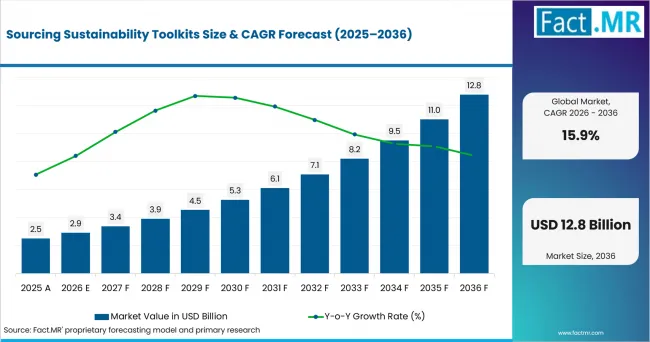
Sourcing Sustainability Toolkits Value Analysis | Source: Fact.MR
What are the defining numbers behind Sourcing Sustainability Toolkits Market growth?
An absolute opportunity of USD 9.9 billion is expected between 2026 and 2036.
- Demand Drivers in the Market
- European due-diligence rules require companies to identify and address adverse impacts through their chains. The European Commission describes the corporate sustainability due diligence framework as risk-based prevention, mitigation and remediation.
- Import enforcement raises the cost of weak traceability. U.S. Customs and Border Protection guidance for the UFLPA calls for due diligence, supply-chain tracing and effective supply-chain management.
- Procurement teams need supplier-level carbon information rather than only corporate totals. EcoVadis positions its Carbon Action Manager around primary Scope 3 information and supplier engagement.
- Key Segments Analyzed
- Supplier ESG assessment represents 28.0% of Toolkit Function demand in 2026. Supplier ESG assessment leads because it creates a common entry point for screening many vendors before deeper carbon or human-rights work.
- Carbon and climate accounts for 31.0% of the 2026 Sustainability Domain mix. Carbon and climate leads because companies need supplier information for Scope 3 inventories, product footprints and decarbonization plans.
- Supplier questionnaires hold 31.0% of Data Method demand in 2026. Supplier questionnaires remain the largest method because they can reach broad supply bases at manageable cost and capture policy, process and activity information in one workflow.
- Procurement teams contribute 38.0% of the 2026 User mix. Procurement teams lead because they control onboarding, sourcing events, contracts and supplier follow-up.
- Analyst Opinion at Fact.MR
- Shambhu Nath Jha, Principal Consultant at Fact.MR, states, “The commercial test for a sourcing sustainability toolkit is whether it changes an owner, a contract condition or a supplier action. A polished score alone is not enough. Platforms that preserve evidence, show why a supplier was prioritized and connect corrective work with purchasing systems will be better placed for recurring enterprise budgets.”
- Strategic Implications
- Assessment vendors should let buyers move from a rating into corrective tasks and primary evidence. EcoVadis uses scorecards across 21 criteria and four themes, while its carbon module extends engagement into supplier emissions information.
- Network platforms should reduce duplicate requests across shared suppliers. Sedex combines site mapping, risk screening, questionnaires, corrective actions and integrations with enterprise procurement systems.
- Enterprise software vendors should embed footprint and due-diligence signals in the purchase workflow. SAP Sustainability Footprint Management automates corporate and product footprints and provides more than 45,000 emission factors for calculation support.
France is projected at 15.2% CAGR through 2036 as vigilance duties shift toward operational evidence. The Netherlands reaches 13.7% through trade-linked supplier engagement and the UK 13.3% as transparency and procurement rules reinforce action. Forced-labor traceability and carbon programs support 12.7% in the USA, while Germany records 11.4% from a more mature due-diligence base.
How does the Sourcing Sustainability Toolkits Market break down by segment?
Toolkit Function: Supplier ESG assessment (28.0%); Sustainability Domain: Carbon and climate (31.0%); Data Method: Supplier questionnaires (31.0%); User: Procurement teams (38.0%).
Which Toolkit Function leads?
Supplier ESG assessment: 28.0% share in 2026.
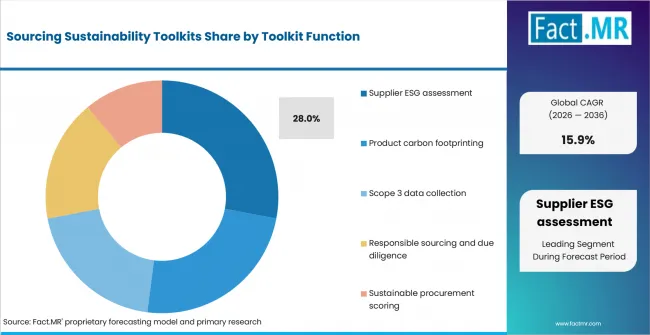
Sourcing Sustainability Toolkits Analysis By Toolkit Function | Source: Fact.MR
Supplier ESG assessment leads because it creates a common entry point for screening many vendors before deeper carbon or human-rights work. A repeatable scorecard helps procurement triage outreach and route higher-risk suppliers into corrective action.
Why does Carbon and climate lead?
Supplier questionnaires: 31.0% share in 2026.
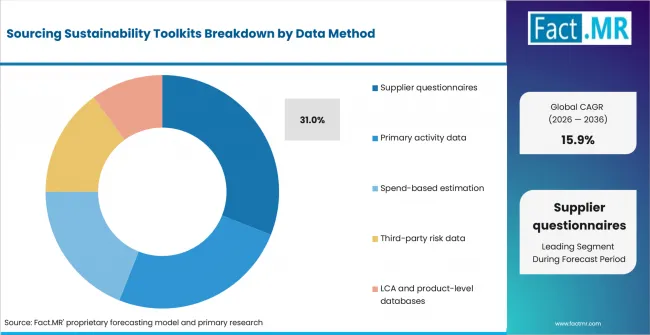
Sourcing Sustainability Toolkits Analysis By Data Method | Source: Fact.MR
Carbon and climate leads because companies need supplier information for Scope 3 inventories, product footprints and decarbonization plans. Carbon also has a more developed base of factors and target-setting practices than several nature-related domains.
Which Data Method remains most widely used?
Carbon and climate: 31.0% share in 2026.
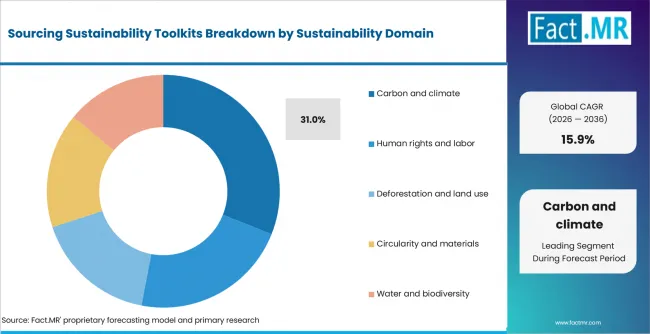
Sourcing Sustainability Toolkits Analysis By Sustainability Domain | Source: Fact.MR
Supplier questionnaires remain the largest method because they can reach broad supply bases at manageable cost and capture policy, process and activity information in one workflow. Their limitation is verification, which creates demand for risk feeds and primary activity evidence.
Why are Procurement teams the leading User?
Procurement teams: 38.0% share in 2026.
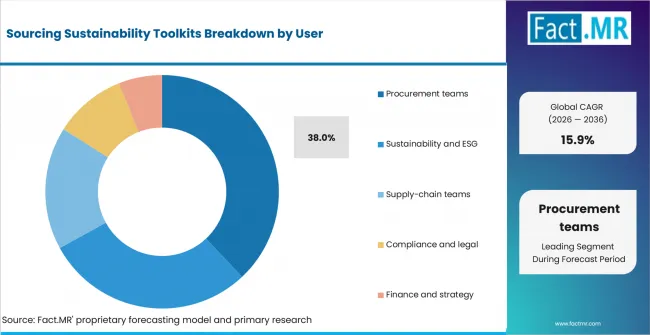
Sourcing Sustainability Toolkits Analysis By User | Source: Fact.MR
Procurement teams lead because they control onboarding, sourcing events, contracts and supplier follow-up. Sustainability specialists define requirements, but procurement determines whether a score changes a commercial decision or remains a reporting artifact.
What is accelerating Sourcing Sustainability Toolkits Market adoption, and what is holding it back?
Adoption is accelerating as supplier sustainability claims face legal, customer and assurance scrutiny. The main constraints are questionnaire fatigue, uncertain primary information, changing regulatory scope and poor linkage between ESG scores and sourcing decisions.
Drivers Impact Analysis
| DRIVER | (~) % IMPACT ON CAGR | GEOGRAPHIC RELEVANCE | IMPACT TIMELINE |
|---|---|---|---|
| Mandatory supply-chain due diligence | +2.0% | France, Germany, UK, EU | Short term (<= 2 years) |
| Scope 3 and product-footprint programs | +1.5% | Global large enterprises | Medium term (2-4 years) |
| Forced-labor import traceability | +1.1% | USA, Europe | Short term (<= 2 years) |
| Sustainability criteria in sourcing events | +0.8% | Global | Long term (>= 4 years) |
- Mandatory supply-chain due diligence: Covered companies need documented risk identification, prevention, mitigation and complaint processes across suppliers.
- Scope 3 and product-footprint programs: Procurement teams must collect supplier-specific activity information to replace broad spend estimates.
- Forced-labor import traceability: Entity, site and shipment evidence becomes commercially important when authorities can detain goods.
Opportunity Impact Analysis
| OPPORTUNITY | (~) % IMPACT ON CAGR | GEOGRAPHIC RELEVANCE | IMPACT TIMELINE |
|---|---|---|---|
| Primary supplier carbon collection | +1.2% | Europe, USA | Short term (<= 2 years) |
| Shared corrective-action networks | +0.9% | Global multi-buyer supply chains | Medium term (2-4 years) |
| Nature and deforestation evidence | +0.7% | Europe, consumer supply chains | Long term (>= 4 years) |
- Primary supplier carbon collection: Guided calculation, factor libraries and quality checks can move buyers beyond spend-based Scope 3 estimates.
- Shared corrective-action networks: Suppliers can answer once and maintain a reusable evidence record across authorized customers, reducing fatigue.
- Nature and deforestation evidence: Toolkits can extend established supplier identity and geolocation workflows into land-use and biodiversity risk.
Restraints Impact Analysis
| RESTRAINT | (~) % IMPACT ON CAGR | GEOGRAPHIC RELEVANCE | IMPACT TIMELINE |
|---|---|---|---|
| Supplier questionnaire fatigue | -0.9% | Global | Short term (<= 2 years) |
| Low assurance of self-reported information | -0.7% | Global | Medium term (2-4 years) |
| Changing regulatory thresholds and timing | -0.6% | Europe | Long term (>= 4 years) |
- Supplier questionnaire fatigue: Vendors face overlapping requests from many customers and may provide incomplete or stale responses.
- Low assurance of self-reported information: Scores lose decision value when claims cannot be tied to documents, sites, activity measures or third-party checks.
- Changing regulatory thresholds and timing: Buyers may postpone broad rollouts when covered entities, phase-in dates or required evidence remain under revision.
Which countries are scaling the Sourcing Sustainability Toolkits Market through 2036?
- France turns corporate vigilance into a cross-functional workflow linking legal ownership with supplier remediation.
- The Netherlands needs international evidence exchange because trading and logistics networks extend far beyond domestic suppliers.
- The UK gives weak supplier controls a procurement consequence in addition to a disclosure consequence.
- The USA emphasizes shipment and entity traceability, rewarding tools that link sourcing records with admissibility evidence.
- Germany's early compliance base shifts spending toward better evidence quality and integration rather than first-wave screening.
Regulatory coverage, supplier-network depth, evidence quality and procurement integration determine how quickly each country converts compliance pressure into toolkit spending. Regional coverage includes North America, Latin America, Western Europe, Eastern Europe, East Asia, South Asia & Pacific, Middle East & Africa.
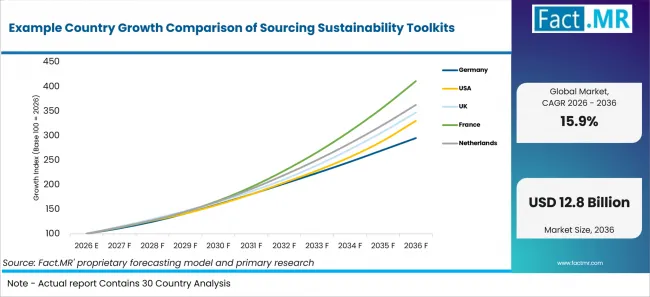
Example Country Growth Comparison Of Sourcing Sustainability Toolkits | Source: Fact.MR
| Country | CAGR (2026-2036) |
|---|---|
| Germany | 11.4% |
| USA | 12.7% |
| UK | 13.3% |
| France | 15.2% |
| Netherlands | 13.7% |
Why is Germany's growth disciplined?
11.4% CAGR, supported by formal due diligence within a comparatively mature supplier-management base.
Germany's Supply Chain Due Diligence Act has required covered companies to establish risk-management and complaint procedures since 2023. That mandate created an early installed base, so the next phase is less about first-time screening and more about improving supplier evidence, remediation workflows and interoperability. Mature industrial procurement systems also make implementation exacting, which moderates the displayed growth rate.
What creates the USA demand signal?
12.7% CAGR, shaped by forced-labor enforcement and enterprise Scope 3 programs.
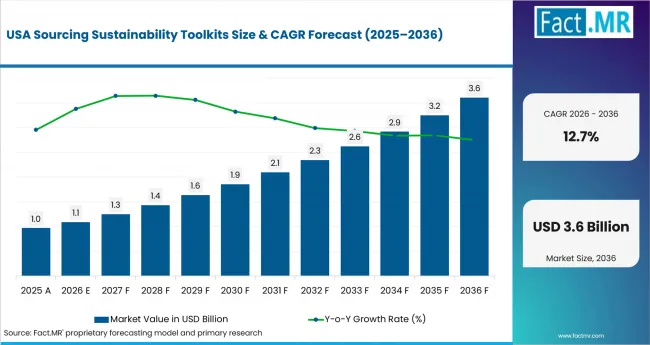
Sourcing Sustainability Toolkits Country Value Analysis | Source: Fact.MR
U.S. importers need traceability that can withstand detention and document requests, particularly under the Uyghur Forced Labor Prevention Act. U.S. Customs and Border Protection guidance emphasizes due diligence, effective supply-chain tracing and supply-chain management. Toolkits gain value when they connect supplier identity and shipment evidence with procurement decisions instead of operating only as annual questionnaires.
How is the UK converting disclosure into procurement practice?
13.3% CAGR, supported by modern-slavery reporting and public-procurement scrutiny.
The UK's Section 54 framework keeps supply-chain transparency on executive agendas for commercial organizations above the relevant turnover threshold. Home Office guidance updated in December 2025 adds practical emphasis to mapping, risk assessment and action. Procurement Act exclusion risk raises the commercial consequence of weak supplier controls, supporting systems that preserve evidence from onboarding through remediation.
What is supporting France's 15.2% CAGR through 2036?
15.2% CAGR, driven by vigilance-plan duties and demand for operational evidence.
France's 2017 Duty of Vigilance law requires large companies to establish reasonable measures for identifying and preventing serious human-rights and environmental harm. The market is moving from narrative plans toward traceable supplier actions, grievance follow-up and environmental metrics. This creates room for toolkits that connect legal ownership with category-level purchasing and supplier engagement.
What distinguishes the Netherlands opportunity?
13.7% CAGR, supported by trade exposure and EU reporting-driven supplier engagement.
Dutch companies manage outward-facing supplier networks through major logistics and trading hubs, making upstream evidence a practical operating need. EU sustainability reporting and due diligence expectations encourage structured engagement even as national implementation timetables evolve. Buyers favor tools that can combine questionnaires with product footprints, sector agreements and corrective-action tracking across international suppliers.
Who leads the Sourcing Sustainability Toolkits Market?
EcoVadis, Sedex, IntegrityNext, Assent, SAP and Coupa.
EcoVadis leads the competitive discussion through sustainability ratings, scorecards and supplier carbon engagement. Its network position helps large buyers assess broad supply bases and reuse recognized assessment structures.
Sedex brings a membership and supplier-site network focused on responsible sourcing, labor and risk management. The platform connects screening, questionnaires, audits and corrective actions for organizations that need site-level social evidence.
IntegrityNext and Assent focus on automated supplier outreach, regulatory workflows and product or supply-chain compliance. IntegrityNext spans European due-diligence and reporting needs, while Assent is strong in complex manufacturing supply chains.
SAP and Coupa can embed sustainability information inside enterprise spending and procurement execution. Their advantage is proximity to supplier masters, purchase decisions and category workflows rather than a stand-alone assessment experience.
Competition turns on supplier participation, evidence quality and integration depth. Buyers increasingly test whether a tool can explain its score, preserve an audit trail and route a material risk to an accountable commercial owner.
Which companies are the key providers?
Key companies include EcoVadis; Sedex; IntegrityNext; Assent; SAP; Coupa.
- EcoVadis
- Sedex
- IntegrityNext
- Assent
- SAP
- Coupa
Bibliography
- European Commission. (2025, February 26). Corporate sustainability due diligence and Omnibus proposal materials.
- Federal Office for Economic Affairs and Export Control. (2026). German Supply Chain Due Diligence Act overview.
- Home Office. (2025, December 1). Transparency in supply chains: Practical guide. UK Government.
- U.S. Customs and Border Protection. (2026). Uyghur Forced Labor Prevention Act frequently asked questions and importer guidance.
- French Republic. (2017, March 27). Law No. 2017-399 on the duty of vigilance of parent companies and ordering companies.
- Direction générale du Trésor. (2025, December 23). OECD tools for operational due diligence.
- Social and Economic Council of the Netherlands. (2026). Meaningful stakeholder engagement and due diligence guidance.
- EcoVadis. (2026). Sustainability ratings and Carbon Action Manager.
- Sedex. (2026). Supply-chain sustainability platform.
- IntegrityNext. (2026). Supply-chain sustainability and due-diligence platform.
- Assent. (2025, March 4). Sustainability platform launch.
- SAP. (2026). Sustainability Footprint Management.
- Coupa. (2025, September 2). Sustainability information in spend and supply decisions.
This Report Answers
- The report explains how sourcing sustainability toolkits demand is distributed across Toolkit Function, Sustainability Domain, Data Method and User.
- Segment analysis identifies the 2026 leaders and explains their purchase logic: Toolkit Function: Supplier ESG assessment at 28.0%; Sustainability Domain: Carbon and climate at 31.0%; Data Method: Supplier questionnaires at 31.0%; User: Procurement teams at 38.0%.
- Country analysis tests Germany, USA, UK, France and Netherlands against differences in regulatory coverage, supplier-network depth, evidence quality and procurement integration.
- Competitive analysis reviews current positions for EcoVadis, Sedex, IntegrityNext, Assent, SAP and Coupa.
- Application analysis tests mandatory supply-chain due diligence against the limiting effect of supplier questionnaire fatigue.
What does the Sourcing Sustainability Toolkits Market cover?
Software toolkits and associated network services used to assess supplier ESG performance, collect footprint information, conduct sourcing due diligence and apply sustainability criteria to procurement decisions.
Adjacent Fact.MR coverage includes supplier management, supplier quality management applications, and carbon footprint management, which clarify neighboring demand pools without being counted in this market.
What is included in the scope?
The scope includes supplier ESG assessment, product carbon footprinting, Scope 3 collection, responsible-sourcing due diligence and sustainable procurement scoring. Commercial subscriptions, assessment fees and bundled supplier-network services are included.
The boundary also considers digital decarbonization solutions and artificial intelligence in supply chains where those markets influence purchase timing but remain separately valued.
Coverage spans carbon, labor and human rights, deforestation, circularity, water and biodiversity. Questionnaires, primary activity information, spend estimates, third-party risk feeds and lifecycle databases are included when used inside a sourcing workflow.
What is excluded from the scope?
The scope excludes general financial supplier management, stand-alone audit firms, carbon credits and consulting engagements without a reusable software toolkit. Corporate reporting software is excluded when it lacks supplier or sourcing functionality.
Trade finance, procurement transaction value and supplier remediation spending are not counted. Public registries and free assessment checklists remain outside the commercial market value.
How Was the Analysis Built?
The analysis draws on 120+ sources, 35+ company portfolios, 25+ countries, and more than 20 industry interviews.
- Primary Research: Interviews cover manufacturers, technology developers, integrators, channel partners, end users and subject-matter experts relevant to this market. Discussions test purchase triggers, specification tradeoffs, implementation barriers, supplier positioning and the conditions required for wider commercial adoption.
- Desk Research: Research covers government statistics, regulatory publications, standards, company announcements, technical studies, trade information and industry associations. Published claims used in the analysis are documented in the bibliography.
- Market Sizing and Forecasting: Sizing reconciles enterprise subscriptions, supplier-network fees, assessment volumes, module attachment and service components by user and domain. Forecasts test regulatory coverage, Scope 3 maturity, supplier participation, assurance demand, procurement integration and cross-border traceability requirements.
- Data Validation and Update Cycle: Findings are triangulated across interviews, public evidence, company activity, policy changes, trade patterns and implementation signals. Updates review product launches, capacity shifts, partnerships, approvals, procurement behavior and material changes in commercial adoption.
What is the report's scope and coverage?
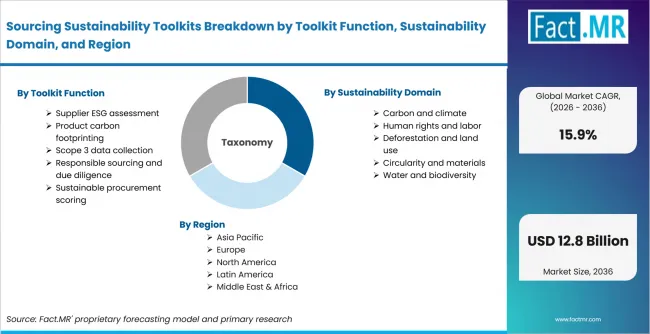
Sourcing Sustainability Toolkits Breakdown By Toolkit Function, Sustainability Domain, And Region | Source: Fact.MR
| Attribute | Details |
|---|---|
| Quantitative Units | USD 2.9 billion in 2026 to USD 12.8 billion by 2036 at a 15.9% CAGR |
| Market Definition | Software toolkits and associated network services used to assess supplier ESG performance, collect footprint information, conduct sourcing due diligence and apply sustainability criteria to procurement decisions. |
| Toolkit Function | Supplier ESG assessment; Product carbon footprinting; Scope 3 data collection; Responsible sourcing and due diligence; Sustainable procurement scoring |
| Sustainability Domain | Carbon and climate; Human rights and labor; Deforestation and land use; Circularity and materials; Water and biodiversity |
| Data Method | Supplier questionnaires; Primary activity data; Spend-based estimation; Third-party risk data; LCA and product-level databases |
| User | Procurement teams; Sustainability and ESG; Supply-chain teams; Compliance and legal; Finance and strategy |
| Regions Covered | North America; Latin America; Western Europe; Eastern Europe; East Asia; South Asia & Pacific; Middle East & Africa |
| Countries Covered | Germany; USA; UK; France; Netherlands |
| Key Companies | EcoVadis; Sedex; IntegrityNext; Assent; SAP; Coupa |
| Forecast Period | 2026 to 2036 |
| Approach | Sizing reconciles enterprise subscriptions, supplier-network fees, assessment volumes, module attachment and service components by user and domain. Forecasts test regulatory coverage, Scope 3 maturity, supplier participation, assurance demand, procurement integration and cross-border traceability requirements. |
How is the market segmented?
-
By Toolkit Function
- Supplier ESG assessment
- Product carbon footprinting
- Scope 3 data collection
- Responsible sourcing and due diligence
- Sustainable procurement scoring
-
By Sustainability Domain
- Carbon and climate
- Human rights and labor
- Deforestation and land use
- Circularity and materials
- Water and biodiversity
-
By Data Method
- Supplier questionnaires
- Primary activity data
- Spend-based estimation
- Third-party risk data
- LCA and product-level databases
-
By User
- Procurement teams
- Sustainability and ESG
- Supply-chain teams
- Compliance and legal
- Finance and strategy
-
By Region
- North America
- Latin America
- Western Europe
- Eastern Europe
- East Asia
- South Asia & Pacific
- Middle East & Africa