- Market Value (2025): USD 12.0 Bn
- Estimated Value (2026): USD 13.1 Bn
- Forecast Value (2036): USD 32.2 Bn
- CAGR (2026-2036): 9.4%
What is the Sovereign MILSATCOM Platforms Market forecast to be worth by 2036?
USD 13.1 billion in 2026 to USD 32.2 billion by 2036 at a 9.4% CAGR.
- As per Fact.MR analysis, the Sovereign MILSATCOM Platforms Market reached USD 12.0 billion in 2025.
- Demand is projected to increase from USD 13.1 billion in 2026 to USD 32.2 billion by 2036.
- The market is forecast to record a 9.4% CAGR from 2026 to 2036 as defence ministries expand protected national links and resilient allied links.
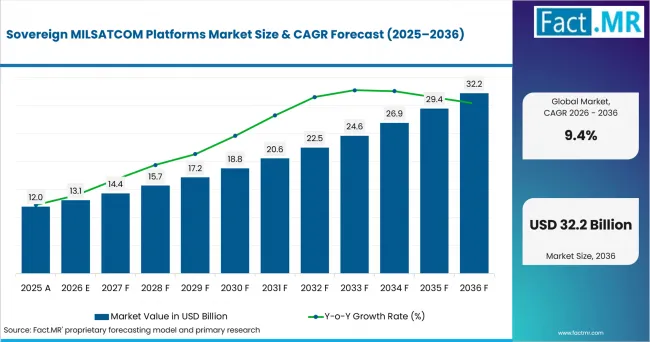
Sovereign Milsatcom Platforms Market Value Analysis | Source: Fact.MR
What are the defining numbers behind Sovereign MILSATCOM Platforms Market growth?
According to Fact.MR analysis, an absolute opportunity of USD 19.1 billion is projected between 2026 and 2036.
- Demand Drivers in the Market
- Defence ministries use government-controlled satellite links to keep communication working during signal problems or disruptions.
- Military commands use secure satellite links to protect important voice and data communication from signal interference. In June 2026, U.S. Space Systems Command awarded two PTS-G contracts worth USD 437.7 million [1].
- Land and naval forces use secure satellite links to stay connected over long distances and in areas with signal interference.
- Allied forces use compatible frequencies and systems to communicate with each other while each country keeps control of its own network.
- Key Segments Analyzed
- By Sovereignty Model: National-owned system will hold 30.0% share in 2026 since direct state ownership keeps tasking and security policy under national control.
- By Orbit: GEO will account for 37.0% share in 2026, supported by wide-area coverage and established military ground infrastructure.
- By Protected Payload: X-band will capture 33.0% share in 2026 owing to its use across protected strategic and field communication links.
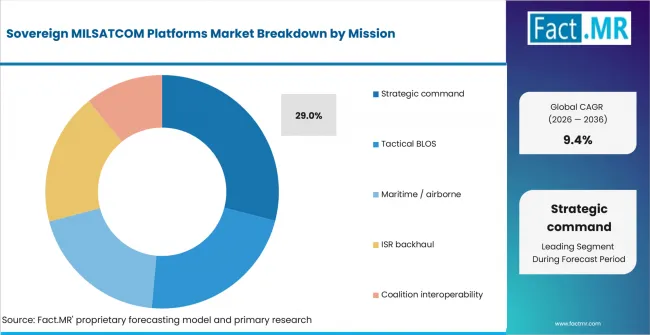
- By Mission: Strategic command will represent 29.0% share in 2026 because defence ministries require assured communication links for national decision-making.
- Analyst Opinion at Fact.MR
- Shambhu Nath Jha, Principal Consultant at Fact.MR, states, “Government control is becoming important for military satellite communication. Defence agencies prefer secure systems that connect with ground systems and allied networks. These systems also protect against signal interference and use different satellite orbits to keep communication working.”
- Strategic Implications
- Defence ministries separate communication that must stay on government-controlled satellites from communication that can use approved commercial satellites during busy periods.
- Satellite makers use software and communication systems that can be updated as security needs change, helping satellites remain useful for longer.
- Ground-system providers plan support for several years. In October 2025, NATO’s NCI Agency listed contractor support for NATO satellite ground stations at an estimated EUR 6.5 million per year for six years [2].
- Terminal suppliers make it easier to connect ships, aircraft, and mobile command centers while keeping communication secure and access controlled.
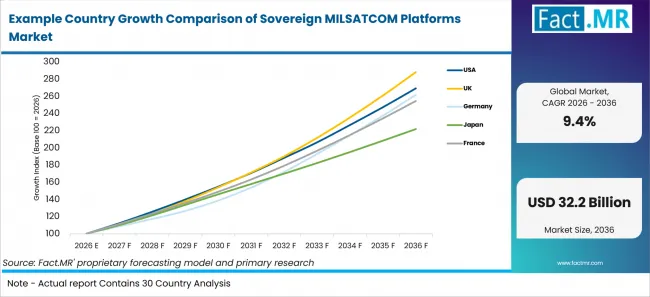
The United Kingdom is expected to grow at 11.2% CAGR through 2036 as SKYNET 6 adds new government-controlled satellite capacity. The USA follows at 10.4% as new secure military satellite systems enter production. Germany reaches 10.1% as spending on national space security increases, while France records 9.8% with the Syracuse IV program. Japan grows at 8.3% as it upgrades its X-band military satellite links.
How does the Sovereign MILSATCOM Platforms Market break down by segment?
National-owned system leads at 30.0%; GEO leads at 37.0%; X-band leads at 33.0%; Strategic command leads at 29.0%.
Which Sovereignty Model dominates?
National-owned system holds 30.0% share in 2026.
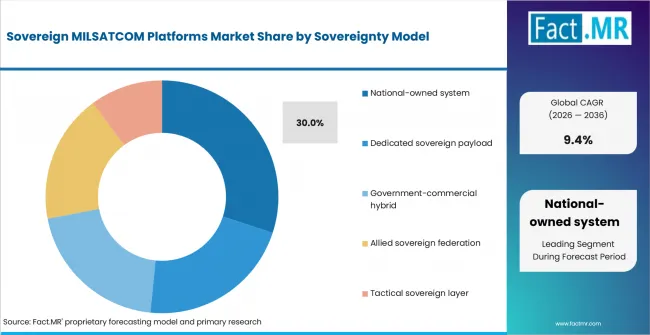
Sovereign Milsatcom Platforms Market Analysis By Sovereignty Model | Source: Fact.MR
National-owned systems lead because defence ministries keep direct control over satellite use and access. Dedicated military satellites and approved commercial services provide extra secure capacity when needed. Allied and tactical networks extend coverage while keeping clear access rules.
What leads the Orbit segment?
GEO accounts for 37.0% share in 2026.
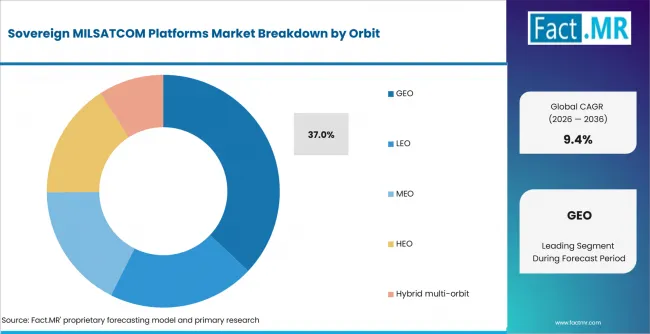
Sovereign Milsatcom Platforms Market Analysis By Orbit | Source: Fact.MR
According to Fact.MR analysis, GEO is projected to lead because it provides wide coverage through existing military ground stations. LEO and MEO provide faster communication, while HEO improves coverage in northern regions.
How does Protected Payload shape demand?
X-band captures 33.0% share in 2026.
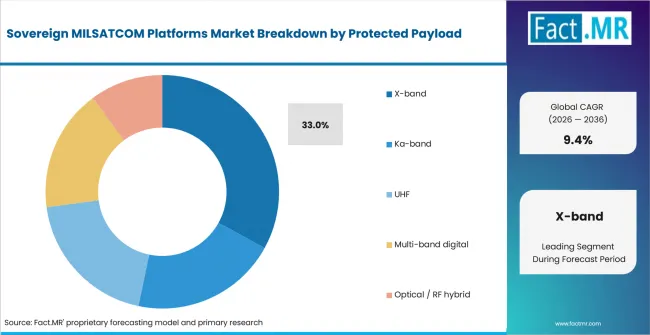
Sovereign Milsatcom Platforms Market Analysis By Protected Payload | Source: Fact.MR
X-band is anticipated to lead because military networks use it for secure communication between command centers and field forces. Ka-band provides more communication capacity, while UHF supports basic communication for field units. Systems that use several frequency bands give military networks more ways to send secure signals. Satellite design also depends on the military antennas used for communication.
What supports Strategic Command within Mission?
Strategic command represents 29.0% share in 2026.
Sovereign Milsatcom Platforms Market Analysis By Mission | Source: Fact.MR
As per Fact.MR analysis, strategic command is expected to lead because government-controlled military satellites keep important national communication secure over long distances. Tactical satellite links connect forces beyond the range of ground radio, while mobile satellite systems keep ships, aircraft, and vehicles connected while moving.
What is accelerating Sovereign MILSATCOM Platforms Market adoption, and what is holding it back?
Secure military communication increases demand, while long approval times can delay the use of new systems.
Drivers Impact Analysis
| DRIVER | (~) % IMPACT ON CAGR | GEOGRAPHIC RELEVANCE | IMPACT TIMELINE |
|---|---|---|---|
| Protected and anti-jam SATCOM | +2.0% | North America, Western Europe | Short term (<= 2 years) |
| Sovereign command and control | +1.6% | Global | Long term (>= 4 years) |
| Multi-orbit resilience | +1.2% | North America, Western Europe, East Asia | Medium term (2-4 years) |
| Allied interoperability | +0.9% | NATO, Indo-Pacific | Medium term (2-4 years) |
| Higher data-rate missions | +0.7% | Global | Long term (>= 4 years) |
Opportunity Impact Analysis
| OPPORTUNITY | (~) % IMPACT ON CAGR | GEOGRAPHIC RELEVANCE | IMPACT TIMELINE |
|---|---|---|---|
| Hybrid sovereign-commercial architecture | +1.1% | Western Europe, North America | Medium term (2-4 years) |
| Protected multi-band payloads | +0.9% | Global | Long term (>= 4 years) |
| Software-upgradeable security | +0.7% | North America, Europe | Medium term (2-4 years) |
| Mobile and platform terminals | +0.5% | Global | Short term (<= 2 years) |
Restraints Impact Analysis
| RESTRAINT | (~) % IMPACT ON CAGR | GEOGRAPHIC RELEVANCE | IMPACT TIMELINE |
|---|---|---|---|
| Long acquisition and qualification cycles | -1.0% | Global | Long term (>= 4 years) |
| High sovereign system cost | -0.8% | Global | Long term (>= 4 years) |
| Spectrum and interoperability complexity | -0.6% | Global | Medium term (2-4 years) |
| Launch and ground-segment dependencies | -0.4% | Global | Short term (<= 2 years) |
Which countries are scaling the Sovereign MILSATCOM Platforms Market through 2036?
- The United Kingdom is projected to stay 0.8 percentage points above the USA as SKYNET 6 renews national defence links.
- The USA is expected to remain 0.3 percentage points above Germany as protected tactical SATCOM moves into production.
- Germany is anticipated to remain 0.3 percentage points above France as secure military space investment expands.
- France is estimated to stay 1.5 percentage points above Japan as Syracuse IV supports protected X/Ka-band links.
- Japan closes the displayed range at 8.3% as the next X-band defence communications satellite moves forward.
Comparable CAGRs create different entry conditions because national control models and satellite renewal cycles vary by country. Full report coverage includes North America, Latin America, Western Europe, Eastern Europe, East Asia, South Asia & Pacific, Middle East & Africa.
Example Country Growth Comparison Of Sovereign Milsatcom Platforms Market | Source: Fact.MR
| Country | CAGR (2026-2036) |
|---|---|
| United Kingdom | 11.2% |
| USA | 10.4% |
| Germany | 10.1% |
| France | 9.8% |
| Japan | 8.3% |
What supports United Kingdom adoption?
11.2% CAGR, supported by SKYNET 6 renewal and protected national capacity.
The UK is expected to record at 11.2% CAGR as SKYNET 6 upgrades government-controlled military satellite communication. More secure communication capacity and better digital systems help military forces and allied missions stay connected.
How is the USA scaling sovereign MILSATCOM demand?
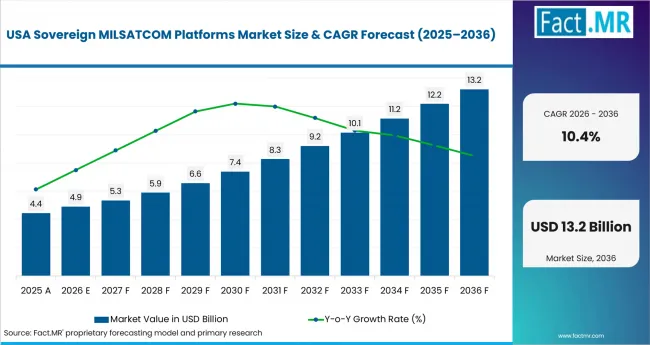
10.4% CAGR, driven by protected tactical and narrowband SATCOM renewal.
Sovereign Milsatcom Platforms Market Country Value Analysis | Source: Fact.MR
U.S. demand is projected to advance at 10.4% CAGR as secure military satellite networks are upgraded. In June 2026, Space Systems Command awarded a USD 2.0 billion contract for two additional MUOS satellites [3]. These satellites provide secure voice and data communication for U.S. and allied forces.
What supports Germany’s outlook?
10.1% CAGR, shaped by national space security investment and secure defence links.
Germany is anticipated to post 10.1% CAGR as the Bundeswehr expands its national military space systems. In October 2025, the Bundeswehr stated that around EUR 35 billion would be invested in space projects and a space security architecture through 2030 [4]. This investment supports the use of secure and reliable military satellite communication.
How is France developing demand?
9.8% CAGR, supported by Syracuse IV and protected X/Ka-band links.
France is estimated to record 9.8% CAGR as Syracuse IV supports government-controlled military satellite communication. In June 2026, the Ministry of Armed Forces stated that up to 380 ground stations are planned for Syracuse 4B across the three armed forces [5]. The system provides secure X-band and Ka-band communication for military users.
What underpins Japan’s growth?
8.3% CAGR, supported by renewal of X-band defence SATCOM.
Japan is forecast to record at 8.3% CAGR as the Ministry of Defense upgrades its X-band military satellite network. In February 2026, the ministry announced a JPY 123.53 billion contract for the satellite that will replace Kirameki-2 [6]. The new satellite is planned to reduce signal interference and handle higher communication needs.
Who leads the Sovereign MILSATCOM Platforms Market?
Lockheed Martin and Northrop Grumman lead protected U.S. coverage, while Airbus Defence and Space and Thales Alenia Space strengthen European sovereign programs.
Lockheed Martin and Northrop Grumman work on secure U.S. military satellite communication systems. In February 2025, Lockheed Martin completed an Early Design Review for its MUOS Service Life Extension satellite. Northrop Grumman provides secure military satellite equipment and supports communication in polar regions through the Enhanced Polar System and EPS-R.
Airbus Defence and Space supports European military satellite programs such as Skynet and SATCOMBw. Thales Alenia Space provides secure satellites, ground systems, and communication networks for programs such as France’s Syracuse IV. Viasat is developing a dual-band mini-GEO system for secure military communication.
Buyers compare communication security, support for different frequency bands, protection from signal interference, and connection with existing ground systems and networks.
Which companies are the key providers?
Key companies include Lockheed Martin; Northrop Grumman; Boeing; Viasat; Thales Alenia Space; and Airbus Defence and Space.
- Lockheed Martin
- Northrop Grumman
- Boeing
- Viasat
- Thales Alenia Space
- Airbus Defence and Space
Bibliography
- [1] Space Systems Command. (2026, June 9). U.S. Space Force advances satellite communications modernization, awards contracts for first global protected tactical constellation.
- [2] NATO Communications and Information Agency. (2025, October 27). Contractor Logistic Support (CLS) for NATO Satellite Ground Stations.
- [3] Space Systems Command. (2026, June 24). Space Force extends MUOS constellation to support worldwide tactical communications with procurement of two satellites.
- [4] Bundeswehr. (2025, October 8). Weltraumschutz – Unverzichtbar für eine Gesellschaft in Sicherheit.
- [5] Ministère des Armées et des Anciens combattants. (2026, May 23). Military telecommunications satellite Syracuse 4B.
- [6] Ministry of Defense, Japan. (2026, February 6). [Progress on the development of next-generation defense satellite communications].
- [7] Lockheed Martin. (2025, February 7). Lockheed Martin matures next secure communications satellite solution for U.S. Space Force with major design milestone.
- [8] Ministry of Defense, Japan. (2025, December 26). Progress and Budget in Fundamental Reinforcement of Defense Capabilities: Overview of FY2026 Budget.
- [9] Airbus. (2025, May 20). Airbus next-generation Skynet satellite reaches major milestone
This Report Addresses
- The report explains sovereign MILSATCOM by sovereignty model, orbit, secure payload and mission.
- Segment analysis covers the 2026 leaders: National-owned system, GEO, X-band and Strategic command.
- Country analysis compares the United Kingdom, USA, Germany, France and Japan through national SATCOM programs.
- Competitive analysis covers Lockheed Martin, Northrop Grumman, Boeing, Viasat, Thales Alenia Space and Airbus Defence and Space.
- Technology analysis covers X-band, Ka-band, UHF, multi-band digital payloads and optical / RF hybrid links.
- Mission analysis covers strategic command, tactical BLOS, mobile links, ISR backhaul and allied use.
What does the Sovereign MILSATCOM Platforms Market cover?
National-owned systems, protected payloads, hybrid networks and allied sovereign capacity used for military SATCOM.
As per Fact.MR analysis, the market covers state-controlled MILSATCOM used for strategic command, tactical BLOS, mobile links, ISR backhaul and allied missions. Coverage includes GEO, LEO, MEO, HEO and hybrid multi-orbit networks.
The assessment covers defence missions that need sovereign authority or secure access. Commercial bandwidth is included when it forms part of a state-controlled hybrid MILSATCOM network.
What is included in the scope?
Sovereign MILSATCOM systems used by defence ministries, armed forces and approved allied networks.
The scope includes national-owned platforms, dedicated sovereign payloads, government-commercial hybrids and allied sovereign systems. It covers GEO, LEO, MEO, HEO and hybrid multi-orbit designs. Payload coverage includes X-band, Ka-band, UHF and multi-band digital links.
What is excluded from the scope?
Civilian broadband services and standalone commercial terminals outside sovereign military SATCOM networks are outside the scope.
The scope leaves out ordinary civilian satellite services and unrelated defence spacecraft. Commercial terminals are covered only when they are part of a sovereign defence SATCOM network.
How Was the Analysis Built?
The analysis draws on 120+ sources, 35+ company portfolios, 25+ countries, and more than 20 industry interviews.
- Primary Research: Primary research includes discussions with manufacturers, service providers, technology developers, distributors, end users, and subject-matter experts. These conversations examine purchasing priorities, product adoption, operational challenges, approval requirements, competitive positioning, and the factors that influence wider market acceptance.
- Desk Research: Desk research covers government statistics, regulatory publications, company filings, trade data, technical studies, industry associations, standards, public policy, and other authoritative sources. Every source used in the analysis is documented in the bibliography.
- Market Sizing and Forecasting: Market estimates combine historical performance, demand indicators, pricing and volume trends, segment shares, company participation, country-level growth, adoption patterns, investment activity, and barriers to market expansion.
- Data Validation and Update Cycle: Findings are validated by comparing primary interviews with public data, company activity, regulatory changes, trade patterns, and industry developments. Regular updates review new product launches, capacity changes, partnerships, approvals, and shifts in commercial adoption.
What is the report’s scope and coverage?
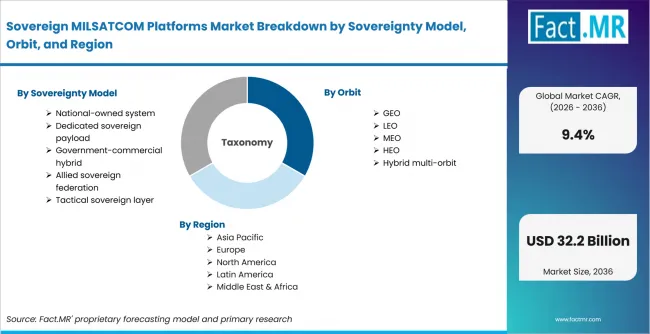
Sovereign Milsatcom Platforms Market Breakdown By Sovereignty Model, Orbit, And Region | Source: Fact.MR
| Attribute | Details |
|---|---|
| Quantitative Units | USD billion |
| Market Definition | Sovereign military satellite communication platforms and controlled capacity used by defence ministries and armed forces for protected strategic and tactical communications. |
| Sovereignty Model | National-owned system; Dedicated sovereign payload; Government-commercial hybrid; Allied sovereign federation; Tactical sovereign layer |
| Orbit | GEO; LEO; MEO; HEO; Hybrid multi-orbit |
| Protected Payload | X-band; Ka-band; UHF; Multi-band digital; Optical / RF hybrid |
| Mission | Strategic command; Tactical BLOS; Maritime / airborne; ISR backhaul; Coalition interoperability |
| Regions Covered | North America; Latin America; Western Europe; Eastern Europe; East Asia; South Asia & Pacific; Middle East & Africa |
| Countries Covered | United Kingdom; USA; Germany; France; Japan |
| Key Companies Profiled | Lockheed Martin; Northrop Grumman; Boeing; Viasat; Thales Alenia Space; Airbus Defence and Space |
| Forecast Period | 2026 to 2036 |
| Approach | Hybrid top-down and bottom-up approach using sovereign SATCOM program activity, protected payload mix, mission requirements, country modernization and provider portfolio review. |
How is the market segmented?
-
By Sovereignty Model:
- National-owned system
- Dedicated sovereign payload
- Government-commercial hybrid
- Allied sovereign federation
- Tactical sovereign layer
-
By Orbit:
- GEO
- LEO
- MEO
- HEO
- Hybrid multi-orbit
-
By Protected Payload:
- X-band
- Ka-band
- UHF
- Multi-band digital
- Optical / RF hybrid
-
By Mission:
- Strategic command
- Tactical BLOS
- Maritime / airborne
- ISR backhaul
- allied compatibility
-
By Region:
- North America
- Latin America
- Western Europe
- Eastern Europe
- East Asia
- South Asia & Pacific
- Middle East & Africa