- Base Value(2025): 8.6 Bn
- Forecast Value (2036): 200.0 Bn
- CAGR (2036): 33.0%
Sovereign AI Enablement Services Market Size, Market Forecast and Outlook by Fact.MR
- The sovereign AI enablement services market was valued at USD 8.6 billion in 2025.
- Demand is expected to increase from USD 11.5 billion in 2026 to USD 200.0 billion by 2036.
- The market is forecast to record 33.0% CAGR from 2026 to 2036 as governments treat AI compute and national models as strategic infrastructure.
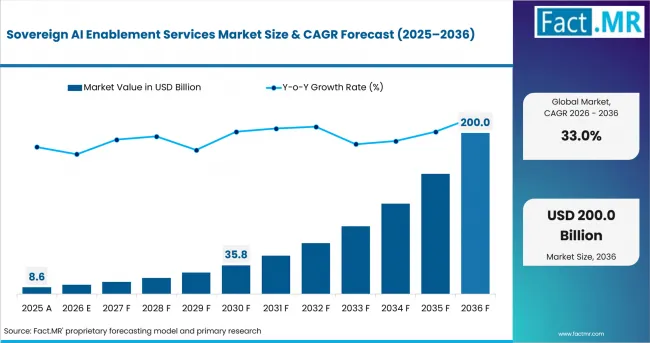
Sovereign Ai Enablement Services Market Value Analysis | Source: Fact.MR
| Metric | Details |
|---|---|
| Market Size in 2026 | USD 11.5 billion |
| Market Forecast in 2036 | USD 200.0 billion |
| CAGR 2026 to 2036 | 33.0% |
Source: Fact.MR analysis. Updated Jun 19, 2026
Summary of Sovereign AI Enablement Services Market
- Demand Drivers in the Market
- Digital government program directors need domestic AI infrastructure before placing public services on generative AI systems.
- National cloud architecture heads need trusted compute that supports data-residency policy.
- Critical infrastructure operators need local AI stacks that reduce exposure to external platform control.
- Public-sector AI teams need local-language models that reflect national service and citizen communication needs.
- Key Segments Analyzed
- By Service Type: Sovereign GPU Cloud Build-Out is expected to hold 41.0% share in 2026 because compute capacity forms the first spending layer.
- By Stack Layer: Compute and Cloud Infrastructure lead because AI factories need GPU capacity first. The segment is projected to capture 46.0% share in 2026.
- By Customer Type: National Governments are expected to account for 48.0% share in 2026 because sovereign AI programs start through public funding.
- By Delivery Model: Public-Private AI Factory Partnerships hold 39.0% share in 2026 as governments combine policy control with private compute expertise.
- By End Use: Government AI Services are expected to capture 35.0% share in 2026 because public administration creates early national AI demand.
- By Geography: Saudi Arabia is projected to grow at 38.5% CAGR through 2036 as HUMAIN-led sovereign AI build-out gives the country a strong program base.
- Analyst Opinion at Fact.MR
- Shambhu Nath Jha, Senior Analyst at Fact.MR, states, “Sovereign AI enablement will become a strategic infrastructure market. Governments will not see AI only as software adoption. They will need compute capacity and national model capability that can support public services and critical sectors.”
- Strategic Implications
- Governments should define AI stack ownership before signing large cloud and GPU contracts.
- Public cloud operators need sovereign control features to win national AI work.
- Critical infrastructure operators should align AI systems with data-residency architecture.
- Model developers need local-language training plans before entering national AI programs.
Services that build nation- and sector-controlled AI stacks - sovereign GPU clouds and government AI factories. NVIDIA defines sovereign AI as a nation’s capability to produce AI using its own infrastructure, data, workforce and business networks. [1] This turns AI enablement into a national infrastructure service line. Saudi Arabia’s PIF launched HUMAIN in May 2025 to build an AI stack covering data centers, cloud infrastructure, models and applications. [2]
Saudi Arabia is expected to record 38.5% CAGR by 2036 as HUMAIN-led infrastructure and Arabic model work scale. The United Arab Emirates is likely to post 37.2% CAGR as Core42 / G42 builds sovereign AI and cloud capabilities. South Korea is set to advance at 35.8% CAGR as national AI factories expand. Japan is projected to grow at 34.6% CAGR from 2026 to 2036 as GENIAC-style compute support continues. Germany is forecast to record 33.4% CAGR as EU AI Factories and sovereign cloud demand support local AI stacks.
Segmental Analysis
Sovereign AI Enablement Services Market Analysis by Service Type
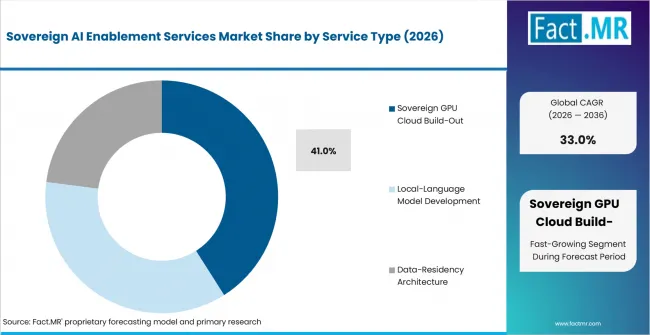
Sovereign Ai Enablement Services Market Analysis By Service Type | Source: Fact.MR
Sovereign GPU Cloud Build-Out is expected to dominate with 41.0% share in 2026. The segment leads because compute capacity is the first major spending layer for national AI programs. Governments need secure GPU infrastructure before they can train, host and scale sovereign AI systems. This makes cloud build-out the starting point for wider sovereign AI enablement.
- Sovereign GPU Cloud Build-Out: GPU cloud build-out gives nations controlled capacity for training and inference.
- Local-Language Model Development: Local models support public services in national and regional languages.
- Data-Residency Architecture: Data-residency design keeps sensitive workloads inside approved infrastructure.
Sovereign AI Enablement Services Market Analysis by Stack Layer
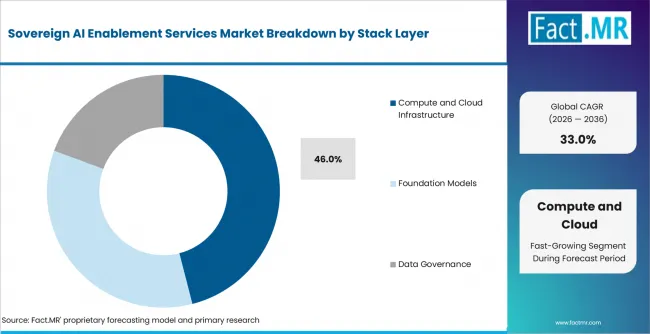
Sovereign Ai Enablement Services Market Analysis By Stack Layer | Source: Fact.MR
Compute and Cloud Infrastructure is expected to dominate with 46.0% share in 2026. The segment leads because AI factories need GPU capacity before model training and deployment can begin. Compute contracts also carry high upfront project value, which gives this segment a stronger revenue position in early sovereign AI programs.
- Compute and Cloud Infrastructure: Compute infrastructure provides the base layer for national AI workloads.
- Foundation Models: Foundation models support local language and sector-specific AI capability.
- Data Governance: Data governance controls how sensitive national data is used in AI systems.
Sovereign AI Enablement Services Market Analysis by Customer Type
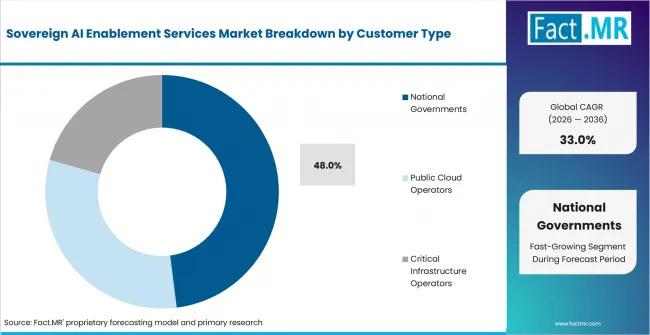
Sovereign Ai Enablement Services Market Analysis By Customer Type | Source: Fact.MR
National Governments are expected to dominate with 48.0% share in 2026. The segment leads because sovereign AI programs usually begin through public funding and national digital strategy. Governments need secure AI infrastructure, domestic compute access and controlled model development before wider public-sector deployment.
- National Governments: Governments fund AI factories and national model programs.
- Public Cloud Operators: Local cloud operators build trusted AI capacity for public-sector users.
- Critical Infrastructure Operators: Critical operators need controlled AI systems for sensitive services.
Sovereign AI Enablement Services Market Analysis by Delivery Model
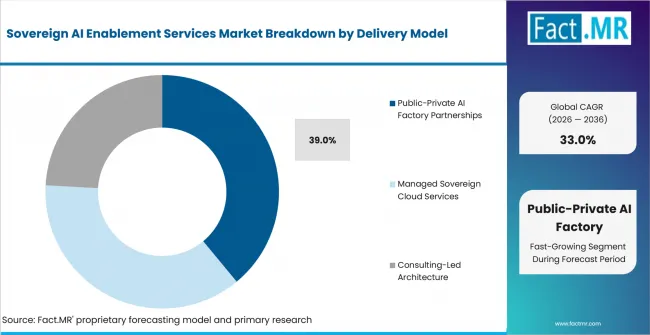
Sovereign Ai Enablement Services Market Analysis By Delivery Model | Source: Fact.MR
Public-Private AI Factory Partnerships are expected to dominate with 39.0% share in 2026. The segment leads because governments need policy control while private partners bring compute expertise and operating capability. These partnerships help countries build AI factories faster while keeping national priorities and infrastructure oversight in focus.
- Public-Private AI Factory Partnerships: Partnerships combine national policy goals with private infrastructure delivery.
- Managed Sovereign Cloud Services: Managed services operate AI clouds under local control rules.
- Joint Venture Build-Out: Joint ventures help countries share ownership and operating risk.
Sovereign AI Enablement Services Market Analysis by End Use
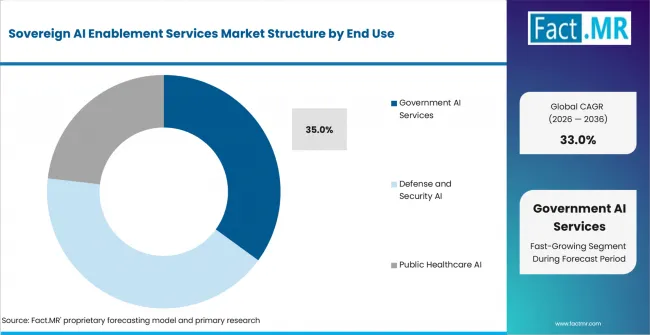
Sovereign Ai Enablement Services Market Analysis By End Use | Source: Fact.MR
Government AI Services are expected to dominate with 35.0% share in 2026. The segment leads because public administration creates the first large demand base for sovereign AI enablement. Governments need controlled AI systems for citizen services and national data use. This makes government AI services an early priority in sovereign AI programs.
- Government AI Services: Public services use sovereign AI for citizen support and administrative workflows.
- Defense and Security AI: Defense AI needs controlled infrastructure and trusted model access.
- Industrial AI Factories: Industrial AI factories support manufacturing and robotics use cases.
Sovereign AI Enablement Services Market Drivers, Restraints, and Opportunities
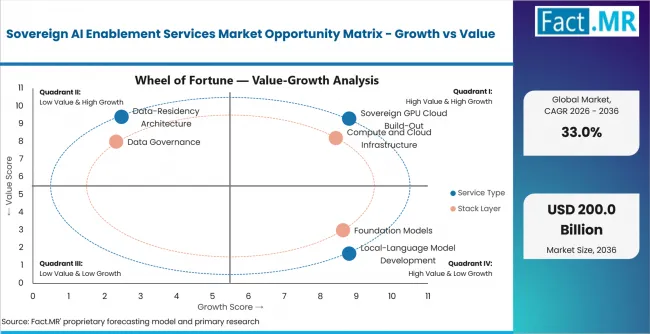
Sovereign Ai Enablement Services Market Opportunity Matrix Growth Vs Value | Source: Fact.MR
The main driver is national control over compute and data. The European Commission’s 2025 AI Continent Action Plan identifies computing infrastructure and data as core pillars for strengthening Europe’s AI position, which supports sovereign AI enablement as a service market tied to strategy and technology delivery [2].
Another driver is public procurement for AI factories. The European Commission’s AI Factories program supports access to AI-optimized supercomputing capacity for startups and researchers. [3] This creates demand for architecture, integration and operations services around national AI facilities.
The main restraint is hardware supply and operating cost. Sovereign AI programs need advanced GPUs and skilled operators. Smaller countries may build policy ambition faster than delivery capacity. Providers must help governments phase projects so early workloads can start before full-stack capability is complete.
Opportunities in the Sovereign AI Enablement Services Market
- AI Factory Program Delivery: Service providers can help governments design AI factories and operating models.
- Local-Language Model Services: Model teams can train and tune systems for national language needs.
- Trusted Cloud Integration: Cloud providers can combine data residency and GPU services for regulated sectors.
Regional Analysis
Based on regional analysis, the sovereign AI enablement services market is segmented into Middle East, East Asia, Europe, North America, South Asia and Pacific, Latin America, and Africa.
.webp "Top Country Growth Comparison Sovereign Ai Enablement Services Market Cagr (2026 2036)")
Top Country Growth Comparison Sovereign Ai Enablement Services Market Cagr (2026 2036) | Source: Fact.MR
| Country | CAGR 2026 to 2036 |
|---|---|
| Saudi Arabia | 38.5% |
| United Arab Emirates | 37.2% |
| South Korea | 35.8% |
| Japan | 34.6% |
| Germany | 33.4% |
Source: Fact.MR analysis. Updated Jun 19, 2026
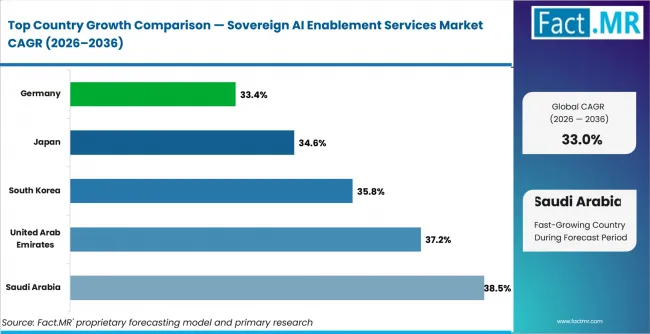
Sovereign Ai Enablement Services Market Cagr Analysis By Country | Source: Fact.MR
Middle East Sovereign AI Enablement Services Market Analysis
Middle East demand is led by Saudi Arabia and the United Arab Emirates. State-backed AI programs and national cloud control create a strong services base for AI factories and local models.
- Saudi Arabia: Saudi Arabia is expected to record 38.5% CAGR through 2036 as HUMAIN-led AI infrastructure moves sovereign AI from strategy into delivery. PIF says HUMAIN was launched in May 2025 to build data centers and applications. This creates demand for AI factory design, GPU operations and Arabic model enablement. Public services and regulated industries will need controlled stacks before using sensitive national data.
- United Arab Emirates: The United Arab Emirates is likely to post 37.2% CAGR by 2036 as Core42 / G42 and related sovereign cloud capabilities support national AI delivery. The country has positioned AI as a strategic economic capability and uses partnerships to extend infrastructure reach. Microsoft and Core42 / G42 expanded their partnership in 2024 to deliver advanced AI solutions through Azure, while supporting UAE sovereignty requirements for public-sector and regulated-industry users [4]. Public-sector and regulated enterprise demand will center on trusted compute and data governance.
East Asia Sovereign AI Enablement Services Market Analysis
East Asia demand is driven by national compute programs and local-language AI capability. South Korea and Japan show strong activity through GPU infrastructure and public compute support.
- South Korea: South Korea is set to advance at 35.8% CAGR from 2026 to 2036 as national AI factories and industrial AI cloud programs expand. NVIDIA stated that South Korea is building AI infrastructure with over a quarter-million GPUs across sovereign clouds and AI factories. This creates demand for integration, workload planning and model operations across public and private sectors. Manufacturing and telecom use cases will need secure AI stacks with local data controls.
- Japan: Japan is projected to grow through 2036 as GENIAC-style programs support domestic foundation model development. The country is likely to record 34.6% CAGR during the forecast period. METI states that GENIAC aims to improve Japan’s development capabilities for generative AI. Sakura Internet also supports domestic AI cloud capacity through its Koukaryoku services. Japanese demand will favor careful rollout because public agencies and companies prioritize reliability.
Europe Sovereign AI Enablement Services Market Analysis
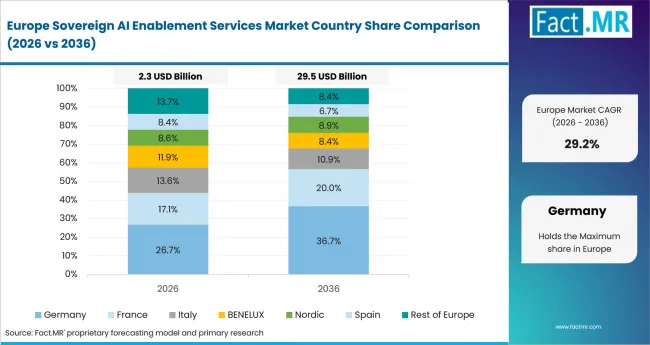
Sovereign Ai Enablement Services Market Europe Country Market Share Analysis, 2026 & 2036 | Source: Fact.MR
Europe demand is supported by AI Factories and digital sovereignty priorities. Germany has a strong industrial base that can convert sovereign AI infrastructure into sector use cases.
- Germany: Germany is forecast to record 33.4% CAGR through 2036 as EU AI Factories and sovereign cloud demand support local AI stacks. Industrial firms need AI systems that can use engineering data without losing control of sensitive information. Public agencies need trusted compute and data-residency architecture before using generative AI at scale. European AI Factories create a public compute base that service firms can build around.
Competitive Aligners for Market Providers
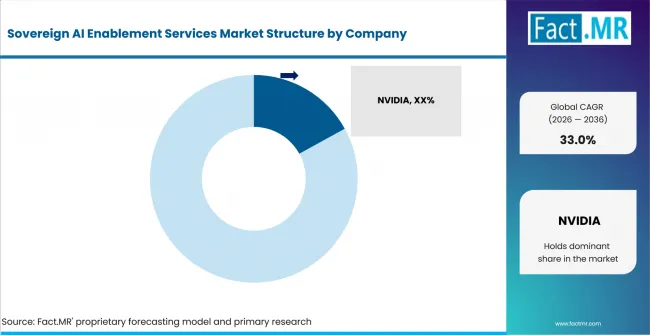
Sovereign Ai Enablement Services Market Analysis By Company | Source: Fact.MR
The sovereign AI enablement services market is led by GPU infrastructure providers, sovereign cloud operators and national AI companies. NVIDIA supports the compute layer and national AI factory ecosystem. HUMAIN builds a full-stack AI ecosystem for Saudi Arabia. Core42 / G42 supports sovereign AI and cloud infrastructure across the Middle East and beyond. OVHcloud and T-Systems / Deutsche Telekom support European trusted cloud needs. Sakura Internet and Naver Cloud support East Asian AI infrastructure and local-language AI capabilities.
Competition is moving from cloud hosting toward controlled AI stack delivery. Governments want partners that can supply compute and help operate national AI programs. Critical infrastructure operators need secure deployment models that protect sector data. This makes operating trust as important as raw GPU capacity.
Provider strength through 2036 will come from local control and delivery capacity. Hardware access will open the door. Data-residency design and local-language capability will decide long-term relevance. Providers that can operate AI factories and support model localization will gain stronger national contracts.
Key Companies in Sovereign AI Enablement Services Market
- NVIDIA
- HUMAIN (PIF)
- Core42 / G42
- OVHcloud
- T-Systems / Deutsche Telekom
- Sakura Internet
- Naver Cloud
Bibliography
- [1] Lee, A. (2024, February 28). What is sovereign AI? NVIDIA Blog.
- [2] European Commission. (2025, April 9). The AI Continent Action Plan. Shaping Europe’s Digital Future.
- [3] European Commission. (2026, April 23). AI Factories. Shaping Europe’s Digital Future.
- [4] Althoff, J. (2024, April 15). Microsoft and G42 partner to accelerate AI innovation in UAE and beyond. The Official Microsoft Blog.
This Report Addresses
- Strategic intelligence on sovereign AI enablement services.
- Forecast mapping from USD 11.5 billion in 2026 to USD 200.0 billion by 2036.
- Segment analysis covering Sovereign GPU Cloud Build-Out and Compute and Cloud Infrastructure.
- Customer review covering National Governments and Critical Infrastructure Operators.
- Regional outlook covering Saudi Arabia, United Arab Emirates, South Korea, Japan and Germany.
- Competitive analysis of NVIDIA, HUMAIN, Core42 / G42, OVHcloud, T-Systems / Deutsche Telekom, Sakura Internet and Naver Cloud.
- Opportunity review across AI factory program delivery and local-language model services.
Sovereign AI Enablement Services Market Definition
The sovereign AI enablement services market covers services that help nations and regulated sectors build controlled AI infrastructure. It includes sovereign GPU clouds and data-residency architectures. The market differs from general AI consulting because the focus is national control and sector-specific AI capability.
Sovereign AI Enablement Services Market Inclusions
The scope includes sovereign AI cloud build-out and GPU capacity planning. It includes local-language foundation model development and adaptation. It covers data-residency architecture and government AI factory program management. It includes sector AI stack integration for critical infrastructure and regulated industries.
Sovereign AI Enablement Services Market Exclusions
The scope excludes generic cloud migration with no AI sovereignty requirement. It excludes standard AI consulting without controlled infrastructure design. It excludes public AI model access that does not meet local data and compute control needs. It excludes consumer chatbot services unless they are part of a national or sector-controlled AI stack.
Sovereign AI Enablement Services Market Research Methodology
- Primary Research: Primary research includes discussions with digital government program directors and national cloud architecture heads. Critical infrastructure technology leaders are reviewed separately.
- Desk Research: Desk research reviews sovereign AI program announcements and official AI factory documentation. Public cloud and GPU infrastructure disclosures support market validation.
- Market-Sizing and Forecasting: Market estimates are developed through AI factory programs and sovereign GPU cloud projects. Local model development work supports service sizing.
- Data Validation and Update Cycle: Forecasts are checked through government program activity and provider build-out signals. Country-level AI infrastructure announcements support validation.
Segmentation
Scope of the Report
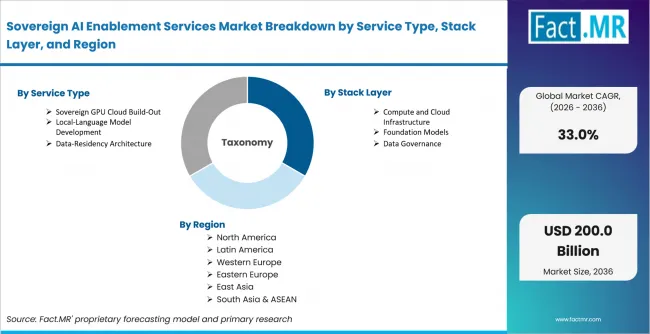
Sovereign Ai Enablement Services Market Breakdown By Service Type, Stack Layer, And Region | Source: Fact.MR
| Attribute | Details |
|---|---|
| Quantitative Units | USD 11.5 billion in 2026 to USD 200.0 billion by 2036 at 33.0% CAGR |
| Market Definition | Services that build nation- and sector-controlled AI stacks through sovereign GPU clouds, local-language models and data-residency architectures |
| Service Type | Sovereign GPU Cloud Build-Out, Local-Language Model Development, Data-Residency Architecture, Government AI Factory Program Management, Sector AI Stack Integration |
| Stack Layer | Compute and Cloud Infrastructure, Foundation Models, Data Governance, Application Enablement, Security and Operations |
| Customer Type | National Governments, Public Cloud Operators, Critical Infrastructure Operators, Defense and Security Agencies, Regulated Enterprises |
| Delivery Model | Public-Private AI Factory Partnerships, Managed Sovereign Cloud Services, Consulting-Led Architecture, Joint Venture Build-Out, Model Localization Projects |
| End Use | Government AI Services, Defense and Security AI, Public Healthcare AI, Industrial AI Factories, Critical Infrastructure AI |
| Regions Covered | Middle East, East Asia, Europe, North America, South Asia and Pacific, Latin America, Africa |
| Countries Covered | Saudi Arabia, United Arab Emirates, South Korea, Japan, Germany |
| Key Companies Profiled | NVIDIA, HUMAIN (PIF), Core42 / G42, OVHcloud, T-Systems / Deutsche Telekom, Sakura Internet and Naver Cloud |
| Forecast Period | 2026 to 2036 |
| Approach | Hybrid top-down and bottom-up approach using AI factory programs, sovereign cloud projects, GPU infrastructure build-outs and local model development activity |
Source: Fact.MR analysis. Updated Jun 19, 2026
Sovereign AI Enablement Services Market Analysis by Segments
-
By Service Type:
- Sovereign GPU Cloud Build-Out
- Local-Language Model Development
- Data-Residency Architecture
- Government AI Factory Program Management
- Sector AI Stack Integration
-
By Stack Layer:
- Compute and Cloud Infrastructure
- Foundation Models
- Data Governance
- Application Enablement
- Security and Operations
-
By Customer Type:
- National Governments
- Public Cloud Operators
- Critical Infrastructure Operators
- Defense and Security Agencies
- Regulated Enterprises
-
By Delivery Model:
- Public-Private AI Factory Partnerships
- Managed Sovereign Cloud Services
- Consulting-Led Architecture
- Joint Venture Build-Out
- Model Localization Projects
-
By End Use:
- Government AI Services
- Defense and Security AI
- Public Healthcare AI
- Industrial AI Factories
- Critical Infrastructure AI
-
By Region:
- North America
- United States
- Canada
- Europe
- Germany
- United Kingdom
- France
- Italy
- Spain
- Asia Pacific
- China
- Japan
- South Korea
- Taiwan
- Singapore
- Latin America
- Brazil
- Mexico
- Argentina
- Middle East & Africa
- GCC Countries
- South Africa
- Israel
- North America
Frequently Asked Questions
What is the Sovereign AI Enablement Services Market size in 2026?
What will the Sovereign AI Enablement Services Market be worth by 2036?
What CAGR is projected for the Sovereign AI Enablement Services Market?
Which service type leads the Sovereign AI Enablement Services Market?
Which country grows fastest in the Sovereign AI Enablement Services Market?
How does the United Arab Emirates perform in the Sovereign AI Enablement Services Market?
How does South Korea perform in the Sovereign AI Enablement Services Market?
How does Japan perform in the Sovereign AI Enablement Services Market?
How does Germany perform in the Sovereign AI Enablement Services Market?
What drives the Sovereign AI Enablement Services Market?
What restrains the Sovereign AI Enablement Services Market?
What is the main opportunity in the Sovereign AI Enablement Services Market?
Who worked on this report


Preview the report firsthand - request a free sample
Free SampleGet the brochure for pricing and purchase details
Download PDF