- Market Value (2025): USD 4966.9 Mn
- Estimated Value (2026): USD 5548.0 Mn
- Forecast Value (2036): USD 16775.2 Mn
- CAGR (2026-2036): 11.7%
What is the Space Cybersecurity Market forecast to be worth by 2036?
USD 5,548.0 million in 2026 to USD 16,775.2 million by 2036, at 11.7% CAGR.
- The Space Cybersecurity Market crossed a valuation of USD 4,966.9 million in 2025 as mission operators expanded protection across satellite links and control environments.
- Demand is projected to rise from USD 5,548.0 million in 2026 to USD 16,775.2 million by 2036 across commercial and public missions.
- The market is forecast to record an 11.7% CAGR from 2026 to 2036, as spacecraft operators and government agencies strengthen mission security.
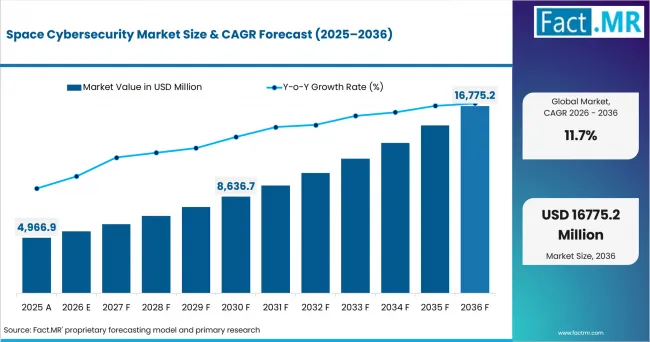
Space Cybersecurity Market Market Value Analysis | Source: Fact.MR
What are the defining numbers behind Space Cybersecurity Market growth?
USD 11,227.2 million absolute opportunity by 2036, supported by Cloud deployment and SME adoption alongside Software security controls.
- Demand Drivers in the Market
- Satellite operators need command-link protection driven by longer mission lives and limited opportunities to repair security weaknesses after launch.
- Ground-station managers require continuous identity control supported by shared cloud infrastructure and remote administration across distributed antenna networks.
- Security operations teams need automated alert triage owing to mixed telemetry streams and narrow response windows during mission anomalies.
- Public mission owners require supply-chain assurance shaped by multi-vendor spacecraft programs and cybersecurity obligations extending across contractors.
- Key Segments Analyzed
- By Component: Software is expected to account for 36.3% share in 2026, driven by continuous monitoring and policy enforcement across mission networks.
- By Deployment: Cloud is projected to garner 43.6% share in 2026, supported by scalable ground-segment processing and remote operations.
- By Organization Size: SME is anticipated to record 49.5% share in 2026, owing to a broad base of specialized operators and security providers.
- By Application: Workflow automation is estimated to capture 39.8% share in 2026, shaped by alert correlation and repeatable incident-response procedures.
- By End Use: BFSI is forecast to hold 26.9% share in 2026, attributable to dependence on satellite timing and resilient communications.
- Analyst Opinion at Fact.MR
- Shambhu Nath Jha, Senior Consultant at Fact.MR states: “Space cybersecurity draws attention because one mission spans spacecraft software and remote ground access. Procurement is expected to favor controls that remain manageable during long service lives and multi-vendor operations. Providers should combine cryptographic lifecycle support with mission-aware monitoring and rehearsed response procedures before operational deployment.”
- Strategic Implications
- Spacecraft operators should map command paths and privileged identities before connecting mission functions to shared ground infrastructure.
- Ground-segment providers should isolate customer workloads and document administrative access controls before expanding managed service coverage.
- Security teams should rehearse satellite-specific incident procedures using representative telemetry and communication-loss scenarios before operational deployment.
- Mission integrators should require vulnerability reporting and cryptographic update plans from component vendors before final system qualification.
Airbus signed an industrial cooperation agreement with Thales Alenia Space and RADMOR in April 2026 for Poland's sovereign defense telecommunications satellite. Its planned geostationary system is designed for end-to-end cyber protection across both ground and space mission segments. The move reflects demand for cybersecurity architecture to be designed into secure satellite communications before deployment.
India is expected to record a 13.5% CAGR during the forecast period, driven by a wider private space base and growing mission assurance needs. China is projected to post a 12.8% CAGR by 2036, supported by commercial constellation activity and expanding satellite operations. Australia is anticipated to advance at an 11.5% CAGR over the assessment period, owing to defense space missions and workforce development. The United Kingdom is estimated to record an 11.2% CAGR between 2026 and 2036, shaped by cloud-ground security work and a broad cyber supplier base. United States demand is forecast to post an 11.0% CAGR during the forecast period, attributable to large civil and defense portfolios requiring continuous cyber risk management.
How does the Space Cybersecurity Market break down by segment?
Cloud accounts for 43.6%; SME captures 49.5%.
Which Component dominates?
Software represents 36.3% share in 2026.
Software is expected to secure 36.3% share in 2026, driven by continuous policy enforcement across mission networks. Services support architecture reviews and incident preparation for operators that lack dedicated mission-security teams and internal response specialists. API tools connect telemetry systems with security workflows across distributed ground environments where several teams share operational responsibility. In May 2026, NASA reported that its Near Space Network returns almost 30 terabytes of critical mission data each day. That data volume keeps monitoring and correlation software central to spacecraft and ground-system security operations.
What share does Cloud account for within Deployment?
Cloud accounts for 43.6% share in 2026.
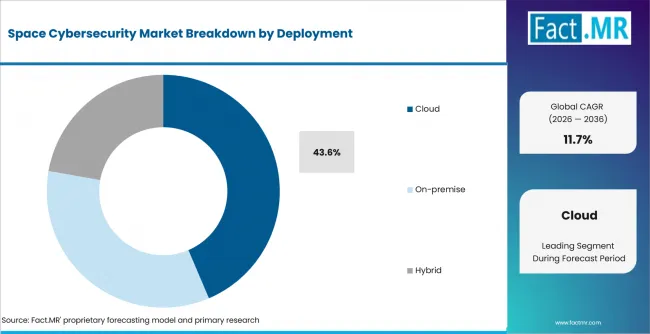
Space Cybersecurity Market Analysis By Deployment | Source: Fact.MR
Cloud is projected to capture 43.6% share in 2026, supported by scalable processing and remote ground-segment operations. On-premise deployment remains relevant for sovereign missions that require direct control over privileged access and security boundaries. Hybrid models connect restricted mission functions with elastic analytics while preserving separation for sensitive operational workloads. In February 2025, ESA reported that Galileo ground sites had begun a hardware and software migration designed to reinforce cybersecurity. The migration illustrates why deployment choices remain tied to operational continuity and strict control requirements across long mission lifecycles.
How does Organization Size shape demand?
SME garners 49.5% share in 2026.
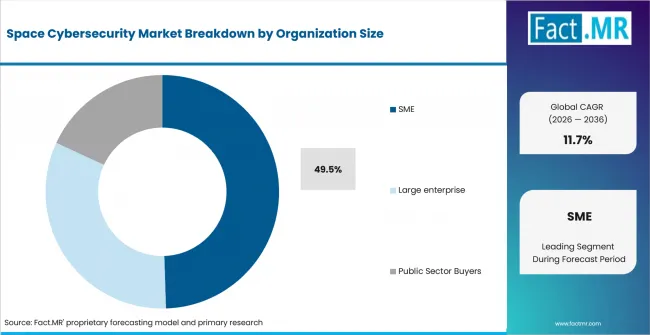
Space Cybersecurity Market Analysis By Organization Size | Source: Fact.MR
SME is anticipated to hold 49.5% share in 2026, owing to specialized operators and security vendors serving narrow mission functions. Large enterprises retain wider internal programs across spacecraft fleets and corporate networks that share identity and monitoring infrastructure. Public sector buyers emphasize assurance evidence and supplier controls across mission programs with several contracted technology layers. In May 2026, the United Kingdom estimated that 2,603 cybersecurity firms were active across its national supplier base. That specialist depth supports modular security procurement for smaller space organizations and program contractors that need focused technical support.
What supports Workflow Automation demand in Application?
Workflow automation records 39.8% share in 2026.
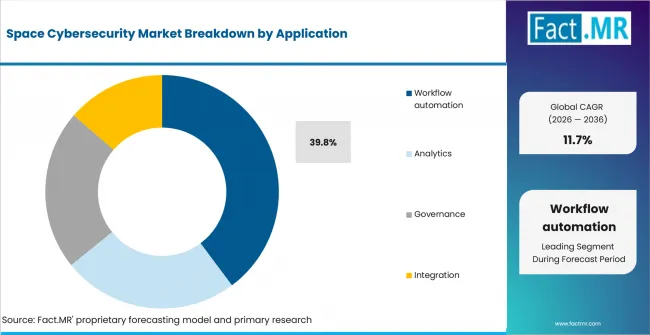
Space Cybersecurity Market Analysis By Application | Source: Fact.MR
Workflow automation is estimated to account for 39.8% share in 2026, shaped by the need to connect alerts with procedures. Analytics supports anomaly review across network logs and spacecraft telemetry before teams escalate a possible incident. Governance tools record risk decisions and supplier responsibility across acquisition and operational change processes throughout mission lifecycles. Integration connects security systems with control-room procedures while preserving existing mission software and operator routines. In June 2025, GAO reported that NIST guidance uses seven risk management steps for federal information systems. Repeatable workflows help space programs apply those steps across environments with several technical and contractual owners.
What drives BFSI within End Use?
BFSI captures 26.9% share in 2026.
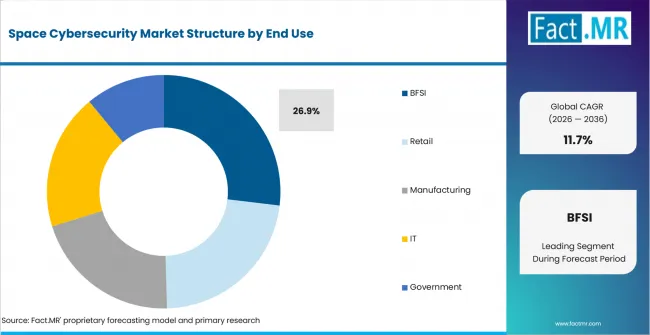
Space Cybersecurity Market Analysis By End Use | Source: Fact.MR
BFSI is forecast to represent 26.9% share in 2026, attributable to reliance on timing and resilient communications. Retail organizations follow where satellite connectivity supports transaction continuity across dispersed sites with uneven terrestrial coverage. Manufacturing users protect satellite-linked logistics and remote asset monitoring against service disruption affecting production visibility. Government agencies secure mission networks supporting services and defense operations that depend on protected communications. In August 2025 the UK Space Agency reported that satellite services support activity equal to 18% of national GDP. Such dependence extends cybersecurity consequences into financial services and satellite-reliant operations that require dependable timing and communications.
What is accelerating Space Cybersecurity Market adoption, and what is holding it back?
Mission attack-surface expansion drives market growth; qualification cost restrains it.
Drivers Impact Analysis
| Driver | (~) % Impact on CAGR | Geographic Relevance | Impact Timeline |
|---|---|---|---|
| Expanded satellite fleets and connected ground systems | +1.7% | North America and Asia Pacific | Medium term (2-4 years) |
| Government mission assurance requirements | +1.4% | United States and Europe | Medium term (2-4 years) |
| Cloud-based ground segment adoption | +1.1% | United Kingdom and Australia | Short term (<= 2 years) |
| Threat intelligence sharing across operators | +0.8% | North America and Europe | Short term (<= 2 years) |
| Cryptographic lifecycle pressure | +0.6% | Global mission operators | Long term (>= 4 years) |
Source: Fact.MR analysis. Updated Jul 8, 2026
- Expanded mission attack surface: Satellite fleets now depend on software-defined spacecraft and remote ground access across several organizations. Every connected interface creates another path that security teams must monitor throughout operations and investigate during abnormal mission behavior. In June 2025 GAO reported that NASA's development portfolio included 36 major projects requiring sustained agency management and oversight. Procurement is expected to expand around controls that remain effective across long acquisition and mission cycles.
- Government mission assurance: Civil and defense programs are turning cybersecurity into an acquisition and operations requirement supported by formal risk management. Supplier evidence must cover spacecraft interfaces and ground administration before systems reach operational use across civil and defense mission programs. NASA updated its IV&V capabilities page in May 2026 and described mission protection services covering security assessment and space-ground control verification. Demand is projected to favor providers that translate general controls into clear mission-specific implementation steps for operators and program managers.
- Cloud-ground transition: Ground segments increasingly use shared compute services for mission processing and remote operator access. Security architecture must separate customers while preserving reliable command paths during service changes and administrative updates across shared infrastructure. The United Kingdom published dedicated cloud-ground cyber risk research during August 2025 for organizations using managed space ground services. Adoption is anticipated to increase for identity control and configuration monitoring around ground-segment services that support remote mission operations.
- Shared threat intelligence: Operators need faster context about campaigns that target spacecraft suppliers and service providers across organizational boundaries. Common indicators reduce duplicated investigation effort during a limited response window when several operators encounter related malicious activity. Space ISAC released another public threat assessment during July 2025 for operators and security teams across the space community. Security programs are estimated to invest more in correlation tools that connect external intelligence with mission telemetry.
- Cryptographic lifecycle pressure: Long spacecraft lifetimes make encryption changes difficult after launch and expose missions to technology transitions. Operators need inventories that show algorithms and certificates across ground systems and payload interfaces before migration decisions affect operational missions. In March 2025, NIST selected HQC as an additional post-quantum encryption algorithm for future standardization and implementation planning. Migration planning is forecast to expand where missions need cryptographic systems that support planned algorithm changes while preserving deployed hardware with limited replacement paths.
Opportunity Impact Analysis
| Opportunity | (~) % Impact on CAGR | Geographic Relevance | Impact Timeline |
|---|---|---|---|
| Mission-aware security operations centers | +0.9% | Europe and North America | Medium term (2-4 years) |
| Space cyber ranges and mission exercises | +0.7% | Europe and Australia | Medium term (2-4 years) |
| Post-quantum migration services | +0.6% | United States and Europe | Long term (>= 4 years) |
| Managed security for smaller operators | +0.5% | India and Asia Pacific | Medium term (2-4 years) |
Source: Fact.MR analysis. Updated Jul 8, 2026
- Mission-aware security operations centers: General network alerts need mission context before operators determine whether spacecraft command or payload delivery faces an operational security risk. Dedicated space monitoring combines cyber events with system state and operational priorities that guide escalation during mission incidents. Thales announced a Space META-SOC capability with the UAE Cyber Security Council in November 2025. Opportunity is expected to expand for providers that join detection engineering with space operations knowledge.
- Space cyber ranges: Operators need representative environments for testing attacks without disrupting live spacecraft or control facilities. Cyber ranges support exercises and validation work before security changes reach mission networks or operational spacecraft control environments. Training demand is projected to grow where operators require repeatable evidence that teams are prepared to handle satellite-specific incidents.
- Post-quantum migration: Space missions require long-lived cryptography across equipment that is difficult to update after deployment. Discovery tools and policy-controlled cryptographic change offer a route to staged migration across connected ground networks. In June 2026, QuSecure was named a World Economic Forum Technology Pioneer for its post-quantum cryptography work. Service opportunity is anticipated to widen as operators inventory encryption dependencies before transition deadlines affect long-lived mission assets.
- Managed security for smaller operators: New space companies often lack dedicated teams for continuous monitoring and incident response across every mission function. Service packages combine alert review with configuration checks and escalation procedures tailored to mission criticality and operator staffing limits. In June 2026, India's Press Information Bureau reported that space start-ups attracted nearly USD 150 million during 2025. Demand is estimated to widen for modular services that fit smaller operator budgets and qualification needs.
Restraints Impact Analysis
| Restraint | (~) % Impact on CAGR | Geographic Relevance | Impact Timeline |
|---|---|---|---|
| Long qualification and change-control cycles | -0.8% | Global mission operators | Long term (>= 4 years) |
| Legacy spacecraft update constraints | -0.6% | North America and Europe | Long term (>= 4 years) |
| Shortage of space-security specialists | -0.5% | Europe and Australia | Medium term (2-4 years) |
| Multi-vendor responsibility gaps | -0.4% | Global supply chains | Medium term (2-4 years) |
Source: Fact.MR analysis. Updated Jul 8, 2026
- Qualification and change control: Mission software updates require testing against operational constraints that ordinary enterprise systems do not carry. Security teams must prove that a control change preserves command reliability and timing before approval within operational mission environments. GAO made 16 recommendations in its June 2025 NASA cybersecurity review covering governance and risk management practices. Adoption is forecast to move slowly where governance gaps delay approval for security improvements across complex program management structures.
- Legacy spacecraft constraints: Deployed satellites often have limited compute capacity and narrow maintenance paths for replacing cryptographic or monitoring components. Ground-side controls therefore carry more responsibility for compensating protection around legacy spacecraft with limited update capacity. GAO reported in June 2025 that NASA had not implemented the recommended plan for updating spacecraft cybersecurity acquisition policies and standards. Demand is expected to remain selective where products assume frequent software replacement that missions cannot support.
- Specialist workforce shortage: Space security work combines cybersecurity knowledge with mission operations and communication engineering that few general security teams possess. Training takes time because practitioners must understand mission control systems and orbital operating constraints alongside ordinary cybersecurity techniques. In February 2025, ESA Academy selected 30 students for its Space Cybersecurity Training Course focused on space-specific security knowledge and practice. Procurement is projected to rely more on providers that pair technical products with mission-specific support.
- Responsibility gaps across suppliers: Space programs depend on component vendors and integrators whose security evidence does not always align across the system lifecycle. Unclear ownership slows vulnerability response and creates blind spots between contractual boundaries during investigation and remediation across complex programs. GAO reported in March 2025 that the DOD fiscal 2025 request included more than a dozen efforts supporting its hybrid satellite communications approach. Adoption is anticipated to favor clearer supplier accountability and shared incident procedures across mission owners and contracted service providers.
Which countries are scaling Space Cybersecurity Market fastest?
India 13.5%; China 12.8%; Australia 11.5%; United Kingdom 11.2%; United States 11.0%.
Space Cybersecurity Market is segmented into North America and Europe alongside Asia Pacific and Central & South America as well as the Middle East & Africa.
| Country | CAGR |
|---|---|
| India | 13.5% |
| China | 12.8% |
| Australia | 11.5% |
| United Kingdom | 11.2% |
| United States | 11.0% |
| Germany | 10.7% |
| Japan | 10.4% |
Source: Fact.MR analysis. Updated Jul 8, 2026
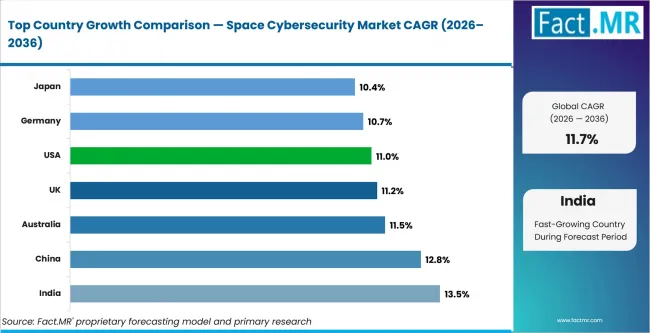
Space Cybersecurity Market Cagr Analysis By Country | Source: Fact.MR
What is powering India's market expansion?
13.5% CAGR, driven by private space participation and growing mission assurance requirements.
India’s market is expanding as a broader private space ecosystem creates new security requirements across smaller mission teams and specialist suppliers. In February 2026 the Press Information Bureau reported that India had more than 400 space start-ups. The Indian market is expected to record a 13.5% CAGR between 2026 and 2036, supported by a broader operator and supplier base. Modular assessment and managed security services have a practical route into smaller mission teams that lack extensive internal cybersecurity staffing.
How is China scaling Space Cybersecurity demand?
12.8% CAGR, supported by commercial satellite activity and expanding constellation operations.
China’s demand base is widening as commercial operators manage larger satellite fleets that require persistent command protection and security monitoring. China had more than 500 commercial space companies by June 2025 according to official government reporting. Demand is projected to post a 12.8% CAGR by 2036 as constellation operators strengthen command protection and fleet monitoring. Local providers have greater commercial relevance when security controls scale across satellite fleets without interrupting mission availability or operator workflows.
What supports the Australia outlook?
11.5% CAGR, owing to defense space missions and specialist workforce development.
Australia’s market is gaining depth as sovereign space operations increasingly connect workforce development with cyber protection and mission assurance requirements. In February 2026 direct-entry recruitment opened for two new Australian Defence Force roles focused specifically on space operations. Demand is anticipated to advance at an 11.5% CAGR during the forecast period, owing to closer integration between defense space and cyber capabilities. Providers benefit when training and security tooling fit sovereign workflows across protected mission environments and established defense operating procedures.
What underpins the United Kingdom outlook?
11.2% CAGR, supported by cloud-ground security work and established specialist cybersecurity capacity.
United Kingdom demand is supported by a broad space supplier ecosystem that creates varied security requirements across spacecraft and ground operations. In August 2025 the UK Space Agency reported 1,907 organizations with space-related activities across the national space economy. The United Kingdom market is estimated to record an 11.2% CAGR over the assessment period, shaped by cloud-ground security work and established cyber expertise. Mission operators have broad supplier access while still requiring evidence that security services fit spacecraft and ground-system operating constraints.
How is the United States expanding Space Cybersecurity demand?
11.0% CAGR, attributable to large civil and defense mission portfolios.
United States demand is deepening as large mission portfolios create recurring cybersecurity requirements throughout spacecraft development and operational review cycles. GAO reported in June 2025 that NASA planned approximately USD 80 billion across 36 major space development projects. The United States market is forecast to post an 11.0% CAGR between 2026 and 2036, attributable to sustained civil and defense mission assurance work. Providers improve account access by demonstrating controls against federal risk frameworks and spacecraft operating constraints during acquisition reviews.
Who leads the Space Cybersecurity Market?
CYSEC and Airbus Defense and Space Cyber provide direct satellite security coverage, while Thales and Leonardo strengthen mission monitoring and secure space infrastructure.
CYSEC focuses on secure satellite communications and mission data protection through ARCA products built for space environments. In December 2025, CYSEC won a CNES contract to demonstrate secure satellite connectivity for mission data exchange. Airbus combines satellite systems with cyber-secured ground infrastructure and secure communications engineering for sovereign programs. Thales combines space systems engineering with cyber operations for infrastructure that needs mission-specific monitoring and response.
In December 2025 Leonardo joined the Earth Observation Veracity project to protect the satellite data supply chain with cybersecurity expertise. Booz Allen Hamilton expanded its space portfolio through an April 2026 investment in Portal Space Systems and brings cybersecurity experience. In September 2025, SpiderOak announced an SDA selection to deliver a zero-trust encryptor for spacecraft and ground communications. QuSecure contributes cryptographic inventory and migration controls that help long-lived systems map dependencies before planned algorithm changes. Competition over the assessment period is expected to be shaped by mission-aware monitoring and cryptographic lifecycle support.
Which companies are the key providers?
CYSEC, Airbus Defense and Space Cyber, Thales, Leonardo, Booz Allen Hamilton, SpiderOak, QuSecure are some companies profiled
- CYSEC
- Airbus Defence and Space Cyber
- Thales
- Leonardo
- Booz Allen Hamilton
- SpiderOak
- QuSecure
Bibliography
- Airbus. (2026, April 20). Airbus, Thales Alenia Space and RADMOR to partner for Poland’s sovereign satellite. Airbus.
- Australian Space Agency. (2026, February 9). New pathways into Australia’s space future. Australian Government.
- Booz Allen Hamilton. (2026, April 9). Booz Allen advances orbital warfare for space domain. Booz Allen Hamilton.
- CYSEC. (2025, December 10). CYSEC wins contract with the French Space Agency to demonstrate secure satellite connectivity. CYSEC.
- Department for Science, Innovation and Technology. (2025, August 8). Cyber risks of cloud computing in the ground segment of the space sector. GOV.UK.
- Department for Science, Innovation and Technology. (2026, May 12). Cyber security sectoral analysis 2026. GOV.UK.
- European Space Agency. (2025, January 23). Estonia to host Europe’s new space cybersecurity testing ground. European Space Agency.
- European Space Agency. (2025, February 5). Apply now for the 2025 edition of ESA Academy’s Space Cybersecurity Training Course. European Space Agency.
- European Space Agency. (2025, February 5). Galileo sites from pole to tropics begin migration. European Space Agency.
- Leonardo UK. (2025, December 1). Leonardo works on vital Earth Observation Veracity project. Leonardo.
- National Aeronautics and Space Administration. (2026, May 11). 11.0 Ground Data Systems and Mission Operations. NASA.
- National Aeronautics and Space Administration. (2026, May 18). IV&V capabilities & services. NASA.
- National Institute of Standards and Technology. (2025, March 11). NIST selects HQC as fifth algorithm for post-quantum encryption. NIST.
- Press Information Bureau. (2026, February 11). Parliament question: Space start-ups in India. Government of India.
- Press Information Bureau. (2026, June 21). India’s space odyssey. Government of India.
- QuSecure. (2026, June 10). QuSecure named a 2026 Technology Pioneer by World Economic Forum for its post-quantum cryptography leadership. QuSecure.
- Space Information Sharing and Analysis Center. (2025, July 2). Space ISAC issues TLP: CLEAR public release on threat level assessment. Space ISAC.
- State Council Information Office of the People’s Republic of China. (2025, June 19). China’s commercial space sector strives to reach new heights. State Council Information Office.
- Thales. (2025, November 20). Thales and the UAE Cyber Security Council join forces to develop a Cyber Centre of Excellence. Thales.
- U.S. Government Accountability Office. (2025, March 4). DOD satellite communications: Reporting on progress needed to provide insight on new approach. U.S. Government Accountability Office.
- U.S. Government Accountability Office. (2025, June 25). Cybersecurity: NASA needs to fully implement risk management. U.S. Government Accountability Office.
- UK Space Agency. (2025, August 22). Factsheet: The UK space sector. GOV.UK.
This Report Addresses
- The report provides strategic intelligence on Space Cybersecurity across Component and Deployment choices that shape mission protection programs.
- Segment analysis identifies Software and Cloud as the leading segments within the 2026 market structure.
- Regional outlook evaluates India and China alongside Australia while the United Kingdom and United States complete the country comparison.
- Competitive analysis profiles CYSEC and Airbus alongside Thales and Leonardo across direct satellite security and mission monitoring. Booz Allen Hamilton and SpiderOak receive coverage while QuSecure completes the provider set for cryptographic lifecycle support.
- Component assessment covers Software and Services alongside API tools and connector layers used across mission security architectures.
- Application assessment covers Workflow automation and Analytics alongside Governance and Integration functions used in security operations.
What does the Space Cybersecurity Market cover?
Software, Services, API tools, and connector security used to protect satellites and mission ground systems.
The Space Cybersecurity Market covers protection for spacecraft networks and satellite communications across mission control and ground infrastructure. Coverage includes monitoring software and security services alongside integration interfaces that support mission assurance across spacecraft and ground systems.
The market differs from general enterprise cybersecurity because controls must account for remote spacecraft and constrained update paths across mission lifecycles. General IT security remains outside the boundary unless it protects satellite services or a space mission connection.
What is included in the scope?
Space cybersecurity systems used across spacecraft, satellite communications, mission control, and cloud-connected ground segments.
The scope includes Software and Services with API tools and connector security across Cloud and On-premise deployments. Hybrid environments qualify when controls protect spacecraft operations or mission data paths across restricted and shared infrastructure. Organization coverage includes SMEs and large enterprises alongside public sector buyers supporting commercial or sovereign mission programs. Applications cover Workflow automation and Analytics alongside Governance and Integration for mission security operations and risk oversight. End-use analysis includes BFSI and Retail alongside Manufacturing and IT organizations dependent on satellite communications or timing. Government agencies complete the structure for sovereign procurement and public mission protection requirements across critical services. Adjacent 5G NTN systems provide security context across terrestrial and non-terrestrial network boundaries for satellite-connected operations.
What is excluded from the scope?
General enterprise cybersecurity and physical anti-jamming equipment are outside the scope.
The scope excludes cybersecurity products sold only for ordinary corporate networks without a satellite or mission-system connection. Physical perimeter security and standalone anti-jamming hardware are excluded unless sold within an integrated cyber protection program for space assets. RF-over-fiber solutions remain adjacent infrastructure unless their security functions protect mission data transport or ground-system access control.
How was the analysis built?
100+ sources, 50+ company portfolios, 25+ countries, 20+ interviews.
- Primary Research
- Primary research includes interviews with space mission operators, satellite manufacturers, cybersecurity executives and space systems integrators. It also covers input from government agencies, defense stakeholders, cybersecurity solution providers and ground-station operators responsible for securing space-based assets and communications networks.
- Desk Research
- Desk research reviews official space industry statistics, cybersecurity frameworks, government space-security initiatives, provider product portfolios and company announcements. Technical publications, threat intelligence reports, satellite cybersecurity guidelines and space infrastructure security developments are also assessed to evaluate market trends and competitive positioning.
- Market-Sizing and Forecasting
- Forecasting uses satellite deployment activity, space infrastructure investments, cybersecurity spending trends, cloud-based space data management adoption and regulatory compliance requirements across major countries. Models consider growth in commercial space operations, defense modernization programs, threat detection requirements and demand for secure satellite communications and mission-critical systems.
- Data Validation and Update Cycle
- Forecasts are validated through provider checks and industry interviews that test assumptions on cybersecurity adoption, space mission security requirements and technology deployment trends. Portfolio mapping, country-level space investment analysis and stakeholder feedback help confirm market direction, while ongoing reviews of threat developments, regulatory updates and product launches support forecast updates.
Segmentation
What is the report’s scope and coverage?
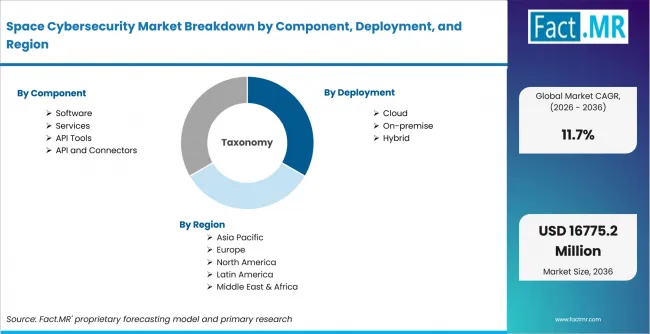
Space Cybersecurity Market Breakdown By Component, Deployment, And Region | Source: Fact.MR
| Attribute | Details |
|---|---|
| Quantitative Units | USD million |
| Market Definition | Cybersecurity software and services designed to protect spacecraft, satellite communications, mission-control infrastructure, and connected ground systems across mission lifecycles |
| Component | Software; Services; API Tools; Connector Security |
| Deployment | Cloud; On-premise; Hybrid |
| Organization Size | SME; Large Enterprise; Public Sector |
| Application | Workflow Automation; Analytics; Governance; Integration |
| End Use | BFSI; Retail; Manufacturing; IT; Government Agencies |
| Regions Covered | North America; Europe; Asia Pacific; Central and South America; Middle East and Africa |
| Countries Covered | India; China; Australia; United Kingdom; United States |
| Key Companies Profiled | CYSEC; Airbus Defense and Space Cyber; Thales; Leonardo; Booz Allen Hamilton; SpiderOak; QuSecure |
| Forecast Period | 2026 to 2036 |
| Approach | Hybrid top-down and bottom-up approach using satellite mission activity; spacecraft and ground-segment security exposure; cloud-ground adoption; mission-assurance requirements; organization size; application mix; end-use dependence; and supplier validation |
Source: Fact.MR analysis. Updated Jul 8, 2026
How is the market segmented?
-
By Component :
- Software
- Services
- API Tools
- Connector Security
-
By Deployment :
- Cloud
- On-premise
- Hybrid
-
By Organization Size :
- SME
- Large Enterprise
- Public Sector
-
By Application :
- Workflow Automation
- Analytics
- Governance
- Integration
-
By End Use :
- BFSI
- Retail
- Manufacturing
- IT
- Government Agencies
-
By Region :
- North America
- United States
- Canada
- Europe
- Germany
- United Kingdom
- France
- Italy
- Spain
- Asia Pacific
- India
- China
- Japan
- South Korea
- Australia
- Latin America
- Brazil
- Argentina
- Mexico
- Chile
- Middle East & Africa
- UAE
- Saudi Arabia
- South Africa
- North America
Frequently Asked Questions
How much share is Software projected to account for in 2026?
Why is Cloud anticipated to lead in 2026?
How much of the market are SMEs estimated to capture in 2026?
Where is Workflow automation forecast to stand in 2026?
What share is BFSI expected to record in 2026?
Which country is estimated to post the fastest CAGR by 2036?
What CAGR is China projected to record over the assessment period?
What growth rate is Australia anticipated to register by 2036?
What CAGR is the United Kingdom estimated to post during the forecast period?
What growth pace is forecast for the United States between 2026 and 2036?
What is the primary driver in the Space Cybersecurity Market?
What is the main restraint in the Space Cybersecurity Market?
Why is Cloud projected to account for the largest deployment share?
Why is BFSI forecast to account for substantial end-use demand?
Who worked on this report


Preview the report firsthand - request a free sample
Free SampleGet the brochure for pricing and purchase details
Download PDF