- Market Value (2025): USD 1.5 Bn
- Estimated Value (2026): USD 1.8 Bn
- Forecast Value (2036): USD 9.0 Bn
- CAGR (2026-2036): 17.4%
What is the HBM for Defense and Space Computing Market forecast to be worth by 2036?
USD 1.8 billion in 2026 to USD 9.0 billion by 2036 at 17.4% CAGR.
- The HBM for defense and space computing market reached USD 1.5 billion in 2025 as defense AI and mission-compute qualification work expanded.
- Demand is projected to increase from USD 1.8 billion in 2026 to USD 9.0 billion by 2036.
- The market is forecast to record 17.4% CAGR from 2026 to 2036.
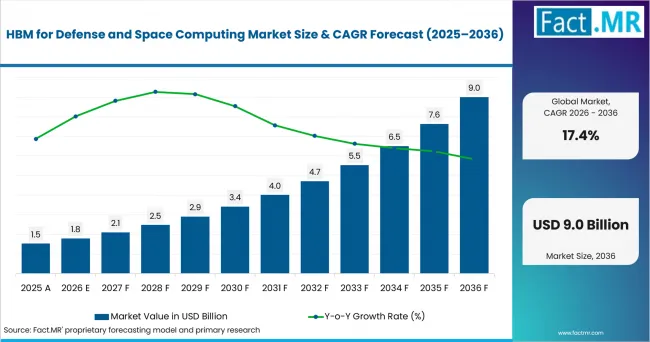
Hbm For Defense And Space Computing Market Value Analysis | Source: Fact.MR
What are the defining numbers behind HBM for Defense and Space Computing Market growth?
USD 7.1 billion absolute opportunity by 2036.
- Demand Drivers in the Market
- Mission AI workloads need memory bandwidth that supports sensor fusion and onboard inference without widening the electronics footprint. The U.S. Department of Defense's FY 2026 budget briefing identified $13.4 billion for autonomy and autonomous systems, including $1.2 billion for enabling autonomy software, supporting faster onboard processing around mission AI processors.
- HBM qualification is expected to gain weight because HBM stack inspection affects how customers judge internal defects before program release.
- Defense contractors are expected to select memory subsystems that fit secure sourcing rules and platform-level integration schedules.
- Rugged edge computers are anticipated to favor compact memory architectures as edge AI high-bandwidth memory chips move closer to deployed workloads.
- Key Segments Analyzed
- By HBM Memory Solution: HBM3E is expected to hold 56.0% share in 2026 because it gives defense AI accelerators the strongest bandwidth bridge.
- By Application: Defense Artificial Intelligence Computing is projected to account for 45.0% share in 2026 as mission workloads need faster memory access.
- By End User: Defense Contractors are anticipated to capture 43.0% share in 2026 since they convert secure hardware needs into platform programs.
- By Integration Platform: Mission Computing Modules are estimated to represent 61.0% share in 2026 due to their role in rugged onboard systems.
- By Packaging Technology: Through-Silicon Via Technology is forecast to hold 71.0% share in 2026 as stacked HBM depends on dense vertical interconnects.
- Analyst Opinion at Fact.MR
- Shambhu Nath Jha, Principal Consultant at Fact.MR, states, "Defense and space buyers no longer evaluate memory only as a component line item. HBM selection affects accelerator qualification and mission-computer architecture. Companies that align memory stacks with test evidence are expected to hold the strongest position through 2036."
- Strategic Implications
- Defense contractors should lock qualification paths across memory companies before accelerator and mission-computer designs are frozen.
- Memory and packaging providers should document TSV reliability, thermal behavior and secure supply continuity before formal bid cycles begin.
- System integrators should validate high-speed memory signal integrity early so later ruggedization work does not delay program approval.
The USA leads at 18.3% CAGR through defense AI infrastructure and secure supply strategy. South Korea follows at 17.8% through memory depth. Japan reaches 17.1% through materials capability. Germany records 16.5%. France posts 15.8%. The UK reaches 15.2%. Canada closes at 14.6%.
How does the HBM for Defense and Space Computing Market break down by segment?
HBM3E leads HBM Memory Solution at 56.0% share in 2026. Defense Artificial Intelligence Computing leads Application at 45.0%.
Which HBM Memory Solution dominates?
HBM3E is projected to account for 56.0% share in 2026.
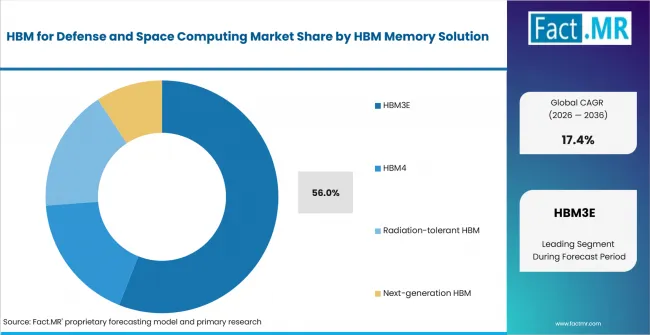
Hbm For Defense And Space Computing Market Analysis By Hbm Memory Solution | Source: Fact.MR
HBM3E leads because defense AI accelerators need dense bandwidth for sensor and inference workloads. Earlier HBM generations remain useful where qualification history lowers integration risk. In March 2025, SK hynix shipped 12-layer HBM4 samples with 36GB capacity and more than 2 TB/s bandwidth to major customers, giving buyers a clearer view of next-generation HBM stack roadmaps.
Why does Defense Artificial Intelligence Computing lead Application?
Defense Artificial Intelligence Computing is expected to hold 45.0% share in 2026.
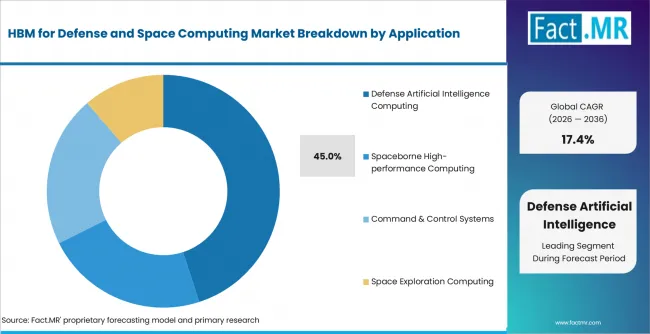
Hbm For Defense And Space Computing Market Analysis By Application | Source: Fact.MR
Defense AI computing carries the largest application share because mission systems need fast memory access for onboard inference and image analysis. Secure HPC simulation and spaceborne data processing move through longer approval paths.
What supports Defense Contractors within End User?
Defense Contractors are anticipated to represent 43.0% share in 2026.
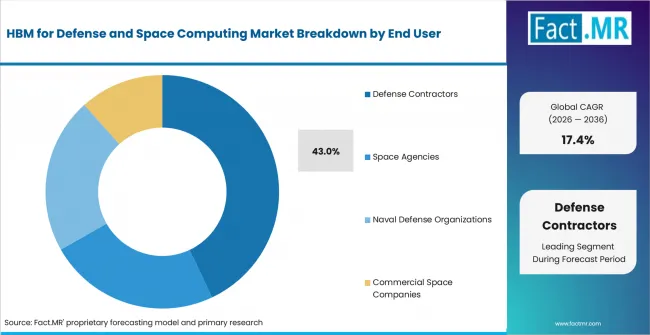
Hbm For Defense And Space Computing Market Analysis By End User | Source: Fact.MR
Defense contractors lead end-user demand because they turn memory selection into platform qualification. Space agencies and research labs shape requirements, but contractors convert those needs into deployable hardware.
Why do Mission Computing Modules lead Integration Platform?
Mission Computing Modules are estimated to capture 61.0% share in 2026.
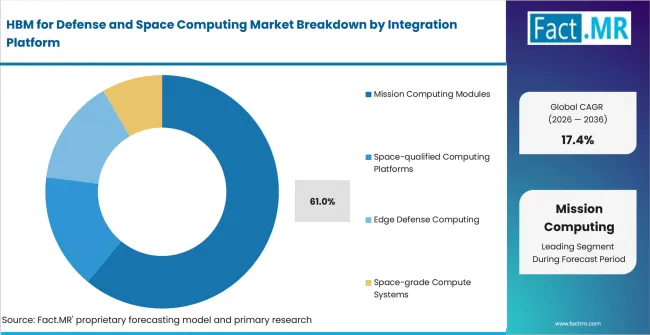
Hbm For Defense And Space Computing Market Analysis By Integration Platform | Source: Fact.MR
Mission computing modules dominate because defense and space platforms need compact boards that fit strict power and thermal envelopes. GPU servers and custom XPU platforms remain useful for larger power budgets.
How does Through-Silicon Via Technology shape Packaging Technology demand?
Through-Silicon Via Technology is forecast to hold 71.0% share in 2026.
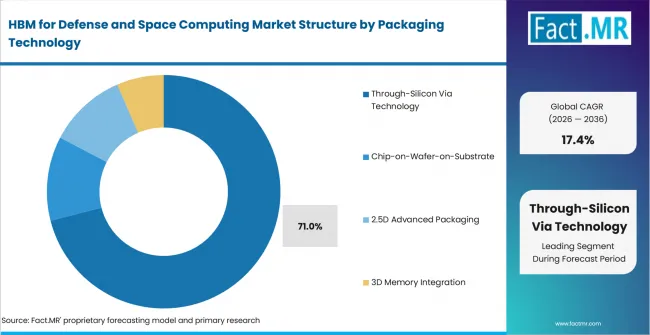
Hbm For Defense And Space Computing Market Analysis By Packaging Technology | Source: Fact.MR
Through-silicon vias lead because stacked HBM depends on dense vertical interconnects between memory dies. Silicon interposers and hybrid bonding add value when accelerators need wider links and closer placement. ASE announced FOCoS-Bridge with TSV for AI and HPC and reported a test vehicle with one ASIC chip and four HBM3 chips per module, with resistance and inductance reduced by 72% and 50%, respectively.
What is accelerating HBM for Defense and Space Computing Market adoption, and what is holding it back?
Demand is expected to rise through defense AI workloads, HBM3E qualification and advanced packaging adoption. Growth is expected to be limited by long approval cycles, memory allocation risk and thermal design burdens in rugged systems.
Drivers Impact Analysis
| DRIVER | (~) % IMPACT ON CAGR | GEOGRAPHIC RELEVANCE | IMPACT TIMELINE |
|---|---|---|---|
| Defense AI compute workload growth | +4.1% | USA, South Korea, Japan | Short term (<= 2 years) |
| HBM3E qualification depth | +3.4% | USA, South Korea, Taiwan supply chain | Short term (<= 2 years) |
| Advanced packaging and TSV integration | +2.8% | Global mission-compute companies | Medium term (2-4 years) |
| Secure sourcing and regional capacity | +2.1% | North America and Europe | Medium term (2-4 years) |
| Thermal and signal-integrity validation | +1.6% | Defense and space programs | Long term (>= 4 years) |
Source: Fact.MR analysis. Updated Aug 10, 2026
- Defense AI compute workload growth: Sensor-rich mission platforms are expected to increase the value of memory bandwidth inside secure processors.
- HBM3E qualification depth: Buyers are expected to favor HBM3E where bandwidth evidence and engineering support reduce program risk.
- Advanced packaging and TSV integration: Stacked memory designs depend on validated TSV routes before defense approval. In 2025, the U.S. Department of Commerce finalized $1.4 billion in CHIPS National Advanced Packaging Manufacturing Program awards, including $1.1 billion for Natcast's advanced packaging piloting facility and $300 million for substrate and materials research.
Opportunity Impact Analysis
| OPPORTUNITY | (~) % IMPACT ON CAGR | GEOGRAPHIC RELEVANCE | IMPACT TIMELINE |
|---|---|---|---|
| Radiation-aware mission computing modules | +1.6% | USA and Europe | Medium term (2-4 years) |
| Heterogeneous integration platforms | +1.3% | South Korea, Japan, Germany | Medium term (2-4 years) |
| Secure accelerator supply qualification | +1.0% | North America | Long term (>= 4 years) |
| Edge and onboard AI inference | +0.8% | USA, UK, Canada | Long term (>= 4 years) |
Source: Fact.MR analysis. Updated Aug 10, 2026
- Radiation-aware mission computing modules: Companies that support mission qualification are expected to gain space and defense program access.
- Heterogeneous integration platforms: Packaging providers that combine HBM, accelerators and organic substrate packaging material are expected to support complex designs.
- Edge and onboard AI inference: Mission systems are expected to require compact acceleration where data center accelerator design experience moves into smaller platforms.
Restraints Impact Analysis
| RESTRAINT | (~) % IMPACT ON CAGR | GEOGRAPHIC RELEVANCE | IMPACT TIMELINE |
|---|---|---|---|
| Qualification cost and long approval cycles | -1.5% | Global | Short term (<= 2 years) |
| HBM supply allocation risk | -1.2% | Memory-dependent programs | Short term (<= 2 years) |
| Thermal design and ruggedization burden | -0.9% | Defense and space integrators | Medium term (2-4 years) |
| Export controls and sourcing limits | -0.7% | Cross-border programs | Long term (>= 4 years) |
Source: Fact.MR analysis. Updated Aug 10, 2026
- Qualification cost and long approval cycles: Defense and space customers require evidence before memory subsystems enter production programs.
- HBM supply allocation risk: Limited access to preferred memory stacks is expected to delay accelerator builds.
- Thermal design and ruggedization burden: High-bandwidth memory adds heat and signal-integrity constraints inside compact mission hardware.
Which countries are scaling HBM for Defense and Space Computing Market fastest?
- The country comparison spans 3.7 percentage points and forms three practical growth bands across the forecast period.
- The USA remains 0.5 percentage point above South Korea through defense AI infrastructure and secure sourcing strategy.
- South Korea remains 0.7 percentage point above Japan as memory manufacturing supports HBM supply and technical support.
- Japan remains 0.6 percentage point above Germany through materials capability and semiconductor equipment depth.
- Germany remains 0.7 percentage point above France through electronics demand and defense system integration.
- France remains 0.6 percentage point above the UK through defense electronics and public-sector technology programs.
- The UK remains 0.6 percentage point above Canada through AI research depth and secure computing activity.
- Canada closes the displayed range through AI research and advanced manufacturing participation.
Comparable CAGRs create different entry conditions because procurement rules, qualification evidence and local engineering depth vary by country. Full report coverage includes North America, Latin America and Europe. It also includes East Asia plus South Asia and Pacific. Middle East and Africa remains included.
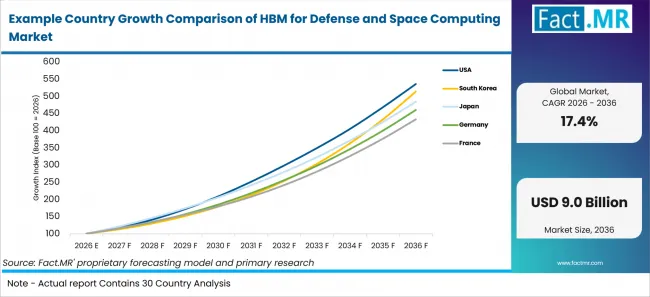
Example Country Growth Comparison Of Hbm For Defense And Space Computing Market | Source: Fact.MR
| Country | CAGR (2026-2036) |
|---|---|
| USA | 18.3% |
| South Korea | 17.8% |
| Japan | 17.1% |
| Germany | 16.5% |
| France | 15.8% |
| UK | 15.2% |
| Canada | 14.6% |
Source: Fact.MR analysis. Updated Aug 10, 2026
What supports USA adoption?
18.3% CAGR, supported by defense AI infrastructure and secure supply strategy.
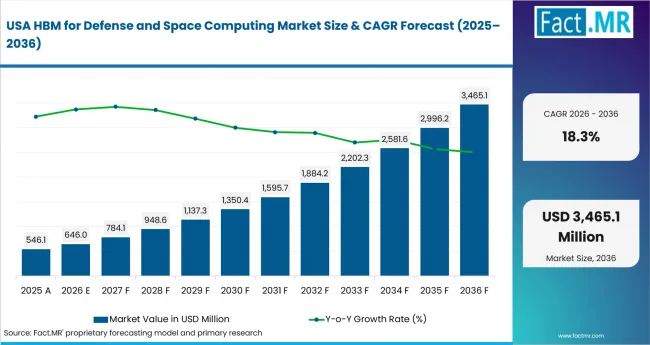
Hbm For Defense And Space Computing Market Country Value Analysis | Source: Fact.MR
USA procurement teams evaluate trusted hardware paths before approving mission-compute components. HBM demand is expected to rise where accelerator programs need fast memory access and supply assurance.
How is South Korea scaling demand?
17.8% CAGR, driven by memory manufacturing depth and HBM company strength.
South Korea holds an advantage because memory manufacturers operate close to package and test partners. This supports faster technical response during HBM qualification. South Korea's Financial Services Commission said semiconductor industry support would expand from KRW 26 trillion to KRW 33 trillion, with the government covering 70% of corporate costs for underground transmission lines at the Yongin and Pyeongtaek semiconductor clusters.
What is driving Japan growth from 2026 to 2036?
17.1% CAGR, backed by materials capability and equipment expertise.
Japan growth is shaped by precision materials and semiconductor equipment capability. Buyers are expected to value reliability evidence for advanced memory packages. Japan's Ministry of Economy, Trade and Industry described a framework to provide more than JPY 10 trillion in public support over seven years for AI and semiconductor industrial infrastructure.
How is Germany developing demand?
16.5% CAGR, supported by industrial electronics and defense system integration.
Germany’s demand is expected to grow through defense electronics, aerospace platforms, and industrial computing programs. System integrators require memory solutions that can pass strict qualification, support long operating cycles, and maintain stable performance in mission-critical environments.
What supports France growth?
15.8% CAGR, led by defense electronics and secure computing programs.
France is expected to expand through secure computing, defense electronics, and space-related programs. HBM adoption will remain selective, with buyers prioritizing memory bandwidth only where mission requirements justify added complexity and platform cost.
How does the UK perform?
15.2% CAGR, backed by AI research links and specialized secure-compute activity.
UK demand is likely to center on specialized defense, intelligence, and secure-computing programs. Integrators value higher memory bandwidth when onboard analytics and AI workloads must operate close to the source with limited latency.
What supports Canada growth?
14.6% CAGR, supported by AI research depth and advanced manufacturing participation.
Canada’s growth is expected to come from research-led AI programs and advanced manufacturing participation. Demand will likely remain tied to specific projects until HBM-enabled mission hardware demonstrates the reliability, durability, and qualification performance required for wider deployment.
Who leads the HBM for Defense and Space Computing Market?
SK hynix, Samsung Electronics and Micron Technology show the clearest memory-stack relevance. TSMC, ASE Technology Holding and Broadcom strengthen packaging and accelerator participation.
SK hynix began volume production of its newest HBM3E product in September 2024. Samsung developed HBM3E 12H DRAM in February 2024. Micron began volume production of HBM3E in February 2024. These developments matter because defense and space programs need production evidence before design approval. TSMC and ASE support packaging. NVIDIA and AMD shape accelerator demand. Intel, Broadcom and Marvell influence custom XPU choices. In March 2025, NVIDIA announced Blackwell Ultra with the GB300 NVL72 rack-scale solution and HGX B300 NVL16 system, with 800 Gb/s data throughput per GPU through ConnectX-8 SuperNICs for large AI infrastructure.
Which companies are the key providers?
Key companies include SK hynix Inc.; Samsung Electronics Co., Ltd.; Micron Technology, Inc.; NVIDIA Corporation; Advanced Micro Devices, Inc.; Altera Corporation.
- SK hynix Inc.
- Samsung Electronics Co., Ltd.
- Micron Technology, Inc.
- NVIDIA Corporation
- Advanced Micro Devices, Inc.
- Altera Corporation
Bibliography
- Micron Technology, Inc. (2024, February 26). Micron commences volume production of industry-leading HBM3E solution to accelerate the growth of AI.
- Samsung Electronics Co., Ltd. (2024, February 27). Samsung develops industry-first 36GB HBM3E 12H DRAM.
- SK hynix Inc. (2024, September 26). SK hynix begins volume production of the world's first 12-layer HBM3E.
- U.S. Department of Commerce. (2024, December 19). Biden-Harris administration announces CHIPS incentives award with SK hynix to advance U.S. technological leadership and expand capacity of chips crucial to the AI supply chain.
- U.S. Department of Defense. (2025, June 26). Background briefing on FY 2026 Defense Budget.
- U.S. Department of Commerce. (2025, January 16). U.S. Department of Commerce announces $1.4 billion in final awards to support the next generation of U.S. semiconductor advanced packaging.
- SK hynix Inc. (2025, March 19). SK hynix ships world's first 12-layer HBM4 samples to customers.
- Advanced Semiconductor Engineering, Inc. (2025, May 28). ASE announces FOCoS-Bridge with TSV; latest package technology reduces power loss by 3x for next-generation AI and HPC applications.
- U.S. Department of Commerce. (2025, June 12). President Trump secures $200B investment from Micron Technology for memory chip manufacturing in the United States.
- Ministry of Economy, Trade and Industry, Japan. (2025, February 7). Press conference by Minister Muto (excerpt).
- NVIDIA Corporation. (2025, March 18). NVIDIA Blackwell Ultra AI factory platform paves way for age of AI reasoning.
This Report Answers
- The report explains memory-solution choices and defense AI applications.
- Segment analysis covers HBM3E and Defense Artificial Intelligence Computing as 2026 share leaders.
- Country outlook evaluates the USA and South Korea alongside Japan and Germany. France, UK and Canada complete the comparison.
- Competitive analysis profiles HBM manufacturers. It also covers foundry, packaging and accelerator companies.
- Technology assessment covers TSV packaging and mission modules. It also reviews accelerator integration and secure sourcing.
What does the HBM for Defense and Space Computing Market cover?
High-bandwidth memory systems are used in defense and space computing where processor performance depends on dense bandwidth and reliable packaging.
The market covers HBM memory solutions for defense AI computing and spaceborne data processing. HBM3E and earlier generations are included where procurement teams need qualified supply.
What is included in the scope?
HBM systems are included when they support defense contractors and space agencies. Research labs and satellite integrators remain included.
The scope includes HBM Memory Solution and Application. It also covers End User, Integration Platform and Packaging Technology. HBM3E and HBM3 remain included. HBM2E, custom stacked HBM and low-power variants remain included.
What is excluded from the scope?
General commodity memory and unrelated consumer electronics memory remain outside the scope.
The scope excludes memory products without a defense or space use case. Standard DRAM modules and enterprise memory upgrades are excluded unless demand depends on HBM integration. Standalone packaging equipment is excluded unless it supports HBM assembly. The scope also excludes through-glass via interposers unless tied to an HBM-based mission-compute package.
How Was the Analysis Built?
The analysis draws on 120+ sources, 35+ company portfolios, 25+ countries, and more than 20 industry interviews.
- Primary Research: Primary research includes discussions with manufacturers, service providers, technology developers, distributors, end users, procurement teams, and subject-matter experts. These conversations examine purchasing priorities, product adoption, operational challenges, approval requirements, competitive positioning, and the factors that influence wider market acceptance.
- Desk Research: Desk research covers government statistics, regulatory publications, company filings, trade data, technical studies, industry associations, standards, public policy, and other authoritative sources. Every source used in the analysis is documented in the bibliography.
- Market Sizing and Forecasting: Market estimates combine historical performance, demand indicators, pricing and volume trends, segment shares, company participation, country-level growth, adoption patterns, investment activity, and barriers to market expansion.
- Data Validation and Update Cycle: Findings are validated by comparing primary interviews with public data, company activity, regulatory changes, trade patterns, and industry developments. Regular updates review new product launches, capacity changes, partnerships, approvals, procurement trends, and shifts in commercial adoption.
Segmentation
What is the report's scope and coverage?
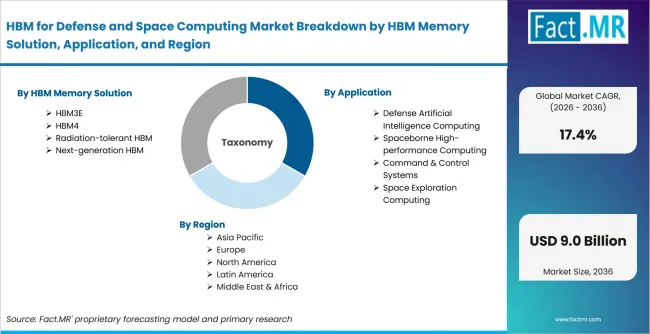
Hbm For Defense And Space Computing Market Breakdown By Hbm Memory Solution, Application, And Region | Source: Fact.MR
| Attribute | Details |
|---|---|
| Quantitative Units | USD billion in 2026 to USD billion by 2036 at CAGR |
| Market Definition | High-bandwidth memory packages used in defense AI, space computing and mission-computer applications where bandwidth, reliability and thermal behavior guide qualification |
| HBM Memory Solution | HBM3E; HBM3; HBM2E; Custom stacked HBM; Low-power HBM variants |
| Application | Defense Artificial Intelligence Computing; Spaceborne Data Processing; Secure HPC Simulation; Mission Sensor Fusion; Edge Inference Platforms |
| End User | Defense Contractors; Space Agencies; Defense Research Labs; Satellite Integrators; Secure Cloud Providers |
| Integration Platform | Mission Computing Modules; GPU Servers; Space Avionics Boards; Rugged Edge Systems; Custom XPU Platforms |
| Packaging Technology | Through-Silicon Via Technology; Silicon Interposers; Hybrid Bonding; 2.5D Packaging; 3D Stacking |
| Regions Covered | North America; Latin America; Europe; East Asia; South Asia and Pacific; Middle East and Africa |
| Countries Covered | USA; South Korea; Japan; Germany; France; UK; Canada |
| Key Companies Profiled | SK hynix Inc.; Samsung Electronics Co., Ltd.; Micron Technology, Inc.; NVIDIA Corporation; Advanced Micro Devices, Inc.; Altera Corporation |
| Forecast Period | 2026 to 2036 |
| Approach | Hybrid top-down and bottom-up approach using defense compute demand; HBM roadmaps; qualification needs; packaging capacity; accelerator integration; thermal requirements; secure sourcing; country adoption and portfolio review |
Source: Fact.MR analysis. Updated Aug 10, 2026
How is the market segmented?
-
By HBM Memory Solution
- HBM3E
- 8-Hi HBM3E
- 12-Hi HBM3E
- HBM4
- Pre-production HBM4
- Early Production HBM4
- Radiation-tolerant HBM
- Radiation-hardened HBM
- Low-power HBM
- Next-generation HBM
- High-bandwidth AI Memory
- Secure Memory Architecture
- HBM3E
-
By Application
- Defense Artificial Intelligence Computing
- Autonomous Defense Systems
- Intelligence Surveillance & Reconnaissance
- Spaceborne High-performance Computing
- Satellite Data Processing
- Missile Guidance Computing
- Command & Control Systems
- Battlefield Decision Systems
- Electronic Warfare Systems
- Space Exploration Computing
- Deep Space Mission Computing
- Orbital Intelligence Processing
- Defense Artificial Intelligence Computing
-
By End User
- Defense Contractors
- Aerospace System Integrators
- Government Defense Agencies
- Space Agencies
- Satellite Manufacturers
- Defense Research Organizations
- Naval Defense Organizations
- Air Force Organizations
- Army Modernization Programs
- Commercial Space Companies
- Launch Service Providers
- Aerospace Research Institutes
- Defense Contractors
-
By Integration Platform
- Mission Computing Modules
- AI Accelerator Cards
- Heterogeneous Compute Modules
- Space-qualified Computing Platforms
- Radiation-hardened Processing Units
- Embedded Mission Computers
- Edge Defense Computing
- High-performance Embedded Systems
- Tactical AI Platforms
- Space-grade Compute Systems
- Orbital Edge Computing
- Secure Mission Platforms
- Mission Computing Modules
-
By Packaging Technology
- Through-Silicon Via Technology
- Advanced TSV Integration
- Hybrid Bonding
- Chip-on-Wafer-on-Substrate
- Micro-bump Packaging
- Fine-pitch Interconnect
- 2.5D Advanced Packaging
- High-density Silicon Interposer
- Advanced Redistribution Layer
- 3D Memory Integration
- High-density Wafer Bonding
- Defense-grade Advanced Packaging
- Through-Silicon Via Technology
-
By Region
- North America
- Latin America
- Western Europe
- Eastern Europe
- East Asia
- South Asia and Pacific
- Middle East & Africa
Frequently Asked Questions
How big is the HBM for defense and space computing market in 2026?
What is the CAGR of the HBM for defense and space computing market from 2026 to 2036?
Which HBM memory solution leads the HBM for defense and space computing market?
Which application leads the HBM for defense and space computing market?
Who are the leading companies in the HBM for defense and space computing market?
Who worked on this report


Preview the report firsthand - request a free sample
Free SampleGet the brochure for pricing and purchase details
Download PDF