- Base Value(2025): 3.3 Bn
- Forecast Value (2035): 11.8 Bn
- CAGR (2035): 19.7%
Spatial Audio Earwear Market Outlook 2025 to 2035
The global spatial audio earwear market is expected to reach USD 11.8 billion by 2035, up from USD 3.3 billion in 2025. During the forecast period 2025 to 2035, the industry is projected to expand at a CAGR of 13.40%.
The demand for immersive audio experiences among consumers is growing in the music, gaming, and AR/VR markets leading to growth in the spatial audio earwear market. Technological advancements in areas such as AI, head-tracking and 3-D audio create opportunities for companies to offer lively, high-fidelity sound.
In addition, the greater utilization of wireless earbuds, smart devices, and streaming services contributes to the growth of spatial audio wearables. Gaming culture and virtual experiences are increasing in popularity. These factors will contribute to the demand for spatial audio applications.
Quick Stats for Spatial Audio Earwear Market
- Industry Value (2025): USD 3.3 billion
- Projected Value (2035): USD 11.8 billion
- Forecast CAGR (2025 to 2035): 13.4%
- Leading Segment (2025): In-ear (earbuds / TWS) (64.9% Market Share)
- Fastest Growing Country (2025-2035): India (13% CAGR)
- Top Key Players: Apple Inc., Sony Corporation, Bose Corporation, Jabra, Sennheiser Electronic, Harman International, Xiaomi, and Boat
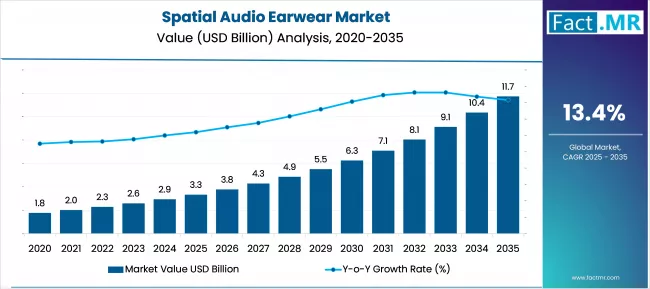
Spatial Audio Earwear Market Market Value Analysis | Source: Fact.MR
What are the drivers of the Spatial Audio Earwear Market?
The demand for extremely immersive and personalized audio experiences in music, gaming, and AR/VR by both consumers and content creators is the main reason for the expansion of the spatial audio earwear market. The significant factor for this market expansion is the evolution of AI, head-tracking, and 3D audio technologies which allow for accurate spatial sound reproduction and user-specific customization.
The integration with digital platforms and streaming services is also a factor that contributes to market growth by facilitating operations and attracting more users. The partnerships between audio hardware manufacturers, software developers, and startups are a major contribution to the pace of innovation in the sector. Besides the global market, there is also a considerable influence of the increasing use of wireless earbuds, smart devices, and gaming peripherals, as well as the inclination of consumers towards authentic, multi-dimensional sound experiences.
What are the regional trends of the Spatial Audio Earwear Market?
The spatial audio earwear market has different trends for each region that are influenced by how technology is adopted and the demand of consumers. To summarize, North America is at the forefront of early growth in all aspects of AI-based spatial audio, premium headphones, and immersive entertainment offerings.
In contrast, Western Europe emphasizes accuracy, product quality, and higher-fidelity sound quality both for professional and consumer applications. Western Europe is more focused on accuracy, product quality, and high-fidelity sound both for professional and consumer use.
In the Asia-Pacific region, the market for earwear is booming as a result of the fast-paced development of the gaming, streaming, and mobile device industries in China, India, and Southeast Asia, which in turn, is pushing up the need for cheap and innovative earwear.
Latin America has been showing a lot of potential for spatial audio through various startup initiatives and retail expansion, whereas the Middle East and Africa are concentrating on the use of immersive audio technologies to, basically, make their products different and gain more customers.
What are the challenges and restraining factors of the Spatial Audio Earwear Market?
The integration of AI-driven spatial audio technology into the existing hardware and production workflow of the spatial audio earwear market is one of the major challenges among different issues which this market has to confront. SMEs may find it difficult to implement high-precision head-tracking, 3D audio processing, and software optimization due to their lack of sufficient finance and technical knowledge.
Besides that, growth of the market depends on the regional technological infrastructure, the set of regulatory standards, and the availability of skilled audio engineers and software developers. Limited supply chains for components, high development costs, long testing periods, and slow consumer adoption in emerging markets are some of the factors that further limit the scale and the possibility of a wide-spread deployment of this technology.
Country-Wise Insights
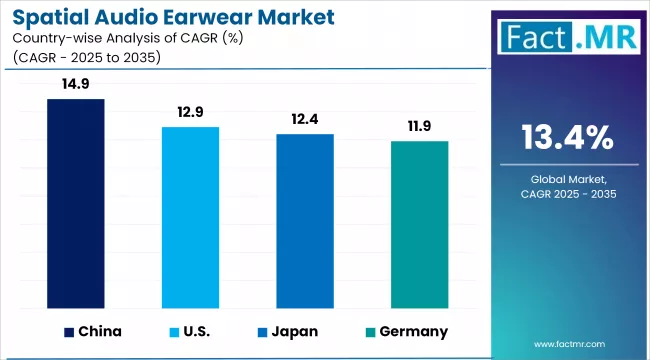
Spatial Audio Earwear Market Cagr Analysis By Country | Source: Fact.MR
United States leads Spatial Audio Earwear with early adoption
The United States is the chief spatial audio earwear market player on a global scale that can be attributed to the rapid implementation of state-of-the-art audio technological devices and a sound entertainment ecosystem. In order to access immersive music, gaming, and AR/VR experiences, consumers adopt spatial audio devices of over-ear, on-ear, and in-ear types more and more. Therefore, a few of the leading tech companies like Apple, Bose, and Sonos are in the forefront of the technological breakthrough by introducing AI-driven sound personalization and head-tracking technologies.
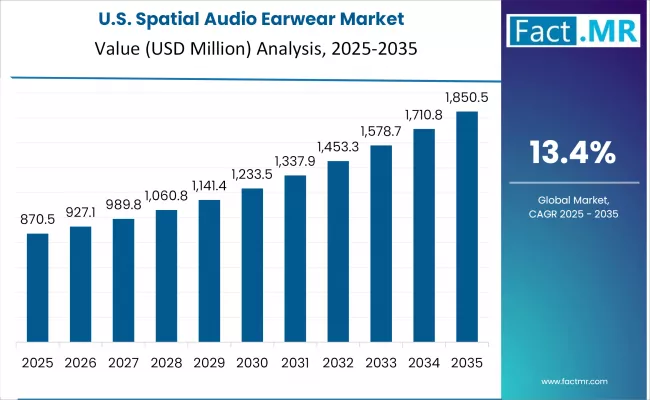
Spatial Audio Earwear Market Country Value Analysis | Source: Fact.MR
Besides that, market growth is being propelled by ample average disposable incomes, a high rate of streaming service usage, and the integration of spatial audio in smartphones, gaming consoles, and smart home devices. In addition to these effects, Regulatory support and advanced digital infrastructure are further becoming facilitators of scalability and consumer trust.
China rapidly grows Spatial Audio Earwear market through innovation
China is one of the leading markets for the Spatial Audio Earwear Industry in the world. It has been growing very fast with a great consumer base and increasing disposable incomes. The market expansion is mainly due to increasing the penetration of smartphones, the popularity of gaming, and the wide adoption of wireless earbuds and TWS devices in the country.
The local companies such as Huawei, Xiaomi, and OPPO, are heavily investing in AI-powered spatial audio and 3D sound technologies to meet the needs of the consumers. The usage of streaming platforms, AR/VR applications, and immersive entertainment experiences are the main factors that are leading to the adoption of these technologies.
The government's support to digital infrastructure, urbanization, and e-commerce expansion are other factors that are strengthening the market. China is charting a very high CAGR in this sector and it is expected to continue holding one of the highest CAGRs globally in this sector.
Germany emphasizes premium Spatial Audio Earwear and high-fidelity audio
Germany is a typical example of a Spatial Audio Earwear Market that's well-developed and has a strong demand for premium and high-fidelity audio devices. The country is very precise in its engineering, innovative and strict in its compliance with regulations, thus creating a lot of opportunities for manufacturers who provide immersive audio solutions.
German consumers are a perfect target for manufacturers of over-ear and in-ear headphones with spatial audio, as they use these devices mainly for gaming, music, and professional content creation. Both local and international brands such as Sennheiser, Beyerdynamic, and Bose are actively competing here, by implementing AI-enhanced audio processing and personalized sound experiences.
The market growth is additionally fueled by the AR/VR uptake, the expansion of the gaming industry, and the increasing trend of digital entertainment consumption, thus, placing Germany at the center of spatial audio innovation in Europe.
Category-Wise Analysis
In-ear earbuds dominate market with portability and AI spatial audio
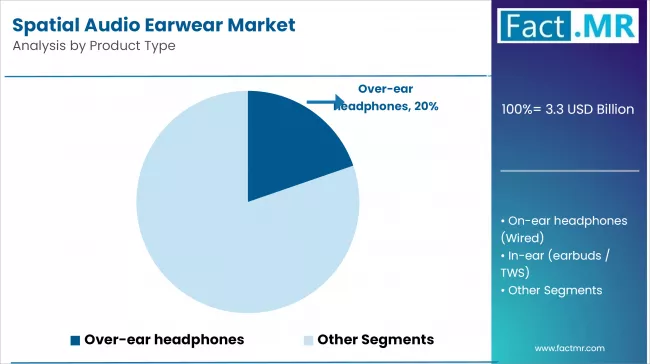
Spatial Audio Earwear Market Analysis By Product Type | Source: Fact.MR
The in-ear category, which comprises earbuds and true wireless stereo (TWS) units, is the major contributor to the Spatial Audio Earwear Market. The reasons include are portability, ease of use, and a very common integration with smartphones. More and more users choose TWS earbuds for travel, audio/video streaming, and getting an immersive audio experience.
A number of companies like Apple, Sony, and Samsung are putting AI-powered spatial audio, 3D sound, and head-tracking features into these small gadgets. The market is expanding due to high rates of adoption in Asia-Pacific and North America, as well as the compatibility of mobile apps, gaming, and streaming platforms. The segment of in-ear devices is the fastest worldwide, thanks to the price factor and the increasing wireless demand.
Gaming headsets grow rapidly due to immersive spatial audio experiences
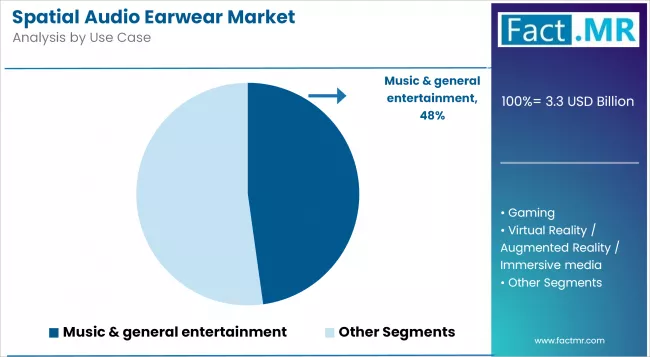
Spatial Audio Earwear Market Analysis By Use Case | Source: Fact.MR
In the gaming market segment, which is growing very fast due to the rise of immersive experiences being a must for both competitive and casual gaming, Spatial Audio Earwear significantly improves the perception of directional sound, in-game awareness, and immersion, thus, professional gamers as well as gaming enthusiasts, can benefit from it.
Both over-ear and in-ear gaming headsets are increasingly using AI, head-tracking, and 3D audio algorithms to provide precise audio cues. The high adoption rate in North America, Europe, and Asia-Pacific is the result of the growth of esports, VR/AR integration, and multiplayer online platforms.
Partnerships between audio brands and game developers are becoming the next big thing in innovation. This segment is very profitable as the users are ready to pay a high price for high-performance, low-latency, spatially aware audio devices.
Online segment expands via streaming, virtual events, and AI audio
The online division concentrates on streaming platforms, virtual events, remote collaboration, and social media content consumption. Spatial Audio Earwear improves online interactions by delivering immersive audio for music streaming, virtual meetings, and engaging media. The main reasons for adoption are AI-driven audio personalization, adaptive noise control, and platform integration.
The growth of the market is being accelerated by the rapid spread of high-speed internet, the increased consumption of digital media, and the rise of subscription-based streaming services, mainly in urban areas of North America, Europe, and Asia-Pacific.
Companies are collaborating with online content providers to enhance the spatial audio experience for users. This segment is representative of the interrelation of hardware, software, and cloud services, thus providing numerous possibilities for market expansion.
Competitive Analysis
Key players in the spatial audio earwear market include Apple Inc., Sony Corporation, Bose Corporation, Samsung Electronics, Jabra, Sennheiser Electronic GmbH & Co. KG, Harman International (JBL), Xiaomi and Boat
The spatial audio earwear sector is a competitive field, with the big competitors being Apple, Sony, Bose, Sennheiser, and Samsung, which sustain significant commitments to AI-driven audio personalization, head-tracking technologies and 3D audio. Companies also differentiate intrinsic characteristics including musical fidelity, immersive experiences, portability, battery life, and software support.
Innovations in spatial audio, noise-fogging devices, and compatibility with streaming services alter the future landscape. Partnerships with the gaming industry, VR/AR companies, and technology start-ups help broaden the marketplace. Market leadership is dependent on R&D, and understanding of consumer experience, in addition to scaling audio ecosystems that can reach consumers.
Competitive advantages are achieved through pricing and trusted brands, through insight on consumer preference and customization, and through alignment with evolving audio taste of consumers.
Recent Development
- In September 2024, Apple launched the AirPods 4, making a massive leap in sound and design. The sound quality has significantly enhanced with a new acoustic architecture, a low-distortion driver, and a high dynamic range amplifier. The AirPods 4 now includes Personalized Spatial Audio with dynamic head tracking to enhance listening for media consumption.
- In May 2024, Sonos announced the Ace to the public a new premium pair of over-ear Bluetooth headphones. The Ace offers stylish lossless audio with spatial audio, Active Noise Cancellation (ANC) that is industry-leading, and Aware Mode too.
Fact.MR has provided detailed information about the price points of key manufacturers of Spatial Audio Earwear Market positioned across regions, sales growth, production capacity, and speculative technological expansion, in the recently published report.
Methodology and Industry Tracking Approach
The Fact.MR (2025) report for the global Spatial Audio Earwear Market analyzed a sample of 6,500 respondents in 22 countries, ensuring a minimum of 150 respondents per market. The sample consisted of approximately 70% end-users (gamers, music lovers, and professional content creators for audio) and 30% industry experts (audio engineers, AI professionals, hardware developers). Data on AI, device types, software features, pricing trends, and market opportunities was collected between September 2024 and October 2025. Market forecasts were developed from over 140 secondary sources, including company reports, patents, industry journals, and standards, and then electronically catered with regression and scenario-based forecasting methods.
With Fact.MR monitoring consumer behavior, product efficacy, industry trends, and market opportunities since 2018, this report is becoming an authoritative source of information that stakeholders can rely on.
Segmentation
Segmentation of Spatial Audio Earwear Market
-
By Product Type :
- Over-ear headphones
- On-ear headphones
- In-ear (earbuds / TWS)
-
By Use Case :
- Music & general entertainment
- Gaming
- Virtual Reality / Augmented Reality / Immersive media
- Professional / Studio / Content Creation
- Other specialized uses
-
By Price :
- Entry / Budget
- Mid-Range
- Premium / Flagship
-
By Distribution Channel :
- Online
- Offline
-
By Region :
- North America
- Latin America
- Western Europe
- Eastern Europe
- East Asia
- South Asia & Pacific
- Middle East & Africa
Frequently Asked Questions
What was the global Spatial Audio Earwear Market size reported by Fact.MR for 2025?
Who are the major players Operating in the Spatial Audio Earwear Market?
What is the estimated valuation of the Spatial Audio Earwear Market in 2035?
What Value CAGR did the Spatial Audio Earwear Market exhibit over the last five years?
Who worked on this report


Preview the report firsthand - request a free sample
Free SampleGet the brochure for pricing and purchase details
Download PDF