The Spill Kits Market is analyzed across its key product, application and end-use segments, with the study covering market dynamics, regional trends and demand outlook, forecast 2026 to 2036.
By Fact.MR Industrial Goods DeskFact-checked under the Fact.MR editorial processUpdated
11 min read
Spill Kits Market Forecast and Outlook 2026 to 2036
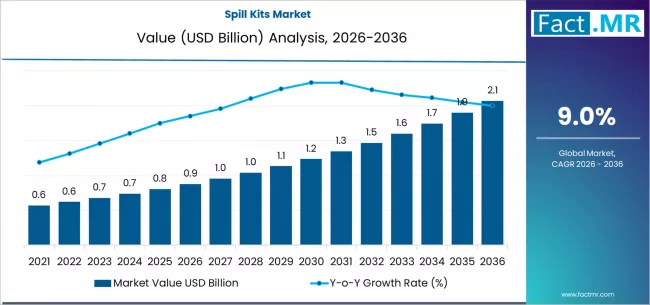
The global spill kits market is projected to total USD 0.87 billion in 2026, and to USD 2.07 billion by 2036, progressing at a 9.0% CAGR.
This steady growth is anchored in the non-negotiable requirement for regulatory compliance and workplace safety across industrial and commercial sectors.
Spill Kits Market Market Value Analysis | Source: Fact.MR
Summary of Spill Kits Market
MarketSnapshot
Global spill kits market revenue stood at USD 0.87 billion in 2026 and is forecasttreachUSD 2.07 billion by 2036.
At a 9.0% CAGR from 2026 t2036, this market is settexpand~2.38x in value, adding USD 1.20 billion in absolute opportunity.
Growth is being driven by increasingregulatory requirementsfor industrial safety and hazardous spill management.
Rising demandfor rapid spillresponse systems across industrial and chemical facilitiesis reinforcing market expansion.
Advancements inabsorbenttechnologies and portable containment systemsare improvingspillcontrol efficiency and operational safety.
Demand andGrowth Drivers
Increasingfocus on industrial safety and environmental compliance
North America, Latin America, WesternEurope, Eastern Europe, East Asia, South Asia & Pacific, Middle East & Africa
Environmental protection agencies and occupational safety regulations worldwide mandate preparedness for accidental releases of oils, chemicals, and other hazardous liquids, making spill response kits a compulsory capital expense rather than a discretionary safety item. The expansion is further driven by the increasing complexity of industrial operations and global supply chains, where the volume and variety of handled fluids continue to rise. Modern kits are evolving from generic supplies to specialized, scenario-specific solutions that offer faster, effective containment and minimal operational downtime. This transforms them from passive insurance items into active risk management tools that directly protect assets, prevent environmental fines, and safeguard corporate reputation.
North America, Latin America, Western Europe, Eastern Europe, East Asia, South Asia & Pacific, Middle East & Africa
Industrial Automation and Safety Integration: Beyond the Closet Kit
Growth patterns are increasingly influenced by integration with broader industrial automation and safety management systems. The rise of connected factories and smart warehouses creates demand for spill response solutions that are logged within digital asset management platforms, with usage triggers for automatic reordering.
Advancements in industrial IoT enable the deployment of spill detection sensors that can automatically alert personnel and even specify the optimal kit type based on the detected fluid. This trend moves spill response from a manual, reactive procedure to a monitored, data-informed component of overall plant safety and operational efficiency protocols.
Segmental Analysis
By Technology, Which Innovation Maximizes Response Efficiency and Minimizes Secondary Waste?
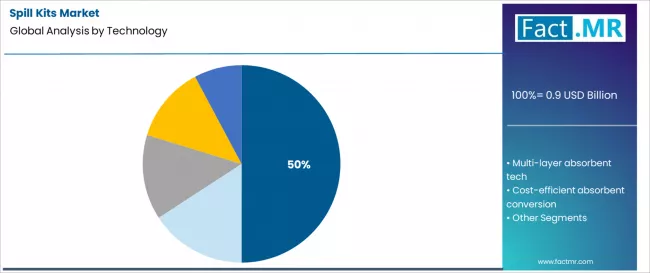
Spill Kits Market Analysis By Technology | Source: Fact.MR
High-absorption melt-blown media commands a leading 50.0% share. This technology produces ultra-fine polypropylene fibers with immense surface area, creating absorbents that can hold many times their weight in fluid.
This efficiency is critical because it allows for smaller, more manageable kits that are easier to deploy and store, while also reducing the volume of saturated waste that must be handled and disposed of post-incident. Advancements in this media directly translate to faster cleanup, lower logistical burdens, and improved cost-effectiveness for end-users.
By End-Use, Which Sector Faces the Broadest Range of Spill Risks and Regulatory Oversight?
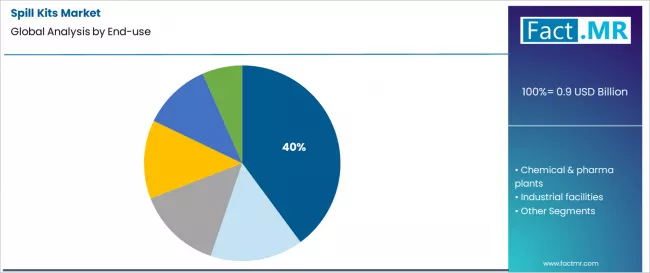
Spill Kits Market Analysis By End Use | Source: Fact.MR
The industrial and manufacturing segment constitutes the primary end-user at 39.9%. Facilities in this sector handle diverse materials including oils, coolants, solvents, and chemical intermediates. This variety necessitates a range of kits, from universal to chemical-specific, to ensure compliant and effective response.
The high concentration of assets, continuous operations, and strict OSHA and EPA regulations make robust spill preparedness a fundamental operational requirement, driving consistent demand for both initial kits and ongoing replenishment.
By Product Type, Which Kit Category Offers the Optimal Balance of Preparedness and Practicality for Most Sites?
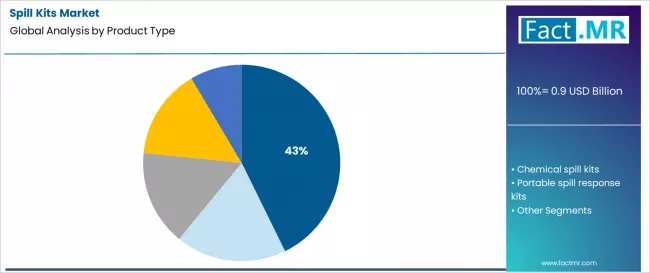
Spill Kits Market Analysis By Product Type | Source: Fact.MR
Universal and oil-only kits hold a dominant 42.8% share. These kits address the most common spill scenarios encountered across transportation, warehousing, and machinery maintenance. Their popularity stems from providing a cost-effective, versatile first line of defense suitable for a wide array of facilities without the need for highly specialized chemical identification before response, making them the default choice for baseline compliance and general risk mitigation.
What are the Principal Drivers, Constraints, and Evolving Dynamics of the Spill Kits Market?
In cost-conscious industries, competition often centers on price over performance, squeezing margins and potentially delaying adoption of advanced, higher-efficacy solutions.
Growth of Hazardous Material Handling in Emerging Economies
Industrial expansion in regions like Asia-Pacific introduces formal spill response requirements to thousands of new facilities, generating fresh volume demand.
Development of Eco-Friendly & Biodegradable Absorbents
Sustainability pressures are driving R&D into plant-based and readily degradable absorbent materials, creating a new premium segment aligned with corporate ESG goals.
Analysis of the Spill Kits Market by Key Countries
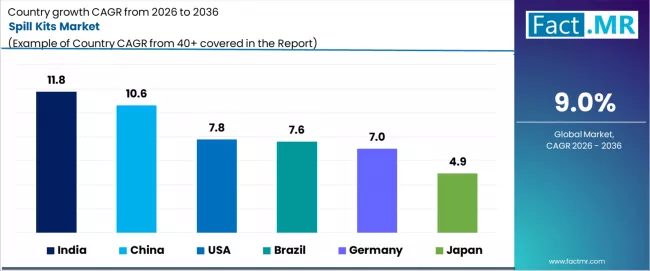
Spill Kits Market Cagr Analysis By Country | Source: Fact.MR
Country
CAGR 2026 to 2036
USA
7.8%
Germany
7.0%
China
10.6%
India
11.8%
Brazil
7.6%
Japan
4.9%
How do Regulatory Enforcement and a Mature Industrial Base define the Landscape in USA?
A 7.8% CAGR reflects steady demand within a mature industrial sector governed by rigorous EPA and OSHA enforcement. The demand driver is strongest in industrial & manufacturing and oil & gas, where routine inspections ensure compliance.
The presence of major safety product distributors and manufacturers like Brady ensures a competitive landscape. Procurement is often standardized across large corporations, focusing on kits that meet specific regulatory benchmarks and can be integrated into enterprise-wide safety management systems.
What characterizes Germany's Precision-Driven and Regulation-Led Adoption Patterns?
A 7.0% CAGR underscores a market shaped by strict EU regulations like REACH and German industrial safety ordinances. The focus is on high-quality, reliable kits for chemical & pharma plants and precision manufacturing, where incorrect response can cause significant production or environmental damage.
Domestic specialists like Denios are key players, emphasizing engineering, certification, and providing comprehensive risk assessment services alongside product sales, reflecting a solutions-based rather than transactional approach.
What Underpins China's Rapid Industrial Expansion and Evolving Safety Standards?
The massive scale of new industrial facilities and chemical plants, coupled with gradually tightening national workplace and environmental safety standards, fuels China’s 10.6% CAGR. The primary demand driver is the foundational need to equip these sites with basic spill response capabilities.
This fuels high-volume production of portable spill response kits and cost-efficient absorbent conversion technologies, with domestic manufacturers scaling rapidly to meet the needs of both state-owned and private enterprises.
Why is India's Industrial Formalization and Infrastructure Growth a Primary Catalyst?
India's leading 11.8% CAGR is propelled by the ongoing formalization and expansion of its manufacturing sector and large-scale infrastructure projects. The demand driver is the establishment of safety protocols in thousands of new and upgraded industrial facilities.
This environment prioritizes affordability and durability, fostering growth for domestic manufacturers like SpillTech India that offer products tailored to local price points and conditions, often sold through extensive distributor networks.
How is Brazil's Focus on Logistics and Commodity Exports Shaping Demand?
A 7.6% CAGR is closely tied to the needs of its large warehousing & logistics sector and agricultural export industries where oils and fuels are handled. The demand driver centers on preventing contamination and operational disruption in storage and transport hubs.
Adoption focuses on mobile spill kits and practical, low-cost absorbent formats that provide effective response without significant capital investment, aligning with the economic realities of many regional operators.
What defines Japan's Niche in High-Stakes, Precision-Risk Environments?
Japan's 4.9% CAGR represents a mature, high-standard market focused on mitigating risks in sensitive environments like electronics precision manufacturing and high-density urban industrial zones. Demand is driven by the extreme cost of disruption or contamination.
Japanese procurers seek ultra-reliable, compact kits with superior absorbent media, often from specialized suppliers like Yamazen, and prioritize seamless integration into meticulously maintained safety and lean manufacturing processes.
Competitive Landscape of the Spill Kits Market
The competitive environment is fragmented, spanning global safety conglomerates, specialized spill response companies, and regional manufacturers. Major players like Brady and New Pig compete through extensive product ranges, strong brand recognition in safety procurement, and robust distribution networks that serve multinational corporations. Specialists such as Denios differentiate through deep expertise in chemical-specific applications and complete secondary containment systems.
Competition is intensifying around the development of sustainable absorbent materials, the provision of digital inventory and compliance management tools, and the ability to offer tailored kits for emerging risks like battery electrolyte spills in the EV sector. Channel strategy is critical, with a blend of direct sales to large industrial accounts and a reliance on safety and industrial supply distributors to reach a vast base of small and medium-sized enterprises.
Key Players in the Spill Kits Market
Brady Corporation
New Pig Corporation
Denios AG
ShanghAI Weiyi
SpillTech India
Yamazen Corporation
Bibliography
European Chemicals Agency (ECHA). (2024). Guidance on the Safe Management of Chemical Spills at Workplace.
National Fire Protection Association (NFPA). (2025). NFPA 30: Flammable and Combustible Liquids Code.
Occupational Safety and Health Administration (OSHA). (2024). Standard 1910.120: Hazardous Waste Operations and Emergency Response.
Spill Control Association of America (SCAA). (2025). White Paper: Trends in Spill Response Technology and Training.
U.S. Environmental Protection Agency (EPA). (2024). Oil Spill Prevention and Response Regulations Overview.
World Bank Group. (2024). Environmental, Health, and Safety Guidelines for Manufacturing.
Brady, New Pig, Denios, ShanghAI Weiyi, SpillTech India, Yamazen
Additional Analysis
Comparative absorption capacity and speed testing across material types; total cost of ownership analysis including waste disposal; study of regulatory variance across key regions; impact of kit design on user compliance and correct deployment; analysis of the used absorbent waste management and recycling ecosystem.
Market by Segments
End-Use :
Industrial & Manufacturing
Chemical & Pharma Plants
Industrial Facilities
Warehousing & Logistics
Oil & Gas
Precision Manufacturing
Product Type :
Universal & Oil-Only Kits
Chemical Spill Kits
Portable Spill Response Kits
Mobile Spill Kits
Others
Absorbent Material :
Polypropylene Absorbents
Chemical-resistant Synthetics
PP & Cellulose Blends
Cellulose & PP
Others
Technology :
High-Absorption Melt-Blown Media
Multi-Layer Absorbent Tech
Cost-Efficient Absorbent Conversion
Low-Cost Absorbent Formats
Others
Region :
North America
USA
Canada
Latin America
Brazil
Mexico
Argentina
Rest of Latin America
Western Europe
Germany
France
Italy
Spain
UK
BENELUX
Rest of Western Europe
Eastern Europe
Russia
Poland
Czech Republic
Rest of Eastern Europe
East Asia
China
Japan
South Korea
Rest of East Asia
South Asia & Pacific
India
ASEAN
Australia
Rest of South Asia & Pacific
MEA
GCC Countries
South Africa
Turkiye
Rest of MEA
Frequently Asked Questions
How big is the spill kits market in 2026?
The global spill kits market is estimated to be valued at USD 0.9 billion in 2026.
What will be the size of spill kits market in 2036?
The market size for the spill kits market is projected to reach USD 2.1 billion by 2036.
How much will be the spill kits market growth between 2026 and 2036?
The spill kits market is expected to grow at a 9.0% CAGR between 2026 and 2036.
What are the key product types in the spill kits market?
The key product types in spill kits market are industrial & manufacturing, chemical & pharma plants, industrial facilities, warehousing & logistics, oil & gas and precision manufacturing.
Which product type segment to contribute significant share in the spill kits market in 2026?
In terms of product type, universal & oil-only kits segment to command 42.8% share in the spill kits market in 2026.