- Forecast Value (2035): 3310.3 Mn
- CAGR (2035): 7.8%
CNC Retrofits Kits Market Outlook 2025 to 2035
The global CNC retrofits kits market is expected to reach USD 3,310.3 million by 2035, up from USD 1,591.3 million in 2025, reflecting a projected CAGR of 7.6% over the forecast period.
A key reason for the increased demand for CNC retrofit kits worldwide is the desire to not only keep but also increase the performance of CNC machines for various industries including the automotive, aerospace, general engineering, and heavy industries sectors by upgrading their CNC controllers.
In an environment where the purchase of new CNC machines is considered as a capital-intensive move, many manufacturers are turning to retrofit kits as a cheaper option to upgrade the performance, accuracy, and networking capabilities of their old machines.
By fitting advanced CNC controls, servo drives, and digital interfaces, older machines become almost as good as new ones in terms of performance, thus reducing the time lost due to machine failure and improving the overall equipment effectiveness rate.
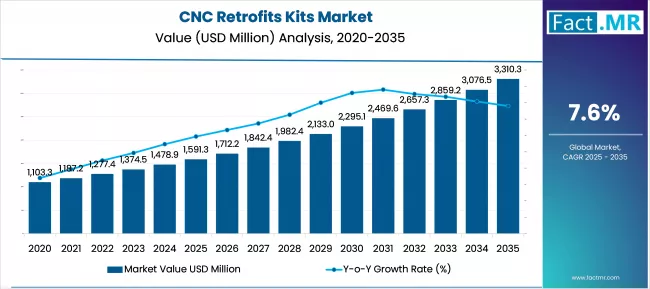
Cnc Retrofits Kits Market Market Value Analysis | Source: Fact.MR
What is driving demand for CNC Retrofits Kits globally?
The widespread adoption of Industry 4.0, smart manufacturing, and IoT-based monitoring systems is persuading industries to upgrade their machines with modern control units and sensors to facilitate real-time data access and predictive maintenance. The trend towards energy efficiency, precision machining, and automation has also led to a surge in the demand for retrofits as these packages make it possible to achieve better energy efficiency, reduced energy consumption, and compatibility with robots or automated production cells through upgraded hardware and software.
Furthermore, the implementation of strict quality standards, the shortage of skilled labor, and the setting of sustainability targets are some of the reasons why industries have decided to upgrade their assets through retrofitting instead of purchasing new machines. In sum, the demand of CNC Retrofit Kits worldwide is largely influenced by the factors of modernization, cost savings, digital connectivity, and environmental friendliness as manufacturers from different sectors are looking to increase their productivity and be able to compete in an industrial landscape that is increasingly automated.
What are the regional dynamics of the CNC Retrofits Kits Market?
Europe
The European market for CNC retrofit is technologically advanced and has very strict regulations standards in terms of quality and safety. Germany, Italy, and the U.K. are the top three countries in this market, where retrofit kits are used not only to meet energy-saving targets but also to comply with the requirements of Industry 4.0.
The primary features are precision upgrades, digital integration, as well as compliance with CE and environmental standards. The aerospace, automotive, and defense industries, being the major players in the market, driven by the factors of achieving higher accuracy, sustainability, and optimization of the performance of the old CNC systems, are thus the key adopters.
Asia-Pacific
The CNC retrofit market in the Asia-Pacific region is expanding very fast, and the four countries China, Japan, India, and South Korea are the major contributors to this growth. The principal reasons for such a refurbishment demand are industrialization at a fast pace, the expansion of the automotive and electronics manufacturing, and modernization programs.
Retrofitting is a method that manufacturers can use to get new capabilities, increase productivity, and at the same time embrace automation without having to make a huge capital investment. Regional industries by the use of servo systems, modern controllers, and IoT solutions are not only raising productivity levels but also becoming more competitive in the global market.
Latin America
The Latin America area, after the example of Brazil and Mexico, is slowly embracing the use of CNC retrofit kits for the extension of machine life and for achieving higher precision in machining. The manufacturers, who take care of their costs, in the sectors of the automotive industry, energy, and metalworking are the ones mainly turning to retrofits as a way to avoid the heavy expenditure on new machinery.
The growth of the market is being supported by several measures such as awareness campaigns, technical collaborations, and training programs, especially among small and medium-sized enterprises.
Middle East & Africa
The Middle East and Africa are two new markets with a lot of potential for the future, a rise in potential being mainly driven by investments in the energy sector, defense, and manufacturing diversification. The countries like Saudi Arabia, the UAE, and South Africa are equipping their workshops with retrofit kits for the purposes of performance, reliability, and energy efficiency improvement. The region’s emphasis on industrial modernization, localized manufacturing, and sustainability is the main reason why the retrofit usage will be further accelerated in the upcoming years.
What are the challenges and restraining factors of CNC Retrofits Kits market?
The CNC Retrofit Kits Market is limited by its set of challenges, which have thus far prevented it from being widely adopted. A major one of these challenges is the high cost of the retrofit projects at their inception, which accounts for not only the price of the retrofit kits, but also the installation, calibration, integration, and skilled labor costs.
Hence the total investment in upgrading legacy machines may be as much as the cost of new equipment for small and medium-sized manufacturers, thus, upgrade choices are less attractive in price-sensitive markets.
It is also the lack of skilled technicians and engineers who are technically proficient in advanced retrofit installations and system integrations that erects most barriers to the adoption of retrofits. Moreover, retrofitting requires knowledge of the product’s electrical, mechanical, and software aspects, and the absence of such proficiencies may result in improper execution and prolonged downtime.
Besides, the compatibility problems between the old hardware and the new CNC systems can significantly delay the completion of a project, especially if the machines are very old or contain components of a particular brand unknown to the person who is to work on the retrofit.
The market also encounters obstacles in the form of differences in regulations and the need for standardization that become very apparent in the precision, safety, and certification-dependent industries. Discrepancies in the compliance regulations across different regions make it hard for the manufacturers of retrofit kits to offer solutions that are accepted everywhere.
Also, the demand for the retrofit kits is limited because most small workshops and, in general, the SME sector in emerging markets do not know about the benefits of retrofits. Moreover, problems such as inadequate after-sales service, long lead times for parts, and difficulties in integrating IoT or smart manufacturing features into older equipment slow down the market development pace.
The difficulty of upgrading old infrastructures while at the same time maintaining productivity is still the major problem, especially for those manufacturers who are operating under the pressure of a tight production schedule and cost constraints.
Country-Wise Outlook
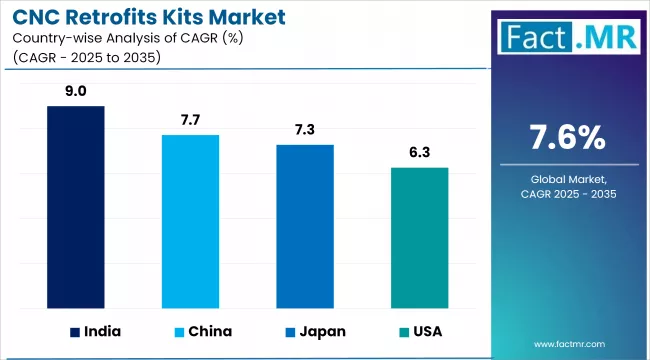
Cnc Retrofits Kits Market Cagr Analysis By Country | Source: Fact.MR
United States leads in advanced and reliable CNC retrofit solutions
The United States is now a key market for high-performance and reliable CNC retrofit technologies, spurred by strong usage of these systems in aerospace, automotive, defense and industrial manufacturing. Market growth is supported by both Federal and State incentive programs dedicated to advanced manufacturing, digital transformation and smart factory initiatives. Federal funding and partnerships with universities and technology institutes are also increasing the technical knowledge base required for modern retrofit integration and automation upgrades
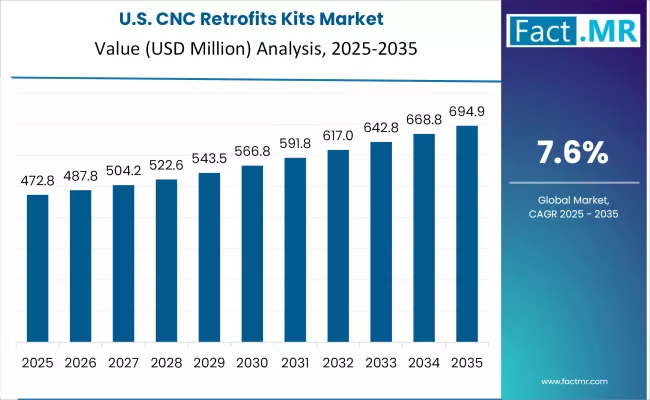
Cnc Retrofits Kits Market Country Value Analysis | Source: Fact.MR
U.S. manufacturers have also increasingly begun to invest in high-precision and energy-efficient retrofit systems that are enabled by IoT applications that increase productivity, decrease operational costs and improve the useful life of legacy CNC machinery. Industries focused on sustainability, efficiency and consistent performance levels are choosing to retrofit existing equipment as opposed to replacing machines altogether. Working with certified retrofit providers and skilled system integration firms together with robust after-sales support assures smooth transition during implementation and compliance with industry standards.
China is coupling local production with government support to achieve large-scale adoption
China is becoming a major market on the CNC retrofit kit, which is supported by the strong local manufacturing base, low-cost manufacturing and vertically integrated supply chains. The policies and programs by the government like Made in China 2025 and intelligent manufacturing are pushing the manufacturers to retrofit the old machines used in the automotive, aerospace, and energy sectors. The retrofit packages are more accurate, efficient, and automated and use IoT-based monitoring to implement proactive maintenance.
The proximity of parts including the CNC controllers and the servo drives reduce the cost and raise the rate of its adoption. Strict industrial and safety requirements enable retrofitted machines to be trustworthy and in conformity, which can propel China into a rapid expanding market in terms of efficient and scalable CNC retrofitting solutions.
Germany leads the use of CNC retrofit, which is precise and sustainably oriented
Germany, with the help of the European Union, is facilitating the development of high manufacturing and environmentally friendly industrial projects, which will support the implementation of CNC retrofit kit in the automotive, aerospace and precision engineering industries. Focus is made on retrofitting old machines to improve on the accuracy, productivity, and also on the energy efficiency besides ensuring that the machines meet high EU standards regarding safety, environmental compliance and reliability too.
Local manufactures, European OEMs and technology suppliers have collaborated to provide access to high quality retrofit solutions and make it easy to add modern controllers, servo drives and automation capabilities to existing machinery. The main reason to use retrofit kits as the means to increase the machines lifetime, minimize energy consumption, and retain the competitive level of manufacturing processes without compromising with the environmental agenda is supported by government-sponsored programs and sustainability policy, such as EU industrial modernization initiatives.
Category-Wise Analysis
Vertical Machining Centers (VMC) remain dominant in retrofit applications requiring high precision
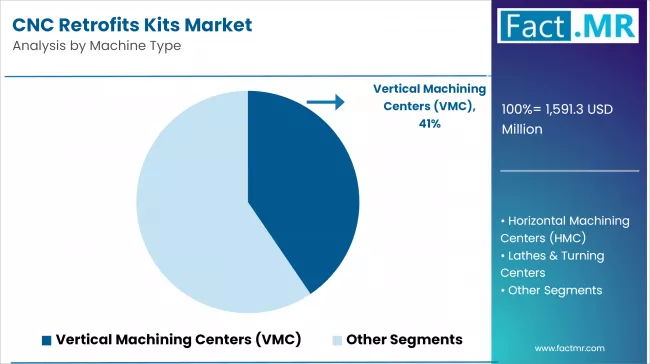
Cnc Retrofits Kits Market Analysis By Machine Type | Source: Fact.MR
Vertical Machining Centers (VMC) are still highly used in retrofit applications where precision is a need. The most common retrofitted machines are Vertical Machining Centers in aerospace, automotive and precision engineering industries where high precision, advanced CNC contros as well as IoT-enabled automation are critical. Upgrading VMCs leads to better motion control, less downtime, and longer life of older machines, and therefore they can be applicable in a high-volume, high-precision production process, and be connected to new manufacturing technologies to enhance their efficiency and productivity.
Horizontal Machining Centers (HMC) are fuelling the new demand in the area of multi-axis performance upgrades
Retrofitting of the Horizontal Machining Centers is becoming more common in order to provide multi-axis accuracy, larger parts and better throughput in automotive, aerospace, and heavy machinery industries. Modern drives, spindle systems, and advanced controllers are also available as upgrades, enabling these machines to be both more precise and faster, and enable them to be integrated into automated production lines, at the same time supporting energy efficiency, predictive maintenance, and Industry 4.0 readiness
Competitive Analysis
The market for CNC retrofit kits is moderately concentrated, with several key companies having a significant percentage of the global value of the market. To remain viable and competitive in this market, companies are concentrating on such levers as precision, reliability, ease of integration, energy utilization, and after sales support.
Manufacturers are getting control of the advanced retrofit solutions, plus the modern CNC controls, servo and spindle updates, IoT enabled monitoring or automation integration, thus assuring to legacy machines almost new performance. Features like modular design for easy replacement, adaptability to more than one machine type, and ease in integrating sold production lines make up key differentiating features.
After sales service, technical training and local support are a necessary ingredient to industrial clients in that they will realize a certified, reliable and long-termed retrofitted system for high volume production or high precision uses. Cost effective and adaptable systems will continue to be leaders where funds are limited or small-scale operations are attempted.
The market is in a gradual movement toward consolidation in that the larger suppliers are furnishing complete retrofit solutions, thus allowing for a movement toward standardization and some moderate price competition. Pricing pressure is more intense in the growing markets where the local suppliers may compete on a price basis as opposed to a means of technological differentiation.
The major players are: Siemens AG, Fanuc Corporation, Mitsubishi Electric Corporation, Bosch Rexroth AG, Heidenhain GmbH, Fagor Automation, NUM AG, Delta Electronics, Inc., Centroid CNC, and MachMotion Inc.
The study was conducted over a 12-month period (June 2024 - May 2025) across 18 countries, combining both demand- and supply-side data to assess the global CNC Retrofit Kits Market. The primary research included over 5,000 respondents, comprising manufacturing plant operators, machine tool OEMs, maintenance engineers, system integrators, and retrofit solution providers across automotive, aerospace, energy, and general engineering sectors.
Primary research focused on:
- Replacement, modernization, and upgrade cycles of legacy CNC machines.
- Preferences for retrofit solutions, including CNC controllers, servo drives, spindle upgrades, HMI panels, and IoT-enabled monitoring systems.
- Application-specific requirements, such as precision, speed, energy efficiency, and automation integration.
- Compatibility with multiple machine types, including vertical and horizontal machining centers, lathes, milling, and grinding machines.
Secondary validation was completed using:
- Industry standards and compliance guidelines from ISO, CE, and regional manufacturing authorities.
- Operational data and adoption trends from national manufacturing associations, industrial reports, and OEM publications.
- Supplier-level analysis based on product catalogs, annual reports, technical datasheets, and retrofit case studies.
Benchmarking and analysis included:
- Performance evaluation of retrofitted CNC machines in terms of accuracy, repeatability, and throughput improvement.
- Assessment of lifecycle costs, maintenance intervals, and operational efficiency gains.
- Analysis of aftermarket support, modular retrofit kits, and integration capabilities with existing production systems.
Since 2018, the market has been tracked within Fact.MR’s extended CNC Machine Modernization Program, focusing on improving legacy machine productivity, operational reliability, and the adoption of high-performance retrofit solutions across diverse manufacturing sectors.
Segmentation
Segmentation of CNC Retrofit Kits market
-
By Machine Type :
- Vertical Machining Centers (VMC)
- Horizontal Machining Centers (HMC)
- Lathes & Turning Centers
- Grinding Machines
- Milling Machines
- Drilling & Tapping Machines
- Boring Mills
- EDM / Wire-EDM Machines
- Special Purpose Machines
-
By Retrofit Type :
- Control Retrofit (CNC Controller Upgrade)
- Drive & Servo Retrofit
- Spindle Retrofit
- HMI / Operator Interface Retrofit
- IoT & Connectivity Retrofit
- Full Turnkey Retrofit
-
By End-User Industry
- Automotive & Auto Components
- Aerospace & Defense
- General Engineering / Job Shops
- Oil & Gas / Energy
- Medical Devices
- Electronics & Semiconductor
- Rail & Heavy Equipment
- Education & Training Institutes
-
By Region
- North America
- Latin America
- Western Europe
- Eastern Europe
- East Asia
- South Asia & Pacific
- Middle East & Africa
Frequently Asked Questions
What is the expected market size of additive-printed turbine blades in 2025?
What is the forecasted valuation by 2035?
Who are the key manufacturers in this market?
Which product type segment dominates demand?
Who worked on this report


Preview the report firsthand - request a free sample
Free SampleGet the brochure for pricing and purchase details
Download PDF