What is the Rewilding Wellness Retreats Market forecast to be worth by 2036?
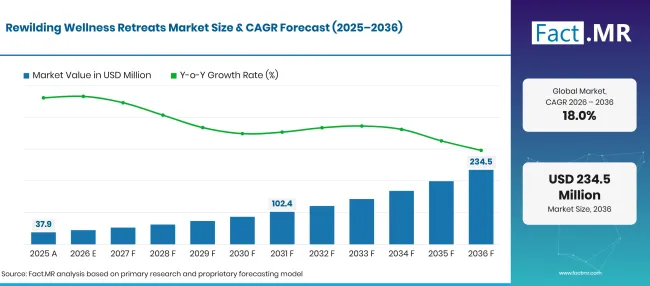
USD 44.7 million in 2026 to USD 234.5 million by 2036 at an 18.0% CAGR.
Rewilding wellness retreats revenue came to USD 37.9 million in 2025, a small base built mostly on estates and resorts that already own land under restoration.
Revenue will expand from USD 44.7 million in 2026 to USD 234.5 million by 2036, as more properties turn habitat projects into bookable guest programmes.
An 18.0% CAGR reflects a young category where each new destination property adds a visible share of total sales.
Year
Basis
Market Value (USD million)
2025
Actual
37.9
2026
Estimate
44.7
2036
Forecast
234.5
CAGR 2026 to 2036
Forecast period
18.0%
Source: Fact.MR analysis. Updated Nov 13, 2026
Rewilding Wellness Retreats Market Forecast Global | Source: Fact.MR
What are the defining numbers behind Rewilding Wellness Retreats Market growth?
The 2026 to 2036 period adds USD 189.8 million in new value, with most of it coming from multi-night stays at restoration estates.
Demand Drivers in the Market
Health systems now treat contact with nature as a wellbeing tool. The WHO Regional Office for Europe links nature-based solutions to better mental wellbeing, more physical activity and stronger social cohesion. Retreat operators use this framing to sell restoration days as health time, not only as volunteering.
Protected landscapes are opening to managed visitor activity. A 2026 European Commission staff working document sets out how tourism and recreation can be run in and around Natura 2000 sites in line with their conservation objectives. Clear rules of this kind lower the planning risk for estates that want to host guests on restored land.
Guests want a role in the work. Seed collecting, tree planting and wildlife surveys give a stay a purpose that a spa visit lacks, and that purpose supports higher spend per night.
Working schedules push demand toward short, intense breaks. Two or three nights in a forest or on a reserve fit around office weeks, which keeps single bookings and weekend packages in steady demand.
Key Segments Analyzed
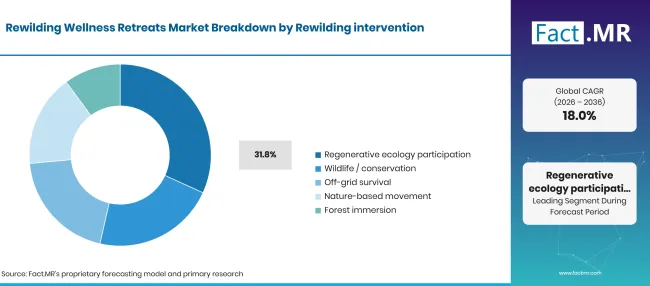
By Rewilding Intervention: Regenerative Ecology Participation will hold 31.8% share in 2026 because guests pay to plant, restore and monitor land with their own hands.
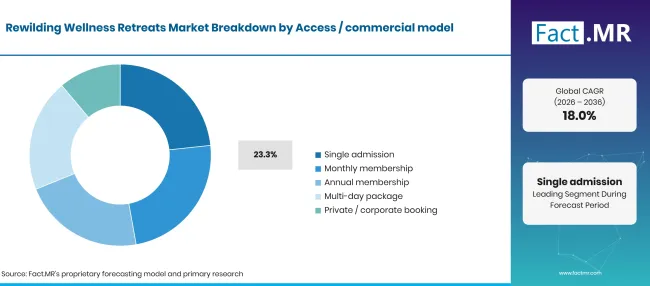
By Access / Commercial Model: Single Admission will account for 23.3% of 2026 value, since first visits are usually booked one stay at a time.
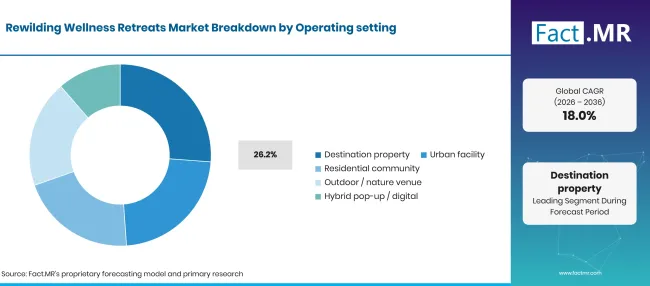
By Operating Setting: Destination Property will capture 26.2% in 2026 as accommodation and restoration land are sold together.
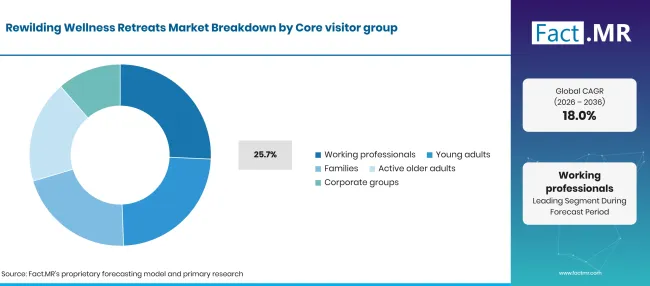
By Core Visitor Group: Working Professionals will represent 25.7% of 2026 revenue, reflecting a need for short breaks away from screens.
Analyst Opinion at Fact.MR
Shambhu Nath Jha, Principal Consultant at Fact.MR, states, “Guests in this market buy proof of impact as much as rest, so operators that can show restored hectares and returning species will earn repeat stays. The next phase will favour estates that own or lease land long enough to run multi-year restoration plans. Retreats that treat ecology as a weekend theme will struggle once buyers start asking for results.”
Strategic Implications
Retreat operators should publish simple, yearly restoration records for each site so returning guests can see the land change.
Landowners and estates should pair habitat plans with a small number of cabins or lodges before adding larger buildings, keeping visitor pressure within what the site can carry.
Corporate travel buyers should test group restoration days as an alternative to standard offsites, since outdoor tasks build team contact without a conference room.
Investors should look for operators with secure land tenure and conservation partners, because the guest offer depends on restoration that runs for many years.
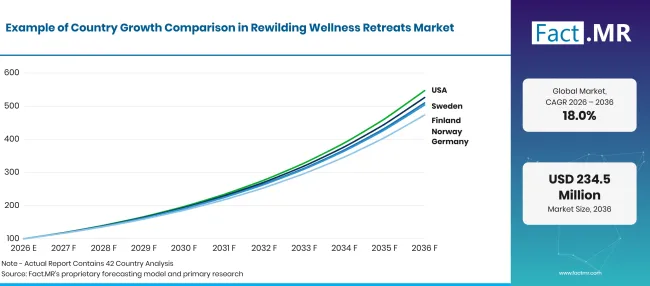
The United States leads the five-country set at 18.5%, helped by a deep outdoor recreation economy and heavy use of public parks. Sweden follows at 18.1%, where camping and cabin stays already carry a large part of guest nights. Finland at 17.7% and Norway at 17.6% are separated by only 0.1 point, as both draw on forest and fjell landscapes and rising foreign arrivals. Germany closes the range at 16.8%, since its strong domestic tourism base leans more toward hotels and spas than toward wild land stays.
How does the Rewilding Wellness Retreats Market break down by segment?
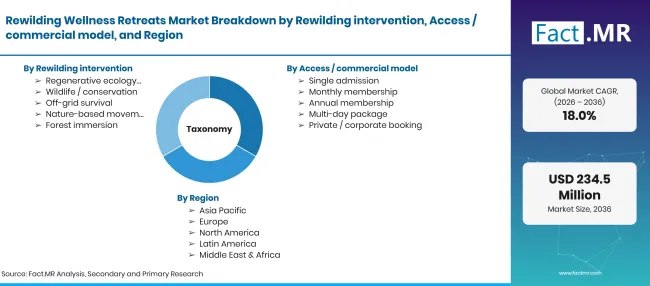
Regenerative Ecology Participation will lead Rewilding Intervention at 31.8%; Single Admission will head Access / Commercial Model at 23.3%; Destination Property will hold Operating Setting at 26.2%; Working Professionals will lead Core Visitor Group at 25.7% in 2026.
Which Rewilding Intervention leads?
Regenerative Ecology Participation takes 31.8% of 2026 sales.
Guests who book a rewilding stay usually want to leave a mark on the land, and planting native species, clearing invasive growth or restoring wetland edges gives them that. Six Senses reports habitat protection, habitat restoration and wildlife programmes across its properties in its 2025 impact data. EU guidance on Natura 2000 tourism also notes that well-managed visits can support ecosystem restoration [2]. Wildlife and conservation tracking, forest immersion, nature-based movement and off-grid survival complete the segment. Forest walks and slow movement suit guests who want rest over labour, while survival courses draw a younger, skills-focused crowd. Many operators package these with lessons from the ecotourism sector to give each day a mix of effort and recovery.
What supports Single Admission within Access / Commercial Model?
Single Admission accounts for 23.3% of 2026 revenue.
First-time guests rarely commit to a membership for an experience they have not tried, so one booking for one stay is the usual entry point. This model also suits travellers who combine a restoration weekend with a longer holiday in the same region. Monthly and annual memberships, multi-day packages and private or corporate bookings serve guests who return often or travel in groups. Memberships work best near cities, where members can come back to the same site through the seasons and follow its recovery.
How does Operating Setting shape demand?
Destination Property commands 26.2% of 2026 value.
Owning both the beds and the land lets an operator design full days, from dawn bird counts to evening talks by ecologists. Outdoor stays are growing in Germany as well: campsites logged nearly 44.7 million overnight stays in 2025, a record and 9.0% of all guest nights. Outdoor and nature venues, urban facilities, residential communities and hybrid pop-up or digital formats widen access beyond remote estates. Urban sites run short planting sessions, while pop-ups bring guided programmes to parks for a day. Some operators borrow ideas from sleep tourism programmes to add dark-sky nights and rest routines to forest stays.
What drives Working Professionals within Core Visitor Group?
Working Professionals represent 25.7% of 2026 spending.
Long office hours and constant screen time push this group toward breaks with no signal and plenty of physical tasks. Two or three nights of planting and walking fit around a working week and offer a reset that a city gym cannot match. Active older adults, families, corporate groups and young adults complete the visitor base. Older guests often prefer gentle guided walks and longer stays, a pattern also tracked in silver tourism demand. Families book school holiday slots with wildlife activities for children.
What is accelerating Rewilding Wellness Retreats Market adoption, and what is holding it back?
Growth comes from guests who want health time outdoors and a real part in restoring land, along with clearer rules for visits to protected sites. The brakes are the cost of buying and restoring land, the long time before habitats show change, strict limits on visitor numbers in sensitive areas and short seasons at northern sites.
Drivers Impact Analysis
DRIVER
(~) % IMPACT ON CAGR
GEOGRAPHIC RELEVANCE
IMPACT TIMELINE
Guest demand for hands-on regenerative ecology work
+1.9%
Global
Long term (>=4 years)
Interest in forest immersion and nature-based wellness
+1.7%
Europe, North America
Short term (<=2 years)
Growth of destination wellness stays on restoration estates
+1.5%
Global
Medium term (2-4 years)
Participation in wildlife conservation and biodiversity programmes
+1.2%
Global
Medium term (2-4 years)
Source: Fact.MR analysis. Updated Nov 13, 2026
Opportunity Impact Analysis
OPPORTUNITY
(~) % IMPACT ON CAGR
GEOGRAPHIC RELEVANCE
IMPACT TIMELINE
Destination properties that combine habitat restoration with lodging
+1.8%
Europe, North America
Medium term (2-4 years)
Conservation-led retreat programmes with partner organisations
+1.5%
Global
Long term (>=4 years)
Flexible single bookings and multi-day nature packages
+1.0%
Global
Short term (<=2 years)
Corporate and group restoration days
+0.9%
Global
Medium term (2-4 years)
Source: Fact.MR analysis. Updated Nov 13, 2026
Restraints Impact Analysis
RESTRAINT
(~) % IMPACT ON CAGR
GEOGRAPHIC RELEVANCE
IMPACT TIMELINE
High land and build costs for destination retreat properties
-0.8%
Global
Short term (<=2 years)
Difficulty sustaining restoration work over many years
-0.7%
Global
Long term (>=4 years)
Visitor limits and permits in sensitive ecosystems
-0.5%
Europe, North America
Medium term (2-4 years)
Short seasons and thin infrastructure at remote sites
-0.3%
Global
Medium term (2-4 years)
Source: Fact.MR analysis. Updated Nov 13, 2026
Which countries are scaling the Rewilding Wellness Retreats Market through 2036?
Rewilding Wellness Retreats Market Growth Index | Source: Fact.MR
Country
CAGR (2026 to 2036)
United States
18.5%
Sweden
18.1%
Finland
17.7%
Norway
17.6%
Germany
16.8%
Source: Fact.MR analysis. Updated Nov 13, 2026
What supports rewilding wellness retreat adoption in the United States?
18.5% CAGR, backed by a large outdoor recreation economy and heavy park use.
Outdoor recreation added USD 696.7 billion in value to the US economy in 2024, equal to 2.4% of GDP, according to the Bureau of Economic Analysis. Public lands draw steady crowds as well: the National Park Service counted more than 323 million recreation visits in 2025. Private ranches and forest estates near these parks are adding restoration stays for guests who want more than a day hike.
How is Sweden developing demand?
18.1% CAGR, helped by a strong camping and cabin culture.
Sweden recorded 70.8 million guest nights in 2025, up 2.5% on 2024, and camping accounted for 24% of them, based on figures from the Swedish Agency for Economic and Regional Growth. That habit of sleeping close to nature gives forest and lake estates a ready audience for longer stays with restoration tasks.
What is supporting Finland’s adoption?
17.7% CAGR, as tourism policy and protected areas both widen access to forest stays.
Finland’s tourism strategy for 2025 to 2028 aims to lift total tourism demand from EUR 16.6 billion in 2024 to EUR 20 billion by 2028, with sustainability named as a core priority. Visitor interest in protected land is already high: Metsähallitus recorded about 3.5 million visits to national parks in 2025. Lodges near these parks can turn that traffic into guided forest and peatland restoration programmes.
How is Norway scaling demand?
17.6% CAGR, driven by record guest nights and rising foreign arrivals.
Norwegian commercial accommodation logged a record 40.6 million guest nights in 2025, up 5.2%, with foreign guest nights up 14% and camping sites reaching 8.4 million. Fjord and mountain properties are using that inflow to sell wildlife and nature-movement stays outside the peak summer weeks.
How does Germany perform?
16.8% CAGR, reflecting a mature domestic tourism base that is only starting to shift outdoors.
Germany counted a record 497.5 million overnight stays in 2025, up 0.3% on 2024, the Federal Statistical Office reports . Most of that volume still goes to hotels, so rewilding stays grow from a smaller starting point. Former farmland, heath and forest estates are the main sites where operators are building guest programmes.
Who leads the Rewilding Wellness Retreats Market?
Competition splits into three groups. Global wellness hospitality brands such as Six Senses, Aman, COMO Shambhala and Chiva-Som bring booking reach and spa expertise, and they add nature content to existing resorts. Aman published a Power of Nature Wellness Immersion at Amanyara, set in a nature reserve, in January 2026 .
Destination wellness resorts such as Canyon Ranch lean on guided outdoor time, with a multi-day Appalachian Trail hiking retreat at its Lenox property in June 2025 . Chiva-Som reports organic farming, composting, renewable power and recycling in its 2025 sustainability data . The third group, land-first estates such as Alladale Wilderness Reserve and Knepp, start from restored habitat and add lodging, safaris and retreats on top. These estates own the most credible ecology story, while the brands own distribution. The operators that gain ground will be those that can prove habitat gains year after year and still fill rooms outside peak season.
Which companies are the key providers?
Key companies in the Rewilding Wellness Retreats Market include Six Senses, Aman, COMO Shambhala, Chiva-Som, Canyon Ranch, Alladale Wilderness Reserve and Knepp.
How large is the rewilding wellness retreats market today, and what will it be worth in 2036?
Which rewilding activities earn the most guest spending, and why do hands-on restoration days lead?
How do single bookings compare with memberships and corporate packages as ways to buy a stay?
Why do destination properties hold the lead over urban, residential and pop-up settings?
Where are the United States, Sweden, Finland, Norway and Germany heading, and what explains their gaps?
Which hospitality brands and restoration estates shape competition, and what sets them apart?
What does the Rewilding Wellness Retreats Market cover?
This market covers wellness stays and day programmes where restoring or observing nature is the core activity. Typical examples include tree planting weeks, wildlife survey stays, forest immersion retreats, off-grid skills courses and slow outdoor movement sessions.
Value is measured as operator revenue from guest bookings, memberships and group packages, including lodging and meals when they are sold as part of the retreat.
What is included in the scope?
Retreats run on restoration estates, nature reserves and resorts with their own habitat programmes.
Single bookings, memberships, multi-day packages and private or corporate bookings tied to rewilding activities.Urban, residential and pop-up formats that run guided restoration or forest sessions, along with hybrid digital programmes linked to a physical site.Programmes for working professionals, older adults, families, young adults and corporate groups across all seven regions.
What is excluded from the scope?
Standard hotels and resorts with no rewilding, conservation or nature-immersion programme for guests.
Wildlife sightseeing tours and safaris sold without a wellness or retreat element.Separately sold outdoor products such as campsite cooking gear or camping hammocks.Restoration contracts with no visitor offer and general leisure tourism spending outside retreat bookings.
How Was the Analysis Built?
The analysis draws on 120+ sources, 35+ company portfolios, 25+ countries, and more than 20 industry interviews.
Primary Research: Primary research includes discussions with manufacturers, service providers, technology developers, distributors, end users, and subject-matter experts. These conversations examine purchasing priorities, product adoption, operational challenges, approval requirements, competitive positioning, and the factors that influence wider market acceptance.
Desk Research: Desk research covers government statistics, regulatory publications, company filings, trade data, technical studies, industry associations, standards, public policy, and other authoritative sources. Every source used in the analysis is documented in the bibliography.
Market Sizing and Forecasting: Market estimates combine historical performance, demand indicators, pricing and volume trends, segment shares, company participation, country-level growth, adoption patterns, investment activity, and barriers to market expansion.
Data Validation and Update Cycle: Findings are validated by comparing primary interviews with public data, company activity, regulatory changes, trade patterns, and industry developments. Regular updates review new product launches, capacity changes, partnerships, approvals, and shifts in commercial adoption.
Working Professionals; Young Adults; Families; Active Older Adults; Corporate Groups
Regions Covered
North America; Latin America; Western Europe; Eastern Europe; East Asia; South Asia & Pacific; Middle East & Africa
Countries Covered
United States; Sweden; Finland; Norway; Germany
Companies Profiled
Six Senses; Aman; COMO Shambhala; Chiva-Som; Canyon Ranch; Alladale Wilderness Reserve; Knepp
Forecast Period
2026 to 2036
Approach
Operator revenue from guest bookings is tracked by intervention, access model, setting and visitor group, then checked against tourism and outdoor recreation statistics for each country.
Source: Fact.MR analysis. Updated Nov 13, 2026
How is the market segmented?
By Rewilding Intervention
Regenerative Ecology Participation
Wildlife / Conservation
Off-grid Survival
Nature-based Movement
Forest Immersion
By Access / Commercial Model
Single Admission
Monthly Membership
Annual Membership
Multi-day Package
Private / Corporate Booking
By Operating Setting
Destination Property
Urban Facility
Residential Community
Outdoor / Nature Venue
Hybrid Pop-up / Digital
By Core Visitor Group
Working Professionals
Young Adults
Families
Active Older Adults
Corporate Groups
By Region
North America
Latin America
Western Europe
Eastern Europe
East Asia
South Asia & Pacific
Middle East & Africa
Questions Answered
Frequently Asked Questions
How large is the rewilding wellness retreats market in 2026?
The market is worth USD 44.7 million in 2026 and will reach USD 234.5 million by 2036.
What growth rate will the rewilding wellness retreats market record?
Between 2026 and 2036, sales will grow at an 18.0% CAGR, adding USD 189.8 million in value.
Which rewilding intervention leads?
Hands-on restoration work leads: Regenerative Ecology Participation takes 31.8% of 2026 sales.
Which access model leads?
Guests most often pay per stay, and Single Admission holds 23.3% of 2026 revenue.
Which operating setting leads?
Destination Property, with 26.2% in 2026, benefits from selling lodging and restoration land together.
Which visitor group leads?
Working Professionals form the top group at 25.7% of 2026 spending.
Which country will grow quickest?
The United States will record an 18.5% CAGR, ahead of Sweden at 18.1%.
Who are the main companies?
Six Senses, Aman, COMO Shambhala, Chiva-Som, Canyon Ranch, Alladale Wilderness Reserve and Knepp are profiled.
What holds the market back?
Land costs, slow habitat recovery, visitor limits in sensitive areas and short northern seasons all slow expansion.