- Base Value(2025): 3510 Mn
- Forecast Value (2035): 5146 Mn
- CAGR (2035): 4.8%
Conveyor Sprockets Market Outlook (2025 to 2035)
The global conveyor sprockets market is expected to reach USD 5,146 million by 2035, up from USD 3,391 million in 2024. During the forecast period 2025 to 2035, the industry is projected to expand at a CAGR of 3.9%.
The conveyor sprockets market is driven by the growing focus on process automation across various sectors, the rapid expansion of e-commerce supply chains, and the increasing emphasis on operational efficiency. Manufacturing and warehousing automated movement systems rely on durable sprockets to enable synchronized motion.
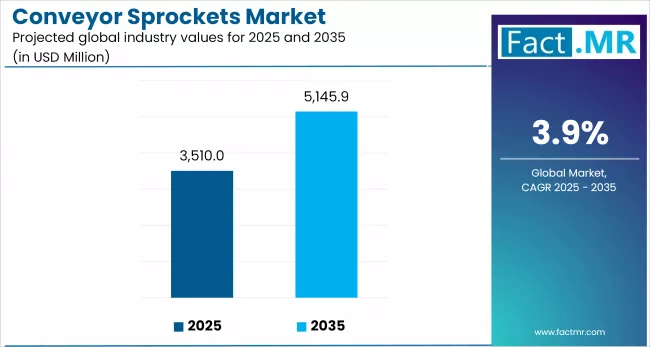
Conveyor Sprockets Market By Industry Value Analysis | Source: Fact.MR
Quick Facts about Conveyor Sprockets Market
- Industry Value (2025): USD 3,510 Million
- Projected Value (2035): USD 5,146 Million
- Forecast CAGR (2025 to 2035): 3.9%
- Leading Segment (2025): Cast-iron (32% Market Share)
- Country Growth Rate (2025 to 2035): India (4.5% CAGR)
- Top Key Players: Yutung Conveyor, Habasit, Tsubaki Nakashima Co. Ltd., W. M. Sprockets, and FB Ketju
With the expansion of online retail, the continuous movement of goods has become essential for timely delivery through advanced conveyor systems. Companies primarily aim to meet time constraints by utilizing low-maintenance vehicle components to maintain efficiency and enhance productivity.
What are the drivers of the conveyor sprockets market?
The automotive industry, food processing and packaging sectors are rapidly adopting automation to enhance productivity. The conveyor sprockets are essential components of these systems as they facilitate the precise transfer of motion.
Automated settings require practical, long-lasting components to ensure uninterrupted operations. Sprockets contribute to synchronized performance alongside belts and chains, supporting a consistent demand for refurbished conveyor parts.
The expansion of online shopping is reshaping warehouse and logistics operations. Business organizations are investing in warehouses with swift and mechanized conveyor belts. The material flow plays a central role in handling and sorting systems and requires the integration of sprockets. Their capacity to manage high loads and uniform motions makes them crucial in continuous e-commerce operations. Such infrastructural development is promoting the demand for sprockets.
Manufacturers are focused on minimizing downtime and maintenance requirements. Long operation cycles are supported by conveyor sprockets, especially those constructed from superior materials. Conveyor sprockets, especially those made from high-grade materials, are integral to sustaining long operation cycles. Their uniformity straightaway influences the productivity and cost control at the system level. This has led companies to invest in durable, low-maintenance sprockets.
What are the regional trends of the conveyor sprockets market?
The market in the U.S. for conveying sprockets is high as automation progresses across warehousing and industrial facilities. This is increasing the sales in the region as major e-commerce companies are upgrading conveyor systems.
The demand for sprockets is growing amid the modernization of production lines and continued focus on efficiency in the automotive and food industries in Europe. Germany and France are leading in this technological transition.
Asia Pacific continues to experience steady expansion, supported by the growth of manufacturing activities and automation. The conveyor systems installations are being driven by the industrial position presented by China and the growth of the logistics industries in India.
An increasing number of investments in mining and processing plants of agricultural products have been observed in Latin American markets. Brazil and Mexico are key markets in the conveyor sprockets demand because of the modernization of equipment.
In the Middle East and Africa, economic diversification efforts are encouraging broader adoption of automated systems. The UAE and South Africa are advancing the use of high-performing conveyor equipment within industrial zones.
What are the challenges and restraining factors of the conveyor sprockets market?
One of the challenges in the conveyor sprocket market is the difficulty in retrofitting newer sprockets into existing hauling systems. Numerous old systems are incompatible with updated components, requiring costly customization or complete replacement.
This increases the risks of downtimes and discourages small-scale facilities from adopting updated technologies. The price-sensitive segments have a more gradual adoption of modernization efforts.
Another concern affecting the market is the limited availability of skilled maintenance providers for high-precision conveyor equipment. Sophisticated sprockets require alignment, tensioning and lubrication to work effectively. In areas where there is a short supply of technical workers, improper handling often causes system breakdown. This culminates in higher maintenance costs as well as ineffectiveness in operations to the end user.
A further restraint for the market involves fluctuations in the price and availability of raw materials such as stainless steel and engineered plastics. The cost of production is directly affected by the increase in the price and restrictions in global trade as well as disruptions in the supply chain. These variables make it difficult for manufacturers to maintain consistent pricing. As a result, procurement in various application-specific industries is often delayed.
Country-Wise Insights
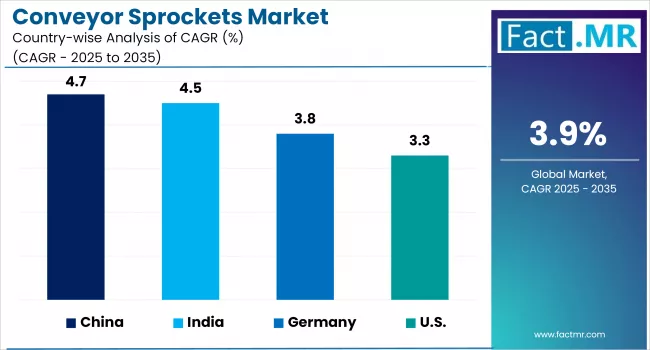
Conveyor Sprockets Market By Country | Source: Fact.MR
Automation retrofits and warehousing overhaul propel USA’s conveyor sprockets market
The American conveyor sprockets industry is undergoing notable transformation with the advancement of automation in industries, usage of robots, and smart logistics in warehouses. The implementation of high-load, durable and self-lubricating sprockets on high-speed conveyors is being implemented in projects such as AM Forward and Manufacturing USA.
At the state level in Michigan, Ohio, and Texas, efforts led by Michigan specialty metals, Ohio gear systems, and Texas innovation programs are supporting the development of sprocket geometry, wear-resistant alloys, and modular drives suitable to rugged and temperature-variable environments.
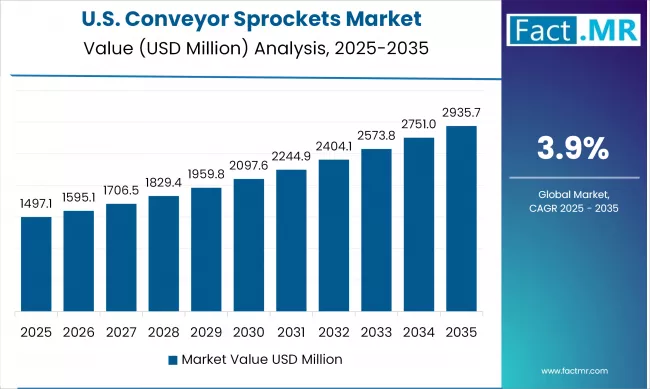
Conveyor Sprockets Market By Country Value Analysis | Source: Fact.MR
There are high-precision sprockets developed by OEMs and system integrators that are designed with IoT-enabled conveyor ecosystems. Among these are systems enabled by the collaboration of Rockwell Automation, Rexnord, and Honeywell. The reduced size of sprockets and rapid-change fastening configurations are also contributing to greater adaptability in warehouse and third-party logistics operations.
Smart manufacturing reforms and logistics scaling drive China’s conveyor sprockets market
The Chinese conveyor sprockets market is undergoing significant transformation as the country advances Industry 4.0 initiatives and automation through the Made in China 2025 plan. Conveyor lines incorporating sprockets with high-wear resistance and automated tension systems are being utilized across various manufacturing industries such as automotive manufacturing, electronics, bulk production, etc.
The Guangdong, Jiangsu and Zhejiang provincial innovation hubs have been investing in R&D focused on corrosion-resistant composites, noise-reducing sprocket teeth, and intelligent load distribution modules. Edge-connected conveyors with adaptive sprockets are being tested in strategic collaborations involving Haier, Huawei, and Siasun. Compact sprockets are being introduced in warehouses located near urban centers and in vertical logistics buildings to improve space utilization.
Through subsides and privately operated smart logistics and predictive maintenance, the local companies are producing high-tech sprockets comparable to those used in high-tech manufacturing. These systems are being deployed in industrial zones featuring artificial intelligence to diagnose and simulate processes in real time.
Smart infrastructure upgrades and logistics acceleration fuel India’s conveyor sprockets market
The conveyor sprockets market in India is expanding steadily, aided by large-scale investments into industrial parks and e-commerce logistics corridors. High-durability, low-friction sprockets are being deployed in manufacturing sectors as automotive, pharmaceuticals, and FMCG, aligned with initiatives like Make in India and National Logistics Policy.
Maharashtra, Gujarat, and Tamil Nadu innovation clusters are advancing the development of heat-resistant coating, modular spur sprockets and precision alignment systems that suit the tropical climates.
IBM and partners are introducing smart conveyors with telemetry-enabled sprocket assemblies and energy-efficient drive mechanisms through collaborations with domestic OEM companies such as Greaves, Flux Drive, and Bosch India.
With support from Atmanirbhar Bharat and Technology Innovation Hubs, startups are introducing sprockets featuring real-time lifecycle monitoring, additive-manufactured prototypes, and remote diagnostic capabilities. These technologies are being tailored to meet the specific requirements of industrial and logistics applications.
Category-Wise Analysis
Miniaturized load transfer and modular alignment define roller chain sprockets in conveyor design
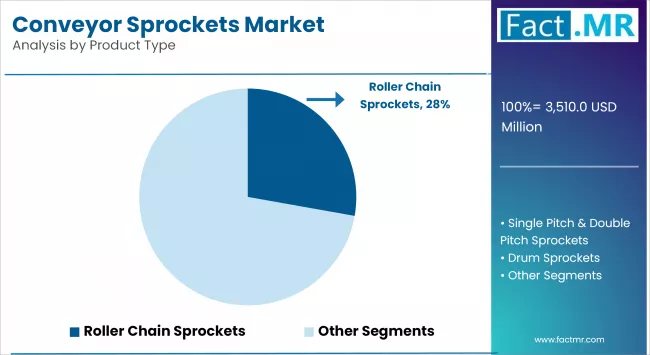
Conveyor Sprockets Market By Product Type | Source: Fact.MR
A roller chain sprocket holds a central role in conveyor systems as it enables balanced and repeatable chain engagement under high-load circumstances. These components can be flexibly integrated in linear, curved or multiple-tier applications, as their dimensions conform to standardized shaft and hub configurations. The sprockets are used to hold high torque transfer and provide reduced backlash to facilitate high precision of movements along the packaging lines, assembly points and warehousing docks.
The compact versions are more cost-effective and lower in inertia, which is of utmost priority in a light-duty system. For advanced applications, flame-hardened teeth, anti-corrosion coatings, and precision-machined bores are commonly utilized. A current focus is placed on optimizing geometry, maintaining pitch consistency, and standardizing tooth profiles to ensure smoother engagement and extend the operational life of both stationary and mobile units.
Thermal strength and cost-efficient molding reinforce cast-iron in conveyor sprockets
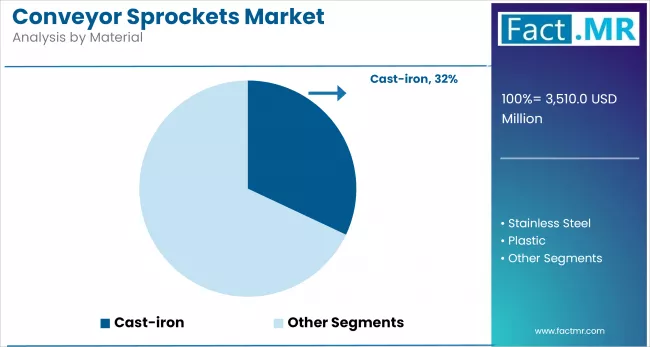
Conveyor Sprockets Market By Material | Source: Fact.MR
Cast iron is a widely used material that companies use in sprocket production as it has balanced properties in tensile strength, cost, and machinability. These sprockets are quite common in the heavy conveyors where thermal carbon resistance and endurance under high load are very crucial. Both the sand casting and shell molding methods are low-cost techniques that allow foundries to manufacture custom geometries with high precision.
Cast-iron sprockets used in heavy industries such as cement, mining and steel are selected for their capability in shock absorption and resistance to corrosion, supported by dimensional stability and treated surfaces. The continued advances in surface hardening, composite coating, and machine vision defect detection are making cast-iron competitive in retrofit as well as OEM conveyor applications.
Line efficiency and load synchronization drive sprocket use in packaging & warehousing
Conveyor sprockets are used in the packaging and warehousing setups to enable the uninterrupted flow of products throughout the sorting, sealing and dispatching devices. Tight-tolerance sprockets with high fatigue limits are required in high-cycle applications where equipment failure must be minimized.
Modular sprockets are preferable as they are replaced easily and can be applied to multi-line configurations. Due to increasing e-business and automated warehousing, the demand is shifting towards sprockets that would fit with intelligent sensors and small conveyor frames. Corrosion-resistant finishes and anti-static coating are increasingly incorporated as hygienic requirements and durability in various packaging areas.
Competitive Analysis
The conveyor sprockets market is a competitive space where producers focus on reliability of performance, precise machining, and adaptability to industrial levels of operation. Key differentiators involve the accuracy of the tooth profile, resistance to corrosion and survival in high-load, high-cycle conditions.
Leading brands are investing in low-noise sprocket designs, self-oiling surfaces and thermally stable materials to meet the increasing demand of automated systems in the food, logistics and heavy manufacturing industries.
As Industry 4.0 and smart conveyor systems become more integrated, the suppliers are optimizing sprockets to accommodate diagnostics based on the Internet of Things and positioning based on sensors.
Advances in technology in additive manufacturing and simulation of fatigue analysis is making it possible to realize faster prototyping and improved structural qualification prior to deployment. Recyclable alloys and low waste of materials used in production are also being considered by leading market participants.
Some manufacturers maintain a strategic position by offering modular sprocket systems with quick-change hubs and easy-lock features, which help reduce downtime. Moreover, companies that have increased global integrated supply chains, regional service centers, and conformity to ISO / ANSI standards of conveyor components have a better chance of serving a multinational customer in the fields of automotive, packaging, mining, and e-commerce.
Key players in the conveyor sprockets industry include Yutung Conveyor, Habasit, Tsubaki Nakashima Co. Ltd., W. M. Sprockets, FB Ketju, KettenWulf Betriebs GmbH, and others.
Recent Developments
- In March 2025, Ramsey Unveils Advanced RZ3 Extended Pitch Silent Chain for Conveying Applications.
- In March 2024, The Rondot Group acquired all shares of UK glass conveyor chain and sprocket technology supplier Pennine Industrial Equipment.
Fact.MR has provided detailed information about the price points of key manufacturers of the Conveyor Sprockets Market positioned across regions, sales growth, production capacity, and speculative technological expansion in the recently published report.
Methodology and Industry Tracking Approach
The report global conveyor sprockets market 2025 has been formulated on the basis of insight derived by questioning over 12,200 industrial gentlemen and ladies in more than 30 countries worldwide and is coined with a total of around 290 correlated responses by region. Merchants were the respondent subjects who were plant maintenance engineers, production line supervisors, materials handling consultants, procurement specialists as well as mechanical system designers.
This study has been performed between 2024 July to 2025 June with a systematic approach designed on the questionnaire that investigates the application of sprocket in various forms of conveyor systems, compatibility of materials, load carrying, environmental resilience, and adherence to industrial standards of ISO and ANSI groups of automobiles and food processing, logistics, and mining industries.
290 confirmed sources were used to verify all the insights including maintenance manuals of the equipment, chain drive guidance book, industrial safety standards, and specifications on parts procurement. The indexed usage analysis and regression forecasting models were evaluated to determine segmental performance and improvement trends.
The strategic advice is to allow OEMs, system designers and component producers to achieve modular, corrosion resistant, low wear and high tolerance sprockets targeted at automated settings, harsh duty operations and intelligent predictive maintenance routes.
With Fact.MR monitoring consumer behavior, product efficacy, industry trends, and market opportunities since 2018, this report is becoming an authoritative source of information that stakeholders can rely on.
Segmentation
Segmentation of Conveyor Sprockets Market
-
By Product:
- Roller Chain Sprockets
- Single Pitch & Double Pitch Sprockets
- Drum Sprockets
- Steel Split Sprockets
- Idler Sprockets
- Others
-
By Material :
- Cast-iron
- Stainless Steel
- Plastic
- Others
-
By End-Use :
- Packaging & Warehousing
- Textile & Paper
- Construction & Mining
- Automotive & Transportation
- Consumer Electronics
- Food & Beverages
- Chemicals & Pharmaceuticals
-
By Region :
- North America
- Latin America
- Western Europe
- Eastern Europe
- East Asia
- South Asia & Pacific
- Middle East & Africa
Frequently Asked Questions
What was the global conveyor sprockets market size reported by Fact.MR for 2025?
Who are the major players operating in the conveyor sprockets market?
What is the estimated valuation of the conveyor sprockets market in 2035?
What value CAGR did the conveyor sprockets market exhibit over the last five years?
Who worked on this report


Preview the report firsthand - request a free sample
Free SampleGet the brochure for pricing and purchase details
Download PDF