Stabilizers for Red Mud and Bauxite Residues Market

Stabilizers for Red Mud and Bauxite Residues Market Size and Share Forecast Outlook 2026 to 2036

Stabilizers for red mud and bauxite residues market is projected to grow from USD 0.5 billion in 2026 to USD 1.4 billion by 2036, at a CAGR of 10.4%. Alkaline neutralizers & pH adjusters will dominate with a 30.0% market share, while tailings storage stabilization & closure will lead the end application segment with a 36.0% share.

Stabilizers for Red Mud and Bauxite Residues Market Forecast and Outlook 2026 to 2036

The global stabilizers for red mud and bauxite residues market is projected to reach USD 1.40 billion by 2036. The market is valued at USD 0.52 billion in 2026 and is set to rise at a CAGR of 10.4% during the assessment period.

By chemical class, alkaline neutralizers & pH adjusters hold a leading 30% share, while proprietary or engineered stabilizer blends represent a notable 7%. Tailings storage stabilization & closure is the dominant end application, accounting for 36% market share.

Key Takeaways from the Stabilizers for Red Mud and Bauxite Residues Market

  • Market Value for 2026: USD 0.52 Billion
  • Market Value for 2036: USD 1.40 Billion
  • Forecast CAGR (2026-2036): 10.4%
  • Leading Chemical Class Share (2026): Alkaline Neutralizers & pH Adjusters (30%)
  • Leading End Application Share (2026): Tailings Storage Stabilization & Closure (36%)
  • Key Players in the Market: Lhoist, Carmeuse, Holcim, Boral, Geopolymer, Kemira, Solvay
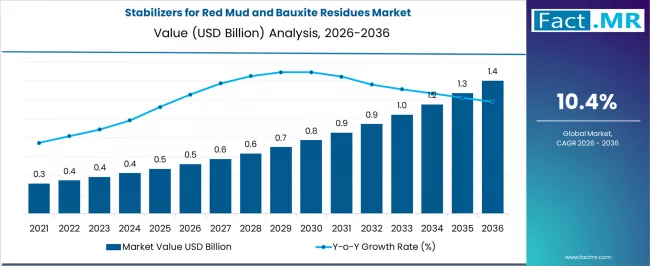
Stabilizers For Red Mud And Bauxite Residues Market Market Value Analysis

Defining trends involve the transition from mere containment to the active chemical and mineralogical stabilization of bauxite residue (red mud) to reduce its long-term environmental liability and enable safe storage or valorization. Innovation is rapidly advancing in geopolymer and alkali-activated binder systems that transform red mud into a valuable precursor for construction materials. Integration of these stabilizers with advanced dewatering and dry stacking techniques is becoming critical for reducing storage footprint and enabling rehabilitation.

Regulatory frameworks globally are tightening the management requirements for industrial by-products like red mud, focusing on the leaching potential of alkalinity and trace metals. Policies promoting a circular economy and reducing the environmental footprint of the aluminum industry act as significant market catalysts, positioning stabilization chemistries as essential for sustainable alumina refining operations and legacy site remediation.

Stabilizers for Red Mud and Bauxite Residues Market

Metric Value
Market Value (2026) USD 0.52 Billion
Market Forecast Value (2036) USD 1.40 Billion
Forecast CAGR (2026-2036) 10.4%

Category

Category Segments
Chemical Class Alkaline neutralizers & pH adjusters, Cementitious binders, Pozzolans & supplementary cementitious materials, Geopolymers & alkali-activated binders, Polymeric binders & soil stabilizers, Flocculants & coagulants (for water control), Proprietary or engineered stabilizer blends
End Application Tailings storage stabilization & closure, Dust & surface crust formation (arid zones), Reuse in construction materials (geopolymer concrete, bricks), Water management (runoff/pond control), Soil amendment & reclamation projects
Region North America, Latin America, Western Europe, Eastern Europe, East Asia, South Asia & Pacific, MEA

Segmental Analysis

By Chemical Class, Which Technology Addresses the Fundamental Chemical Hazard of Red Mud?
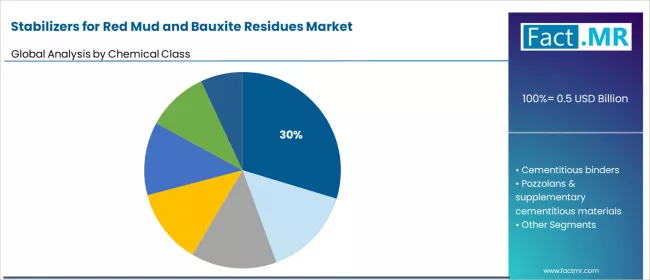
Stabilizers For Red Mud And Bauxite Residues Market Analysis By Chemical Class

Alkaline neutralizers & pH adjusters lead the segment with a 30% share. This dominance is due to the primary environmental challenge of red mud: its high alkalinity (pH 10-13) and associated sodium content. Chemicals like gypsum (calcium sulfate), carbonates, and acids are used to neutralize the residue, reducing its pH and leaching potential. This treatment is often the foundational step before further stabilization or reuse, making it a high-volume, essential chemical intervention in residue management.

By End Application, What is the Primary Driver for Stabilizer Use Given the Vast Volumes Generated?
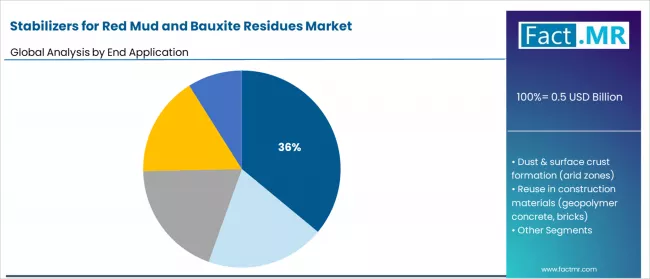
Stabilizers For Red Mud And Bauxite Residues Market Analysis By End Application

Tailings storage stabilization & closure commands the largest application share at 36%. The alumina industry generates over 150 million tonnes of red mud annually, requiring vast, secure storage facilities. Stabilizers are critical for improving the geotechnical properties (strength, density) and chemical stability of these deposits for long-term storage, enabling safer dam construction, reducing seepage risks, and ultimately facilitating the final closure and capping of residue disposal areas.

What are the Drivers, Restraints, and Key Trends of the Stabilizers for Red Mud and Bauxite Residues Market?

Market growth is driven by stringent new global regulations on the management and storage of industrial mineral wastes, specifically targeting leaching criteria. The aluminum industry's strong ESG focus on reducing its environmental footprint and legacy liability is a key push. Incidents related to traditional wet storage methods are accelerating the shift to stabilized, dry stacking. The economic potential of converting residue into saleable construction materials via geopolymerization is creating a positive market pull.

A significant restraint is the immense volume and very low (or negative) economic value of the residue, making cost-per-ton of treatment a paramount concern. The variable chemical and mineralogical composition of red mud globally complicates the development of one-size-fits-all stabilizer solutions. The high capital cost of retrofitting existing refineries with new stabilization and dewatering circuits can be prohibitive. Long-term performance validation of novel stabilization methods under field conditions also requires time.

Key trends include intensive R&D into geopolymer binders that utilize red mud as a primary raw material. There is growing use of industrial by-products (e.g., fly ash, slag) as supplementary stabilizers in a "waste-to-waste" treatment approach. The integration of superabsorbent polymers for moisture retention and dust control in dry stacks is emerging. Additionally, digital tools for modeling the long-term geochemical evolution of stabilized residues are gaining importance for closure planning.

Analysis of the Stabilizers for Red Mud and Bauxite Residues Market by Key Countries
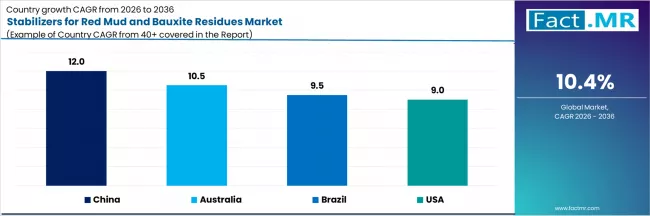
Stabilizers For Red Mud And Bauxite Residues Market Cagr Analysis By Country

Country CAGR (2026-2036)
China 12.00%
Australia 10.50%
Brazil 9.50%
USA 9.00%

How does China's Dominant Aluminum Production and Environmental Policy Drive Market Leadership?

China leads with a 12.00% CAGR, driven by its position as the world's largest producer of alumina and aluminum. Facing severe environmental pressures from historical red mud storage, the government is enforcing strict new standards for residue management and promoting utilization technologies. The sheer scale of its residue output creates immense demand for cost-effective stabilization solutions, driving domestic innovation and large-scale trials of geopolymer applications.

Why is Australia's Bauxite Mining and Dry Stacking Focus a Key Driver?

Australia's 10.50% growth is fueled by its major bauxite mining and alumina refining industry, which is a global leader in adopting dry stacking for red mud. This method inherently requires effective chemical stabilization to create a trafficable and stable deposit. Australian operators and research institutions are at the forefront of developing and implementing advanced stabilizer blends and geopolymerization processes tailored to local bauxite ore characteristics.

What Role does Brazil's Large Alumina Industry and Land Rehabilitation Focus Play?

Brazil's 9.50% growth is anchored in its significant alumina refining capacity. The industry operates within the biodiverse Amazon and Atlantic Forest biomes, where stringent rehabilitation requirements exist. This drives the need for robust stabilization chemistries that not only secure storage facilities but also chemically condition the residue for eventual soil amendment and revegetation as part of progressive closure and rehabilitation plans.

How does the USA's Regulatory Framework and Focus on Utilization Influence the Market?
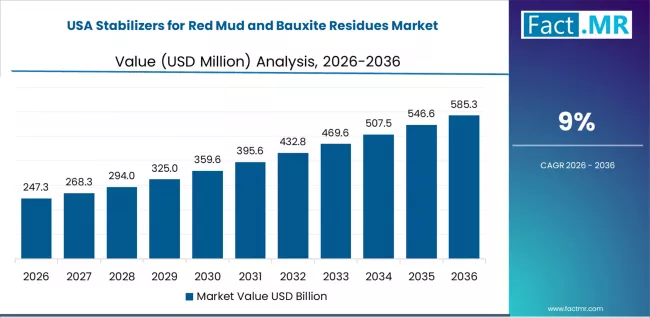
Stabilizers For Red Mud And Bauxite Residues Market Country Value Analysis

A strong regulatory framework for industrial waste management (RCRA) and active research into beneficial use applications underpins the USA’s 9.00% growth. While domestic alumina production is smaller, there is significant focus on transforming red mud from a liability into a resource. This drives demand for advanced stabilizer systems, particularly geopolymer activators and pozzolanic blends, that enable the production of compliant construction materials from residue.

Competitive Landscape of the Stabilizers for Red Mud and Bauxite Residues Market
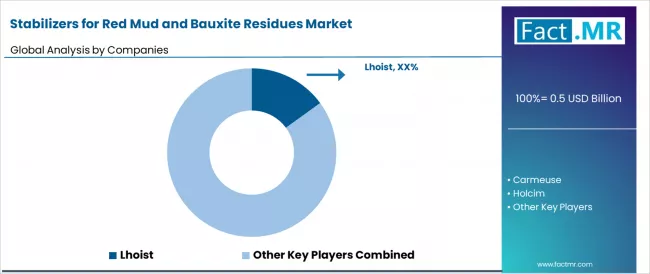
Stabilizers For Red Mud And Bauxite Residues Market Analysis By Company

The competitive landscape is divided between traditional construction material suppliers and specialty chemical companies. Global lime and cement giants like Lhoist, Carmeuse, Holcim, and Boral compete by supplying bulk alkaline neutralizers (gypsum, lime) and cementitious binders, leveraging their expertise in mineral-based stabilization.

Specialty firms like Geopolymer and chemical companies like Solvay and Kemira compete with advanced, engineered solutions including tailored geopolymer activators, proprietary polymeric binders, and flocculant systems. Competition centers on forming strategic partnerships with major alumina refineries, demonstrating cost-effective performance at pilot and full scale, and providing solutions that address both geotechnical stability and chemical leaching compliance.

Key Players in the Stabilizers for Red Mud and Bauxite Residues Market

  • Lhoist
  • Carmeuse
  • Holcim
  • Boral
  • Geopolymer
  • Kemira
  • Solvay

Scope of Report

Items Values
Quantitative Units USD Billion
Chemical Class Alkaline neutralizers, Cementitious binders, Pozzolans, Geopolymers, Polymeric binders, Flocculants & coagulants, Proprietary blends
End Application Tailings storage & closure, Dust control, Reuse in construction, Water management, Soil amendment
Key Countries China, Australia, Brazil, USA
Key Companies Lhoist, Carmeuse, Holcim, Boral, Geopolymer, Kemira, Solvay
Additional Analysis Analysis of neutralization efficiency, unconfined compressive strength (UCS) development, leaching test performance (e.g., TCLP, SPLP), long-term durability under weathering, and total cost-benefit analysis versus conventional wet storage.

Stabilizers for Red Mud and Bauxite Residues Market by Segments

  • Chemical Class :

    • Alkaline neutralizers & pH adjusters
    • Cementitious binders
    • Pozzolans & supplementary cementitious materials
    • Geopolymers & alkali-activated binders
    • Polymeric binders & soil stabilizers
    • Flocculants & coagulants (for water control)
    • Proprietary or engineered stabilizer blends
  • End Application :

    • Tailings storage stabilization & closure
    • Dust & surface crust formation (arid zones)
    • Reuse in construction materials (geopolymer concrete, bricks)
    • Water management (runoff/pond control)
    • Soil amendment & reclamation projects
  • Region :

    • North America

      • USA
      • Canada
    • Latin America

      • Brazil
      • Mexico
      • Argentina
      • Chile
      • Rest of Latin America
    • Western Europe

      • Germany
      • France
      • Spain
      • Italy
      • BENELUX
      • UK
      • Rest of Western Europe
    • Eastern Europe

      • Russia
      • Poland
      • Czech Republic
      • Rest of Eastern Europe
    • East Asia

      • China
      • Japan
      • South Korea
      • Rest of East Asia
    • South Asia & Pacific

      • Australia
      • Indonesia
      • India
      • Rest of South Asia & Pacific
    • MEA

      • UAE
      • South Africa
      • Rest of MEA

Table of Content

  1. Executive Summary
    • Global Market Outlook
    • Demand to side Trends
    • Supply to side Trends
    • Technology Roadmap Analysis
    • Analysis and Recommendations
  2. Market Overview
    • Market Coverage / Taxonomy
    • Market Definition / Scope / Limitations
  3. Market Background
    • Market Dynamics
      • Drivers
      • Restraints
      • Opportunity
      • Trends
    • Scenario Forecast
      • Demand in Optimistic Scenario
      • Demand in Likely Scenario
      • Demand in Conservative Scenario
    • Opportunity Map Analysis
    • Product Life Cycle Analysis
    • Supply Chain Analysis
    • Investment Feasibility Matrix
    • Value Chain Analysis
    • PESTLE and Porter’s Analysis
    • Regulatory Landscape
    • Regional Parent Market Outlook
    • Production and Consumption Statistics
    • Import and Export Statistics
  4. Global Market Analysis 2021 to 2025 and Forecast, 2026 to 2036
    • Historical Market Size Value (USD Million) Analysis, 2021 to 2025
    • Current and Future Market Size Value (USD Million) Projections, 2026 to 2036
      • Y to o to Y Growth Trend Analysis
      • Absolute $ Opportunity Analysis
  5. Global Market Pricing Analysis 2021 to 2025 and Forecast 2026 to 2036
  6. Global Market Analysis 2021 to 2025 and Forecast 2026 to 2036, By Chemical Class
    • Introduction / Key Findings
    • Historical Market Size Value (USD Million) Analysis By Chemical Class, 2021 to 2025
    • Current and Future Market Size Value (USD Million) Analysis and Forecast By Chemical Class, 2026 to 2036
      • Alkaline neutralizers & pH adjusters
      • Cementitious binders
      • Pozzolans & supplementary cementitious materials
      • Geopolymers & alkali-activated binders
      • Polymeric binders & soil stabilizers
      • Flocculants & coagulants (for water control)
      • Proprietary or engineered stabilizer blends
    • Y to o to Y Growth Trend Analysis By Chemical Class, 2021 to 2025
    • Absolute $ Opportunity Analysis By Chemical Class, 2026 to 2036
  7. Global Market Analysis 2021 to 2025 and Forecast 2026 to 2036, By End Application
    • Introduction / Key Findings
    • Historical Market Size Value (USD Million) Analysis By End Application, 2021 to 2025
    • Current and Future Market Size Value (USD Million) Analysis and Forecast By End Application, 2026 to 2036
      • Tailings storage stabilization & closure
      • Dust & surface crust formation (arid zones)
      • Reuse in construction materials (geopolymer concrete, bricks)
      • Water management (runoffpond control)
      • Soil amendment & reclamation projects
    • Y to o to Y Growth Trend Analysis By End Application, 2021 to 2025
    • Absolute $ Opportunity Analysis By End Application, 2026 to 2036
  8. Global Market Analysis 2021 to 2025 and Forecast 2026 to 2036, By Region
    • Introduction
    • Historical Market Size Value (USD Million) Analysis By Region, 2021 to 2025
    • Current Market Size Value (USD Million) Analysis and Forecast By Region, 2026 to 2036
      • North America
      • Latin America
      • Western Europe
      • Eastern Europe
      • East Asia
      • South Asia and Pacific
      • Middle East & Africa
    • Market Attractiveness Analysis By Region
  9. North America Market Analysis 2021 to 2025 and Forecast 2026 to 2036, By Country
    • Historical Market Size Value (USD Million) Trend Analysis By Market Taxonomy, 2021 to 2025
    • Market Size Value (USD Million) Forecast By Market Taxonomy, 2026 to 2036
      • By Country
        • USA
        • Canada
        • Mexico
      • By Chemical Class
      • By End Application
    • Market Attractiveness Analysis
      • By Country
      • By Chemical Class
      • By End Application
    • Key Takeaways
  10. Latin America Market Analysis 2021 to 2025 and Forecast 2026 to 2036, By Country
    • Historical Market Size Value (USD Million) Trend Analysis By Market Taxonomy, 2021 to 2025
    • Market Size Value (USD Million) Forecast By Market Taxonomy, 2026 to 2036
      • By Country
        • Brazil
        • Chile
        • Rest of Latin America
      • By Chemical Class
      • By End Application
    • Market Attractiveness Analysis
      • By Country
      • By Chemical Class
      • By End Application
    • Key Takeaways
  11. Western Europe Market Analysis 2021 to 2025 and Forecast 2026 to 2036, By Country
    • Historical Market Size Value (USD Million) Trend Analysis By Market Taxonomy, 2021 to 2025
    • Market Size Value (USD Million) Forecast By Market Taxonomy, 2026 to 2036
      • By Country
        • Germany
        • UK
        • Italy
        • Spain
        • France
        • Nordic
        • BENELUX
        • Rest of Western Europe
      • By Chemical Class
      • By End Application
    • Market Attractiveness Analysis
      • By Country
      • By Chemical Class
      • By End Application
    • Key Takeaways
  12. Eastern Europe Market Analysis 2021 to 2025 and Forecast 2026 to 2036, By Country
    • Historical Market Size Value (USD Million) Trend Analysis By Market Taxonomy, 2021 to 2025
    • Market Size Value (USD Million) Forecast By Market Taxonomy, 2026 to 2036
      • By Country
        • Russia
        • Poland
        • Hungary
        • Balkan & Baltic
        • Rest of Eastern Europe
      • By Chemical Class
      • By End Application
    • Market Attractiveness Analysis
      • By Country
      • By Chemical Class
      • By End Application
    • Key Takeaways
  13. East Asia Market Analysis 2021 to 2025 and Forecast 2026 to 2036, By Country
    • Historical Market Size Value (USD Million) Trend Analysis By Market Taxonomy, 2021 to 2025
    • Market Size Value (USD Million) Forecast By Market Taxonomy, 2026 to 2036
      • By Country
        • China
        • Japan
        • South Korea
      • By Chemical Class
      • By End Application
    • Market Attractiveness Analysis
      • By Country
      • By Chemical Class
      • By End Application
    • Key Takeaways
  14. South Asia and Pacific Market Analysis 2021 to 2025 and Forecast 2026 to 2036, By Country
    • Historical Market Size Value (USD Million) Trend Analysis By Market Taxonomy, 2021 to 2025
    • Market Size Value (USD Million) Forecast By Market Taxonomy, 2026 to 2036
      • By Country
        • India
        • ASEAN
        • Australia & New Zealand
        • Rest of South Asia and Pacific
      • By Chemical Class
      • By End Application
    • Market Attractiveness Analysis
      • By Country
      • By Chemical Class
      • By End Application
    • Key Takeaways
  15. Middle East & Africa Market Analysis 2021 to 2025 and Forecast 2026 to 2036, By Country
    • Historical Market Size Value (USD Million) Trend Analysis By Market Taxonomy, 2021 to 2025
    • Market Size Value (USD Million) Forecast By Market Taxonomy, 2026 to 2036
      • By Country
        • Kingdom of Saudi Arabia
        • Other GCC Countries
        • Turkiye
        • South Africa
        • Other African Union
        • Rest of Middle East & Africa
      • By Chemical Class
      • By End Application
    • Market Attractiveness Analysis
      • By Country
      • By Chemical Class
      • By End Application
    • Key Takeaways
  16. Key Countries Market Analysis
    • USA
      • Pricing Analysis
      • Market Share Analysis, 2025
        • By Chemical Class
        • By End Application
    • Canada
      • Pricing Analysis
      • Market Share Analysis, 2025
        • By Chemical Class
        • By End Application
    • Mexico
      • Pricing Analysis
      • Market Share Analysis, 2025
        • By Chemical Class
        • By End Application
    • Brazil
      • Pricing Analysis
      • Market Share Analysis, 2025
        • By Chemical Class
        • By End Application
    • Chile
      • Pricing Analysis
      • Market Share Analysis, 2025
        • By Chemical Class
        • By End Application
    • Germany
      • Pricing Analysis
      • Market Share Analysis, 2025
        • By Chemical Class
        • By End Application
    • UK
      • Pricing Analysis
      • Market Share Analysis, 2025
        • By Chemical Class
        • By End Application
    • Italy
      • Pricing Analysis
      • Market Share Analysis, 2025
        • By Chemical Class
        • By End Application
    • Spain
      • Pricing Analysis
      • Market Share Analysis, 2025
        • By Chemical Class
        • By End Application
    • France
      • Pricing Analysis
      • Market Share Analysis, 2025
        • By Chemical Class
        • By End Application
    • India
      • Pricing Analysis
      • Market Share Analysis, 2025
        • By Chemical Class
        • By End Application
    • ASEAN
      • Pricing Analysis
      • Market Share Analysis, 2025
        • By Chemical Class
        • By End Application
    • Australia & New Zealand
      • Pricing Analysis
      • Market Share Analysis, 2025
        • By Chemical Class
        • By End Application
    • China
      • Pricing Analysis
      • Market Share Analysis, 2025
        • By Chemical Class
        • By End Application
    • Japan
      • Pricing Analysis
      • Market Share Analysis, 2025
        • By Chemical Class
        • By End Application
    • South Korea
      • Pricing Analysis
      • Market Share Analysis, 2025
        • By Chemical Class
        • By End Application
    • Russia
      • Pricing Analysis
      • Market Share Analysis, 2025
        • By Chemical Class
        • By End Application
    • Poland
      • Pricing Analysis
      • Market Share Analysis, 2025
        • By Chemical Class
        • By End Application
    • Hungary
      • Pricing Analysis
      • Market Share Analysis, 2025
        • By Chemical Class
        • By End Application
    • Kingdom of Saudi Arabia
      • Pricing Analysis
      • Market Share Analysis, 2025
        • By Chemical Class
        • By End Application
    • Turkiye
      • Pricing Analysis
      • Market Share Analysis, 2025
        • By Chemical Class
        • By End Application
    • South Africa
      • Pricing Analysis
      • Market Share Analysis, 2025
        • By Chemical Class
        • By End Application
  17. Market Structure Analysis
    • Competition Dashboard
    • Competition Benchmarking
    • Market Share Analysis of Top Players
      • By Regional
      • By Chemical Class
      • By End Application
  18. Competition Analysis
    • Competition Deep Dive
      • Lhoist
        • Overview
        • Product Portfolio
        • Profitability by Market Segments (Product/Age /Sales Channel/Region)
        • Sales Footprint
        • Strategy Overview
          • Marketing Strategy
          • Product Strategy
          • Channel Strategy
      • Carmeuse
      • Holcim
      • Boral
      • Geopolymer
      • Kemira
      • Solvay
  19. Assumptions & Acronyms Used
  20. Research Methodology

List Of Table

  • Table 1: Global Market Value (USD Million) Forecast by Region, 2021 to 2036
  • Table 2: Global Market Value (USD Million) Forecast by Chemical Class, 2021 to 2036
  • Table 3: Global Market Value (USD Million) Forecast by End Application, 2021 to 2036
  • Table 4: North America Market Value (USD Million) Forecast by Country, 2021 to 2036
  • Table 5: North America Market Value (USD Million) Forecast by Chemical Class, 2021 to 2036
  • Table 6: North America Market Value (USD Million) Forecast by End Application, 2021 to 2036
  • Table 7: Latin America Market Value (USD Million) Forecast by Country, 2021 to 2036
  • Table 8: Latin America Market Value (USD Million) Forecast by Chemical Class, 2021 to 2036
  • Table 9: Latin America Market Value (USD Million) Forecast by End Application, 2021 to 2036
  • Table 10: Western Europe Market Value (USD Million) Forecast by Country, 2021 to 2036
  • Table 11: Western Europe Market Value (USD Million) Forecast by Chemical Class, 2021 to 2036
  • Table 12: Western Europe Market Value (USD Million) Forecast by End Application, 2021 to 2036
  • Table 13: Eastern Europe Market Value (USD Million) Forecast by Country, 2021 to 2036
  • Table 14: Eastern Europe Market Value (USD Million) Forecast by Chemical Class, 2021 to 2036
  • Table 15: Eastern Europe Market Value (USD Million) Forecast by End Application, 2021 to 2036
  • Table 16: East Asia Market Value (USD Million) Forecast by Country, 2021 to 2036
  • Table 17: East Asia Market Value (USD Million) Forecast by Chemical Class, 2021 to 2036
  • Table 18: East Asia Market Value (USD Million) Forecast by End Application, 2021 to 2036
  • Table 19: South Asia and Pacific Market Value (USD Million) Forecast by Country, 2021 to 2036
  • Table 20: South Asia and Pacific Market Value (USD Million) Forecast by Chemical Class, 2021 to 2036
  • Table 21: South Asia and Pacific Market Value (USD Million) Forecast by End Application, 2021 to 2036
  • Table 22: Middle East & Africa Market Value (USD Million) Forecast by Country, 2021 to 2036
  • Table 23: Middle East & Africa Market Value (USD Million) Forecast by Chemical Class, 2021 to 2036
  • Table 24: Middle East & Africa Market Value (USD Million) Forecast by End Application, 2021 to 2036

List Of Figures

  • Figure 1: Global Market Pricing Analysis
  • Figure 2: Global Market Value (USD Million) Forecast 2021 to 2036
  • Figure 3: Global Market Value Share and BPS Analysis by Chemical Class, 2026 and 2036
  • Figure 4: Global Market Y to o to Y Growth Comparison by Chemical Class, 2026 to 2036
  • Figure 5: Global Market Attractiveness Analysis by Chemical Class
  • Figure 6: Global Market Value Share and BPS Analysis by End Application, 2026 and 2036
  • Figure 7: Global Market Y to o to Y Growth Comparison by End Application, 2026 to 2036
  • Figure 8: Global Market Attractiveness Analysis by End Application
  • Figure 9: Global Market Value (USD Million) Share and BPS Analysis by Region, 2026 and 2036
  • Figure 10: Global Market Y to o to Y Growth Comparison by Region, 2026 to 2036
  • Figure 11: Global Market Attractiveness Analysis by Region
  • Figure 12: North America Market Incremental Dollar Opportunity, 2026 to 2036
  • Figure 13: Latin America Market Incremental Dollar Opportunity, 2026 to 2036
  • Figure 14: Western Europe Market Incremental Dollar Opportunity, 2026 to 2036
  • Figure 15: Eastern Europe Market Incremental Dollar Opportunity, 2026 to 2036
  • Figure 16: East Asia Market Incremental Dollar Opportunity, 2026 to 2036
  • Figure 17: South Asia and Pacific Market Incremental Dollar Opportunity, 2026 to 2036
  • Figure 18: Middle East & Africa Market Incremental Dollar Opportunity, 2026 to 2036
  • Figure 19: North America Market Value Share and BPS Analysis by Country, 2026 and 2036
  • Figure 20: North America Market Value Share and BPS Analysis by Chemical Class, 2026 and 2036
  • Figure 21: North America Market Y to o to Y Growth Comparison by Chemical Class, 2026 to 2036
  • Figure 22: North America Market Attractiveness Analysis by Chemical Class
  • Figure 23: North America Market Value Share and BPS Analysis by End Application, 2026 and 2036
  • Figure 24: North America Market Y to o to Y Growth Comparison by End Application, 2026 to 2036
  • Figure 25: North America Market Attractiveness Analysis by End Application
  • Figure 26: Latin America Market Value Share and BPS Analysis by Country, 2026 and 2036
  • Figure 27: Latin America Market Value Share and BPS Analysis by Chemical Class, 2026 and 2036
  • Figure 28: Latin America Market Y to o to Y Growth Comparison by Chemical Class, 2026 to 2036
  • Figure 29: Latin America Market Attractiveness Analysis by Chemical Class
  • Figure 30: Latin America Market Value Share and BPS Analysis by End Application, 2026 and 2036
  • Figure 31: Latin America Market Y to o to Y Growth Comparison by End Application, 2026 to 2036
  • Figure 32: Latin America Market Attractiveness Analysis by End Application
  • Figure 33: Western Europe Market Value Share and BPS Analysis by Country, 2026 and 2036
  • Figure 34: Western Europe Market Value Share and BPS Analysis by Chemical Class, 2026 and 2036
  • Figure 35: Western Europe Market Y to o to Y Growth Comparison by Chemical Class, 2026 to 2036
  • Figure 36: Western Europe Market Attractiveness Analysis by Chemical Class
  • Figure 37: Western Europe Market Value Share and BPS Analysis by End Application, 2026 and 2036
  • Figure 38: Western Europe Market Y to o to Y Growth Comparison by End Application, 2026 to 2036
  • Figure 39: Western Europe Market Attractiveness Analysis by End Application
  • Figure 40: Eastern Europe Market Value Share and BPS Analysis by Country, 2026 and 2036
  • Figure 41: Eastern Europe Market Value Share and BPS Analysis by Chemical Class, 2026 and 2036
  • Figure 42: Eastern Europe Market Y to o to Y Growth Comparison by Chemical Class, 2026 to 2036
  • Figure 43: Eastern Europe Market Attractiveness Analysis by Chemical Class
  • Figure 44: Eastern Europe Market Value Share and BPS Analysis by End Application, 2026 and 2036
  • Figure 45: Eastern Europe Market Y to o to Y Growth Comparison by End Application, 2026 to 2036
  • Figure 46: Eastern Europe Market Attractiveness Analysis by End Application
  • Figure 47: East Asia Market Value Share and BPS Analysis by Country, 2026 and 2036
  • Figure 48: East Asia Market Value Share and BPS Analysis by Chemical Class, 2026 and 2036
  • Figure 49: East Asia Market Y to o to Y Growth Comparison by Chemical Class, 2026 to 2036
  • Figure 50: East Asia Market Attractiveness Analysis by Chemical Class
  • Figure 51: East Asia Market Value Share and BPS Analysis by End Application, 2026 and 2036
  • Figure 52: East Asia Market Y to o to Y Growth Comparison by End Application, 2026 to 2036
  • Figure 53: East Asia Market Attractiveness Analysis by End Application
  • Figure 54: South Asia and Pacific Market Value Share and BPS Analysis by Country, 2026 and 2036
  • Figure 55: South Asia and Pacific Market Value Share and BPS Analysis by Chemical Class, 2026 and 2036
  • Figure 56: South Asia and Pacific Market Y to o to Y Growth Comparison by Chemical Class, 2026 to 2036
  • Figure 57: South Asia and Pacific Market Attractiveness Analysis by Chemical Class
  • Figure 58: South Asia and Pacific Market Value Share and BPS Analysis by End Application, 2026 and 2036
  • Figure 59: South Asia and Pacific Market Y to o to Y Growth Comparison by End Application, 2026 to 2036
  • Figure 60: South Asia and Pacific Market Attractiveness Analysis by End Application
  • Figure 61: Middle East & Africa Market Value Share and BPS Analysis by Country, 2026 and 2036
  • Figure 62: Middle East & Africa Market Value Share and BPS Analysis by Chemical Class, 2026 and 2036
  • Figure 63: Middle East & Africa Market Y to o to Y Growth Comparison by Chemical Class, 2026 to 2036
  • Figure 64: Middle East & Africa Market Attractiveness Analysis by Chemical Class
  • Figure 65: Middle East & Africa Market Value Share and BPS Analysis by End Application, 2026 and 2036
  • Figure 66: Middle East & Africa Market Y to o to Y Growth Comparison by End Application, 2026 to 2036
  • Figure 67: Middle East & Africa Market Attractiveness Analysis by End Application
  • Figure 68: Global Market - Tier Structure Analysis
  • Figure 69: Global Market - Company Share Analysis

- FAQs -

How big is the stabilizers for red mud and bauxite residues market in 2026?

The global stabilizers for red mud and bauxite residues market is estimated to be valued at USD 0.5 billion in 2026.

What will be the size of stabilizers for red mud and bauxite residues market in 2036?

The market size for the stabilizers for red mud and bauxite residues market is projected to reach USD 1.4 billion by 2036.

How much will be the stabilizers for red mud and bauxite residues market growth between 2026 and 2036?

The stabilizers for red mud and bauxite residues market is expected to grow at a 10.4% CAGR between 2026 and 2036.

What are the key product types in the stabilizers for red mud and bauxite residues market?

The key product types in stabilizers for red mud and bauxite residues market are alkaline neutralizers & ph adjusters, cementitious binders, pozzolans & supplementary cementitious materials, geopolymers & alkali-activated binders, polymeric binders & soil stabilizers, flocculants & coagulants (for water control) and proprietary or engineered stabilizer blends.

Which end application segment to contribute significant share in the stabilizers for red mud and bauxite residues market in 2026?

In terms of end application, tailings storage stabilization & closure segment to command 36.0% share in the stabilizers for red mud and bauxite residues market in 2026.

Stabilizers for Red Mud and Bauxite Residues Market