- Market Value (2025): USD 2.36 Bn
- Estimated Value (2026): USD 2.5 Bn
- Forecast Value (2036): USD 4.37 Bn
- CAGR (2026-2036): 5.7%
What is the Stainless Steel Sanitary Ware Market forecast to be worth by 2036?
USD 2.5 billion in 2026 to USD 4.4 billion by 2036 at a 5.7% CAGR.
- As per Fact.MR analysis, the stainless steel sanitary ware market was valued at USD 2.36 billion in 2025.
- Demand is projected to increase from approximately USD 2.5 billion in 2026 to USD 4.37 billion by 2036.
- The forecast records a 5.7% CAGR from 2026 to 2036 as demand for durable sanitary products expands across residential and commercial settings.
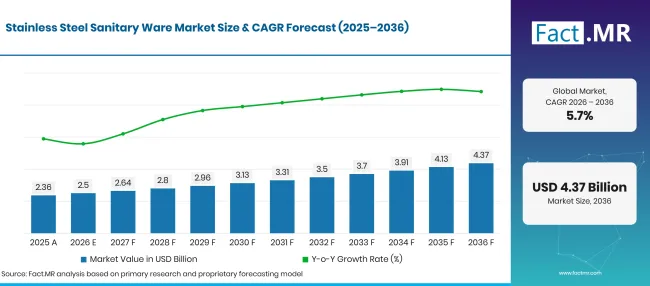
Stainless Steel Sanitary Ware Market Forecast Global | Source: Fact.MR
| Year | Basis | Market Value (USD billion) |
|---|---|---|
| 2025 | Actual | 2.36 |
| 2026 | Estimate | 2.5 |
| 2036 | Forecast | 4.37 |
| CAGR 2026 to 2036 | Forecast period | 5.7% |
Source: Fact.MR analysis. Updated Oct 27, 2026
What are the defining numbers behind Stainless Steel Sanitary Ware Market growth?
Approximately USD 1.9 billion in absolute opportunity between 2026 and 2036, calculated from the displayed rounded market values
- Demand Drivers in the Market
- Residential construction and renovation support demand for sanitary fixtures. New housing and bathroom upgrades create demand for sinks and other sanitary fixtures. Germany's Federal Statistical Office reported in May 2026 that 206,600 dwellings were completed in 2025, while 238,500 dwellings received building approval during the year [1] [2]. [1] [2]
- An expanding residential housing base creates opportunities for sanitary fixture installations and replacements. Brazil's national statistics agency reported in April 2026 that the country had 79.3 million permanent private housing units in 2025, up 18.9% from 2016 [3]. The expansion in permanent housing stock provides a larger base of properties requiring sanitary fixtures. The statistic does not directly measure stainless steel sanitary ware purchases.[3][3]
- Commercial hygiene requirements support demand for durable sanitary fixtures suited to frequent cleaning. Hospitals, hotels, restaurants and public facilities require sanitary products suited to frequent use and cleaning. Stainless steel can be relevant where corrosion resistance and cleanability are priorities, although performance depends on the grade, finish, fabrication and maintenance practices.
- Online product discovery and retail availability are supporting demand for the stainless steel sanitary ware market, as consumers and commercial buyers increasingly compare product designs, durability, corrosion resistance, pricing, and supplier availability across online and offline retail channels. Digital catalogues and online sales allow buyers to compare dimensions, finishes and installation requirements before purchase. Offline retail remains important for physical inspection and installation guidance, particularly for products that require precise plumbing compatibility.
- Key Segments Analyzed
- By Product Type: Sinks are projected to represent 34.8% of the market in 2026, supported by their use across residential kitchens and washrooms as well as commercial facilities.
- By Application: Residential applications leads with 48.3% of the market in 2026, reflecting demand from household construction and bathroom renovation.
- By Distribution Channel: Offline retail is forecast to hold 68.4% of the market in 2026 because customers often prefer to inspect product quality and dimensions before purchasing sanitary fixtures.
- By End-User: Households capture 42.7% of the market in 2026, supported by new installations and replacement purchases.
- Analyst Opinion at Fact.MR
- Shambhu Nath Jha, Principal Consultant at Fact.MR, states, “Stainless steel sanitary ware demand will depend on the balance between durability requirements and the cost of installation. Residential buyers prioritize practicality and appearance, while commercial purchasers place greater emphasis on repeated-use performance, maintenance requirements and compatibility with existing plumbing systems.”
- Strategic Implications
- Manufacturers need to communicate stainless steel grade and finish specifications alongside corrosion resistance and cleaning requirements.
- Retailers can strengthen product selection by providing accurate dimensions and installation guidance for sinks and other fixtures.
- Commercial suppliers should differentiate their portfolios through products designed for frequent use in hospitality and healthcare facilities.
- Manufacturers and distributors need to balance online product discovery with offline inspection and after-sales support.
- Product developers need to evaluate manufacturing costs and installation compatibility when expanding stainless steel sanitary ware portfolios.
Germany is projected to record a 7.1% CAGR through 2036. Brazil is expected to grow at 6.5%, followed by the USA at 5.9%. The UK is forecast to advance at 5.3%, while Japan is projected to register a 4.7% CAGR.
How does the Stainless Steel Sanitary Ware Market break down by segment?
Fact.MR identifies sinks as the leading product type with a 34.8% share in 2026. Residential applications are expected to account for 48.3% of demand, offline retail for 68.4% of distribution and households for 42.7% of end-user demand.
Which Product Type dominates?
Sinks are set to hold 34.8% of the market in 2026.
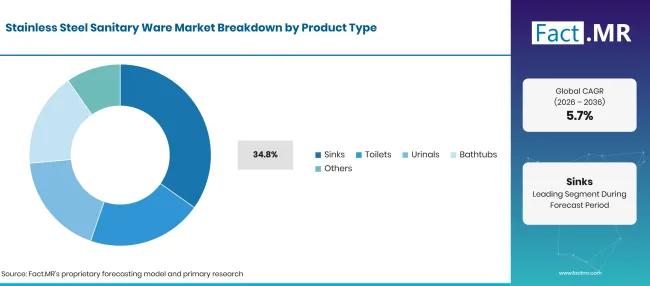
Stainless Steel Sanitary Ware Market Breakdown Product Type | Source: Fact.MR
| Product Type | Share (2026) |
|---|---|
| Sinks (Leading segment) | 34.8% |
| Other segments combined | 65.2%* |
| Total | 100.0% |
Source: Fact.MR analysis. Updated Oct 27, 2026
Sinks serve kitchens and washrooms in homes and commercial buildings. Stainless steel offers a practical combination of durability and ease of cleaning, making it relevant to frequently used installations. Toilets and urinals serve dedicated washroom requirements, while bathtubs address more specialized residential and hospitality applications. Product selection depends on dimensions and design as well as installation conditions and expected usage.
How does Application shape demand?
Residential applications are projected to represent 48.3% of the market in 2026.
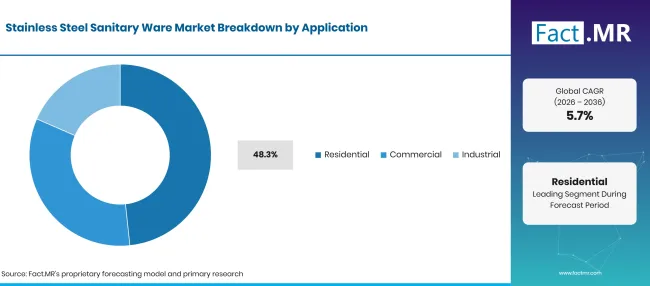
Stainless Steel Sanitary Ware Market Breakdown Application | Source: Fact.MR
| Application | Share (2026) |
|---|---|
| Residential (Leading segment) | 48.3% |
| Other segments combined | 51.7%* |
| Total | 100.0% |
Source: Fact.MR analysis. Updated Oct 27, 2026
Residential demand is linked to new homes and apartment construction as well as bathroom upgrades and fixture replacement. Household purchasing decisions typically balance cost and appearance with durability and maintenance. Commercial and industrial applications have different requirements because fixtures may experience heavier use and more frequent cleaning. The suitability of stainless steel depends on the required design and operating environment.
Which Distribution Channel leads?
Offline retail is forecast to account for 68.4% of the market in 2026.
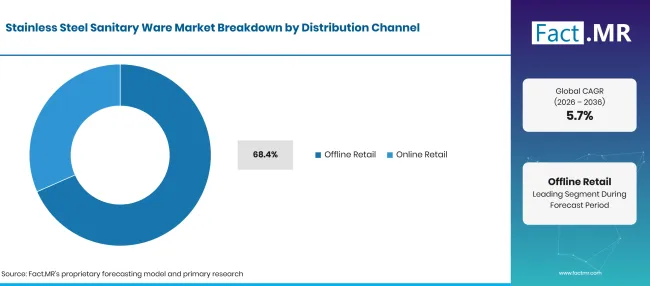
Stainless Steel Sanitary Ware Market Breakdown Distribution Channel | Source: Fact.MR
| Distribution Channel | Share (2026) |
|---|---|
| Offline Retail (Leading segment) | 68.4% |
| Other segments combined | 31.6%* |
| Total | 100.0% |
Source: Fact.MR analysis. Updated Oct 27, 2026
Offline retail gives buyers an opportunity to examine product finishes and construction quality before purchase. Retailers and plumbing dealers can also explain installation requirements and help customers compare sizes. Online channels support product discovery and specification comparisons, although delivery logistics and the risk of dimension mismatches can affect purchasing decisions.
Which End-User segment dominates?
Households are projected to account for a 42.7% share in 2026.
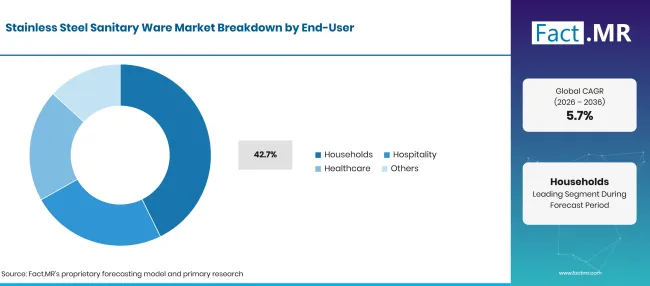
Stainless Steel Sanitary Ware Market Breakdown End User | Source: Fact.MR
| End-User | Share (2026) |
|---|---|
| Households (Leading segment) | 42.7% |
| Other segments combined | 57.3%* |
| Total | 100.0% |
Source: Fact.MR analysis. Updated Oct 27, 2026
Households form an important customer base because sanitary fixtures are installed in new homes and replaced during renovation. Household purchases can include individual sinks or coordinated bathroom fixtures. Hospitality operators and healthcare facilities buy for different operating conditions and may prioritize cleaning requirements and repeated-use performance. Other end users include buyers whose needs vary with building type and installation scale.
What is accelerating Stainless Steel Sanitary Ware Market adoption, and what is holding it back?
Housing development and renovation create demand for durable fixtures, while higher upfront costs and competition from alternative materials can constrain adoption.
Drivers Impact Analysis
| DRIVER | (~) % IMPACT ON CAGR | GEOGRAPHIC RELEVANCE | IMPACT TIMELINE |
|---|---|---|---|
| Residential construction and bathroom installation | +1.0% | Global | Medium term (2–4 years) |
| Replacement of aging sanitary fixtures | +0.8% | Europe, North America | Medium term (2–4 years) |
| Hygiene requirements in commercial washrooms | +0.7% | Global | Short term (≤ 2 years) |
| Product availability through retail networks | +0.5% | Global | Short term (≤ 2 years) |
| Durable finishes and installation-ready designs | +0.4% | Global | Long term (≥ 4 years) |
Source: Fact.MR analysis. Updated Oct 27, 2026
Opportunity Impact Analysis
| OPPORTUNITY | (~) % IMPACT ON CAGR | GEOGRAPHIC RELEVANCE | IMPACT TIMELINE |
|---|---|---|---|
| Stainless steel fixtures for commercial washrooms | +0.8% | Global | Medium term (2–4 years) |
| Renovation-focused product portfolios | +0.7% | Europe, North America | Medium term (2–4 years) |
| Online product discovery and specification tools | +0.5% | Global | Short term (≤ 2 years) |
| Improved surface finishes and design options | +0.5% | Global | Long term (≥ 4 years) |
| Integrated supply for hospitality projects | +0.4% | Asia, Europe | Medium term (2–4 years) |
Source: Fact.MR analysis. Updated Oct 27, 2026
Restraints Impact Analysis
| RESTRAINT | (~) % IMPACT ON CAGR | GEOGRAPHIC RELEVANCE | IMPACT TIMELINE |
|---|---|---|---|
| Higher upfront cost versus some alternatives | -0.8% | Global | Short term (≤ 2 years) |
| Competition from ceramic and composite fixtures | -0.7% | Global | Medium term (2–4 years) |
| Installation and plumbing compatibility issues | -0.5% | Global | Short term (≤ 2 years) |
| Price sensitivity in residential projects | -0.5% | Emerging markets | Medium term (2–4 years) |
| Variations in steel grade and surface quality | -0.3% | Global | Long term (≥ 4 years) |
Source: Fact.MR analysis. Updated Oct 27, 2026
Which countries are scaling the Stainless Steel Sanitary Ware Market through 2036?
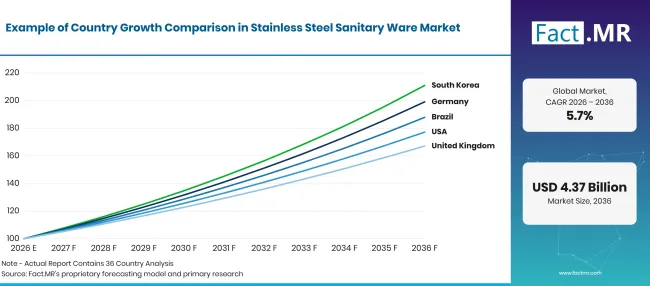
Stainless Steel Sanitary Ware Market Growth Index | Source: Fact.MR
| Country | CAGR (2026–2036) |
|---|---|
| Germany | 7.1% |
| Brazil | 6.5% |
| USA | 5.9% |
| UK | 5.3% |
| Japan | 4.7% |
Source: Fact.MR analysis. Updated Oct 27, 2026
What supports Germany adoption?
7.1% CAGR, supported by demand for residential fixtures and renovation-related purchases.
Germany’s stainless steel sanitary ware market is driven by demand for durable, corrosion-resistant and hygienic bathroom products across residential, commercial and public infrastructure. Modern bathroom renovations, premium interior design and the need for easy-to-maintain fixtures support adoption in hotels, hospitals, offices and public facilities. Stainless steel’s resistance to moisture, long service life and suitability for high-traffic environments make it attractive for applications where durability and hygiene are priorities.
How is Brazil developing stainless steel sanitary ware adoption?
6.5% CAGR, driven by a substantial housing stock and demand for household improvements.
Brazil’s stainless steel sanitary ware market is supported by its extensive residential housing base and demand for bathroom renovations and fixture replacements. Stainless steel sinks and sanitary products can appeal to buyers seeking durability, corrosion resistance and easy maintenance. Adoption will depend on product affordability, consumer preferences, construction standards and the availability of products through local distributors and retail channels.
What supports United States adoption?
5.9% CAGR, led by residential construction and commercial fixture requirements.
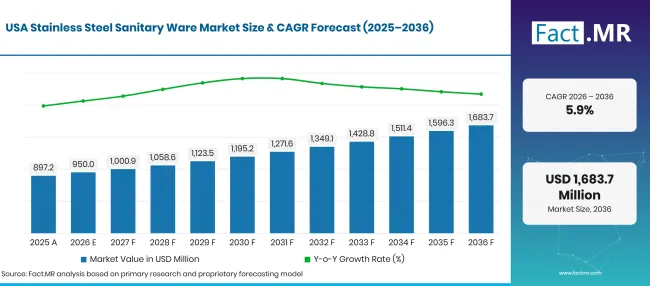
Stainless Steel Sanitary Ware Market Forecast Usa | Source: Fact.MR
The U.S. Census Bureau reported that privately owned housing starts reached a seasonally adjusted annual rate of 1.221 million units in September 2026 [4]. Although this was below the August rate, construction activity continues to provide a demand indicator for sanitary fixtures. Manufacturers also serve renovation projects and commercial washrooms where product durability and maintenance requirements influence selection.
How is the United Kingdombuilding adoption?
5.3% CAGR, shaped by new housing supply and refurbishment demand.
The Office for National Statistics published updated UK housebuilding indicators in February 2026 covering new dwelling starts and completions across England, Wales, Scotland and Northern Ireland [5]. Housing construction provides an installation opportunity for sanitary ware, while refurbishment creates additional replacement demand. Product selection will depend on installation dimensions and cost alongside design preferences.
What supports Japan adoption?
4.7% CAGR, backed by residential construction and replacement requirements.
Japan's Ministry of Land, Infrastructure, Transport and Tourism reported in April 2026 that new housing starts declined in fiscal year 2025 after an increase in the previous fiscal year [6]. This indicates that new-build demand may fluctuate. Replacement purchases and renovation requirements offer additional routes for stainless steel sanitary ware suppliers, particularly where durability and ease of cleaning are priorities.
Who leads the Stainless Steel Sanitary Ware Market?
Fact.MR identifies Kohler Co.; THIELMANN PORTINOX SPAIN, S.A.; DELABIE S.A.S.; and Purus AB among the companies profiled in the stainless steel sanitary ware market. These companies have varying degrees of relevance to the market through their bathroom products, stainless steel sanitary equipment, and washroom solutions.
Kohler Co. participates in the broader bathroom and sanitary products industry. THIELMANN PORTINOX SPAIN, S.A. specializes in stainless steel products for sanitary and commercial applications, while DELABIE S.A.S. offers stainless steel washroom equipment designed for public and commercial facilities. Purus AB supplies bathroom drainage and sanitary products, including solutions for wet rooms and commercial installations. Their portfolios differ in product scope, so their broader offerings should not be interpreted as consisting exclusively of stainless steel sanitary ware.
THIELMANN PORTINOX SPAIN, S.A. and DELABIE S.A.S. have directly documented stainless steel sanitary ware portfolios, including toilets, washbasins and urinals for public and commercial facilities. Purus AB also offers dedicated stainless steel sanitary ware, including washbasins, urinals, sinks and WC products. Kohler Co. has broader bathroom product portfolios, but their inclusion in this market should be supported by product-specific evidence rather than their overall sanitary ware presence alone.
Commercial competition is influenced by product quality, durability, hygiene, design, price and distribution. Manufacturers need to provide clear material specifications and dependable product availability. Retailers and installers contribute through product comparisons and installation support, while commercial buyers evaluate maintenance requirements, vandal resistance and suitability for frequent use.
Which companies are the key providers?
Key companies include Kohler Co.; THIELMANN PORTINOX SPAIN, S.A.; DELABIE S.A.S.; and Purus AB.
- Kohler Co.
- THIELMANN PORTINOX SPAIN, S.A.
- DELABIE S.A.S.
- Purus AB
Bibliography
- [1] Statistisches Bundesamt (Destatis). (2026, May 22). 18.0% fewer dwellings completed in 2025. Destatis source
- [2] Statistisches Bundesamt (Destatis). (2026, February 18). 10.8% more building permits for dwellings in 2025. Destatis source
- [3] Instituto Brasileiro de Geografia e Estatística. (2026, April 17). Rented housing units grew more than 50% since 2016. IBGE source
- [4] U.S. Census Bureau. (2026, October 20). Monthly new residential construction, September 2026. U.S. Census Bureau source
- [5] Office for National Statistics. (2026, February 17). Indicators of house building, UK: overview. ONS source
- [6] Ministry of Land, Infrastructure, Transport and Tourism. (2026, April 30). 建築着工統計調査報告(令和7年度計分) [Building Starts Statistics Survey Report: FY2025 total]. MLIT source
- [7] Ministry of Steel, Government of India. (2026, September 24). India's steel demand stays robust in Apr–Aug 2026. Press Information Bureau. PIB source
- [8] Bureau of Indian Standards. (2025). Compendium of Indian standards on vitreous china sanitary appliances. Civil Engineering Department. BIS compendium
This Report Answers
- The report describes the role of stainless steel sanitary ware in residential and commercial installations.
- Product analysis compares sinks, toilets, urinals, bathtubs and other sanitary fixtures.
- Application analysis examines residential, commercial and industrial demand.
- Distribution analysis compares offline retail with online retail.
- Country analysis discusses Germany, Brazil, the USA, the UK and Japan alongside official construction indicators.
- The competitive overview profiles four named companies across the broader sanitary products industry.
What does the Stainless Steel Sanitary Ware Market cover?
The market covers stainless steel sanitary fixtures intended for installation in residential buildings and commercial or industrial facilities. Product coverage includes sinks, toilets, urinals, bathtubs and other sanitary ware within the classification. Demand analysis considers new construction and replacement purchases alongside renovation and institutional requirements.
What is included in the scope?
The analysis includes stainless steel sanitary ware sold for household and institutional use. It considers product selection and installation requirements as well as distribution channels and end-user demand. The defined market covers the product types and applications across the specified geographic regions.
What is excluded from the scope?
The analysis excludes sanitary fixtures made entirely from ceramic or other materials unless they fall within a separately defined stainless steel product category. General plumbing equipment and bathroom accessories are excluded when sold independently of the covered sanitary ware. Installation services and construction contracts are also excluded from the product revenue boundary.
How Was the Analysis Built?
The analysis draws on 120+ sources, 35+ company portfolios, 25+ countries, and more than 20 industry interviews.
- Primary Research: Primary research includes discussions with manufacturers, service providers, technology developers, distributors, end users, and subject-matter experts. These conversations examine purchasing priorities, product adoption, operational challenges, approval requirements, competitive positioning, and the factors that influence wider market acceptance.
- Desk Research: Desk research covers government statistics, regulatory publications, company filings, trade data, technical studies, industry associations, standards, public policy, and other authoritative sources. Every source used in the analysis is documented in the bibliography.
- Market Sizing and Forecasting: Market estimates combine historical performance, demand indicators, pricing and volume trends, segment shares, company participation, country-level growth, adoption patterns, investment activity, and barriers to market expansion.
- Data Validation and Update Cycle: Findings are validated by comparing primary interviews with public data, company activity, regulatory changes, trade patterns, and industry developments. Regular updates review new product launches, capacity changes, partnerships, approvals, and shifts in commercial adoption.
Segmentation
What is the report's scope and coverage?
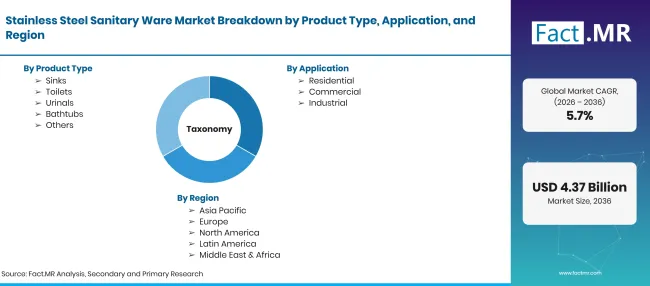
Stainless Steel Sanitary Ware Market Taxonomy | Source: Fact.MR
| Attribute | Details |
|---|---|
| Quantitative Units | USD billion in 2026 to USD billion by 2036 at CAGR |
| Market Definition | Stainless steel sanitary ware products used in residential, commercial and industrial sanitary installations |
| Product Type | Sinks; Toilets; Urinals; Bathtubs; Others |
| Application | Residential; Commercial; Industrial |
| Distribution Channel | Offline Retail; Online Retail |
| End-User | Households; Hospitality; Healthcare; Others |
| Regions Covered | North America; Latin America; Western Europe; Eastern Europe; East Asia; South Asia & Pacific; Middle East & Africa |
| Countries Covered | Germany; Brazil; USA; UK; Japan |
| Companies Profiled | Kohler Co.; THIELMANN PORTINOX SPAIN, S.A.; DELABIE S.A.S.; Purus AB |
| Forecast Period | 2026 to 2036 |
| Approach | Market segmentation and scenario-based analysis supported by official housing and construction statistics |
Source: Fact.MR analysis. Updated Oct 27, 2026
How is the market segmented?
-
By Product Type
- Sinks
- Toilets
- Urinals
- Bathtubs
- Others
-
By Application
- Residential
- Commercial
- Industrial
-
By Distribution Channel
- Offline Retail
- Online Retail
-
By End-User
- Households
- Hospitality
- Healthcare
- Others
-
By Region
- North America
- Latin America
- Western Europe
- Eastern Europe
- East Asia
- South Asia & Pacific
- Middle East & Africa
Frequently Asked Questions
How big is the Stainless Steel Sanitary Ware Market in 2026?
What is the CAGR from 2026 to 2036?
Which product type has the largest share?
Which application leads the market?
Which distribution channel leads?
Which end-user segment has the largest share?
Which country has the highest projected CAGR?
Which companies are covered?
Who worked on this report


Preview the report firsthand - request a free sample
Free SampleGet the brochure for pricing and purchase details
Download PDF