- Base Value(2025): 1.4 Bn
- Estimated Value(2026): 1.5 Bn
- Forecast Value (2036): 2.7 Bn
- CAGR (2026 - 2036): 6.1%
Stainless Steel Turning Inserts Market Forecast and Outlook By Fact. MR
In 2025, the stainless steel turning inserts market was valued at USD 1.4 billion. Based on Fact.Mr’ analysis, demand for stainless steel turning inserts is estimated to grow to USD 1.5 billion in 2026 and USD 2.7 billion by 2036. FACT.MR projects a CAGR of 6.1% during the forecast period.
Between 2026 and 2036, the market is projected to create an absolute dollar opportunity of USD 1.2 billion. This represents a near-doubling of market value, reflecting sustained demand from automotive manufacturing, aerospace component machining, and medical device production. Structural constraints include raw material cost volatility for carbide substrates and cobalt binder, and price pressure from low-cost insert producers in Asia.
Country growth is shaped by manufacturing sector investment, automotive production volume, and industrial precision requirements. China leads at 8.8% CAGR, driven by expanding stainless steel component manufacturing in automotive and electronics industries and rising domestic machine tool capacity. India follows at 7.9%, supported by growing automotive component exports and government-backed industrial modernization under the Production Linked Incentive scheme. Germany posts 7.3% as automotive OEMs and medical device manufacturers upgrade tooling for high-precision stainless alloy components. Brazil registers 6.9% linked to automotive sector recovery and expanding stainless steel use in food processing and oil and gas equipment. The United States grows at 6.0%, reflecting aerospace and medical device sector precision machining demand and ongoing tooling upgrades in automotive plants.
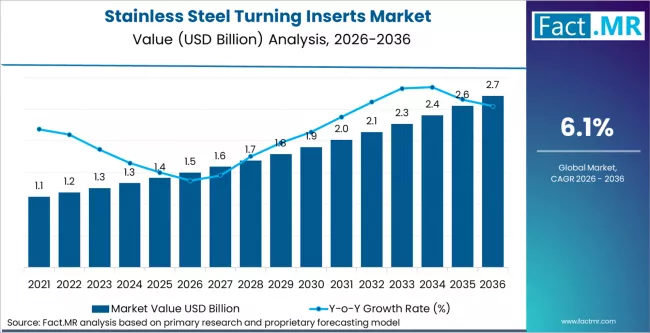
Stainless Steel Turning Inserts Market Market Value Analysis | Source: Fact.MR
| Metric | Value |
|---|---|
| Estimated Value in 2026 | USD 1.5 billion |
| Forecast Value in 2036 | USD 2.7 billion |
| Forecast CAGR (2026 to 2036) | 6.1% |
Source: Fact.MR analysis. Updated Mar 17, 2026
Stainless Steel Turning Inserts Market Definition
The stainless steel turning inserts market covers coated and uncoated carbide inserts engineered for turning operations on stainless steel grades including austenitic, ferritic, martensitic, and duplex alloys. These inserts are used in CNC turning centres across automotive, aerospace, medical device, and industrial equipment manufacturing to achieve tight tolerances and high surface finishes on difficult-to-machine stainless materials.
Market Inclusions
Includes global and regional revenue forecasts from 2026 to 2036 by coating type (CVD, PVD, uncoated) and end use (aerospace, automotive, military, others) across North America, Europe, Asia Pacific, Latin America, and Middle East and Africa.
Market Exclusions
Excludes milling inserts, drilling inserts, and general-purpose carbide grades not specifically engineered for stainless steel. Excludes insert holders, tooling systems, and machine tools. Excludes turning inserts used exclusively on non-stainless ferrous or non-ferrous materials.
Research Methodology
- Primary Research: Interviews with cutting tool engineers, procurement managers at automotive and aerospace OEMs, metalworking distributors, and CNC machine tool operators across Asia Pacific, Europe, and North America.
- Desk Research: Sources include OEM technical publications, ISO 513 and ANSI tooling standards, automotive industry production data, aerospace component machining reports, and patent filings from 2024 to 2025.
- Market Sizing and Forecasting: A hybrid top-down and bottom-up model using stainless steel machining volume estimates, insert consumption rates by end use, average selling prices by coating type, and replacement cycle data.
- Data Validation and Update Cycle: Outputs validated against OEM revenue disclosures, distributor sell-through data, and production volume statistics with annual forecast updates.
Summary of Stainless Steel Turning Inserts Market
- Market Definition
- Stainless steel turning inserts are precision carbide cutting tools used in CNC turning operations on austenitic, martensitic, and duplex stainless steel grades across industrial manufacturing.
- Demand Drivers
- Automotive light weighting programmers require high-precision turning of stainless steel exhaust, fuel system, and structural components at elevated cutting speeds, increasing coated insert consumption per vehicle.
- Aerospace component manufacturing tolerances for stainless steel turbine and structural parts demand advanced CVD-coated inserts with superior thermal resistance and edge consistency.
- Medical device production growth in implants, surgical tools, and instruments made from stainless alloys drives recurring insert replacement demand in ISO 9001 and FDA-regulated machining environments.
- Key Segments Analyzed
- By Coating Type: CVD-coated inserts hold approximately 40% share in 2026 due to exceptional wear resistance, thermal stability, and suitability for high-speed stainless steel turning.
- By End Use Industry: Automotive leads with approximately 53% share in 2026, driven by high-volume stainless steel component machining requirements and productivity-driven tooling upgrades.
- By Geography: Asia Pacific leads growth through manufacturing expansion; North America leads value through aerospace and medical device precision machining.
- Analyst Opinion at FACT.MR
- Shambhu Nath Jha, Principal Consultant at Fact.Mr, opines that CXOs will find the market underpinned by automotive and aerospace tooling upgrade cycles, with CVD coating dominance creating a structural premium pricing advantage for established cutting tool OEMs.
- Strategic Implications
- Tooling manufacturers should expand CVD-coated insert grades engineered for specific stainless alloy families, including duplex and super-austenitic grades used in oil and gas applications.
- Distributors in China and India should offer application engineering support and trial programmes alongside insert supply to accelerate premium coating adoption in automotive and industrial accounts.
- Companies should develop lightweight, multi-edge insert geometries that extend tool life on stainless steel and reduce cost-per-part for high-volume automotive machining customers.
- Methodology
- Market sizing used stainless steel machining volume estimates and insert consumption rates by end use, validated against OEM revenue data and distributor shipment records.
- Automotive production statistics, aerospace component machining reports, and ISO tooling standards from 2024 to 2025 supported segment demand analysis.
- Forecasts incorporated manufacturing output data, coating technology adoption surveys, and primary interviews with cutting tool engineers and procurement managers.
Segmental Analysis
Stainless Steel Turning Inserts Market Analysis by Coating Type
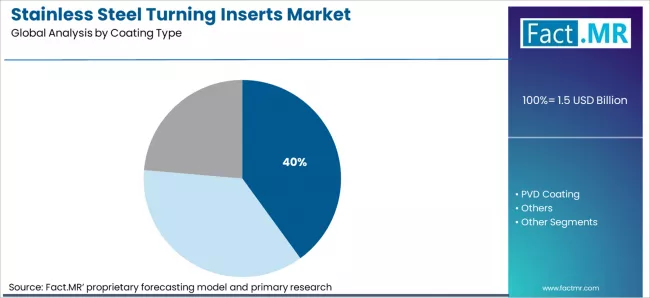
Stainless Steel Turning Inserts Market Analysis By Coating Type | Source: Fact.MR
Based on FACT.MR’s stainless steel turning inserts market report, consumption of CVD-coated inserts is estimated to hold approximately 40% share in 2026. CVD coatings deliver superior thickness uniformity and thermal resistance compared to PVD coatings, making them the preferred choice for high-speed stainless steel turning where heat generation and flank wear are critical failure modes.
- Sandvik Coromant CVD Grade Expansion: In 2025, Sandvik Coromant launched the GC4415 and GC4425 CVD-coated insert grades specifically engineered for stainless steel turning at elevated cutting speeds. The launch was accompanied by application data showing a 25% increase in tool life versus predecessor grades. [5]
- Kennametal PVD Technology Development: In 2024, Kennametal introduced its KCP25C PVD-coated grade with a new AlTiN coating architecture designed for finishing operations on austenitic stainless steel, expanding PVD’s competitiveness in the precision segment. [6]
- Multi-Layer Coating Adoption Trend: KYOCERA’s 2024 distributor data showed multi-layer CVD inserts accounting for the fastest-growing sub-category in stainless steel turning, reflecting OEM customer demand for consistent edge quality across long batch runs. [7]
Stainless Steel Turning Inserts Market Analysis by End Use Industry.
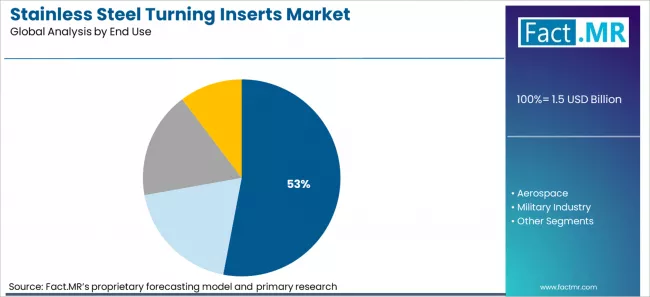
Stainless Steel Turning Inserts Market Analysis By End Use | Source: Fact.MR
Based on FACT.MR’s stainless steel turning inserts market report, the automotive end use segment is projected to hold approximately 53% share in 2026 due to the sector’s massive stainless steel component consumption and productivity-driven tooling requirements. High-volume automotive machining environments demand inserts with consistent tool life and rapid indexing capability to minimize cycle time.
- Mitsubishi Materials Automotive Tooling Investment: In 2025, Mitsubishi Materials Corporation expanded its MC6025 insert series for automotive stainless steel turning with new geometry variants for interrupted cut and EV component applications. [8]
- Seco Tools Aerospace Segment Technology: In 2024, Seco Tools launched its Duratomic TP2501 grade designed specifically for aerospace stainless alloy and titanium turning, featuring a reinforced edge for consistent performance on deep cuts in difficult alloys. [9]
- Military and Defence Sector Adoption Trend: Walter Tools reported rising insert orders from defence contractors in 2024 and 2025 related to stainless steel component production for naval and armoured vehicle platforms, driven by NATO procurement increases across European and North American members. [10]
Regional Analysis
The stainless steel turning inserts market is analysed across Asia Pacific, Europe, North America, Latin America, and Middle East and Africa, covering 40-plus countries with demand profiles shaped by automotive production volume, aerospace activity, industrial modernization, and precision machining investment. The full report offers market attractiveness analysis based on manufacturing sector growth and tooling upgrade cycles.
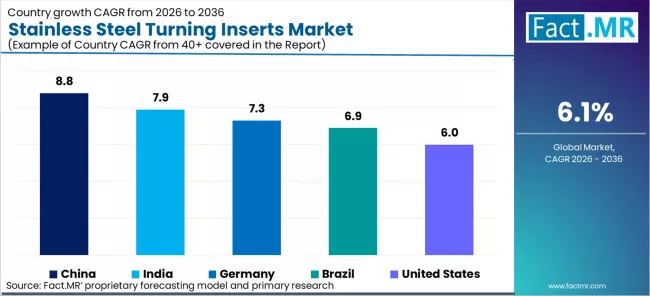
Stainless Steel Turning Inserts Market Cagr Analysis By Country | Source: Fact.MR
| Country | CAGR (2026-2036) |
|---|---|
| China | 8.8% |
| India | 7.9% |
| Germany | 7.3% |
| Brazil | 6.9% |
| United States | 6.0% |
Source: Fact.MR analysis. Updated Mar 17, 2026
Source: Fact.MR (FACT.MR) analysis, based on proprietary forecasting model and primary research
Asia Pacific Stainless Steel Turning Inserts Market Analysis
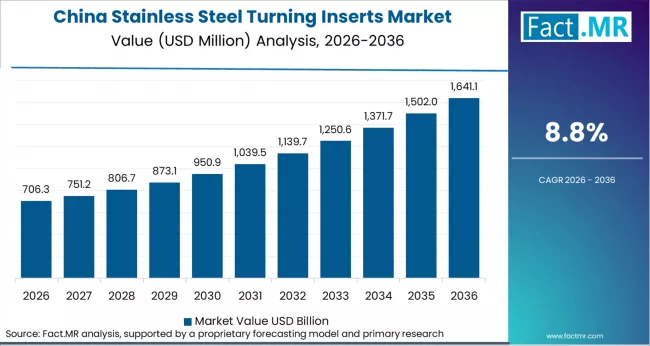
Stainless Steel Turning Inserts Market Country Value Analysis | Source: Fact.MR
Asia Pacific is the fastest-growing region for stainless steel turning inserts, driven by China’s expanding stainless steel manufacturing base and India’s growing automotive component export sector. Global cutting tool OEMs including Sandvik Coromant and KYOCERA hold strong positions in premium segments, while regional manufacturers compete aggressively in mid-range uncoated and entry-level coated grades.
- China: Demand for stainless steel turning inserts in China is projected to rise at 8.8% CAGR through 2036. The country’s 14th Five-Year Plan continued funding advanced manufacturing equipment upgrades through 2025, expanding CNC turning capacity in automotive and electronics sectors. BYD’s 2025 expansion of stainless steel battery enclosure production lines generated measurable demand for premium coated inserts among its Tier 1 machining suppliers.
- India: Demand for stainless steel turning inserts in India is expected to expand at 7.9% CAGR through 2036. The Production Linked Incentive scheme for automotive components, extended through 2025 by the Ministry of Heavy Industries, increased domestic stainless steel component machining volumes. Tata Motors and Mahindra’s 2025 stainless exhaust and structural component sourcing programmes drove tooling upgrades among approved machining suppliers.
FACT.MR’s Asia Pacific analysis of the stainless steel turning inserts market covers China, Japan, South Korea, India, Australia and New Zealand, ASEAN, and Rest of South Asia and Pacific. Readers can find country CAGR forecasts, manufacturing sector investment data, automotive production timelines, and OEM competitive positioning.
Europe Stainless Steel Turning Inserts Market Analysis
Europe is a high-value stainless steel turning inserts market anchored by Germany’s automotive and medical device manufacturing and supported by aerospace component production in France and the United Kingdom. Established OEMs including Sandvik Coromant, Seco Tools, and Walter Tools maintain strong distribution and application engineering presence across the region.
- Germany: Demand for stainless steel turning inserts in Germany is forecast to grow at 7.3% CAGR through 2036. Germany’s automotive OEMs including BMW Group and Mercedes-Benz continued to upgrade stainless steel exhaust and EV structural component machining lines in 2024 and 2025. The German Machinery and Plant Manufacturers’ Association (VDMA) reported continued cutting tool procurement growth linked to high-precision stainless alloy turning in automotive and medical device sectors through Q1 2025.
FACT.MR’s European analysis of the stainless steel turning inserts market covers Germany, France, the United Kingdom, Italy, Spain, Nordic countries, BENELUX, and Rest of Western Europe. Readers can find EU manufacturing investment data, automotive OEM tooling upgrade trends, and country-level forecasts by coating type and end use.
North America Stainless Steel Turning Inserts Market Analysis
North America is the largest revenue market for stainless steel turning inserts, led by aerospace and medical device precision machining in the United States. Kennametal, Sandvik Coromant, and Seco Tools maintain strong distribution and technical support networks across the region, competing primarily on tooling performance, application support, and total cost-per-part value.
- United States: Demand for stainless steel turning inserts in the United States is projected to rise at 6.0% CAGR through 2036. Boeing and Raytheon Technologies continued stainless steel component machining programmes in 2025 under long-term defence and commercial aerospace contracts, sustaining premium insert procurement. The U.S. FDA’s Class II and III medical device approval pipeline expansion in 2024 and 2025 also drove stainless steel implant and instrument machining volumes.
FACT.MR’s North American analysis of the stainless steel turning inserts market covers the United States, Canada, and Mexico. Readers can find aerospace and medical device machining demand data, automotive tooling upgrade trends, and country forecasts by coating type.
Latin America Stainless Steel Turning Inserts Market Analysis
Latin America is an emerging stainless steel turning inserts market driven by automotive sector recovery and expanding stainless steel use in food processing and oil and gas equipment. Brazil leads the region through both manufacturing volume and safety-linked machining specification upgrades.
- Brazil: Demand for stainless steel turning inserts in Brazil is projected to grow at 6.9% CAGR through 2036. Brazil’s automotive sector recovery saw Stellantis and Volkswagen do Brasil expand stainless steel component machining in 2025, increasing insert consumption among contracted machining suppliers. Brazil’s national oil company Petrobras also continued equipment maintenance programmes requiring stainless steel valve and fitting machining through 2025.
FACT.MR’s Latin American analysis of the stainless steel turning inserts market covers Brazil, Chile, Ecuador, and Rest of Latin America. Readers can find automotive sector recovery data, oil and gas machining trends, and country-level insert demand forecasts.
Competitive Aligners for Market Players
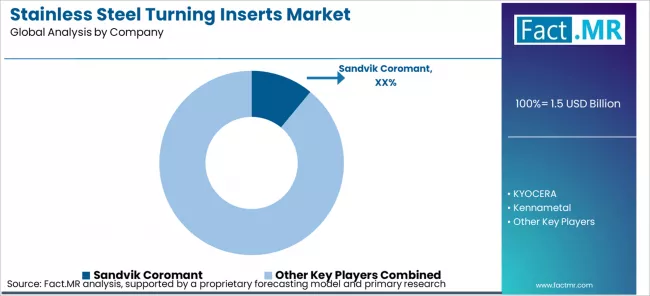
Stainless Steel Turning Inserts Market Analysis By Company | Source: Fact.MR
The global stainless steel turning inserts market is moderately concentrated in the premium coated insert tier and highly fragmented in mid-range and uncoated segments. Sandvik Coromant, KYOCERA, Kennametal, and Mitsubishi Materials Corporation hold the largest global positions by revenue across CVD-coated, PVD-coated, and multi-layer insert categories. Their strength derives from extensive application-specific grade portfolios, global technical sales forces capable of machining process optimization, and strong relationships with automotive and aerospace OEM procurement teams that specify approved tooling grades.
Chinese domestic insert producers including ZCC Cutting Tools and Zhuzhou Cemented Carbide Group are expanding competitively in mid-range segments across Asia, Africa, and Latin America by offering certified inserts at significant price discounts to global OEMs. Technology differentiation through advanced coating architecture, new carbide substrate compositions, and digital tooling management platforms represents the primary competitive lever in premium segments where Sandvik Coromant and Seco Tools are building tooling service revenue beyond standard insert supply. Dormer Pramet and Korloy compete effectively in the European and Asian mid-range market through broad product coverage and responsive regional distribution.
Large automotive and aerospace machining customers manage supplier dependency by maintaining approved tooling lists with two to three competing insert suppliers per machining operation, limiting single-supplier pricing power in standard grades. However, customers who adopt OEM-provided tooling management software and insert tracking platforms develop higher switching costs, creating a structural advantage for first-mover platform providers in high-volume automotive machining accounts.
Key Players of Stainless Steel Turning Inserts Market
- Sandvik Coromant
- KYOCERA
- Kennametal
- Mitsubishi Materials Corporation
- Sumitomo Corporation
- Seco Tools
- Walter Tools
- Dormer Pramet
- Korloy
- ISCAR
Bibliography
[1] Sandvik AB. (2025). Q4 2024 Earnings Call Transcript: Machining Solutions Segment Performance and Stainless Steel Tooling Innovation Investment Commentary. February 2025. home. sandvik
[2] Volkswagen AG. (2025). Supplier Quality Requirements Update: Surface Finish and Tooling Traceability Standards for Stainless Steel Structural Components. January 2025. volkswagen-group.com
[3] Boeing Company. (2024). Supplier Quality Management System Update: Tooling Performance Documentation Requirements for Critical Stainless Steel Machining Operations. September 2024. boeing.com
[4] National Development and Reform Commission, People’s Republic of China. (2025). 14th Five-Year Plan Advanced Manufacturing Equipment Upgrade Programme Progress Report. March 2025. ndrc.gov.cn
[5] Sandvik Coromant. (2025). Product Launch Release: GC4415 and GC4425 CVD-Coated Turning Insert Grades for Stainless Steel Machining. January 2025. sandvik.coromant.com
[6] Kennametal Inc. (2024). Product Innovation Brief: KCP25C PVD-Coated Grade with AlTiN Architecture for Austenitic Stainless Steel Finishing Operations. August 2024. kennametal.com
[7] KYOCERA Corporation. (2024). Annual Report 2024: Cutting Tools Division Multi-Layer CVD Insert Segment Growth in Stainless Steel Turning Applications. December 2024. kyocera.com
[8] Mitsubishi Materials Corporation. (2025). Product Catalogue Update: MC6025 Insert Series Expansion for Automotive Stainless Steel Turning and EV Component Applications. February 2025. mmc.co.jp
[9] Seco Tools AB. (2024). Product Launch: Duratomic TP2501 Grade for Aerospace Stainless Alloy and Titanium Turning. June 2024. secotools.com
[10] Walter AG. (2025). Investor Presentation: Defence Sector Machining Tool Demand Growth and NATO Procurement Expansion Impact on Cutting Tool Orders. March 2025. walter-tools.com
This Report Addresses
- Strategic intelligence on CVD coating dominance in stainless steel turning, automotive and aerospace OEM tooling upgrade cycles, China manufacturing modernization driving insert consumption, and premium insert adoption in North American aerospace machining.
- Market forecast from USD 1.5 billion in 2026 to USD 2.7 billion by 2036 at 6.1% CAGR, segmented by coating type, end use industry, and region.
- Growth opportunity mapping across China’s 14th Five-Year Plan manufacturing investment, India PLI automotive machining expansion, Brazil automotive sector recovery, and Germany’s precision machining upgrades.
- Country CAGR outlook for China 8.8%, India 7.9%, Germany 7.3%, Brazil 6.9%, and United States 6.0%, with key automotive, aerospace, and industrial sector demand drivers per country.
- Competitive analysis of Sandvik Coromant, KYOCERA, Kennametal, Mitsubishi Materials, Seco Tools, and Walter Tools covering product portfolios, coating technologies, distribution networks, and application engineering capabilities.
- Technology tracking including advanced CVD multi-layer coatings, PVD AlTiN architecture inserts, application-specific geometries for duplex stainless, and digital tooling management platforms.
- Regulatory and standards analysis covering ISO 513 cutting tool classification, AS9100D aerospace quality requirements, FDA medical device machining standards, and automotive OEM supplier quality specifications.
- Report delivered in PDF, Excel datasets, PowerPoint summary, and dashboard formats supported by OEM disclosures, cutting tool distributor data, and primary research interviews.
Segmentation
Scope of Report
| Metric | Value |
|---|---|
| Quantitative Units | USD 1.5 billion (2026) to USD 2.7 billion (2036), at a CAGR of 6.1% |
| Market Definition | Coated and uncoated carbide turning inserts engineered for stainless steel machining operations across CNC turning centres in automotive, aerospace, military, and industrial manufacturing. |
| Coating Type Segmentation | CVD Coating (40%), PVD Coating, Others |
| End Use Segmentation | Automotive (53%), Aerospace, Military Industry, Others |
| Application Coverage | External turning, internal turning, facing, grooving, and profiling operations on austenitic, ferritic, martensitic, duplex, and super-austenitic stainless steel grades. |
| Regions Covered | Asia Pacific, Europe, North America, Latin America, Middle East and Africa |
| Countries Covered | China, Japan, South Korea, India, Australia and New Zealand, ASEAN, Rest of South Asia and Pacific, Germany, UK, France, Italy, Spain, Nordic, BENELUX, Rest of Western Europe, Russia, Poland, Hungary, Balkan and Baltic, USA, Canada, Mexico, Brazil, Chile, Ecuador, Rest of Latin America, Saudi Arabia, GCC, Turkey, South Africa, Rest of MEA |
| Key Companies Profiled | Sandvik Coromant, KYOCERA, Kennametal, Mitsubishi Materials Corporation, Sumitomo Corporation, Seco Tools, Walter Tools, Dormer Pramet, Korloy, ISCAR |
| Forecast Period | 2026 to 2036 |
| Approach | Hybrid top-down and bottom-up model using stainless steel machining volume estimates, insert consumption rates by end use, average selling prices by coating type, replacement cycle data, and primary interviews with cutting tool engineers, OEM procurement managers, and metalworking distributors. |
Source: Fact.MR analysis. Updated Mar 17, 2026
Stainless Steel Turning Inserts Market by Segments
-
By Coating Type:
- CVD Coating
- PVD Coating
- Others
-
By End Use Industry:
- Aerospace
- Automotive
- Military Industry
- Others
-
By Region:
- North America
- United States
- Canada
- Mexico
- Latin America
- Brazil
- Chile
- Ecuador
- Rest of Latin America
- Western Europe
- Germany
- United Kingdom
- France
- Italy
- Spain
- Nordic
- BENELUX
- Rest of Western Europe
- Eastern Europe
- Russia
- Poland
- Hungary
- Balkan and Baltic
- Rest of Eastern Europe
- East Asia
- China
- Japan
- South Korea
- South Asia and Pacific
- India
- ASEAN
- Australia and New Zealand
- Rest of South Asia and Pacific
- Middle East and Africa
- Kingdom of Saudi Arabia
- Other GCC Countries
- Turkey
- South Africa
- Other African Union
- Rest of Middle East and Africa
- North America
Frequently Asked Questions
How large is the stainless steel turning inserts market in 2025?
What will the market size be in 2026?
What is the projected market size by 2036?
What is the expected CAGR?
Which coating type segment leads the market?
Which end use industry dominates?
Which country shows the fastest growth?
What is the expected CAGR for India?
What role does CVD coating play?
What is the primary restraint?
Who worked on this report


Preview the report firsthand - request a free sample
Free SampleGet the brochure for pricing and purchase details
Download PDF