- Market Value (2025): USD 12.9 Bn
- Estimated Value (2026): USD 13.4 Bn
- Forecast Value (2036): USD 21.2 Bn
- CAGR (2026-2036):4.7%
What is the Stainless Steel Wire Rods Market forecast to be worth by 2036?
From USD 13.5 billion in 2026 to USD 21.2 billion by 2036 at a 4.7% CAGR.
- Fact.MR estimates that the stainless steel wire rods market reached USD 12.9 billion in 2025, with cold-heading and spring wire accounting for most coil orders.
- By 2036 revenue will climb from USD 13.4 billion in 2026 to USD 21.2 billion, as fastener makers in vehicle and energy supply chains add stainless content.
- Annual growth will average 4.7% CAGR from 2026 to 2036, since import rules in Western markets steer orders toward documented domestic melt.
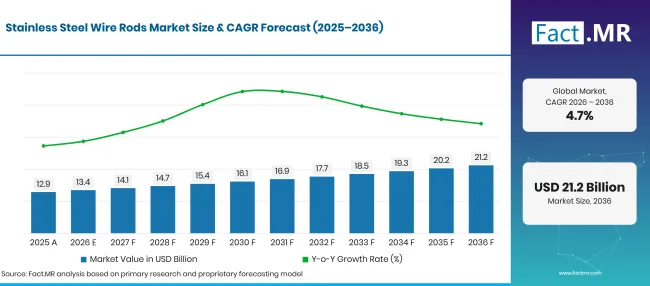
Factmr Stainless Steel Wire Rods Market Forecast Global | Source: Fact.MR
| Year | Basis | Market Value (USD billion) |
|---|---|---|
| 2025 | Actual | 12.9 |
| 2026 | Estimate | 13.4 |
| 2036 | Forecast | 21.2 |
| CAGR 2026 to 2036 | Forecast period | 4.7% |
Source: Fact.MR analysis. Updated Oct 16, 2026
What are the defining numbers behind Stainless Steel Wire Rods Market growth?
The 2026 to 2036 period adds USD 7.7 billion in new value, led by fastener and automotive wire demand.
- Demand Drivers in the Market
- Import protection is tightening in major Western markets. From 1 July 2026, the EU regime cut duty-free steel quota volumes by about 47% against 2024, capped them at 18.3 million tonnes a year and raised the out-of-quota duty to 50% [1]. Mills melting inside the EU gain firmer pricing for coil sold to local wire drawers.
- Global stainless output keeps growing, but its geography is uneven. The International Stainless Steel Forum reported world melt shop production of 64.2 million tonnes in 2025, up 2.1%, with Asia accounting for 55.3 million tonnes [2]. Rod buyers in Europe and North America now weigh delivery distance and mill approvals alongside price.
- Origin documentation is becoming a condition of entry. From 1 October 2026, EU importers must present a mill test certificate showing the country of melt and pour and the heat number for each steel lot [3]. Rod rolled in one country from billets cast elsewhere now needs a paper trail back to the melt shop.
- Cold-headed fasteners remain the main outlet for stainless rod. Bolts, screws and rivets for vehicles and process plants need grades such as 304, 316 and 302HQ. These grades hold their strength in wet or chemical service.
- Key Segments Analyzed
- By Diameter: 6mm will hold 43.9% share in 2026, as wire drawers can pull it down to most fastener and spring sizes in a few passes.
- By Application: Fasteners will account for 50.4% share in 2026 owing to the volume of cold-headed bolts and screws used in vehicles, plants and buildings.
- By End-use Industry: Automobile will capture 31.7% share in 2026, given the corrosion and heat resistance that carmakers specify for exhaust, fuel and chassis parts.
- Analyst Opinion at Fact.MR
- Shambhu Nath Jha, Principal Consultant at Fact.MR, states, “Wire rod buyers now ask where the steel was melted before they ask for a price. That shift favors mills with their own melt shops near the customer. In 6mm, 8mm and 10mm coil, the winners will be the producers that hold grade approvals at the big fastener and spring makers. Clear nickel surcharge terms will count for as much as tonnage when long contracts come up for renewal.”
- Strategic Implications
- Rod producers should match diameters and grades to the approved specifications of fastener and spring makers, since converters qualify a new mill slowly and seldom switch.
- Mills outside protected markets should secure quota access or a local rolling partner, given that EU and UK out-of-quota duties and the general U.S. rate now stand at 50%.
- Wire drawers and cold headers should keep melt-origin records for every heat and qualify a second source, as border checks on origin and carbon content tighten.
- Distributors should hold stock in the three core diameters near fastener clusters, because short lead times win orders when imported coil faces quota limits.
Germany will grow at 6.0% CAGR, drawing on its car plants and fastener makers behind EU import protection. Brazil follows at 5.5% as vehicle assembly expands under a revised industry outlook. In the United States, a 4.9% pace will reflect Section 232 duties that reward rod melted at home. A tighter quota regime will hold the United Kingdom at 4.4%. Japan closes the group at 3.9%, where domestic steel output keeps shrinking.
How does the Stainless Steel Wire Rods Market break down by segment?
6mm will lead Diameter at 43.9%; Fasteners will top Application at 50.4%; Automobile will hold first place in End-use Industry at 31.7%.
Which Diameter leads?
6mm makes up 43.9% of 2026 sales.
| Diameter | Share (2026) |
|---|---|
| 6mm (Leading segment) | 43.9% |
| Other segments combined | 56.1%* |
| Total | 100.0% |
Source: Fact.MR analysis. Updated Oct 16, 2026
Wire drawers prefer a starting coil that reaches many finished sizes with little reduction work. A 6mm rod draws down to cold-heading wire, spring wire and fine drawn steel wire in a few passes, so one stocked size serves most orders. The 8mm and 10mm coils go to heavier fastener blanks, bolts and welded mesh wire. Nickel sets much of the cost of austenitic rod in every diameter. The U.S. Geological Survey estimated the 2025 LME cash nickel price at about USD 15,000 per tonne, roughly 11% below 2024 [4]. It put Indonesia at 2.6 million of the 3.9 million tonnes of world mine output [4]. Chinese and Indonesian melt shops that run on nickel pig iron can price coil below Western mills.
What leads the Application segment?
Fasteners take 50.4% of 2026 sales.
| Application | Share (2026) |
|---|---|
| Fasteners (Leading segment) | 50.4% |
| Other segments combined | 49.6%* |
| Total | 100.0% |
Source: Fact.MR analysis. Updated Oct 16, 2026
Cold headers turn stainless rod into bolts, screws, nuts and rivets for cars and chemical plants. Makers of industrial fasteners need clean steel with low inclusion levels, since cracks during heading scrap whole batches. Spring makers buy 302 and 631 grades for valve, clip and seat springs that must resist fatigue and corrosion. Producers of welding electrodes draw stainless rod into filler wire matched to the base metal. Wire mesh weavers use annealed rod for filters, screens and architectural panels.
What supports Automobile within End-use Industry?
Automobile buyers represent 31.7% of 2026 sales.
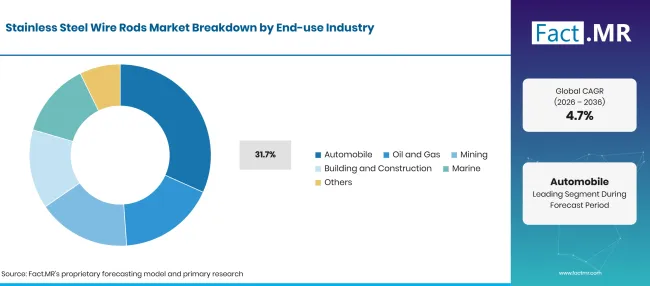
Factmr Stainless Steel Wire Rods Market Breakdown End Use Industry | Source: Fact.MR
| End-use Industry | Share (2026) |
|---|---|
| Automobile (Leading segment) | 31.7% |
| Other segments combined | 68.3%* |
| Total | 100.0% |
Source: Fact.MR analysis. Updated Oct 16, 2026
Carmakers specify stainless wire for exhaust clamps, fuel system parts, seat springs and trim fasteners. Each of these parts faces heat, road salt or moisture. Tier 1 suppliers qualify each rod source on grade and surface quality, which keeps volume with approved mills for the life of a platform. Electric cars add stainless content in battery housings, cooling circuits and charging hardware. The International Energy Agency reported that global electric car sales grew 20% to more than 20 million in 2025, about a quarter of all new cars sold [5]. Oil and gas and mining operators buy corrosion-resistant fasteners and screens, while building and marine users choose duplex stainless steel for chloride-rich sites.
What is accelerating Stainless Steel Wire Rods Market adoption, and what is holding it back?
Import protection, steady vehicle output and origin rules are moving rod orders toward regional mills. Volatile nickel surcharges, higher landed costs for converters that rely on imported coil and slow industrial output in mature economies hold growth back.
Drivers Impact Analysis
| DRIVER | (~) % IMPACT ON CAGR | GEOGRAPHIC RELEVANCE | IMPACT TIMELINE |
|---|---|---|---|
| Import quotas and tariffs shielding EU, UK and U.S. mills | +1.2% | Western Europe, North America | Short term (<= 2 years) |
| Stainless fastener demand from vehicle, process plant and building projects | +1.0% | Global | Medium term (2-4 years) |
| Electric vehicle platforms adding stainless wire content | +0.8% | Western Europe, East Asia, Latin America | Medium term (2-4 years) |
| Corrosion-resistant wire demand from oil, gas, mining and marine operators | +0.6% | Global | Long term (>= 4 years) |
Source: Fact.MR analysis. Updated Oct 16, 2026
Opportunity Impact Analysis
| OPPORTUNITY | (~) % IMPACT ON CAGR | GEOGRAPHIC RELEVANCE | IMPACT TIMELINE |
|---|---|---|---|
| Melt-and-pour origin rules favoring regional rod supply | +0.7% | Western Europe | Short term (<= 2 years) |
| Low-carbon stainless rod ahead of border carbon charges from 2027 | +0.5% | Western Europe | Medium term (2-4 years) |
| Rising vehicle assembly in Brazil | +0.4% | Latin America | Medium term (2-4 years) |
| Long-term supply agreements with approved wire drawers and fastener makers | +0.3% | Global | Long term (>= 4 years) |
Source: Fact.MR analysis. Updated Oct 16, 2026
Restraints Impact Analysis
| RESTRAINT | (~) % IMPACT ON CAGR | GEOGRAPHIC RELEVANCE | IMPACT TIMELINE |
|---|---|---|---|
| Nickel and alloy price swings squeezing mill margins | -0.5% | Global | Short term (<= 2 years) |
| Higher landed costs for converters dependent on imported rod | -0.4% | Western Europe, North America | Medium term (2-4 years) |
| Weak industrial output in mature markets | -0.3% | Western Europe, East Asia | Long term (>= 4 years) |
Source: Fact.MR analysis. Updated Oct 16, 2026
Which countries are scaling the Stainless Steel Wire Rods Market through 2036?
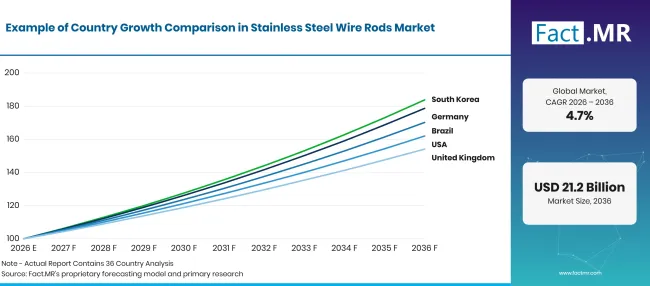
Factmr Stainless Steel Wire Rods Market Growth Index | Source: Fact.MR
| Country | CAGR (2026–2036) |
|---|---|
| Germany | 6.0% |
| Brazil | 5.5% |
| United States | 4.9% |
| United Kingdom | 4.4% |
| Japan | 3.9% |
Source: Fact.MR analysis. Updated Oct 16, 2026
What supports Germany’s adoption?
6.0% CAGR, reflecting a deep automotive base behind EU import protection.
German plants built 4.15 million passenger cars in 2025, up 2%, according to the VDA [6]. Electric car output reached about 1.56 million units from January to November 2025 [6]. The association sees 2026 production easing 1% to 4.11 million, so rod demand will depend on stainless content per vehicle more than on unit growth [6].
How is Brazil scaling demand?
5.5% CAGR, driven by rising vehicle assembly and local converter demand.
Anfavea counted 2.644 million vehicles produced in Brazil in 2025 [7]. In July 2026, the association raised its 2026 production outlook to 2.798 million units, a 5.8% gain [7]. It still sees exports falling 12.8% this year [7]. A larger domestic build lifts demand for stainless fasteners, clamps and springs made by local converters.
What anchors U.S. adoption?
4.9% CAGR, backed by Section 232 duties that favor domestic melt.
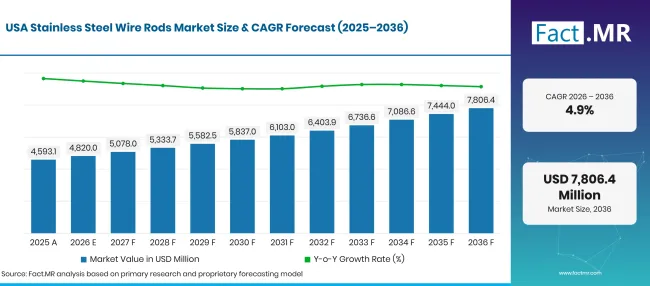
Factmr Stainless Steel Wire Rods Market Forecast Usa | Source: Fact.MR
An April 2026 proclamation set a general Section 232 rate of 50%, applied to the full customs value of covered steel imports entered from 6 April 2026 [8]. Derivative articles made entirely from steel melted and poured in the United States pay 10% [8]. U.S. stainless melt shop output rose 7.6% to 2.1 million tonnes in 2025 [2]. Domestic rod producers gain pricing room with fastener and wire customers.
How is the United Kingdom developing demand?
4.4% CAGR, as tighter import quotas reshape coil sourcing.
The UK steel trade measure replaced the safeguard on 1 July 2026, cutting quota volumes by 51% across 20 product categories and setting a 50% duty on imports above quota [9]. Goods contracted before 14 March 2026 stayed exempt from that duty until 30 September 2026 [9]. A UK carbon border adjustment mechanism will cover iron and steel imports from 1 January 2027 [10], raising the cost of high-emission rod.
How does Japan perform?
3.9% CAGR, on the back of high-grade demand amid shrinking steel output.
Japan produced 80.7 million tonnes of crude steel in 2025, down 4.0% from 2024, according to the World Steel Association [11]. Domestic wire makers still buy free-cutting and spring-grade stainless rod for precision parts and cars. Volume gains will stay modest as local steelmaking contracts.
Who leads the Stainless Steel Wire Rods Market?
Producers fall into three groups. Nippon Steel (through Nippon Steel Stainless Steel Corporation) and Tsingshan combine melting scale with broad grade lists.
Tsingshan’s Qingtian base runs high-speed stainless rod mills. Acerinox, through North American Stainless and Roldan, gives buyers a melt source inside the U.S. and the EU tariff zones. Indian producers Jindal Stainless and Viraj Profiles compete on cost and export reach. In April 2025, Jindal Stainless signed a solar deal to replace nearly 40% of conventional energy use at JSL Super Steel [12]. That unit rolls 160,000 tonnes of stainless wire rod and rebar a year [12]. Daido Steel, Cogne Acciai Speciali and Acciaierie Valbruna specialize in free-cutting, cold-heading and spring grades. In August 2025, Cogne reported that over 94% of its electricity came from certified renewable sources [13]. Grade approvals, origin records and lower-carbon melt will set the stronger suppliers apart.
Which companies are the key providers?
Key companies include Acerinox, S.A. (including North American Stainless and Roldan); Nippon Steel Corporation (including Nippon Steel Stainless Steel Corporation); Tsingshan Holding Group Co., Ltd.; Jindal Stainless Ltd.; Viraj Profiles Pvt. Ltd.; Daido Steel Co., Ltd.; Cogne Acciai Speciali S.p.A.; and Acciaierie Valbruna S.p.A.
- Acerinox, S.A. (including North American Stainless and Roldan)
- Nippon Steel Corporation (including Nippon Steel Stainless Steel Corporation)
- Tsingshan Holding Group Co., Ltd.
- Jindal Stainless Ltd.
- Viraj Profiles Pvt. Ltd.
- Daido Steel Co., Ltd.
- Cogne Acciai Speciali S.p.A.
- Acciaierie Valbruna S.p.A.
Bibliography
- [1] European Commission. (2026, June 30). New EU safeguards on steel imports from third countries.
- [2] International Stainless Steel Forum. (2026, February 27). Stainless steel melt shop production increases by 2.1% in 2025.
- [3] European Commission. (2026, August 28). Commission Implementing Regulation (EU) 2026/1963 on determining the type of evidence to be provided by importers to prove the country of melt and pour.
- [4] U.S. Geological Survey. (2026, February). Mineral Commodity Summaries 2026: Nickel.
- [5] International Energy Agency. (2026, May 20). Close to 30% of cars sold this year are set to be electric as countries and consumers respond to energy crisis.
- [6] Verband der Automobilindustrie (VDA). (2026, January 5). Passenger car production in 2025 slightly above previous year’s level.
- [7] Anfavea. (2026, July 7). Estatísticas e Mercados: Projeções 2026 [Statistics and Markets: 2026 Projections].
- [8] The White House. (2026, April 2). Strengthening Actions Taken to Adjust Imports of Aluminum, Steel, and Copper Into the United States.
- [9] Department for Business and Trade, UK. (2026, October 1). UK’s steel trade measure from 1 July 2026.
- [10] HM Revenue & Customs. (2026, September 9). Carbon Border Adjustment Mechanism.
- [11] World Steel Association. (2026, January 23). December 2025 crude steel production and 2025 global crude steel production totals.
- [12] Jindal Stainless. (2025, April 10). JSL Super Steel and Sunsure Energy sign 11 MWp PPA.
- [13] Cogne Acciai Speciali. (2025, August 25). Cogne Acciai Speciali: 94% of the energy used comes from renewable sources and 93% of employees have permanent contracts.
This Report Answers
- Wire rod revenue is split by diameter, application and end-use industry.
- Which diameter, application and end-use industry hold first place in 2026, and what buyer needs put them there?
- Import quotas, vehicle output and domestic steelmaking set the terms for comparing the five listed countries.
- Producers are grouped into integrated groups, cost-led exporters and grade specialists, with what each competes on.
- Quota schedules, melt-and-pour evidence rules and carbon border charges are traced to show how they shift rod sourcing.
What does the Stainless Steel Wire Rods Market cover?
Hot-rolled stainless steel wire rod in coil form falls within the Stainless Steel Wire Rods Market. Core grades are austenitic 304 and 316, with ferritic, martensitic and duplex grades for specific uses. Free-cutting, precipitation-hardening and ultra-clean rod made through secondary refining are also counted.
The assessment tracks rod sold to wire drawers, fastener producers, spring manufacturers and welding consumable producers. Revenue is measured at the rod stage, before drawing, heading or weaving adds value.
What is included in the scope?
Austenitic, ferritic, martensitic, duplex and precipitation-hardening rods in standard and precision-rolled sizes are in scope. Coils sold annealed, direct-cooled or pickled for wire drawing and cold forming are included.
Captive rod that an integrated mill draws into wire in-house is counted at its rod value. Rod rolled by re-rollers from purchased stainless billets is also included.
What is excluded from the scope?
Carbon, galvanized and high-carbon wire rod are not part of this assessment, nor are carbon long steel bars and sections. Titanium, nickel alloy and non-ferrous wire rod are also left out.
Drawn stainless wire, finished fasteners, springs and woven mesh sold after the rod stage are excluded. Stainless flat products such as coil, sheet and plate do not count toward rod revenue, and neither do tubes.
How Was the Analysis Built?
The analysis draws on 120+ sources, 35+ company portfolios, 25+ countries, and more than 20 industry interviews.
- Primary Research: Primary research includes discussions with manufacturers, service providers, technology developers, distributors, end users, and subject-matter experts. These conversations examine purchasing priorities, product adoption, operational challenges, approval requirements, competitive positioning, and the factors that influence wider market acceptance.
- Desk Research: Desk research covers government statistics, regulatory publications, company filings, trade data, technical studies, industry associations, standards, public policy, and other authoritative sources. Every source used in the analysis is documented in the bibliography.
- Market Sizing and Forecasting: Market estimates combine historical performance, demand indicators, pricing and volume trends, segment shares, company participation, country-level growth, adoption patterns, investment activity, and barriers to market expansion.
- Data Validation and Update Cycle: Findings are validated by comparing primary interviews with public data, company activity, regulatory changes, trade patterns, and industry developments. Regular updates review new product launches, capacity changes, partnerships, approvals, and shifts in commercial adoption.
Segmentation
What is the report’s scope and coverage?
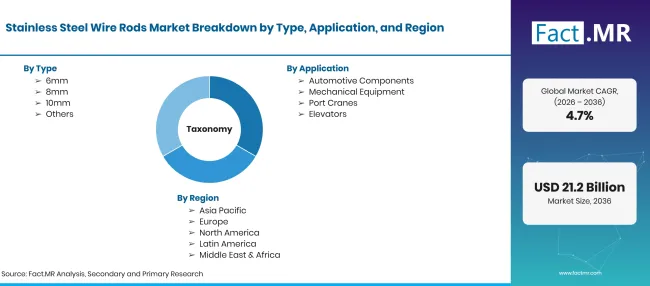
Factmr Stainless Steel Wire Rods Market Taxonomy | Source: Fact.MR
| Attribute | Details |
|---|---|
| Quantitative Units | USD billion in 2026 to USD billion by 2036 at CAGR |
| Market Definition | Hot-rolled stainless steel wire rod sold in coils, mainly in 6mm, 8mm and 10mm diameters. Buyers are wire drawers, cold headers, spring makers and welding consumable producers. |
| Diameter | 6mm; 8mm; 10mm |
| Application | Fasteners; Springs; Welding Electrodes; Wire Mesh |
| End-use Industry | Automobile; Oil and Gas; Mining; Building and Construction; Marine |
| Regions Covered | North America; Latin America; Western Europe; Eastern Europe; East Asia; South Asia & Pacific; Middle East & Africa |
| Countries Covered | Germany; Brazil; United States; United Kingdom; Japan |
| Companies Profiled | Acerinox, S.A. (including North American Stainless and Roldan); Nippon Steel Corporation (including Nippon Steel Stainless Steel Corporation); Tsingshan Holding Group Co., Ltd.; Jindal Stainless Ltd.; Viraj Profiles Pvt. Ltd.; Daido Steel Co., Ltd.; Cogne Acciai Speciali S.p.A.; Acciaierie Valbruna S.p.A. |
| Forecast Period | 2026 to 2036 |
| Approach | Hybrid top-down and bottom-up approach using stainless melt shop output; wire rod share of long product rolling; fastener, spring and vehicle production; trade measures by country; and mill portfolio review. |
Source: Fact.MR analysis. Updated Oct 16, 2026
How is the market segmented?
-
By Diameter:
- 6mm
- 8mm
- 10mm
-
By Application:
- Fasteners
- Springs
- Welding Electrodes
- Wire Mesh
-
By End-use Industry:
- Automobile
- Oil and Gas
- Mining
- Building and Construction
- Marine
-
By Region:
- North America
- Latin America
- Western Europe
- Eastern Europe
- East Asia
- South Asia & Pacific
- Middle East & Africa
Frequently Asked Questions
How big is the stainless steel wire rods market in 2026?
What is the CAGR of the stainless steel wire rods market from 2026 to 2036?
Which diameter leads the stainless steel wire rods market?
Which application leads the stainless steel wire rods market?
Which end-use industry leads the stainless steel wire rods market?
Which country will grow the most in the stainless steel wire rods market?
Who are the main companies in the stainless steel wire rods market?
Who worked on this report


Preview the report firsthand - request a free sample
Free SampleGet the brochure for pricing and purchase details
Download PDF