- Market Value (2025): USD 2.0 Bn
- Estimated Value (2026): UUSD 2.3 Bn
- Forecast Value (2036): USD 7.3 Bn
- CAGR (2026-2036): 12.4%
What is the Starch Bioplastic Grades Market forecast to be worth by 2036?
USD 2.3 Billion in 2026 to USD 7.3 Billion by 2036 at a 12.4% CAGR.
- The Starch Bioplastic Grades Market crossed a valuation of USD 2.0 Billion in 2025.
- Demand is projected to increase from USD 2.3 Billion in 2026 to USD 7.3 Billion by 2036.
- The market is forecast to record 12.4% CAGR from 2026 to 2036 as packaging converters and compounders shift toward certified compostable films, molded foodservice ware and agriculture grades.
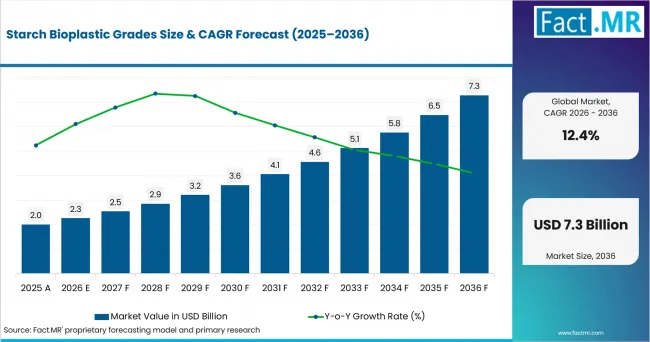
Starch Bioplastic Grades Value Analysis | Source: Fact.MR
What are the defining numbers behind Starch Bioplastic Grades Market growth?
An absolute opportunity of USD 5.0 Billion is expected between 2026 and 2036.
- Demand Drivers in the Market
- Flexible packaging converters need resin grades that seal, print and run on blown-film assets already used for carrier bags and liners.
- Foodservice brands need rigid grades that can serve hot or cold items while keeping the end-of-life label simple for consumers.
- Agricultural-film producers need soil-degradable options where film removal after harvest adds labor and disposal cost.
- European Bioplastics reported on December 2, 2025 that global biobased plastics production capacity stood at 2.31 million tonnes in 2025, with packaging representing 41.3% (0.95 million tonnes) of global bioplastics production capacity.
- Key Segments Analyzed
- By Grade Type: Thermoplastic starch is expected to hold 36.0% share in 2026 because it gives compounders a cost-sensitive base for flexible films and molded items.
- By End-of-Life: Industrial compostable is projected to account for 42.0% share in 2026 due to established certification routes under EN 13432 and ASTM D6400.
- By Conversion: Blown film is anticipated to capture 35.0% share in 2026 as bags, liners and agricultural films use high-volume extrusion assets.
- By Application: Bags & liners are estimated to represent 34.0% share in 2026 owing to demand for organic waste collection bags, retail bags and produce bags.
- Analyst Opinion at Fact.MR
- Shambhu Nath Jha, Principal Consultant at Fact.MR, states, “Starch bioplastic grades are being judged by proof of use beyond the word bio-based alone. The market is expected to reward grades that carry certification, predictable conversion behavior and clear disposal instructions. Suppliers should pair application testing with country-specific end-of-life documentation so converters can approve grades with fewer trial rounds.”
- Strategic Implications
- Compounders should separate film, molding and thermoforming grades clearly so converters can shorten trial cycles.
- Packaging brands should check compostability claims against the waste route available in each sales country.
- Foodservice operators should specify heat behavior and food-contact suitability before switching to starch-based rigid ware.
- Agricultural-film suppliers should document soil-biodegradation performance and crop-use limits for each mulch film grade.
France is projected to record 12.6% CAGR through 2036 as plastic-reduction rules and bio-waste sorting widen the addressable base for certified compostable formats. Germany is forecast to post 12.0% CAGR through packaging compliance and converter demand for documented grades. The UK is expected to advance at 11.2% CAGR as Plastic Packaging Tax and separate food-waste collection reshape packaging choices. Italy is anticipated to register 9.7% CAGR due to its compostable bag base and proposed national rules for specific single-use packaging. The USA is estimated to reach 8.7% CAGR as compostability labeling scrutiny and recycling contamination concerns narrow acceptable end-of-life claims.
How does the Starch Bioplastic Grades Market break down by segment?
Thermoplastic starch leads Grade Type at 36.0% share in 2026; industrial compostable leads End-of-Life at 42.0% share.
Which Grade Type leads?
Thermoplastic starch is expected to hold 36.0% share in 2026.
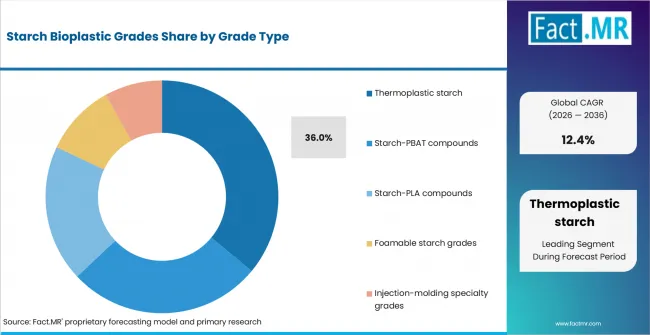
Starch Bioplastic Grades Analysis By Grade Type | Source: Fact.MR
Thermoplastic starch leads because it is the starch-rich base for many flexible and rigid compounds. It helps formulators manage cost while PBAT or PLA improves strength, moisture resistance or sealability.
What leads the End-of-Life segment?
Industrial compostable is projected to account for 42.0% share in 2026.
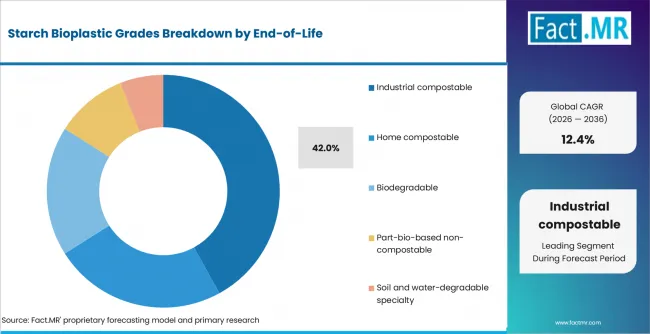
Starch Bioplastic Grades Analysis By End Of Life | Source: Fact.MR
Industrial compostable grades lead because controlled composting has clearer certification than home composting. EPA explains that a plastic labeled commercially compostable must break down through biological treatment at a commercial or industrial composting facility under specified conditions, making disposal instructions central to grade selection.
How does Conversion shape demand?
Blown film is anticipated to capture 35.0% share in 2026.
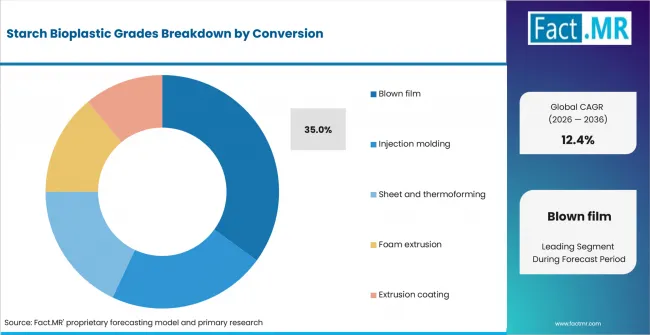
Starch Bioplastic Grades Analysis By Conversion | Source: Fact.MR
Blown film leads because bags, liners, and agricultural films provide practical entry points for starch-based grades. The process supports thin-gauge structures, familiar converter equipment, and scalable production, making it suitable for compostable packaging and soil-biodegradable film applications across established manufacturing lines.
What supports Bags & liners within Application?
Bags & liners are estimated to represent 34.0% share in 2026.
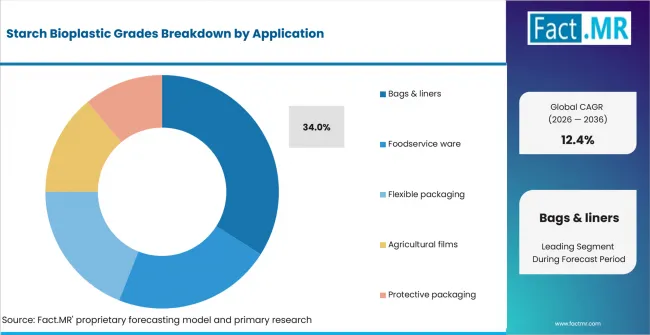
Starch Bioplastic Grades Analysis By Application | Source: Fact.MR
Bags and liners lead because starch-based grades fit thin-gauge formats that can carry clear compostability and disposal instructions. Their compatibility with organic-waste collection programs, retail bag applications, and routine waste handling supports repeat demand while giving converters a familiar film-format pathway.
How does Region influence grade selection?
Western Europe is forecast to set the clearest compliance pathway through 2036.
Western Europe shapes grade selection because policy language is detailed on compostability and recyclability. The PPWR requires packaging to be recyclable and introduces design-for-recycling criteria from 2030, followed by recycled-at-scale requirements from 2035. It also establishes separate compostability requirements for specified packaging formats.
What is accelerating Starch Bioplastic Grades Market adoption, and what is holding it back?
Demand is expected to rise through compostable film use, packaging rules and foodservice substitution. Growth is constrained by disposal confusion, resin cost and composting access.
Drivers Impact Analysis
| DRIVER | (~) % IMPACT ON CAGR | GEOGRAPHIC RELEVANCE | IMPACT TIMELINE |
|---|---|---|---|
| Certified compostable bag and liner demand | +1.8% | Europe, North America | Short term (<= 2 years) |
| Packaging regulation and recyclability pressure | +1.6% | European Union, UK | Medium term (2-4 years) |
| Agricultural mulch film replacement needs | +1.1% | Europe, USA | Medium term (2-4 years) |
| Converter demand for drop-in processing | +0.9% | Global | Long term (>= 4 years) |
- Certified compostable bag and liner demand: Organic-waste collection supports demand for starch-based bags and liners where local composting systems accept certified materials. Suppliers can benefit by offering grades with clear compostability documentation, dependable film strength, and compatibility with established waste-collection programs.
- Packaging regulation and recyclability pressure: Packaging rules are increasing attention on material design, recyclability, and compostability requirements. Starch-based compounds can gain relevance where converters need alternatives that align with evolving packaging frameworks while maintaining functional performance.
- Agricultural mulch film replacement needs: Soil-biodegradable mulch films can reduce post-harvest retrieval work and residual plastic concerns. Starch-based grades are well suited where farmers need films that provide adequate field durability while supporting more practical end-of-life management.
- Converter demand for drop-in processing: Starch-PBAT and starch-PLA compounds attract interest when they can run on existing blown-film, injection-molding, or thermoforming equipment. Drop-in processing reduces conversion barriers and helps manufacturers test compostable materials without extensive machinery changes.
Opportunity Impact Analysis
| OPPORTUNITY | (~) % IMPACT ON CAGR | GEOGRAPHIC RELEVANCE | IMPACT TIMELINE |
|---|---|---|---|
| Foodservice ware using molding grades | +1.3% | Europe, USA | Short term (<= 2 years) |
| Home compostable niche grades | +0.9% | UK, France, Italy | Medium term (2-4 years) |
| Extrusion-coated paper applications | +0.8% | Western Europe | Long term (>= 4 years) |
- Foodservice ware using molding grades: Injection-molding specialty grades can serve cutlery, cups and caps when heat performance and food-contact documentation are proven.
- Home compostable niche grades: Home compostable grades can gain narrower use where certification, local instructions and consumer behavior align.
- Extrusion-coated paper applications: Starch-based coating blends can help paper cups, wraps and trays reduce conventional plastic layers while retaining grease and moisture resistance.
Restraints Impact Analysis
| RESTRAINT | (~) % IMPACT ON CAGR | GEOGRAPHIC RELEVANCE | IMPACT TIMELINE |
|---|---|---|---|
| Confusion over compostable disposal routes | -0.8% | USA, Germany, UK | Short term (<= 2 years) |
| Moisture and heat-performance limits | -0.6% | Global | Medium term (2-4 years) |
| Higher qualification cost for converters | -0.4% | Europe, North America | Long term (>= 4 years) |
- Compostable disposal-route confusion: EPA explains that commercially compostable plastics are designed to break down at commercial or industrial composting facilities and must meet applicable compostability specifications. Brand owners need clear bin labels and collection instructions before using compostable claims at scale.
- Moisture and heat-performance limits: Starch-rich grades often need blending or additives to meet the toughness, sealability and temperature needs of packaging applications.
- Higher qualification cost for converters: New grades require machine trials, certification checks and customer approval before they can replace established PE or PP formats.
Which countries are scaling the Starch Bioplastic Grades Market through 2036?
- The country comparison spans 3.83 percentage points and forms three practical growth bands across the forecast period.
- France remains 0.61 percentage point above Germany on the back of plastic-reduction policy and bio-waste sorting access.
- Germany remains 0.80 percentage point above the United Kingdom, supported by packaging design rules and converter depth.
- The United Kingdom remains 1.51 percentage points above Italy through Plastic Packaging Tax and separate food-waste collection.
- Italy remains 0.91 percentage point above the United States, linked to compostable packaging rules and converter experience.
- The United States closes the displayed range as compostability labels and recycling-stream control guide grade acceptance.
Comparable CAGRs create different entry conditions due to waste rules, collection routes and converter capability. Full report coverage includes North America, Latin America, Western Europe, Eastern Europe, East Asia, South Asia & Pacific, Middle East & Africa.
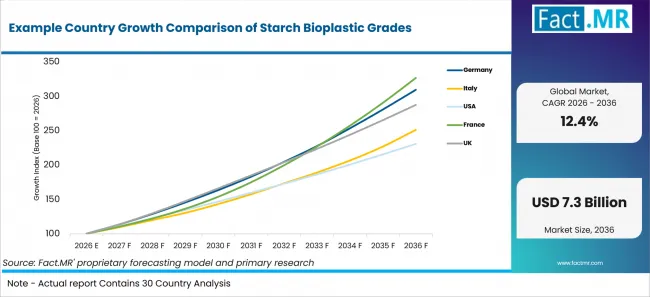
Example Country Growth Comparison Of Starch Bioplastic Grades | Source: Fact.MR
| Country | CAGR (2026-2036) |
|---|---|
| France | 12.6% |
| Germany | 12.0% |
| United Kingdom | 11.2% |
| Italy | 9.7% |
| United States | 8.7% |
What supports France adoption?
12.6% CAGR, supported by plastic-reduction policy and bio-waste sorting access.
France is expected to remain the quickest scaling listed market because policy puts single-use plastic packaging under direct reduction pressure. Starch-rich films and molded grades gain from that pressure where converters can match end-of-life instructions to the local waste route. ADEME reported in April 2025 that 32.1 million French residents had access to bio-waste sorting. Certified bags and liners are therefore expected to gain more buyer attention where organic-waste collection is visible to households.
What supports Germany adoption?
12.0% CAGR, supported by packaging compliance and industrial conversion capability.
Germany is forecast to advance through packaging compliance and a deeper converter base for film and molded applications. JRC reported in July 2026 that Germany placed 16 kg per person of plastic packaging on the market in 2024. That packaging base gives starch-PBAT and starch-PLA compounds a wide testing field. Industrial compostability remains the practical route when recyclability and organic-waste rules are treated separately.
What supports United Kingdom adoption?
11.2% CAGR, backed by Plastic Packaging Tax and separate food-waste collection.
The United Kingdom is projected to grow through recycled-content taxation and separate food-waste collection rules. HMRC reported in August 2025 that 4,927 businesses were registered for Plastic Packaging Tax as of 6 August 2025. Packaging brands can compare recycled-content compliance with compostable alternatives for foodservice and bag formats. Biome Bioplastics gives local buyers a plant-based and compostable material specialist for technical evaluations.
What supports Italy adoption?
9.7% CAGR, driven by compostable bag experience and proposed packaging rules.
Italy is anticipated to develop demand through compostable packaging policy and an established converter base linked to Novamont. European Commission TRIS notification 2026/0167/IT, received on April 1, 2026, describes an Italian draft technical regulation proposing biodegradability and compostability requirements for certain single-use plastic packaging. That rule direction supports starch-rich blown-film and molded formats where disposal routes are already familiar. Beverage packaging remains more demanding because barrier and clarity needs favor tighter material qualification.
What supports United States adoption?
8.7% CAGR, shaped by compostability labeling and recycling-stream control.
The United States is estimated to scale through specification-led adoption in foodservice ware and certified collection bags. EPA states that ASTM D6400 and D6868 outline the specifications that must be met for a plastic to be labeled commercially compostable. That standards route supports grades that carry clear labels and facility-compatible claims. Foodservice operators are expected to favor starch blends that separate compostable use cases from conventional recycling streams.
Who leads the Starch Bioplastic Grades Market?
Novamont competes through MATER-BI®, a family of biodegradable and compostable bioplastics used across retail bags, food packaging, foodservice and agricultural applications. In January 2026, Novamont presented a new MATER-BI visual identity at Marca 2026 and highlighted the product family’s verified carbon footprint supported by ISO 14067 certification.
Biome Bioplastics, FKuR, Cardia Bioplastics under MyEco Group broaden the competitive field with biobased and compostable materials for flexible-film, packaging and selected molded applications. FKuR published an update on August 3, 2026 on the BioROOTGUARD research project, which is developing a forest-soil-biodegradable plastic compound for root-protection film.
Which companies are the key providers?
Key companies include Novamont; Biome Bioplastics; FKuR; and Cardia Bioplastics.
- Novamont
- Biome Bioplastics
- FKuR
- Cardia Bioplastics
Bibliography
- European Commission. (2026, August 12). New packaging rules for less waste and easier recycling.
- European Commission, Joint Research Centre. (2026, March 3). Bio-based plastics: Technology readiness and high cost key barriers to wide use.
- European Commission, Joint Research Centre. (2026, July 6). Packaging materials in the EU: Quantities stay significant, plastic grew by 11%.
- European Commission. (2026, April 1). Proposal for a technical regulation laying down biodegradability and compostability requirements for certain single-use plastic packaging (Notification No. 2026/0167/IT).
- European Bioplastics. (2025, December 2). EUBP presents the results of the 2025 market data report.
- Agence de la transition écologique. (2025, April). Un an après sa mise en place, quel bilan peut-on tirer du tri à la source des biodéchets ?
- HM Revenue & Customs. (2025, August 28). Plastic Packaging Tax (PPT) statistics commentary.
- Department for Environment, Food & Rural Affairs. (2026, March 31). Simpler household recycling rules come into force across England.
- Umweltbundesamt. (2025, April 30). Kunststoffabfälle.
- Zentrale Stelle Verpackungsregister. (2025, August 29). 2025 minimum standard published – initial touchstone for companies preparing for the EU Packaging and Packaging Waste Regulation (PPWR).
- U.S. Environmental Protection Agency. (2025, October 31). Frequently asked questions about plastic recycling and composting.
- U.S. Environmental Protection Agency. (2026, July 31). U.S. recycling infrastructure assessment and state data collection reports.
- Novamont. (2026, January 15). Mater-Bi takes on a new look: Novamont unveils its rebranding and communication campaign.
- FKuR Kunststoff GmbH. (2026, August 3). Biodegradable plastic film protects roots from cockchafer grub damage.
- MyEco Group. (2025, February). H1 FY25 Appendix 4D and half-year report.
This Report Answers
- The report explains how starch grades fit the wider bioplastics market boundary across grade type and end-of-life route. It also covers conversion and application demand.
- Segment analysis connects blown film and sheet routes with biopolymer films where thin-gauge applications overlap. It identifies the operating reasons converters prioritize each route.
- Country analysis examines Germany, Italy, the USA, France and the UK through policy, collection and conversion factors. The country logic also reflects adjacent bioplastics for packaging adoption routes.
- Competitive analysis reviews active providers across starch-rich compounds, compostable film grades and molded bioplastic materials. The supplier view is tied to bio polymer processing aids where conversion performance affects grade selection.
- Application analysis assesses bags, liners, foodservice ware and agricultural films. It connects food-contact formats with sustainable food packaging where disposal claims influence buyer screening.
What does the Starch Bioplastic Grades Market cover?
The Starch Bioplastic Grades Market covers resin grades and compounds that use starch as a material base or blend component for compostable, biodegradable or partly bio-based plastic products. It includes thermoplastic starch, starch-PBAT compounds, starch-PLA compounds, foamable starch grades, injection-molding specialty grades and soil or water-degradable specialty grades.
The assessment covers blown film, injection molding, sheet and thermoforming, foam extrusion and extrusion coating. Demand is assessed across bags and liners, foodservice ware, flexible packaging, agricultural films and protective packaging. The packaging boundary is informed by sustainable packaging where compostability and recyclability claims are compared.
What is included in the scope?
The scope includes commercial starch-based resin grades sold to converters, compounders and packaging manufacturers. It includes industrial compostable, home compostable and biodegradable grades where the product is supported by a recognized certification or defined disposal route. The scope also touches compostable laminate packaging materials where starch blends serve coating or lamination needs.
It includes starch blends used with PBAT or PLA, thermoplastic starch grades and specialty formulations for films, molded items and coated paper.
What is excluded from the scope?
The scope excludes conventional petroleum-based plastics sold without bio-based or biodegradable functionality. It also excludes oxo-degradable additives, finished packaged goods, raw agricultural starch sold as food or industrial starch, and recycling services.
General sustainable packaging materials are outside the revenue boundary when starch-based resin grade selection is absent from the product. PLA, PHA or bio-PE grades are outside the boundary unless they are sold as part of a starch-containing compound. The exclusion line separates this market from zero waste packaging where the material set is wider.
How Was the Analysis Built?
The analysis draws on 120+ sources, 35+ company portfolios, 25+ countries, and more than 20 industry interviews.
- Primary Research: Primary research includes discussions with manufacturers, service providers, technology developers, distributors, end users, and subject-matter experts. These conversations examine purchasing priorities, product adoption, operational challenges, approval requirements, competitive positioning, and the factors that influence wider market acceptance.
- Desk Research: Desk research covers government statistics, regulatory publications, company filings, trade data, technical studies, industry associations, standards, public policy, and other authoritative sources. Every source used in the analysis is documented in the bibliography.
- Market Sizing and Forecasting: Market estimates combine historical performance, demand indicators, pricing and volume trends, segment shares, company participation, country-level growth, adoption patterns, investment activity, and barriers to market expansion.
- Data Validation and Update Cycle: Findings are validated by comparing primary interviews with public data, company activity, regulatory changes, trade patterns, and industry developments. Regular updates review new product launches, capacity changes, partnerships, approvals, and shifts in commercial adoption.
What is the report’s scope and coverage?
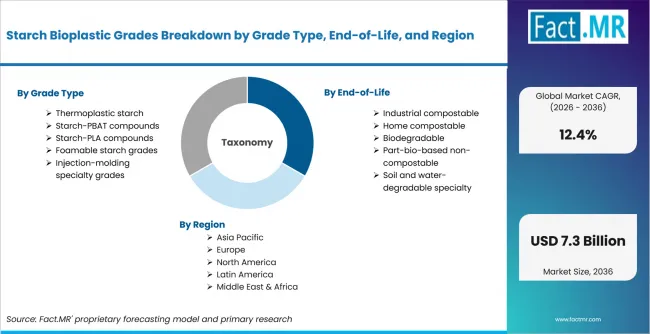
Starch Bioplastic Grades Breakdown By Grade Type, End Of Life, And Region | Source: Fact.MR
| Attribute | Details |
|---|---|
| Quantitative Units | USD Billion |
| Market Definition | Starch bioplastic grades are thermoplastic or blended resin materials based on starch and used to make compostable, biodegradable or partly bio-based products for films, molded parts, coated paper and packaging applications. |
| Grade Type | Thermoplastic starch; Starch-PBAT compounds; Starch-PLA compounds; Foamable starch grades; Injection-molding specialty grades; Soil and water-degradable specialty |
| End-of-Life | Industrial compostable; Home compostable; Biodegradable; Part-bio-based non-compostable |
| Conversion | Blown film; Injection molding; Sheet and thermoforming; Foam extrusion; Extrusion coating |
| Application | Bags & liners; Foodservice ware; Flexible packaging; Agricultural films; Protective packaging |
| Regions Covered | North America; Latin America; Western Europe; Eastern Europe; East Asia; South Asia & Pacific; Middle East & Africa |
| Countries Covered | Germany; Italy; USA; France; UK |
| Key Companies Profiled | Novamont; Biome Bioplastics; FKuR; Cardia Bioplastics |
| Forecast Period | 2026 to 2036 |
| Approach | Hybrid top-down and bottom-up approach using resin demand by application, conversion route, compostability requirement, country rules, company portfolio review and converter adoption signals. |
How is the market segmented?
-
By Grade Type:
- Thermoplastic starch
- Starch-PBAT compounds
- Starch-PLA compounds
- Foamable starch grades
- Injection-molding specialty grades
- Soil and water-degradable specialty
-
By End-of-Life:
- Industrial compostable
- Home compostable
- Biodegradable
- Part-bio-based non-compostable
-
By Conversion:
- Blown film
- Injection molding
- Sheet and thermoforming
- Foam extrusion
- Extrusion coating
-
By Application:
- Bags & liners
- Foodservice ware
- Flexible packaging
- Agricultural films
- Protective packaging
-
By Region:
- North America
- Latin America
- Western Europe
- Eastern Europe
- East Asia
- South Asia & Pacific
- Middle East & Africa