- Market Value (2025): USD 1.5 Bn
- Estimated Value (2026): USD 1.7 Bn
- Forecast Value (2036): USD 7.5 Bn
- CAGR (2026-2036): 15.7%
What is the Corn Starch Bioplastics Market forecast to be worth by 2036?
USD 1.7 Billion in 2026 to USD 7.5 Billion by 2036 at a 15.7% CAGR.
- The Corn Starch Bioplastics Market crossed a valuation of USD 1.5 Billion in 2025.
- Demand is projected to increase from USD 1.7 Billion in 2026 to USD 7.5 Billion by 2036.
- The market is forecast to record a 15.7% CAGR from 2026 to 2036 as film converters and foodservice brands adopt certified compostable formats.
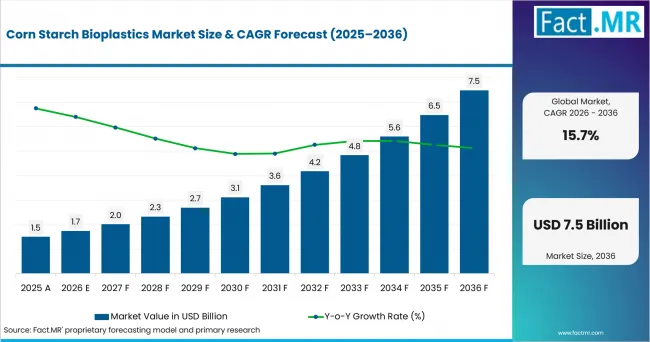
Corn Starch Bioplastics Market Value Analysis | Source: Fact.MR
What are the defining numbers behind Corn Starch Bioplastics Market growth?
USD 5.74 Billion absolute opportunity by 2036, led by thermoplastic starch, industrial compostable claims and France.
- Demand Drivers in the Market
- Foodservice brands need compostable trays and liners that handle hot food while moving cleanly into accepted organic-waste systems.
- Film extruders need starch blends that run on blown film lines while holding seal strength for bags and liners.
- Retail chains need packaging materials that reduce fossil-plastic exposure while keeping print quality and shelf handling stable.
- Municipal waste teams need liners tied to organic diversion; EPA reports that organic materials, including food, yard trimmings, wood, and paper/paperboard, account for 51.4% of municipal solid waste in U.S. landfills.
- Key Segments Analyzed
- By Material Type: Thermoplastic starch is expected to hold 38.00% share in 2026 due to direct use in flexible and molded starch compounds.
- By Conversion Route: Blown film is projected to account for 34.00% share in 2026 supported by bag, liner and retail film demand.
- By End Product: Compostable bags & liners are anticipated to capture 36.00% share in 2026 owing to food scraps handling and organics collection.
- By End-of-Life Claim: Industrial compostable is estimated to represent 44.00% share in 2026 shaped by certification and facility acceptance.
- Analyst Opinion at Fact.MR
- Shambhu Nath Jha, Principal Consultant at Fact.MR, states, "Corn starch bioplastics are being judged by proof of disposal route as much as by renewable content. Demand is expected to shift toward compounds that balance seal strength, moisture behavior and certification evidence. The better-positioned suppliers combine tested recipes for film, molded foodservice ware and agricultural use."
- Strategic Implications
- Compounders should document bio-based content, compostability route and processing settings for each starch-blend grade.
- Film converters should match resin choice to bag thickness, load strength and the accepted organic-waste pathway in the target city.
- Foodservice brands should separate industrial-compostable and home-compostable claims before package approval to keep labeling clear.
- Waste-system managers should align accepted liner formats with the composting or digestion equipment used locally.
France is estimated to advance at 20.4% CAGR through 2036 due to plastic recovery pressure and source-separated biowaste rules. The USA is projected to record 16.8% CAGR supported by large corn availability and organics diversion. Germany is forecast to post 15.7% CAGR owing to packaging law pressure and converter discipline. The UK is anticipated to hold 15.1% CAGR shaped by packaging tax and EPR fees. Italy is expected to reach 14.1% CAGR led by compostable-bioplastic recycling channels and separate collection systems.
How does the Corn Starch Bioplastics Market break down by segment?
Thermoplastic starch leads at 38.0%; Industrial compostable leads at 44.0%.
Which Material Type dominates?
Thermoplastic starch holds 38.0% share in 2026.
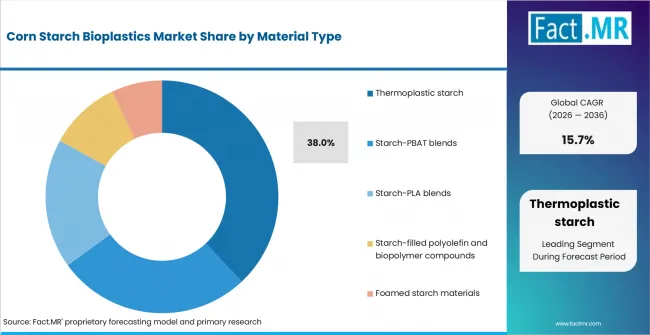
Corn Starch Bioplastics Market Analysis By Material Type | Source: Fact.MR
Thermoplastic starch is expected to hold 38.0% share in 2026 due to its role as the base resin route for starch-rich compounds. Starch-PBAT blends follow where converters need higher flexibility and tear resistance. Starch-PLA blends serve thermoformed ware where stiffness carries more weight than stretch. Foamed starch materials remain focused on loose-fill and protective uses. USDA ERS states that U.S. corn is processed into starch and industrial products, linking feedstock availability with conversion routes.
What leads the Conversion Route segment?
Blown film leads with 34.0% share in 2026.
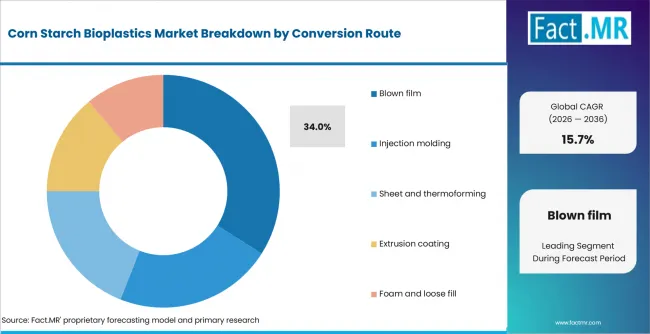
Corn Starch Bioplastics Market Analysis By Conversion Route | Source: Fact.MR
Blown film is projected to account for 34.0% share in 2026 supported by compostable bags, shopping bags and bin liners. Injection molding serves cutlery and rigid items where cycle time and stiffness are central. Sheet and thermoforming handle trays and lids that need formed detail. Extrusion coating supports coated paper or board when brands need a compostable barrier. BASF launched a new ecovio portfolio in April 2026 for flexible packaging with certified home-compostable grades suitable for extrusion coating and film lamination.
How does End Product shape demand?
Compostable bags & liners capture 36.0% share in 2026.
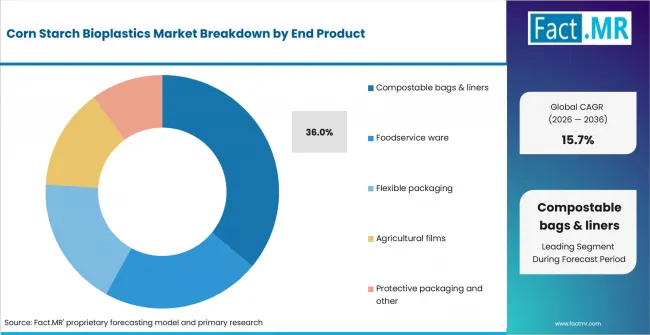
Corn Starch Bioplastics Market Analysis By End Product | Source: Fact.MR
Compostable bags & liners are anticipated to capture 36.0% share in 2026 owing to direct use in food scraps collection and retail carryout. Foodservice ware follows where bowls and trays move with wet organic waste. Flexible packaging remains a target where barrier needs are moderate. Agricultural films create a distinct route for soil-degradable materials. Local collection rules are expected to guide liner selection because starch bags need acceptance from the treatment facility.
What supports Industrial compostable within End-of-Life Claim?
Industrial compostable represents 44.0% share in 2026.
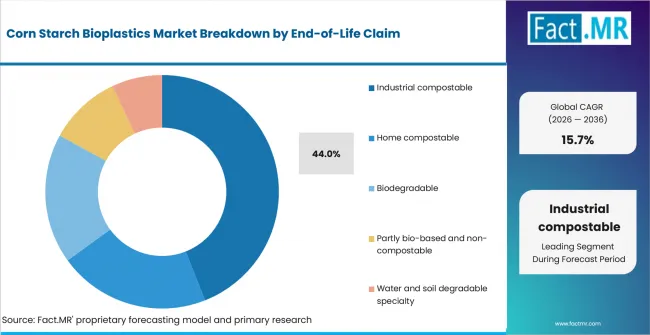
Corn Starch Bioplastics Market Analysis By End Of Life Claim | Source: Fact.MR
Industrial compostable is estimated to represent 44.0% share in 2026 shaped by clearer heat, time and process conditions in commercial composting. Home compostable formats are growing in small bags and coated paper where local rules permit use. Biodegradable claims need careful wording because unmanaged disposal weakens their commercial value. Partly bio-based and non-compostable compounds serve applications where renewable input carries more weight. Eurostat reported in October 2025 that the EU generated 79.7 million tonnes of packaging waste in 2023, reinforcing the importance of recyclability and other end-of-life considerations in packaging decisions.
What is accelerating Corn Starch Bioplastics Market adoption, and what is holding it back?
Compostable packaging demand drives it; infrastructure and claim complexity restrain it.
Drivers Impact Analysis
| DRIVER | (~) % IMPACT ON CAGR | GEOGRAPHIC RELEVANCE | IMPACT TIMELINE |
|---|---|---|---|
| Industrial compostable bag conversion | +2.0% | North America, Western Europe | Short term (<=2 years) |
| Foodservice ware substitution | +1.6% | Europe, North America | Medium term (2-4 years) |
| Agricultural film soil-biodegradation | +1.2% | Western Europe, North America | Medium term (2-4 years) |
| Retail bag and liner replacement | +0.9% | Europe, USA | Short term (<=2 years) |
| Paper coating and barrier applications | +0.7% | Europe, East Asia | Long term (>=4 years) |
Source: Fact.MR analysis. Updated Sep 3, 2026
- Industrial compostable bag conversion: Compostable bag programs can increase demand for starch-based blends where organic-waste collection systems accept compostable liners. These materials can support cleaner food-scrap collection and provide municipalities and waste operators with a practical alternative to conventional plastic liners.
- Foodservice ware substitution: Foodservice operators can adopt starch-based bowls, trays, lids, and related formats where composting infrastructure is available. Certified compostable ware offers a practical route for packaging contaminated with food residue, especially when organic-waste collection programs accept both scraps and associated packaging.
- Agricultural film soil-biodegradation: Soil-biodegradable mulch films can expand where farmers seek to reduce post-harvest film retrieval and disposal requirements. Starch-based materials are well suited to this application when they provide adequate field performance, controlled degradation, and compliance with relevant agricultural material standards.
- Retail bag and liner replacement: Retailers can use starch-based bags for checkout, produce, and waste-liner applications as packaging policies and sustainability targets influence material selection. Resin suppliers can strengthen adoption by helping converters maintain film strength, flexibility, and processing performance at efficient material usage levels.
- Paper coating and barrier applications: Starch-based materials can support coated paper applications where brands seek fiber-based packaging with compostable or biodegradable barrier layers. This creates opportunities in food and beverage packaging that requires grease resistance, moisture control, and compatibility with paper-converting processes.
Opportunity Impact Analysis
| OPPORTUNITY | (~) % IMPACT ON CAGR | GEOGRAPHIC RELEVANCE | IMPACT TIMELINE |
|---|---|---|---|
| Certified home-compostable packaging | +1.3% | Western Europe, UK | Medium term (2-4 years) |
| Compostable flexible barrier formats | +1.1% | Europe, North America | Medium term (2-4 years) |
| Soil-degradable agricultural films | +0.8% | Italy, France, USA | Long term (>=4 years) |
| Brand-specific resin qualification | +0.6% | Global | Short term (<=2 years) |
Source: Fact.MR analysis. Updated Sep 3, 2026
- Certified home-compostable packaging: Home-compostable packaging creates opportunities for small packs and food-contact paper formats where brands want disposal options beyond industrial composting. Adoption depends on clear labeling, suitable local disposal conditions, and verified degradation performance.
- Compostable flexible barrier formats: Flexible barrier packaging can expand starch-based bioplastic use beyond simple carry bags. Food and personal-care packs require grease, moisture, and oxygen resistance, giving suppliers an advantage when their materials work effectively in laminates, coatings, and existing converting lines.
- Soil-degradable agricultural films: Agricultural films provide corn starch bioplastics with opportunities outside consumer packaging. Soil-biodegradable alternatives can appeal where farmers want to reduce film-retrieval costs, simplify post-harvest handling, and limit residual plastic contamination in fields.
- Brand-specific resin qualification: Large brands often prefer compounds already tested for sealing, printing, storage, and converting conditions. Detailed qualification packages can shorten approval cycles, while application guidance tailored to film gauge or molded-part thickness can improve repeat business.
Restraints Impact Analysis
| RESTRAINT | (~) % IMPACT ON CAGR | GEOGRAPHIC RELEVANCE | IMPACT TIMELINE |
|---|---|---|---|
| Composting access gaps | -0.8% | North America, Europe | Short term (<=2 years) |
| Moisture and heat limits | -0.6% | Global | Medium term (2-4 years) |
| Claim and label complexity | -0.5% | Europe, UK | Short term (<=2 years) |
| Cost premium against polyethylene | -0.4% | Global | Long term (>=4 years) |
Source: Fact.MR analysis. Updated Sep 3, 2026
- Composting access gaps: Certified compostable materials provide limited value where local treatment facilities do not accept compostable packaging. Acceptance rules can differ across food scraps, yard waste, bags, and liners, making clear municipal guidance important for wider adoption.
- Moisture and heat limits: Starch-based compounds can be sensitive to moisture and heat, requiring careful formulation for foodservice, film, and coated-paper applications. Converters often need sealing, storage, and shelf-condition testing before approval, which can lengthen qualification cycles.
- Claim and label complexity: End-of-life terminology can create confusion when biodegradable, industrial-compostable, and home-compostable claims are used inconsistently. Brands need clear evidence showing that each claim matches the material’s verified degradation conditions and intended disposal route.
- Cost premium against polyethylene: Corn starch compounds can carry a price premium over conventional polyethylene, particularly in cost-sensitive applications. Adoption is stronger where regulations, waste-management programs, or brand sustainability targets create a clear reason to shift toward compostable materials.
Which countries are scaling the Corn Starch Bioplastics Market through 2036?
- The country comparison spans 6.24 percentage points and forms three practical growth bands across the forecast period.
- France remains 3.57 percentage points above the USA due to plastic recovery pressure and source-separated biowaste rules.
- The USA remains 1.10 percentage points above Germany as corn availability supports starch conversion and organics diversion.
- Germany remains 0.63 percentage point above the UK through packaging law pressure and converter discipline.
- The UK remains 0.94 percentage point above Italy as packaging tax and EPR fees sharpen packaging material choices.
- Italy closes the displayed range through compostable-bioplastic recycling channels and separate collection systems.
Comparable CAGRs can create different entry conditions due to feedstock availability, composting access, packaging regulation and converter depth. Full report coverage includes North America, Latin America, Western Europe, Eastern Europe, East Asia, South Asia & Pacific, Middle East & Africa.
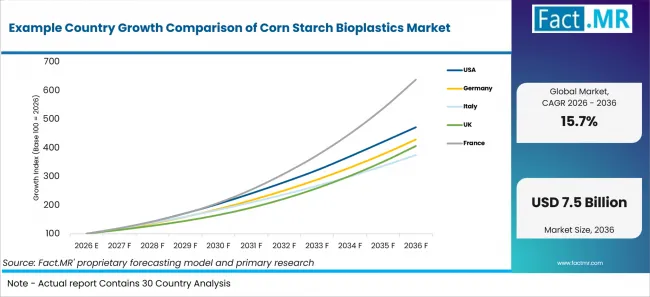
Example Country Growth Comparison Of Corn Starch Bioplastics Market | Source: Fact.MR
| Country | CAGR |
|---|---|
| France | 20.4% |
| United States | 16.8% |
| Germany | 15.7% |
| United Kingdom | 15.1% |
| Italy | 14.1% |
Source: Fact.MR analysis. Updated Sep 3, 2026
What supports France adoption?
20.4% CAGR, supported by plastic recovery pressure and source-separated biowaste.
French packaging brands are expected to test starch-based compostable formats where plastic recovery remains limited. In May 2025, SDES reported that plastic recycling in France reached 20% for 2022. The country is expected to reward materials that combine clear disposal language with a link to organic-waste treatment.
How is the USA scaling demand?
16.8% CAGR, driven by corn availability and organics diversion.
U.S. film converters are projected to benefit from a deep corn base and established starch processing. In January 2026, USDA NASS estimated U.S. corn for grain production at 17.0 billion bushels for 2025. This feedstock base is expected to support compounders serving bags, liners and molded foodservice ware.
What supports the Germany outlook?
15.7% CAGR, backed by packaging law pressure and converter discipline.
Germany is expected to remain a strict qualification market for compostable starch compounds. In May 2026, the German Environment Agency reported packaging consumption of 17.92 million tonnes for 2023. Converter discipline is expected to favor grades with clear processing windows and well-documented compostability claims.
What supports United Kingdom growth?
15.1% CAGR, shaped by packaging tax and EPR fee signals.
United Kingdom brands are anticipated to evaluate starch bioplastics where packaging fees make material choice visible. In July 2025, Defra reported 2,265 thousand tonnes of plastic packaging waste arising in 2024 under Methodology 1 (PackFlow). The market is expected to favor liner and foodservice formats that pair performance with an accepted disposal route.
How does Italy perform?
14.1% CAGR, led by compostable-bioplastic recycling and separate collection.
Italy has a practical base for compostable bioplastics because municipalities and consortia already manage accepted packaging streams. In June 2025, CONAI reported that Italy recycled 47,500 tonnes of compostable bioplastic packaging in 2024. Domestic converter familiarity is expected to support bags, liners and agricultural film applications.
Who leads the Corn Starch Bioplastics Market?
Novamont and BASF lead direct compostable resin coverage, while FKuR strengthens compound breadth.
Novamont anchors competition through MATER-BI, its family of biodegradable and compostable bioplastics based on technologies involving starches, vegetable oils and their combinations, with applications in compostable packaging and agricultural films. In November 2025, Novamont announced EU Fertilising Products Regulation conformity certification for its soil-biodegradable MATER-BI mulch film, adding a recent regulatory reference for agricultural biodegradation performance. BASF participates through ecovio®, including certified compostable grades used in bags, flexible packaging, agricultural films and coated-paper applications.
FKuR and Cardia Bioplastics broaden the supplier set across bio-based compounds, starch-containing resin systems and compostable processing grades. Cardia Bioplastics operates as a brand within MyEco Group and supplies proprietary compostable resins and films. Competition centers on processing performance, barrier properties, substantiation of environmental claims and certification of applicable end-of-life routes.
Which companies are the key providers?
Key companies include Novamont, BASF, FKuR, and Cardia Bioplastics.
- Novamont
- BASF
- FKuR
- Cardia Bioplastics
Bibliography
- U.S. Department of Agriculture, National Agricultural Statistics Service. (2026, January 12). Crop production 2025 summary.
- U.S. Environmental Protection Agency. (2026, May 18). Composting.
- Eurostat. (2025, October 22). Plastic packaging waste in the EU: 35.3 kg per person.
- Service des données et études statistiques. (2026, March 27). Gestion des déchets et économie circulaire en France - État des connaissances en 2025.
- Umweltbundesamt. (2026, May 13). Verpackungsverbrauch 2023 gesunken, Recyclingquote gestiegen.
- Department for Environment, Food & Rural Affairs. (2025, July 23). UK statistics on waste. GOV.UK.
- CONAI. (2025, June 25). Packaging recycling: Italy reaches 76.7%.
- BASF. (2026, April 29). New ecovio® portfolio for flexible packaging: Multiple barrier options combined with organic or paper recycling.
- Novamont. (2025, November 7). MATER-BI mulch film certified as an inorganic soil improver under EU regulation.
- Economic Research Service, U.S. Department of Agriculture. (2026, May 7). Corn and other feed grains - Feed grains sector at a glance.
This Report Answers
- The report explains how corn starch compounds fit within bioplastics for packaging. It separates starch blends from broader bioplastics categories.
- Segment analysis reviews Material Type and Conversion Route, including bags, liners and biodegradable packaging materials.
- Country analysis covers France, the USA, Germany, the UK and Italy using official packaging and waste evidence.
- Competitive analysis reviews Novamont, BASF, FKuR, Cardia Bioplastics.
- Scope review covers compostable delivery bags, zero waste packaging formats and adjacent packaging uses.
What does the Corn Starch Bioplastics Market cover?
Thermoplastic starch, starch blends, starch-filled compounds and foamed starch materials used for packaging and films.
The Corn Starch Bioplastics Market covers starch-based compounds converted into packaging, foodservice ware, agricultural films and protective formats. It includes materials designed for industrial composting, home composting, soil degradation or partly bio-based claims where corn starch is a functional resin input.
The assessment is narrower than broad plant-based packaging because it focuses on corn starch participation in the compound system. Bio-PE, bio-PET, PHA and cellulose products are outside the boundary unless a corn starch blend is part of the commercial material.
What is included in the scope?
Corn starch bioplastics used in packaging, foodservice ware, agricultural films and protective formats.
The scope includes thermoplastic starch, starch-PBAT blends, starch-PLA blends, starch-filled compounds and foamed starch materials used in blown film, injection molding, thermoforming, extrusion coating and loose-fill applications. It covers compostable bags and liners, foodservice ware, flexible packaging, agricultural films and protective packaging. The scope also connects starch materials to compostable heat-seal coatings and biopolymer films where converter needs overlap.
What is excluded from the scope?
Petroleum-only additives and conventional recycled resins are outside the scope.
The scope excludes petroleum-only biodegradable additives, oxo-degradable plastic systems, recycled conventional resins and bio-based plastics without corn starch participation. It also excludes upstream bioplastic building blocks and standalone PBAT materials unless they are sold inside a starch-blend compound.
How Was the Analysis Built?
The analysis draws on 120+ sources, 35+ company portfolios, 25+ countries, and more than 20 industry interviews.
- Primary Research: Primary research includes discussions with manufacturers, service providers, technology developers, distributors, end users, and subject-matter experts. These conversations examine purchasing priorities, product adoption, operational challenges, approval requirements, competitive positioning, and the factors that influence wider market acceptance.
- Desk Research: Desk research covers government statistics, regulatory publications, company filings, trade data, technical studies, industry associations, standards, public policy, and other authoritative sources. Every source used in the analysis is documented in the bibliography.
- Market Sizing and Forecasting: Market estimates combine historical performance, demand indicators, pricing and volume trends, segment shares, company participation, country-level growth, adoption patterns, investment activity, and barriers to market expansion.
- Data Validation and Update Cycle: Findings are validated by comparing primary interviews with public data, company activity, regulatory changes, trade patterns, and industry developments. Regular updates review new product launches, capacity changes, partnerships, approvals, and shifts in commercial adoption.
Segmentation
What is the report's scope and coverage?
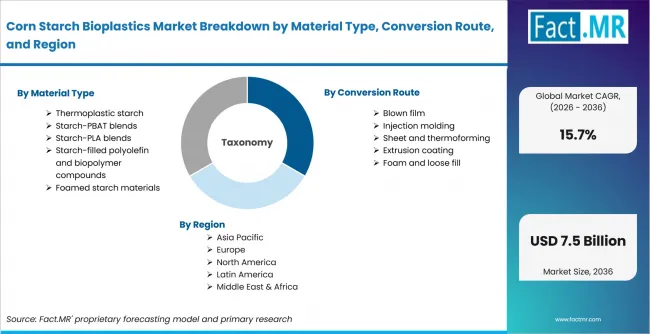
Corn Starch Bioplastics Market Breakdown By Material Type, Conversion Route, And Region | Source: Fact.MR
| Attribute | Details |
|---|---|
| Quantitative Units | USD Billion |
| Market Definition | Corn starch-based bioplastics used in compostable, biodegradable or partly bio-based packaging and film applications. |
| Material Type | Thermoplastic starch; Starch-PBAT blends; Starch-PLA blends; Starch-filled polyolefin and biopolymer compounds; Foamed starch materials |
| Conversion Route | Blown film; Injection molding; Sheet and thermoforming; Extrusion coating; Foam and loose fill |
| End Product | Compostable bags & liners; Foodservice ware; Flexible packaging; Agricultural films; Protective packaging and other |
| End-of-Life Claim | Industrial compostable; Home compostable; Biodegradable; Partly bio-based and non-compostable; Water and soil degradable specialty |
| Regions Covered | North America; Latin America; Western Europe; Eastern Europe; East Asia; South Asia & Pacific; Middle East & Africa |
| Countries Covered | United States; Germany; Italy; United Kingdom; France |
| Key Companies Profiled | Novamont; BASF; FKuR; Cardia Bioplastics |
| Forecast Period | 2026 to 2036 |
| Approach | Hybrid top-down and bottom-up approach using feedstock availability, compostable packaging conversion, country regulations, end-of-life infrastructure and provider portfolio review. |
Source: Fact.MR analysis. Updated Sep 3, 2026
How is the market segmented?
-
By Material Type
- Thermoplastic starch
- Starch-PBAT blends
- Starch-PLA blends
- Starch-filled polyolefin and biopolymer compounds
- Foamed starch materials
-
By Conversion Route
- Blown film
- Injection molding
- Sheet and thermoforming
- Extrusion coating
- Foam and loose fill
-
By End Product
- Compostable bags & liners
- Foodservice ware
- Flexible packaging
- Agricultural films
- Protective packaging and other
-
By End-of-Life Claim
- Industrial compostable
- Home compostable
- Biodegradable
- Partly bio-based and non-compostable
- Water and soil degradable specialty
-
By Region
- North America
- Latin America
- Western Europe
- Eastern Europe
- East Asia
- South Asia & Pacific
- Middle East & Africa
Frequently Asked Questions
How big is the Corn Starch Bioplastics Market in 2026?
What is the CAGR of the Corn Starch Bioplastics Market from 2026 to 2036?
Which Material Type leads the Corn Starch Bioplastics Market?
Which Conversion Route leads the Corn Starch Bioplastics Market?
Who are the leading companies in the Corn Starch Bioplastics Market?
Who worked on this report


Preview the report firsthand - request a free sample
Free SampleGet the brochure for pricing and purchase details
Download PDF