- Base Value(2026): 560 Mn
- Estimated Value(2026): 560 Mn
- Forecast Value (2036): 806 Mn
- CAGR (2026 - 2036): 3.7%
Stationary Water Screen Market Forecast Outlook 2026 to 2036
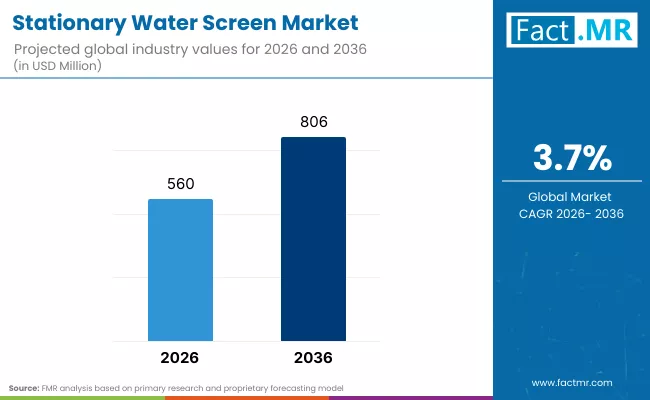
The stationary water screen market is valued at USD 560 million in 2026 and is projected to reach USD 806 million by 2036, expanding at a 3.7% compound annual growth rate (CAGR).
Key Takeaways from Stationary Water Screen Market
- Stationary Water Screen Market Value (2026): USD 560 million
- Stationary Water Screen Market Forecast Value (2036): USD 806 million
- Stationary Water Screen Market Forecast CAGR (2026-2036): 3.7%
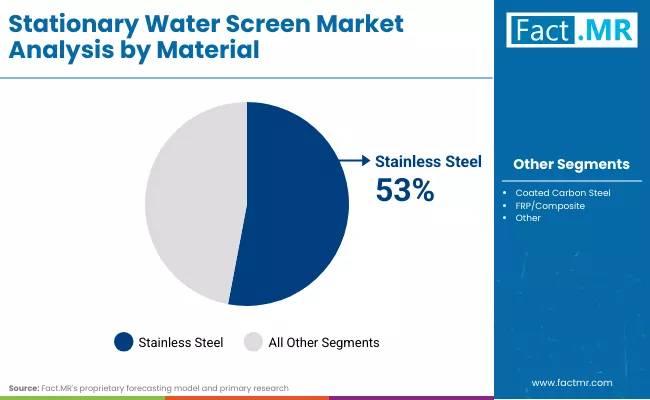
- Leading Segment in Stationary Water Screen Market: Stainless Steel (53%)
- Key Growth Region in Stationary Water Screen Market: India (4.8% CAGR)
- Key Players in Stationary Water Screen Market: Aqseptence Group GmbH, Huber SE, WesTech Engineering, LLC, ANDRITZ AG, Xylem Inc., Veolia Water Technologies & Solutions, Parkson Corporation, Jash Engineering Pvt. Ltd., Ovivo Inc., SUEZ S.A.
Stationary Water Screen Market By Industry | Source: Fact.MR
Growth quality in this sector is fundamentally determined by a high application concentration within the power generation and municipal water sectors, where stationary screens function as non-discretionary protective assets. End-use dependency is absolute; cooling water circuits and treatment intakes cannot operate without these barriers to prevent catastrophic debris ingestion.
Consequently, the market benefits from a unique volume stability, as demand is anchored more by mandatory replacement cycles and regulatory compliance than by speculative infrastructure expansion. While growth remains conservative compared to automated alternatives, the strategic importance of stationary units persists in legacy facilities and smaller-scale industrial bypasses where mechanical simplicity is a hedge against operational downtime. As aging plants extend their lifecycles through 2036, these screens provide a reliable, low-complexity floor for the broader water-intake ecosystem.
Stationary Water Screen Market
| Metric | Value |
|---|---|
| Estimated Value in (2026E) | USD 560 million |
| Forecast Value in (2036F) | USD 806 million |
| Forecast CAGR (2026 to 2036) | 3.7% |
Source: Fact.MR analysis. Updated Feb 6, 2026
Category
| Category | Sub-Segment |
|---|---|
| By Screen Type | Fixed Bar Screens; Static Wedge-Wire Screens; Coarse Trash Racks; Other |
| By Application | Raw Water Intake; Wastewater Headworks; Industrial Process Water; Stormwater/Other |
| By Material | Stainless Steel; Coated Carbon Steel; FRP/Composite; Other |
| By Sales Channel | Municipal Tenders; Industrial Direct Sales; EPC Contracts; Other |
| Region | North America; Europe; Asia Pacific; Latin America; Middle East & Africa |
Source: Fact.MR analysis. Updated Feb 6, 2026
Segmental Analysis
What is Driving the Dominance of Stainless Steel in the Stationary Water Screen Market?
Stationary Water Screen Market By Mkaterial | Source: Fact.MR
Stainless Steel leads the stationary water screen market with 53% of the market share in 2026. Stainless steel is preferred due to its durability, corrosion resistance, and ability to withstand harsh environmental conditions, particularly in water treatment plants, power stations, and industrial applications. Its strength and resistance to rust and chemical degradation make it ideal for long-term, reliable performance in water intake systems exposed to varying water conditions.
What is the Role of Municipal Tenders in the Stationary Water Screen Market?
Stationary Water Screen Market By Sales Channel | Source: Fact.MR
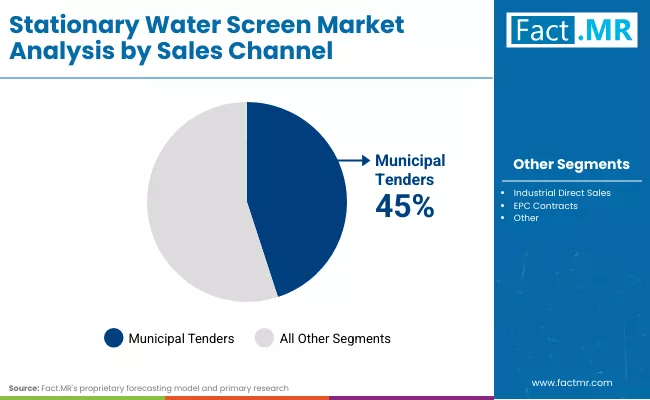
Municipal Tenders account for 45% of the market share in 2026. Municipal water treatment plants and infrastructure projects are major drivers of demand, as stationary water screens are essential for filtering debris from water intake systems in urban water supplies. Tenders for such projects typically require high standards of performance and material durability, which further drives the adoption of stainless steel screens. As cities continue to expand and upgrade their water management systems, municipal tenders remain a significant channel for growth in this market.
What are the Drivers, Restraints, and Key Trends in the Stationary Water Screen Market?
Demand for stationary water screens is shaped by requirements to remove coarse debris and protect downstream equipment in municipal water intake, industrial cooling systems, and wastewater treatment plants. Operators specify screens that deliver reliable solids capture, minimal head loss, and robust performance in continuous flow conditions. Procurement teams prioritize solutions that withstand variable water conditions, offer accessible maintenance, and integrate with existing screening and pumping infrastructure. Higher upfront cost and installation complexity can constrain adoption in facilities with limited capital budgets, and variability in debris load and flow rates affects screen selection and sizing. Key trends include development of enhanced penetration and debris rejection capabilities that extend cleaning intervals, and expansion of modular screen designs that support scalable implementation and simplified servicing across diverse intake environments.
Analysis of the Stationary Water Screen Market by Key Country
| Country | CAGR (2026-2036) |
|---|---|
| India | 4.8% |
| China | 4.4% |
| Indonesia | 4.3% |
| Brazil | 4.0% |
| Mexico | 3.7% |
| USA | 2.6% |
| Germany | 2.3% |
| Japan | 1.9% |
Source: Fact.MR analysis. Updated Feb 6, 2026
The report covers an in-depth analysis of 40+ countries; top-performing countries are highlighted below.
What Drives the Growth in the India Stationary Water Screen Market?
The India stationary water screen market is growing at a rate of 4.8%, driven by the country’s increasing need for efficient water treatment systems. As India continues to urbanize and industrialize, there is a rising demand for stationary water screens in both municipal water treatment plants and industrial applications. The government’s focus on improving water quality and infrastructure development is also contributing to the demand for such systems. Additionally, with the country’s increasing reliance on water resources for agriculture and power generation, the market for stationary water screens is expected to expand significantly over the coming years.
How Does the China Stationary Water Screen Market Expand?
The China stationary water screen market is experiencing growth at 4.4%, driven by the country’s ongoing industrial development and the rising demand for water treatment solutions. China’s growing industrial base, particularly in the power generation and manufacturing sectors, requires advanced water intake systems to ensure that debris is effectively filtered. The country’s efforts to modernize water infrastructure and adhere to environmental standards further contribute to the adoption of stationary water screens. With China’s large-scale investments in sustainable water management technologies, the market for these water intake solutions continues to grow.
What Influences the Growth of the Indonesia Stationary Water Screen Market?
The Indonesia stationary water screen market is expanding at 4.3%, supported by the country’s rapid industrialization and infrastructure development. Indonesia’s growing population and the increasing demand for water in agriculture, power generation, and industrial sectors drive the need for efficient water treatment systems, including stationary water screens. Additionally, the government’s focus on improving water quality, coupled with rising investments in desalination and wastewater treatment plants, contributes to market growth. The demand for these systems is expected to increase as Indonesia continues to modernize its water infrastructure and address its water resource challenges.
How Does the Brazil Stationary Water Screen Market Expand?
The Brazil stationary water screen market is growing at a rate of 4.0%, driven by the country’s strong agricultural sector, which requires efficient water management solutions. Brazil’s large-scale irrigation systems and industrial applications, such as mining and power generation, necessitate the use of stationary water screens to ensure proper filtration and water quality. The country’s expanding municipal water treatment infrastructure also supports the demand for these systems. Brazil’s focus on sustainable water management practices and improving access to clean water further accelerates the adoption of stationary water screens in various sectors.
What Factors Support the Growth of the Mexico Stationary Water Screen Market?
The Mexico stationary water screen market is expanding at 3.7%, driven by its growing industrial sector and proximity to major manufacturing hubs in North America. The need for efficient water treatment solutions in power plants, agricultural irrigation systems, and municipal water facilities is fueling demand for stationary water screens. Mexico’s ongoing infrastructure development projects and the adoption of more stringent environmental regulations also contribute to market growth. As the country increasingly invests in water conservation technologies, the demand for these systems, which offer efficient debris filtration, is expected to rise.
What Drives the Growth in the USA Stationary Water Screen Market?
The USA stationary water screen market is growing at a rate of 2.6%, influenced by the country’s continued investment in upgrading its aging water infrastructure. As the U.S. focuses on improving water quality in both municipal and industrial applications, the demand for reliable water intake systems, such as stationary water screens, is increasing. Moreover, the expansion of power generation facilities and the rising importance of sustainable water resource management play a significant role in driving market growth. While growth is slower than in other countries, the USA remains a key market for water treatment technologies.
How Does the Germany Stationary Water Screen Market Expand?
The Germany stationary water screen market is growing at 2.3%, with demand driven by the country’s emphasis on environmental sustainability and water quality management. Germany’s commitment to reducing water consumption and improving wastewater treatment in industrial applications creates a steady need for stationary water screens. The country’s strong industrial base, particularly in the automotive, chemical, and energy sectors, requires advanced water intake and filtration solutions. While market growth is slower in comparison to other regions, Germany's regulatory standards and focus on efficient water management contribute to the ongoing adoption of these systems.
What Influences the Growth of the Japan Stationary Water Screen Market?
The Japan stationary water screen market is growing at a rate of 1.9%, supported by the country’s technological advancements and commitment to environmental sustainability. Japan’s industrial sectors, including manufacturing and power generation, require efficient water intake systems to ensure clean water for operations. The increasing need for efficient water management solutions in agriculture and municipal water facilities also contributes to the demand for stationary water screens. While Japan’s market growth is relatively slower compared to other countries, the country’s strong regulatory framework and commitment to sustainable water practices support the steady adoption of water intake systems.
How Are Key Players Competing in the Stationary Water Screen Market?
Stationary Water Screen Market By Company | Source: Fact.MR
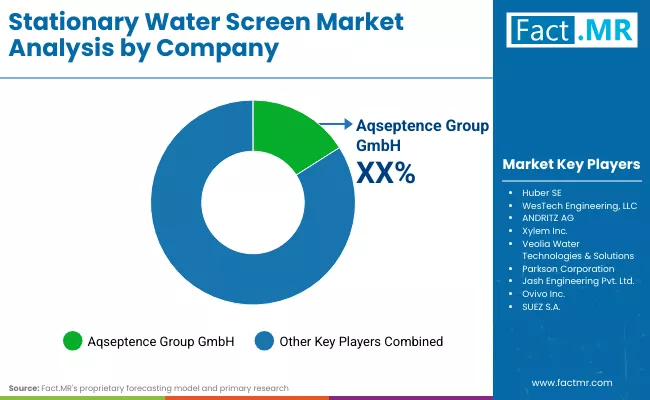
The stationary water screen market is expanding as industries and municipalities seek advanced water filtration solutions for sustainable water management. Aqseptence Group GmbH and Huber SE dominate the market with high-performance stationary screens designed for large-scale water treatment and sewage systems. WesTech Engineering and ANDRITZ AG provide tailored stationary water screens for desalination and power plant intakes, focusing on durability and high-efficiency filtration. Xylem Inc. and Veolia Water Technologies focus on integrating smart technologies and digital monitoring to improve system reliability and reduce maintenance. Parkson Corporation and Jash Engineering Pvt. Ltd. provide cost-effective solutions for municipal and industrial applications, offering high-quality filtration for water intake systems. Ovivo Inc. and SUEZ S.A. specialize in innovative stationary screen designs, emphasizing environmental compliance and energy efficiency for large-scale water management projects.
Recent Industry Developments
- Patent - Stationary Automatic Debris Screen (Published Mar 7, 2023): A patent was published for a stationary automatic debris screen designed to remove trash and solids from water intakes using self-cleaning operation, aimed at reducing manual maintenance in municipal or industrial applications.
- Patent - Stationary Water Inlet Screen with Adjustable Flow Openings (Published Oct 17, 2024): A patent application describes a stationary water intake screen for selective flow control, where panel openings can be adjusted to optimize flow and screening efficiency under variable conditions - reflecting ongoing engineering innovation in stationary screen design.
- Municipal Water Project Deployment (2025): East Bay Municipal Utility District (California, USA) documented the installation of stationary water intake screens as part of its East Bayshore Treatment Plant project to improve debris exclusion and protect downstream equipment in its water treatment infrastructure.
Key Players of the Stationary Water Screen Market
- Aqseptence Group GmbH
- Huber SE
- WesTech Engineering, LLC
- ANDRITZ AG
- Xylem Inc.
- Veolia Water Technologies & Solutions
- Parkson Corporation
- Jash Engineering Pvt. Ltd.
- Ovivo Inc.
- SUEZ S.A.
Bibliographies
- U.S. Environmental Protection Agency. (2023). Cooling Water Intake Structures (CWA 316(b)) - National Pollutant Discharge Elimination System requirements. EPA.
- National Oceanic and Atmospheric Administration, National Marine Fisheries Service. (2024). Fish protection at water intake structures: Engineering and operational measures. NOAA Fisheries.
- U.S. Army Corps of Engineers. (2023). Engineering manual: Design of water intake structures and debris screening systems. USACE.
- Bureau of Reclamation, U.S. Department of the Interior. (2024). Design standards for water diversion and intake structures. USBR.
- ASTM International. (2023). ASTM F489: Standard practice for design of intake trash racks and screens. ASTM.
Segmentation
Scope of the Report
| Items | Values |
|---|---|
| Quantitative Units (2026) | USD Million |
| By Screen Type | Fixed Bar Screens, Static Wedge-Wire Screens, Coarse Trash Racks, Other |
| By Application | Raw Water Intake, Wastewater Headworks, Industrial Process Water, Stormwater/Other |
| By Material | Stainless Steel, Coated Carbon Steel, FRP/Composite, Other |
| By Sales Channel | Municipal Tenders, Industrial Direct Sales, EPC Contracts, Other |
| Regions Covered | North America, Europe, Asia Pacific, Latin America, Middle East & Africa |
| Countries Covered | United States, Canada, Mexico, Germany, United Kingdom, France, Japan, South Korea, China, India, Brazil, and other countries |
| Key Companies Profiled | Aqseptence Group GmbH, Huber SE, WesTech Engineering, LLC, ANDRITZ AG, Xylem Inc., Veolia Water Technologies & Solutions, Parkson Corporation, Jash Engineering Pvt. Ltd., Ovivo Inc., SUEZ S.A. |
| Additional Attributes | Dollar revenue by screen type, application, material, sales channel, and region; regional demand trends, competitive landscape, technological advancements in stationary water screens, operational performance optimization initiatives, and product development strategies |
Source: Fact.MR analysis. Updated Feb 6, 2026
Stationary Water Screen Market Key Segments
-
By Screen Type :
- Fixed Bar Screens
- Static Wedge-Wire Screens
- Coarse Trash Racks
- Other
-
By Application :
- Raw Water Intake
- Wastewater Headworks
- Industrial Process Water
- Stormwater/Other
-
By Material :
- Stainless Steel
- Coated Carbon Steel
- FRP/Composite
- Other
-
By Sales Channel :
- Municipal Tenders
- Industrial Direct Sales
- EPC Contracts
- Other
-
Region :
- North America
- USA
- Canada
- Mexico
- Europe
- Germany
- UK
- France
- Italy
- Spain
- Nordic Countries
- BENELUX
- Rest of Europe
- Asia Pacific
- China
- Japan
- South Korea
- India
- Australia
- Rest of Asia Pacific
- Latin America
- Brazil
- Argentina
- Rest of Latin America
- Middle East and Africa
- Kingdom of Saudi Arabia
- United Arab Emirates
- South Africa
- Rest of Middle East and Africa
- Other Regions
- Oceania
- Central Asia
- Other Markets
- North America
Frequently Asked Questions
What is the projected market size for stationary water screens in 2026?
What value is expected for stationary water screens in 2036?
At what rate will the stationary water screen market progress from 2026 to 2036?
Which region is expected to experience the fastest growth and what rate is it projected at?
Which material dominates demand and what share does it hold?
Who are the major players in the stationary water screen market?
Who worked on this report


Preview the report firsthand - request a free sample
Free SampleGet the brochure for pricing and purchase details
Download PDF