Substrate Reduction Therapies Market
Substrate Reduction Therapies Market Size and Share Forecast Outlook 2026 to 2036
Substrate reduction therapies market is projected to grow from USD 1.8 billion in 2026 to USD 4.8 billion by 2036, at a CAGR of 10.6%. Small-molecule SRTs will dominate with a 68.4% market share, while gaucher disease will lead the application segment with a 43.7% share.
Substrate Reduction Therapies Market Forecast and Outlook 2026 to 2036
The global substrate reduction therapies market is projected to grow from USD 1.75 billion in 2026 to USD 4.78 billion by 2036, progressing at a CAGR of 10.6%. This specialized market is defined by its strategic role in managing rare lysosomal storage disorders, offering a crucial therapeutic alternative to enzyme replacement therapy.
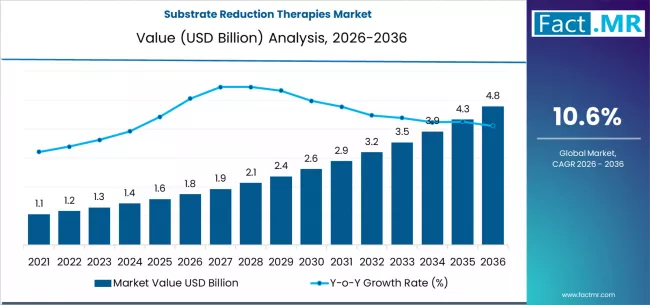
Key Takeaways from the Substrate Reduction Therapies Market
- Market Value for 2026: USD 1.75 Billion
- Market Value for 2036: USD 4.78 Billion
- Forecast CAGR 2026 to 2036: 10.6%
- Leading Product Segment (2026): Small-molecule SRTs (68.4%)
- Leading Application Segment (2026): Gaucher Disease (43.7%)
- Leading End-User Segment (2026): Specialty Hospitals (55.1%)
- Key Growth Countries: India (12.8% CAGR), China (12.6% CAGR), Brazil (12.4% CAGR), USA (11.8% CAGR), UK (10.7% CAGR), Germany (10.6% CAGR), France (10.5% CAGR)
- Key Players in the Market: Takeda Pharmaceutical Company Limited, Sanofi, Amicus Therapeutics, Inc., Pfizer Inc., Chiesi Farmaceutici S.p.A.

Growth is fundamentally driven by advancements in diagnosis, the expansion of newborn screening programs in key economies, and the significant clinical preference for oral administration. The market is characterized by high innovation concentration and the pursuit of therapies that can cross the blood-brain barrier to address neuropathic forms of disease.
The dominant trend is the strong preference for oral small-molecule therapies, which provide patients with a less burdensome treatment option compared to lifelong intravenous infusions. The pipeline is increasingly focused on next-generation molecules with improved potency and safety profiles, as well as combination regimens that target disease pathology through multiple mechanisms.
Geographic expansion into emerging markets, where diagnosis rates are rapidly catching up to developed nations, presents a major growth vector, though it is tempered by the challenges of securing reimbursement for ultra-orphan drugs.
Metric
| Metric | Value |
|---|---|
| Market Value (2026) | USD 1.75 Billion |
| Market Forecast Value (2036) | USD 4.78 Billion |
| Forecast CAGR 2026 to 2036 | 10.6% |
Category
| Category | Segments |
|---|---|
| Product | Small-molecule SRTs, Combination Therapies |
| Application | Gaucher Disease, Fabry Disease, Others |
| End User | Specialty Hospitals, Rare Disease Clinics, Home Care |
| Region | North America, Latin America, Western Europe, Eastern Europe, East Asia, South Asia & Pacific, Middle East & Africa |
Segmental Analysis
By Product, Which Segment is dominated by Patient-Centric Oral Administration?
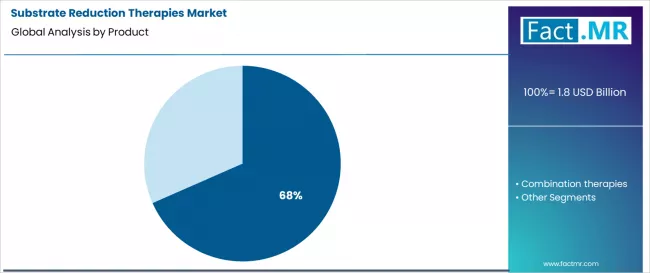
Small-molecule substrate reduction therapies command a dominant 68.4% share. This overwhelming preference is directly tied to their oral route of administration, which offers a transformative quality-of-life improvement over intravenous enzyme replacement therapies.
The convenience of at-home dosing significantly enhances treatment adherence and reduces the burden on healthcare facilities, making them the first-line systemic treatment option for eligible patients with non-neuropathic forms of lysosomal storage disorders.
By Application, Which Indication Serves as the Primary Model for SRT Development?
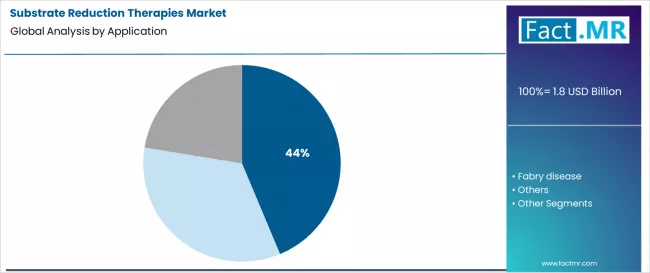
Gaucher disease constitutes the leading application segment at 43.7%. It represents the most prevalent lysosomal storage disorder amenable to SRT and was the first to see successful therapeutic development in this class.
The well-characterized patient pathways, established treatment guidelines, and proven efficacy of SRTs in managing visceral and hematological symptoms solidify its role as the cornerstone indication and a model for expanding SRTs to other rare diseases.
By End User, Which Setting Provides the Necessary Multidisciplinary Expertise?
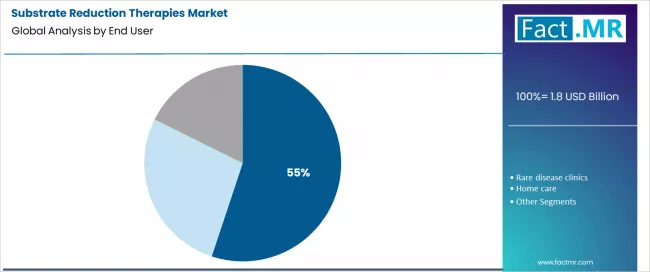
Specialty hospitals form the primary end-user segment at 55.1%. The management of complex rare diseases like Gaucher and Fabry disease requires coordinated care from geneticists, neurologists, hematologists, and specialized pharmacists.
Specialty hospitals centralize this multidisciplinary expertise, facilitate accurate diagnosis and monitoring, and are equipped to manage the initiation and titration of these high-cost, specialized therapies.
What are the Principal Drivers, Constraints, and Evolving Dynamics of this Market?
The principal driver is the significant patient preference and clinical adoption of oral small-molecule therapies over lifelong intravenous enzyme replacements, dramatically improving treatment adherence and quality of life. A major constraint is the extremely high annual cost of therapy, which creates profound challenges for reimbursement and patient access globally, particularly in public healthcare systems. A significant opportunity lies in the development of next-generation molecules capable of crossing the blood-brain barrier to address the devastating neuropathic forms of diseases like Gaucher and Fabry, a major unmet need. The dominant trend is the strategic shift towards combination therapies, which pair substrate reduction agents with enzyme stabilizers or chaperone therapies to enhance clinical efficacy and potentially slow disease progression more effectively than monotherapy.
Analysis of the Substrate Reduction Therapies Market by Key Countries
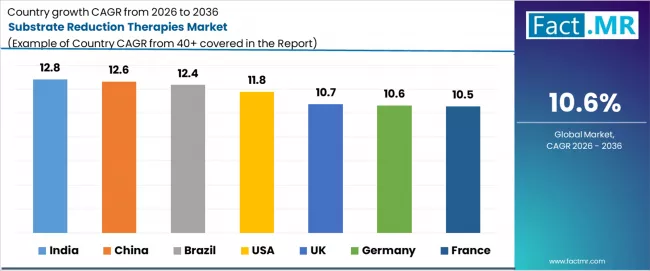
| Country | CAGR 2026 to 2036 |
|---|---|
| India | 12.8% |
| China | 12.6% |
| Brazil | 12.4% |
| USA | 11.8% |
| UK | 10.7% |
| Germany | 10.6% |
| France | 10.5% |
Do Premium Pricing and a Concentration of Specialist Centers fuel the USA’s Market Growth?
The USA’s 11.8% CAGR is driven by its ability to support premium pricing for orphan drugs, robust private insurance, and a dense network of specialist treatment centers. Growth is characterized by the rapid adoption of newly approved and more convenient oral therapies. Specialty pharmacy distribution and comprehensive patient support programs designed to optimize adherence and outcomes significantly influence market dynamics.
Can Brazil's Public Health System Overcome Fiscal Constraints to Fund Ultra-Orphan Therapies?
Brazil’s 12.4% CAGR faces the critical challenge of funding extremely high-cost therapies within its public Unified Health System (SUS). Growth is heavily dependent on judicialization (court-mandated access) and complex government negotiations for centralized procurement. Market expansion is often non-linear, following successful legal precedents and advocacy efforts to recognize these treatments as essential.
Does China's Market Trajectory Hinge on Domestic Biosimilar and Novel Drug Development?
China’s 12.6% CAGR is propelled by its national rare disease policy and rapidly improving diagnostic capabilities. A key growth factor is the active development of domestically produced biosimilars for enzyme replacement therapy and novel SRT candidates, which promise to reduce costs and increase supply security. Expansion of national reimbursement for rare disease drugs is crucial for sustained market access.
Will Improving Diagnostic Rates and Tiered Pricing Models define India’s Growth?
A large undiagnosed population and gradual improvements in genetic testing infrastructure in metropolitan centers fuel India’s leading 12.8% CAGR. Growth relies on innovative tiered pricing and patient access programs from multinational companies, as well as the emerging presence of domestic generic manufacturers for older therapies, creating a multi-layered market structure.
Is Germany's Structured Orphan Drug Framework Enabling Predictable Market Access?
Germany’s 10.6% CAGR benefits from a well-defined regulatory and reimbursement framework for orphan drugs. The market is characterized by early access following EU approval, with pricing negotiated based on added benefit assessments. Growth is steady and predictable, facilitated by a network of specialized university hospitals that serve as central hubs for diagnosis and treatment.
Does France's Early Access Pathway and CEPS Negotiation Shape the Adoption Curve?
France’s 10.5% CAGR is influenced by its early access authorization (Autorisation d'accès précoce) pathway, which can facilitate availability prior to formal marketing authorization. Final adoption and price levels are determined through negotiations with the Economic Committee for Health Products (CEPS). This system aims to balance rapid patient access with budgetary control, leading to a measured growth pattern.
Is the UK's Growth Contingent on Positive NICE Appraisals for High-Cost, Low-Volume Therapies?
The UK’s 10.7% CAGR is fundamentally governed by assessments from the National Institute for Health and Care Excellence (NICE) and the Scottish Medicines Consortium (SMC). Market growth for ultra-orphan SRTs is highly dependent on demonstrating sufficient clinical value to justify their exceptional cost, often through specialized highly specialized technologies (HST) evaluations or managed access agreements with the NHS.
Competitive Landscape of the Substrate Reduction Therapies Market
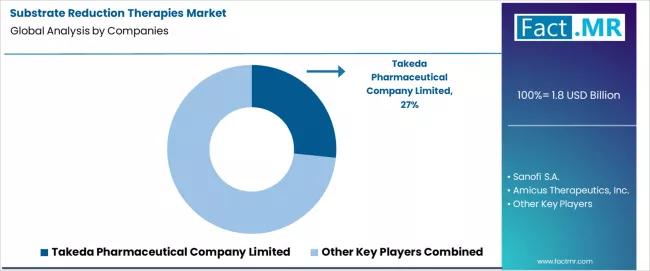
The competitive landscape is niche and knowledge-intensive, dominated by a small number of companies with deep expertise in lysosomal biology. These players compete on the basis of therapeutic innovation, particularly in developing next-generation oral agents with improved efficacy or the potential to treat neurological manifestations. Establishing robust long-term safety and real-world effectiveness data is critical for maintaining market position against enzyme replacement therapy alternatives.
Success is heavily reliant on building strong relationships with the global community of rare disease specialists and patient advocacy groups. Given the small, dispersed patient populations, companies invest significantly in disease awareness, diagnostic support programs, and personalized patient services. Strategic priorities include life-cycle management of existing therapies through pediatric indications or new formulations, and pursuing combination therapy approaches to enhance treatment outcomes.
Key Players in the Substrate Reduction Therapies Market
- Takeda Pharmaceutical Company Limited
- Sanofi S.A.
- Amicus Therapeutics, Inc.
- Pfizer Inc.
- Chiesi Farmaceutici S.p.A.
- Others
Scope of Report
| Items | Metrics |
|---|---|
| Quantitative Units | USD Billion |
| Product | Small-molecule SRTs, Combination Therapies |
| Application | Gaucher Disease, Fabry Disease, Others |
| End User | Specialty Hospitals, Rare Disease Clinics, Home Care |
| Key Countries | India, China, Brazil, USA, Germany, France, UK |
| Key Companies | Takeda, Sanofi, Amicus Therapeutics, Pfizer, Chiesi, Others |
| Additional Analysis | Comparative analysis of SRT vs. Enzyme Replacement Therapy (ERT) cost and outcomes; impact of newborn screening on early intervention rates; biomarkers for monitoring SRT efficacy; challenges and models for sustainable pricing and access in emerging economies. |
Market by Segments
-
Product :
- Small-molecule SRTs
- Combination Therapies
-
Application :
- Gaucher Disease
- Fabry Disease
- Others
-
End User :
- Specialty Hospitals
- Rare Disease Clinics
- Home Care
-
Region :
- North America
- USA
- Canada
- Latin America
- Brazil
- Mexico
- Argentina
- Rest of Latin America
- Western Europe
- Germany
- France
- UK
- Italy
- Spain
- BENELUX
- Rest of Western Europe
- Eastern Europe
- Russia
- Poland
- Czech Republic
- Rest of Eastern Europe
- East Asia
- China
- Japan
- South Korea
- Rest of East Asia
- South Asia & Pacific
- India
- ASEAN
- Australia
- Rest of South Asia & Pacific
- MEA
- GCC Countries
- South Africa
- Turkiye
- Rest of MEA
- North America
References
- European Medicines Agency (EMA). (2025). Guideline on Clinical Development of Medicinal Products for the Treatment of Lysosomal Storage Disorders.
- International Society for Pharmacoeconomics and Outcomes Research (ISPOR). (2024). Special Report: Value Assessment and Pricing Models for Ultra-Orphan Therapies.
- National Organization for Rare Disorders (NORD). (2025). State of the Rare Disease Drug Development Landscape.
- World Health Organization (WHO). (2024). Report on Public Health Priorities for Rare Diseases.
Table of Content
- Executive Summary
- Global Market Outlook
- Demand to side Trends
- Supply to side Trends
- Technology Roadmap Analysis
- Analysis and Recommendations
- Market Overview
- Market Coverage / Taxonomy
- Market Definition / Scope / Limitations
- Market Background
- Market Dynamics
- Drivers
- Restraints
- Opportunity
- Trends
- Scenario Forecast
- Demand in Optimistic Scenario
- Demand in Likely Scenario
- Demand in Conservative Scenario
- Opportunity Map Analysis
- Product Life Cycle Analysis
- Supply Chain Analysis
- Investment Feasibility Matrix
- Value Chain Analysis
- PESTLE and Porter’s Analysis
- Regulatory Landscape
- Regional Parent Market Outlook
- Production and Consumption Statistics
- Import and Export Statistics
- Market Dynamics
- Global Market Analysis 2021 to 2025 and Forecast, 2026 to 2036
- Historical Market Size Value (USD Million) Analysis, 2021 to 2025
- Current and Future Market Size Value (USD Million) Projections, 2026 to 2036
- Y to o to Y Growth Trend Analysis
- Absolute $ Opportunity Analysis
- Global Market Pricing Analysis 2021 to 2025 and Forecast 2026 to 2036
- Global Market Analysis 2021 to 2025 and Forecast 2026 to 2036, By Product
- Introduction / Key Findings
- Historical Market Size Value (USD Million) Analysis By Product, 2021 to 2025
- Current and Future Market Size Value (USD Million) Analysis and Forecast By Product, 2026 to 2036
- Small-molecule SRTs
- Combination therapies
- Small-molecule SRTs
- Y to o to Y Growth Trend Analysis By Product, 2021 to 2025
- Absolute $ Opportunity Analysis By Product, 2026 to 2036
- Global Market Analysis 2021 to 2025 and Forecast 2026 to 2036, By Application
- Introduction / Key Findings
- Historical Market Size Value (USD Million) Analysis By Application, 2021 to 2025
- Current and Future Market Size Value (USD Million) Analysis and Forecast By Application, 2026 to 2036
- Gaucher disease
- Fabry disease
- Others
- Gaucher disease
- Y to o to Y Growth Trend Analysis By Application, 2021 to 2025
- Absolute $ Opportunity Analysis By Application, 2026 to 2036
- Global Market Analysis 2021 to 2025 and Forecast 2026 to 2036, By End User
- Introduction / Key Findings
- Historical Market Size Value (USD Million) Analysis By End User, 2021 to 2025
- Current and Future Market Size Value (USD Million) Analysis and Forecast By End User, 2026 to 2036
- Specialty hospitals
- Rare disease clinics
- Home care
- Specialty hospitals
- Y to o to Y Growth Trend Analysis By End User, 2021 to 2025
- Absolute $ Opportunity Analysis By End User, 2026 to 2036
- Global Market Analysis 2021 to 2025 and Forecast 2026 to 2036, By Region
- Introduction
- Historical Market Size Value (USD Million) Analysis By Region, 2021 to 2025
- Current Market Size Value (USD Million) Analysis and Forecast By Region, 2026 to 2036
- North America
- Latin America
- Western Europe
- Eastern Europe
- East Asia
- South Asia and Pacific
- Middle East & Africa
- Market Attractiveness Analysis By Region
- North America Market Analysis 2021 to 2025 and Forecast 2026 to 2036, By Country
- Historical Market Size Value (USD Million) Trend Analysis By Market Taxonomy, 2021 to 2025
- Market Size Value (USD Million) Forecast By Market Taxonomy, 2026 to 2036
- By Country
- USA
- Canada
- Mexico
- By Product
- By Application
- By End User
- By Country
- Market Attractiveness Analysis
- By Country
- By Product
- By Application
- By End User
- Key Takeaways
- Latin America Market Analysis 2021 to 2025 and Forecast 2026 to 2036, By Country
- Historical Market Size Value (USD Million) Trend Analysis By Market Taxonomy, 2021 to 2025
- Market Size Value (USD Million) Forecast By Market Taxonomy, 2026 to 2036
- By Country
- Brazil
- Chile
- Rest of Latin America
- By Product
- By Application
- By End User
- By Country
- Market Attractiveness Analysis
- By Country
- By Product
- By Application
- By End User
- Key Takeaways
- Western Europe Market Analysis 2021 to 2025 and Forecast 2026 to 2036, By Country
- Historical Market Size Value (USD Million) Trend Analysis By Market Taxonomy, 2021 to 2025
- Market Size Value (USD Million) Forecast By Market Taxonomy, 2026 to 2036
- By Country
- Germany
- UK
- Italy
- Spain
- France
- Nordic
- BENELUX
- Rest of Western Europe
- By Product
- By Application
- By End User
- By Country
- Market Attractiveness Analysis
- By Country
- By Product
- By Application
- By End User
- Key Takeaways
- Eastern Europe Market Analysis 2021 to 2025 and Forecast 2026 to 2036, By Country
- Historical Market Size Value (USD Million) Trend Analysis By Market Taxonomy, 2021 to 2025
- Market Size Value (USD Million) Forecast By Market Taxonomy, 2026 to 2036
- By Country
- Russia
- Poland
- Hungary
- Balkan & Baltic
- Rest of Eastern Europe
- By Product
- By Application
- By End User
- By Country
- Market Attractiveness Analysis
- By Country
- By Product
- By Application
- By End User
- Key Takeaways
- East Asia Market Analysis 2021 to 2025 and Forecast 2026 to 2036, By Country
- Historical Market Size Value (USD Million) Trend Analysis By Market Taxonomy, 2021 to 2025
- Market Size Value (USD Million) Forecast By Market Taxonomy, 2026 to 2036
- By Country
- China
- Japan
- South Korea
- By Product
- By Application
- By End User
- By Country
- Market Attractiveness Analysis
- By Country
- By Product
- By Application
- By End User
- Key Takeaways
- South Asia and Pacific Market Analysis 2021 to 2025 and Forecast 2026 to 2036, By Country
- Historical Market Size Value (USD Million) Trend Analysis By Market Taxonomy, 2021 to 2025
- Market Size Value (USD Million) Forecast By Market Taxonomy, 2026 to 2036
- By Country
- India
- ASEAN
- Australia & New Zealand
- Rest of South Asia and Pacific
- By Product
- By Application
- By End User
- By Country
- Market Attractiveness Analysis
- By Country
- By Product
- By Application
- By End User
- Key Takeaways
- Middle East & Africa Market Analysis 2021 to 2025 and Forecast 2026 to 2036, By Country
- Historical Market Size Value (USD Million) Trend Analysis By Market Taxonomy, 2021 to 2025
- Market Size Value (USD Million) Forecast By Market Taxonomy, 2026 to 2036
- By Country
- Kingdom of Saudi Arabia
- Other GCC Countries
- Turkiye
- South Africa
- Other African Union
- Rest of Middle East & Africa
- By Product
- By Application
- By End User
- By Country
- Market Attractiveness Analysis
- By Country
- By Product
- By Application
- By End User
- Key Takeaways
- Key Countries Market Analysis
- USA
- Pricing Analysis
- Market Share Analysis, 2025
- By Product
- By Application
- By End User
- Canada
- Pricing Analysis
- Market Share Analysis, 2025
- By Product
- By Application
- By End User
- Mexico
- Pricing Analysis
- Market Share Analysis, 2025
- By Product
- By Application
- By End User
- Brazil
- Pricing Analysis
- Market Share Analysis, 2025
- By Product
- By Application
- By End User
- Chile
- Pricing Analysis
- Market Share Analysis, 2025
- By Product
- By Application
- By End User
- Germany
- Pricing Analysis
- Market Share Analysis, 2025
- By Product
- By Application
- By End User
- UK
- Pricing Analysis
- Market Share Analysis, 2025
- By Product
- By Application
- By End User
- Italy
- Pricing Analysis
- Market Share Analysis, 2025
- By Product
- By Application
- By End User
- Spain
- Pricing Analysis
- Market Share Analysis, 2025
- By Product
- By Application
- By End User
- France
- Pricing Analysis
- Market Share Analysis, 2025
- By Product
- By Application
- By End User
- India
- Pricing Analysis
- Market Share Analysis, 2025
- By Product
- By Application
- By End User
- ASEAN
- Pricing Analysis
- Market Share Analysis, 2025
- By Product
- By Application
- By End User
- Australia & New Zealand
- Pricing Analysis
- Market Share Analysis, 2025
- By Product
- By Application
- By End User
- China
- Pricing Analysis
- Market Share Analysis, 2025
- By Product
- By Application
- By End User
- Japan
- Pricing Analysis
- Market Share Analysis, 2025
- By Product
- By Application
- By End User
- South Korea
- Pricing Analysis
- Market Share Analysis, 2025
- By Product
- By Application
- By End User
- Russia
- Pricing Analysis
- Market Share Analysis, 2025
- By Product
- By Application
- By End User
- Poland
- Pricing Analysis
- Market Share Analysis, 2025
- By Product
- By Application
- By End User
- Hungary
- Pricing Analysis
- Market Share Analysis, 2025
- By Product
- By Application
- By End User
- Kingdom of Saudi Arabia
- Pricing Analysis
- Market Share Analysis, 2025
- By Product
- By Application
- By End User
- Turkiye
- Pricing Analysis
- Market Share Analysis, 2025
- By Product
- By Application
- By End User
- South Africa
- Pricing Analysis
- Market Share Analysis, 2025
- By Product
- By Application
- By End User
- USA
- Market Structure Analysis
- Competition Dashboard
- Competition Benchmarking
- Market Share Analysis of Top Players
- By Regional
- By Product
- By Application
- By End User
- Competition Analysis
- Competition Deep Dive
- Takeda Pharmaceutical Company Limited
- Overview
- Product Portfolio
- Profitability by Market Segments (Product/Age /Sales Channel/Region)
- Sales Footprint
- Strategy Overview
- Marketing Strategy
- Product Strategy
- Channel Strategy
- Sanofi S.A.
- Amicus Therapeutics, Inc.
- Pfizer Inc.
- Chiesi Farmaceutici S.p.A.
- Others
- Takeda Pharmaceutical Company Limited
- Competition Deep Dive
- Assumptions & Acronyms Used
- Research Methodology
List Of Table
- Table 1: Global Market Value (USD Million) Forecast by Region, 2021 to 2036
- Table 2: Global Market Value (USD Million) Forecast by Product, 2021 to 2036
- Table 3: Global Market Value (USD Million) Forecast by Application, 2021 to 2036
- Table 4: Global Market Value (USD Million) Forecast by End User, 2021 to 2036
- Table 5: North America Market Value (USD Million) Forecast by Country, 2021 to 2036
- Table 6: North America Market Value (USD Million) Forecast by Product, 2021 to 2036
- Table 7: North America Market Value (USD Million) Forecast by Application, 2021 to 2036
- Table 8: North America Market Value (USD Million) Forecast by End User, 2021 to 2036
- Table 9: Latin America Market Value (USD Million) Forecast by Country, 2021 to 2036
- Table 10: Latin America Market Value (USD Million) Forecast by Product, 2021 to 2036
- Table 11: Latin America Market Value (USD Million) Forecast by Application, 2021 to 2036
- Table 12: Latin America Market Value (USD Million) Forecast by End User, 2021 to 2036
- Table 13: Western Europe Market Value (USD Million) Forecast by Country, 2021 to 2036
- Table 14: Western Europe Market Value (USD Million) Forecast by Product, 2021 to 2036
- Table 15: Western Europe Market Value (USD Million) Forecast by Application, 2021 to 2036
- Table 16: Western Europe Market Value (USD Million) Forecast by End User, 2021 to 2036
- Table 17: Eastern Europe Market Value (USD Million) Forecast by Country, 2021 to 2036
- Table 18: Eastern Europe Market Value (USD Million) Forecast by Product, 2021 to 2036
- Table 19: Eastern Europe Market Value (USD Million) Forecast by Application, 2021 to 2036
- Table 20: Eastern Europe Market Value (USD Million) Forecast by End User, 2021 to 2036
- Table 21: East Asia Market Value (USD Million) Forecast by Country, 2021 to 2036
- Table 22: East Asia Market Value (USD Million) Forecast by Product, 2021 to 2036
- Table 23: East Asia Market Value (USD Million) Forecast by Application, 2021 to 2036
- Table 24: East Asia Market Value (USD Million) Forecast by End User, 2021 to 2036
- Table 25: South Asia and Pacific Market Value (USD Million) Forecast by Country, 2021 to 2036
- Table 26: South Asia and Pacific Market Value (USD Million) Forecast by Product, 2021 to 2036
- Table 27: South Asia and Pacific Market Value (USD Million) Forecast by Application, 2021 to 2036
- Table 28: South Asia and Pacific Market Value (USD Million) Forecast by End User, 2021 to 2036
- Table 29: Middle East & Africa Market Value (USD Million) Forecast by Country, 2021 to 2036
- Table 30: Middle East & Africa Market Value (USD Million) Forecast by Product, 2021 to 2036
- Table 31: Middle East & Africa Market Value (USD Million) Forecast by Application, 2021 to 2036
- Table 32: Middle East & Africa Market Value (USD Million) Forecast by End User, 2021 to 2036
List Of Figures
- Figure 1: Global Market Pricing Analysis
- Figure 2: Global Market Value (USD Million) Forecast 2021 to 2036
- Figure 3: Global Market Value Share and BPS Analysis by Product, 2026 and 2036
- Figure 4: Global Market Y to o to Y Growth Comparison by Product, 2026 to 2036
- Figure 5: Global Market Attractiveness Analysis by Product
- Figure 6: Global Market Value Share and BPS Analysis by Application, 2026 and 2036
- Figure 7: Global Market Y to o to Y Growth Comparison by Application, 2026 to 2036
- Figure 8: Global Market Attractiveness Analysis by Application
- Figure 9: Global Market Value Share and BPS Analysis by End User, 2026 and 2036
- Figure 10: Global Market Y to o to Y Growth Comparison by End User, 2026 to 2036
- Figure 11: Global Market Attractiveness Analysis by End User
- Figure 12: Global Market Value (USD Million) Share and BPS Analysis by Region, 2026 and 2036
- Figure 13: Global Market Y to o to Y Growth Comparison by Region, 2026 to 2036
- Figure 14: Global Market Attractiveness Analysis by Region
- Figure 15: North America Market Incremental Dollar Opportunity, 2026 to 2036
- Figure 16: Latin America Market Incremental Dollar Opportunity, 2026 to 2036
- Figure 17: Western Europe Market Incremental Dollar Opportunity, 2026 to 2036
- Figure 18: Eastern Europe Market Incremental Dollar Opportunity, 2026 to 2036
- Figure 19: East Asia Market Incremental Dollar Opportunity, 2026 to 2036
- Figure 20: South Asia and Pacific Market Incremental Dollar Opportunity, 2026 to 2036
- Figure 21: Middle East & Africa Market Incremental Dollar Opportunity, 2026 to 2036
- Figure 22: North America Market Value Share and BPS Analysis by Country, 2026 and 2036
- Figure 23: North America Market Value Share and BPS Analysis by Product, 2026 and 2036
- Figure 24: North America Market Y to o to Y Growth Comparison by Product, 2026 to 2036
- Figure 25: North America Market Attractiveness Analysis by Product
- Figure 26: North America Market Value Share and BPS Analysis by Application, 2026 and 2036
- Figure 27: North America Market Y to o to Y Growth Comparison by Application, 2026 to 2036
- Figure 28: North America Market Attractiveness Analysis by Application
- Figure 29: North America Market Value Share and BPS Analysis by End User, 2026 and 2036
- Figure 30: North America Market Y to o to Y Growth Comparison by End User, 2026 to 2036
- Figure 31: North America Market Attractiveness Analysis by End User
- Figure 32: Latin America Market Value Share and BPS Analysis by Country, 2026 and 2036
- Figure 33: Latin America Market Value Share and BPS Analysis by Product, 2026 and 2036
- Figure 34: Latin America Market Y to o to Y Growth Comparison by Product, 2026 to 2036
- Figure 35: Latin America Market Attractiveness Analysis by Product
- Figure 36: Latin America Market Value Share and BPS Analysis by Application, 2026 and 2036
- Figure 37: Latin America Market Y to o to Y Growth Comparison by Application, 2026 to 2036
- Figure 38: Latin America Market Attractiveness Analysis by Application
- Figure 39: Latin America Market Value Share and BPS Analysis by End User, 2026 and 2036
- Figure 40: Latin America Market Y to o to Y Growth Comparison by End User, 2026 to 2036
- Figure 41: Latin America Market Attractiveness Analysis by End User
- Figure 42: Western Europe Market Value Share and BPS Analysis by Country, 2026 and 2036
- Figure 43: Western Europe Market Value Share and BPS Analysis by Product, 2026 and 2036
- Figure 44: Western Europe Market Y to o to Y Growth Comparison by Product, 2026 to 2036
- Figure 45: Western Europe Market Attractiveness Analysis by Product
- Figure 46: Western Europe Market Value Share and BPS Analysis by Application, 2026 and 2036
- Figure 47: Western Europe Market Y to o to Y Growth Comparison by Application, 2026 to 2036
- Figure 48: Western Europe Market Attractiveness Analysis by Application
- Figure 49: Western Europe Market Value Share and BPS Analysis by End User, 2026 and 2036
- Figure 50: Western Europe Market Y to o to Y Growth Comparison by End User, 2026 to 2036
- Figure 51: Western Europe Market Attractiveness Analysis by End User
- Figure 52: Eastern Europe Market Value Share and BPS Analysis by Country, 2026 and 2036
- Figure 53: Eastern Europe Market Value Share and BPS Analysis by Product, 2026 and 2036
- Figure 54: Eastern Europe Market Y to o to Y Growth Comparison by Product, 2026 to 2036
- Figure 55: Eastern Europe Market Attractiveness Analysis by Product
- Figure 56: Eastern Europe Market Value Share and BPS Analysis by Application, 2026 and 2036
- Figure 57: Eastern Europe Market Y to o to Y Growth Comparison by Application, 2026 to 2036
- Figure 58: Eastern Europe Market Attractiveness Analysis by Application
- Figure 59: Eastern Europe Market Value Share and BPS Analysis by End User, 2026 and 2036
- Figure 60: Eastern Europe Market Y to o to Y Growth Comparison by End User, 2026 to 2036
- Figure 61: Eastern Europe Market Attractiveness Analysis by End User
- Figure 62: East Asia Market Value Share and BPS Analysis by Country, 2026 and 2036
- Figure 63: East Asia Market Value Share and BPS Analysis by Product, 2026 and 2036
- Figure 64: East Asia Market Y to o to Y Growth Comparison by Product, 2026 to 2036
- Figure 65: East Asia Market Attractiveness Analysis by Product
- Figure 66: East Asia Market Value Share and BPS Analysis by Application, 2026 and 2036
- Figure 67: East Asia Market Y to o to Y Growth Comparison by Application, 2026 to 2036
- Figure 68: East Asia Market Attractiveness Analysis by Application
- Figure 69: East Asia Market Value Share and BPS Analysis by End User, 2026 and 2036
- Figure 70: East Asia Market Y to o to Y Growth Comparison by End User, 2026 to 2036
- Figure 71: East Asia Market Attractiveness Analysis by End User
- Figure 72: South Asia and Pacific Market Value Share and BPS Analysis by Country, 2026 and 2036
- Figure 73: South Asia and Pacific Market Value Share and BPS Analysis by Product, 2026 and 2036
- Figure 74: South Asia and Pacific Market Y to o to Y Growth Comparison by Product, 2026 to 2036
- Figure 75: South Asia and Pacific Market Attractiveness Analysis by Product
- Figure 76: South Asia and Pacific Market Value Share and BPS Analysis by Application, 2026 and 2036
- Figure 77: South Asia and Pacific Market Y to o to Y Growth Comparison by Application, 2026 to 2036
- Figure 78: South Asia and Pacific Market Attractiveness Analysis by Application
- Figure 79: South Asia and Pacific Market Value Share and BPS Analysis by End User, 2026 and 2036
- Figure 80: South Asia and Pacific Market Y to o to Y Growth Comparison by End User, 2026 to 2036
- Figure 81: South Asia and Pacific Market Attractiveness Analysis by End User
- Figure 82: Middle East & Africa Market Value Share and BPS Analysis by Country, 2026 and 2036
- Figure 83: Middle East & Africa Market Value Share and BPS Analysis by Product, 2026 and 2036
- Figure 84: Middle East & Africa Market Y to o to Y Growth Comparison by Product, 2026 to 2036
- Figure 85: Middle East & Africa Market Attractiveness Analysis by Product
- Figure 86: Middle East & Africa Market Value Share and BPS Analysis by Application, 2026 and 2036
- Figure 87: Middle East & Africa Market Y to o to Y Growth Comparison by Application, 2026 to 2036
- Figure 88: Middle East & Africa Market Attractiveness Analysis by Application
- Figure 89: Middle East & Africa Market Value Share and BPS Analysis by End User, 2026 and 2036
- Figure 90: Middle East & Africa Market Y to o to Y Growth Comparison by End User, 2026 to 2036
- Figure 91: Middle East & Africa Market Attractiveness Analysis by End User
- Figure 92: Global Market - Tier Structure Analysis
- Figure 93: Global Market - Company Share Analysis
- FAQs -
How big is the substrate reduction therapies market in 2026?
The global substrate reduction therapies market is estimated to be valued at USD 1.8 billion in 2026.
What will be the size of substrate reduction therapies market in 2036?
The market size for the substrate reduction therapies market is projected to reach USD 4.8 billion by 2036.
How much will be the substrate reduction therapies market growth between 2026 and 2036?
The substrate reduction therapies market is expected to grow at a 10.6% CAGR between 2026 and 2036.
What are the key product types in the substrate reduction therapies market?
The key product types in substrate reduction therapies market are small-molecule srts and combination therapies.
Which application segment to contribute significant share in the substrate reduction therapies market in 2026?
In terms of application, gaucher disease segment to command 43.7% share in the substrate reduction therapies market in 2026.