Bio-Stimulation Therapies Market (2026 - 2036)

Bio-Stimulation Therapies Market Size and Share Forecast Outlook 2026 to 2036

Core Findings

    Bio-Stimulation Therapies Market Forecast and Outlook 2026 to 2036

    The global demand for bio stimulation therapies is projected to rise from USD 2.5 billion in 2026 to approximately USD 6.7 billion by 2036, representing a CAGR of about 10.2% over the forecast period. This growth reflects a fundamental transformation in aesthetic medicine, where the market focus has shifted from adding facial volume to restoring underlying biological function. Rather than relying on temporary correction, the industry is increasingly centered on neocollagenesis, the body’s natural collagen regeneration process, as the core driver of long term aesthetic outcomes.

    Key Takeaways from the Bio-Stimulation Therapies Market

    • Bio-Stimulation Therapies Market Value (2025): USD 2.5 billion
    • Bio-Stimulation Therapies Market Forecast Value (2035): USD 6.7 billion
    • Bio-Stimulation Therapies Market Forecast CAGR (2025-2035): 10.2%
    • Leading Therapy / Technology Type: PLLA-based collagen stimulators (25.0%)
    • Key market participants: Galderma, Merz Aesthetics, AbbVie through Allergan Aesthetics, Sinclair, and Suneva Medical
    • Key Growth Regions: North America, Europe, Asia Pacific, Middle East and Africa
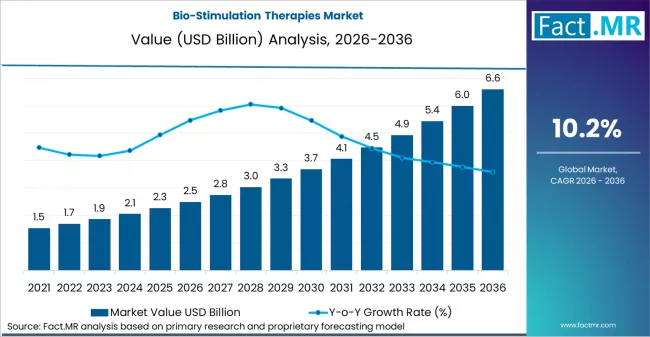
    Bio Stimulation Therapies Market Market Value Analysis

    This shift toward regenerative aesthetics was clearly articulated by John Maltman, “Allergan Aesthetics is driving the future of aesthetic medicine through a focus on scientifically driven innovation... we’re unveiling breakthrough new research that addresses patient concerns and offers health care providers new insight to on-market and emerging treatment options across neurotoxin, biostimulatory and HA filler modalities." His remarks reflect broader market alignment around treatments that enhance skin quality, firmness, and biological resilience rather than producing an overfilled appearance. Growth is further supported by the integration of bio stimulators such as PLLA and CaHA into multimodal protocols, where injectable are combined with energy based devices to amplify collagen synthesis, improve tissue tightening, and deliver more natural and durable aesthetic results.

    Bio-Stimulation Therapies Market

    Metric Value
    Estimated Value in (2026E) USD 2.5 billion
    Forecast Value in (2036F) USD 6.7 billion
    Forecast CAGR (2026 to 2036) 10.2 %

    Category 

    Category Segments
    Therapy Type PLLA-based collagen stimulators, CaHA-based biostimulators, PCL-based stimulators, PMMA/collagen fillers (biostim), Energy-based collagen induction (RF/US), Autologous biostimulation (PRP/biologic kits)
    Aesthetic Use Facial volume restoration, Skin laxity tightening, Acne scar remodelingBody contouring & cellulite, Post-procedure regeneration
    End User Dermatology clinics, Plastic surgery centers, Med-spas / aesthetic chainsHospitals & ambulatory centers, Independent injectors
    Region North America; Europe; Asia Pacific; Latin America; Middle East & Africa

    Segmental Analysis

    How are regenerative outcomes positioning collagen stimulators as the leading modality in the Bio-Stimulation Therapies Market?
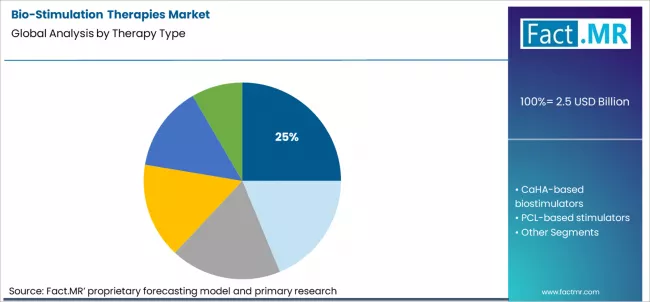
    Bio Stimulation Therapies Market Analysis By Therapy Type

    PLLA-based collagen stimulators lead the bio-stimulation therapies market with a 25.0% share, reflecting strong clinical preference for injectables that drive neocollagenesis rather than immediate volume. These modalities work by stimulating the body’s natural collagen production, resulting in gradual improvements in skin firmness, elasticity, and structural integrity. This regenerative mechanism aligns with growing patient demand for natural looking, long lasting outcomes and avoidance of overfilled appearances. Their predictable safety profiles, durability, and compatibility with multiple aesthetic indications have positioned collagen stimulators as the foundation of modern regenerative treatment plans, particularly in facial volume restoration and skin laxity correction.

    Why does facial volume restoration remain the leading application in the Bio-Stimulation Therapies Market?
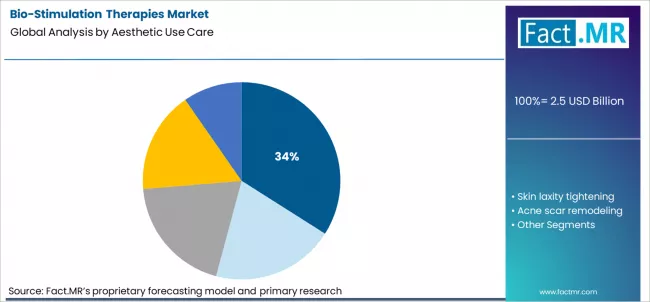
    Bio Stimulation Therapies Market Analysis By Aesthetic Use Care

    Facial volume restoration accounts for 34% of total demand, making it the leading application for bio-stimulation therapies. This dominance reflects sustained clinical need to address age related volume loss while preserving natural facial movement and proportion. Bio-stimulators such as PLLA and CaHA are increasingly preferred over traditional fillers because they restore structural support through gradual collagen induction rather than immediate bulk. This approach delivers longer lasting correction, improved skin quality, and reduced risk of overfilling, aligning well with patient preference for subtle, regenerative facial rejuvenation.

    Market Dynamics

    • Drivers: A primary driver of the bio-stimulation therapies market is the global shift toward regenerative aesthetics. Patients are increasingly prioritizing long term skin health, collagen restoration, and natural aging outcomes over short lived volumization. Advances in biomaterial science have improved the predictability and safety of collagen stimulators, encouraging wider physician adoption. In addition, rising demand for minimally invasive procedures with gradual, subtle results supports sustained utilization of bio-stimulating injectable across facial and body indications.
    • Restraints: Market growth is moderated by the need for high clinical expertise and patient education. Bio-stimulation outcomes are gradual and technique sensitive, requiring experienced injectors and clear expectation setting. Treatment costs are also higher compared to traditional fillers, which may limit accessibility in price sensitive markets. Regulatory scrutiny around injectable materials and biologics further adds complexity to product approvals and geographic expansion.
    • Trend 1: Regenerative First Treatment Planning Clinicians are increasingly restructuring aesthetic protocols to prioritize collagen induction before any volumetric correction. Instead of using fillers as the primary intervention, bio-stimulation therapies such as PLLA and CaHA are now employed to restore dermal density, elasticity, and structural support at a biological level. Once tissue quality improves, limited contour refinement may be applied if necessary. This approach delivers more natural outcomes, reduces the risk of overfilling, and aligns with patient demand for subtle, long lasting rejuvenation.
    • Trend 2: Expansion Beyond Facial Aesthetics Bio-stimulation therapies are rapidly extending beyond facial indications into areas such as the neck, décolletage, arms, abdomen, and cellulite prone regions. Their ability to stimulate collagen makes them particularly effective for improving skin laxity, texture irregularities, and post procedure recovery. In addition, bio-stimulators are increasingly used following energy based treatments or surgical procedures to enhance tissue regeneration and healing. This expansion of clinical use cases is increasing treatment frequency per patient and elevating overall market value by positioning bio-stimulation as a full body regenerative solution.

    Analysis of the Bio-Stimulation Therapies Market by Key Country
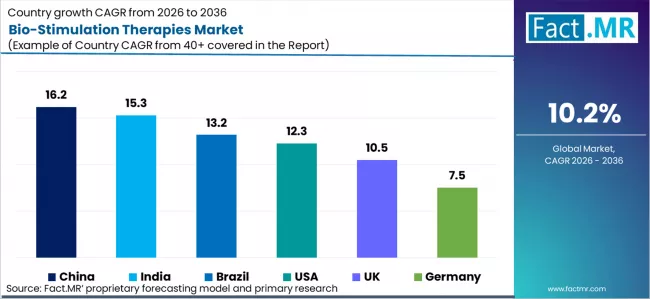
    Bio Stimulation Therapies Market Cagr Analysis By Country

    Country CAGR 2026 to 2036
    China 16.2%
    India 15.3%
    Brazil 13.2%
    USA 12.3%
    UK 10.5%
    Germany 7.5%

    Why is China becoming a skin-quality-focused bio-stimulation market?

    China is recording a strong CAGR of 16.2%, supported by regulatory clarity and product approvals under NMPA 2025-2026 frameworks. The approval and scaling of PCL-based Ellansé® and MaiLi® by Sinclair Pharma favor biostimulators with long degradation cycles and proven biocompatibility. As a result, Chinese practitioners emphasize collagen density, luminosity, and skin quality rather than aggressive volumization. This regulatory environment has accelerated adoption of injectables positioned around natural glow and gradual tissue regeneration in urban aesthetic clinics.

    How are regulatory reforms accelerating bio-stimulation adoption in India?

    India is growing at a CAGR of 15.3%, supported by regulatory formalization of biostimulant standards under Schedule VI. The removal of more than 9,300 provisional products in 2025 has consolidated the market around certified, high-purity biostimulatory inputs. This has significantly improved clinician confidence and patient trust in localized regenerative therapies. As a result, India is seeing steady uptake of collagen-inducing treatments in dermatology clinics, particularly among younger patients seeking early intervention and long-term skin health rather than corrective aesthetics.

    Why is Brazil emerging as the fastest-growing hub for bio-stimulation therapies worldwide?

    Brazil leads the bio-stimulation therapies market with a CAGR of 13.2%, making it the fastest-growing country globally. Growth is culturally and clinically driven by the country’s strong preference for body contouring and skin-firming procedures, particularly in gluteal and thigh regions. Manufacturers such as Merz Aesthetics and Natura & Co. are investing in bio-foundry hubs and regenerative kits tailored for high-volume applications. This has positioned Brazil as a proving ground for hyper-volume biostimulation protocols used in cellulite remodeling and large-area tightening, accelerating both procedural frequency and average treatment value.

    How is the United States shaping precision-driven growth in bio-stimulation therapies?

    The United States is expanding at a CAGR of 12.3%, driven by rapid adoption of hybrid injectable technologies. AbbVie through Allergan Aesthetics has expanded HarmonyCa™ alongside dual-modality physician training programs. Demand is centered on precision rejuvenation, where immediate HA lift is combined with long-term CaHA biostimulation. Clinicians increasingly use these products to refine jawlines and chin contours without excessive bulk, reinforcing a shift toward structurally precise, minimally invasive regenerative outcomes.

    Why is the UK shifting toward premium certified bio-stimulation products?

    The UK bio-stimulation therapies market is expanding at a CAGR of 10.5%, largely influenced by regulatory tightening under the EU MDR framework effective in 2026. Galderma’s MDR certification for Sculptra® body indications has set a benchmark for safety and manufacturing rigor. Clinics are increasingly prioritizing premium, MDR-certified injectables that guarantee long-term biological safety and zero impurity standards, positioning bio-stimulation as a high-trust, physician-led aesthetic category.

    How is Germany institutionalizing bio-stimulation as a body-tightening solution?

    Germany is advancing at a CAGR of 7.5%, with growth rooted in clinical protocol adoption rather than consumer trends. Merz Aesthetics’ launch of Radiesse® (+) with lidocaine for body indications has accelerated use of hyper-dilute CaHA protocols. German clinicians increasingly treat large surface areas such as the neck, décolletage, and upper arms, positioning biostimulators as direct competitors to energy-based tightening devices within regulated medical aesthetics settings.

    Competitive Landscape Evolution of the Bio-Stimulation Therapies Market
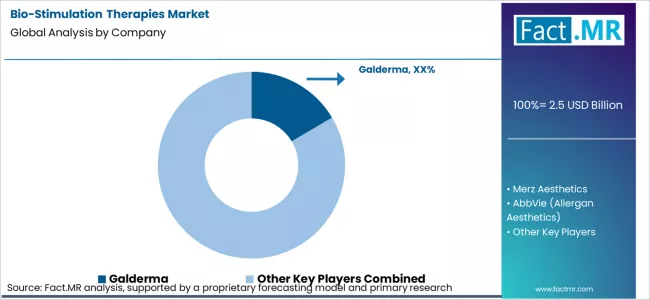
    Bio Stimulation Therapies Market Analysis By Company

    Competition in the bio-stimulation therapies market has transitioned from adjunct aesthetic use to a clinically anchored, regeneration-first strategy. In 2024, bio-stimulators were largely positioned as secondary options within injectable portfolios, often used to complement hyaluronic acid fillers or reserved for select patients seeking gradual results. Most clinics continued to prioritize immediate volumization, with bio-stimulation viewed as a long-term alternative rather than a core treatment. Investment during this phase focused on physician education and limited indication expansion, while clinical messaging emphasized durability rather than biological restoration.

    In 2025, competitive dynamics shifted meaningfully. Leading manufacturers began repositioning bio-stimulators as foundational aesthetic therapies, supported by growing clinical evidence around neocollagenesis, tissue remodeling, and skin quality improvement. Companies expanded indications beyond facial volume to include skin laxity, body contouring, and post-procedure regeneration. Product strategies increasingly centered on treatment protocols rather than standalone injections, enabling predictable, natural outcomes over extended periods. This repositioning elevated bio-stimulation from a supplementary role to a primary driver of aesthetic correction.

    External forces have further accelerated this evolution. Heightened patient awareness of overfilling risks, combined with demand for natural looking results, has reshaped practitioner preferences. At the same time, regulatory emphasis on safety, traceability, and long-term outcomes has favored well-established bio-stimulators with strong clinical validation. As a result, competition is now defined less by immediate visual impact and more by biological efficacy, treatment integration, and long-term patient outcomes.

    Recent Development

    • In January 2026, Galderma secured EU Medical Device Regulation (MDR) certification for Sculptra® for use on the body. New approved indications include the gluteal area, posterior thighs, décolletage, and upper arms, specifically to improve skin firmness and cellulite appearance.
    • In 2025, Merz announced new FDA-cleared indications for its Ultherapy PRIME platform to treat skin laxity on the arms and abdomen, reinforcing the trend of "energy-based biostimulation" for the body.

    Key Players in Bio-Stimulation Therapies Market

    • Galderma
    • Merz Aesthetics
    • AbbVie (Allergan Aesthetics)
    • Sinclair
    • Suneva Medical

    Scope of Report

    Items Values
    Quantitative Units (2026) USD 2.5 Billion
    Product Type Exfoliating, Hydrating, and Brightening
    Therapy Type PLLA-based collagen stimulators, CaHA-based biostimulators, PCL-based stimulators, PMMA/collagen fillers (biostim), Energy-based collagen induction (RF/US), Autologous biostimulation (PRP/biologic kits)
    Aesthetic Use Facial volume restoration, Skin laxity tightening, Acne scar remodelingBody contouring & cellulite, Post-procedure regeneration
    End User Dermatology clinics, Plastic surgery centers, Med-spas / aesthetic chainsHospitals & ambulatory centers, Independent injectors
    Regions Covered North America, Europe, Asia Pacific, Latin America, Middle East & Africa
    Countries Covered U.S., Canada, Germany, Italy, UK, France, Japan, Australia, and other countries
    Key Companies Profiled Galderma, Merz Aesthetics, AbbVie through Allergan Aesthetics, Sinclair, and Suneva Medical
    Additional Attributes Dollar revenue in the bio-stimulation therapies market is segmented by therapy or technology type, aesthetic use case, end user, treatment protocol, price tier, and region. Regional demand patterns are shaped by rising adoption of regenerative aesthetic procedures, increasing emphasis on collagen induction and tissue quality restoration, growing integration of injectable biostimulators with energy based devices, and premiumization of minimally invasive aesthetic treatments.

    Bio-Stimulation Therapies Market by segment

    • Aesthetic Use Care :

      • Facial volume restoration
      • Skin laxity tightening
      • Acne scar remodeling
      • Body contouring & cellulite
      • Post-procedure regeneration
    • End User :

      • Dermatology clinics
      • Plastic surgery centers
      • Med-spas / aesthetic chains
      • Hospitals & ambulatory centers
      • Independent injectors
    • Therapy Type :

      • PLLA-based collagen stimulators
      • CaHA-based biostimulators
      • PCL-based stimulators
      • PMMA/collagen fillers (biostim)
      • Energy-based collagen induction (RF/US)
      • Autologous biostimulation (PRP/biologic kits)
    • Region :

      • Asia Pacific
        • Japan
        • South Korea
        • China
        • Australia
        • New Zealand
        • Rest of Asia Pacific
      • North America
        • United States
        • Canada
        • Mexico
      • Europe
        • France
        • Italy
        • Spain
        • Norway
        • UK
        • Rest of Europe
      • Latin America
        • Chile
        • Peru
        • Argentina
        • Rest of Latin America

    Bibliography

    • European Commission. 2022. Medical devices regulation and injectable product safety requirements applicable to aesthetic and regenerative therapies. Brussels: European Union.
    • International Organization for Standardization (ISO). 2023. Medical aesthetics and minimally invasive procedures: Safety, risk management, and quality standards for injectable biostimulation therapies. ISO Technical Report. Geneva: ISO.
    • International Society of Aesthetic Plastic Surgery (ISAPS). 2024. Global trends in regenerative aesthetics and collagen stimulation procedures. ISAPS Annual Scientific Report.
    • Journal of Cosmetic Dermatology. 2024. Collagen biostimulators and neocollagenesis: Clinical efficacy, safety, and long term outcomes. Journal of Cosmetic Dermatology 23(4): 1105-1120.
    • Mintel Group Ltd. 2025. Global aesthetic medicine trends: Regenerative treatments, minimally invasive procedures, and premiumization dynamics. London: Mintel.
    • Personal Care Products Council. 2023. Injectable aesthetics and biologic skin rejuvenation: Market evolution and consumer demand patterns. Washington, DC: PCPC.

    Table of Content

    1. Executive Summary
      • Global Market Outlook
      • Demand to side Trends
      • Supply to side Trends
      • Technology Roadmap Analysis
      • Analysis and Recommendations
    2. Market Overview
      • Market Coverage / Taxonomy
      • Market Definition / Scope / Limitations
    3. Research Methodology
      • Market Structure, Signals, and Trend Drivers
      • Benchmarking and Cross-market Comparability
      • Market Sizing, Forecasting, and Opportunity Mapping
    4. Research Design and Evidence Framework
      • Desk Research Programme (Secondary Evidence)
        • Company Annual and Sustainability Reports
        • Peer-reviewed Journals and Academic Literature
        • Corporate Websites, Product Literature, and Technical Notes
        • Earnings Decks and Investor Briefings
        • Statutory Filings and Regulatory Disclosures
        • Technical White Papers and Standards Notes
        • Trade Journals, Industry Magazines, and Analyst Briefs
        • Sector Databases and Reference Repositories
        • FMR Internal Proprietary Databases and Historical Market Datasets
        • Subscription Datasets and Paid Sources
        • Social Channels, Communities, and Digital Listening Inputs
        • Additional Desk Sources
      • Expert Input and Fieldwork (Primary Evidence)
        • Primary Modes
          • Qualitative Interviews and Expert Elicitation
          • Quantitative Surveys and Structured Data Capture
          • Blended Approach
        • Why Primary Evidence is Used
        • Field Techniques
          • Interviews
          • Surveys
          • Focus Groups
          • Observational and In-context Research
          • Social and Community Interactions
        • Stakeholder Universe Engaged
          • C-suite Leaders
          • Board Members
          • Presidents and Vice Presidents
          • R&D and Innovation Heads
          • Technical Specialists
          • Domain Subject-matter Experts
          • Scientists
          • Physicians and Other Healthcare Professionals
        • Governance, Ethics, and Data Stewardship
          • Research Ethics
          • Data Integrity and Handling
      • Tooling, Models, and Reference Databases
    5. Data Engineering and Model Build
      • Data Acquisition and Ingestion
      • Cleaning, Normalisation, and Verification
      • Synthesis, Triangulation, and Analysis
    6. Quality Assurance and Audit Trail
    7. Market Background
      • Market Dynamics
        • Drivers
        • Restraints
        • Opportunity
        • Trends
      • Scenario Forecast
        • Demand in Optimistic Scenario
        • Demand in Likely Scenario
        • Demand in Conservative Scenario
      • Opportunity Map Analysis
      • Product Life Cycle Analysis
      • Supply Chain Analysis
      • Investment Feasibility Matrix
      • Value Chain Analysis
      • PESTLE and Porter’s Analysis
      • Regulatory Landscape
      • Regional Parent Market Outlook
      • Production and Consumption Statistics
      • Import and Export Statistics
    8. Global Market Analysis 2021 to 2025 and Forecast, 2026 to 2036
      • Historical Market Size Value (USD Million) Analysis, 2021 to 2025
      • Current and Future Market Size Value (USD Million) Projections, 2026 to 2036
        • Y to o to Y Growth Trend Analysis
        • Absolute $ Opportunity Analysis
    9. Global Market Pricing Analysis 2021 to 2025 and Forecast 2026 to 2036
    10. Global Market Analysis 2021 to 2025 and Forecast 2026 to 2036, By Therapy Type
      • Introduction / Key Findings
      • Historical Market Size Value (USD Million) Analysis By Therapy Type, 2021 to 2025
      • Current and Future Market Size Value (USD Million) Analysis and Forecast By Therapy Type, 2026 to 2036
        • PLLA-based collagen stimulators
        • CaHA-based biostimulators
        • PCL-based stimulators
        • PMMA/collagen fillers (biostim)
        • Energy-based collagen induction (RF/US)
        • Autologous biostimulation (PRP/biologic kits)
      • Y to o to Y Growth Trend Analysis By Therapy Type, 2021 to 2025
      • Absolute $ Opportunity Analysis By Therapy Type, 2026 to 2036
    11. Global Market Analysis 2021 to 2025 and Forecast 2026 to 2036, By Aesthetic Use Care
      • Introduction / Key Findings
      • Historical Market Size Value (USD Million) Analysis By Aesthetic Use Care, 2021 to 2025
      • Current and Future Market Size Value (USD Million) Analysis and Forecast By Aesthetic Use Care, 2026 to 2036
        • Facial volume restoration
        • Skin laxity tightening
        • Acne scar remodeling
        • Body contouring & cellulite
        • Post-procedure regeneration
      • Y to o to Y Growth Trend Analysis By Aesthetic Use Care, 2021 to 2025
      • Absolute $ Opportunity Analysis By Aesthetic Use Care, 2026 to 2036
    12. Global Market Analysis 2021 to 2025 and Forecast 2026 to 2036, By End User
      • Introduction / Key Findings
      • Historical Market Size Value (USD Million) Analysis By End User, 2021 to 2025
      • Current and Future Market Size Value (USD Million) Analysis and Forecast By End User, 2026 to 2036
        • Dermatology clinics
        • Plastic surgery centers
        • Med-spas / aesthetic chains
        • Hospitals & ambulatory centers
        • Independent injectors
      • Y to o to Y Growth Trend Analysis By End User, 2021 to 2025
      • Absolute $ Opportunity Analysis By End User, 2026 to 2036
    13. Global Market Analysis 2021 to 2025 and Forecast 2026 to 2036, By Region
      • Introduction
      • Historical Market Size Value (USD Million) Analysis By Region, 2021 to 2025
      • Current Market Size Value (USD Million) Analysis and Forecast By Region, 2026 to 2036
        • North America
        • Latin America
        • Western Europe
        • Eastern Europe
        • East Asia
        • South Asia and Pacific
        • Middle East & Africa
      • Market Attractiveness Analysis By Region
    14. North America Market Analysis 2021 to 2025 and Forecast 2026 to 2036, By Country
      • Historical Market Size Value (USD Million) Trend Analysis By Market Taxonomy, 2021 to 2025
      • Market Size Value (USD Million) Forecast By Market Taxonomy, 2026 to 2036
        • By Country
          • USA
          • Canada
          • Mexico
        • By Therapy Type
        • By Aesthetic Use Care
        • By End User
      • Market Attractiveness Analysis
        • By Country
        • By Therapy Type
        • By Aesthetic Use Care
        • By End User
      • Key Takeaways
    15. Latin America Market Analysis 2021 to 2025 and Forecast 2026 to 2036, By Country
      • Historical Market Size Value (USD Million) Trend Analysis By Market Taxonomy, 2021 to 2025
      • Market Size Value (USD Million) Forecast By Market Taxonomy, 2026 to 2036
        • By Country
          • Brazil
          • Chile
          • Rest of Latin America
        • By Therapy Type
        • By Aesthetic Use Care
        • By End User
      • Market Attractiveness Analysis
        • By Country
        • By Therapy Type
        • By Aesthetic Use Care
        • By End User
      • Key Takeaways
    16. Western Europe Market Analysis 2021 to 2025 and Forecast 2026 to 2036, By Country
      • Historical Market Size Value (USD Million) Trend Analysis By Market Taxonomy, 2021 to 2025
      • Market Size Value (USD Million) Forecast By Market Taxonomy, 2026 to 2036
        • By Country
          • Germany
          • UK
          • Italy
          • Spain
          • France
          • Nordic
          • BENELUX
          • Rest of Western Europe
        • By Therapy Type
        • By Aesthetic Use Care
        • By End User
      • Market Attractiveness Analysis
        • By Country
        • By Therapy Type
        • By Aesthetic Use Care
        • By End User
      • Key Takeaways
    17. Eastern Europe Market Analysis 2021 to 2025 and Forecast 2026 to 2036, By Country
      • Historical Market Size Value (USD Million) Trend Analysis By Market Taxonomy, 2021 to 2025
      • Market Size Value (USD Million) Forecast By Market Taxonomy, 2026 to 2036
        • By Country
          • Russia
          • Poland
          • Hungary
          • Balkan & Baltic
          • Rest of Eastern Europe
        • By Therapy Type
        • By Aesthetic Use Care
        • By End User
      • Market Attractiveness Analysis
        • By Country
        • By Therapy Type
        • By Aesthetic Use Care
        • By End User
      • Key Takeaways
    18. East Asia Market Analysis 2021 to 2025 and Forecast 2026 to 2036, By Country
      • Historical Market Size Value (USD Million) Trend Analysis By Market Taxonomy, 2021 to 2025
      • Market Size Value (USD Million) Forecast By Market Taxonomy, 2026 to 2036
        • By Country
          • China
          • Japan
          • South Korea
        • By Therapy Type
        • By Aesthetic Use Care
        • By End User
      • Market Attractiveness Analysis
        • By Country
        • By Therapy Type
        • By Aesthetic Use Care
        • By End User
      • Key Takeaways
    19. South Asia and Pacific Market Analysis 2021 to 2025 and Forecast 2026 to 2036, By Country
      • Historical Market Size Value (USD Million) Trend Analysis By Market Taxonomy, 2021 to 2025
      • Market Size Value (USD Million) Forecast By Market Taxonomy, 2026 to 2036
        • By Country
          • India
          • ASEAN
          • Australia & New Zealand
          • Rest of South Asia and Pacific
        • By Therapy Type
        • By Aesthetic Use Care
        • By End User
      • Market Attractiveness Analysis
        • By Country
        • By Therapy Type
        • By Aesthetic Use Care
        • By End User
      • Key Takeaways
    20. Middle East & Africa Market Analysis 2021 to 2025 and Forecast 2026 to 2036, By Country
      • Historical Market Size Value (USD Million) Trend Analysis By Market Taxonomy, 2021 to 2025
      • Market Size Value (USD Million) Forecast By Market Taxonomy, 2026 to 2036
        • By Country
          • Kingdom of Saudi Arabia
          • Other GCC Countries
          • Turkiye
          • South Africa
          • Other African Union
          • Rest of Middle East & Africa
        • By Therapy Type
        • By Aesthetic Use Care
        • By End User
      • Market Attractiveness Analysis
        • By Country
        • By Therapy Type
        • By Aesthetic Use Care
        • By End User
      • Key Takeaways
    21. Key Countries Market Analysis
      • USA
        • Pricing Analysis
        • Market Share Analysis, 2025
          • By Therapy Type
          • By Aesthetic Use Care
          • By End User
      • Canada
        • Pricing Analysis
        • Market Share Analysis, 2025
          • By Therapy Type
          • By Aesthetic Use Care
          • By End User
      • Mexico
        • Pricing Analysis
        • Market Share Analysis, 2025
          • By Therapy Type
          • By Aesthetic Use Care
          • By End User
      • Brazil
        • Pricing Analysis
        • Market Share Analysis, 2025
          • By Therapy Type
          • By Aesthetic Use Care
          • By End User
      • Chile
        • Pricing Analysis
        • Market Share Analysis, 2025
          • By Therapy Type
          • By Aesthetic Use Care
          • By End User
      • Germany
        • Pricing Analysis
        • Market Share Analysis, 2025
          • By Therapy Type
          • By Aesthetic Use Care
          • By End User
      • UK
        • Pricing Analysis
        • Market Share Analysis, 2025
          • By Therapy Type
          • By Aesthetic Use Care
          • By End User
      • Italy
        • Pricing Analysis
        • Market Share Analysis, 2025
          • By Therapy Type
          • By Aesthetic Use Care
          • By End User
      • Spain
        • Pricing Analysis
        • Market Share Analysis, 2025
          • By Therapy Type
          • By Aesthetic Use Care
          • By End User
      • France
        • Pricing Analysis
        • Market Share Analysis, 2025
          • By Therapy Type
          • By Aesthetic Use Care
          • By End User
      • India
        • Pricing Analysis
        • Market Share Analysis, 2025
          • By Therapy Type
          • By Aesthetic Use Care
          • By End User
      • ASEAN
        • Pricing Analysis
        • Market Share Analysis, 2025
          • By Therapy Type
          • By Aesthetic Use Care
          • By End User
      • Australia & New Zealand
        • Pricing Analysis
        • Market Share Analysis, 2025
          • By Therapy Type
          • By Aesthetic Use Care
          • By End User
      • China
        • Pricing Analysis
        • Market Share Analysis, 2025
          • By Therapy Type
          • By Aesthetic Use Care
          • By End User
      • Japan
        • Pricing Analysis
        • Market Share Analysis, 2025
          • By Therapy Type
          • By Aesthetic Use Care
          • By End User
      • South Korea
        • Pricing Analysis
        • Market Share Analysis, 2025
          • By Therapy Type
          • By Aesthetic Use Care
          • By End User
      • Russia
        • Pricing Analysis
        • Market Share Analysis, 2025
          • By Therapy Type
          • By Aesthetic Use Care
          • By End User
      • Poland
        • Pricing Analysis
        • Market Share Analysis, 2025
          • By Therapy Type
          • By Aesthetic Use Care
          • By End User
      • Hungary
        • Pricing Analysis
        • Market Share Analysis, 2025
          • By Therapy Type
          • By Aesthetic Use Care
          • By End User
      • Kingdom of Saudi Arabia
        • Pricing Analysis
        • Market Share Analysis, 2025
          • By Therapy Type
          • By Aesthetic Use Care
          • By End User
      • Turkiye
        • Pricing Analysis
        • Market Share Analysis, 2025
          • By Therapy Type
          • By Aesthetic Use Care
          • By End User
      • South Africa
        • Pricing Analysis
        • Market Share Analysis, 2025
          • By Therapy Type
          • By Aesthetic Use Care
          • By End User
    22. Market Structure Analysis
      • Competition Dashboard
      • Competition Benchmarking
      • Market Share Analysis of Top Players
        • By Regional
        • By Therapy Type
        • By Aesthetic Use Care
        • By End User
    23. Competition Analysis
      • Competition Deep Dive
        • Galderma
          • Overview
          • Product Portfolio
          • Profitability by Market Segments (Product/Age /Sales Channel/Region)
          • Sales Footprint
          • Strategy Overview
            • Marketing Strategy
            • Product Strategy
            • Channel Strategy
        • Merz Aesthetics
        • AbbVie (Allergan Aesthetics)
        • Sinclair
        • Suneva Medical
    24. Assumptions & Acronyms Used

    List Of Table

    • Table 1: Global Market Value (USD Million) Forecast by Region, 2021 to 2036
    • Table 2: Global Market Value (USD Million) Forecast by Therapy Type, 2021 to 2036
    • Table 3: Global Market Value (USD Million) Forecast by Aesthetic Use Care, 2021 to 2036
    • Table 4: Global Market Value (USD Million) Forecast by End User, 2021 to 2036
    • Table 5: North America Market Value (USD Million) Forecast by Country, 2021 to 2036
    • Table 6: North America Market Value (USD Million) Forecast by Therapy Type, 2021 to 2036
    • Table 7: North America Market Value (USD Million) Forecast by Aesthetic Use Care, 2021 to 2036
    • Table 8: North America Market Value (USD Million) Forecast by End User, 2021 to 2036
    • Table 9: Latin America Market Value (USD Million) Forecast by Country, 2021 to 2036
    • Table 10: Latin America Market Value (USD Million) Forecast by Therapy Type, 2021 to 2036
    • Table 11: Latin America Market Value (USD Million) Forecast by Aesthetic Use Care, 2021 to 2036
    • Table 12: Latin America Market Value (USD Million) Forecast by End User, 2021 to 2036
    • Table 13: Western Europe Market Value (USD Million) Forecast by Country, 2021 to 2036
    • Table 14: Western Europe Market Value (USD Million) Forecast by Therapy Type, 2021 to 2036
    • Table 15: Western Europe Market Value (USD Million) Forecast by Aesthetic Use Care, 2021 to 2036
    • Table 16: Western Europe Market Value (USD Million) Forecast by End User, 2021 to 2036
    • Table 17: Eastern Europe Market Value (USD Million) Forecast by Country, 2021 to 2036
    • Table 18: Eastern Europe Market Value (USD Million) Forecast by Therapy Type, 2021 to 2036
    • Table 19: Eastern Europe Market Value (USD Million) Forecast by Aesthetic Use Care, 2021 to 2036
    • Table 20: Eastern Europe Market Value (USD Million) Forecast by End User, 2021 to 2036
    • Table 21: East Asia Market Value (USD Million) Forecast by Country, 2021 to 2036
    • Table 22: East Asia Market Value (USD Million) Forecast by Therapy Type, 2021 to 2036
    • Table 23: East Asia Market Value (USD Million) Forecast by Aesthetic Use Care, 2021 to 2036
    • Table 24: East Asia Market Value (USD Million) Forecast by End User, 2021 to 2036
    • Table 25: South Asia and Pacific Market Value (USD Million) Forecast by Country, 2021 to 2036
    • Table 26: South Asia and Pacific Market Value (USD Million) Forecast by Therapy Type, 2021 to 2036
    • Table 27: South Asia and Pacific Market Value (USD Million) Forecast by Aesthetic Use Care, 2021 to 2036
    • Table 28: South Asia and Pacific Market Value (USD Million) Forecast by End User, 2021 to 2036
    • Table 29: Middle East & Africa Market Value (USD Million) Forecast by Country, 2021 to 2036
    • Table 30: Middle East & Africa Market Value (USD Million) Forecast by Therapy Type, 2021 to 2036
    • Table 31: Middle East & Africa Market Value (USD Million) Forecast by Aesthetic Use Care, 2021 to 2036
    • Table 32: Middle East & Africa Market Value (USD Million) Forecast by End User, 2021 to 2036

    List Of Figures

    • Figure 1: Global Market Pricing Analysis
    • Figure 2: Global Market Value (USD Million) Forecast 2021 to 2036
    • Figure 3: Global Market Value Share and BPS Analysis by Therapy Type, 2026 and 2036
    • Figure 4: Global Market Y to o to Y Growth Comparison by Therapy Type, 2026 to 2036
    • Figure 5: Global Market Attractiveness Analysis by Therapy Type
    • Figure 6: Global Market Value Share and BPS Analysis by Aesthetic Use Care, 2026 and 2036
    • Figure 7: Global Market Y to o to Y Growth Comparison by Aesthetic Use Care, 2026 to 2036
    • Figure 8: Global Market Attractiveness Analysis by Aesthetic Use Care
    • Figure 9: Global Market Value Share and BPS Analysis by End User, 2026 and 2036
    • Figure 10: Global Market Y to o to Y Growth Comparison by End User, 2026 to 2036
    • Figure 11: Global Market Attractiveness Analysis by End User
    • Figure 12: Global Market Value (USD Million) Share and BPS Analysis by Region, 2026 and 2036
    • Figure 13: Global Market Y to o to Y Growth Comparison by Region, 2026 to 2036
    • Figure 14: Global Market Attractiveness Analysis by Region
    • Figure 15: North America Market Incremental Dollar Opportunity, 2026 to 2036
    • Figure 16: Latin America Market Incremental Dollar Opportunity, 2026 to 2036
    • Figure 17: Western Europe Market Incremental Dollar Opportunity, 2026 to 2036
    • Figure 18: Eastern Europe Market Incremental Dollar Opportunity, 2026 to 2036
    • Figure 19: East Asia Market Incremental Dollar Opportunity, 2026 to 2036
    • Figure 20: South Asia and Pacific Market Incremental Dollar Opportunity, 2026 to 2036
    • Figure 21: Middle East & Africa Market Incremental Dollar Opportunity, 2026 to 2036
    • Figure 22: North America Market Value Share and BPS Analysis by Country, 2026 and 2036
    • Figure 23: North America Market Value Share and BPS Analysis by Therapy Type, 2026 and 2036
    • Figure 24: North America Market Y to o to Y Growth Comparison by Therapy Type, 2026 to 2036
    • Figure 25: North America Market Attractiveness Analysis by Therapy Type
    • Figure 26: North America Market Value Share and BPS Analysis by Aesthetic Use Care, 2026 and 2036
    • Figure 27: North America Market Y to o to Y Growth Comparison by Aesthetic Use Care, 2026 to 2036
    • Figure 28: North America Market Attractiveness Analysis by Aesthetic Use Care
    • Figure 29: North America Market Value Share and BPS Analysis by End User, 2026 and 2036
    • Figure 30: North America Market Y to o to Y Growth Comparison by End User, 2026 to 2036
    • Figure 31: North America Market Attractiveness Analysis by End User
    • Figure 32: Latin America Market Value Share and BPS Analysis by Country, 2026 and 2036
    • Figure 33: Latin America Market Value Share and BPS Analysis by Therapy Type, 2026 and 2036
    • Figure 34: Latin America Market Y to o to Y Growth Comparison by Therapy Type, 2026 to 2036
    • Figure 35: Latin America Market Attractiveness Analysis by Therapy Type
    • Figure 36: Latin America Market Value Share and BPS Analysis by Aesthetic Use Care, 2026 and 2036
    • Figure 37: Latin America Market Y to o to Y Growth Comparison by Aesthetic Use Care, 2026 to 2036
    • Figure 38: Latin America Market Attractiveness Analysis by Aesthetic Use Care
    • Figure 39: Latin America Market Value Share and BPS Analysis by End User, 2026 and 2036
    • Figure 40: Latin America Market Y to o to Y Growth Comparison by End User, 2026 to 2036
    • Figure 41: Latin America Market Attractiveness Analysis by End User
    • Figure 42: Western Europe Market Value Share and BPS Analysis by Country, 2026 and 2036
    • Figure 43: Western Europe Market Value Share and BPS Analysis by Therapy Type, 2026 and 2036
    • Figure 44: Western Europe Market Y to o to Y Growth Comparison by Therapy Type, 2026 to 2036
    • Figure 45: Western Europe Market Attractiveness Analysis by Therapy Type
    • Figure 46: Western Europe Market Value Share and BPS Analysis by Aesthetic Use Care, 2026 and 2036
    • Figure 47: Western Europe Market Y to o to Y Growth Comparison by Aesthetic Use Care, 2026 to 2036
    • Figure 48: Western Europe Market Attractiveness Analysis by Aesthetic Use Care
    • Figure 49: Western Europe Market Value Share and BPS Analysis by End User, 2026 and 2036
    • Figure 50: Western Europe Market Y to o to Y Growth Comparison by End User, 2026 to 2036
    • Figure 51: Western Europe Market Attractiveness Analysis by End User
    • Figure 52: Eastern Europe Market Value Share and BPS Analysis by Country, 2026 and 2036
    • Figure 53: Eastern Europe Market Value Share and BPS Analysis by Therapy Type, 2026 and 2036
    • Figure 54: Eastern Europe Market Y to o to Y Growth Comparison by Therapy Type, 2026 to 2036
    • Figure 55: Eastern Europe Market Attractiveness Analysis by Therapy Type
    • Figure 56: Eastern Europe Market Value Share and BPS Analysis by Aesthetic Use Care, 2026 and 2036
    • Figure 57: Eastern Europe Market Y to o to Y Growth Comparison by Aesthetic Use Care, 2026 to 2036
    • Figure 58: Eastern Europe Market Attractiveness Analysis by Aesthetic Use Care
    • Figure 59: Eastern Europe Market Value Share and BPS Analysis by End User, 2026 and 2036
    • Figure 60: Eastern Europe Market Y to o to Y Growth Comparison by End User, 2026 to 2036
    • Figure 61: Eastern Europe Market Attractiveness Analysis by End User
    • Figure 62: East Asia Market Value Share and BPS Analysis by Country, 2026 and 2036
    • Figure 63: East Asia Market Value Share and BPS Analysis by Therapy Type, 2026 and 2036
    • Figure 64: East Asia Market Y to o to Y Growth Comparison by Therapy Type, 2026 to 2036
    • Figure 65: East Asia Market Attractiveness Analysis by Therapy Type
    • Figure 66: East Asia Market Value Share and BPS Analysis by Aesthetic Use Care, 2026 and 2036
    • Figure 67: East Asia Market Y to o to Y Growth Comparison by Aesthetic Use Care, 2026 to 2036
    • Figure 68: East Asia Market Attractiveness Analysis by Aesthetic Use Care
    • Figure 69: East Asia Market Value Share and BPS Analysis by End User, 2026 and 2036
    • Figure 70: East Asia Market Y to o to Y Growth Comparison by End User, 2026 to 2036
    • Figure 71: East Asia Market Attractiveness Analysis by End User
    • Figure 72: South Asia and Pacific Market Value Share and BPS Analysis by Country, 2026 and 2036
    • Figure 73: South Asia and Pacific Market Value Share and BPS Analysis by Therapy Type, 2026 and 2036
    • Figure 74: South Asia and Pacific Market Y to o to Y Growth Comparison by Therapy Type, 2026 to 2036
    • Figure 75: South Asia and Pacific Market Attractiveness Analysis by Therapy Type
    • Figure 76: South Asia and Pacific Market Value Share and BPS Analysis by Aesthetic Use Care, 2026 and 2036
    • Figure 77: South Asia and Pacific Market Y to o to Y Growth Comparison by Aesthetic Use Care, 2026 to 2036
    • Figure 78: South Asia and Pacific Market Attractiveness Analysis by Aesthetic Use Care
    • Figure 79: South Asia and Pacific Market Value Share and BPS Analysis by End User, 2026 and 2036
    • Figure 80: South Asia and Pacific Market Y to o to Y Growth Comparison by End User, 2026 to 2036
    • Figure 81: South Asia and Pacific Market Attractiveness Analysis by End User
    • Figure 82: Middle East & Africa Market Value Share and BPS Analysis by Country, 2026 and 2036
    • Figure 83: Middle East & Africa Market Value Share and BPS Analysis by Therapy Type, 2026 and 2036
    • Figure 84: Middle East & Africa Market Y to o to Y Growth Comparison by Therapy Type, 2026 to 2036
    • Figure 85: Middle East & Africa Market Attractiveness Analysis by Therapy Type
    • Figure 86: Middle East & Africa Market Value Share and BPS Analysis by Aesthetic Use Care, 2026 and 2036
    • Figure 87: Middle East & Africa Market Y to o to Y Growth Comparison by Aesthetic Use Care, 2026 to 2036
    • Figure 88: Middle East & Africa Market Attractiveness Analysis by Aesthetic Use Care
    • Figure 89: Middle East & Africa Market Value Share and BPS Analysis by End User, 2026 and 2036
    • Figure 90: Middle East & Africa Market Y to o to Y Growth Comparison by End User, 2026 to 2036
    • Figure 91: Middle East & Africa Market Attractiveness Analysis by End User
    • Figure 92: Global Market - Tier Structure Analysis
    • Figure 93: Global Market - Company Share Analysis

    - Frequently Asked Questions -

    How big is the bio-stimulation therapies market in 2026?

    The global bio-stimulation therapies market is estimated to be valued at USD 2.5 billion in 2026.

    What will be the size of bio-stimulation therapies market in 2036?

    The market size for the bio-stimulation therapies market is projected to reach USD 6.6 billion by 2036.

    How much will be the bio-stimulation therapies market growth between 2026 and 2036?

    The bio-stimulation therapies market is expected to grow at a 10.2?GR between 2026 and 2036.

    What are the key product types in the bio-stimulation therapies market ?

    The key product types in bio-stimulation therapies market are plla-based collagen stimulators, caha-based biostimulators, pcl-based stimulators, pmma/collagen fillers (biostim), energy-based collagen induction (rf/us) and autologous biostimulation (prp/biologic kits).

    Which aesthetic use care segment to contribute significant share in the bio-stimulation therapies market in 2026?

    In terms of aesthetic use care, facial volume restoration segment to command 34.0% share in the bio-stimulation therapies market in 2026.

    Bio-Stimulation Therapies Market