- Market Value (2025): USD 2.23 Bn
- Estimated Value (2026): USD 2.39 Bn
- Forecast Value (2036): USD 4.83 Bn
- CAGR (2026-2036): 7.3%
What is the Medical Grade TPEs Market forecast to be worth by 2036?
USD 2.4 billion in 2026 to USD 4.8 billion by 2036 at a 7.3% CAGR.
- As per Fact.MR analysis, the Medical Grade TPEs Market was valued at USD 2.23 billion in 2025.
- Demand will grow from USD 2.39 billion in 2026 to USD 4.83 billion by 2036.
- The market is forecast to expand at a 7.3% CAGR from 2026 to 2036, supported by demand for flexible polymer materials in medical devices and healthcare applications.
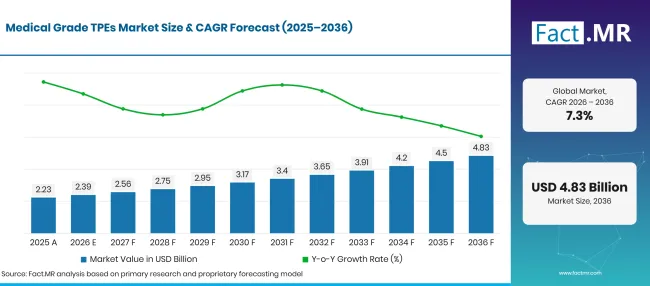
Medical Grade Tpes Market Forecast Global | Source: Fact.MR
| Year | Basis | Market Value (USD billion) |
|---|---|---|
| 2025 | Actual | 2.23 |
| 2026 | Estimate | 2.39 |
| 2036 | Forecast | 4.83 |
| CAGR 2026 to 2036 | Forecast period | 7.3% |
Source: Fact.MR analysis. Updated Nov 4, 2026
What are the defining numbers behind Medical Grade TPEs Market growth?
USD 2.4 billion absolute opportunity between 2026 and 2036
- Demand Drivers in the Market
- Medical device manufacturers require flexible polymer materials for components that need repeated handling, bending or contact with patients. Medical grade TPEs can offer rubber-like flexibility while retaining the processing advantages of thermoplastics.
- Demand for disposable and single-use medical products supports the need for materials that can be processed consistently and designed for specific device applications. Material selection depends on the intended use and required performance.
- Medical product developers assess biocompatibility and chemical compatibility when selecting materials for patient-contact applications. Suppliers that provide reliable technical documentation and application-specific grades can strengthen their position with device manufacturers.
- Key Segments Analyzed
- By Product Type: Thermoplastic Polyurethane (TPU) will account for 38.2% of the market in 2026, supported by its flexibility and abrasion resistance.
- By Application: Medical Devices will lead with a 42.6% share in 2026, reflecting the use of flexible polymer materials in medical equipment and components.
- By End-User: Hospitals are projected lead with 44.8% share in 2026, driven by demand for medical products and equipment used in patient care.
- Analyst Opinion at Fact.MR
- Shambhu Nath Jha, Principal Consultant at Fact.MR, states, “Medical grade TPE suppliers can strengthen their position by offering application-specific materials with consistent processing characteristics and appropriate biocompatibility documentation. Close collaboration with medical device manufacturers will remain important as product designs and material requirements evolve.”
- Strategic Implications
- Material suppliers should provide application-specific grades supported by relevant biocompatibility and regulatory documentation.
- Medical device manufacturers need to assess flexibility and durability alongside sterilization compatibility and chemical resistance.
- Polymer compounders must work with device developers during product design to address processing requirements and end-use performance.
- Hospitals and healthcare service teams can consider the material specifications and intended use of medical products when evaluating suppliers.
Germany is forecast to record an 8.3% CAGR through 2036. Brazil is set to post 7.6%, followed by the USA at 6.8%. The UK is estimated to advance at 6.1%, while Japan is forecast to grow at 5.4%.
How does the Medical Grade TPEs Market break down by segment?
Fact.MR finds that Thermoplastic Polyurethane leads Product Type with 38.2%; Medical Devices leads Application with 42.6%; and Hospitals leads End-User with 44.8%.
Which Product Type dominates?
Thermoplastic Polyurethane is set to hold 38.2% share in 2026.
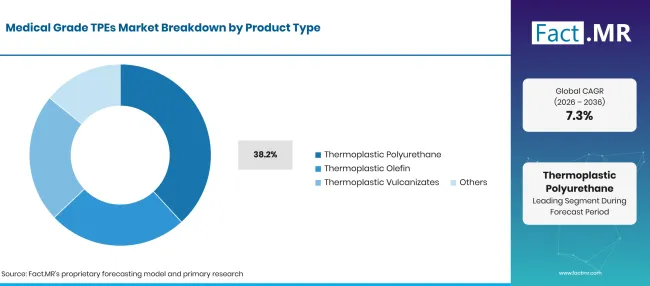
Medical Grade Tpes Market Breakdown Product Type | Source: Fact.MR
| Product Type | Share (2026) |
|---|---|
| Thermoplastic Polyurethane (Leading segment) | 38.2% |
| Other segments combined | 61.8%* |
| Total | 100.0% |
Source: Fact.MR analysis. Updated Nov 4, 2026
Thermoplastic Polyurethane is used in medical applications that require flexibility and resistance to wear. Its suitability depends on the intended device and the required material characteristics. Thermoplastic Olefins and Thermoplastic Vulcanizates provide alternative material options for applications with different softness and performance requirements. Buyers need to assess the specific grade rather than assume that all TPU or TPE products meet medical-use requirements.
Which Application leads demand?
Medical Devices is set to represent 42.6% share in 2026.
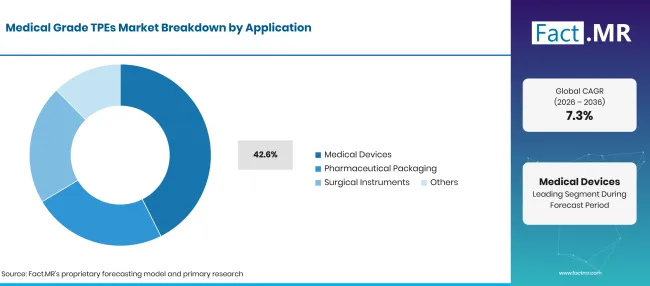
Medical Grade Tpes Market Breakdown Application | Source: Fact.MR
| Application | Share (2026) |
|---|---|
| Medical Devices (Leading segment) | 42.6% |
| Other segments combined | 57.4%* |
| Total | 100.0% |
Source: Fact.MR analysis. Updated Nov 4, 2026
Medical devices represent a broad application area for medical grade TPEs. Flexible tubing and device components can require materials with controlled softness and durability. Pharmaceutical packaging uses elastomeric materials in selected closures and flexible packaging components, while surgical instruments may use TPEs in grips and other flexible parts. Material suitability depends on contact conditions and the relevant regulatory requirements.
Which End-User segment leads?
Hospitals are projected to account for 44.8% share in 2026.
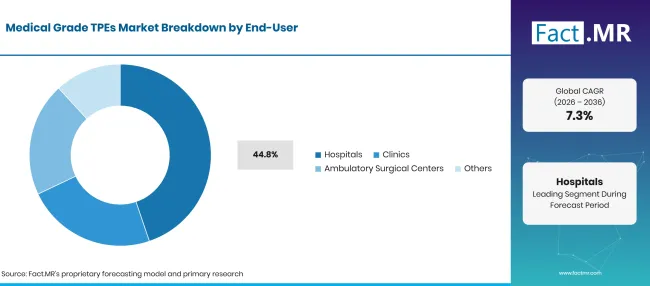
Medical Grade Tpes Market Breakdown End User | Source: Fact.MR
| End-User | Share (2026) |
|---|---|
| Hospitals (Leading segment) | 44.8% |
| Other segments combined | 55.2%* |
| Total | 100.0% |
Source: Fact.MR analysis. Updated Nov 4, 2026
Hospitals represent a major end-user segment because they purchase and use a wide range of medical devices and healthcare products. Clinics and ambulatory surgical centers also require equipment and consumables designed for regular patient care. Demand for medical grade TPEs is generally indirect, as polymer suppliers sell materials to compounders and medical product manufacturers rather than directly to healthcare facilities.
What is accelerating Medical Grade TPEs Market adoption, and what is holding it back?
Demand for flexible medical components and application-specific polymer grades supports growth, while qualification costs and regulatory requirements can slow material adoption.
Drivers Impact Analysis
| DRIVER | (~) % IMPACT ON CAGR | GEOGRAPHIC RELEVANCE | IMPACT TIMELINE |
|---|---|---|---|
| Demand for flexible medical device components | +1.0% | Global | Medium term (2–4 years) |
| Growth in single-use medical products | +0.8% | Global | Medium term (2–4 years) |
| Need for material alternatives to PVC and rubber | +0.7% | Europe, Americas, Asia | Long term (≥ 4 years) |
| Medical device manufacturing expansion | +0.6% | Global | Medium term (2–4 years) |
| Custom polymer compounding for device applications | +0.5% | Global | Short term (≤ 2 years) |
Source: Fact.MR analysis. Updated Nov 4, 2026
Opportunity Impact Analysis
| OPPORTUNITY | (~) % IMPACT ON CAGR | GEOGRAPHIC RELEVANCE | IMPACT TIMELINE |
|---|---|---|---|
| Development of application-specific medical TPE grades | +0.8% | Global | Medium term (2–4 years) |
| Flexible tubing and fluid-management applications | +0.7% | Global | Medium term (2–4 years) |
| Medical-grade compounds with verified biocompatibility | +0.6% | Europe, North America | Short term (≤ 2 years) |
| Local medical device manufacturing expansion | +0.5% | Asia, Latin America | Long term (≥ 4 years) |
| Materials designed for improved processing and bonding | +0.4% | Global | Medium term (2–4 years) |
Source: Fact.MR analysis. Updated Nov 4, 2026
Restraints Impact Analysis
| RESTRAINT | (~) % IMPACT ON CAGR | GEOGRAPHIC RELEVANCE | IMPACT TIMELINE |
|---|---|---|---|
| Cost of medical-grade material qualification | -0.8% | Global | Short term (≤ 2 years) |
| Regulatory and biocompatibility testing requirements | -0.7% | Global | Medium term (2–4 years) |
| Compatibility with sterilization processes | -0.6% | Global | Medium term (2–4 years) |
| Long qualification cycles with medical device manufacturers | -0.5% | Global | Long term (≥ 4 years) |
| Competition from silicone, PVC and other polymers | -0.4% | Global | Medium term (2–4 years) |
Source: Fact.MR analysis. Updated Nov 4, 2026
Which countries are scaling the Medical Grade TPEs Market through 2036?
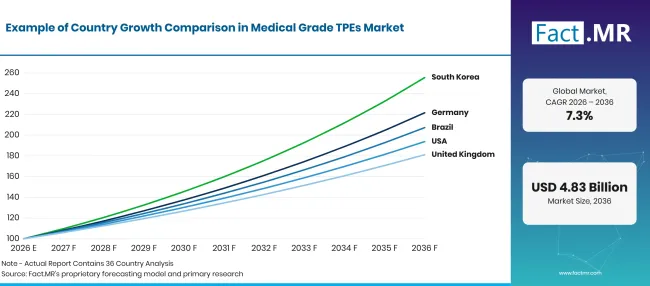
Medical Grade Tpes Market Growth Index | Source: Fact.MR
| Country | CAGR (2026–2036) |
|---|---|
| Germany | 8.3% |
| Brazil | 7.6% |
| USA | 6.8% |
| UK | 6.1% |
| Japan | 5.4% |
Source: Fact.MR analysis. Updated Nov 4, 2026
What supports Germany adoption?
8.3% CAGR, supported by a large medical technology manufacturing base and demand for specialized polymer materials.
Germany's established medical technology industry creates opportunities for suppliers of materials used in medical devices and components. Germany Trade & Invest reported that the country's medical technology production value reached EUR 46 billion in 2024, with more than 265,000 people employed in the sector. This manufacturing base supports demand for materials that meet specific flexibility and performance requirements. TPE suppliers need to provide reliable technical documentation and grades suited to medical device applications. [1]
How is Brazil developing Medical Grade TPEs adoption?
7.6% CAGR, driven by efforts to strengthen domestic healthcare manufacturing and improve access to medical products.
Brazil is working to expand domestic production across its healthcare industrial supply chain. In March 2026, the Ministry of Development, Industry, Trade and Services outlined a national target to achieve 50% autonomy in domestic production of health-related goods by 2026, with a longer-term target of 70% by 2033. The policy includes medical devices among its priority areas [2]
What supports United States adoption?
6.8% CAGR, led by a broad medical device manufacturing and regulatory ecosystem.
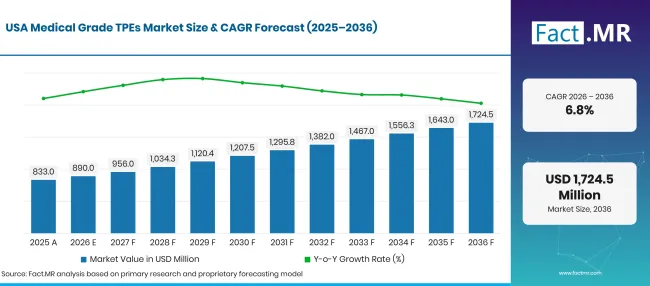
Medical Grade Tpes Market Forecast Usa | Source: Fact.MR
The United States has an extensive base of medical device establishments and a large market for healthcare products. The U.S. Food and Drug Administration reported 29,178 medical device establishments registered during fiscal year 2025, including domestic and foreign establishments. This reflects the scale of the regulated device supply chain and creates opportunities for suppliers of specialized materials. Medical grade TPE producers need to support device manufacturers with material documentation and application-specific testing. [3]
How is the United Kingdom building adoption?
6.1% CAGR, shaped by a sizeable medical technology industry and demand for healthcare products.
The UK's medical technology sector provides an established customer base for suppliers of polymers used in medical products. The Office for Life Sciences reported that the UK medical technology subsector generated approximately £44.6 billion in turnover in 2023/24 in its 2024/25 statistical release. Medical device manufacturers require materials that meet product-specific performance and regulatory requirements [4]
What supports Japan adoption?
5.4% CAGR, backed by a substantial medical device market and established domestic production.
Japan's medical device industry creates demand for specialized polymer materials used in healthcare equipment and consumables. The Ministry of Health, Labour and Welfare reported that domestic medical device production reached approximately JPY 2.66 trillion in 2024, while domestic shipments were approximately JPY 4.72 trillion [5]
Who leads the Medical Grade TPEs Market?
Fact.MR identifies Kraton Corporation, BASF SE, Covestro AG, Teknor Apex Company, RTP Company, Avient Corporation, Kuraray Co., Ltd., Mitsubishi Chemical Corporation, Arkema S.A. and HEXPOL TPE as companies to assess in the competitive landscape.
Competition is shaped by material formulation and the ability to meet medical application requirements. Kraton supplies styrenic block copolymers for medical compounds, including materials used in medical patches and syringe components. Kuraray offers medical grade TPEs for applications such as tubing and IV bags [6] [7]. RTP Company provides medical grade TPE compounds tested against ISO 10993 biocompatibility standards [8].
Mitsubishi Chemical's ZELAS portfolio includes TPE materials for medical tubing and infusion bags. HEXPOL TPE markets its Mediprene range for medical applications [10]. Covestro offers medical-grade TPU and other healthcare materials, with a portfolio that includes products supported by biocompatibility and regulatory documentation. [11]
Which companies are the key providers?
The company set for the Medical Grade TPEs Market includes:
- Kraton Corporation
- BASF SE
- Covestro AG
- Teknor Apex Company
- RTP Company
- Avient Corporation
- Kuraray Co., Ltd.
- Mitsubishi Chemical Corporation
- Arkema S.A.
- HEXPOL TPE
Bibliography
- [1] Germany Trade & Invest. (2025, September). The medical technology industry in Germany: Issue 2025/2026. GTAI
- Official source
- [2] Ministry of Development, Industry, Trade and Services, Brazil. (2026, March 13). Revisão e implementação de instrumentos para fortalecimento produtivo e tecnológico do Complexo Econômico e Industrial da Saúde (CEIS). Serviços e Informações do Brasil
- Official source
- [3] U.S. Food and Drug Administration. (2026). FY 2025 annual report on inspections of establishments. U.S. Food and Drug Administration
- Official source
- [4] Office for Life Sciences. (2026, September 17). Bioscience and health technology sector statistics 2024 to 2025: User guide. GOV.UK. GOV.UK
- Official source
- [5] Ministry of Health, Labour and Welfare, Japan. (2025, December 24). 令和6年 薬事工業生産動態統計年報の公表について [Publication of the 2024 annual report on pharmaceutical and medical device production statistics]. 厚生労働省
- Official source
- [6] Kraton Corporation. (n.d.). Medical solutions with ERS polymers and SBC polymers. kraton.com
- Official source
- [7] Kuraray Co., Ltd. (n.d.). Medical grade TPEs.
- Official source
- [8] RTP Company. (n.d.). Thermoplastic elastomers for medical devices. RTP Company
- Official source
- [9] Mitsubishi Chemical Corporation. (n.d.). Thermoplastic elastomers designed for medical applications: ZELAS™. 三菱ケミカル株式会社
- Official source
- [10] HEXPOL TPE. (n.d.). Soft + safe TPE materials for medical applications. Hexpol
- Official source
- [11] Covestro. (2025, August). Healthcare reference guide. Covestro AG
- Official source
This Report Answers
- The report describes how medical grade TPE materials are used across medical devices and other healthcare applications.
- Product analysis compares TPU, TPO, TPV and other thermoplastic elastomer categories.
- Application analysis examines medical devices and pharmaceutical packaging alongside surgical instruments.
- End-user analysis compares demand across hospitals, clinics and ambulatory surgical centers.
- Country analysis discusses Germany, Brazil, the USA, the UK and Japan.
- The competitive overview profiles the ten companies for this market.
What does the Medical Grade TPEs Market cover?
The market covers thermoplastic elastomer materials specifically formulated or qualified for medical and healthcare applications. These materials provide flexibility and elastic performance while retaining thermoplastic processing characteristics. The analysis includes material types such as TPU, TPO and TPV, along with their use in medical devices and selected healthcare-related applications.
What is included in the scope?
The scope includes medical grade TPE materials for medical device components and other defined healthcare applications.
It covers materials used in flexible tubing and device components, as well as selected pharmaceutical packaging and surgical instrument applications. Products must be intended or qualified for the relevant medical application rather than simply being general-purpose TPE grades.
What is excluded from the scope?
The analysis excludes general-purpose TPEs without a defined medical application or relevant medical-grade qualification.
It also excludes silicone, PVC and other polymer materials unless they are part of a specific TPE compound included in the market definition. Finished medical devices and equipment are excluded from the material market's revenue boundary, as are pharmaceutical products and unrelated industrial elastomer applications.
How Was the Analysis Built?
The analysis draws on 120+ sources, 35+ company portfolios, 25+ countries and more than 20 industry interviews.
- Primary Research: Primary research includes discussions with polymer manufacturers, compounders, medical device developers, distributors, healthcare specialists and subject-matter experts. These discussions examine material selection, qualification requirements, processing performance, regulatory considerations and purchasing priorities.
- Desk Research: Desk research covers government statistics, regulatory publications, company product portfolios, technical datasheets, industry reports, trade data and medical technology publications. Sources used in the analysis are documented in the bibliography.
- Market Sizing and Forecasting: Market estimates combine historical performance, material demand, pricing and volume trends, application shares, end-user demand, company participation and country-level growth indicators.
- Data Validation and Update Cycle: Findings are validated by comparing primary interviews with public information, company product updates, regulatory developments and changes in medical device manufacturing. Regular updates review new material grades, production capabilities, partnerships and customer qualification activity.
Segmentation
What is the report’s scope and coverage?
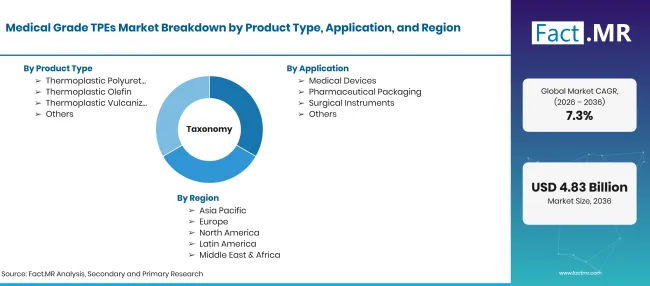
Medical Grade Tpes Market Taxonomy | Source: Fact.MR
| Attribute | Details |
|---|---|
| Quantitative Units | USD billion in 2026 to USD billion by 2036, at CAGR |
| Market Definition | The Medical Grade TPEs Market comprises thermoplastic elastomer materials specifically formulated or qualified for use in medical and healthcare applications. These materials combine rubber-like flexibility and elasticity with the processing advantages of thermoplastics. They are used in medical devices and components, surgical instruments and selected pharmaceutical packaging applications. |
| Product Type | Thermoplastic Polyurethane; Thermoplastic Olefin; Thermoplastic Vulcanizates; Others |
| Application | Medical Devices; Pharmaceutical Packaging; Surgical Instruments; Others |
| End-User | Hospitals; Clinics; Ambulatory Surgical Centers; Others |
| Regions Covered | North America; Latin America; Western Europe; Eastern Europe; East Asia; South Asia & Pacific; Middle East & Africa |
| Countries Covered | Germany; Brazil; USA; UK; Japan |
| Companies Profiled | Kraton Corporation; BASF SE; Covestro AG; Teknor Apex Company; RTP Company; Avient Corporation; Kuraray Co., Ltd.; Mitsubishi Chemical Corporation; Arkema S.A.; HEXPOL TPE |
| Forecast Period | 2026 to 2036 |
| Approach | Market segmentation and scenario-based analysis supported by industry research, company portfolios and official medical technology statistics |
Source: Fact.MR analysis. Updated Nov 4, 2026
How is the market segmented?
-
By Product Type
- Thermoplastic Polyurethane
- Thermoplastic Olefin
- Thermoplastic Vulcanizates
- Others
-
By Application
- Medical Devices
- Pharmaceutical Packaging
- Surgical Instruments
- Others
-
By End-User
- Hospitals
- Clinics
- Ambulatory Surgical Centers
- Others
-
By Region
- North America
- Latin America
- Western Europe
- Eastern Europe
- East Asia
- South Asia & Pacific
- Middle East & Africa
Frequently Asked Questions
How big is the Medical Grade TPEs Market in 2026?
What is the CAGR from 2026 to 2036?
Which product type has the largest share?
Which application leads the market?
Which end-user segment has the largest share?
Which companies are covered?
Who worked on this report


Preview the report firsthand - request a free sample
Free SampleGet the brochure for pricing and purchase details
Download PDF