- Market Value (2025): USD 76.2 Bn
- Estimated Value (2026): USD 82.5 Bn
- Forecast Value (2036): USD 181.4 Bn
- CAGR (2026-2036): 8.2%
What is the Type 2 Diabetes Market forecast to be worth by 2036?
USD 82.5 billion in 2026 to USD 181.4 billion by 2036 at an 8.2% CAGR.
- As per Fact.MR analysis, the Type 2 diabetes market was valued at USD 76.2 billion in 2025.
- Demand is projected to increase from USD 82.5 billion in 2026 to USD 181.4 billion by 2036.
- The forecast represents an 8.2% CAGR from 2026 to 2036, supported by the need for long-term glucose management and wider use of advanced therapies and monitoring technologies.
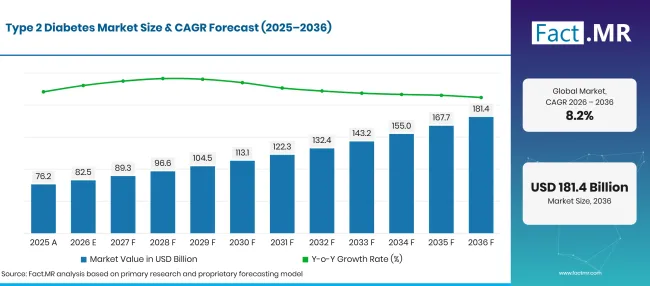
Type 2 Diabetes Market Forecast Global | Source: Fact.MR
| Year | Basis | Market Value (USD billion) |
|---|---|---|
| 2025 | Actual | 76.2 |
| 2026 | Estimate | 82.5 |
| 2036 | Forecast | 181.4 |
| CAGR 2026 to 2036 | Forecast period | 8.2% |
Source: Fact.MR analysis. Updated Nov 4, 2026
What are the defining numbers behind Type 2 Diabetes Market growth?
USD 98.9 billion absolute opportunity between 2026 and 2036.
- Demand Drivers in the Market
- The rising need for long-term blood glucose management is supporting demand for medicines used to control Type 2 diabetes. Patients may require changes in treatment as their condition progresses, creating demand across insulin and non-insulin drug classes.
- Wider use of GLP-1 receptor agonists and SGLT2 inhibitors is expanding treatment options beyond conventional glucose-lowering medicines. These therapies can offer additional clinical benefits for eligible patients, influencing prescribing decisions and treatment selection.
- Regular glucose monitoring is an important part of diabetes management. Blood glucose monitoring devices help patients and healthcare professionals assess glucose patterns and make informed treatment decisions.
- Increasing focus on treatment adherence and patient convenience is supporting demand for insulin delivery devices and accessible distribution channels. Easier access to medicines and monitoring products can help patients maintain prescribed treatment routines.
- Key Segments Analyzed
- By Drug Class: Insulin will account for 38.2% of the market in 2026, driven by continued role in glucose management among patients who require insulin therapy.
- By Device Type: Blood Glucose Monitoring Devices will represent 54.6% share in 2026, supported by the need for regular glucose tracking and treatment management.
- By Distribution Channel: Retail Pharmacies hold 44.7% share in 2026, reflecting their role in providing ongoing access to prescription medicines and diabetes-care products.
- Analyst Opinion at Fact.MR
- Shambhu Nath Jha, Principal Consultant at Fact.MR, states, “The Type 2 diabetes market is evolving as treatment decisions increasingly consider long-term glucose control and patient-specific care needs. Providers need to balance therapeutic effectiveness with affordability, treatment adherence and access to monitoring devices. Companies that support a broader diabetes-care pathway can strengthen their position across this market.”
- Strategic Implications
- Pharmaceutical companies should strengthen their portfolios across established glucose-lowering therapies and newer treatment options while addressing patient affordability.
- Device manufacturers need to focus on accurate monitoring, ease of use and compatibility with digital diabetes-management platforms.
- Healthcare providers can consider patient-specific treatment requirements when selecting medicines and monitoring technologies.
- Distribution partners must maintain reliable access to prescription therapies and essential diabetes-care devices across retail and hospital settings.
Germany is set to record a 10.3% CAGR through 2036. Brazil is projected to post 8.4%, followed by the UK at 9.3%. The USA is estimated to advance at 6.9%, while Japan is forecast to grow at 6.2%.
How does the Type 2 Diabetes Market break down by segment?
Fact.MR finds that Insulin leads Drug Class at 38.2%; Blood Glucose Monitoring Devices Lead Device Type at 54.6%; and Retail Pharmacies lead Distribution Channel at 44.7%.
Which Drug Class dominates?
Insulin is set to hold 38.2% share in 2026.
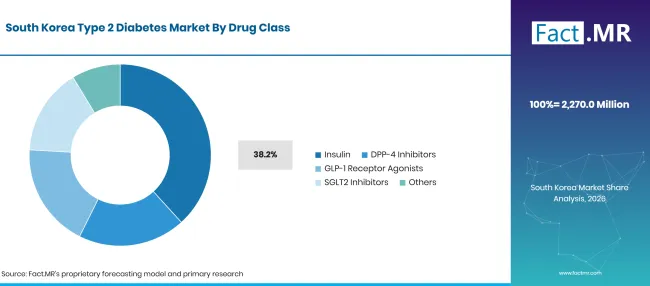
Type 2 Diabetes Market South Korea By Drug Class | Source: Fact.MR
| Drug Class | Share (2026) |
|---|---|
| Insulin (Leading segment) | 38.2% |
| Other segments combined | 61.8%* |
| Total | 100.0% |
Source: Fact.MR analysis. Updated Nov 4, 2026
Insulin remains an important treatment option for people with Type 2 diabetes who require additional glucose control beyond other therapies. Treatment selection depends on disease progression, glucose levels and individual clinical needs. DPP-4 inhibitors, GLP-1 receptor agonists and SGLT2 inhibitors provide non-insulin treatment options. Other drug classes also contribute to the treatment landscape.
Which Device Type leads?
Blood Glucose Monitoring Devices are set to represent 54.6% share in 2026.
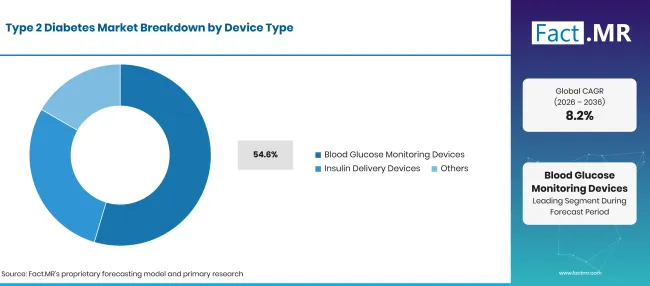
Type 2 Diabetes Market Breakdown Device Type | Source: Fact.MR
| Device Type | Share (2026) |
|---|---|
| Blood Glucose Monitoring Devices (Leading segment) | 54.6% |
| Other segments combined | 45.4%* |
| Total | 100.0% |
Source: Fact.MR analysis. Updated Nov 4, 2026
Blood glucose monitoring devices help patients track glucose levels and understand how meals, physical activity and medicines affect their readings. These products support day-to-day diabetes management and can help healthcare professionals review treatment progress. Insulin delivery devices serve patients who require insulin and include products designed to support accurate and convenient administration.
Which Distribution Channel dominates?
Retail Pharmacies are set to account for 44.7% share in 2026.
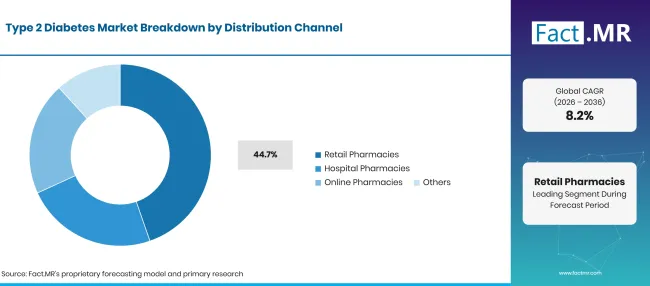
Type 2 Diabetes Market Breakdown Distribution Channel | Source: Fact.MR
| Distribution Channel | Share (2026) |
|---|---|
| Retail Pharmacies (Leading segment) | 44.7% |
| Other segments combined | 55.3%* |
| Total | 100.0% |
Source: Fact.MR analysis. Updated Nov 4, 2026
Retail pharmacies provide patients with access to prescribed diabetes medicines and essential monitoring supplies. Their role is particularly relevant for ongoing treatment, repeat prescriptions and routine purchases. Hospital pharmacies support access to medicines during inpatient care and specialist consultations. Online pharmacies offer another route for prescription fulfilment and home delivery, subject to local regulations.
What is accelerating Type 2 Diabetes Market adoption, and what is holding it back?
Growing demand for long-term glucose management and wider access to newer therapies support market expansion, while treatment costs, access disparities and adherence challenges can restrain growth.
Drivers Impact Analysis
| DRIVER | (~) % IMPACT ON CAGR | GEOGRAPHIC RELEVANCE | IMPACT TIMELINE |
|---|---|---|---|
| Rising need for long-term glucose management | +1.1% | Global | Short term (≤2 years) |
| Adoption of GLP-1 receptor agonists and SGLT2 inhibitors | +0.9% | North America, Europe | Medium term (2–4 years) |
| Growing use of blood glucose monitoring devices | +0.8% | Global | Short term (≤2 years) |
| Wider access to diabetes medicines through retail pharmacies | +0.6% | Asia, Americas | Medium term (2–4 years) |
| Increasing use of connected diabetes-care technologies | +0.5% | North America, Europe, Asia | Long term (≥4 years) |
Source: Fact.MR analysis. Updated Nov 4, 2026
Opportunity Impact Analysis
| OPPORTUNITY | (~) % IMPACT ON CAGR | GEOGRAPHIC RELEVANCE | IMPACT TIMELINE |
|---|---|---|---|
| Expansion of continuous and connected glucose monitoring | +0.9% | North America, Europe | Medium term (2–4 years) |
| Development of patient-friendly combination therapies | +0.7% | Global | Medium term (2–4 years) |
| Wider access to diabetes care in emerging economies | +0.6% | Asia, Latin America | Long term (≥4 years) |
| Integration of monitoring devices with digital health platforms | +0.5% | Global | Long term (≥4 years) |
| Improved affordability and availability of established therapies | +0.4% | Asia, Latin America, Africa | Medium term (2–4 years) |
Source: Fact.MR analysis. Updated Nov 4, 2026
Restraints Impact Analysis
| RESTRAINT | (~) % IMPACT ON CAGR | GEOGRAPHIC RELEVANCE | IMPACT TIMELINE |
|---|---|---|---|
| High costs of newer diabetes therapies | -0.9% | Global | Short term (≤2 years) |
| Unequal access to diagnosis and ongoing treatment | -0.7% | Asia, Africa, Latin America | Medium term (2–4 years) |
| Treatment adherence challenges and therapy discontinuation | -0.6% | Global | Medium term (2–4 years) |
| Reimbursement and insurance coverage limitations | -0.5% | Global | Short term (≤2 years) |
| Device affordability and usability barriers | -0.4% | Emerging economies | Medium term (2–4 years) |
Source: Fact.MR analysis. Updated Nov 4, 2026
Which countries are scaling the Type 2 Diabetes Market through 2036?
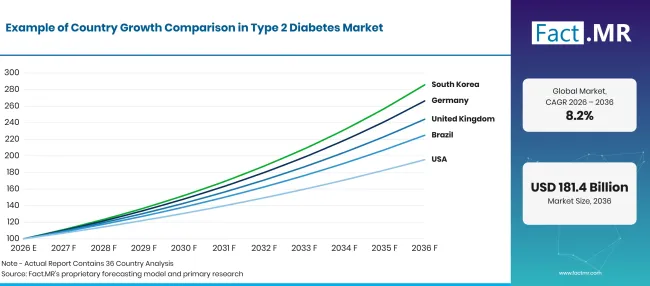
Type 2 Diabetes Market Growth Index | Source: Fact.MR
| Country | CAGR (2026–2036) |
|---|---|
| Germany | 10.3% |
| Brazil | 8.4% |
| USA | 6.9% |
| UK | 9.3% |
| Japan | 6.2% |
Source: Fact.MR analysis. Updated Nov 4, 2026
What supports Germany adoption?
10.3% CAGR, supported by demand for advanced diabetes therapies and structured healthcare access.
Germany's market is supported by access to prescription medicines and established diabetes-care services. Demand spans insulin and non-insulin therapies, alongside glucose monitoring devices used for routine disease management. Wider use of newer treatment options and continued attention to diabetes complications can support market expansion. Manufacturers need to address reimbursement requirements and demonstrate the clinical value of their therapies. Germany’s Robert Koch Institute (RKI), in information updated on 13 July 2026, reported that 10.3% of adults aged 18 years and above (approximately 7 million people) had been diagnosed with diabetes. More than 90% of diabetes cases in Germany are attributed to Type 2 diabetes. [1]
How is Brazil developing Type 2 diabetes adoption?
8.4% CAGR, driven by the need to improve access to diabetes treatment and monitoring.
Brazil's large patient base creates demand for accessible medicines and monitoring products across public and private healthcare settings. Retail pharmacies play an important role in ongoing treatment access, while hospital pharmacies support specialist care. Brazil's Ministry of Health reported on 28 January 2026 that the proportion of adults with diabetes increased from 5.5% in 2006 to 12.9% in 2024, representing a 135% increase. The figures refer to self-reported medical diagnoses among adults in Brazil’s state capitals and the Federal District, according to Vigitel Brasil 2006–2024. [2] [6][2][2]
What supports United States adoption?
6.9% CAGR, led by advanced treatment options and wider use of diabetes monitoring technologies.
The United States has an established market for insulin and non-insulin therapies, including GLP-1 receptor agonists and SGLT2 inhibitors. Blood glucose monitoring devices also support routine diabetes management. The US Centers for Disease Control and Prevention (CDC) updated its National Diabetes Statistics Report on 16 September 2026. It estimated that 40.1 million people had diagnosed or undiagnosed diabetes in 2023, representing 12.0% of the population. Of these, 29.1 million had diagnosed diabetes and 11.0 million adults with diabetes remained undiagnosed. [3]
How is the United Kingdom building adoption?
9.3% CAGR, shaped by structured diabetes management and demand for effective long-term treatment.
The UK market benefits from organised diabetes-care pathways and access to prescription therapies through established healthcare channels. Medicines remain central to glucose management, while monitoring devices support treatment review and patient self-management. The government's April 2026 diabetes profile reported that more than 152,000 adults aged 19 to 39 in England had diagnosed Type 2 diabetes as of March 2024. It also reported that 58.2% of people with Type 2 and other diabetes received eight recommended care processes in the financial year ending March 2025. These findings highlight the importance of regular monitoring and treatment management. Manufacturers need to consider clinical guidance and cost-effectiveness when introducing new therapies. [4]
What supports Japan adoption?
6.2% CAGR, backed by an ageing population and demand for continued diabetes management.
Japan's market is shaped by the need for long-term management of Type 2 diabetes and related health risks. Prescription medicines and glucose monitoring devices support routine treatment across healthcare settings. Japan's Ministry of Health, Labour and Welfare (MHLW) published the results of its 2024 National Health and Nutrition Survey on 2 December 2025. The survey estimated that approximately 11 million people were strongly suspected of having diabetes, while around 7 million could not be ruled out as potentially having diabetes. [5]
Who leads the Type 2 Diabetes Market?
Fact.MR profiles Novo Nordisk A/S, Sanofi, Eli Lilly and Company, Merck & Co., Inc. and AstraZeneca plc alongside Boehringer Ingelheim, Johnson & Johnson across the diabetes therapeutics and care landscape.
Novo Nordisk participates in the market through its insulin portfolio and GLP-1-based diabetes therapies. Sanofi has an established presence in insulin treatment, while Eli Lilly offers insulin products and newer incretin-based therapies for Type 2 diabetes. Merck participates through its DPP-4 inhibitor portfolio, including sitagliptin-based treatments.
AstraZeneca and Boehringer Ingelheim have a strong position in SGLT2 inhibitor therapies. Their diabetes portfolios include dapagliflozin- and empagliflozin-based treatments, respectively. These medicines are used in the management of Type 2 diabetes and have additional clinical considerations that influence prescribing.
Which companies are the key providers?
Key companies profiled include Novo Nordisk A/S; Sanofi; Eli Lilly and Company; Merck & Co., Inc.; AstraZeneca plc; Boehringer Ingelheim; and Johnson & Johnson.
- Novo Nordisk A/S
- Sanofi
- Eli Lilly and Company
- Merck & Co., Inc.
- AstraZeneca plc
- Boehringer Ingelheim
- Johnson & Johnson
Bibliography
- [1] Robert Koch Institute. (2026, July 13). Diabetes mellitus.
- [2] Agência Gov. (2026, January 28). Diabetes, hipertensão e obesidade: Saúde investe R$ 340 milhões para estimular prevenção
- [3] Centers for Disease Control and Prevention. (2026, September 16). National Diabetes Statistics Report.
- [4] Office for Health Improvement and Disparities. (2026, April 8). Diabetes profile: Statistical commentary, April 2026
- [5] Ministry of Health, Labour and Welfare. (2025, December 2).[Results of the 2024 National Health and Nutrition Survey].
- [6] Ministério da Saúde. (2026, July 7). Vigitel Brasil 2006–2024. https://www.gov.br/saude/pt-br/centrais-de-conteudo/publicacoes/svsa/vigitel/vigitel-brasil-2006-2024.pdf/view/
This Report Answers
- The report examines demand for medicines and medical devices used in Type 2 diabetes management.
- Drug class analysis compares insulin and non-insulin treatment categories.
- Device analysis evaluates blood glucose monitoring and insulin delivery solutions.
- Distribution channel analysis examines retail pharmacies, hospital pharmacies and online pharmacies.
- Country analysis discusses Germany, Brazil, the USA, the UK and Japan alongside diabetes-care requirements.
- The competitive overview profiles the eight companies included in the company set.
What does the Type 2 Diabetes Market cover?
The market covers medicines and medical devices used to manage Type 2 diabetes. Pharmaceutical coverage includes insulin and non-insulin drug classes such as DPP-4 inhibitors, GLP-1 receptor agonists and SGLT2 inhibitors. Device coverage includes blood glucose monitoring and insulin delivery products. The analysis also considers distribution through retail pharmacies, hospital pharmacies and online pharmacies.
What is included in the scope?
Included products comprise prescription medicines indicated for Type 2 diabetes management and medical devices used for glucose monitoring or insulin administration. The market also covers sales through the specified distribution channels. Product inclusion depends on its intended use and relevance to Type 2 diabetes care.
What is excluded from the scope?
The analysis excludes medicines intended exclusively for Type 1 diabetes or other unrelated conditions. General healthcare equipment without a direct diabetes-management function is outside the defined market. Products used exclusively for gestational diabetes are excluded unless they are also marketed and included for Type 2 diabetes management. General hospital services, diagnostic consultations and unrelated digital health platforms are also excluded.
How Was the Analysis Built?
The analysis draws on 120+ sources, 35+ company portfolios, 25+ countries and more than 20 industry interviews.
- Primary Research: Primary research includes discussions with pharmaceutical manufacturers, medical device companies, healthcare providers, distributors, pharmacies, patients' care stakeholders and subject-matter experts. These conversations examine treatment preferences, product adoption, purchasing priorities, reimbursement requirements and factors influencing market access.
- Desk Research: Desk research covers government health statistics, regulatory publications, clinical guidelines, company filings, product information, healthcare studies, industry associations and other authoritative sources. Sources used in the analysis should be documented in the bibliography.
- Market Sizing and Forecasting: Market estimates combine historical performance, treatment demand, pricing and volume trends, segment shares, company participation, country-level growth, adoption patterns and barriers to market expansion.
- Data Validation and Update Cycle: Findings are validated by comparing primary interviews with public data, company activity, regulatory developments, product approvals and changes in healthcare access. Regular updates review new product launches, clinical developments, partnerships and shifts in commercial adoption.
Segmentation
What is the report’s scope and coverage?
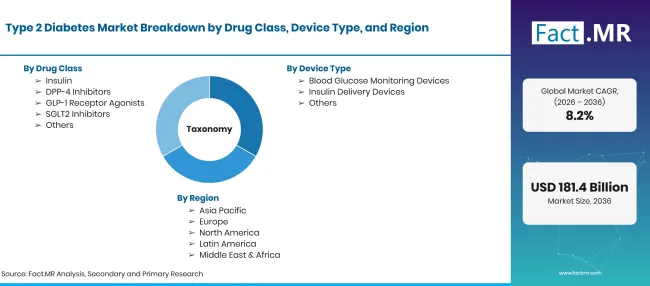
Type 2 Diabetes Market Taxonomy | Source: Fact.MR
| Attribute | Details |
|---|---|
| Quantitative Units | USD billion |
| Market Definition | The Type 2 diabetes market comprises pharmaceutical therapies and medical devices used to manage blood glucose levels and support the long-term treatment of Type 2 diabetes. The market includes insulin and non-insulin glucose-lowering medicines such as DPP-4 inhibitors, GLP-1 receptor agonists and SGLT2 inhibitors. |
| Drug Class | Insulin; DPP-4 Inhibitors; GLP-1 Receptor Agonists; SGLT2 Inhibitors; Others |
| Device Type | Blood Glucose Monitoring Devices; Insulin Delivery Devices; Others |
| Distribution Channel | Retail Pharmacies; Hospital Pharmacies; Online Pharmacies; Others |
| Regions Covered | North America; Latin America; Western Europe; Eastern Europe; East Asia; South Asia & Pacific; Middle East & Africa |
| Countries Covered | Germany; Brazil; USA; UK; Japan |
| Companies Profiled | Novo Nordisk A/S; Sanofi; Eli Lilly and Company; Merck & Co., Inc.; AstraZeneca plc; Boehringer Ingelheim; Johnson & Johnson |
| Forecast Period | 2026 to 2036 |
| Approach | Market segmentation and scenario-based analysis supported by diabetes treatment trends, healthcare indicators, company portfolios and medical device developments |
Source: Fact.MR analysis. Updated Nov 4, 2026
How is the market segmented?
-
By Drug Class
- Insulin
- DPP-4 Inhibitors
- GLP-1 Receptor Agonists
- SGLT2 Inhibitors
- Others
-
By Device Type
- Blood Glucose Monitoring Devices
- Insulin Delivery Devices
- Others
-
By Distribution Channel
- Retail Pharmacies
- Hospital Pharmacies
- Online Pharmacies
- Others
-
By Region
- North America
- Latin America
- Western Europe
- Eastern Europe
- East Asia
- South Asia & Pacific
- Middle East & Africa
Frequently Asked Questions
How big is the Type 2 Diabetes Market in 2026?
What is the CAGR from 2026 to 2036?
Which drug class has the largest share?
Which device type leads the market?
Which distribution channel has the largest share?
Which countries are covered?
Which companies are covered?
Who worked on this report


Preview the report firsthand - request a free sample
Free SampleGet the brochure for pricing and purchase details
Download PDF