- Base Value(2025): 81.3 Bn
- Estimated Value(2026): 87.0 Bn
- Forecast Value (2036): 169.5 Bn
- CAGR (2026 - 2036): 6.9%
Supply Chain Management BPO Market Forecast and Outlook By Fact.MR
In 2025, the supply chain management BPO market was valued at USD 81.3 billion. Based on Fact.MR analysis, demand for supply chain management BPO services is estimated to grow to USD 87.0 billion in 2026 and USD 169.5 billion by 2036. FACT.MR projects a CAGR of 6.9% during the forecast period.
FACT.MR projects that the supply chain management BPO market will add USD 82.5 billion in new revenue between 2026 and 2036. The expansion is driven by increasing outsourcing of logistics coordination, AI-based planning tools, and compliance management services. Adoption remains partially constrained by regulatory limits on data movement, enterprise concerns around data governance, and integration challenges with established ERP infrastructure. The supply chain management BPO market is expanding as enterprises seek cost-efficient and technology-enabled supply chain operations through specialist outsourcing partners.
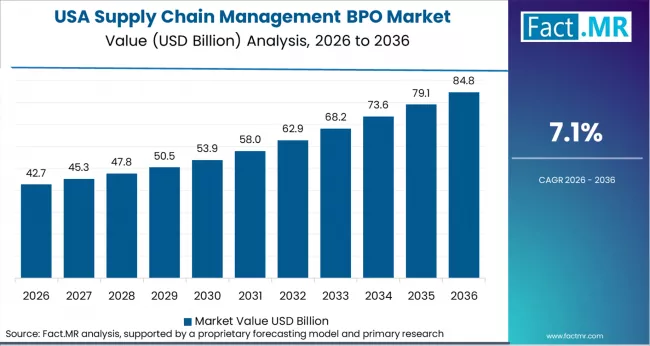
Country growth reflects enterprise outsourcing adoption, e-commerce expansion, and supply chain regulatory investment. China leads at 8.2% CAGR, driven by domestic e-commerce logistics outsourcing and cross-border trade compliance services. South Korea follows at 7.8% supported by chaebol supply chain digitalization programs. Japan records 7.5% through manufacturing sector BPO adoption and procurement outsourcing. Germany grows at 7.4% driven by automotive and industrial supply chain outsourcing. France advances at 7.2% through retail CPG inventory management BPO adoption. The United States posts 7.1% supported by healthcare logistics and last-mile delivery outsourcing. The United Kingdom grows at 6.8%, driven by post-Brexit trade compliance outsourcing demand.
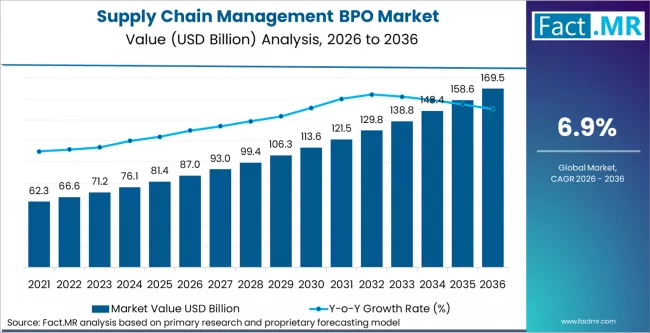
Supply Chain Management Bpo Market Market Value Analysis | Source: Fact.MR
| Metric | Value |
|---|---|
| Estimated Value in 2026 | USD 87.0 billion |
| Forecast Value in 2036 | USD 169.5 billion |
| Forecast CAGR (2026 to 2036) | 6.9% |
Source: Fact.MR analysis. Updated Mar 13, 2026
Market Definition
The supply chain management BPO market covers outsourced supply chain operations such as logistics coordination, inventory management, demand forecasting, vendor management, order fulfilment, and trade compliance handled by third-party providers.
Market Inclusions
Includes global and regional forecasts from 2026 to 2036 by outsourcing model, service type, application vertical, and enterprise size across retail, manufacturing, healthcare, energy, and telecom sectors.
Market Exclusions
Excludes in-house supply chain operations, standalone logistics services, and supply chain software sold without managed outsourcing services.
Research Methodology
- Primary Research: Interviews with procurement heads, logistics outsourcing buyers, retail operations managers, healthcare supply chain officers, and BPO contract managers.
- Desk Research: Sources include outsourcing contract databases, BPO company reports, WTO trade compliance studies, e-commerce logistics data, and pharmaceutical cold chain regulations.
- Market Sizing and Forecasting: Hybrid model using outsourcing contract values, vertical spending patterns, contract tenure analysis, and BPO provider revenue disclosures.
- Data Validation and Update Cycle: Forecasts validated using ISG outsourcing index data, provider financial reports, enterprise procurement surveys, and expert interviews.
Summary
- Market Definition
- Supply chain management BPO includes outsourced logistics coordination, inventory control, demand planning, vendor management, fulfilment, and trade compliance services delivered to enterprises.
- Demand Drivers
- Rapid e-commerce growth is increasing outsourcing of fulfilment coordination and inventory management.
- Manufacturers are outsourcing supplier monitoring and compliance management to strengthen supply chain resilience.
- Healthcare companies outsource cold chain logistics and regulatory compliance management.
- Key Segments Analyzed
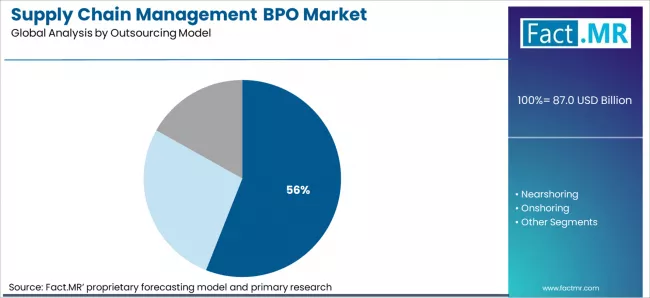
- By Outsourcing Model: Offshoring holds about 56% share in 2026 due to cost advantages in India, the Philippines, and Eastern Europe.
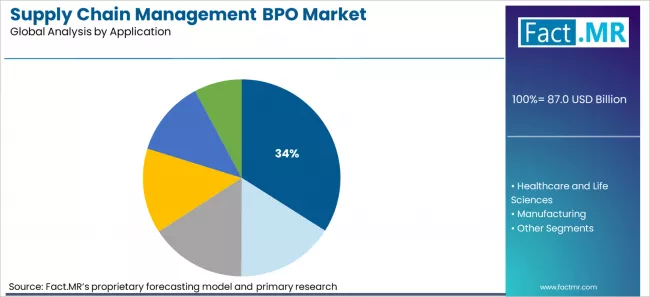
- By Application: Retail and CPG lead with 34% share in 2026 driven by e-commerce logistics outsourcing demand.
- By Service Type: Logistics management outsourcing holds the largest share due to complex global freight and delivery coordination.
- By Enterprise Size: Large enterprises lead due to complex global supply chains requiring specialized outsourcing support.
- Analyst Opinion at FACT.MR
- • Shambhu Nath Jha, Principal Consultant at Fact.MR, states that CXOs will gain the most value from AI-driven forecasting, nearshoring-based vendor risk management, and healthcare compliance outsourcing through 2036.
- Strategic Implications
- BPO firms should invest in AI-enabled forecasting and inventory optimisation platforms.
- Providers should expand nearshore centres in Eastern Europe and Mexico to support regional data compliance needs.
- Healthcare BPO providers should obtain GDP certification and DSCSA compliance to secure pharmaceutical contracts.
- Methodology
- Market sizing used outsourcing contract values and BPO revenue data validated with ISG outsourcing reports.
- E-commerce logistics data, cold chain regulations, and nearshoring investment trends supported demand analysis.
- Forecasts incorporated supply chain digitalisation trends, regulatory compliance spending, and interviews with enterprise buyers.
- and electronics manufacturers increasing outsourcing of tier-2 and tier-3 supplier management and procurement analytics. [10] make each point short, keep same format, remove dashes, kep numbers
Segmental Analysis
Supply Chain Management BPO Market Analysis by Outsourcing Model
Supply Chain Management Bpo Market Analysis By Outsourcing Model | Source: Fact.MR
Based on FACT.MR analysis, offshoring is projected to hold about 56% share in 2026 due to established delivery centres in India, the Philippines, and Eastern Europe offering skilled labour and mature outsourcing capabilities.
- TCS Supply Chain BPO Investment: Tata Consultancy Services expanded its Supply Chain Centre of Excellence in Chennai in November 2024 adding 2,500 specialists focused on AI logistics and demand forecasting services. [5]
- Genpact AI Platform Development: Genpact launched the Cora Supply Chain AI platform in September 2024 integrating demand sensing, supplier risk scoring, and automated inventory planning. [6]
- Nearshoring Adoption Trend: ISG Outsourcing Index Q3 2024 reported nearshoring contract growth of 22% year over year in North America driven by demand for regionally compliant supply chain outsourcing. [7]
Supply Chain Management BPO Market Analysis by Application
Supply Chain Management Bpo Market Analysis By Application | Source: Fact.MR
Based on FACT.MR analysis, Retail and CPG holds about 34% share in 2026 due to high outsourcing demand for inventory optimisation, omnichannel fulfilment, and last-mile delivery coordination.
- DHL Supply Chain Retail Investment: DHL Supply Chain announced a EUR 300 million investment in January 2025 for AI-enabled warehouse automation and outsourced inventory services across European retail networks. [8]
- Accenture Healthcare BPO Development: Accenture expanded its Life Sciences Supply Chain BPO platform in October 2024 adding DSCSA compliance tracking and EU medicines serialisation management tools. [9]
- Manufacturing BPO Adoption Trend: ISG Provider Lens 2024 reported manufacturing as the fastest growing sector for supply chain BPO with automotive and electronics companies outsourcing supplier management and procurement analytics. [10]
Drivers, Restraints, and Opportunities
FACT.MR analysts note that the supply chain management BPO market, valued at USD 81.3 billion in 2025, has evolved from a cost-saving tool into a strategic outsourcing capability as supply chain disruptions, regulatory complexity, and e-commerce expansion increase enterprise reliance on specialised providers.
The market is shifting as nearshoring and onshoring models expand alongside traditional offshore delivery. Data sovereignty rules and geopolitical disruptions are pushing enterprises to regionalise BPO operations. AI-driven forecasting and logistics automation are helping providers offset higher nearshore operating costs.
- DSCSA Pharmaceutical Compliance Mandate: The US Drug Supply Chain Security Act reached full enforcement in November 2024, requiring electronic drug traceability across the supply chain. Pharmaceutical companies are outsourcing serialisation data management and compliance monitoring to DSCSA-certified BPO providers. [2]
- EU Supply Chain Due Diligence Regulation: The EU Corporate Sustainability Due Diligence Directive adopted in May 2024 requires companies to conduct supplier risk monitoring for human rights and environmental compliance, creating demand for outsourced vendor risk management services. [3]
- China Cross-Border E-Commerce BPO Growth: China’s Ministry of Commerce expanded cross-border e-commerce pilot zones to 165 cities in 2024, increasing outsourcing demand for customs compliance, bonded warehouse operations, and global fulfilment coordination. [4]
Regional Analysis
The supply chain management BPO market is analysed across Asia Pacific, Europe, North America, Latin America, and Middle East and Africa, covering 40+ countries with distinct demand profiles shaped by e-commerce growth, regulatory compliance requirements, enterprise outsourcing maturity, and nearshoring versus offshoring model adoption. The full report offers market attractiveness analysis based on outsourcing contract pipelines, regulatory compliance investment timelines, and enterprise BPO adoption benchmarks.
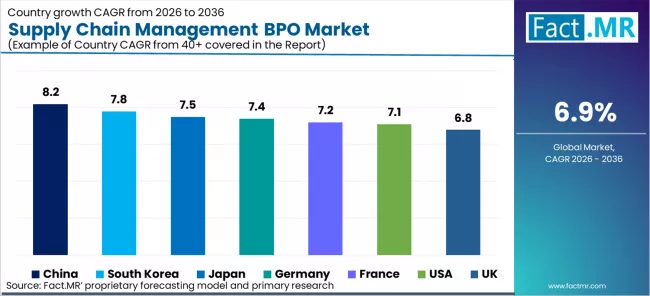
Supply Chain Management Bpo Market Cagr Analysis By Country | Source: Fact.MR
| Country | CAGR (2026-2036) |
|---|---|
| China | 8.2% |
| South Korea | 7.8% |
| Japan | 7.5% |
| Germany | 7.4% |
| France | 7.2% |
| United States | 7.1% |
| United Kingdom | 6.8% |
Source: Fact.MR analysis. Updated Mar 13, 2026
Source: Fact.MR analysis, based on proprietary forecasting model and primary research
Asia Pacific Supply Chain Management BPO Market Analysis
Asia Pacific remains the largest delivery base for supply chain management BPO, supported by large outsourcing hubs in India and the Philippines and expanding logistics outsourcing platforms in China. Regional providers support global retail, manufacturing, and e-commerce supply chains through technology-enabled process delivery.
- China: Cross-border e-commerce expansion is accelerating supply chain outsourcing demand in China with the market growing at 8.2% CAGR through 2036. The Ministry of Commerce expanded cross-border e-commerce pilot zones to 165 cities in 2024, increasing demand for customs compliance and bonded warehouse outsourcing. JD Logistics reported 31% revenue growth in third-party logistics management services in 2025 results. Alibaba’s Cainiao network processed 42 billion packages in FY2024 supporting outsourced fulfilment services across Asia and Europe.
- South Korea: Export-driven manufacturing supply chains are increasing outsourcing demand in South Korea where the market grows at 7.8% CAGR through 2036. Samsung Electronics increased third-party logistics and procurement outsourcing spending by 18% in 2024 as part of supply chain resilience initiatives. The Korea International Trade Association introduced updated ESG supplier monitoring guidance in October 2024 expanding vendor risk management outsourcing. LG Electronics disclosed procurement analytics outsourcing partnerships with Accenture and Capgemini.
- Japan: Supply chain digitalisation initiatives are strengthening BPO adoption in Japan with demand rising at 7.5% CAGR through 2036. The Ministry of Economy Trade and Industry released a supply chain resilience strategy in 2024 encouraging outsourcing of non-core logistics and procurement processes. Toyota confirmed outsourced demand forecasting and supplier management services through TCS Japan. Updated pharmaceutical cold chain compliance rules in 2024 increased outsourcing demand among healthcare companies.
FACT.MR’s analysis of the supply chain management BPO market in Asia Pacific consists of country wise assessment including China, Japan, South Korea, India, ASEAN, Australia and New Zealand, and Rest of South Asia and Pacific. Readers can find country CAGR forecasts, logistics outsourcing benchmarks, regulatory compliance investment trends, and enterprise BPO adoption insights.
Europe Supply Chain Management BPO Market Analysis
Europe represents a compliance-driven outsourcing market where regulatory frameworks and trade documentation complexity are accelerating adoption of specialist supply chain BPO services. Global providers such as Capgemini, Accenture, and DHL Supply Chain serve automotive, retail, and pharmaceutical industries across the region.
- Germany: Regulatory compliance requirements are driving BPO adoption in Germany where demand grows at 7.4% CAGR through 2036. The German Supply Chain Due Diligence Act requires companies with over 1,000 employees to conduct supplier monitoring and compliance reporting. BMW expanded outsourced ESG supplier management with Accenture covering more than 12,000 suppliers. BASF announced procurement analytics outsourcing contracts with Capgemini in 2024.
- France: Retail and consumer goods supply chains are increasingly relying on outsourcing services in France with growth projected at 7.2% CAGR through 2036. The Loi Agec circular economy regulation increased product tracking and supply chain reporting requirements in 2024. Carrefour expanded outsourced inventory and analytics services with Infosys across its European operations. L’Oréal confirmed procurement and vendor compliance outsourcing through Accenture.
- United Kingdom: Trade compliance complexity following Brexit continues to expand supply chain outsourcing demand in the United Kingdom where the market grows at 6.8% CAGR through 2036. UK importers rely on BPO providers for customs declarations and Rules of Origin documentation. DHL Supply Chain UK invested GBP 120 million in logistics outsourcing infrastructure in 2024. Updated pharmaceutical distribution guidelines increased cold chain compliance outsourcing among healthcare companies.
FACT.MR’s analysis of the supply chain management BPO market in Europe consists of country wise assessment including Germany, France, the United Kingdom, Italy, Spain, Nordic countries, BENELUX, and Rest of Western Europe. Readers can find regulatory compliance investment data, trade documentation outsourcing trends, nearshoring adoption insights, and country forecasts by service type.
North America Supply Chain Management BPO Market Analysis
Supply Chain Management Bpo Market Country Value Analysis | Source: Fact.MR
North America generates the highest supply chain BPO revenues due to strong enterprise outsourcing adoption in healthcare, retail, and manufacturing sectors. Major providers including Accenture, IBM, Cognizant, and EXL deliver integrated technology and managed supply chain services across large enterprises.
- United States: Regulatory compliance and e-commerce logistics are driving market expansion in the United States with demand growing at 7.1% CAGR through 2036. The Drug Supply Chain Security Act reached full traceability enforcement in November 2024 requiring pharmaceutical distributors to manage interoperable supply chain data systems. Companies such as McKesson and Cardinal Health expanded outsourced serialisation data management services. Amazon reported 18% growth in third-party fulfilment outsourcing through Amazon Logistics in 2024.
FACT.MR’s analysis of the supply chain management BPO market in North America consists of country wise assessment including the United States, Canada, and Mexico. Readers can find pharmaceutical compliance outsourcing benchmarks, e-commerce logistics outsourcing trends, healthcare procurement BPO adoption data, and country-level forecasts by service type and enterprise size.
Competitive Aligners for Market Players
Supply Chain Management Bpo Market Analysis By Company | Source: Fact.MR
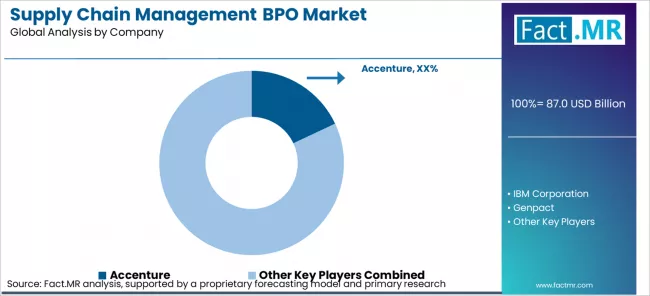
The supply chain management BPO market has a blended competitive landscape where a few large global providers dominate complex enterprise contracts, while many smaller firms compete in niche services and regional markets. In the high-value enterprise segment, companies such as Accenture, IBM, TCS, and Capgemini hold strong positions. They typically manage large outsourcing programs that cover multi-country logistics coordination, demand forecasting systems, and regulatory compliance services for industries like pharmaceuticals and retail.
At the same time, the mid-market segment remains more fragmented. Providers including Genpact, Wipro, Cognizant, Infosys, and EXL Service compete by offering specialized services such as procurement analytics, vendor management, or inventory optimization for specific industries or geographic markets.
Some firms benefit from structural advantages. Accenture and IBM combine advanced AI-driven supply chain analytics with managed outsourcing services, which helps simplify technology integration for clients and makes switching providers more difficult. TCS and Infosys leverage their large offshore delivery centers in India to provide cost-efficient processing for logistics and inventory operations. DHL Supply Chain stands out because it also operates a global logistics network, allowing it to combine physical supply chain execution with outsourcing services.
Large enterprises usually work with two or three BPO providers to avoid dependency, but deep integration with ERP and forecasting systems often makes switching vendors costly and time-consuming.
Key Players
- Accenture
- IBM Corporation
- Genpact
- Capgemini
- Wipro Limited
- Tata Consultancy Services (TCS)
- Infosys
- DHL Supply Chain
- Cognizant
- EXL Service
Bibliography
- [1] Accenture plc. (2024). Annual Report Fiscal Year 2024: Operations Segment Revenue Performance, Supply Chain and Outsourcing Growth Commentary, and AI Integration in Managed Services. October 2024.
- [2] U.S. Food and Drug Administration. (2024). Drug Supply Chain Security Act Enhanced Drug Distribution Security Enforcement: Full Interoperable Electronic Tracing Milestone November 2024 Announcement. November 2024.
- [3] European Parliament and Council of the European Union. (2024). Directive (EU) 2024/1760 on Corporate Sustainability Due Diligence: Supply Chain Human Rights and Environmental Risk Obligations and Compliance Timeline for Large Enterprises. May 2024.
- [4] Ministry of Commerce, People's Republic of China. (2024). Cross-Border E-Commerce Pilot Zone Network Expansion Announcement: 165 City Coverage and Customs Compliance, Bonded Warehouse, and Logistics BPO Service Support Framework. September 2024.
- [5] Tata Consultancy Services Ltd. (2024). Press Release: Supply Chain Centre of Excellence Expansion in Chennai-AI-Driven Logistics Management, Demand Forecasting, and Inventory Optimisation Specialist Hiring Programme. November 2024.
- [6] Genpact Ltd. (2024). Product Launch: Cora Supply Chain AI Platform-Real-Time Demand Sensing, Supplier Risk Scoring, and Automated Reorder Management for Enterprise Retail and CPG BPO Clients. September 2024.
- [7] ISG Information Services Group. (2024). ISG Outsourcing Index Q3 2024: North America Supply Chain BPO Contract Award Analysis, Nearshoring Growth Rate, and Trade Compliance Outsourcing Demand Data. October 2024.
- [8] DHL Group. (2025). Press Release: DHL Supply Chain EUR 300 Million AI-Enabled Warehouse Automation and Managed Inventory Management Investment for European Retail and E-Commerce Clients. January 2025.
- [9] Accenture plc. (2024). Life Sciences Supply Chain BPO Platform Update: DSCSA Compliance Tracking Module and EU Falsified Medicines Directive Serialisation Management Capability Expansion. October 2024.
- [10] ISG Information Services Group. (2024). ISG Provider Lens Procurement and Supply Chain BPO Report 2024: Manufacturing Vertical Growth Analysis, Automotive Tier-2 Supplier Management Outsourcing Benchmarks. December 2024.
This Report Addresses
- Strategic intelligence on EU CS3D compliance outsourcing, US DSCSA pharmaceutical traceability enforcement, China MOFCOM e-commerce expansion, Germany supply chain due diligence law, and post-Brexit UK trade compliance outsourcing trends.
- Market forecast from USD 87.0 billion in 2026 to USD 169.5 billion by 2036 at 6.9% CAGR across outsourcing model, application, service type, and enterprise size.
- Growth opportunities across China e-commerce logistics outsourcing, Germany supplier compliance services, US DSCSA pharmaceutical outsourcing, France retail inventory management BPO, and South Korea supply chain digitalisation programs.
- Country CAGR outlook: China 8.2%, South Korea 7.8%, Japan 7.5%, Germany 7.4%, France 7.2%, United States 7.1%, United Kingdom 6.8%.
- Competitive analysis of Accenture, IBM, Genpact, Capgemini, Wipro, TCS, Infosys, DHL Supply Chain, Cognizant, and EXL Service.
- Technology tracking of AI demand forecasting platforms, blockchain supplier traceability, robotic process automation, real-time inventory analytics, and supply chain compliance monitoring tools.
- Regulatory analysis covering US DSCSA enforcement, EU CS3D obligations, Germany supplier due diligence law, UK MHRA distribution rules, and China cross-border e-commerce regulations.
- Report delivered in PDF, Excel datasets, PowerPoint summary, and dashboard formats supported by ISG outsourcing data, BPO company reports, regulatory databases, and expert interviews.
Segmentation
Scope of Report
| Attribute | Details |
|---|---|
| Quantitative Units | USD 87.0 billion (2026) to USD 169.5 billion (2036), at a CAGR of 6.9% |
| Market Definition | Third-party outsourcing of supply chain functions including logistics management, inventory control, demand forecasting, vendor management, order fulfilment, and compliance operations for retail, manufacturing, healthcare, and industrial enterprises. |
| Outsourcing Model Segmentation | Offshoring (56%), Nearshoring, Onshoring |
| Application Segmentation | Retail and CPG (34%), Healthcare and Life Sciences, Manufacturing, Energy and Utilities, Telecom, Others |
| Service Type Segmentation | Inventory Management Outsourcing, Demand Forecasting and Planning, Logistics Management Outsourcing, Risk and Compliance Outsourcing, Vendor Management Outsourcing, Order Management Outsourcing, Others |
| Enterprise Size Segmentation | Small Offices (1-9), Small Enterprises (10-99), Medium Enterprises (100-499), Large Enterprises (500-999), Very Large Enterprises (1,000+) |
| Application Coverage | Retail inventory and last-mile delivery, pharmaceutical cold chain management, manufacturing procurement outsourcing, energy logistics optimisation, telecom vendor management, and e-commerce order fulfilment. |
| Regions Covered | Asia Pacific, Europe, North America, Latin America, Middle East and Africa |
| Countries Covered | China, Japan, South Korea, India, Australia and New Zealand, ASEAN, Rest of South Asia and Pacific, Germany, UK, France, Italy, Spain, Nordic, BENELUX, Rest of Western Europe, Russia, Poland, Hungary, USA, Canada, Mexico, Brazil, Chile, Ecuador, Rest of Latin America, Saudi Arabia, GCC, Turkey, South Africa, Rest of MEA |
| Key Companies Profiled | Accenture, IBM Corporation, Genpact, Capgemini, Wipro Limited, Tata Consultancy Services (TCS), Infosys, DHL Supply Chain, Cognizant, EXL Service |
| Forecast Period | 2026 to 2036 |
| Approach | Hybrid top-down and bottom-up model using enterprise outsourcing contract values, service type spending data, application vertical adoption rates, and primary interviews with procurement leaders and BPO contract managers. |
Source: Fact.MR analysis. Updated Mar 13, 2026
Supply Chain Management BPO Market by Segments
-
By Outsourcing Model:
- Offshoring
- Nearshoring
- Onshoring
-
By Application:
- Retail and CPG
- Healthcare and Life Sciences
- Manufacturing
- Energy and Utilities
- Telecom
- Others
-
By Service Type:
- Inventory Management Outsourcing
- Demand Forecasting and Planning
- Logistics Management Outsourcing
- Risk and Compliance Outsourcing
- Vendor Management Outsourcing
- Order Management Outsourcing
- Others
-
By Enterprise Size:
- Small Offices (1-9 Employees)
- Small Enterprises (10-99 Employees)
- Medium-Sized Enterprises (100-499 Employees)
- Large Enterprises (500-999 Employees)
- Very Large Enterprises (1,000+ Employees)
-
By Region:
- North America
- United States
- Canada
- Mexico
- Latin America
- Brazil
- Chile
- Ecuador
- Rest of Latin America
- Western Europe
- Germany
- United Kingdom
- France
- Italy
- Spain
- Nordic
- BENELUX
- Rest of Western Europe
- Eastern Europe
- Russia
- Poland
- Hungary
- Balkan and Baltic
- Rest of Eastern Europe
- East Asia
- China
- Japan
- South Korea
- South Asia and Pacific
- India
- ASEAN
- Australia and New Zealand
- Rest of South Asia and Pacific
- Middle East and Africa
- Kingdom of Saudi Arabia
- Other GCC Countries
- Turkey
- South Africa
- Other African Union
- Rest of Middle East and Africa
- North America
Frequently Asked Questions
How large is the supply chain management BPO market in 2025?
What will the market size be in 2026?
What is the projected market size by 2036?
What is the expected CAGR?
Which outsourcing model leads the market?
Which application segment dominates?
Which service type holds the largest share?
Which enterprise size leads?
Which country shows the fastest growth?
What is the primary restraint?
Who worked on this report


Preview the report firsthand - request a free sample
Free SampleGet the brochure for pricing and purchase details
Download PDF