Sustainable Jet Fuel Microalgae Market
Sustainable Jet Fuel Microalgae Market Size and Share Forecast Outlook 2026 to 2036
Sustainable jet fuel microalgae market is projected to grow from USD 1.6 billion in 2026 to USD 4.7 billion by 2036, at a CAGR of 11.2%. Nannochloropsis spp. will dominate with a 28.0% market share, while hydrothermal liquefaction will lead the technology route segment with a 38.0% share.
Sustainable Jet Fuel Microalgae Market Forecast and Outlook 2026 to 2036
The global market for sustainable jet fuel derived from microalgae is projected to ascend from USD 1.62 billion in 2026 to USD 4.68 billion by 2036, accelerating at an 11.2% CAGR. This growth is propelled by the aviation sector's legally binding commitment to net-zero emissions and the subsequent inadequacy of current waste- and crop-based feedstocks to meet future demand at scale. Microalgae presents a nonpareil solution, offering exponential yield per acre without competing for arable land or freshwater, while simultaneously sequestering industrial CO2.
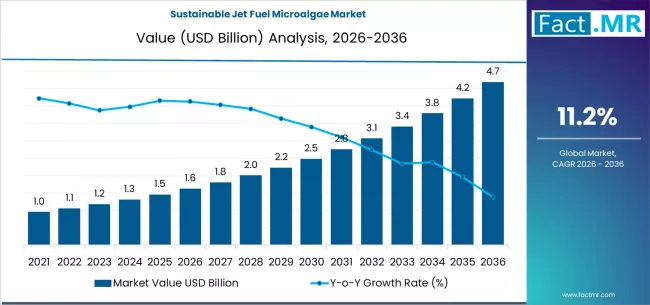
Key Takeaways from the Sustainable Jet Fuel Microalgae Market
- Market Value for 2026: USD 1.62 Billion
- Market Value for 2036: USD 4.68 Billion
- Forecast CAGR (2026 to 2036): 11.2%
- Leading Feedstock Type Segment (2026): Nannochloropsis spp. (28%)
- Leading Technology Route Segment (2026): Hydrothermal Liquefaction (38%)
- Leading End Use Segment (2026): Commercial Aviation (56%)
- Key Growth Countries: China (18.10% CAGR), India (17.30% CAGR), USA (14.80% CAGR), UK (13.90% CAGR), Japan (12.70% CAGR)
- Key Players in the Market: ExxonMobil (Algae Biofuels JV), Shell Aviation (Sustainable Fuels), TotalEnergies (SAF Programs), LanzaTech/LanzaJet (Algal SAF Partner)

The market is transitioning from pilot-scale validation to the first wave of commercial biorefinery investments, driven by offtake agreements from airlines seeking to secure long-term, scalable supplies of low-carbon fuel. The staggering 18.10% CAGR in China underscores a national strategy to dominate the green industrial value chain, leveraging algae cultivation as part of a broader carbon capture and utilization ecosystem.
Success is no longer defined by laboratory lipid yields but by the integration of biology with industrial engineering, creating robust, continuous cultivation systems and cost-effective downstream processing that can reliably produce drop-in hydrocarbons compatible with global aviation infrastructure. This market represents the critical bridge between decarbonization mandates and the technical reality of powering global flight, making algae not merely an alternative fuel but a strategic commodity for energy security in a carbon-constrained future.
Metric
| Metric | Value |
|---|---|
| Market Value (2026) | USD 1.62 Billion |
| Market Forecast Value (2036) | USD 4.68 Billion |
| Forecast CAGR (2026 to 2036) | 11.2% |
Category
| Category | Segments |
|---|---|
| Feedstock Type | Nannochloropsis spp., Chlorella spp., Spirulina spp., Mixed/Engineered Strains, Others |
| Technology Route | Hydrothermal Liquefaction, Transesterification + Upgrading, Pyrolysis & Catalytic Cracking, Gasification-Based Routes, Others |
| End Use | Commercial Aviation, Military Aviation, Business & General Aviation, Others |
| Region | North America, Latin America, Western Europe, Eastern Europe, East Asia, South Asia & Pacific, MEA |
Segmental Analysis
By Feedstock Type, Which Strain Balances High Lipid Content with Cultivation Robustness?
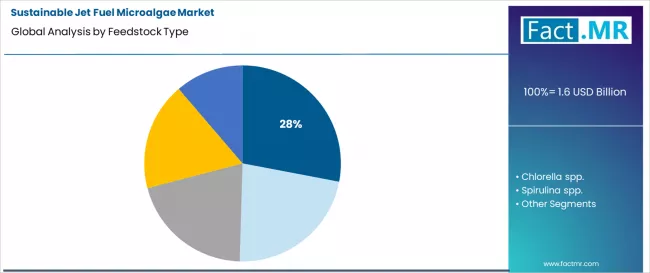
Nannochloropsis spp. leads the segment with a 28% share. This genus is favored for its naturally high lipid yield, particularly triglycerides suitable for fuel conversion, and its resilience in varied cultivation conditions, including saline water.
Its predominance reflects a focus on strains that provide a strong baseline economic potential for lipid-per-acre metrics. The extensive research history and genetic tractability of Nannochloropsis also allow for further strain improvement through engineering, positioning it as a foundational organism for the first generation of commercial algae-to-jet fuel operations.
By Technology Route, Which Process Best Handles Wet Biomass and Delivers High-Qield Hydrocarbons?
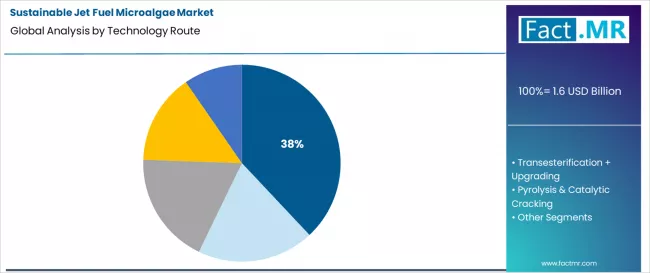
Hydrothermal liquefaction is the leading technology at 38%. HTL’s advantage lies in its ability to process wet algae biomass directly, eliminating the energy-intensive drying step—a major cost hurdle. It efficiently converts the entire biomass, including proteins and carbohydrates, into a crude bio-oil that can be catalytically upgraded to jet-range hydrocarbons.
This whole-biomass utilization and compatibility with high-moisture feedstock make HTL the most promising pathway for achieving the necessary economic and energy balance for commercial scale, attracting significant R&D and pilot investment.
By End Use, Which Sector Provides the Anchor Demand and Willingness to Pay a Premium?
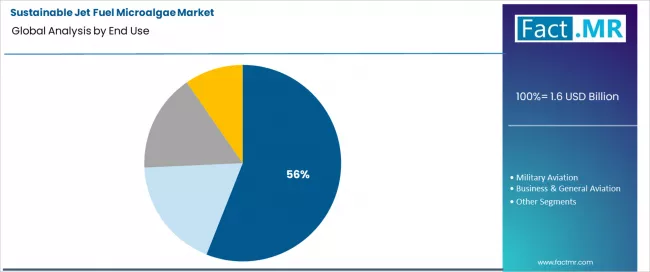
Commercial aviation is the dominant end-use segment, accounting for 56% of demand. Airlines are under the most intense regulatory and public pressure to decarbonize, facing mandates like the EU’s ReFuelEU and CORSIA. Their large, centralized fuel needs provide the volume necessary to justify large-scale biorefinery investments.
The sector’s ability to absorb a cost premium through sustainability surcharges or blended ticket prices creates the initial market pull, making commercial aviation the essential first customer for scaling microalgae SAF production.
What are the Drivers, Restraints, and Key Trends of the Sustainable Jet Fuel Microalgae Market?
| Factor | Type | Elaboration |
|---|---|---|
| Regulatory Blending Mandates | Driver | Policies like ReFuelEU legally require increasing SAF volumes, creating guaranteed demand and de-risking production investments. |
| Capital Intensity & System Integration | Restraint | The need for massive photobioreactors or pond systems, plus downstream refining, requires billion-dollar investments and untested scale-up. |
| Integration with Carbon Capture | Trend | Co-locating algae farms with industrial emitters (e.g., cement plants) transforms a cost center (CO2) into a feedstock, improving economics and LCA. |
Analysis of the Sustainable Jet Fuel Microalgae Market by Key Countries
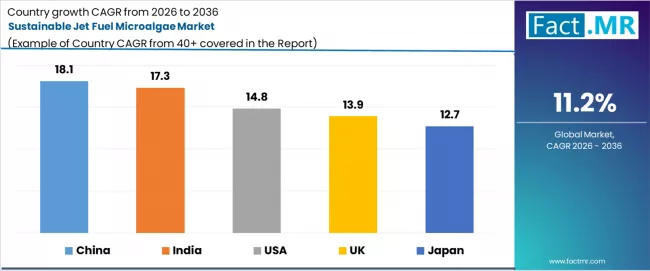
| Country | CAGR (2026 to 2036) |
|---|---|
| China | 18.10% |
| India | 17.30% |
| USA | 14.80% |
| UK | 13.90% |
| Japan | 12.70% |
How is China's Command-Driven Industrial Ecology and Carbon Neutrality Pledge Catalyzing Scale?
China's leading 18.10% CAGR is a function of its state-capitalist model, where national carbon neutrality goals directly translate into targeted funding and pilot projects. Algae cultivation is strategically linked to industrial carbon capture from its vast manufacturing base.
The government can mandate pilot partnerships between state-owned energy giants, airlines, and research institutes, rapidly iterating and scaling integrated systems with a focus on controlling the entire technological value chain for future export.
What is the Impact of India's Focus on Energy Security and Non-Arable Land Utilization?
India's 17.30% growth is driven by its imperative for energy import independence and the strategic use of its extensive non-arable land and coastline. National programs promote algae cultivation as a means to produce biofuel without impacting food security.
The growth is characterized by a focus on developing low-cost, open-pond cultivation systems resilient to local climatic conditions and on leveraging India's strong biotechnology sector for strain development.
Why is the USA's Blend of Policy, Venture Capital, and Airline Offtake Agreements a Key Factor?
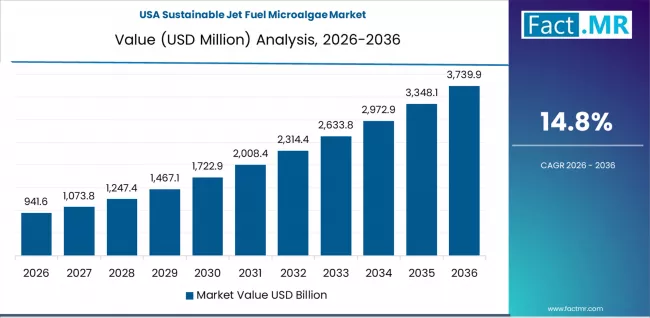
A powerful mix supports the USA’s 14.80% growth: the Inflation Reduction Act's production tax credits for SAF, a deep pool of venture capital for hard-tech bio-innovation, and proactive offtake deals from major US airlines.
This ecosystem allows for multiple technology pathways to be pursued in parallel, from startups focusing on novel strains to oil majors scaling HTL technology, all competing to deliver cost-competitive fuel to a ready and incentivized market.
How is the UK's Legislative Leadership and Focus on Synthetic Fuels Pathway Shaping Its Role?
The UK's 13.90% CAGR stems from its early and aggressive legislative targets for SAF uptake, including a revenue certainty mechanism. This policy environment attracts project finance.
The UK’s technical focus often aligns with gasification-based pathways, viewing algae as a biomass source for synthesis gas that can be funneled into established Fischer-Tropsch processes to produce certified jet fuel, aiming for technological compatibility with other waste biomass streams.
What Role does Japan's Technological Sophistication and Geopolitical Resource Strategy Play?
Japan's 12.70% growth is underpinned by its advanced biotechnology and engineering capabilities, applied to a national strategy of securing alternative energy resources. With limited domestic fossil fuels, Japan invests in algae as a technologically intensive, high-yield renewable resource that can be cultivated domestically or via overseas projects. The focus is on high-efficiency closed photobioreactor systems and maximizing value extraction from every ton of biomass.
Competitive Landscape of the Sustainable Jet Fuel Microalgae Market
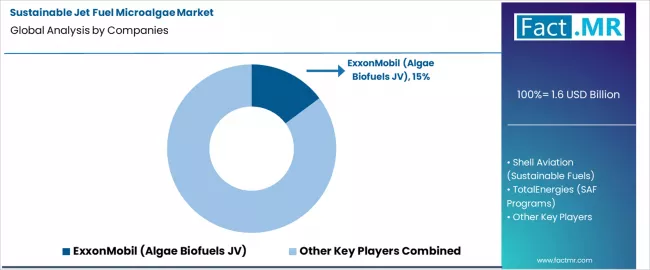
The competitive landscape features an uneasy alliance between global energy supermajors, biotechnology startups, and national research entities. Energy companies bring crucial scaling capital, refining expertise, and access to distribution, while biotech firms contribute proprietary strains and novel cultivation technologies.
Competition centers on securing intellectual property around high-productivity algal strains and efficient conversion processes, and most critically, on forming alliances with airlines for long-term offtake agreements that can finance the construction of first-of-their-kind commercial facilities. Success is measured by the ability to move from pilot volumes to delivering thousands of barrels per day under a binding contract.
Likely Scenarios for Market Expansion
| Scenario | Description |
|---|---|
| Vertical Integration Scenario | An oil major partners with a biotech firm to build an integrated facility, controlling the supply chain from strain to fuel to achieve cost leadership and secure exclusive airline deals. |
| Technology Licensing Model | A technology developer licenses its proprietary cultivation or conversion process to global partners, accelerating deployment and generating revenue without bearing full capital costs. |
| Consortium-Based Build-Out | Airlines form a consortium to co-finance a dedicated production plant, transforming from fuel offtakers to equity investors to guarantee supply and manage costs. |
| Government-Backed National Champion | A state-directed enterprise leverages policy support, low-cost resources, and regulatory advantages to scale domestic production for both local use and export. |
Key Players in the Sustainable Jet Fuel Microalgae Market
- ExxonMobil (Algae Biofuels JV)
- Shell Aviation (Sustainable Fuels)
- TotalEnergies (SAF Programs)
- LanzaTech/LanzaJet (Algal SAF Partner)
Scope of Report
| Items | Values |
|---|---|
| Quantitative Units | USD Billion |
| Feedstock Type | Nannochloropsis spp., Chlorella spp., Spirulina spp., Mixed/Engineered Strains, Others |
| Technology Route | Hydrothermal Liquefaction, Transesterification + Upgrading, Pyrolysis & Catalytic Cracking, Gasification-Based Routes, Others |
| End Use | Commercial Aviation, Military Aviation, Business & General Aviation, Others |
| Key Countries | China, India, USA, UK, Japan |
| Key Companies | ExxonMobil, Shell Aviation, TotalEnergies, LanzaTech/LanzaJet |
| Additional Analysis | Lifecycle carbon intensity analysis of different algae cultivation and conversion pathways; water and nutrient footprint analysis for large-scale operations; techno-economic assessment of competing technology routes at commercial scale; impact of carbon pricing and SAF credits on project economics; analysis of fuel certification and logistics integration challenges; geopolitical risks associated with scaling a new global commodity supply chain. |
Market by Segments
-
Feedstock Type :
- Nannochloropsis spp.
- Chlorella spp.
- Spirulina spp.
- Mixed/Engineered Strains
- Others
-
Technology Route :
- Hydrothermal Liquefaction
- Transesterification + Upgrading
- Pyrolysis & Catalytic Cracking
- Gasification-Based Routes
- Others
-
End Use :
- Commercial Aviation
- Military Aviation
- Business & General Aviation
- Others
-
Region :
- North America
- USA
- Canada
- Latin America
- Brazil
- Mexico
- Argentina
- Rest of Latin America
- Western Europe
- UK
- Germany
- Italy
- France
- Spain
- BENELUX
- Rest of Western Europe
- Eastern Europe
- Russia
- Poland
- Czech Republic
- Rest of Eastern Europe
- East Asia
- China
- Japan
- South Korea
- Rest of East Asia
- South Asia & Pacific
- India
- ASEAN
- Australia
- Rest of South Asia & Pacific
- MEA
- Saudi Arabia
- UAE
- Turkiye
- Rest of MEA
- North America
References
- International Air Transport Association. 2024. Net Zero Roadmaps: The Role of Sustainable Aviation Fuel. IATA Reports.
- International Civil Aviation Organization. 2023. CORSIA and the Development of Sustainable Aviation Fuels. ICAO Environmental Reports.
- Jones, C. S., & Mayfield, S. P. 2022. Algae Biofuels: Versatility for the Future of Bioenergy. Current Opinion in Biotechnology.
- National Renewable Energy Laboratory. 2023. The State of Sustainable Aviation Fuel. NREL Technical Reports.
- Sayre, R. T., & Wagner, J. M. 2024. Genetic Engineering of Algae for Enhanced Biofuel Production. Annual Review of Plant Biology.
- U.S. Department of Energy. 2024. BETO Multi-Year Program Plan: Algae and Wet Waste Feedstocks. DOE/EE Reports.
- Zhu, L., & Hiltunen, E. 2022. Microalgae-Based Biofuels and Bioproducts: From Feedstock Cultivation to End-Products. Woodhead Publishing Series in Energy.
Table of Content
- Executive Summary
- Global Market Outlook
- Demand to side Trends
- Supply to side Trends
- Technology Roadmap Analysis
- Analysis and Recommendations
- Market Overview
- Market Coverage / Taxonomy
- Market Definition / Scope / Limitations
- Market Background
- Market Dynamics
- Drivers
- Restraints
- Opportunity
- Trends
- Scenario Forecast
- Demand in Optimistic Scenario
- Demand in Likely Scenario
- Demand in Conservative Scenario
- Opportunity Map Analysis
- Product Life Cycle Analysis
- Supply Chain Analysis
- Investment Feasibility Matrix
- Value Chain Analysis
- PESTLE and Porter’s Analysis
- Regulatory Landscape
- Regional Parent Market Outlook
- Production and Consumption Statistics
- Import and Export Statistics
- Market Dynamics
- Global Market Analysis 2021 to 2025 and Forecast, 2026 to 2036
- Historical Market Size Value (USD Million) Analysis, 2021 to 2025
- Current and Future Market Size Value (USD Million) Projections, 2026 to 2036
- Y to o to Y Growth Trend Analysis
- Absolute $ Opportunity Analysis
- Global Market Pricing Analysis 2021 to 2025 and Forecast 2026 to 2036
- Global Market Analysis 2021 to 2025 and Forecast 2026 to 2036, By Feedstock Type
- Introduction / Key Findings
- Historical Market Size Value (USD Million) Analysis By Feedstock Type, 2021 to 2025
- Current and Future Market Size Value (USD Million) Analysis and Forecast By Feedstock Type, 2026 to 2036
- Nannochloropsis spp.
- Chlorella spp.
- Spirulina spp.
- Mixed/Engineered Strains
- Others
- Nannochloropsis spp.
- Y to o to Y Growth Trend Analysis By Feedstock Type, 2021 to 2025
- Absolute $ Opportunity Analysis By Feedstock Type, 2026 to 2036
- Global Market Analysis 2021 to 2025 and Forecast 2026 to 2036, By Technology Route
- Introduction / Key Findings
- Historical Market Size Value (USD Million) Analysis By Technology Route, 2021 to 2025
- Current and Future Market Size Value (USD Million) Analysis and Forecast By Technology Route, 2026 to 2036
- Hydrothermal Liquefaction
- Transesterification + Upgrading
- Pyrolysis & Catalytic Cracking
- Gasification-Based Routes
- Others
- Hydrothermal Liquefaction
- Y to o to Y Growth Trend Analysis By Technology Route, 2021 to 2025
- Absolute $ Opportunity Analysis By Technology Route, 2026 to 2036
- Global Market Analysis 2021 to 2025 and Forecast 2026 to 2036, By End Use
- Introduction / Key Findings
- Historical Market Size Value (USD Million) Analysis By End Use, 2021 to 2025
- Current and Future Market Size Value (USD Million) Analysis and Forecast By End Use, 2026 to 2036
- Commercial Aviation
- Military Aviation
- Business & General Aviation
- Others
- Commercial Aviation
- Y to o to Y Growth Trend Analysis By End Use, 2021 to 2025
- Absolute $ Opportunity Analysis By End Use, 2026 to 2036
- Global Market Analysis 2021 to 2025 and Forecast 2026 to 2036, By Region
- Introduction
- Historical Market Size Value (USD Million) Analysis By Region, 2021 to 2025
- Current Market Size Value (USD Million) Analysis and Forecast By Region, 2026 to 2036
- North America
- Latin America
- Western Europe
- Eastern Europe
- East Asia
- South Asia and Pacific
- Middle East & Africa
- Market Attractiveness Analysis By Region
- North America Market Analysis 2021 to 2025 and Forecast 2026 to 2036, By Country
- Historical Market Size Value (USD Million) Trend Analysis By Market Taxonomy, 2021 to 2025
- Market Size Value (USD Million) Forecast By Market Taxonomy, 2026 to 2036
- By Country
- USA
- Canada
- Mexico
- By Feedstock Type
- By Technology Route
- By End Use
- By Country
- Market Attractiveness Analysis
- By Country
- By Feedstock Type
- By Technology Route
- By End Use
- Key Takeaways
- Latin America Market Analysis 2021 to 2025 and Forecast 2026 to 2036, By Country
- Historical Market Size Value (USD Million) Trend Analysis By Market Taxonomy, 2021 to 2025
- Market Size Value (USD Million) Forecast By Market Taxonomy, 2026 to 2036
- By Country
- Brazil
- Chile
- Rest of Latin America
- By Feedstock Type
- By Technology Route
- By End Use
- By Country
- Market Attractiveness Analysis
- By Country
- By Feedstock Type
- By Technology Route
- By End Use
- Key Takeaways
- Western Europe Market Analysis 2021 to 2025 and Forecast 2026 to 2036, By Country
- Historical Market Size Value (USD Million) Trend Analysis By Market Taxonomy, 2021 to 2025
- Market Size Value (USD Million) Forecast By Market Taxonomy, 2026 to 2036
- By Country
- Germany
- UK
- Italy
- Spain
- France
- Nordic
- BENELUX
- Rest of Western Europe
- By Feedstock Type
- By Technology Route
- By End Use
- By Country
- Market Attractiveness Analysis
- By Country
- By Feedstock Type
- By Technology Route
- By End Use
- Key Takeaways
- Eastern Europe Market Analysis 2021 to 2025 and Forecast 2026 to 2036, By Country
- Historical Market Size Value (USD Million) Trend Analysis By Market Taxonomy, 2021 to 2025
- Market Size Value (USD Million) Forecast By Market Taxonomy, 2026 to 2036
- By Country
- Russia
- Poland
- Hungary
- Balkan & Baltic
- Rest of Eastern Europe
- By Feedstock Type
- By Technology Route
- By End Use
- By Country
- Market Attractiveness Analysis
- By Country
- By Feedstock Type
- By Technology Route
- By End Use
- Key Takeaways
- East Asia Market Analysis 2021 to 2025 and Forecast 2026 to 2036, By Country
- Historical Market Size Value (USD Million) Trend Analysis By Market Taxonomy, 2021 to 2025
- Market Size Value (USD Million) Forecast By Market Taxonomy, 2026 to 2036
- By Country
- China
- Japan
- South Korea
- By Feedstock Type
- By Technology Route
- By End Use
- By Country
- Market Attractiveness Analysis
- By Country
- By Feedstock Type
- By Technology Route
- By End Use
- Key Takeaways
- South Asia and Pacific Market Analysis 2021 to 2025 and Forecast 2026 to 2036, By Country
- Historical Market Size Value (USD Million) Trend Analysis By Market Taxonomy, 2021 to 2025
- Market Size Value (USD Million) Forecast By Market Taxonomy, 2026 to 2036
- By Country
- India
- ASEAN
- Australia & New Zealand
- Rest of South Asia and Pacific
- By Feedstock Type
- By Technology Route
- By End Use
- By Country
- Market Attractiveness Analysis
- By Country
- By Feedstock Type
- By Technology Route
- By End Use
- Key Takeaways
- Middle East & Africa Market Analysis 2021 to 2025 and Forecast 2026 to 2036, By Country
- Historical Market Size Value (USD Million) Trend Analysis By Market Taxonomy, 2021 to 2025
- Market Size Value (USD Million) Forecast By Market Taxonomy, 2026 to 2036
- By Country
- Kingdom of Saudi Arabia
- Other GCC Countries
- Turkiye
- South Africa
- Other African Union
- Rest of Middle East & Africa
- By Feedstock Type
- By Technology Route
- By End Use
- By Country
- Market Attractiveness Analysis
- By Country
- By Feedstock Type
- By Technology Route
- By End Use
- Key Takeaways
- Key Countries Market Analysis
- USA
- Pricing Analysis
- Market Share Analysis, 2025
- By Feedstock Type
- By Technology Route
- By End Use
- Canada
- Pricing Analysis
- Market Share Analysis, 2025
- By Feedstock Type
- By Technology Route
- By End Use
- Mexico
- Pricing Analysis
- Market Share Analysis, 2025
- By Feedstock Type
- By Technology Route
- By End Use
- Brazil
- Pricing Analysis
- Market Share Analysis, 2025
- By Feedstock Type
- By Technology Route
- By End Use
- Chile
- Pricing Analysis
- Market Share Analysis, 2025
- By Feedstock Type
- By Technology Route
- By End Use
- Germany
- Pricing Analysis
- Market Share Analysis, 2025
- By Feedstock Type
- By Technology Route
- By End Use
- UK
- Pricing Analysis
- Market Share Analysis, 2025
- By Feedstock Type
- By Technology Route
- By End Use
- Italy
- Pricing Analysis
- Market Share Analysis, 2025
- By Feedstock Type
- By Technology Route
- By End Use
- Spain
- Pricing Analysis
- Market Share Analysis, 2025
- By Feedstock Type
- By Technology Route
- By End Use
- France
- Pricing Analysis
- Market Share Analysis, 2025
- By Feedstock Type
- By Technology Route
- By End Use
- India
- Pricing Analysis
- Market Share Analysis, 2025
- By Feedstock Type
- By Technology Route
- By End Use
- ASEAN
- Pricing Analysis
- Market Share Analysis, 2025
- By Feedstock Type
- By Technology Route
- By End Use
- Australia & New Zealand
- Pricing Analysis
- Market Share Analysis, 2025
- By Feedstock Type
- By Technology Route
- By End Use
- China
- Pricing Analysis
- Market Share Analysis, 2025
- By Feedstock Type
- By Technology Route
- By End Use
- Japan
- Pricing Analysis
- Market Share Analysis, 2025
- By Feedstock Type
- By Technology Route
- By End Use
- South Korea
- Pricing Analysis
- Market Share Analysis, 2025
- By Feedstock Type
- By Technology Route
- By End Use
- Russia
- Pricing Analysis
- Market Share Analysis, 2025
- By Feedstock Type
- By Technology Route
- By End Use
- Poland
- Pricing Analysis
- Market Share Analysis, 2025
- By Feedstock Type
- By Technology Route
- By End Use
- Hungary
- Pricing Analysis
- Market Share Analysis, 2025
- By Feedstock Type
- By Technology Route
- By End Use
- Kingdom of Saudi Arabia
- Pricing Analysis
- Market Share Analysis, 2025
- By Feedstock Type
- By Technology Route
- By End Use
- Turkiye
- Pricing Analysis
- Market Share Analysis, 2025
- By Feedstock Type
- By Technology Route
- By End Use
- South Africa
- Pricing Analysis
- Market Share Analysis, 2025
- By Feedstock Type
- By Technology Route
- By End Use
- USA
- Market Structure Analysis
- Competition Dashboard
- Competition Benchmarking
- Market Share Analysis of Top Players
- By Regional
- By Feedstock Type
- By Technology Route
- By End Use
- Competition Analysis
- Competition Deep Dive
- ExxonMobil (Algae Biofuels JV)
- Overview
- Product Portfolio
- Profitability by Market Segments (Product/Age /Sales Channel/Region)
- Sales Footprint
- Strategy Overview
- Marketing Strategy
- Product Strategy
- Channel Strategy
- Shell Aviation (Sustainable Fuels)
- TotalEnergies (SAF Programs)
- LanzaTech/LanzaJet (Algal SAF Partner)
- Others
- ExxonMobil (Algae Biofuels JV)
- Competition Deep Dive
- Assumptions & Acronyms Used
- Research Methodology
List Of Table
- Table 1: Global Market Value (USD Million) Forecast by Region, 2021 to 2036
- Table 2: Global Market Value (USD Million) Forecast by Feedstock Type, 2021 to 2036
- Table 3: Global Market Value (USD Million) Forecast by Technology Route, 2021 to 2036
- Table 4: Global Market Value (USD Million) Forecast by End Use, 2021 to 2036
- Table 5: North America Market Value (USD Million) Forecast by Country, 2021 to 2036
- Table 6: North America Market Value (USD Million) Forecast by Feedstock Type, 2021 to 2036
- Table 7: North America Market Value (USD Million) Forecast by Technology Route, 2021 to 2036
- Table 8: North America Market Value (USD Million) Forecast by End Use, 2021 to 2036
- Table 9: Latin America Market Value (USD Million) Forecast by Country, 2021 to 2036
- Table 10: Latin America Market Value (USD Million) Forecast by Feedstock Type, 2021 to 2036
- Table 11: Latin America Market Value (USD Million) Forecast by Technology Route, 2021 to 2036
- Table 12: Latin America Market Value (USD Million) Forecast by End Use, 2021 to 2036
- Table 13: Western Europe Market Value (USD Million) Forecast by Country, 2021 to 2036
- Table 14: Western Europe Market Value (USD Million) Forecast by Feedstock Type, 2021 to 2036
- Table 15: Western Europe Market Value (USD Million) Forecast by Technology Route, 2021 to 2036
- Table 16: Western Europe Market Value (USD Million) Forecast by End Use, 2021 to 2036
- Table 17: Eastern Europe Market Value (USD Million) Forecast by Country, 2021 to 2036
- Table 18: Eastern Europe Market Value (USD Million) Forecast by Feedstock Type, 2021 to 2036
- Table 19: Eastern Europe Market Value (USD Million) Forecast by Technology Route, 2021 to 2036
- Table 20: Eastern Europe Market Value (USD Million) Forecast by End Use, 2021 to 2036
- Table 21: East Asia Market Value (USD Million) Forecast by Country, 2021 to 2036
- Table 22: East Asia Market Value (USD Million) Forecast by Feedstock Type, 2021 to 2036
- Table 23: East Asia Market Value (USD Million) Forecast by Technology Route, 2021 to 2036
- Table 24: East Asia Market Value (USD Million) Forecast by End Use, 2021 to 2036
- Table 25: South Asia and Pacific Market Value (USD Million) Forecast by Country, 2021 to 2036
- Table 26: South Asia and Pacific Market Value (USD Million) Forecast by Feedstock Type, 2021 to 2036
- Table 27: South Asia and Pacific Market Value (USD Million) Forecast by Technology Route, 2021 to 2036
- Table 28: South Asia and Pacific Market Value (USD Million) Forecast by End Use, 2021 to 2036
- Table 29: Middle East & Africa Market Value (USD Million) Forecast by Country, 2021 to 2036
- Table 30: Middle East & Africa Market Value (USD Million) Forecast by Feedstock Type, 2021 to 2036
- Table 31: Middle East & Africa Market Value (USD Million) Forecast by Technology Route, 2021 to 2036
- Table 32: Middle East & Africa Market Value (USD Million) Forecast by End Use, 2021 to 2036
List Of Figures
- Figure 1: Global Market Pricing Analysis
- Figure 2: Global Market Value (USD Million) Forecast 2021-2036
- Figure 3: Global Market Value Share and BPS Analysis by Feedstock Type, 2026 and 2036
- Figure 4: Global Market Y to o to Y Growth Comparison by Feedstock Type, 2026 to 2036
- Figure 5: Global Market Attractiveness Analysis by Feedstock Type
- Figure 6: Global Market Value Share and BPS Analysis by Technology Route, 2026 and 2036
- Figure 7: Global Market Y to o to Y Growth Comparison by Technology Route, 2026 to 2036
- Figure 8: Global Market Attractiveness Analysis by Technology Route
- Figure 9: Global Market Value Share and BPS Analysis by End Use, 2026 and 2036
- Figure 10: Global Market Y to o to Y Growth Comparison by End Use, 2026 to 2036
- Figure 11: Global Market Attractiveness Analysis by End Use
- Figure 12: Global Market Value (USD Million) Share and BPS Analysis by Region, 2026 and 2036
- Figure 13: Global Market Y to o to Y Growth Comparison by Region, 2026 to 2036
- Figure 14: Global Market Attractiveness Analysis by Region
- Figure 15: North America Market Incremental Dollar Opportunity, 2026 to 2036
- Figure 16: Latin America Market Incremental Dollar Opportunity, 2026 to 2036
- Figure 17: Western Europe Market Incremental Dollar Opportunity, 2026 to 2036
- Figure 18: Eastern Europe Market Incremental Dollar Opportunity, 2026 to 2036
- Figure 19: East Asia Market Incremental Dollar Opportunity, 2026 to 2036
- Figure 20: South Asia and Pacific Market Incremental Dollar Opportunity, 2026 to 2036
- Figure 21: Middle East & Africa Market Incremental Dollar Opportunity, 2026 to 2036
- Figure 22: North America Market Value Share and BPS Analysis by Country, 2026 and 2036
- Figure 23: North America Market Value Share and BPS Analysis by Feedstock Type, 2026 and 2036
- Figure 24: North America Market Y to o to Y Growth Comparison by Feedstock Type, 2026 to 2036
- Figure 25: North America Market Attractiveness Analysis by Feedstock Type
- Figure 26: North America Market Value Share and BPS Analysis by Technology Route, 2026 and 2036
- Figure 27: North America Market Y to o to Y Growth Comparison by Technology Route, 2026 to 2036
- Figure 28: North America Market Attractiveness Analysis by Technology Route
- Figure 29: North America Market Value Share and BPS Analysis by End Use, 2026 and 2036
- Figure 30: North America Market Y to o to Y Growth Comparison by End Use, 2026 to 2036
- Figure 31: North America Market Attractiveness Analysis by End Use
- Figure 32: Latin America Market Value Share and BPS Analysis by Country, 2026 and 2036
- Figure 33: Latin America Market Value Share and BPS Analysis by Feedstock Type, 2026 and 2036
- Figure 34: Latin America Market Y to o to Y Growth Comparison by Feedstock Type, 2026 to 2036
- Figure 35: Latin America Market Attractiveness Analysis by Feedstock Type
- Figure 36: Latin America Market Value Share and BPS Analysis by Technology Route, 2026 and 2036
- Figure 37: Latin America Market Y to o to Y Growth Comparison by Technology Route, 2026 to 2036
- Figure 38: Latin America Market Attractiveness Analysis by Technology Route
- Figure 39: Latin America Market Value Share and BPS Analysis by End Use, 2026 and 2036
- Figure 40: Latin America Market Y to o to Y Growth Comparison by End Use, 2026 to 2036
- Figure 41: Latin America Market Attractiveness Analysis by End Use
- Figure 42: Western Europe Market Value Share and BPS Analysis by Country, 2026 and 2036
- Figure 43: Western Europe Market Value Share and BPS Analysis by Feedstock Type, 2026 and 2036
- Figure 44: Western Europe Market Y to o to Y Growth Comparison by Feedstock Type, 2026 to 2036
- Figure 45: Western Europe Market Attractiveness Analysis by Feedstock Type
- Figure 46: Western Europe Market Value Share and BPS Analysis by Technology Route, 2026 and 2036
- Figure 47: Western Europe Market Y to o to Y Growth Comparison by Technology Route, 2026 to 2036
- Figure 48: Western Europe Market Attractiveness Analysis by Technology Route
- Figure 49: Western Europe Market Value Share and BPS Analysis by End Use, 2026 and 2036
- Figure 50: Western Europe Market Y to o to Y Growth Comparison by End Use, 2026 to 2036
- Figure 51: Western Europe Market Attractiveness Analysis by End Use
- Figure 52: Eastern Europe Market Value Share and BPS Analysis by Country, 2026 and 2036
- Figure 53: Eastern Europe Market Value Share and BPS Analysis by Feedstock Type, 2026 and 2036
- Figure 54: Eastern Europe Market Y to o to Y Growth Comparison by Feedstock Type, 2026 to 2036
- Figure 55: Eastern Europe Market Attractiveness Analysis by Feedstock Type
- Figure 56: Eastern Europe Market Value Share and BPS Analysis by Technology Route, 2026 and 2036
- Figure 57: Eastern Europe Market Y to o to Y Growth Comparison by Technology Route, 2026 to 2036
- Figure 58: Eastern Europe Market Attractiveness Analysis by Technology Route
- Figure 59: Eastern Europe Market Value Share and BPS Analysis by End Use, 2026 and 2036
- Figure 60: Eastern Europe Market Y to o to Y Growth Comparison by End Use, 2026 to 2036
- Figure 61: Eastern Europe Market Attractiveness Analysis by End Use
- Figure 62: East Asia Market Value Share and BPS Analysis by Country, 2026 and 2036
- Figure 63: East Asia Market Value Share and BPS Analysis by Feedstock Type, 2026 and 2036
- Figure 64: East Asia Market Y to o to Y Growth Comparison by Feedstock Type, 2026 to 2036
- Figure 65: East Asia Market Attractiveness Analysis by Feedstock Type
- Figure 66: East Asia Market Value Share and BPS Analysis by Technology Route, 2026 and 2036
- Figure 67: East Asia Market Y to o to Y Growth Comparison by Technology Route, 2026 to 2036
- Figure 68: East Asia Market Attractiveness Analysis by Technology Route
- Figure 69: East Asia Market Value Share and BPS Analysis by End Use, 2026 and 2036
- Figure 70: East Asia Market Y to o to Y Growth Comparison by End Use, 2026 to 2036
- Figure 71: East Asia Market Attractiveness Analysis by End Use
- Figure 72: South Asia and Pacific Market Value Share and BPS Analysis by Country, 2026 and 2036
- Figure 73: South Asia and Pacific Market Value Share and BPS Analysis by Feedstock Type, 2026 and 2036
- Figure 74: South Asia and Pacific Market Y to o to Y Growth Comparison by Feedstock Type, 2026 to 2036
- Figure 75: South Asia and Pacific Market Attractiveness Analysis by Feedstock Type
- Figure 76: South Asia and Pacific Market Value Share and BPS Analysis by Technology Route, 2026 and 2036
- Figure 77: South Asia and Pacific Market Y to o to Y Growth Comparison by Technology Route, 2026 to 2036
- Figure 78: South Asia and Pacific Market Attractiveness Analysis by Technology Route
- Figure 79: South Asia and Pacific Market Value Share and BPS Analysis by End Use, 2026 and 2036
- Figure 80: South Asia and Pacific Market Y to o to Y Growth Comparison by End Use, 2026 to 2036
- Figure 81: South Asia and Pacific Market Attractiveness Analysis by End Use
- Figure 82: Middle East & Africa Market Value Share and BPS Analysis by Country, 2026 and 2036
- Figure 83: Middle East & Africa Market Value Share and BPS Analysis by Feedstock Type, 2026 and 2036
- Figure 84: Middle East & Africa Market Y to o to Y Growth Comparison by Feedstock Type, 2026 to 2036
- Figure 85: Middle East & Africa Market Attractiveness Analysis by Feedstock Type
- Figure 86: Middle East & Africa Market Value Share and BPS Analysis by Technology Route, 2026 and 2036
- Figure 87: Middle East & Africa Market Y to o to Y Growth Comparison by Technology Route, 2026 to 2036
- Figure 88: Middle East & Africa Market Attractiveness Analysis by Technology Route
- Figure 89: Middle East & Africa Market Value Share and BPS Analysis by End Use, 2026 and 2036
- Figure 90: Middle East & Africa Market Y to o to Y Growth Comparison by End Use, 2026 to 2036
- Figure 91: Middle East & Africa Market Attractiveness Analysis by End Use
- Figure 92: Global Market - Tier Structure Analysis
- Figure 93: Global Market - Company Share Analysis
- FAQs -
How big is the sustainable jet fuel microalgae market in 2026?
The global sustainable jet fuel microalgae market is estimated to be valued at USD 1.6 billion in 2026.
What will be the size of sustainable jet fuel microalgae market in 2036?
The market size for the sustainable jet fuel microalgae market is projected to reach USD 4.7 billion by 2036.
How much will be the sustainable jet fuel microalgae market growth between 2026 and 2036?
The sustainable jet fuel microalgae market is expected to grow at a 11.2% CAGR between 2026 and 2036.
What are the key product types in the sustainable jet fuel microalgae market?
The key product types in sustainable jet fuel microalgae market are nannochloropsis spp., chlorella spp., spirulina spp., mixed/engineered strains and others.
Which technology route segment to contribute significant share in the sustainable jet fuel microalgae market in 2026?
In terms of technology route, hydrothermal liquefaction segment to command 38.0% share in the sustainable jet fuel microalgae market in 2026.