Long-Haul Sustainable Composite Wings Market
Long-Haul Sustainable Composite Wings Market Size and Share Forecast Outlook 2026 to 2036
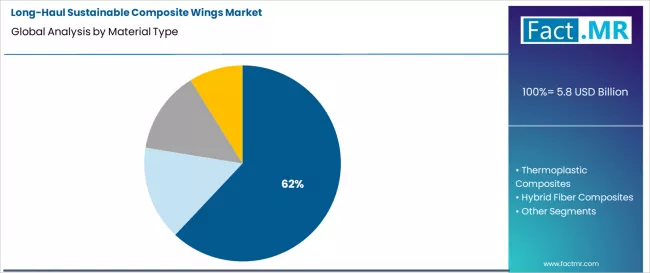
Long-haul sustainable composite wings market is projected to grow from USD 5.8 billion in 2026 to USD 13.4 billion by 2036, at a CAGR of 8.7%. Carbon Fiber Reinforced Polymer (CFRP) will dominate with a 62.0% market share, while wide-body long-haul jets will lead the aircraft type segment with a 58.0% share.
Long-Haul Sustainable Composite Wings Market Forecast and Outlook 2026 to 2036
The global long-haul sustainable composite wings market is poised for significant expansion, projected to grow from USD 5.84 billion in 2026 to USD 13.45 billion by 2036, advancing at a CAGR of 8.7%.
Key Takeaways from the Long-Haul Sustainable Composite Wings Market
- Market Value for 2026: USD 5.84 Billion
- Market Value for 2036: USD 13.45 Billion
- Forecast CAGR (2026-2036): 8.7%
- Leading Material Type Segment (2026): Carbon Fiber Reinforced Polymer (CFRP) (62%)
- Leading Aircraft Type Segment (2026): Wide-Body Long-Haul Jets (58%)
- Leading End User Segment (2026): Commercial Aircraft OEMs (67%)
- Key Growth Countries: China (9.60% CAGR), USA (8.20% CAGR), France (7.90% CAGR), Germany (7.60% CAGR), Japan (7.40% CAGR)
- Key Players in the Market: The Boeing Company (Composite Wings Unit), Airbus S.A.S., GKN Aerospace, Toray Industries, Inc., Hexcel Corporation

Growth is fundamentally propelled by the global aviation industry's imperative to achieve ambitious decarbonization targets. Composite wings, characterized by their exceptional strength-to-weight ratio and design flexibility, are no longer merely performance enhancers but critical enablers of sustainability.
The integration of advanced materials like CFRP and next-generation thermoplastics directly contributes to substantial reductions in airframe weight, leading to lower fuel consumption, decreased CO2 emissions, and extended aircraft range.
This market evolution is intrinsically linked to the development of next-generation, fuel-efficient aircraft platforms and the retrofitting of existing fleets, driven by stringent environmental regulations, rising fuel costs, and airline demand for operational efficiency.
The focus has shifted towards not only the performance of composites but also their entire lifecycle, including sustainable sourcing, manufacturing energy efficiency, and end-of-life recyclability, shaping a new paradigm in aerospace materials.
Metric
| Metric | Value |
|---|---|
| Market Value (2026) | USD 5.84 Billion |
| Market Forecast Value (2036) | USD 13.45 Billion |
| Forecast CAGR (2026-2036) | 8.7% |
Category
| Category | Segments |
|---|---|
| Material Type | Carbon Fiber Reinforced Polymer (CFRP), Thermoplastic Composites, Hybrid Fiber Composites, Other Sustainable Matrix Composites |
| Aircraft Type | Wide-Body Long-Haul Jets, Narrow-Body Extended Range, Freighter Aircraft, Business Jets (Long-Range) |
| End User | Commercial Aircraft OEMs, MRO & Retrofit Services, Tier-1 Composite Suppliers, Research & Flight Development Centers |
| Region | North America, Latin America, Western Europe, Eastern Europe, East Asia, South Asia & Pacific, MEA |
Segmental Analysis
By Material Type, Which Composite Dominates Aerospace Structural Applications?

Carbon fiber reinforced polymer (CFRP) overwhelmingly leads the material segment with a 62% share. Its dominance is rooted in a decades-proven track record of delivering unparalleled specific stiffness and strength, which is essential for the primary structure of wings that must withstand immense aerodynamic and gravitational loads over millions of flight cycles.
The material's fatigue resistance and corrosion immunity offer significant maintenance advantages over traditional aluminum. Continuous innovation in CFRP focuses on developing lower-cost, higher-throughput manufacturing processes and integrating bio-based or recycled carbon fibers to enhance the sustainability profile without compromising the critical mechanical properties required for flight safety.
By Aircraft Type, Which Platform Drives the Most Significant Demand?

Wide-body long-haul jets constitute the leading aircraft segment, holding 58% of the market. These aircraft, such as the Boeing 777X, 787, and Airbus A350, represent the pinnacle of composite wing integration, where weight savings translate directly into billions of dollars in fuel savings over the fleet's lifetime.
The immense wingspan and fuel volume requirements of wide-body aircraft benefit most dramatically from the design freedom and weight reduction offered by composites, enabling advanced aerodynamic profiles like raked wingtips that further boost efficiency.
The high unit value of these wings and their centrality to the aircraft's performance and economics make this segment the primary driver of advanced composite technology and production capacity.
By End User, Who is the Principal Integrator and Driver of Innovation?

Commercial aircraft OEMs are the dominant end users, accounting for 67% of demand. Original Equipment Manufacturers like Boeing and Airbus are the ultimate integrators, responsible for the design, certification, and final assembly of the complete wing structure onto the aircraft. Their demand dictates material specifications, manufacturing timelines, and technological roadmaps for the entire supply chain.
New aircraft development programs drive growth in this segment and production rate increases for existing composite-wing platforms. OEMs work in deep, strategic partnership with Tier-1 suppliers and material producers, but they hold the prime responsibility for the wing's airworthiness, making them the central node in the market ecosystem.
What are the Drivers, Restraints, Opportunities and Trends in the Market?
The paramount driver for this market is the existential pressure on the aviation industry to reduce its environmental footprint, with composite wings being a proven, scalable technology to cut fuel burn and emissions by 15-20% per aircraft. Supportive global regulations like CORSIA and national net-zero pledges are accelerating adoption.
A primary restraint is the exceptionally high capital intensity and technical complexity associated with composite wing manufacturing, requiring massive autoclaves, specialized tooling, and a skilled workforce, which creates high barriers to entry and limits supply chain flexibility.
The certification process for new composite materials and manufacturing methods remains lengthy and costly. A significant opportunity lies in the development and commercialization of thermoplastic composites and bio-derived resins, which offer the potential for faster production cycles, weldability, and improved end-of-life recyclability compared to traditional thermoset CFRP.
The dominant trend is the industry-wide shift towards more sustainable composite ecosystems, encompassing the use of recycled carbon fiber from production scrap or decommissioned aircraft, the adoption of resin systems with lower environmental impact, and the exploration of closed-loop recycling processes to address the growing issue of composite waste, thereby aligning material innovation with circular economy principles.
Analysis of the Long-Haul Sustainable Composite Wings Market by Key Countries

| Country | CAGR (2026-2036) |
|---|---|
| China | 9.60% |
| USA | 8.20% |
| France | 7.90% |
| Germany | 7.60% |
| Japan | 7.40% |
How does the USA's Aerospace Leadership and Next-Gen Development Fuel Growth?

The USA's 8.20% CAGR is anchored in its position as the home of Boeing and a dense ecosystem of advanced material suppliers and aerospace innovators. Growth is sustained through ongoing production of the 787 and 777X wings, investment in next-generation aircraft concepts, and significant defense-related composite research.
The market is driven by a continuous cycle of product improvement, factory automation, and efforts to reduce the cost of composite manufacturing to maintain competitiveness and meet future clean-sheet aircraft demands.
What drives China's Strategic Ascent in Aerospace Composites?
China's leading 9.60% CAGR is propelled by a comprehensive national strategy to achieve self-sufficiency and global competitiveness in aerospace. The COMAC C919 program and the development of the wide-body C929 exemplify this, which rely heavily on composite structures.
Massive state and private investment are building indigenous capacity across the entire value chain, from carbon fiber production to advanced aerostructure manufacturing, aiming to capture a larger share of the global market and supply future domestic and international aircraft programs.
Why do France and Germany Represent the Core of European Collaborative Excellence?
France's 7.90% and Germany's 7.60% growth are intrinsically linked to their roles within the Airbus consortium and the European aerospace landscape. France, as the home of Airbus's headquarters and major wing design centers, drives innovation and final assembly for programs like the A350.
Germany is a powerhouse for composite component manufacturing, automation research, and material science. Growth in both countries is fueled by ramping up production rates for in-demand aircraft, investing in Industry 4.0 smart factories for composites, and leading European Union-funded research initiatives like Clean Aviation, which focuses on ultra-efficient aircraft architectures reliant on advanced materials.
How does Japan's Mastery of Advanced Materials Underpin Its Market Role?
Japan's 7.40% growth is rooted in its world-leading expertise in carbon fiber production, with Toray Industries being a primary global supplier. Japan’s role is less as a final integrator and more as a critical, technology-leading supplier of the foundational materials and precision pre-pregs that enable composite wings.
Growth is sustained through long-term contracts with OEMs, continuous development of higher-performance and more sustainable fiber grades, and participation in international aerospace partnerships, ensuring its materials are specified on every major new aircraft program.
Competitive Landscape of the Long-Haul Sustainable Composite Wings Market

The competitive landscape is an oligopoly of deeply entrenched aerospace primes and specialized material giants, characterized by extremely high barriers to entry due to the capital, technology, and certification requirements. Competition revolves around technological leadership in material performance, manufacturing efficiency and the ability to co-develop and industrialize new sustainable composite solutions.
The market structure is defined by long-term, symbiotic relationships: OEMs (Boeing, Airbus) design and integrate; Tier-1 aerostructure specialists (GKN, Spirit AeroSystems) manufacture major assemblies; and material suppliers (Toray, Hexcel) provide the advanced feedstock. Success is determined by securing a position on the bill of materials for next-generation aircraft platforms a decade or more before entry-into-service, requiring immense R&D investment and risk-sharing partnerships. Competition is increasingly focused on the entire lifecycle sustainability of composite solutions, adding a new dimension to the traditional performance and cost criteria.
Key Players in the Long-Haul Sustainable Composite Wings Market
- The Boeing Company (Composite Wings Unit)
- Airbus S.A.S.
- GKN Aerospace
- Toray Industries, Inc.
- Hexcel Corporation
Scope of Report
| Items | Values |
|---|---|
| Quantitative Units | USD Billion |
| Material Type | Carbon Fiber Reinforced Polymer (CFRP), Thermoplastic Composites, Hybrid Fiber Composites, Other Sustainable Matrix Composites |
| Aircraft Type | Wide-Body Long-Haul Jets, Narrow-Body Extended Range, Freighter Aircraft, Business Jets (Long-Range) |
| End User | Commercial Aircraft OEMs, MRO & Retrofit Services, Tier-1 Composite Suppliers, Research & Flight Development Centers |
| Key Countries | China, USA, France, Germany, Japan |
| Key Companies | The Boeing Company (Composite Wings Unit), Airbus S.A.S., GKN Aerospace, Toray Industries, Inc., Hexcel Corporation |
| Additional Analysis | Detailed techno-economic analysis of autoclave vs. out-of-autoclave (OOA) manufacturing; assessment of supply chain resilience and geographic concentration risks for carbon fiber precursor; study on certification pathways for thermoplastic primary structures; lifecycle assessment (LCA) comparing composite and metallic wing environmental impact from cradle-to-grave; analysis of the emerging market for composite wing repair, refurbishment, and recycling services. |
Market by Segments
-
Material Type :
- Carbon Fiber Reinforced Polymer (CFRP)
- Thermoplastic Composites
- Hybrid Fiber Composites
- Other Sustainable Matrix Composites
-
Aircraft Type :
- Wide-Body Long-Haul Jets
- Narrow-Body Extended Range
- Freighter Aircraft
- Business Jets (Long-Range)
-
End User :
- Commercial Aircraft OEMs
- MRO & Retrofit Services
- Tier-1 Composite Suppliers
- Research & Flight Development Centers
-
Region :
-
North America
- USA
- Canada
-
Latin America
- Brazil
- Mexico
- Argentina
- Rest of Latin America
-
Western Europe
- Germany
- France
- Italy
- Spain
- UK
- BENELUX
- Rest of Western Europe
-
Eastern Europe
- Russia
- Poland
- Czech Republic
- Rest of Eastern Europe
-
East Asia
- China
- Japan
- South Korea
- Rest of East Asia
-
South Asia & Pacific
- India
- ASEAN
- Australia
- Rest of South Asia & Pacific
-
MEA
- GCC Countries
- South Africa
- Turkiye
- Rest of MEA
-
References
- Air Transport Action Group (ATAG). (2024). Waypoint 2050: The aviation industry's roadmap to net-zero carbon emissions. ATAG Publications.
- Clean Sky 2 Joint Undertaking. (2024). Annual activity report on sustainable composite materials and structures. European Commission.
- Mallick, P. K. (2023). Fiber-reinforced composites: Materials, manufacturing, and design (4th ed.). CRC Press.
- National Aeronautics and Space Administration (NASA). (2024). Advanced Composites Project: Research on sustainable aviation materials. NASA Aeronautics Research Mission Directorate.
- Society of Automotive Engineers (SAE) International. (2024). Aerospace Material Specifications (AMS) for composite materials. SAE International.
- The International Air Transport Association (IATA). (2024). IATA technology roadmap for sustainable composite lifecycle management. IATA Publications.
Table of Content
- Executive Summary
- Global Market Outlook
- Demand to side Trends
- Supply to side Trends
- Technology Roadmap Analysis
- Analysis and Recommendations
- Market Overview
- Market Coverage / Taxonomy
- Market Definition / Scope / Limitations
- Market Background
- Market Dynamics
- Drivers
- Restraints
- Opportunity
- Trends
- Scenario Forecast
- Demand in Optimistic Scenario
- Demand in Likely Scenario
- Demand in Conservative Scenario
- Opportunity Map Analysis
- Product Life Cycle Analysis
- Supply Chain Analysis
- Investment Feasibility Matrix
- Value Chain Analysis
- PESTLE and Porter’s Analysis
- Regulatory Landscape
- Regional Parent Market Outlook
- Production and Consumption Statistics
- Import and Export Statistics
- Market Dynamics
- Global Market Analysis 2021 to 2025 and Forecast, 2026 to 2036
- Historical Market Size Value (USD Million) Analysis, 2021 to 2025
- Current and Future Market Size Value (USD Million) Projections, 2026 to 2036
- Y to o to Y Growth Trend Analysis
- Absolute $ Opportunity Analysis
- Global Market Pricing Analysis 2021 to 2025 and Forecast 2026 to 2036
- Global Market Analysis 2021 to 2025 and Forecast 2026 to 2036, By Material Type
- Introduction / Key Findings
- Historical Market Size Value (USD Million) Analysis By Material Type, 2021 to 2025
- Current and Future Market Size Value (USD Million) Analysis and Forecast By Material Type, 2026 to 2036
- Carbon Fiber Reinforced Polymer (CFRP)
- Thermoplastic Composites
- Hybrid Fiber Composites
- Other Sustainable Matrix Composites
- Carbon Fiber Reinforced Polymer (CFRP)
- Y to o to Y Growth Trend Analysis By Material Type, 2021 to 2025
- Absolute $ Opportunity Analysis By Material Type, 2026 to 2036
- Global Market Analysis 2021 to 2025 and Forecast 2026 to 2036, By Aircraft Type
- Introduction / Key Findings
- Historical Market Size Value (USD Million) Analysis By Aircraft Type, 2021 to 2025
- Current and Future Market Size Value (USD Million) Analysis and Forecast By Aircraft Type, 2026 to 2036
- Wide-Body Long-Haul Jets
- Narrow-Body Extended Range
- Freighter Aircraft
- Business Jets (Long-Range)
- Wide-Body Long-Haul Jets
- Y to o to Y Growth Trend Analysis By Aircraft Type, 2021 to 2025
- Absolute $ Opportunity Analysis By Aircraft Type, 2026 to 2036
- Global Market Analysis 2021 to 2025 and Forecast 2026 to 2036, By End User
- Introduction / Key Findings
- Historical Market Size Value (USD Million) Analysis By End User, 2021 to 2025
- Current and Future Market Size Value (USD Million) Analysis and Forecast By End User, 2026 to 2036
- Commercial Aircraft OEMs
- MRO & Retrofit Services
- Tier-1 Composite Suppliers
- Research & Flight Development Centers
- Commercial Aircraft OEMs
- Y to o to Y Growth Trend Analysis By End User, 2021 to 2025
- Absolute $ Opportunity Analysis By End User, 2026 to 2036
- Global Market Analysis 2021 to 2025 and Forecast 2026 to 2036, By Region
- Introduction
- Historical Market Size Value (USD Million) Analysis By Region, 2021 to 2025
- Current Market Size Value (USD Million) Analysis and Forecast By Region, 2026 to 2036
- North America
- Latin America
- Western Europe
- Eastern Europe
- East Asia
- South Asia and Pacific
- Middle East & Africa
- Market Attractiveness Analysis By Region
- North America Market Analysis 2021 to 2025 and Forecast 2026 to 2036, By Country
- Historical Market Size Value (USD Million) Trend Analysis By Market Taxonomy, 2021 to 2025
- Market Size Value (USD Million) Forecast By Market Taxonomy, 2026 to 2036
- By Country
- USA
- Canada
- Mexico
- By Material Type
- By Aircraft Type
- By End User
- By Country
- Market Attractiveness Analysis
- By Country
- By Material Type
- By Aircraft Type
- By End User
- Key Takeaways
- Latin America Market Analysis 2021 to 2025 and Forecast 2026 to 2036, By Country
- Historical Market Size Value (USD Million) Trend Analysis By Market Taxonomy, 2021 to 2025
- Market Size Value (USD Million) Forecast By Market Taxonomy, 2026 to 2036
- By Country
- Brazil
- Chile
- Rest of Latin America
- By Material Type
- By Aircraft Type
- By End User
- By Country
- Market Attractiveness Analysis
- By Country
- By Material Type
- By Aircraft Type
- By End User
- Key Takeaways
- Western Europe Market Analysis 2021 to 2025 and Forecast 2026 to 2036, By Country
- Historical Market Size Value (USD Million) Trend Analysis By Market Taxonomy, 2021 to 2025
- Market Size Value (USD Million) Forecast By Market Taxonomy, 2026 to 2036
- By Country
- Germany
- UK
- Italy
- Spain
- France
- Nordic
- BENELUX
- Rest of Western Europe
- By Material Type
- By Aircraft Type
- By End User
- By Country
- Market Attractiveness Analysis
- By Country
- By Material Type
- By Aircraft Type
- By End User
- Key Takeaways
- Eastern Europe Market Analysis 2021 to 2025 and Forecast 2026 to 2036, By Country
- Historical Market Size Value (USD Million) Trend Analysis By Market Taxonomy, 2021 to 2025
- Market Size Value (USD Million) Forecast By Market Taxonomy, 2026 to 2036
- By Country
- Russia
- Poland
- Hungary
- Balkan & Baltic
- Rest of Eastern Europe
- By Material Type
- By Aircraft Type
- By End User
- By Country
- Market Attractiveness Analysis
- By Country
- By Material Type
- By Aircraft Type
- By End User
- Key Takeaways
- East Asia Market Analysis 2021 to 2025 and Forecast 2026 to 2036, By Country
- Historical Market Size Value (USD Million) Trend Analysis By Market Taxonomy, 2021 to 2025
- Market Size Value (USD Million) Forecast By Market Taxonomy, 2026 to 2036
- By Country
- China
- Japan
- South Korea
- By Material Type
- By Aircraft Type
- By End User
- By Country
- Market Attractiveness Analysis
- By Country
- By Material Type
- By Aircraft Type
- By End User
- Key Takeaways
- South Asia and Pacific Market Analysis 2021 to 2025 and Forecast 2026 to 2036, By Country
- Historical Market Size Value (USD Million) Trend Analysis By Market Taxonomy, 2021 to 2025
- Market Size Value (USD Million) Forecast By Market Taxonomy, 2026 to 2036
- By Country
- India
- ASEAN
- Australia & New Zealand
- Rest of South Asia and Pacific
- By Material Type
- By Aircraft Type
- By End User
- By Country
- Market Attractiveness Analysis
- By Country
- By Material Type
- By Aircraft Type
- By End User
- Key Takeaways
- Middle East & Africa Market Analysis 2021 to 2025 and Forecast 2026 to 2036, By Country
- Historical Market Size Value (USD Million) Trend Analysis By Market Taxonomy, 2021 to 2025
- Market Size Value (USD Million) Forecast By Market Taxonomy, 2026 to 2036
- By Country
- Kingdom of Saudi Arabia
- Other GCC Countries
- Turkiye
- South Africa
- Other African Union
- Rest of Middle East & Africa
- By Material Type
- By Aircraft Type
- By End User
- By Country
- Market Attractiveness Analysis
- By Country
- By Material Type
- By Aircraft Type
- By End User
- Key Takeaways
- Key Countries Market Analysis
- USA
- Pricing Analysis
- Market Share Analysis, 2025
- By Material Type
- By Aircraft Type
- By End User
- Canada
- Pricing Analysis
- Market Share Analysis, 2025
- By Material Type
- By Aircraft Type
- By End User
- Mexico
- Pricing Analysis
- Market Share Analysis, 2025
- By Material Type
- By Aircraft Type
- By End User
- Brazil
- Pricing Analysis
- Market Share Analysis, 2025
- By Material Type
- By Aircraft Type
- By End User
- Chile
- Pricing Analysis
- Market Share Analysis, 2025
- By Material Type
- By Aircraft Type
- By End User
- Germany
- Pricing Analysis
- Market Share Analysis, 2025
- By Material Type
- By Aircraft Type
- By End User
- UK
- Pricing Analysis
- Market Share Analysis, 2025
- By Material Type
- By Aircraft Type
- By End User
- Italy
- Pricing Analysis
- Market Share Analysis, 2025
- By Material Type
- By Aircraft Type
- By End User
- Spain
- Pricing Analysis
- Market Share Analysis, 2025
- By Material Type
- By Aircraft Type
- By End User
- France
- Pricing Analysis
- Market Share Analysis, 2025
- By Material Type
- By Aircraft Type
- By End User
- India
- Pricing Analysis
- Market Share Analysis, 2025
- By Material Type
- By Aircraft Type
- By End User
- ASEAN
- Pricing Analysis
- Market Share Analysis, 2025
- By Material Type
- By Aircraft Type
- By End User
- Australia & New Zealand
- Pricing Analysis
- Market Share Analysis, 2025
- By Material Type
- By Aircraft Type
- By End User
- China
- Pricing Analysis
- Market Share Analysis, 2025
- By Material Type
- By Aircraft Type
- By End User
- Japan
- Pricing Analysis
- Market Share Analysis, 2025
- By Material Type
- By Aircraft Type
- By End User
- South Korea
- Pricing Analysis
- Market Share Analysis, 2025
- By Material Type
- By Aircraft Type
- By End User
- Russia
- Pricing Analysis
- Market Share Analysis, 2025
- By Material Type
- By Aircraft Type
- By End User
- Poland
- Pricing Analysis
- Market Share Analysis, 2025
- By Material Type
- By Aircraft Type
- By End User
- Hungary
- Pricing Analysis
- Market Share Analysis, 2025
- By Material Type
- By Aircraft Type
- By End User
- Kingdom of Saudi Arabia
- Pricing Analysis
- Market Share Analysis, 2025
- By Material Type
- By Aircraft Type
- By End User
- Turkiye
- Pricing Analysis
- Market Share Analysis, 2025
- By Material Type
- By Aircraft Type
- By End User
- South Africa
- Pricing Analysis
- Market Share Analysis, 2025
- By Material Type
- By Aircraft Type
- By End User
- USA
- Market Structure Analysis
- Competition Dashboard
- Competition Benchmarking
- Market Share Analysis of Top Players
- By Regional
- By Material Type
- By Aircraft Type
- By End User
- Competition Analysis
- Competition Deep Dive
- The Boeing Company (Composite Wings Value (USD Million))
- Overview
- Product Portfolio
- Profitability by Market Segments (Product/Age /Sales Channel/Region)
- Sales Footprint
- Strategy Overview
- Marketing Strategy
- Product Strategy
- Channel Strategy
- Airbus S.A.S.
- GKN Aerospace
- Toray Industries, Inc.
- Hexcel Corporation
- The Boeing Company (Composite Wings Value (USD Million))
- Competition Deep Dive
- Assumptions & Acronyms Used
- Research Methodology
List Of Table
- Table 1: Global Market Value (USD Million) Forecast by Region, 2021 to 2036
- Table 2: Global Market Value (USD Million) Forecast by Material Type, 2021 to 2036
- Table 3: Global Market Value (USD Million) Forecast by Aircraft Type, 2021 to 2036
- Table 4: Global Market Value (USD Million) Forecast by End User, 2021 to 2036
- Table 5: North America Market Value (USD Million) Forecast by Country, 2021 to 2036
- Table 6: North America Market Value (USD Million) Forecast by Material Type, 2021 to 2036
- Table 7: North America Market Value (USD Million) Forecast by Aircraft Type, 2021 to 2036
- Table 8: North America Market Value (USD Million) Forecast by End User, 2021 to 2036
- Table 9: Latin America Market Value (USD Million) Forecast by Country, 2021 to 2036
- Table 10: Latin America Market Value (USD Million) Forecast by Material Type, 2021 to 2036
- Table 11: Latin America Market Value (USD Million) Forecast by Aircraft Type, 2021 to 2036
- Table 12: Latin America Market Value (USD Million) Forecast by End User, 2021 to 2036
- Table 13: Western Europe Market Value (USD Million) Forecast by Country, 2021 to 2036
- Table 14: Western Europe Market Value (USD Million) Forecast by Material Type, 2021 to 2036
- Table 15: Western Europe Market Value (USD Million) Forecast by Aircraft Type, 2021 to 2036
- Table 16: Western Europe Market Value (USD Million) Forecast by End User, 2021 to 2036
- Table 17: Eastern Europe Market Value (USD Million) Forecast by Country, 2021 to 2036
- Table 18: Eastern Europe Market Value (USD Million) Forecast by Material Type, 2021 to 2036
- Table 19: Eastern Europe Market Value (USD Million) Forecast by Aircraft Type, 2021 to 2036
- Table 20: Eastern Europe Market Value (USD Million) Forecast by End User, 2021 to 2036
- Table 21: East Asia Market Value (USD Million) Forecast by Country, 2021 to 2036
- Table 22: East Asia Market Value (USD Million) Forecast by Material Type, 2021 to 2036
- Table 23: East Asia Market Value (USD Million) Forecast by Aircraft Type, 2021 to 2036
- Table 24: East Asia Market Value (USD Million) Forecast by End User, 2021 to 2036
- Table 25: South Asia and Pacific Market Value (USD Million) Forecast by Country, 2021 to 2036
- Table 26: South Asia and Pacific Market Value (USD Million) Forecast by Material Type, 2021 to 2036
- Table 27: South Asia and Pacific Market Value (USD Million) Forecast by Aircraft Type, 2021 to 2036
- Table 28: South Asia and Pacific Market Value (USD Million) Forecast by End User, 2021 to 2036
- Table 29: Middle East & Africa Market Value (USD Million) Forecast by Country, 2021 to 2036
- Table 30: Middle East & Africa Market Value (USD Million) Forecast by Material Type, 2021 to 2036
- Table 31: Middle East & Africa Market Value (USD Million) Forecast by Aircraft Type, 2021 to 2036
- Table 32: Middle East & Africa Market Value (USD Million) Forecast by End User, 2021 to 2036
List Of Figures
- Figure 1: Global Market Pricing Analysis
- Figure 2: Global Market Value (USD Million) Forecast 2021 to 2036
- Figure 3: Global Market Value Share and BPS Analysis by Material Type, 2026 and 2036
- Figure 4: Global Market Y to o to Y Growth Comparison by Material Type, 2026 to 2036
- Figure 5: Global Market Attractiveness Analysis by Material Type
- Figure 6: Global Market Value Share and BPS Analysis by Aircraft Type, 2026 and 2036
- Figure 7: Global Market Y to o to Y Growth Comparison by Aircraft Type, 2026 to 2036
- Figure 8: Global Market Attractiveness Analysis by Aircraft Type
- Figure 9: Global Market Value Share and BPS Analysis by End User, 2026 and 2036
- Figure 10: Global Market Y to o to Y Growth Comparison by End User, 2026 to 2036
- Figure 11: Global Market Attractiveness Analysis by End User
- Figure 12: Global Market Value (USD Million) Share and BPS Analysis by Region, 2026 and 2036
- Figure 13: Global Market Y to o to Y Growth Comparison by Region, 2026 to 2036
- Figure 14: Global Market Attractiveness Analysis by Region
- Figure 15: North America Market Incremental Dollar Opportunity, 2026 to 2036
- Figure 16: Latin America Market Incremental Dollar Opportunity, 2026 to 2036
- Figure 17: Western Europe Market Incremental Dollar Opportunity, 2026 to 2036
- Figure 18: Eastern Europe Market Incremental Dollar Opportunity, 2026 to 2036
- Figure 19: East Asia Market Incremental Dollar Opportunity, 2026 to 2036
- Figure 20: South Asia and Pacific Market Incremental Dollar Opportunity, 2026 to 2036
- Figure 21: Middle East & Africa Market Incremental Dollar Opportunity, 2026 to 2036
- Figure 22: North America Market Value Share and BPS Analysis by Country, 2026 and 2036
- Figure 23: North America Market Value Share and BPS Analysis by Material Type, 2026 and 2036
- Figure 24: North America Market Y to o to Y Growth Comparison by Material Type, 2026 to 2036
- Figure 25: North America Market Attractiveness Analysis by Material Type
- Figure 26: North America Market Value Share and BPS Analysis by Aircraft Type, 2026 and 2036
- Figure 27: North America Market Y to o to Y Growth Comparison by Aircraft Type, 2026 to 2036
- Figure 28: North America Market Attractiveness Analysis by Aircraft Type
- Figure 29: North America Market Value Share and BPS Analysis by End User, 2026 and 2036
- Figure 30: North America Market Y to o to Y Growth Comparison by End User, 2026 to 2036
- Figure 31: North America Market Attractiveness Analysis by End User
- Figure 32: Latin America Market Value Share and BPS Analysis by Country, 2026 and 2036
- Figure 33: Latin America Market Value Share and BPS Analysis by Material Type, 2026 and 2036
- Figure 34: Latin America Market Y to o to Y Growth Comparison by Material Type, 2026 to 2036
- Figure 35: Latin America Market Attractiveness Analysis by Material Type
- Figure 36: Latin America Market Value Share and BPS Analysis by Aircraft Type, 2026 and 2036
- Figure 37: Latin America Market Y to o to Y Growth Comparison by Aircraft Type, 2026 to 2036
- Figure 38: Latin America Market Attractiveness Analysis by Aircraft Type
- Figure 39: Latin America Market Value Share and BPS Analysis by End User, 2026 and 2036
- Figure 40: Latin America Market Y to o to Y Growth Comparison by End User, 2026 to 2036
- Figure 41: Latin America Market Attractiveness Analysis by End User
- Figure 42: Western Europe Market Value Share and BPS Analysis by Country, 2026 and 2036
- Figure 43: Western Europe Market Value Share and BPS Analysis by Material Type, 2026 and 2036
- Figure 44: Western Europe Market Y to o to Y Growth Comparison by Material Type, 2026 to 2036
- Figure 45: Western Europe Market Attractiveness Analysis by Material Type
- Figure 46: Western Europe Market Value Share and BPS Analysis by Aircraft Type, 2026 and 2036
- Figure 47: Western Europe Market Y to o to Y Growth Comparison by Aircraft Type, 2026 to 2036
- Figure 48: Western Europe Market Attractiveness Analysis by Aircraft Type
- Figure 49: Western Europe Market Value Share and BPS Analysis by End User, 2026 and 2036
- Figure 50: Western Europe Market Y to o to Y Growth Comparison by End User, 2026 to 2036
- Figure 51: Western Europe Market Attractiveness Analysis by End User
- Figure 52: Eastern Europe Market Value Share and BPS Analysis by Country, 2026 and 2036
- Figure 53: Eastern Europe Market Value Share and BPS Analysis by Material Type, 2026 and 2036
- Figure 54: Eastern Europe Market Y to o to Y Growth Comparison by Material Type, 2026 to 2036
- Figure 55: Eastern Europe Market Attractiveness Analysis by Material Type
- Figure 56: Eastern Europe Market Value Share and BPS Analysis by Aircraft Type, 2026 and 2036
- Figure 57: Eastern Europe Market Y to o to Y Growth Comparison by Aircraft Type, 2026 to 2036
- Figure 58: Eastern Europe Market Attractiveness Analysis by Aircraft Type
- Figure 59: Eastern Europe Market Value Share and BPS Analysis by End User, 2026 and 2036
- Figure 60: Eastern Europe Market Y to o to Y Growth Comparison by End User, 2026 to 2036
- Figure 61: Eastern Europe Market Attractiveness Analysis by End User
- Figure 62: East Asia Market Value Share and BPS Analysis by Country, 2026 and 2036
- Figure 63: East Asia Market Value Share and BPS Analysis by Material Type, 2026 and 2036
- Figure 64: East Asia Market Y to o to Y Growth Comparison by Material Type, 2026 to 2036
- Figure 65: East Asia Market Attractiveness Analysis by Material Type
- Figure 66: East Asia Market Value Share and BPS Analysis by Aircraft Type, 2026 and 2036
- Figure 67: East Asia Market Y to o to Y Growth Comparison by Aircraft Type, 2026 to 2036
- Figure 68: East Asia Market Attractiveness Analysis by Aircraft Type
- Figure 69: East Asia Market Value Share and BPS Analysis by End User, 2026 and 2036
- Figure 70: East Asia Market Y to o to Y Growth Comparison by End User, 2026 to 2036
- Figure 71: East Asia Market Attractiveness Analysis by End User
- Figure 72: South Asia and Pacific Market Value Share and BPS Analysis by Country, 2026 and 2036
- Figure 73: South Asia and Pacific Market Value Share and BPS Analysis by Material Type, 2026 and 2036
- Figure 74: South Asia and Pacific Market Y to o to Y Growth Comparison by Material Type, 2026 to 2036
- Figure 75: South Asia and Pacific Market Attractiveness Analysis by Material Type
- Figure 76: South Asia and Pacific Market Value Share and BPS Analysis by Aircraft Type, 2026 and 2036
- Figure 77: South Asia and Pacific Market Y to o to Y Growth Comparison by Aircraft Type, 2026 to 2036
- Figure 78: South Asia and Pacific Market Attractiveness Analysis by Aircraft Type
- Figure 79: South Asia and Pacific Market Value Share and BPS Analysis by End User, 2026 and 2036
- Figure 80: South Asia and Pacific Market Y to o to Y Growth Comparison by End User, 2026 to 2036
- Figure 81: South Asia and Pacific Market Attractiveness Analysis by End User
- Figure 82: Middle East & Africa Market Value Share and BPS Analysis by Country, 2026 and 2036
- Figure 83: Middle East & Africa Market Value Share and BPS Analysis by Material Type, 2026 and 2036
- Figure 84: Middle East & Africa Market Y to o to Y Growth Comparison by Material Type, 2026 to 2036
- Figure 85: Middle East & Africa Market Attractiveness Analysis by Material Type
- Figure 86: Middle East & Africa Market Value Share and BPS Analysis by Aircraft Type, 2026 and 2036
- Figure 87: Middle East & Africa Market Y to o to Y Growth Comparison by Aircraft Type, 2026 to 2036
- Figure 88: Middle East & Africa Market Attractiveness Analysis by Aircraft Type
- Figure 89: Middle East & Africa Market Value Share and BPS Analysis by End User, 2026 and 2036
- Figure 90: Middle East & Africa Market Y to o to Y Growth Comparison by End User, 2026 to 2036
- Figure 91: Middle East & Africa Market Attractiveness Analysis by End User
- Figure 92: Global Market - Tier Structure Analysis
- Figure 93: Global Market - Company Share Analysis
- FAQs -
How big is the long-haul sustainable composite wings market in 2026?
The global long-haul sustainable composite wings market is estimated to be valued at USD 5.8 billion in 2026.
What will be the size of long-haul sustainable composite wings market in 2036?
The market size for the long-haul sustainable composite wings market is projected to reach USD 13.4 billion by 2036.
How much will be the long-haul sustainable composite wings market growth between 2026 and 2036?
The long-haul sustainable composite wings market is expected to grow at a 8.7% CAGR between 2026 and 2036.
What are the key product types in the long-haul sustainable composite wings market?
The key product types in long-haul sustainable composite wings market are carbon fiber reinforced polymer (cfrp), thermoplastic composites, hybrid fiber composites and other sustainable matrix composites.
Which aircraft type segment to contribute significant share in the long-haul sustainable composite wings market in 2026?
In terms of aircraft type, wide-body long-haul jets segment to command 58.0% share in the long-haul sustainable composite wings market in 2026.