- Base Value(2025): 1.3 Bn
- Estimated Value(2026): 1.35 Bn
- Forecast Value (2036): 2.02 Bn
- CAGR (2026 - 2036): 4.1%
Synthetic Silica Glass Market Size, Market Forecast and Outlook By Fact.MR
In 2025, the synthetic silica glass market was valued at USD 1.3 billion. Based on Fact.MR analysis, demand for synthetic silica glass is estimated to grow to USD 1.35 billion in 2026 and USD 2.02 billion by 2036. Fact.MR projects a CAGR of 4.1% during the forecast period from 2026 to 2036.
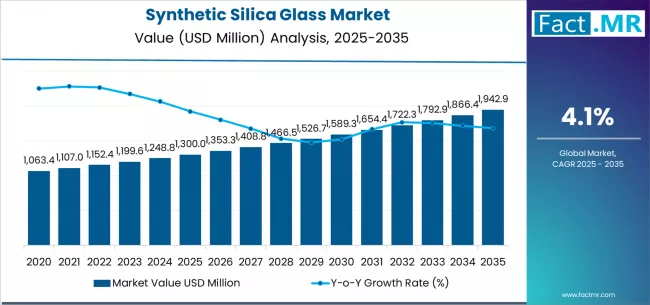
Synthetic Silica Glass Market Market Value Analysis | Source: Fact.MR
Summary of Synthetic Silica Glass Market
- Market Overview
- The market is valued at USD 1.3 billion in 2025 and is projected to reach USD 2.02 billion by 2036.
- The industry is expected to grow at a 4.1% CAGR from 2026 to 2036, creating an incremental opportunity of USD 0.67 billion.
- The market is a high-purity, specification-driven materials category where semiconductor lithography node transitions, optical transmission requirements, and cleanroom contamination thresholds define supplier qualification.
- Demand and Growth Drivers
- Demand is rising as advanced logic and memory fabrication node transitions below 5nm require UV-grade synthetic silica glass with tighter homogeneity and transmission specifications for photomask and stepper lens applications.
- Government semiconductor incentive programmes in India, USA, and the European Union are funding new fabrication facilities that generate procurement orders for high-purity quartz components.
- Optical fibre preform production and laboratory-grade quartz consumable replacement cycles contribute secondary demand alongside the primary semiconductor pull.
- Among key countries, India leads at 5.0% CAGR, followed by China at 4.5%, Taiwan at 4.0%, USA at 3.8%, South Korea at 3.7%, Germany at 3.5%, and Japan at 3.4%.
- Product and Segment View
- Synthetic silica glass is a high-purity amorphous silicon dioxide material produced through vapour deposition or flame hydrolysis processes, offering superior UV transmission and thermal stability compared to natural quartz.
- Primary applications include semiconductor photolithography substrates, optical device components, fibre optic preforms, and laboratory-grade quartz consumables.
- UV Grade leads by Type with 40.0% share in 2026, driven by photomask blank and stepper lens procurement specifications at advanced semiconductor fabrication nodes.
- Semiconductor leads by End Use with 45.0% share in 2026, reflecting the dominant volume pull from wafer fabrication facility component procurement cycles.
- Scope includes synthetic fused silica produced via vapour deposition or flame hydrolysis for semiconductor, optical, and laboratory applications, excluding natural quartz, fused silica sand, and commodity glass products.
- Geography and Competitive Outlook
- India and China are the fastest-growing markets, propelled by semiconductor fabrication incentive programmes and domestic photomask blank localization initiatives.
- Taiwan, South Korea, and Japan maintain high-value demand tied to established foundry and memory fabrication clusters requiring continuous silica component replenishment.
- Competition centres on vapour deposition purity control, large-diameter ingot production capability, and semiconductor OEM qualification status, with key players including Heraeus Holding GmbH, Shin-Etsu Quartz Products Co. Ltd., Tosoh Corporation, Corning Incorporated, AGC Inc., Nikon Corporation, HOYA Corporation, Momentive Technologies, Ohara Inc., QSIL GmbH, and GCL Opto.
Synthetic Silica Glass Market Key Takeaways
| Metric | Details |
|---|---|
| Industry Size (2026) | USD 1.35 billion |
| Industry Value (2036) | USD 2.02 billion |
| CAGR (2026 to 2036) | 4.1% |
Source: Fact.MR analysis. Updated Mar 27, 2026
Source: Fact.MR, 2026
Absolute dollar opportunity between 2026 and 2036 stands at approximately USD 0.67 billion. Growth reflects the expanding semiconductor fabrication cycle and increasing lithography wavelength requirements that mandate ultra-high-purity fused silica substrates. Capacity additions at advanced logic and memory fabrication facilities are pulling demand for UV-grade silica glass components used in photomask blanks, stepper lenses, and wafer handling tools. Optical fibre preform consumption and laboratory-grade quartz requirements add secondary demand layers, though pricing pressure from Chinese synthetic quartz entrants constrains margin expansion for established producers.
All major semiconductor and optics markets reflect measured expansion. India sets the pace at 5.0% CAGR as new semiconductor fabrication incentive programmes create demand for photolithography-grade silica components. China follows at 4.5%, supported by domestic fab construction and photomask blank localization efforts. Taiwan maintains 4.0% growth anchored by leading-edge foundry capacity expansions. USA advances at 3.8% under CHIPS Act funded fabrication facility buildouts. South Korea tracks at 3.7% tied to memory chip production upgrades. Germany registers 3.5% growth as optical instrument manufacturers and EUV component suppliers expand specification requirements. Japan maintains a 3.4% trajectory sustained by its established quartz glass production base serving both domestic and export lithography supply chains.
Why is the Synthetic Silica Glass Market Growing?
Market expansion is being supported by the increasing demand for precision optical components and the corresponding need for high-efficiency manufacturing systems in synthetic silica glass applications across global semiconductor and optical device operations. Modern electronics manufacturers are increasingly focused on advanced optical technologies that can improve production efficiency, reduce defect rates, and enhance product performance while meeting stringent purity requirements. The proven efficacy of synthetic silica glass in various manufacturing applications makes them an essential component of comprehensive production strategies and precision manufacturing programs.
The growing emphasis on electronics industry transformation and advanced manufacturing optimization is driving demand for ultra-efficient optical systems that meet stringent performance specifications and quality requirements for specialized applications. Electronics manufacturers' preference for reliable, high-performance optical systems that can ensure consistent product quality is creating opportunities for innovative synthetic silica glass technologies and customized manufacturing solutions. The rising influence of quality standards and manufacturing protocols is also contributing to increased adoption of premium-grade optical systems across different manufacturing applications and production systems requiring advanced precision technology.
Opportunity Pathways - Synthetic Silica Glass Market
The synthetic silica glass market represents a specialized growth opportunity, expanding from USD 1,300.0 million in 2025 to USD 1,950.0 million by 2035 at a 4.1% CAGR. As manufacturers prioritize production efficiency, quality compliance, and performance optimization in complex manufacturing processes, optical systems have evolved from a niche manufacturing technology to an essential component enabling production enhancement, quality optimization, and multi-stage manufacturing production across industrial operations and specialized manufacturing applications.
The convergence of manufacturing expansion, increasing optical adoption, specialized production organization growth, and precision requirements creates momentum in demand. High-efficiency formulations offering superior optical performance, cost-effective UV grade systems balancing performance with economics, and specialized IR grade variants for premium applications will capture market premiums, while geographic expansion into high-growth Asian manufacturing markets and emerging market penetration will drive volume leadership. Industry emphasis on performance quality and reliability provides structural support.
- Pathway A - UV Grade Dominance: Leading with 40.0% market share, UV grade applications drive primary demand through complex manufacturing workflows requiring comprehensive optical systems for precision production. Advanced formulations enabling improved product quality, reduced defect rates, and enhanced manufacturing performance command premium pricing from manufacturers requiring stringent performance specifications and quality compliance. Expected revenue pool: USD 520.0-780.0 million.
- Pathway B - Semiconductor Leadership: Dominating with 45.0% market share through an optimal balance of performance and application suitability, semiconductor serves most manufacturing applications while meeting precision requirements. This end-use addresses both performance standards and technical considerations, making it the preferred choice for manufacturing and production operations seeking reliable optical performance. Opportunity: USD 585.0-877.5 million.
- Pathway C - Asian Market Acceleration: India (5.0% CAGR) and China (4.5% CAGR) lead global growth through manufacturing infrastructure expansion, technology adoption development, and domestic synthetic silica glass demand. Strategic partnerships with local manufacturers, quality compliance expertise, and supply chain localization enable the expansion of optical technology in major manufacturing hubs. Geographic expansion upside: USD 200.0-400.0 million.
- Pathway D - Rods Premium Segment: Rods serve specialized applications requiring exceptional performance specifications for critical manufacturing processes. Rod formulations supporting precision requirements, complex optical applications, and performance-sensitive processes command significant premiums from advanced manufacturing organizations and specialized production facilities. Revenue potential: USD 455.0-682.5 million.
- Pathway E - Advanced Manufacturing & Technology Systems: Companies investing in sophisticated optical technologies, precision manufacturing systems, and automated production processes gain competitive advantages through consistent system performance and quality reliability. Advanced capabilities enabling customized specifications and rapid deployment capture premium manufacturing partnerships. Technology premium: USD 150.0-300.0 million.
- Pathway F - Supply Chain Optimization & Reliability: Specialized distribution networks, strategic inventory management, and reliable supply chain systems create competitive differentiation in manufacturing markets requiring consistent synthetic silica glass availability. Companies offering guaranteed supply security, technical support, and quality documentation gain preferred supplier status with compliance-focused manufacturers. Supply chain value: USD 100.0-200.0 million.
- Pathway G - Emerging Applications & Market Development: Beyond traditional UV grade applications, synthetic silica glass in specialty optical devices, premium laboratory equipment, and novel manufacturing systems represent growth opportunities. Companies developing new applications, supporting R&D initiatives, and expanding into adjacent manufacturing markets capture incremental demand while diversifying revenue streams. Emerging opportunity: USD 80.0-150.0 million.
Segmental Analysis
The market is segmented by type, form, end use, and region. By type, the market is divided into UV grade, IR grade, and others. Based on form, the market is categorized into rods, plates, tubes, and others. By end use, the market is divided into semiconductor, optical devices, and laboratory/other. Regionally, the market is divided into Asia Pacific, North America, Europe, Latin America, Middle East & Africa.
By Type, UV Grade Segment Accounts for 40% Market Share
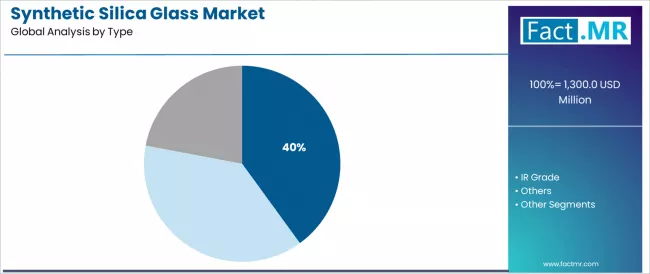
Synthetic Silica Glass Market Analysis By Type | Source: Fact.MR
The UV grade segment is projected to account for 40% of the synthetic silica glass market in 2026, reaffirming its position as the category's dominant type. Manufacturers increasingly recognize the optimal balance of performance and versatility offered by UV grade for most industrial applications, particularly in semiconductor manufacturing and optical device production processes. This type addresses both performance requirements and technical considerations while providing reliable quality across diverse manufacturing applications.
This type forms the foundation of most manufacturing protocols for optical applications, as it represents the most widely accepted and commercially viable level of synthetic silica glass technology in the industry. Quality control standards and extensive performance testing continue to strengthen confidence in UV grade formulations among manufacturing and production providers. With increasing recognition of the performance optimization requirements in industrial applications, UV grade systems align with both operational efficiency and product quality goals, making them the central growth driver of comprehensive manufacturing strategies.
By End Use, Semiconductor Segment Accounts for 45% Market Share
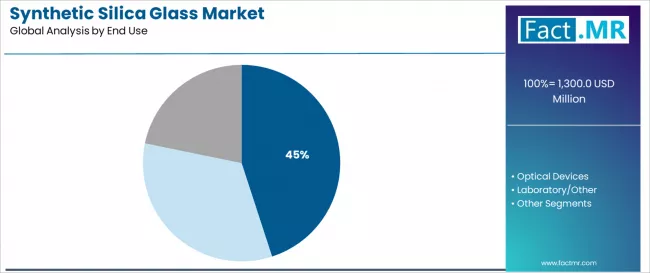
Synthetic Silica Glass Market Analysis By End Use | Source: Fact.MR
Semiconductor is projected to represent 45% of synthetic silica glass demand in 2026, underscoring its role as the primary end-use segment driving market adoption and growth. Manufacturers recognize that semiconductor requirements, including complex fabrication processes, specialized performance needs, and multi-stage production systems, often require advanced optical materials that standard manufacturing technologies cannot adequately provide. Synthetic silica glass offers enhanced manufacturing performance and quality compliance in semiconductor manufacturing applications.
The segment is supported by the growing nature of semiconductor adoption, requiring sophisticated optical systems, and the increasing recognition that advanced synthetic silica glass technologies can improve manufacturing performance and production outcomes. Manufacturers are increasingly adopting evidence-based quality guidelines that recommend specific optical materials for optimal production efficiency. As understanding of semiconductor complexity advances and manufacturing requirements become more stringent, synthetic silica glass will continue to play a crucial role in comprehensive production strategies within the semiconductor market.
By Form, Rods Segment Accounts for 35% Market Share
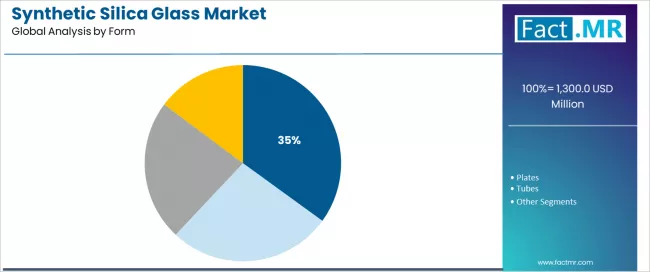
Synthetic Silica Glass Market Analysis By Form | Source: Fact.MR
Rods are projected to represent 35% of synthetic silica glass demand in 2026, establishing their position as the leading form segment in the market. Manufacturers recognize that rod applications, including precision optical components, specialized manufacturing tools, and high-performance production systems, require advanced synthetic silica glass materials that can provide superior dimensional stability and optical clarity. Rod formulations offer enhanced manufacturing capabilities and performance consistency in precision optical applications.
The segment benefits from the specialized nature of rod applications, requiring precise dimensional control, and the increasing recognition that advanced rod technologies can improve optical performance and manufacturing outcomes. Manufacturing organizations are increasingly adopting quality standards that specify rod materials for critical optical applications, supporting continued growth within this form segment.
What are the Drivers, Restraints, and Key Trends of the Synthetic Silica Glass Market?
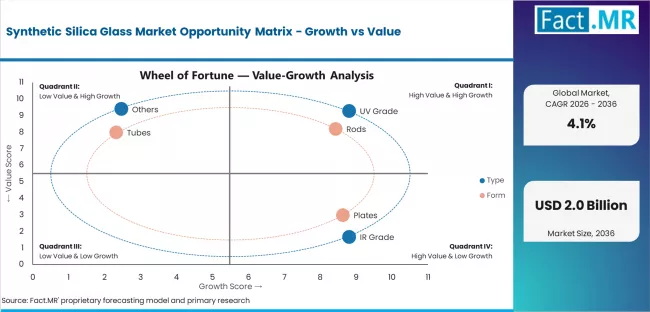
Synthetic Silica Glass Market Opportunity Matrix Growth Vs Value | Source: Fact.MR
The synthetic silica glass market is advancing steadily due to increasing recognition of optical technologies' importance and growing demand for high-efficiency manufacturing systems across the semiconductor and optical device sectors. The market faces challenges, including complex integration processes, potential for quality variations during production and processing, and concerns about supply chain consistency for specialized manufacturing equipment. Innovation in optical technologies and customized manufacturing protocols continues to influence product development and market expansion patterns.
Expansion of Advanced Manufacturing Facilities and Optical Technologies
The growing adoption of advanced manufacturing facilities is enabling the development of more sophisticated optical production and quality control systems that can meet stringent performance requirements. Specialized manufacturing facilities offer comprehensive optical services, including advanced fabrication and precision processing that are particularly important for achieving high-efficiency requirements in semiconductor applications. Advanced manufacturing channels provide access to premium services that can optimize product performance and reduce defect rates while maintaining cost-effectiveness for large-scale production operations.
Integration of Quality Control Systems and Manufacturing Management Systems
Modern manufacturing organizations are incorporating advanced technologies such as real-time performance monitoring, automated quality systems, and supply chain integration to enhance optical material production and distribution processes. These technologies improve material performance, enable continuous quality monitoring, and provide better coordination between suppliers and manufacturers throughout the production cycle. Advanced quality platforms also enable customized performance specifications and early identification of potential material deviations or supply disruptions, supporting reliable manufacturing production.
Analysis of the Synthetic Silica Glass Market by Key Country
.webp "Top Country Growth Comparison Synthetic Silica Glass Market Cagr (2026 2036)")
Top Country Growth Comparison Synthetic Silica Glass Market Cagr (2026 2036) | Source: Fact.MR
| Country | CAGR (2026-2036) |
|---|---|
| India | 5.0% |
| China | 4.5% |
| Taiwan | 4.0% |
| USA | 3.8% |
| South Korea | 3.7% |
| Germany | 3.5% |
| Japan | 3.4% |
Source: Fact.MR analysis. Updated Mar 27, 2026
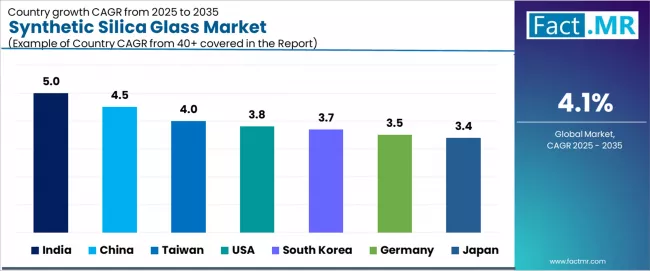
Synthetic Silica Glass Market Cagr Analysis By Country | Source: Fact.MR
The synthetic silica glass market is experiencing varied growth globally, with India leading at a 5.0% CAGR through 2036, driven by the expansion of manufacturing infrastructure development, increasing technology adoption capabilities, and growing domestic demand for high-efficiency optical systems. China follows at 4.5%, supported by manufacturing expansion, growing recognition of advanced optical technology importance, and expanding production capacity. Taiwan records 4.0% growth, with a focus on developing the semiconductor technology and electronics manufacturing industries. USA shows 3.8% growth, representing a mature market with established manufacturing patterns and technology frameworks. South Korea demonstrates 3.7% growth with focus on advanced manufacturing adoption. Germany demonstrates 3.5% growth, emphasizing manufacturing infrastructure expansion and systematic technology approaches. Japan demonstrates 3.4% growth, emphasizing manufacturing infrastructure expansion and systematic technology approaches.
India Demonstrates Growing Market Potential with Manufacturing Infrastructure Development
Revenue from synthetic silica glass in India is projected to exhibit robust growth with a CAGR of 5.0% through 2036, driven by ongoing manufacturing expansion and increasing recognition of high-efficiency optical systems as essential production components for complex manufacturing processes. The country's expanding manufacturing infrastructure and growing availability of specialized fabrication capabilities are creating significant opportunities for synthetic silica glass adoption across both domestic and export-oriented production facilities. Major international and domestic manufacturing companies are establishing comprehensive production and distribution networks to serve the growing population of manufacturers and production facilities requiring high-performance optical systems across industrial and manufacturing applications throughout India's major manufacturing hubs.
The Indian government's strategic emphasis on manufacturing modernization and technology advancement is driving substantial investments in specialized fabrication capabilities. This policy support, combined with the country's large domestic manufacturing market and expanding technology requirements, creates a favorable environment for the synthetic silica glass market development. Indian manufacturers are increasingly focusing on high-value production technologies to improve manufacturing capabilities, with optical systems representing a key component in this industrial transformation.
- Government initiatives supporting manufacturing development and technology modernization are driving demand for high-efficiency optical systems throughout major manufacturing and production centers, including Mumbai, Delhi, and Bangalore regions.
- Manufacturing capacity expansion and fabrication system development are supporting appropriate utilization of optical materials among manufacturers and production facilities nationwide, with particular growth in semiconductor operations and electronics manufacturing services.
China Demonstrates Exceptional Market Potential with Manufacturing Growth
Demand for synthetic silica glass in China is expanding at a CAGR of 4.5%, supported by increasing manufacturing accessibility, growing technology awareness, and developing industrial market presence across the country's major manufacturing clusters. The country's large manufacturing sector and increasing recognition of advanced optical systems are driving demand for effective high-efficiency precision solutions in both semiconductor manufacturing and optical device applications. International manufacturing companies and domestic providers are establishing comprehensive distribution channels to serve the growing demand for quality optical systems while supporting the country's position as an emerging manufacturing technology market.
China's manufacturing sector continues to benefit from favorable industrial policies, expanding production capabilities, and cost-competitive manufacturing infrastructure development. The country's focus on becoming a global manufacturing technology hub is driving investments in specialized optical technology and production infrastructure. This development is particularly important for synthetic silica glass applications, as manufacturers seek reliable domestic sources for critical optical technologies to reduce import dependency and improve supply chain security.
- Rising awareness about advanced optical options and improving manufacturing capabilities are creating opportunities for specialized synthetic silica glass systems across industrial and manufacturing settings in major hubs like Beijing, Shanghai, and Guangzhou.
- Growing manufacturing infrastructure development and technology adoption are supporting increased access to high-efficiency optical services among organizations requiring comprehensive precision capabilities, particularly in semiconductor manufacturing and electronics production organizations.
Taiwan Maintains Technology Leadership
Advanced semiconductor manufacturing market in Taiwan demonstrates sophisticated optical component deployment with documented synthetic silica glass effectiveness in production departments and manufacturing centers through integration with existing manufacturing systems and precision infrastructure. The country leverages technical expertise in semiconductor technology and manufacturing systems integration to maintain a 4.0% CAGR through 2036. Manufacturing centers, including major industrial areas, showcase premium installations where optical systems integrate with comprehensive manufacturing information systems and production platforms to optimize precision accuracy and operational workflow effectiveness.
Taiwanese manufacturers prioritize system reliability and quality compliance in technology development, creating demand for premium systems with advanced features, including performance validation and integration with Taiwan manufacturing standards. The market benefits from established semiconductor industry infrastructure and a willingness to invest in advanced optical technologies that provide long-term operational benefits and compliance with manufacturing regulations.
USA Shows Strong Technology Leadership
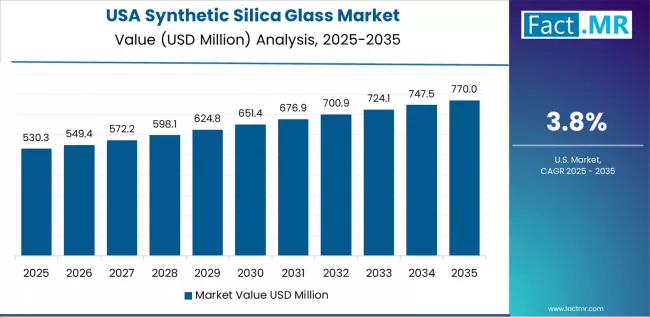
Synthetic Silica Glass Market Country Value Analysis | Source: Fact.MR
Synthetic silica glass market expansion in the USA benefits from diverse manufacturing demand, including semiconductor modernization in California and Texas, technology development programs, and government manufacturing programs that increasingly incorporate synthetic silica glass solutions for performance enhancement applications. The country maintains a 3.8% CAGR through 2036, driven by rising technology awareness and increasing adoption of optical benefits, including superior manufacturing capabilities and reduced complexity.
Market dynamics focus on cost-effective optical solutions that balance advanced performance features with affordability considerations important to US manufacturing operators. Growing manufacturing infrastructure creates demand for modern optical systems in new production facilities and manufacturing equipment modernization projects.
Strategic Market Considerations:
- Manufacturing and semiconductor segments leading growth with focus on performance enhancement and operational efficiency applications
- Regional technology requirements are driving a diverse product portfolio from basic optical systems to advanced precision platforms
- Import dependency challenges offset by potential local development partnerships with international optical manufacturers
- Government manufacturing initiatives beginning to influence procurement standards and technology requirements
South Korea Shows Strong Technology Development
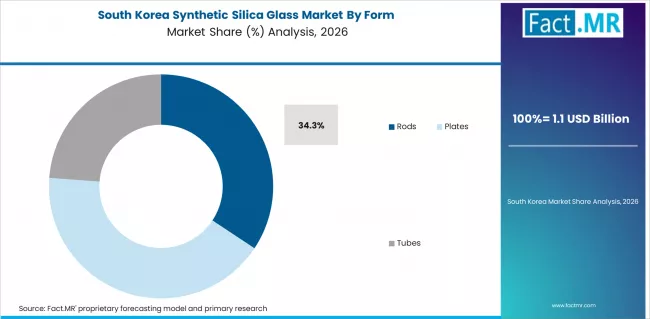
Synthetic Silica Glass Market South Korea Market Share Analysis By Form | Source: Fact.MR
South Korea demonstrates strong market development with a 3.7% CAGR through 2036, distinguished by manufacturing operators' preference for high-quality optical systems that integrate seamlessly with existing production equipment and provide reliable long-term operation in specialized manufacturing applications. The market prioritizes advanced features, including precision optical algorithms, quality validation, and integration with comprehensive manufacturing platforms that reflect South Korean technology expectations for technological advancement and operational excellence.
South Korean manufacturers focus on system reliability and precision in technology development, creating demand for premium systems with advanced features including automated quality monitoring and comprehensive technical support. The market benefits from established manufacturing research infrastructure and investment in optical technology that provides long-term manufacturing benefits.
Strategic Market Indicators:
- Premium focus on precision systems with advanced optical algorithms and high-reliability capabilities
- Integration requirements with existing manufacturing information systems and production management platforms
- Emphasis on optical reliability and long-term performance in manufacturing applications
Germany Shows Steady Market Growth
Germany demonstrates steady market development with a 3.5% CAGR through 2036, distinguished by manufacturing operators' preference for high-quality optical systems that integrate seamlessly with existing production equipment and provide reliable long-term operation in specialized manufacturing applications. The market prioritizes advanced features, including precision optical algorithms, quality validation, and integration with comprehensive manufacturing platforms that reflect German manufacturing expectations for technological advancement and operational excellence.
German manufacturers focus on system reliability and precision in technology development, creating demand for premium systems with advanced features including automated quality monitoring and comprehensive technical support. The market benefits from established manufacturing research infrastructure and investment in optical technology that provides long-term manufacturing benefits.
Strategic Market Indicators:
- Premium focus on precision systems with advanced optical algorithms and high-reliability capabilities
- Integration requirements with existing manufacturing information systems and production management platforms
- Emphasis on optical reliability and long-term performance in manufacturing applications
Japan Emphasizes Precision and Integration Excellence
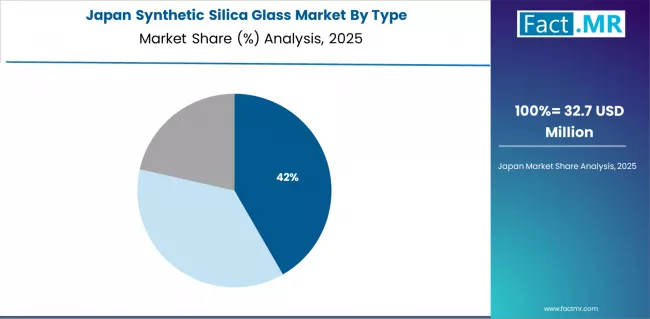
Synthetic Silica Glass Market Japan Market Share Analysis By Type | Source: Fact.MR
Japan demonstrates steady market development with a 3.4% CAGR through 2036, distinguished by manufacturing operators' preference for high-quality optical systems that integrate seamlessly with existing production equipment and provide reliable long-term operation in specialized manufacturing applications. The market prioritizes advanced features, including precision optical algorithms, quality validation, and integration with comprehensive manufacturing platforms that reflect Japanese manufacturing expectations for technological advancement and operational excellence.
Japanese manufacturers focus on system reliability and precision in technology development, creating demand for premium systems with advanced features including automated quality monitoring and comprehensive technical support. The market benefits from established manufacturing research infrastructure and investment in optical technology that provides long-term manufacturing benefits.
Strategic Market Indicators:
- Premium focus on precision systems with advanced optical algorithms and high-reliability capabilities
- Integration requirements with existing manufacturing information systems and production management platforms
- Emphasis on optical reliability and long-term performance in manufacturing applications
Europe Market Split by Country
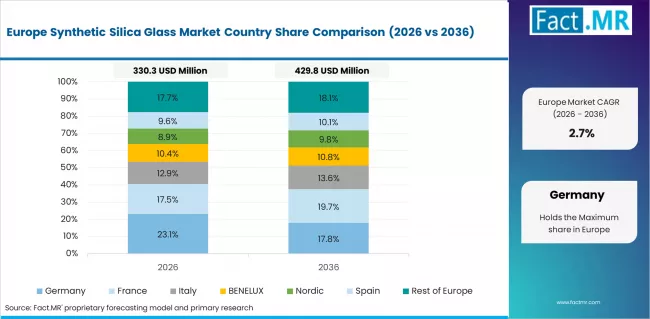
Synthetic Silica Glass Market Europe Country Market Share Analysis, 2026 & 2036 | Source: Fact.MR
The synthetic silica glass market in Europe is projected to grow steadily with individual country performance varying across the region. Germany is expected to maintain its leadership position with a market value of USD 300.0 million in 2026, supported by its advanced manufacturing infrastructure, precision optical capabilities, and strong industrial presence throughout major manufacturing regions.
UK follows with USD 200.0 million in 2026, driven by advanced optical protocols, manufacturing innovation integration, and expanding specialty production networks serving both domestic and international markets. France holds USD 160.0 million in 2026, supported by manufacturing infrastructure expansion and growing adoption of high-efficiency optical systems. Italy commands USD 130.0 million in 2026, while Spain accounts for USD 100.0 million in 2026. The Rest of Europe region, including Nordic countries, Eastern Europe, and smaller Western European markets, holds USD 410.0 million in 2026, representing diverse market opportunities with established manufacturing and technology capabilities.
Competitive Landscape of the Synthetic Silica Glass Market
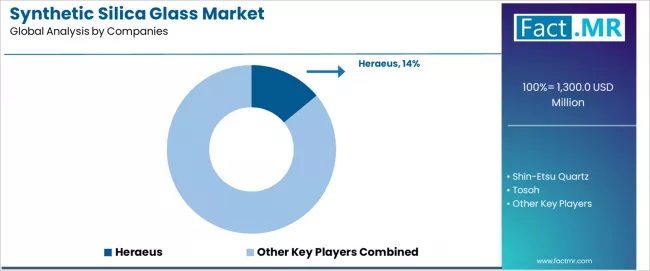
Synthetic Silica Glass Market Analysis By Company | Source: Fact.MR
The synthetic silica glass market is characterized by competition among established optical companies, specialty manufacturing companies, and technology suppliers focused on delivering high-efficiency, consistent, and reliable optical systems. Companies are investing in optical technology advancement, performance control enhancement, strategic partnerships, and customer technical support to deliver effective, efficient, and reliable synthetic silica glass solutions that meet stringent manufacturing and industrial requirements. Product optimization, performance validation protocols, and supply chain strategies are central to strengthening product portfolios and market presence.
Heraeus leads the market with comprehensive high-efficiency optical system offerings with a focus on performance consistency and material reliability for manufacturing applications, holding 14.0% market share. Shin-Etsu Quartz provides specialized optical systems with emphasis on semiconductor applications and comprehensive technical support services. Tosoh focuses on advanced optical technologies and customized manufacturing solutions for precision systems serving global markets. Corning delivers established manufacturing systems with strong quality control systems and customer service capabilities.
AGC operates with a focus on bringing innovative optical technologies to specialized manufacturing applications and emerging markets. Nikon provides comprehensive optical system portfolios, including advanced manufacturing services, across multiple industrial applications and production processes. HOYA specializes in customized optical solutions and performance management systems for manufacturing systems with emphasis on quality compliance. Momentive provides reliable supply chain solutions and technical expertise to enhance market accessibility and customer access to essential optical systems.
Key Players in the Synthetic Silica Glass Market
- Heraeus
- Shin-Etsu Quartz
- Tosoh
- Corning
- AGC
- Nikon
- HOYA
- Momentive
- Luvata
- Suprasil
- UQG Optics
- Ohara
- Leoni Fiber
- QSIL
- GCL Opto
Bibliography
- SEMI. (2024). SEMI C10-0324: Specification for synthetic fused silica used as photomask substrates. SEMI International Standards.
- United States Congress. (2022). CHIPS and Science Act of 2022 (Public Law 117-167): semiconductor fabrication incentive programme. U.S. Government Publishing Office.
- European Commission. (2024). European Chips Act: Council Regulation (EU) 2023/1781 implementation guidance for semiconductor ecosystem investments. Official Journal of the European Union.
- Ministry of Electronics and Information Technology, Government of India. (2024). India Semiconductor Mission: modified programme guidelines for semiconductor and display fabrication units. MeitY.
- International Organization for Standardization. (2024). ISO 13320:2020 Particle size analysis: laser diffraction methods, applied to synthetic silica characterization. ISO.
- Semiconductor Industry Association. (2024). 2024 State of the U.S. semiconductor industry report. SIA.
This bibliography is provided for reader reference. The full Fact.MR report contains the complete reference list with primary research documentation.
This Report Addresses
- Market sizing and quantitative forecast metrics detailing the precise materials expenditure dedicated to synthetic silica glass procurement across semiconductor, optical, and laboratory sectors through 2036.
- Segmentation analysis mapping the adoption velocity of UV-grade, IR-grade, and general-purpose synthetic quartz and evaluating the lithography node transitions driving purity specification tightening.
- Regional deployment intelligence comparing the expanding fab construction pipelines in India and China against the established semiconductor and optics production clusters in Taiwan, South Korea, and Japan.
- Regulatory and incentive assessment analyzing how CHIPS Act, European Chips Act, and India Semiconductor Mission allocations translate into synthetic silica glass procurement orders.
- Competitive posture evaluation tracking vapour deposition capacity investments, large-diameter ingot production capabilities, and semiconductor OEM qualification pipelines across leading quartz glass producers.
- Supply chain vulnerability analysis identifying silicon tetrachloride precursor pricing, cleanroom-grade logistics constraints, and long lead time risks for photomask-grade substrates.
- Custom data delivery formats encompassing interactive dashboards, raw Excel datasets, and comprehensive PDF narrative reports.
Synthetic Silica Glass Market Definition
Synthetic silica glass is a high-purity amorphous form of silicon dioxide manufactured through controlled vapour deposition, flame hydrolysis, or plasma oxidation of silicon-containing precursors such as silicon tetrachloride. Unlike natural fused quartz produced by melting mined quartz crystals, synthetic variants achieve parts-per-billion impurity levels, delivering superior ultraviolet transmission, thermal shock resistance, and dimensional stability required for semiconductor lithography optics and advanced photonic components. Core product grades include UV-transmitting, infrared-transmitting, and general-purpose synthetic quartz. End buyers include semiconductor equipment manufacturers, photomask blank producers, optical fibre preform fabricators, and scientific instrument companies.
Synthetic Silica Glass Market Inclusions
Market scope includes UV-grade, IR-grade, and general-purpose synthetic silica glass produced via vapour deposition or flame hydrolysis processes. Coverage extends to global and regional market sizes, the 2026 to 2036 forecast period, and segment breakdowns by type, form, and end use. Pricing analysis for photomask-grade substrates and trade flow assessment across major semiconductor supply corridors are incorporated.
Synthetic Silica Glass Market Exclusions
The scope excludes natural fused quartz produced from mined quartz crystals, commodity silica sand, float glass, and borosilicate laboratory glassware. Finished semiconductor devices, optical fibre cables, and assembled photolithography equipment fall outside the analytical boundary. Synthetic quartz crystals grown for piezoelectric applications are explicitly omitted from the valuation.
Synthetic Silica Glass Market Research Methodology
- Primary Research: Analysts conducted structured consultations with quartz glass production engineers, semiconductor equipment procurement managers, photomask blank quality directors, and optical component specification leads to map the decision triggers governing synthetic silica sourcing and qualification.
- Desk Research: Data collection aggregated SEMI standards for photomask substrates, semiconductor fabrication capacity announcements, government incentive programme allocations, and published quartz glass manufacturer capacity expansion disclosures.
- Market-Sizing and Forecasting: Baseline values derive from a bottom-up aggregation of synthetic silica glass shipment volumes by grade, applying fab construction timelines and lithography node transition schedules to project demand through 2036.
- Data Validation and Update Cycle: Projections are cross-checked against semiconductor equipment manufacturer revenue guidance, photomask blank consumption disclosures, and quartz glass industry association production statistics to confirm directional alignment.
Segmentation
Scope of the Report
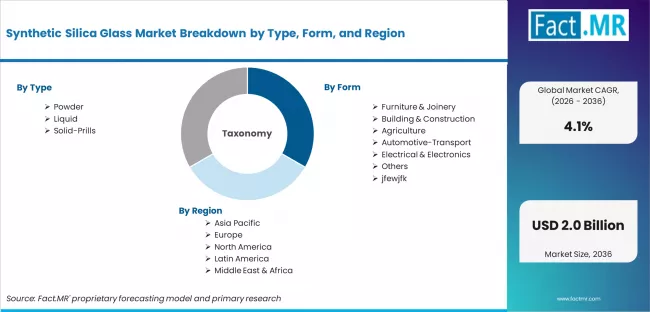
Synthetic Silica Glass Market Breakdown By Type, Form, And Region | Source: Fact.MR
| Metric | Value |
|---|---|
| Quantitative Units | USD 1.35 billion to USD 2.02 billion, at a CAGR of 4.1% |
| Market Definition | Synthetic silica glass is a high-purity amorphous silicon dioxide material produced through vapour deposition or flame hydrolysis, offering superior UV transmission and thermal stability for semiconductor, optical, and laboratory applications. |
| Type Segmentation | UV Grade, IR Grade, Others |
| Form Segmentation | Rods, Plates, Tubes, Others |
| End Use Segmentation | Semiconductor, Optical Devices, Laboratory/Other |
| Regions Covered | North America, Latin America, Europe, East Asia, South Asia, Oceania, Middle East & Africa |
| Countries Covered | India, China, Taiwan, USA, South Korea, Germany, Japan, and 40 plus countries |
| Key Companies Profiled | Heraeus Holding GmbH, Shin-Etsu Quartz Products Co. Ltd., Tosoh Corporation, Corning Incorporated, AGC Inc., Nikon Corporation, HOYA Corporation, Momentive Technologies, Ohara Inc., QSIL GmbH, GCL Opto |
| Forecast Period | 2026 to 2036 |
| Approach | Forecasting models apply a bottom-up methodology starting with global synthetic silica glass shipment volumes by grade and applying fab construction timelines, cross-validated against semiconductor equipment revenue guidance. |
Source: Fact.MR analysis. Updated Mar 27, 2026
Synthetic Silica Glass Market by Segments
-
Type :
- UV Grade
- IR Grade
- Others
-
Form :
- Rods
- Plates
- Tubes
- Others
-
End Use :
- Semiconductor
- Optical Devices
- Laboratory/Other
-
Region :
-
Asia Pacific
- China
- India
- Japan
- South Korea
- Taiwan
- ASEAN
- Australia & New Zealand
- Rest of Asia Pacific
-
North America
- United States
- Canada
- Mexico
-
Europe
- Germany
- United Kingdom
- France
- Italy
- Spain
- Nordic
- BENELUX
- Rest of Europe
-
Latin America
- Brazil
- Argentina
- Chile
- Rest of Latin America
-
Middle East & Africa
- Kingdom of Saudi Arabia
- Other GCC Countries
- Turkey
- South Africa
- Other African Countries
- Rest of Middle East & Africa
-
Frequently Asked Questions
How large is the demand for synthetic silica glass in the global market in 2026?
What will be the market size of synthetic silica glass in the global market by 2036?
What is the expected demand growth for synthetic silica glass in the global market between 2026 and 2036?
Which Type is poised to lead global sales by 2026?
How significant is the role of Semiconductor in driving synthetic silica glass adoption in 2026?
What is driving demand in India?
What is the India growth outlook in this report?
What is the main demand theme linked to Taiwan in its region coverage?
Who worked on this report


Preview the report firsthand - request a free sample
Free SampleGet the brochure for pricing and purchase details
Download PDF