- Base Value(2025): 2.9 Bn
- Estimated Value(2026): 3.3 Bn
- Forecast Value (2036): 11.2 Bn
- CAGR (2026 - 2036): 13.0%
Telematics-Linked Fleet Battery Health Management Systems Market Outlook and Forecast By Fact.MR
In 2025, the telematics-linked fleet battery health management systems market was valued at USD 2.9 billion. Fact MR analysis indicates demand for telematics-linked fleet battery health management systems is expected to reach USD 3.3 billion in 2026 and USD 11.2 billion by 2036. FMR estimates the market will expand at a CAGR of 13.0% across the forecast period.
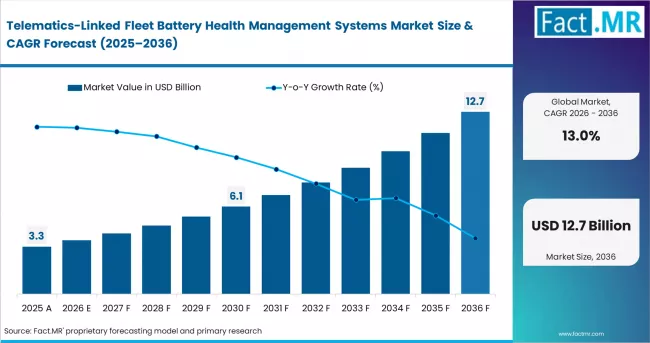
Telematics Linked Fleet Battery Health Management Systems Market Market Value Analysis | Source: Fact.MR
Telematics-Linked Fleet Battery Health Management Systems Market
| Metric | Details |
|---|---|
| Industry Size (2026E) | USD 3.3 billion |
| Industry Value (2036F) | USD 11.2 billion |
| CAGR (2026 to 2036) | 13.0% |
Source: Fact.MR analysis. Updated May 5, 2026
Summary of Telematics-Linked Fleet Battery Health Management Systems Market
- Market Definition:
- The telematics-linked fleet battery health management systems market refers to connected platforms that combine telematics communication with battery diagnostics to monitor performance, degradation, temperature variation, and charge cycles across fleet vehicles. These systems integrate sensors, telematics control units, analytics software, and cloud platforms to support predictive maintenance, optimize battery lifecycle, and improve operational uptime across electric fleet environments.
- Demand Drivers:
- Expansion of electric fleet vehicles increasing requirement for real-time battery health monitoring and lifecycle analytics capability.
- Rising adoption of predictive maintenance platforms supporting optimization of charging cycles and reduction of unexpected downtime.
- Increasing integration of telematics control units enabling continuous transmission of battery performance data across connected fleet networks.
- Growing focus on improving fleet uptime efficiency through remote diagnostics and condition-based battery maintenance scheduling.
- Development of cloud-connected analytics platforms supporting performance benchmarking across large fleet vehicle populations.
- Key Segments Analyzed:
- Battery Type: Lithium-ion batteries lead with 68.5% share supported by widespread use across electric commercial fleet vehicles.
- Deployment Type: Embedded telematics systems account for 54.7% share due to direct integration within vehicle electronic architecture.
- Component: Battery monitoring sensors and analytics software demonstrate strong adoption supporting real-time diagnostics capability.
- Application: Electric fleet vehicles and logistics fleet vehicles show increased integration supported by fleet electrification initiatives.
- Geography: China and India show strong growth supported by expansion of connected fleet infrastructure.
- Analyst Opinion at Fact MR:
- Shambhu Nath Jha, Principal Consultant at Fact MR, states, "Telematics-linked battery analytics platforms are becoming essential for fleet electrification as operators require continuous visibility of battery degradation patterns and operational performance. Suppliers capable of improving data accuracy and system interoperability will maintain strong positioning as connected fleet ecosystems expand."
- Strategic Implications:
- Strengthen integration between telematics communication modules and battery monitoring sensors supporting continuous diagnostics capability.
- Expand development of predictive analytics software supporting battery lifecycle optimization and maintenance scheduling.
- Improve interoperability between telematics platforms and fleet management software supporting unified data architecture.
- Support scalable cloud-connected platforms enabling monitoring across large electric fleet vehicle networks.
- Methodology:
- Based on primary interviews with telematics providers, fleet operators, battery analytics developers, and automotive electronics engineers.
- Supported by review of telematics platform documentation, battery diagnostics research, and connected fleet technology publications.
- Market estimation uses hybrid modeling combining telematics platform revenue benchmarking with evaluation of electric fleet deployment trends.
- Data validation conducted using technical literature and expert consultation inputs.
The increase from USD 3.3 billion in 2026 to USD 11.2 billion in 2036 reflects strong 10-year growth, indicating structural expansion of predictive diagnostics within connected commercial vehicle ecosystems. Adoption is supported by uptime optimization needs and battery lifecycle tracking, while moderated by data integration complexity, cybersecurity compliance requirements, and interoperability across telematics platforms and OEM systems.
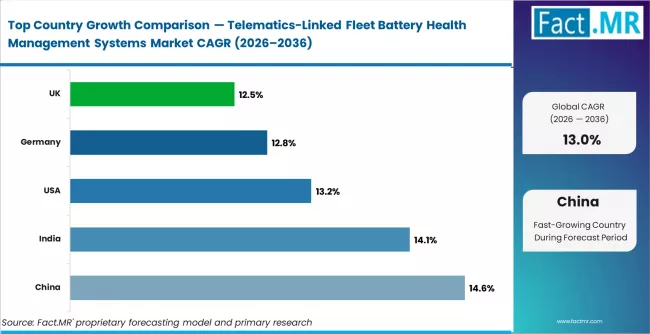
China records the fastest growth at 14.6%, supported by increasing deployment of connected fleet analytics platforms for electric commercial vehicle battery monitoring. India follows at 14.1%, driven by rising adoption of telematics-enabled predictive maintenance systems for fleet electrification programs. The USA shows 13.2% growth, linked to integration of cloud-based battery diagnostics across logistics fleet management networks. Germany at 12.8% and the United Kingdom at 12.5% represent mature markets where demand is largely replacement-driven due to established penetration of telematics infrastructure in commercial vehicle fleets. A structural constraint across mature markets is interoperability complexity with legacy fleet management software, which slows deployment of advanced battery analytics platforms.
Segmental Analysis
Telematics-Linked Fleet Battery Health Management Systems Market Analysis by Battery Type
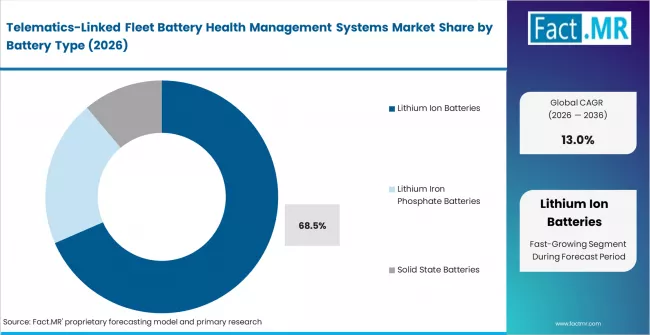
Telematics Linked Fleet Battery Health Management Systems Market Analysis By Battery Type | Source: Fact.MR
- Market Overview: Lithium-ion batteries are projected to hold 68.5% share of the telematics-linked fleet battery health management systems market in 2026. Demand concentration reflects widespread deployment of lithium-ion battery systems across electric commercial vehicles requiring continuous monitoring of charge cycles, temperature behavior, and degradation patterns through connected telematics platforms. Battery health management systems support predictive maintenance strategies across fleet operations utilizing high-capacity rechargeable battery architectures.
- Demand Drivers:
- Battery Performance Monitoring Requirements: Lithium-ion battery systems require real-time observation of voltage, temperature, and charge-discharge cycles to maintain operational stability across fleet vehicle applications.
- Predictive Maintenance Implementation: Telematics-enabled monitoring supports early identification of battery degradation trends enabling scheduled maintenance planning across commercial fleet environments.
- Fleet Electrification Expansion: Increasing deployment of electric commercial vehicles supports integration of connected battery health monitoring technologies aligned with lithium-ion battery system usage patterns.
Telematics-Linked Fleet Battery Health Management Systems Market Analysis by Deployment Type
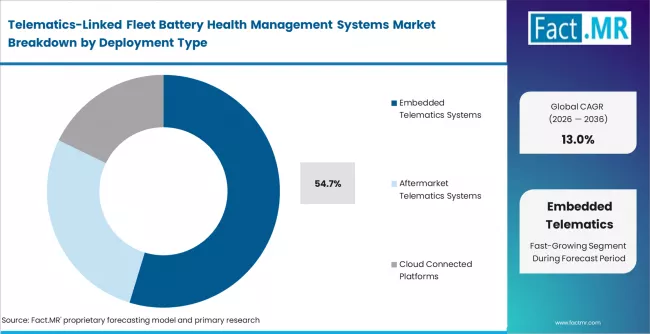
Telematics Linked Fleet Battery Health Management Systems Market Analysis By Deployment Type | Source: Fact.MR
- Market Overview: Embedded telematics is estimated to account for 54.7% share in 2026, supported by integration of communication modules directly within vehicle electronic architecture enabling continuous transmission of battery performance data to fleet management platforms. Embedded deployment supports automated data collection without dependence on external hardware connectivity configurations.
- Demand Drivers:
- Real-Time Data Transmission: Embedded telematics modules enable continuous communication of battery diagnostics information including temperature, state of charge, and performance indicators.
- System Integration Efficiency: Embedded solutions integrate with vehicle onboard control units supporting automated data exchange across fleet management software platforms.
- Operational Visibility Requirements: Fleet operators utilize embedded telematics infrastructure to maintain continuous visibility of battery condition across distributed electric vehicle networks.
Key Dynamics
Telematics-Linked Fleet Battery Health Management Systems Market Drivers, Restraints, and Opportunities
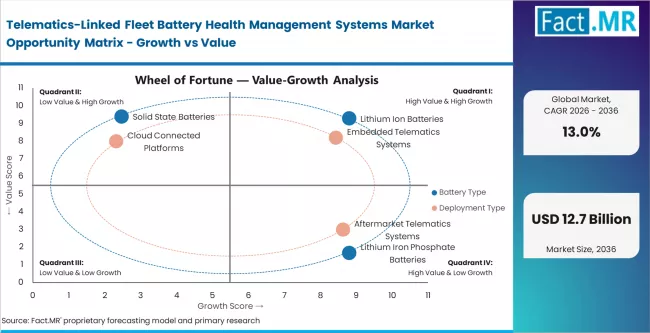
Telematics Linked Fleet Battery Health Management Systems Market Opportunity Matrix Growth Vs Value | Source: Fact.MR
Fact MR analysis indicates the market reflects a high-growth digital mobility infrastructure segment positioned between battery management systems and cloud-connected fleet telematics platforms. Market size exists because commercial electric fleets require continuous monitoring of battery state-of-health, charge cycles, degradation patterns, and thermal behavior to manage operational uptime and total cost of ownership. Structural demand is tied to electrification of logistics fleets, public transport buses, and last-mile delivery vehicles, where battery performance directly determines asset utilization efficiency and lifecycle cost predictability. Telematics platforms enable real-time data collection from onboard diagnostics systems, transforming battery condition data into predictive maintenance insights.
Current dynamics show declining reliance on standalone onboard battery management units that provide limited diagnostic visibility, while cloud-linked telematics battery analytics platforms command higher per-vehicle pricing due to integration of IoT sensors, AI-based predictive algorithms, and remote firmware update capability. Higher system costs are offset by reduced downtime risk, optimized charging schedules, and extended battery lifespan across commercial fleet operations. Market expansion reflects convergence between connected vehicle platforms and advanced battery analytics as fleet operators increasingly adopt predictive maintenance strategies to stabilize operating margins.
- Battery Passport Regulation: EU Battery Regulation 2023/1542 and ISO 26262 functional safety requirements are accelerating integration of cloud-connected battery diagnostics enabling lifecycle traceability and safety validation across EV fleets.
- Fleet Electrification Scale: North America, China, and Europe logistics fleets are expanding telematics deployment to monitor battery degradation patterns and optimize charging utilization across high-mileage commercial EV operations.
- Predictive Analytics Integration: AI-enabled telematics platforms analyze charge cycles, temperature exposure, and route energy consumption to predict battery replacement timing and reduce unexpected vehicle downtime.
Regional Analysis
The telematics-linked fleet battery health management systems market is assessed across Asia Pacific, Europe, and North America, segmented by country-level demand for cloud-connected battery diagnostics, predictive maintenance software, remote fleet monitoring platforms, and telematics-integrated energy performance analytics used in electric commercial fleets. Geographic variation reflects connected fleet adoption, electrified logistics expansion, and demand for predictive battery lifecycle management. The full report offers market attractiveness analysis.
.webp "Top Country Growth Comparison Telematics Linked Fleet Battery Health Management Systems Market Cagr (2026 2036)")
Top Country Growth Comparison Telematics Linked Fleet Battery Health Management Systems Market Cagr (2026 2036) | Source: Fact.MR
CAGR Table
| Country | CAGR (2026–2036) |
|---|---|
| China | 14.6% |
| India | 14.1% |
| USA | 13.2% |
| Germany | 12.8% |
| UK | 12.5% |
Source: Fact.MR analysis. Updated May 5, 2026
Source: Fact MR analysis, based on proprietary forecasting model and primary research
Telematics Linked Fleet Battery Health Management Systems Market Cagr Analysis By Country | Source: Fact.MR
Asia Pacific
Asia Pacific functions as the connected fleet electrification monitoring hub supported by expansion of electric commercial vehicles and integration of telematics-enabled battery analytics platforms. Huawei Digital Power strengthens battery analytics platform capability. Tata Elxsi expands connected vehicle diagnostics portfolio depth. CATL supports battery lifecycle monitoring innovation.
- China: China is projected to record 14.6% CAGR in telematics-linked fleet battery health management systems through 2036. Intelligent Connected Vehicle Development Strategy update (Ministry of Industry and Information Technology, January 2023) supports telematics-enabled fleet monitoring adoption. CATL expanded battery diagnostics platform capability (June 2023).
- India: India is expected to observe 14.1% CAGR in telematics-linked fleet battery health management systems through 2036. National Electric Mobility Mission Plan update (Ministry of Heavy Industries, March 2023) supports connected EV fleet management technologies. Tata Elxsi expanded telematics-enabled battery analytics capability (July 2023).
North America
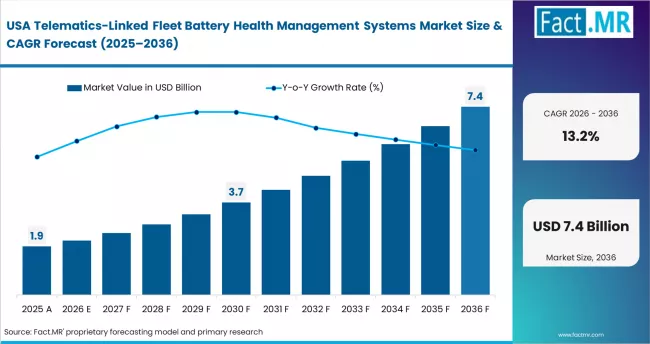
Telematics Linked Fleet Battery Health Management Systems Market Country Value Analysis | Source: Fact.MR
North America operates as the fleet analytics commercialization center supported by strong adoption of connected logistics platforms and increasing demand for predictive battery performance monitoring systems. Geotab Inc. strengthens fleet telematics analytics capability. Verizon Connect expands battery monitoring software portfolio depth. Samsara Inc. supports connected fleet intelligence innovation.
- USA: The USA is anticipated to expand at 13.2% CAGR in telematics-linked fleet battery health management systems through 2036. U.S. Department of Energy EV fleet infrastructure initiative update (February 2023) supports telematics-integrated battery performance monitoring adoption. Geotab Inc. expanded electric fleet analytics platform capability (August 2023).
Europe
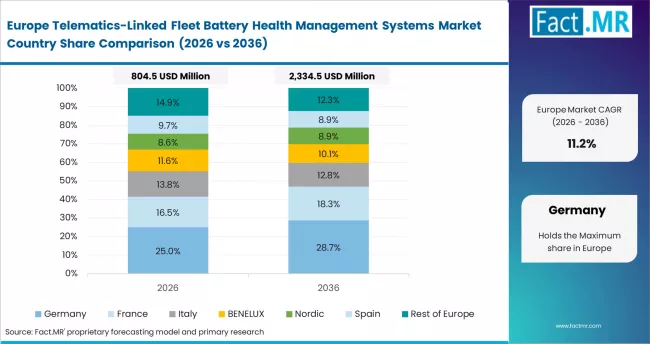
Telematics Linked Fleet Battery Health Management Systems Market Europe Country Market Share Analysis, 2026 & 2036 | Source: Fact.MR
Europe functions as the connected mobility compliance laboratory supported by strict vehicle emission frameworks and increasing integration of digital fleet monitoring technologies. Bosch Mobility Solutions strengthens telematics-enabled battery analytics capability. Continental AG expands fleet monitoring software portfolio depth. Vodafone Automotive supports connected vehicle data platform innovation.
- Germany: Germany is forecast to grow at 12.8% CAGR in telematics-linked fleet battery health management systems through 2036. EU Alternative Fuels Infrastructure Regulation update (European Commission, January 2023) supports connected EV fleet monitoring integration. Bosch Mobility Solutions expanded battery analytics software capability (May 2023).
- UK: The UK is projected to register 12.5% CAGR in telematics-linked fleet battery health management systems through 2036. Zero Emission Vehicle mandate implementation update (Department for Transport, March 2023) supports connected fleet electrification technologies. Vodafone Automotive expanded fleet telematics analytics capability (June 2023).
Fact MR's analysis of telematics-linked fleet battery health management systems market in global regions consists of country-wise assessment that includes China, India, USA, Germany, and UK. Readers can find connected fleet analytics trends, electric vehicle monitoring developments, regulatory positioning frameworks, and competitive telematics innovation insights.
Competitive Landscape
What is the Competitive Structure of the Telematics-Linked Fleet Battery Health Management Systems Market?
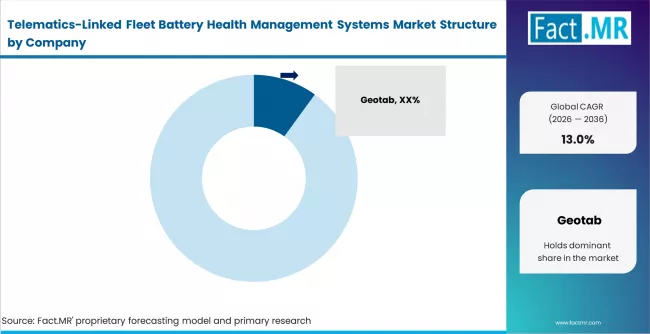
Telematics Linked Fleet Battery Health Management Systems Market Analysis By Company | Source: Fact.MR
The Telematics-Linked Fleet Battery Health Management Systems Market demonstrates a moderately fragmented competitive structure, supported by telematics platform providers and automotive electronics companies offering remote battery diagnostics and predictive maintenance capabilities. Leading companies including Geotab, Verizon Connect, Trimble, Samsara, Bosch, Continental, Octo Telematics, TomTom Telematics, Zonar Systems, and Teletrac Navman collectively account for approximately 50–60% of market presence, particularly in cloud-based monitoring systems used for electric commercial fleets and connected mobility operations. Competitive positioning is primarily determined by data analytics capability, integration with vehicle control systems, predictive maintenance accuracy, and scalability across multi-vehicle fleet environments. Technical expertise in telematics data processing and battery performance modeling creates moderate entry barriers, limiting rapid expansion of smaller software providers lacking advanced analytics infrastructure.
Structural advantages are observed among companies possessing established telematics platforms and long-term contracts with logistics operators and fleet management companies. Geotab and Samsara benefit from strong data collection networks and cloud analytics infrastructure supporting real-time battery performance monitoring and diagnostics. Buyers typically manage supplier dependency through multi-platform compatibility evaluation and integration benchmarking across existing fleet management software ecosystems. Procurement decisions often consider data accuracy, interoperability with vehicle electronic systems, and reliability of predictive maintenance algorithms. Pricing power remains relatively balanced, though suppliers retain moderate leverage where proprietary analytics capabilities and large connected vehicle datasets create switching constraints for fleet operators implementing battery health monitoring solutions.
Key Players of the Telematics-Linked Fleet Battery Health Management Systems Market
- Geotab
- Verizon Connect
- Trimble
- Samsara
- Bosch
- Continental
- Octo Telematics
- TomTom Telematics
- Zonar Systems
- Teletrac Navman
Bibliographies
- [1] Ministry of Industry and Information Technology (MIIT), China. (2025, January). The Emerging Intelligent and Connected Vehicle Industry in China (Development Plan Update).
- [2] Ministry of Heavy Industries, India. (2024, October). Status of Implementation of the National Electric Mobility Mission Plan (NEMMP) 2020.
- [3] U.S. Department of Energy. (2023, Q3). Electric Vehicle Charging Infrastructure Trends (Third Quarter 2023).
- [4] European Commission. (2023, September). Regulation (EU) 2023/1804 on the Deployment of Alternative Fuels Infrastructure (AFIR).
- [5] Department for Transport, UK. (2024, January). Pathway for Zero Emission Vehicle Transition by 2035 Becomes Law (ZEV Mandate).
- [6] China Association of Automobile Manufacturers (CAAM). (2020/2023). Interpretation of "Intelligent Connected Vehicle Technology Roadmap 2.0".
- [7] European Sources Online. (2023, April). Proposal for a Regulation on the Deployment of Alternative Fuels Infrastructure (AFIR).
- [8] Press Information Bureau, India. (2024, October). The Status of Implementation of the National Electric Mobility Mission Plan.
This Report Addresses
- Market size estimation and revenue forecast for 2026 to 2036 supported by electric fleet deployment benchmarks and telematics integration adoption data.
- Growth opportunity evaluation across battery monitoring sensors, telematics control units, analytics software, communication modules, and cloud connected platforms.
- Segment level demand assessment covering lithium ion, lithium iron phosphate, solid state, and nickel based battery monitoring environments.
- Regional adoption analysis identifying demand trends across Asia Pacific, Europe, and North America connected fleet ecosystems.
- Competitive benchmarking covering telematics platform providers specializing in predictive battery analytics, fleet diagnostics software, and connected vehicle data infrastructure.
- Technology evaluation assessing real time diagnostics capability, predictive maintenance algorithms, cloud connectivity architecture, and integration with fleet management systems.
- Supply chain assessment identifying dependency on IoT modules, embedded communication hardware, analytics software infrastructure, and interoperability validation cycles.
- Deliverables including PDF report, Excel dataset, presentation slides, and forecast models supporting fleet electrification planning and battery lifecycle optimization strategy.
Segmentation
Report Scope
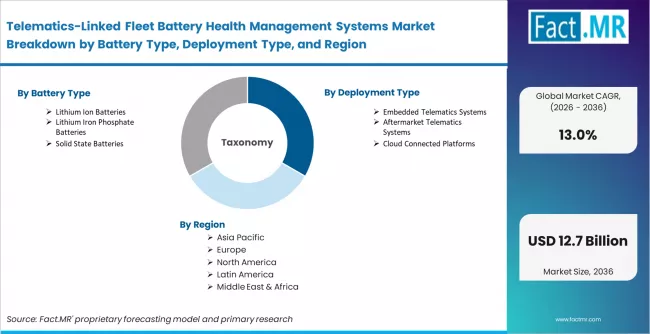
Telematics Linked Fleet Battery Health Management Systems Market Breakdown By Battery Type, Deployment Type, And Region | Source: Fact.MR
| Metric | Value |
|---|---|
| Quantitative Units | USD 3.3 billion (2026) to USD 11.2 billion (2036), at a CAGR of 13.0% |
| Market Definition | The telematics-linked fleet battery health management systems market includes integrated hardware and software platforms that monitor battery performance, operational conditions, and lifecycle parameters across connected fleet vehicles. These systems combine sensor data, telematics communication, and analytics tools to enable predictive maintenance, performance optimization, and remote diagnostics for electric mobility and fleet energy management applications. |
| Component Segmentation | Battery monitoring sensors, Telematics control units, Data analytics software, Communication modules, Cloud platforms |
| Battery Type Segmentation | Lithium-ion batteries, Lithium iron phosphate batteries, Solid-state batteries, Nickel-based batteries |
| Application Segmentation | Electric fleet vehicles, Logistics fleet vehicles, Public transport fleets, Construction fleet equipment, Shared mobility fleets |
| Deployment Type Segmentation | Embedded telematics systems, Aftermarket telematics systems, Cloud-connected platforms |
| Regions Covered | North America, Latin America, Europe, East Asia, South Asia, Oceania, Middle East and Africa |
| Countries Covered | United States, Canada, Mexico, Brazil, Argentina, Germany, France, United Kingdom, Italy, Spain, China, India, Japan, South Korea, Indonesia, Australia, and 40+ countries |
| Key Companies Profiled | Geotab, Verizon Connect, Trimble, Samsara, Bosch, Continental, Octo Telematics, TomTom Telematics, Zonar Systems, Teletrac Navman |
| Forecast Period | 2026 to 2036 |
| Approach | Hybrid top-down and bottom-up market estimation validated through primary interviews with telematics solution providers, fleet management platform developers, battery monitoring technology suppliers, and mobility service operators, supported by fleet electrification benchmarking, connected vehicle data analytics assessment, and evaluation of adoption trends across remote battery health management platforms |
Source: Fact.MR analysis. Updated May 5, 2026
Telematics Linked Fleet Battery Health Management Systems Market Key Segments
-
Component
- Battery Monitoring Sensors
- Telematics Control Units
- Data Analytics Software
- Communication Modules
- Cloud Platforms
-
Battery Type
- Lithium Ion Batteries
- Lithium Iron Phosphate Batteries
- Solid State Batteries
- Nickel Based Batteries
-
Application
- Electric Fleet Vehicles
- Logistics Fleet Vehicles
- Public Transport Fleets
- Construction Fleet Equipment
- Shared Mobility Fleets
-
Deployment Type
- Embedded Telematics Systems
- Aftermarket Telematics Systems
- Cloud Connected Platforms
-
Region
- North America
- USA
- Canada
- Mexico
- Europe
- Germany
- UK
- France
- Italy
- Spain
- Nordic Countries
- BENELUX
- Rest of Europe
- Asia Pacific
- China
- Japan
- South Korea
- India
- Australia
- Rest of Asia Pacific
- Latin America
- Brazil
- Argentina
- Rest of Latin America
- Middle East and Africa
- Kingdom of Saudi Arabia
- United Arab Emirates
- South Africa
- Rest of Middle East and Africa
- Other Regions
- Oceania
- Central Asia
- Other Markets
- North America
Frequently Asked Questions
How large is the demand for Telematics Linked Fleet Battery Health Management Systems in the global market in 2026?
What will be the market size of Telematics Linked Fleet Battery Health Management Systems in the global market by 2036?
What is the expected demand growth for Telematics Linked Fleet Battery Health Management Systems in the global market between 2026 and 2036?
Which Battery Type is poised to lead global demand by 2026?
What is Driving Telematics Linked Fleet Battery Health Management System Demand in China?
What is the China Growth Outlook in this Report?
What is Driving Telematics Linked Fleet Battery Health Management System Demand in India?
What is the India Growth Outlook in this Report?
What is Driving Telematics Linked Fleet Battery Health Management System Demand in the United States?
What is the United States Growth Outlook in this Report?
What is Driving Telematics Linked Fleet Battery Health Management System Demand in Germany?
What is the Germany Growth Outlook in this Report?
What is Driving Telematics Linked Fleet Battery Health Management System Demand in the United Kingdom?
What is the United Kingdom Growth Outlook in this Report?
Which Companies are Identified as Leading Participants in the Telematics Linked Fleet Battery Health Management Systems Market?
What are Telematics Linked Fleet Battery Health Management Systems and What are They Mainly Used For?
What does Telematics Linked Fleet Battery Health Management Systems Market Mean in this Report?
What is Included in the Scope of this Telematics Linked Fleet Battery Health Management Systems Market Report?
What is Excluded from the Scope of this Report?
What does Market Forecast Mean on this Page?
How is the Telematics Linked Fleet Battery Health Management Systems Market Forecast Developed in this Report?
What does Data Validation Approach Mean in this Report?
Who worked on this report


Preview the report firsthand - request a free sample
Free SampleGet the brochure for pricing and purchase details
Download PDF