- Base Value(2025): 15.5 Bn
- Estimated Value(2026): 16.9 Bn
- Forecast Value (2036): 39.3 Bn
- CAGR (2026 - 2036): 9.1%
Fleet Telematics Sensor and Data Acquisition Module Systems Market Forecast and Outlook By FACT.MR
The market was valued at USD 15.5 billion in 2025 and is estimated to reach USD 16.9 billion in 2026. It is projected to expand to USD 39.3 billion by 2036, registering a CAGR of 9.1% over the forecast period. Growth reflects steady integration of telematics hardware across commercial fleets, where data-driven operations are becoming standard. The market is set to generate USD 22.4 billion in incremental opportunity between 2026 and 2036, supported by expanding logistics activity and increasing adoption of connected vehicle technologies.
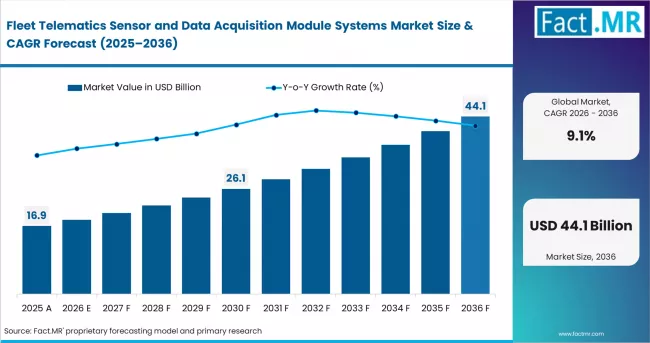
Fleet Telematics Sensor And Data Acquisition Module Systems Market Value Analysis | Source: Fact.MR
Summary of Fleet Telematics Sensor and Data Acquisition Module Systems Market
- Market Definition
- Fleet telematics systems collect and transmit vehicle and driver data to improve fleet performance, safety, and compliance.
- Demand Drivers
- Logistics companies are adopting telematics to reduce fuel costs and improve route efficiency.
- Regulatory requirements are increasing the use of tracking and monitoring systems in commercial fleets.
- E-commerce growth is expanding fleet sizes, increasing demand for monitoring solutions.
- Key Segments Analyzed
- By Device Type: GPS tracking devices are estimated to account for 37.4% share in 2026, driven by widespread adoption.
- By Fleet Type: Commercial trucks are projected to account for 36.0% share in 2026, reflecting logistics dominance.
- By Connectivity: 4G/LTE modules are expected to represent 48% share in 2026, supported by existing network infrastructure.
- Analyst Opinion at FACT.MR
- Shambhu Nath Jha, Senior Analyst at Fact.MR, states that fleet telematics is moving beyond basic tracking functions and becoming a core part of operational intelligence. Sensor data is increasingly used to monitor vehicle performance, driver behavior, fuel consumption, and maintenance needs in real time. This shift allows fleet operators to make more informed decisions that directly affect cost control, safety standards, and overall efficiency. As telematics systems integrate with analytics platforms, they support predictive maintenance, route optimization, and compliance reporting. The role of telematics is expanding from a monitoring tool to a decision-support system that influences daily fleet operations and long-term planning.
- Strategic Implications
- Expand sensor-integrated modules to support real-time diagnostics and predictive maintenance, improving fault detection and reducing unplanned downtime across fleet operations.
- Strengthen partnerships with logistics operators to scale deployments, ensuring better alignment with operational needs and faster adoption across transport networks.
- Invest in connectivity upgrades to handle higher data volumes, enabling reliable data transmission, faster processing, and improved decision-making across fleet management systems.
- Methodology
- Market sizing uses fleet population data and device penetration rates across commercial vehicles to estimate overall demand and adoption levels in different regions.
- Analysis includes regulatory mandates related to vehicle tracking, safety compliance, and data reporting, along with trends in connectivity adoption across logistics networks.
- Forecasts reflect ongoing logistics expansion and digital transformation, highlighting how increasing use of connected systems and data-driven operations is shaping long-term demand for telematics solutions.
| Metric | Value |
|---|---|
| Estimated Value in 2026 | USD 16.9 billion |
| Forecast Value in 2036 | USD 39.3 billion |
| Forecast CAGR (2026 to 2036) | 9.1% |
Source: Fact.MR analysis. Updated Apr 23, 2026
Telematics systems are being deployed to support regulatory compliance related to vehicle tracking, driver behavior, and safety monitoring. Governments are introducing mandates that require fleet visibility and reporting, which is accelerating hardware adoption. Fleet operators are using telematics data to improve route planning, reduce fuel consumption, and enhance vehicle utilization. Integration of sensors and real-time analytics is also supporting predictive maintenance, helping reduce downtime and extend vehicle life. These factors are making telematics systems an operational requirement across logistics and transport sectors.
China is projected to grow at 11.7% CAGR through 2036, supported by large-scale logistics expansion and regulatory enforcement. Brazil is expected to expand at 11.4%, driven by fleet modernization and transport network growth. The United States is likely to grow at 9.2%, while South Korea at 9.1% and Germany at 9.0% reflect steady adoption supported by advanced fleet management practices and regulatory frameworks.
Segmental Analysis
Fleet Telematics Sensor and Data Acquisition Module Systems Market Analysis by Device Type
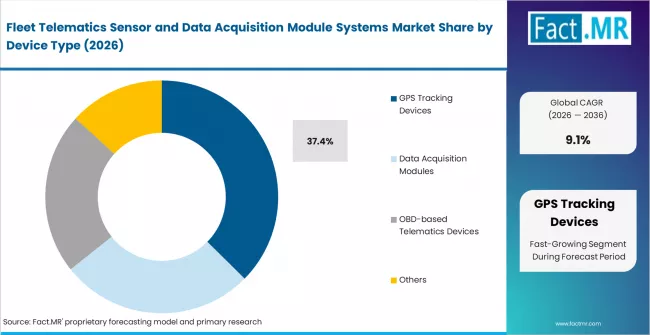
Fleet Telematics Sensor And Data Acquisition Module Systems Market Analysis By Device Type | Source: Fact.MR
GPS tracking devices and sensor-integrated modules are expected to account for 37.4% share of the fleet telematics sensor and data acquisition module systems market in 2026. These systems form the core of fleet monitoring by combining location tracking with operational data collection such as engine diagnostics, fuel usage, and driver behavior. Integrated modules are increasingly replacing standalone devices as fleet operators look for unified platforms that reduce installation complexity and improve data accuracy. The shift toward multi-functional devices also support better decision-making by providing a consolidated view of fleet performance. As telematics adoption expands, demand for compact, scalable, and easy-to-deploy systems continues to grow across fleet sizes.
- Geotab expansion: Geotab expanded global telematics deployments in 2024, increasing device penetration across fleets and supporting wider adoption of integrated monitoring solutions [1]. These deployments highlight the growing preference for scalable systems that can support both small and large fleet operations.
- Product development: Integrated modules now combine GPS tracking, vehicle diagnostics, and multiple sensor inputs into a single platform. This reduces hardware redundancy, simplifies data management, and enables real-time analytics for improved fleet performance monitoring.
- Industry trend: Fleet operators prefer unified devices that simplify installation and reduce maintenance complexity. Centralized data collection also improves operational visibility and supports faster decision-making across logistics networks.
Fleet Telematics Sensor and Data Acquisition Module Systems Market Analysis by Fleet Type
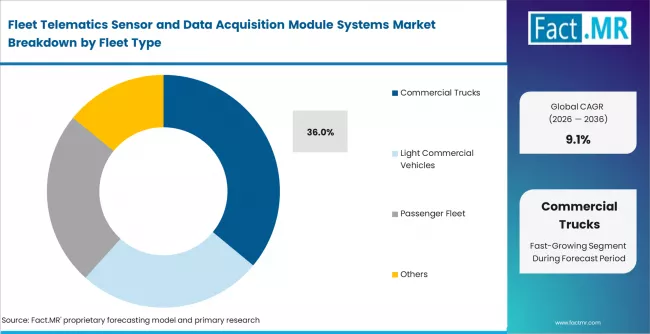
Fleet Telematics Sensor And Data Acquisition Module Systems Market Analysis By Fleet Type | Source: Fact.MR
Commercial trucks are projected to account for 36.0% share of the market in 2026, reflecting their heavy reliance on telematics for operational efficiency and regulatory compliance. These fleets operate over long distances and require continuous monitoring of vehicle performance, driver activity, and route conditions. Telematics systems help optimize routing, reduce idle time, and improve fuel efficiency, which directly impacts operating costs. As logistics networks expand and delivery timelines become more demanding, commercial truck fleets are increasing investment in advanced telematics solutions. The need to comply with safety regulations and reporting requirements further supports system adoption across this segment.
- Verizon Connect deployment: Verizon Connect expanded fleet monitoring solutions in 2024 for logistics operators, supporting improved visibility and control over fleet operations [2]. These solutions enable real-time tracking and performance analysis across large vehicle fleets.
- Operational need: High mileage, fuel costs, and maintenance requirements increase reliance on telematics systems. Continuous monitoring helps identify inefficiencies and supports cost reduction strategies.
- Adoption pattern: Large fleets deploy telematics to improve efficiency, reduce downtime, and enhance compliance with safety and regulatory standards across operations.
Fleet Telematics Sensor and Data Acquisition Module Systems Market Analysis by Connectivity
4G/LTE-connected modules are expected to represent 48% share of the market in 2026, supported by their ability to provide reliable and cost-effective data transmission across fleet operations. These networks enable real-time communication between vehicles and management platforms, allowing continuous monitoring of performance and location. 4G/LTE connectivity remains widely available across regions, making it the preferred choice for telematics deployment. As data requirements increase, connectivity plays a critical role in supporting advanced analytics, predictive maintenance, and operational optimization. While newer technologies are emerging, 4G/LTE continues to offer a stable foundation for large-scale telematics systems.
- Samsara platform upgrade: Samsara enhanced connectivity features in 2024 to support real-time data streaming and improved system responsiveness across fleet networks [3]. These upgrades enable faster data processing and better integration with analytics platforms.
- Technology trend: 4G remains dominant due to its widespread coverage, network stability, and cost efficiency, making it suitable for large-scale deployment across diverse regions.
- Transition outlook: 5G adoption is increasing, offering higher data speeds and lower latency, though deployment remains limited and gradual compared to established 4G/LTE networks.
Drivers, Restraints, and Opportunities
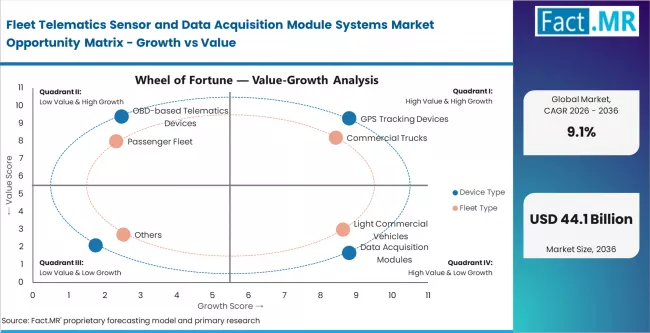
Fleet Telematics Sensor And Data Acquisition Module Systems Market Opportunity Matrix Growth Vs Value | Source: Fact.MR
Telematics adoption is closely linked to the need for operational visibility and cost control in fleet management. Commercial transport operators depend on real-time data to manage fuel consumption, optimize routes, monitor driver behavior, and plan maintenance schedules. These capabilities help reduce operating costs and improve asset utilization across fleets. The market is expanding as telematics systems move from optional tools to standard infrastructure within fleet operations. As logistics networks become more complex, continuous monitoring and data-driven decision-making are becoming essential for maintaining efficiency and meeting regulatory requirements.
Demand is shifting from basic GPS tracking toward integrated data acquisition systems that combine multiple sensor inputs. These systems collect information on vehicle performance, engine health, braking patterns, and environmental conditions, providing a more complete view of fleet operations. Integration with analytics platforms allows operators to identify inefficiencies, predict maintenance needs, and improve overall fleet performance. This transition is increasing the value of telematics systems beyond location tracking and turning them into core operational tools.
Advanced telematics modules offer higher functionality, including predictive maintenance, advanced diagnostics, and real-time alerts. These systems come with higher costs, which can limit adoption among smaller fleet operators with tighter budgets. Larger fleets continue to invest in these advanced solutions because they deliver measurable efficiency gains, reduce downtime, and support compliance with safety and reporting regulations. As technology matures and costs stabilize, broader adoption across fleet segments is expected.
- Regulatory compliance: Mandates such as electronic logging device (ELD) requirements are increasing telematics adoption, as fleets must track driving hours, vehicle usage, and safety data to meet regulatory standards.
- Connectivity expansion: Growth in 4G/LTE and emerging 5G networks supports faster and more reliable real-time data transmission across fleet operations.
- Emerging markets growth: Fleet expansion across Asia and Latin America is increasing demand for telematics systems to support logistics efficiency and operational visibility.
Regional Analysis
The market is assessed across North America, Europe, Asia Pacific, Latin America, and Middle East & Africa. Demand varies based on fleet size, regulatory frameworks, and connectivity infrastructure. The report includes market attractiveness analysis.
.webp "Top Country Growth Comparison Fleet Telematics Sensor And Data Acquisition Module Systems Market Cagr (2026 2036)")
Top Country Growth Comparison Fleet Telematics Sensor And Data Acquisition Module Systems Market Cagr (2026 2036) | Source: Fact.MR
| Country | CAGR (2026 to 2036) |
|---|---|
| China | 11.7% |
| Brazil | 11.4% |
| U.S. | 9.2% |
| South Korea | 9.1% |
| Germany | 9.0% |
Source: Fact.MR analysis. Updated Apr 23, 2026
Source: Fact.MR (FACTMR) analysis, based on proprietary forecasting model and primary research
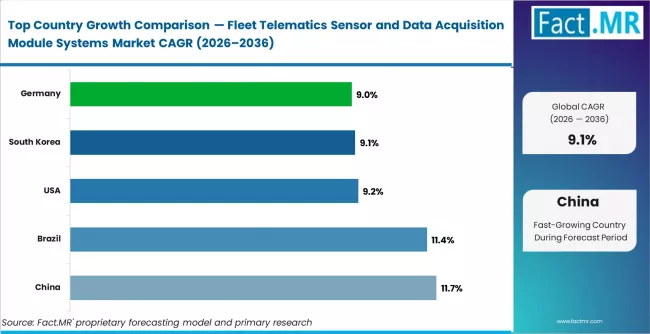
Fleet Telematics Sensor And Data Acquisition Module Systems Market Cagr Analysis By Country | Source: Fact.MR
Asia Pacific Market Analysis
Asia Pacific remains the most dynamic region, supported by rapid logistics expansion and increasing digitalization of fleet operations. Governments are actively promoting smart transport systems, creating a favorable environment for telematics adoption across commercial vehicles.
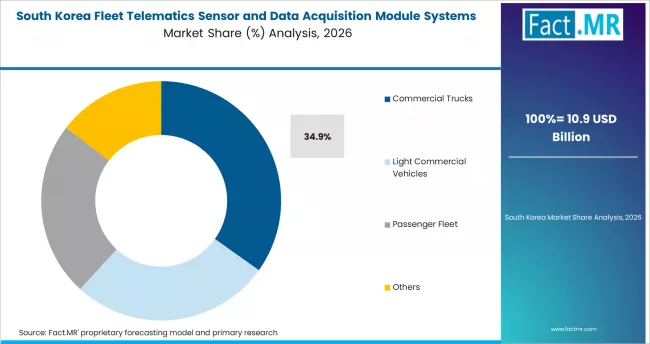
Fleet Telematics Sensor And Data Acquisition Module Systems Market South Korea Market Share Analysis By Fleet Type | Source: Fact.MR
- China: China leads regional growth, driven by large-scale logistics networks and regulatory monitoring requirements. Government-backed smart transport initiatives introduced in 2024 have accelerated the deployment of telematics systems across freight fleets. Operators are increasingly adopting real-time tracking and data-driven fleet management tools to improve efficiency and compliance. The market is expected to grow at an 11.7% CAGR [4], reflecting strong alignment between policy support and commercial demand. Continued fleet digitization across logistics providers is expected to sustain momentum, particularly in long-haul and urban delivery segments.
- South Korea: South Korea demonstrates strong adoption of connected vehicle technologies, supported by advanced digital infrastructure and high connectivity penetration. Fleet operators are integrating telematics systems to enhance route optimization, fuel efficiency, and vehicle monitoring. Growth is projected at a 9.1% CAGR [5], reflecting steady expansion driven by technology readiness and strong OEM integration. Suppliers that align with high-performance connectivity standards can benefit from long-term opportunities in this market.
Latin America Market Analysis
Latin America is emerging as a high-growth region, where telematics adoption is closely linked to logistics expansion and operational challenges such as theft prevention and route inefficiencies. The market is still developing, which creates opportunities for both hardware providers and software platforms.
- Brazil: Brazil stands out as the key growth market in the region. Fleet operators are increasingly adopting telematics systems to improve visibility, reduce operational risks, and enhance fleet utilization. The market is expected to grow at an 11.4% CAGR [6], reflecting strong demand driven by logistics activity and security concerns. Adoption is particularly strong in long-distance trucking, where real-time tracking and monitoring provide clear operational benefits. Suppliers that offer scalable and cost-effective solutions can gain traction, especially among mid-sized fleet operators.
North America Market Analysis
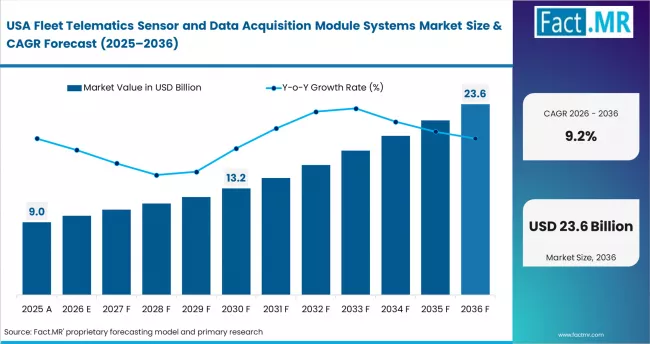
Fleet Telematics Sensor And Data Acquisition Module Systems Market Country Value Analysis | Source: Fact.MR
North America represents a mature telematics market where adoption is driven by regulatory compliance and advanced fleet management practices. Operators in this region are already familiar with digital fleet solutions, shifting the focus toward system upgrades and integration with broader logistics platforms.
- U.S.: The United States continues to lead regional demand, supported by well-established logistics networks and regulatory requirements related to safety and fleet monitoring. Growth is expected at a 9.2% CAGR [7], reflecting steady adoption across commercial fleets. Telematics systems are widely used for compliance reporting, driver performance tracking, and operational efficiency improvements. Suppliers that provide integrated solutions combining hardware, analytics, and connectivity can maintain a competitive advantage in this mature market.
Europe Market Analysis
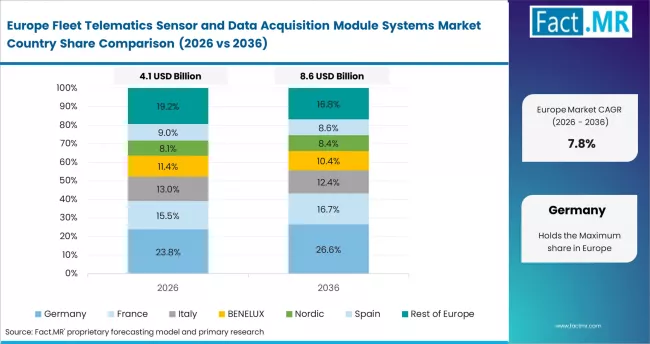
Fleet Telematics Sensor And Data Acquisition Module Systems Market Europe Country Market Share Analysis, 2026 & 2036 | Source: Fact.MR
Europe operates as a regulation-driven market, where compliance requirements and sustainability goals influence telematics adoption. Fleet operators are increasingly adopting advanced systems to meet emission standards, improve efficiency, and ensure regulatory adherence.
- Germany: Germany remains a key market, supported by strong industrial activity and a well-developed logistics sector. Fleet modernization efforts and regulatory frameworks are driving the integration of telematics systems into commercial vehicles. The market is projected to expand at a 9.0% CAGR, reflecting stable demand linked to both compliance and operational efficiency. Suppliers that meet stringent technical and regulatory requirements can secure long-term opportunities in this structured environment.
FACTMR's analysis of fleet telematics sensor and data acquisition module systems market consists of country-wise assessment that includes China, Brazil, U.S., South Korea, and Germany. Readers can find insights on fleet expansion, connectivity adoption, and regulatory impact.
Competitive Aligners for Market Players
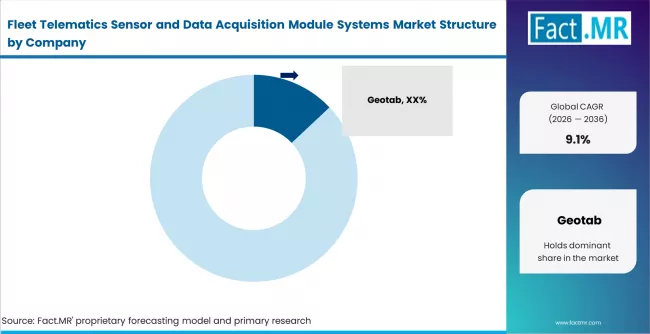
Fleet Telematics Sensor And Data Acquisition Module Systems Market Analysis By Company | Source: Fact.MR
The market remains moderately fragmented, with several global telematics providers competing across fleet segments such as logistics, transportation, and service vehicles. Competition is shaped by device capability, depth of data analytics, and reliability of connectivity across operating environments. Suppliers are expected to deliver consistent performance, accurate data capture, and seamless integration with fleet management platforms. As telematics systems become central to operations, reliability and system compatibility carry more weight than pricing alone in supplier selection.
Companies with strong platform ecosystems and large installed bases hold clear advantages in this environment. Geotab, Verizon Connect, and Samsara benefit from integrated hardware and software solutions that support end-to-end fleet management. Their platforms combine data acquisition, analytics, and reporting, allowing fleet operators to manage performance, compliance, and maintenance within a single system. Broad customer bases also support continuous product improvement and service expansion.
Fleet operators retain bargaining power through vendor selection and platform integration decisions. Multi-vendor evaluation and switching flexibility limit supplier control over pricing. Suppliers compete by improving system performance, ensuring scalability across fleet sizes, and maintaining high service reliability. Long-term success depends on the ability to support data-driven operations while aligning with evolving fleet requirements.
Key Players
- Geotab
- Verizon Connect
- Samsara
- Trimble
- Omnitracs
- TomTom Telematics
- CalAmp
- Gurtam
- Inseego
- Queclink
Bibliography
- [1] Geotab, Telematics Deployment Update, 2024
- [2] Verizon Connect, Fleet Monitoring Expansion, 2024
- [3] Samsara, Connectivity Platform Update, 2024
- [4] China Ministry of Transport, Smart Logistics Program, 2024
- [5] South Korea Transport Authority, Connected Vehicle Initiative, 2024
- [6] Brazil Logistics Association, Fleet Digitization Report, 2024
- [7] U.S. Department of Transportation, Telematics Adoption Report, 2024
This Report Addresses
- Provides intelligence on fleet telematics systems and sensor integration
- Covers market size from USD 16.9 billion in 2026 to USD 39.3 billion by 2036
- Identifies growth opportunities across logistics and transportation
- Offers segment and regional forecasts
- Evaluates competitive strategies
- Tracks connectivity and telematics innovations
- Analyzes regulatory impact
- Delivered in PDF and dataset formats
Fleet Telematics Sensor and Data Acquisition Module Systems Market Definition
Fleet telematics sensor and data acquisition module systems are devices installed in vehicles to collect and transmit operational data such as location, speed, fuel consumption, engine performance, and driver behavior. These systems combine sensors, communication modules, and data processors to provide real-time insights for fleet operators. They are widely used in commercial transport, logistics, delivery services, and fleet management. Their primary function is to improve operational efficiency, enhance safety, ensure regulatory compliance, and enable data-driven decision-making.
Fleet Telematics Sensor and Data Acquisition Module Systems Market Inclusions
The report covers global and regional market size, forecasts from 2026 to 2036, and segment analysis by device type, fleet type, and connectivity. It includes demand trends across logistics, transportation, and commercial fleet operations. The study also evaluates pricing trends, connectivity adoption, and data-driven fleet management practices.
Fleet Telematics Sensor and Data Acquisition Module Systems Market Exclusions
The scope excludes standalone fleet management software platforms without embedded hardware modules. It does not include consumer vehicle infotainment systems or passenger vehicle telematics outside fleet operations. The focus remains on sensor-integrated telematics devices and data acquisition modules used in commercial fleet environments.
Fleet Telematics Sensor and Data Acquisition Module Systems Market Research Methodology
- Primary Research
- Interviews with fleet operators, telematics providers, logistics companies, and OEM partners.
- Desk Research
- Uses transport statistics, regulatory data, and company disclosures from telematics providers.
- Market-Sizing and Forecasting
- Hybrid model using fleet size, device penetration rates, and connectivity adoption.
- Data Validation and Update Cycle
- Validated using deployment data and supplier shipments, updated annually.
Segmentation
Scope of Report
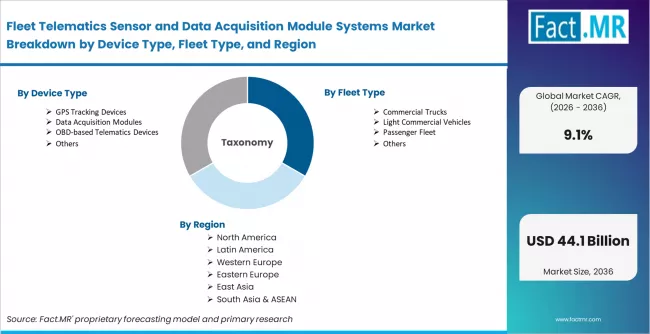
Fleet Telematics Sensor And Data Acquisition Module Systems Market Breakdown By Device Type Fleet Type And Region | Source: Fact.MR
| Attribute | Details |
|---|---|
| Quantitative Units | USD 16.9 billion (2026) to USD 39.3 billion (2036), at a CAGR of 9.1% |
| Market Definition | Fleet telematics sensor and data acquisition module systems that collect, process, and transmit vehicle data such as location, speed, fuel usage, engine diagnostics, and driver behavior, enabling real-time fleet monitoring, operational efficiency, and regulatory compliance across commercial transport and logistics sectors globally. |
| Device Type Segmentation | GPS Tracking Devices / Sensor-Integrated Tracking Modules, Data Acquisition Modules, OBD-based Telematics Devices, Others |
| Fleet Type Segmentation | Commercial Trucks, Light Commercial Vehicles, Passenger Fleet, Others |
| Connectivity Segmentation | 4G/LTE, 5G, LPWAN, Others |
| Application Coverage | Real-time vehicle tracking, fleet monitoring, fuel management, predictive maintenance, driver behavior analytics, route optimization, compliance monitoring, and logistics performance management across commercial fleet operations |
| Regions Covered | North America, Europe, Asia Pacific, Latin America, Middle East & Africa |
| Countries Covered | United States, Canada, Germany, United Kingdom, France, Italy, Spain, China, Japan, South Korea, Taiwan, Singapore, Brazil, Mexico, Argentina, GCC Countries, South Africa, Israel |
| Key Companies Profiled | Geotab, Verizon Connect, Samsara, Trimble, Omnitracs, TomTom Telematics, CalAmp, Gurtam, Inseego, Queclink |
| Forecast Period | 2026 to 2036 |
| Approach | Hybrid top-down and bottom-up model using fleet population, telematics device penetration rates, connectivity adoption levels, average selling prices, and primary interviews with fleet operators, logistics providers, and telematics solution vendors |
Source: Fact.MR analysis. Updated Apr 23, 2026
Fleet Telematics Sensor and Data Acquisition Module Systems Market by Segments
-
By Device Type:
- GPS Tracking Devices
- Data Acquisition Modules
- OBD-based Telematics Devices
- Others
-
By Fleet Type:
- Commercial Trucks
- Light Commercial Vehicles
- Passenger Fleet
- Others
-
By Connectivity:
- 4G/LTE
- 5G
- LPWAN
- Others
-
By Region:
- North America
- United States
- Canada
- Europe
- Germany
- United Kingdom
- France
- Italy
- Spain
- Asia Pacific
- China
- Japan
- South Korea
- Taiwan
- Singapore
- Latin America
- Brazil
- Mexico
- Argentina
- Middle East & Africa
- GCC Countries
- South Africa
- Israel
- North America
Frequently Asked Questions
What is the size of the fleet telematics sensor and data acquisition module systems market in 2025?
What will the fleet telematics market size be in 2026?
What is the forecast market size by 2036?
What is the expected CAGR of the fleet telematics market?
What are fleet telematics sensor and data acquisition systems?
Why are telematics systems important for fleet operators?
Which device type leads the fleet telematics market?
Which fleet type dominates telematics adoption?
Which connectivity technology is most widely used?
Which country is growing the fastest in this market?
What factors are driving demand in this market?
How does telematics improve fleet efficiency?
What challenges affect market growth?
How is connectivity impacting telematics adoption?
What opportunities exist in the fleet telematics market?
Who worked on this report


Preview the report firsthand - request a free sample
Free SampleGet the brochure for pricing and purchase details
Download PDF