Thermal Abuse Indicator Color Additives for Food Packaging Market
Thermal Abuse Indicator Color Additives for Food Packaging Market Size and Share Forecast Outlook 2026 to 2036
Thermal abuse indicator color additives for food packaging market is projected to grow from USD 82.9 million in 2026 to USD 172.4 million by 2036, at a CAGR of 7.6%. Dairy/Alt-Dairy will dominate with a 52.4% market share, while thermochromic will lead the technology segment with a 36.6% share.
Thermal Abuse Indicator Color Additives for Food Packaging Market Forecast and Outlook 2026 to 2036
The global market for thermal abuse indicator color additives in food packaging is undergoing a significant transformation, projected to grow from USD 82.88 million in 2026 to USD 172.42 million by 2036, advancing at a 7.6% CAGR.
Key Takeaways from the Thermal Abuse Indicator Color Additives for Food Packaging Market
- Market Value for 2026: USD 82.88 Million
- Market Value for 2036: USD 172.42 Million
- Forecast CAGR (2026-2036): 7.6%
- Leading Application Segment (2026): Dairy/Alt-Dairy (52%)
- Leading Technology Segment (2026): Thermochromic (37%)
- Leading Channel Segment (2026): Direct-to-B2B (59%)
- Key Growth Countries: China (15.1% CAGR), USA (14.2% CAGR), Germany (13.8% CAGR), France (13.6% CAGR)
- Key Players in the Market: Sun Chemical, Sensient, DIC Corporation, BASF SE, Clariant AG, Toyo Ink
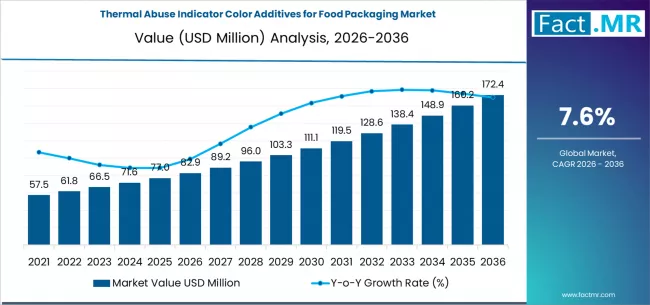
Growth is directly tied to the escalating demand for intelligent packaging solutions that provide transparent, visual evidence of supply chain integrity, moving beyond static expiration dates to dynamic, condition-based food safety assurance.
The market's evolution is characterized by a decisive shift from simple temperature-sensitive inks to sophisticated, integrated indicator systems that correlate color change precisely with cumulative thermal degradation.
Key trends include the rapid integration of these indicators into high-value, sensitive product segments like fresh dairy, alt-dairy probiotics, premium juices, and prepared meals, where flavor, nutrient content, and safety are highly vulnerable to temperature fluctuations.
Development is focused on improving the accuracy and reliability of indicators to differentiate between brief, harmless exposures and damaging thermal abuse, thereby reducing false positives and unnecessary waste.
The push toward sustainable packaging substrates is driving innovation in water-based, non-toxic, and biodegradable indicator formulations that can be printed directly onto compostable films or paperboard without compromising functionality or migrating into food.
Metric
| Metric | Value |
|---|---|
| Market Value (2026) | USD 82.88 Million |
| Market Forecast Value (2036) | USD 172.42 Million |
| Forecast CAGR (2026-2036) | 7.6% |
Category
| Category | Segments |
|---|---|
| Application | Dairy/Alt-Dairy, Beverages, Bakery/Snacks, Meat/Alt-Meat |
| Technology | Thermochromic, Photochromic, pH Sensitive, Time-Temperature Integrator (TTI) |
| Channel | Direct-to-B2B, Distributors, Online B2B, Contract Manufacturing |
| Region | North America, Latin America, Western Europe, Eastern Europe, East Asia, South Asia & Pacific, MEA |
Segmental Analysis
By Application, Which Segment Demonstrates the Broadest Adoption?
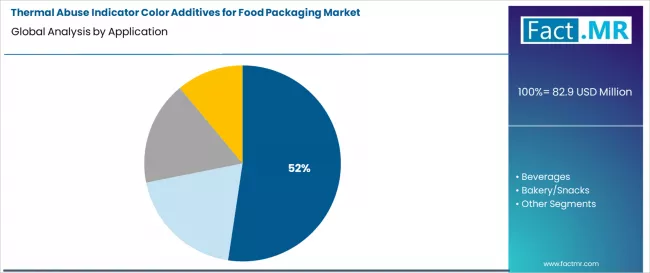
The dairy and alternative-dairy segment commands a dominant 52% market share, driven by the critical need to maintain the cold chain for perishable products like milk, yogurt, fresh cheese, and probiotic drinks. Thermal abuse can rapidly degrade product quality, safety, and viable microbial counts in these categories. Indicators provide a clear visual cue to retailers and consumers, enhancing trust and reducing liability.
The growth of premium, extended-shelf-life (ESL) dairy and plant-based alternatives, which still require precise temperature control, further solidifies this segment's leadership, as brands use the technology to justify premium positioning and guarantee product integrity.
By Technology, Which Type Forms the Current Technological Core?
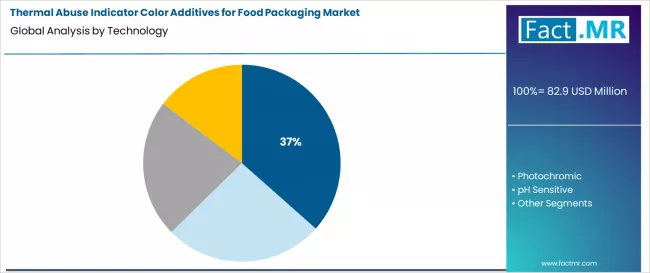
Thermochromic technology leads the segment with a 37% share, favored for its direct visual feedback and relatively lower cost implementation. These reversible or irreversible color-changing inks, often based on leuco dyes or liquid crystals, provide an immediate indication when a specific temperature threshold is breached.
Their integration into labels, lids, or direct packaging prints is straightforward, making them accessible for a wide range of applications. While Time-Temperature Integrators (TTIs) offer more precise cumulative history, thermochromic indicators currently dominate due to their simplicity, speed of interpretation, and scalability for mass-market products.
By Channel, How are Products Primarily Reaching End-Users?
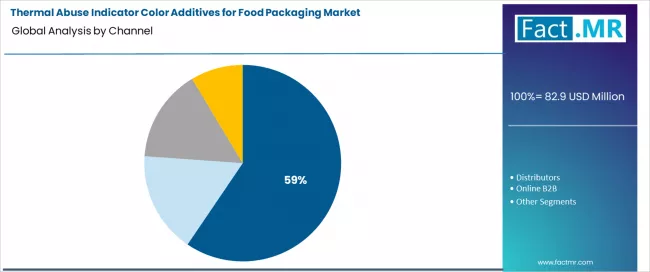
Direct-to-B2B sales are the predominant channel, holding a 59% share. This reflects the highly customized nature of indicator development, which must be tailored to a specific product's thermal sensitivity, packaging material, and supply chain logistics.
Ink and chemical suppliers work directly with packaging converters and brand owners' R&D teams to co-develop solutions. This close collaboration is essential for calibrating the indicator's activation threshold, ensuring printability and adhesion on specific substrates, and validating performance under real-world distribution conditions.
What are the Drivers, Restraints, and Key Trends of the Thermal abuse Indicator Color Additives for Food Packaging Market?
The primary market driver is the growing consumer and regulatory focus on food safety and reducing food waste, coupled with the expansion of complex, global cold chains for perishable goods.
The rise of e-commerce grocery delivery, with its less-controlled last-mile logistics, creates new risks of thermal abuse, making visual indicators a valuable tool for quality assurance and dispute resolution. Brand differentiation through enhanced transparency and smart packaging features also propels adoption among premium product manufacturers.
A significant market restraint is the added cost per package, which can be a barrier for high-volume, low-margin products. The need for calibration and validation for each new product-package combination adds to development time and expense.
There is also a lack of standardized protocols for what constitutes a meaningful color change correlated to product degradation, leading to potential confusion in interpretation among consumers and supply chain workers. The performance of some indicators can also be influenced by factors other than temperature, such as humidity or light, potentially leading to inaccurate readings.
Key trends include the convergence of indicators with other smart packaging technologies, such as QR codes or NFC tags, to provide digital tracking and more detailed information. There is active development of multi-threshold indicators that show progressive color changes corresponding to different levels of thermal exposure.
The use of bio-based and food-grade colorant systems is increasing to meet sustainability and safety demands. Furthermore, integration with blockchain-based supply chain platforms is emerging, where a color change could trigger a digital record of a potential breach, enhancing traceability and accountability.
Analysis of the Thermal abuse Indicator Color Additives for Food Packaging Market by Key Countries
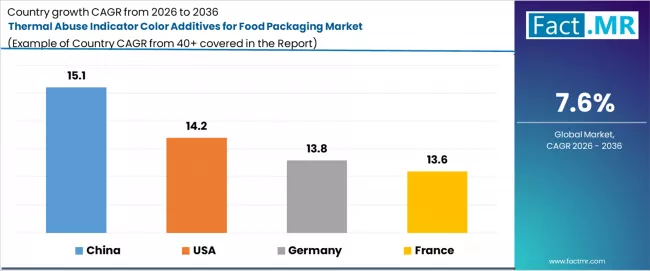
| Country | CAGR (2026-2036) |
|---|---|
| China | 15.1% |
| USA | 14.2% |
| Germany | 13.8% |
| France | 13.6% |
How is China's Expansive E-commerce and Cold Chain Development Driving Growth?
The world’s largest and fastest-growing market for fresh food e-commerce and a rapidly modernizing, but still fragmented, cold chain logistics network fuel China’s leading CAGR of 15.1%. The risk of temperature excursions during delivery is a major concern for platforms and brands.
Adoption of thermal abuse indicators is seen as a competitive necessity to build consumer trust, reduce returns, and ensure the quality of perishable goods ordered online, from fresh milk to prepared meals, driving rapid market uptake.
What is the Impact of the USA's Litigious Environment and Premium Brand Focus?
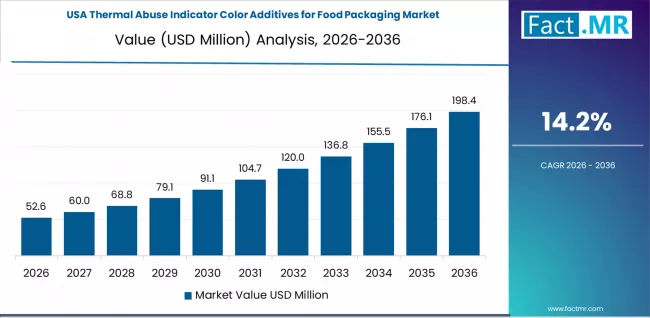
The USA's 14.2% growth is driven by a strong focus on food safety liability and brand protection, particularly for premium refrigerated and fresh-prepared brands. American consumers are receptive to clear, visual safety cues.
The market is characterized by demand for highly reliable, validated indicator systems that can serve as a defensible record of proper handling. Innovation is geared toward creating intuitive, consumer-friendly indicators that also provide a legal safeguard for brands across extensive national distribution networks.
Why is Germany a Hub for Technical Precision and Engineering in This Market?
Germany's 13.8% CAGR reflects its engineering rigor and leadership in high-quality packaging machinery and chemical engineering. German manufacturers demand indicators with precise, predictable performance that can be seamlessly integrated into high-speed automated packaging lines.
The market favors advanced, often irreversible, TTIs that provide an accurate cumulative history of temperature exposure, aligning with Germany's methodical approach to quality control and supply chain optimization for exports.
How is France's Leadership in Premium Dairy and Fresh Food Influencing Adoption?
France's 13.6% growth is closely linked to its strong culinary heritage and production of high-value fresh dairy, cheeses, and gourmet prepared foods. French brands and retailers use thermal abuse indicators as a mark of quality and provenance assurance, crucial for protecting the reputation of AOC and regional products.
The demand is for elegant, discreet indicator designs that integrate aesthetically into premium packaging while providing unambiguous safety signals, supporting both domestic quality standards and export credibility.
Competitive Landscape of the Thermal abuse Indicator Color Additives for Food Packaging Market
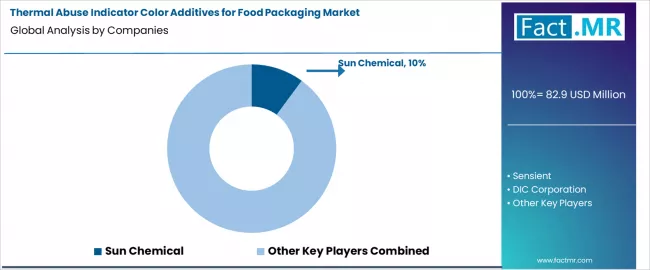
The competitive landscape is dominated by global specialty chemical and pigment manufacturers, with strong participation from specialized ink companies. Competition revolves around proprietary chemistry for color-changing systems, precision in activation thresholds, and stability of the indicators under various environmental conditions.
Success is increasingly tied to forming strategic partnerships with packaging converters and major brand owners to develop application-specific solutions. Companies are competing to expand their portfolios beyond thermochromics to include full TTI systems and to integrate their indicators with digital traceability platforms, offering a complete smart packaging solution rather than just an additive.
Key Players in the Thermal abuse Indicator Color Additives for Food Packaging Market
- Sun Chemical
- Sensient
- DIC Corporation
- BASF SE
- Clariant AG
- Toyo Ink
Scope of Report
| Items | Values |
|---|---|
| Quantitative Units | USD Million |
| Application | Dairy/Alt-Dairy, Beverages, Bakery/Snacks, Meat/Alt-Meat |
| Technology | Thermochromic, Photochromic, pH Sensitive, Time-Temperature Integrator (TTI) |
| Channel | Direct-to-B2B, Distributors, Online B2B, Contract Manufacturing |
| Key Countries | China, USA, Germany, France |
| Key Companies | Sun Chemical, Sensient, DIC Corporation, BASF SE, Clariant AG, Toyo Ink |
| Additional Analysis | Chemistry and kinetics of leuco dye and polymer-based TTI systems; migration and food contact safety studies; correlation studies between indicator response and specific microbial growth or nutrient degradation; cost-benefit analysis for different product categories; impact on consumer behavior and food waste reduction; integration with IoT and supply chain management software. |
Market by Segments
-
Application :
- Dairy/Alt-Dairy
- Beverages
- Bakery/Snacks
- Meat/Alt-Meat
-
Technology :
- Thermochromic
- Photochromic
- pH Sensitive
- Time-Temperature Integrator (TTI)
-
Channel :
- Direct-to-B2B
- Distributors
- Online B2B
- Contract Manufacturing
-
Region :
-
North America
- USA
- Canada
-
Latin America
- Brazil
- Mexico
- Argentina
- Rest of Latin America
-
Western Europe
- Germany
- UK
- France
- Spain
- Italy
- BENELUX
- Rest of Western Europe
-
Eastern Europe
- Russia
- Poland
- Czech Republic
- Rest of Eastern Europe
-
East Asia
- China
- Japan
- South Korea
- Rest of East Asia
-
South Asia & Pacific
- India
- ASEAN
- Australia
- Rest of South Asia & Pacific
-
MEA
- Saudi Arabia
- UAE
- Turkiye
- Rest of MEA
-
References
- Brizio, A. P., & Prentice, C. (2023). Use of time-temperature indicators to monitor the food quality in the cold chain. Trends in Food Science & Technology, 132, 112-124.
- Fu, M., & Chen, W. (2024). Development of a novel irreversible thermochromic label for cold chain monitoring. Food Packaging and Shelf Life, 41, 101215.
- Ghaani, M., Cozzolino, C. A., & Farris, S. (2023). An overview of the intelligent packaging technologies in the food sector. Trends in Food Science & Technology, 105, 87-98.
- Heising, J. K., Dekker, M., & van Boekel, M. A. J. S. (2024). Consumer acceptance of intelligent food packaging: The role of visual indicators. Food Quality and Preference, 113, 105087.
- Kuswandi, B., & Jumina, J. (2023). Active and intelligent packaging for food quality and safety. Packaging Technology and Science, 36(3), 195-214.
- Lee, S. Y., & Yoon, J. H. (2024). pH-sensitive and photochromic materials for visual freshness monitoring in food packaging. Dyes and Pigments, 221, 111814.
- Müller, P., & Schmid, M. (2023). Intelligent packaging in the meat industry: Concepts, applications, and future trends. Meat Science, 195, 109027.
- Pereira, V. A., & de Arruda, I. N. Q. (2024). Natural colorants in smart packaging: A sustainable approach for food quality monitoring. Sustainable Materials and Technologies, 39, e00845.
- Realini, C. E., & Marcos, B. (2023). Active and intelligent packaging systems for a modern society. Food Control, 108, 106870.
- Zhang, L., & Li, R. (2024). Integration of time-temperature indicators with blockchain for enhanced food supply chain traceability. Journal of Food Engineering, 369, 111912.
Table of Content
- Executive Summary
- Global Market Outlook
- Demand to side Trends
- Supply to side Trends
- Technology Roadmap Analysis
- Analysis and Recommendations
- Market Overview
- Market Coverage / Taxonomy
- Market Definition / Scope / Limitations
- Market Background
- Market Dynamics
- Drivers
- Restraints
- Opportunity
- Trends
- Scenario Forecast
- Demand in Optimistic Scenario
- Demand in Likely Scenario
- Demand in Conservative Scenario
- Opportunity Map Analysis
- Product Life Cycle Analysis
- Supply Chain Analysis
- Investment Feasibility Matrix
- Value Chain Analysis
- PESTLE and Porter’s Analysis
- Regulatory Landscape
- Regional Parent Market Outlook
- Production and Consumption Statistics
- Import and Export Statistics
- Market Dynamics
- Global Market Analysis 2021 to 2025 and Forecast, 2026 to 2036
- Historical Market Size Value (USD Million) Analysis, 2021 to 2025
- Current and Future Market Size Value (USD Million) Projections, 2026 to 2036
- Y to o to Y Growth Trend Analysis
- Absolute $ Opportunity Analysis
- Global Market Pricing Analysis 2021 to 2025 and Forecast 2026 to 2036
- Global Market Analysis 2021 to 2025 and Forecast 2026 to 2036, By Application
- Introduction / Key Findings
- Historical Market Size Value (USD Million) Analysis By Application, 2021 to 2025
- Current and Future Market Size Value (USD Million) Analysis and Forecast By Application, 2026 to 2036
- Dairy/Alt-Dairy
- Beverages
- Bakery/Snacks
- Meat/Alt-Meat
- Dairy/Alt-Dairy
- Y to o to Y Growth Trend Analysis By Application, 2021 to 2025
- Absolute $ Opportunity Analysis By Application, 2026 to 2036
- Global Market Analysis 2021 to 2025 and Forecast 2026 to 2036, By Technology
- Introduction / Key Findings
- Historical Market Size Value (USD Million) Analysis By Technology, 2021 to 2025
- Current and Future Market Size Value (USD Million) Analysis and Forecast By Technology, 2026 to 2036
- Thermochromic
- Photochromic
- pH Sensitive
- Time-Temp
- Thermochromic
- Y to o to Y Growth Trend Analysis By Technology, 2021 to 2025
- Absolute $ Opportunity Analysis By Technology, 2026 to 2036
- Global Market Analysis 2021 to 2025 and Forecast 2026 to 2036, By Channel
- Introduction / Key Findings
- Historical Market Size Value (USD Million) Analysis By Channel, 2021 to 2025
- Current and Future Market Size Value (USD Million) Analysis and Forecast By Channel, 2026 to 2036
- Direct-to-B2B
- Distributors
- Online B2B
- Contract Mfg
- Direct-to-B2B
- Y to o to Y Growth Trend Analysis By Channel, 2021 to 2025
- Absolute $ Opportunity Analysis By Channel, 2026 to 2036
- Global Market Analysis 2021 to 2025 and Forecast 2026 to 2036, By Region
- Introduction
- Historical Market Size Value (USD Million) Analysis By Region, 2021 to 2025
- Current Market Size Value (USD Million) Analysis and Forecast By Region, 2026 to 2036
- North America
- Latin America
- Western Europe
- Eastern Europe
- East Asia
- South Asia and Pacific
- Middle East & Africa
- Market Attractiveness Analysis By Region
- North America Market Analysis 2021 to 2025 and Forecast 2026 to 2036, By Country
- Historical Market Size Value (USD Million) Trend Analysis By Market Taxonomy, 2021 to 2025
- Market Size Value (USD Million) Forecast By Market Taxonomy, 2026 to 2036
- By Country
- USA
- Canada
- Mexico
- By Application
- By Technology
- By Channel
- By Country
- Market Attractiveness Analysis
- By Country
- By Application
- By Technology
- By Channel
- Key Takeaways
- Latin America Market Analysis 2021 to 2025 and Forecast 2026 to 2036, By Country
- Historical Market Size Value (USD Million) Trend Analysis By Market Taxonomy, 2021 to 2025
- Market Size Value (USD Million) Forecast By Market Taxonomy, 2026 to 2036
- By Country
- Brazil
- Chile
- Rest of Latin America
- By Application
- By Technology
- By Channel
- By Country
- Market Attractiveness Analysis
- By Country
- By Application
- By Technology
- By Channel
- Key Takeaways
- Western Europe Market Analysis 2021 to 2025 and Forecast 2026 to 2036, By Country
- Historical Market Size Value (USD Million) Trend Analysis By Market Taxonomy, 2021 to 2025
- Market Size Value (USD Million) Forecast By Market Taxonomy, 2026 to 2036
- By Country
- Germany
- UK
- Italy
- Spain
- France
- Nordic
- BENELUX
- Rest of Western Europe
- By Application
- By Technology
- By Channel
- By Country
- Market Attractiveness Analysis
- By Country
- By Application
- By Technology
- By Channel
- Key Takeaways
- Eastern Europe Market Analysis 2021 to 2025 and Forecast 2026 to 2036, By Country
- Historical Market Size Value (USD Million) Trend Analysis By Market Taxonomy, 2021 to 2025
- Market Size Value (USD Million) Forecast By Market Taxonomy, 2026 to 2036
- By Country
- Russia
- Poland
- Hungary
- Balkan & Baltic
- Rest of Eastern Europe
- By Application
- By Technology
- By Channel
- By Country
- Market Attractiveness Analysis
- By Country
- By Application
- By Technology
- By Channel
- Key Takeaways
- East Asia Market Analysis 2021 to 2025 and Forecast 2026 to 2036, By Country
- Historical Market Size Value (USD Million) Trend Analysis By Market Taxonomy, 2021 to 2025
- Market Size Value (USD Million) Forecast By Market Taxonomy, 2026 to 2036
- By Country
- China
- Japan
- South Korea
- By Application
- By Technology
- By Channel
- By Country
- Market Attractiveness Analysis
- By Country
- By Application
- By Technology
- By Channel
- Key Takeaways
- South Asia and Pacific Market Analysis 2021 to 2025 and Forecast 2026 to 2036, By Country
- Historical Market Size Value (USD Million) Trend Analysis By Market Taxonomy, 2021 to 2025
- Market Size Value (USD Million) Forecast By Market Taxonomy, 2026 to 2036
- By Country
- India
- ASEAN
- Australia & New Zealand
- Rest of South Asia and Pacific
- By Application
- By Technology
- By Channel
- By Country
- Market Attractiveness Analysis
- By Country
- By Application
- By Technology
- By Channel
- Key Takeaways
- Middle East & Africa Market Analysis 2021 to 2025 and Forecast 2026 to 2036, By Country
- Historical Market Size Value (USD Million) Trend Analysis By Market Taxonomy, 2021 to 2025
- Market Size Value (USD Million) Forecast By Market Taxonomy, 2026 to 2036
- By Country
- Kingdom of Saudi Arabia
- Other GCC Countries
- Turkiye
- South Africa
- Other African Union
- Rest of Middle East & Africa
- By Application
- By Technology
- By Channel
- By Country
- Market Attractiveness Analysis
- By Country
- By Application
- By Technology
- By Channel
- Key Takeaways
- Key Countries Market Analysis
- USA
- Pricing Analysis
- Market Share Analysis, 2025
- By Application
- By Technology
- By Channel
- Canada
- Pricing Analysis
- Market Share Analysis, 2025
- By Application
- By Technology
- By Channel
- Mexico
- Pricing Analysis
- Market Share Analysis, 2025
- By Application
- By Technology
- By Channel
- Brazil
- Pricing Analysis
- Market Share Analysis, 2025
- By Application
- By Technology
- By Channel
- Chile
- Pricing Analysis
- Market Share Analysis, 2025
- By Application
- By Technology
- By Channel
- Germany
- Pricing Analysis
- Market Share Analysis, 2025
- By Application
- By Technology
- By Channel
- UK
- Pricing Analysis
- Market Share Analysis, 2025
- By Application
- By Technology
- By Channel
- Italy
- Pricing Analysis
- Market Share Analysis, 2025
- By Application
- By Technology
- By Channel
- Spain
- Pricing Analysis
- Market Share Analysis, 2025
- By Application
- By Technology
- By Channel
- France
- Pricing Analysis
- Market Share Analysis, 2025
- By Application
- By Technology
- By Channel
- India
- Pricing Analysis
- Market Share Analysis, 2025
- By Application
- By Technology
- By Channel
- ASEAN
- Pricing Analysis
- Market Share Analysis, 2025
- By Application
- By Technology
- By Channel
- Australia & New Zealand
- Pricing Analysis
- Market Share Analysis, 2025
- By Application
- By Technology
- By Channel
- China
- Pricing Analysis
- Market Share Analysis, 2025
- By Application
- By Technology
- By Channel
- Japan
- Pricing Analysis
- Market Share Analysis, 2025
- By Application
- By Technology
- By Channel
- South Korea
- Pricing Analysis
- Market Share Analysis, 2025
- By Application
- By Technology
- By Channel
- Russia
- Pricing Analysis
- Market Share Analysis, 2025
- By Application
- By Technology
- By Channel
- Poland
- Pricing Analysis
- Market Share Analysis, 2025
- By Application
- By Technology
- By Channel
- Hungary
- Pricing Analysis
- Market Share Analysis, 2025
- By Application
- By Technology
- By Channel
- Kingdom of Saudi Arabia
- Pricing Analysis
- Market Share Analysis, 2025
- By Application
- By Technology
- By Channel
- Turkiye
- Pricing Analysis
- Market Share Analysis, 2025
- By Application
- By Technology
- By Channel
- South Africa
- Pricing Analysis
- Market Share Analysis, 2025
- By Application
- By Technology
- By Channel
- USA
- Market Structure Analysis
- Competition Dashboard
- Competition Benchmarking
- Market Share Analysis of Top Players
- By Regional
- By Application
- By Technology
- By Channel
- Competition Analysis
- Competition Deep Dive
- Sun Chemical
- Overview
- Product Portfolio
- Profitability by Market Segments (Product/Age /Sales Channel/Region)
- Sales Footprint
- Strategy Overview
- Marketing Strategy
- Product Strategy
- Channel Strategy
- Sensient
- DIC Corporation
- BASF SE
- Clariant AG
- Toyo Ink
- Sun Chemical
- Competition Deep Dive
- Assumptions & Acronyms Used
- Research Methodology
List Of Table
- Table 1: Global Market Value (USD Million) Forecast by Region, 2021 to 2036
- Table 2: Global Market Value (USD Million) Forecast by Application, 2021 to 2036
- Table 3: Global Market Value (USD Million) Forecast by Technology, 2021 to 2036
- Table 4: Global Market Value (USD Million) Forecast by Channel, 2021 to 2036
- Table 5: North America Market Value (USD Million) Forecast by Country, 2021 to 2036
- Table 6: North America Market Value (USD Million) Forecast by Application, 2021 to 2036
- Table 7: North America Market Value (USD Million) Forecast by Technology, 2021 to 2036
- Table 8: North America Market Value (USD Million) Forecast by Channel, 2021 to 2036
- Table 9: Latin America Market Value (USD Million) Forecast by Country, 2021 to 2036
- Table 10: Latin America Market Value (USD Million) Forecast by Application, 2021 to 2036
- Table 11: Latin America Market Value (USD Million) Forecast by Technology, 2021 to 2036
- Table 12: Latin America Market Value (USD Million) Forecast by Channel, 2021 to 2036
- Table 13: Western Europe Market Value (USD Million) Forecast by Country, 2021 to 2036
- Table 14: Western Europe Market Value (USD Million) Forecast by Application, 2021 to 2036
- Table 15: Western Europe Market Value (USD Million) Forecast by Technology, 2021 to 2036
- Table 16: Western Europe Market Value (USD Million) Forecast by Channel, 2021 to 2036
- Table 17: Eastern Europe Market Value (USD Million) Forecast by Country, 2021 to 2036
- Table 18: Eastern Europe Market Value (USD Million) Forecast by Application, 2021 to 2036
- Table 19: Eastern Europe Market Value (USD Million) Forecast by Technology, 2021 to 2036
- Table 20: Eastern Europe Market Value (USD Million) Forecast by Channel, 2021 to 2036
- Table 21: East Asia Market Value (USD Million) Forecast by Country, 2021 to 2036
- Table 22: East Asia Market Value (USD Million) Forecast by Application, 2021 to 2036
- Table 23: East Asia Market Value (USD Million) Forecast by Technology, 2021 to 2036
- Table 24: East Asia Market Value (USD Million) Forecast by Channel, 2021 to 2036
- Table 25: South Asia and Pacific Market Value (USD Million) Forecast by Country, 2021 to 2036
- Table 26: South Asia and Pacific Market Value (USD Million) Forecast by Application, 2021 to 2036
- Table 27: South Asia and Pacific Market Value (USD Million) Forecast by Technology, 2021 to 2036
- Table 28: South Asia and Pacific Market Value (USD Million) Forecast by Channel, 2021 to 2036
- Table 29: Middle East & Africa Market Value (USD Million) Forecast by Country, 2021 to 2036
- Table 30: Middle East & Africa Market Value (USD Million) Forecast by Application, 2021 to 2036
- Table 31: Middle East & Africa Market Value (USD Million) Forecast by Technology, 2021 to 2036
- Table 32: Middle East & Africa Market Value (USD Million) Forecast by Channel, 2021 to 2036
List Of Figures
- Figure 1: Global Market Pricing Analysis
- Figure 2: Global Market Value (USD Million) Forecast 2021 to 2036
- Figure 3: Global Market Value Share and BPS Analysis by Application, 2026 and 2036
- Figure 4: Global Market Y to o to Y Growth Comparison by Application, 2026 to 2036
- Figure 5: Global Market Attractiveness Analysis by Application
- Figure 6: Global Market Value Share and BPS Analysis by Technology, 2026 and 2036
- Figure 7: Global Market Y to o to Y Growth Comparison by Technology, 2026 to 2036
- Figure 8: Global Market Attractiveness Analysis by Technology
- Figure 9: Global Market Value Share and BPS Analysis by Channel, 2026 and 2036
- Figure 10: Global Market Y to o to Y Growth Comparison by Channel, 2026 to 2036
- Figure 11: Global Market Attractiveness Analysis by Channel
- Figure 12: Global Market Value (USD Million) Share and BPS Analysis by Region, 2026 and 2036
- Figure 13: Global Market Y to o to Y Growth Comparison by Region, 2026 to 2036
- Figure 14: Global Market Attractiveness Analysis by Region
- Figure 15: North America Market Incremental Dollar Opportunity, 2026 to 2036
- Figure 16: Latin America Market Incremental Dollar Opportunity, 2026 to 2036
- Figure 17: Western Europe Market Incremental Dollar Opportunity, 2026 to 2036
- Figure 18: Eastern Europe Market Incremental Dollar Opportunity, 2026 to 2036
- Figure 19: East Asia Market Incremental Dollar Opportunity, 2026 to 2036
- Figure 20: South Asia and Pacific Market Incremental Dollar Opportunity, 2026 to 2036
- Figure 21: Middle East & Africa Market Incremental Dollar Opportunity, 2026 to 2036
- Figure 22: North America Market Value Share and BPS Analysis by Country, 2026 and 2036
- Figure 23: North America Market Value Share and BPS Analysis by Application, 2026 and 2036
- Figure 24: North America Market Y to o to Y Growth Comparison by Application, 2026 to 2036
- Figure 25: North America Market Attractiveness Analysis by Application
- Figure 26: North America Market Value Share and BPS Analysis by Technology, 2026 and 2036
- Figure 27: North America Market Y to o to Y Growth Comparison by Technology, 2026 to 2036
- Figure 28: North America Market Attractiveness Analysis by Technology
- Figure 29: North America Market Value Share and BPS Analysis by Channel, 2026 and 2036
- Figure 30: North America Market Y to o to Y Growth Comparison by Channel, 2026 to 2036
- Figure 31: North America Market Attractiveness Analysis by Channel
- Figure 32: Latin America Market Value Share and BPS Analysis by Country, 2026 and 2036
- Figure 33: Latin America Market Value Share and BPS Analysis by Application, 2026 and 2036
- Figure 34: Latin America Market Y to o to Y Growth Comparison by Application, 2026 to 2036
- Figure 35: Latin America Market Attractiveness Analysis by Application
- Figure 36: Latin America Market Value Share and BPS Analysis by Technology, 2026 and 2036
- Figure 37: Latin America Market Y to o to Y Growth Comparison by Technology, 2026 to 2036
- Figure 38: Latin America Market Attractiveness Analysis by Technology
- Figure 39: Latin America Market Value Share and BPS Analysis by Channel, 2026 and 2036
- Figure 40: Latin America Market Y to o to Y Growth Comparison by Channel, 2026 to 2036
- Figure 41: Latin America Market Attractiveness Analysis by Channel
- Figure 42: Western Europe Market Value Share and BPS Analysis by Country, 2026 and 2036
- Figure 43: Western Europe Market Value Share and BPS Analysis by Application, 2026 and 2036
- Figure 44: Western Europe Market Y to o to Y Growth Comparison by Application, 2026 to 2036
- Figure 45: Western Europe Market Attractiveness Analysis by Application
- Figure 46: Western Europe Market Value Share and BPS Analysis by Technology, 2026 and 2036
- Figure 47: Western Europe Market Y to o to Y Growth Comparison by Technology, 2026 to 2036
- Figure 48: Western Europe Market Attractiveness Analysis by Technology
- Figure 49: Western Europe Market Value Share and BPS Analysis by Channel, 2026 and 2036
- Figure 50: Western Europe Market Y to o to Y Growth Comparison by Channel, 2026 to 2036
- Figure 51: Western Europe Market Attractiveness Analysis by Channel
- Figure 52: Eastern Europe Market Value Share and BPS Analysis by Country, 2026 and 2036
- Figure 53: Eastern Europe Market Value Share and BPS Analysis by Application, 2026 and 2036
- Figure 54: Eastern Europe Market Y to o to Y Growth Comparison by Application, 2026 to 2036
- Figure 55: Eastern Europe Market Attractiveness Analysis by Application
- Figure 56: Eastern Europe Market Value Share and BPS Analysis by Technology, 2026 and 2036
- Figure 57: Eastern Europe Market Y to o to Y Growth Comparison by Technology, 2026 to 2036
- Figure 58: Eastern Europe Market Attractiveness Analysis by Technology
- Figure 59: Eastern Europe Market Value Share and BPS Analysis by Channel, 2026 and 2036
- Figure 60: Eastern Europe Market Y to o to Y Growth Comparison by Channel, 2026 to 2036
- Figure 61: Eastern Europe Market Attractiveness Analysis by Channel
- Figure 62: East Asia Market Value Share and BPS Analysis by Country, 2026 and 2036
- Figure 63: East Asia Market Value Share and BPS Analysis by Application, 2026 and 2036
- Figure 64: East Asia Market Y to o to Y Growth Comparison by Application, 2026 to 2036
- Figure 65: East Asia Market Attractiveness Analysis by Application
- Figure 66: East Asia Market Value Share and BPS Analysis by Technology, 2026 and 2036
- Figure 67: East Asia Market Y to o to Y Growth Comparison by Technology, 2026 to 2036
- Figure 68: East Asia Market Attractiveness Analysis by Technology
- Figure 69: East Asia Market Value Share and BPS Analysis by Channel, 2026 and 2036
- Figure 70: East Asia Market Y to o to Y Growth Comparison by Channel, 2026 to 2036
- Figure 71: East Asia Market Attractiveness Analysis by Channel
- Figure 72: South Asia and Pacific Market Value Share and BPS Analysis by Country, 2026 and 2036
- Figure 73: South Asia and Pacific Market Value Share and BPS Analysis by Application, 2026 and 2036
- Figure 74: South Asia and Pacific Market Y to o to Y Growth Comparison by Application, 2026 to 2036
- Figure 75: South Asia and Pacific Market Attractiveness Analysis by Application
- Figure 76: South Asia and Pacific Market Value Share and BPS Analysis by Technology, 2026 and 2036
- Figure 77: South Asia and Pacific Market Y to o to Y Growth Comparison by Technology, 2026 to 2036
- Figure 78: South Asia and Pacific Market Attractiveness Analysis by Technology
- Figure 79: South Asia and Pacific Market Value Share and BPS Analysis by Channel, 2026 and 2036
- Figure 80: South Asia and Pacific Market Y to o to Y Growth Comparison by Channel, 2026 to 2036
- Figure 81: South Asia and Pacific Market Attractiveness Analysis by Channel
- Figure 82: Middle East & Africa Market Value Share and BPS Analysis by Country, 2026 and 2036
- Figure 83: Middle East & Africa Market Value Share and BPS Analysis by Application, 2026 and 2036
- Figure 84: Middle East & Africa Market Y to o to Y Growth Comparison by Application, 2026 to 2036
- Figure 85: Middle East & Africa Market Attractiveness Analysis by Application
- Figure 86: Middle East & Africa Market Value Share and BPS Analysis by Technology, 2026 and 2036
- Figure 87: Middle East & Africa Market Y to o to Y Growth Comparison by Technology, 2026 to 2036
- Figure 88: Middle East & Africa Market Attractiveness Analysis by Technology
- Figure 89: Middle East & Africa Market Value Share and BPS Analysis by Channel, 2026 and 2036
- Figure 90: Middle East & Africa Market Y to o to Y Growth Comparison by Channel, 2026 to 2036
- Figure 91: Middle East & Africa Market Attractiveness Analysis by Channel
- Figure 92: Global Market - Tier Structure Analysis
- Figure 93: Global Market - Company Share Analysis
- FAQs -
How big is the thermal abuse indicator color additives for food packaging market in 2026?
The global thermal abuse indicator color additives for food packaging market is estimated to be valued at USD 82.9 million in 2026.
What will be the size of thermal abuse indicator color additives for food packaging market in 2036?
The market size for the thermal abuse indicator color additives for food packaging market is projected to reach USD 172.4 million by 2036.
How much will be the thermal abuse indicator color additives for food packaging market growth between 2026 and 2036?
The thermal abuse indicator color additives for food packaging market is expected to grow at a 7.6% CAGR between 2026 and 2036.
What are the key product types in the thermal abuse indicator color additives for food packaging market?
The key product types in thermal abuse indicator color additives for food packaging market are dairy/alt-dairy, beverages, bakery/snacks and meat/alt-meat.
Which technology segment to contribute significant share in the thermal abuse indicator color additives for food packaging market in 2026?
In terms of technology, thermochromic segment to command 36.6% share in the thermal abuse indicator color additives for food packaging market in 2026.