- Market Value (2025): USD 4.25 Bn
- Estimated Value (2026): USD 8.3 Bn
- Forecast Value (2036): USD 4.5 Bn
- CAGR (2026-2036): 6.3%
What is the Thin Film Transistor Market forecast to be worth by 2036?
USD 4.5 billion in 2026 to USD 8.3 billion by 2036 at a 6.3% CAGR.
- The thin film transistor market was valued at USD 4.25 billion in 2025, according to Fact.MR.
- Cars, laptops and wearables will take more pixels per device, lifting backplane value to USD 8.3 billion in 2036 from USD 4.52 billion in 2026.
- A 6.3% CAGR will hold over the forecast years. Higher refresh rates and oxide arrays will raise the value of each panel.
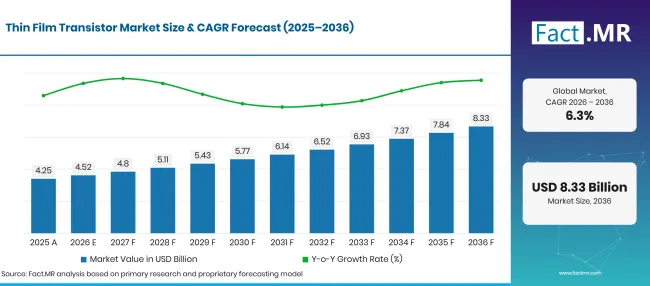
Factmr Thin Film Transistor Market Forecast Global | Source: Fact.MR
| Year | Basis | Market Value (USD billion) |
|---|---|---|
| 2025 | Actual | 4.25 |
| 2026 | Estimate | 4.5 |
| 2036 | Forecast | 8.3 |
| CAGR 2026 to 2036 | Forecast period | 6.3% |
Source: Fact.MR analysis. Updated Oct 21, 2026
What are the defining numbers behind Thin Film Transistor Market growth?
The 2026 to 2036 period will add USD 3.8 billion, mostly from mobile, IT and automotive backplanes.
- Demand Drivers in the Market
- TFT display demand follows the number of connected screens in use. ITU reported that about 6 billion people were online in 2025, an increase of more than 240 million in one year [1]. Almost all of these users reach the internet through a phone, laptop or tablet built on an active-matrix panel.
- Automotive display backplanes are gaining area in every new model. The IEA found that electric car sales passed 20 million in 2025, about one-quarter of new cars sold worldwide [2]. Electric models tend to carry wide instrument clusters and center screens, which use large LTPS and oxide arrays.
- IT OLED panels for laptops and tablets are moving onto larger glass. New 8.6-generation lines cut more notebook-size panels from each substrate, and each of those panels needs an LTPS or LTPO backplane with tight threshold control.
- Oxide TFT technology is spreading beyond monitors. Indium gallium zinc oxide channels leak little current, so a panel can refresh slowly when the image is static and save battery power in phones, watches and color e-paper signs.
- Medical imaging relies on the same glass process. Flat-panel X-ray detectors use amorphous silicon arrays to read each pixel, and hospitals replacing film and older detectors add steady, high-value orders.
- Key Segments Analyzed
- By Type: Amorphous Silicon will hold 42.3% share in 2026, since large-glass fabs depreciated over many years still make television and monitor arrays at the lowest cost per square meter.
- By End-User: Display Manufacturers will account for 72.3% share in 2026, given that nearly every TFT array is deposited inside an integrated panel fab and sold only as part of a finished module.
- Analyst Opinion at Fact.MR
- Shambhu Nath Jha, Principal Consultant at Fact.MR, states, “Backplane value is shifting from square meters of glass to performance per pixel. Amorphous silicon will keep the TV and monitor base, but LTPS and oxide arrays will take most of the new revenue as laptops, cars and wearables ask for variable refresh and lower power. Panel makers that can run oxide or hybrid LTPO arrays on large substrates will set the pace through 2036.”
- Strategic Implications
- Display fabs should convert part of their amorphous silicon capacity to oxide arrays, since IT and automotive buyers now ask for low leakage and slow refresh modes.
- Equipment and materials suppliers should secure indium and gallium supply contracts, given that oxide channels and transparent electrodes both draw on concentrated metal sources.
- Automotive Tier 1 suppliers should qualify more than one backplane technology per cockpit program, which spreads risk when one fab type runs short.
- Medical device makers should treat detector arrays as long-life components, as hospitals expect a decade of service from each imaging system.
Japan heads the group at 7.3% CAGR, where oxide and LTPS know-how supports new backplane work outside phones. Germany follows with 6.4% as premium car interiors take wider displays. Growth of 6.1% in the United States rests on dense device ownership and steady monitor upgrades. The United Kingdom will move at 5.6% while zero emission car registrations rise. Brazil completes the five at 5.2%, backed by near-universal TV ownership and rising phone use.
How does the Thin Film Transistor Market break down by segment?
Amorphous Silicon will lead Type at 42.3%; Display Manufacturers will hold first place in End-User at 72.3%.
Which Type dominates?
Amorphous Silicon takes 42.3% of 2026 sales.
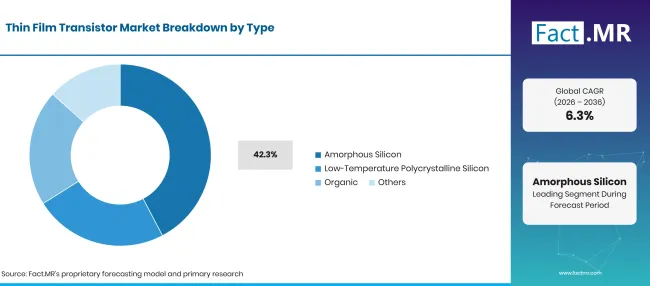
Factmr Thin Film Transistor Market Breakdown Type | Source: Fact.MR
| Type | Share (2026) |
|---|---|
| Amorphous Silicon (Leading segment) | 42.3% |
| Other segments combined | 57.7%* |
| Total | 100.0% |
Source: Fact.MR analysis. Updated Oct 21, 2026
Television and monitor glass is cut in very large sheets, and that format favors a simple, low-mask process. Amorphous silicon arrays need fewer photolithography steps than polysilicon, so 8.5 and 10.5 generation fabs can run them at scale for large-area LCD displays. The material also serves X-ray detectors, where uniform response across a wide plate is required. Low-temperature polycrystalline silicon gives much higher electron mobility, which lets drive circuits be built along the glass edge of phone and watch screens. Oxide arrays based on IGZO fill the gap between the two, and they depend on gallium supply. USGS estimated that China accounted for 99% of primary low-purity gallium production in 2025 [3]. Organic transistors remain a niche for flexible sensors and printed labels. They can be printed at low temperature on plastic, but their mobility and stability still trail inorganic channels.
What leads the End-User segment?
Display Manufacturers account for 72.3% of 2026 demand.
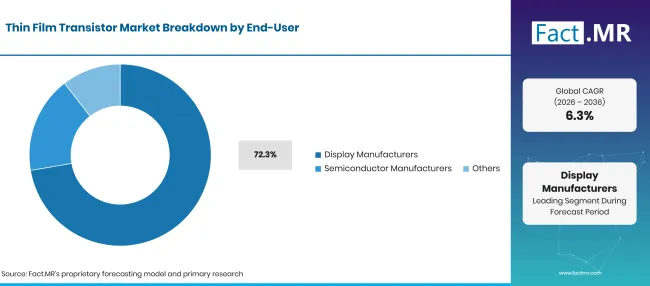
Factmr Thin Film Transistor Market Breakdown End User | Source: Fact.MR
| End-User | Share (2026) |
|---|---|
| Display Manufacturers (Leading segment) | 72.3% |
| Other segments combined | 27.7%* |
| Total | 100.0% |
Source: Fact.MR analysis. Updated Oct 21, 2026
Panel fabs build the transistor array and the front plane under one roof, because an array cannot be shipped or stored once it leaves the clean room. Revenue is therefore booked inside the LCD panel and OLED module price that brands pay. Array yield is the main cost lever for these buyers. The transparent electrodes on each array use indium tin oxide. USGS reported that indium tin oxide accounts for most global indium use, mainly in flat-panel displays, and estimated world refinery output at 1,100 tons in 2025 [4]. Semiconductor manufacturers form a smaller buyer group, using glass TFT processes for sensors, biochips and panel-level packaging.
What is accelerating Thin Film Transistor Market adoption, and what is holding it back?
Adoption will rise with screen time, larger car displays and the move to oxide and LTPO arrays in laptops and wearables. Panel price cycles, high fab costs and reliance on concentrated metal supply hold growth back.
Drivers Impact Analysis
| DRIVER | (~) % IMPACT ON CAGR | GEOGRAPHIC RELEVANCE | IMPACT TIMELINE |
|---|---|---|---|
| More connected screens per person across phones, laptops and tablets | +1.5% | Global | Short term (<= 2 years) |
| Wider instrument clusters and center displays in electric cars | +1.3% | East Asia, Western Europe, North America | Medium term (2-4 years) |
| 8.6-generation IT OLED lines needing LTPS and LTPO backplanes | +1.1% | East Asia | Medium term (2-4 years) |
| Oxide TFT adoption for low-power, variable refresh panels | +0.8% | East Asia, North America | Medium term (2-4 years) |
| Flat-panel X-ray detector replacement in hospitals | +0.6% | North America, Western Europe | Long term (>= 4 years) |
Source: Fact.MR analysis. Updated Oct 21, 2026
Opportunity Impact Analysis
| OPPORTUNITY | (~) % IMPACT ON CAGR | GEOGRAPHIC RELEVANCE | IMPACT TIMELINE |
|---|---|---|---|
| Color e-paper signage and shelf labels on oxide arrays | +0.8% | Western Europe, East Asia | Medium term (2-4 years) |
| Micro LED displays driven by LTPS backplanes | +0.7% | East Asia, North America | Long term (>= 4 years) |
| Glass TFT arrays for biochips and sensors | +0.4% | North America, East Asia | Long term (>= 4 years) |
Source: Fact.MR analysis. Updated Oct 21, 2026
Restraints Impact Analysis
| RESTRAINT | (~) % IMPACT ON CAGR | GEOGRAPHIC RELEVANCE | IMPACT TIMELINE |
|---|---|---|---|
| Panel price cycles that delay fab upgrades | -0.7% | Global | Short term (<= 2 years) |
| High capital cost of LTPS and oxide lines | -0.5% | East Asia | Medium term (2-4 years) |
| Concentrated supply of indium and gallium | -0.4% | Global | Long term (>= 4 years) |
Source: Fact.MR analysis. Updated Oct 21, 2026
Which countries are scaling the Thin Film Transistor Market through 2036?
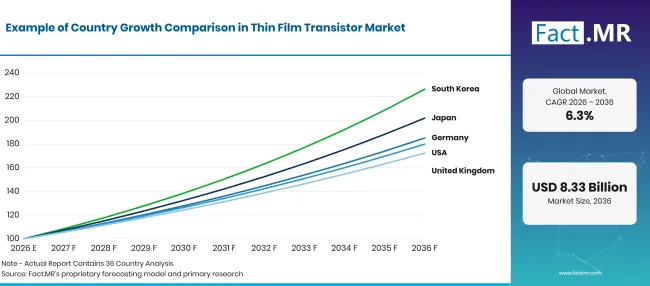
Factmr Thin Film Transistor Market Growth Index | Source: Fact.MR
| Country | CAGR (2026 to 2036) |
|---|---|
| Japan | 7.3% |
| Germany | 6.4% |
| United States | 6.1% |
| United Kingdom | 5.6% |
| Brazil | 5.2% |
Source: Fact.MR analysis. Updated Oct 21, 2026
What supports Japan’s adoption?
7.3% CAGR, driven by oxide and LTPS process skills moving into new backplane uses.
Thin film transistor demand in Japan draws on a home market where screens are part of daily life. The Ministry of Internal Affairs and Communications reported that 91.8% of households owned a smartphone in its 2025 survey [5]. Japanese fabs pioneered IGZO and LTPS arrays, and they now apply that know-how to automotive cockpits, medical sensors and color e-paper.
How is Germany scaling demand?
6.4% CAGR, backed by premium car cockpits and dense household device ownership.
Display panel demand in Germany rises with the number of screens in each home and car. Destatis reported that 90.8% of households owned a smartphone in 2024, with 170.6 phones per 100 households [6]. The Federal Motor Transport Authority counted 545,142 new battery electric cars in 2025, a 19.1% share of registrations [7]. Many of these cars carry curved or pillar-wide automotive smart displays.
What supports United States adoption?
6.1% CAGR, helped by near-universal computer ownership and monitor upgrades.
LCD and OLED screen use in the United States spans home, office and vehicle. The Census Bureau reported that 95.5% of households had a computer over 2020 to 2024 [8]. EPA data show that battery electric vehicles made up 7% of new vehicles in model year 2024 [9]. Buyers here favor high refresh gaming monitors and large laptop screens, which use oxide and LTPS arrays.
How is the United Kingdom developing demand?
5.6% CAGR, on the back of rising zero emission vehicle registrations.
Car display demand in the United Kingdom is tied to the shift in new registrations. The Department for Transport reported that 528,000 zero emission vehicles were registered for the first time in 2025, up 24% on 2024 [10]. Licensed zero emission vehicles reached 2,012,000 by the end of 2025 [10]. Retail and transport operators also buy digital signage and e-paper displays for stores and stations. British design houses source these panels from Asian fabs, so local demand shows up as imports of finished modules.
How does Brazil perform?
5.2% CAGR, as phone and TV ownership keep screen replacement steady.
Smartphone and TV screens in Brazil reach most of the population. IBGE reported that 167.4 million people aged 10 and older had a personal mobile phone in 2025, or 89.8% of that group [11]. The same survey found a television in 93.9% of households [11]. Local assembly in the Manaus Free Trade Zone turns imported panels into finished TVs and phones.
Who leads the Thin Film Transistor Market?
Three groups compete for backplane revenue. Large Korean and Chinese fabs, namely BOE, Samsung Display and LG Display, run LTPS and oxide arrays across TV, IT and mobile panels, with BOE and LG Display also running amorphous silicon, and they compete on substrate size and yield.
AUO and other Taiwanese makers focus on automotive, gaming and Micro LED backplanes. In January 2026, AUO said Micro LED made up most of the display patents it was issued in 2025 [12]. Japanese specialists Sharp and Japan Display compete on oxide and LTPS process depth. Sharp listed a color e-paper display in March 2026 that uses an IGZO oxide TFT array from Sharp Display Technology [13]. Japan Display agreed with CyteSi in June 2026 to develop and make TFT glass backplanes for a droplet-based bio-sample device [14]. Oxide array yield on large glass and new uses outside phones and TVs will separate the stronger producers.
Which companies are the key providers?
Key companies include BOE Technology Group Co., Ltd.; Samsung Display Co., Ltd.; LG Display Co., Ltd.; AUO Corporation; Sharp Corporation; and Japan Display Inc.
- BOE Technology Group Co., Ltd.
- Samsung Display Co., Ltd.
- LG Display Co., Ltd.
- AUO Corporation
- Sharp Corporation
- Japan Display Inc.
What is the report’s scope and coverage?
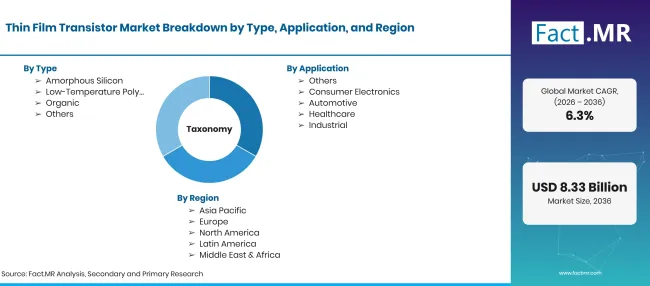
Factmr Thin Film Transistor Market Taxonomy | Source: Fact.MR
| Attribute | Details |
|---|---|
| Quantitative Units | USD billion in 2026 to USD billion by 2036 at CAGR |
| Market Definition | Thin film transistor arrays deposited on glass, polyimide or other substrates to switch pixels or sensor cells. Value is counted at the backplane level within panels, detectors and other active-matrix devices. |
| Type | Amorphous Silicon; Low-Temperature Polycrystalline Silicon; Organic; Others |
| Application | Consumer Electronics; Automotive; Healthcare; Industrial; Others |
| Technology | LCD; OLED; E-Paper; Others |
| End-User | Display Manufacturers; Semiconductor Manufacturers; Others |
| Regions Covered | North America; Latin America; Western Europe; Eastern Europe; East Asia; South Asia & Pacific; Middle East & Africa |
| Countries Covered | Japan; Germany; United States; United Kingdom; Brazil |
| Companies Profiled | BOE Technology Group Co., Ltd.; Samsung Display Co., Ltd.; LG Display Co., Ltd.; AUO Corporation; Sharp Corporation; Japan Display Inc. |
| Forecast Period | 2026 to 2036 |
| Approach | Hybrid top-down and bottom-up model using panel shipments by size and technology; backplane cost share per panel type; fab capacity by generation and array process; country device ownership; and producer portfolio review. |
Source: Fact.MR analysis. Updated Oct 21, 2026
Bibliography
- [1] International Telecommunication Union. (2025, November 17). Global number of Internet users increases, but disparities deepen key digital divides.
- [2] International Energy Agency. (2026). Global EV Outlook 2026: Executive summary.
- [3] U.S. Geological Survey. (2026, February). Mineral Commodity Summaries 2026: Gallium.
- [4] U.S. Geological Survey. (2026, February). Mineral Commodity Summaries 2026: Indium.
- [5] Ministry of Internal Affairs and Communications, Japan. (2026, May 29).[Results of the 2025 Communications Usage Trend Survey].
- [6] Statistisches Bundesamt (Destatis). (2026, August 17). Ausstattung privater Haushalte mit Informations- und Kommunikationstechnik - Deutschland [Household equipment with information and communication technology, Germany].
- [7] Kraftfahrt-Bundesamt. (2026, January 6). Fahrzeugzulassungen im Dezember 2025 - Jahresbilanz [Vehicle registrations in December 2025, annual review].
- [8] U.S. Census Bureau. (2025). QuickFacts: United States, Households with a computer, percent, 2020-2024.
- [9] U.S. Environmental Protection Agency. (2026, February 19). Highlights of the Automotive Trends Report.
- [10] Department for Transport. (2026, April 29). Vehicle licensing statistics: 2025.
- [11] Instituto Brasileiro de Geografia e Estatística (IBGE). (2026). Acesso à Internet e à televisão e posse de telefone móvel celular para uso pessoal 2025 [Internet and television access and personal mobile phone ownership 2025].
- [12] AUO Corporation. (2026, January 21). AUO Named Top 100 Global Innovators by Clarivate for the Fifth Consecutive Year.
- [13] Sharp Corporation. (2026, March 10). Electronic paper Display .
- [14] Japan Display Inc. (2026, June 5). JDIとCyteSi、Electro-Wetting on Dielectric(EWOD [JDI and CyteSi agree to develop and manufacture backplanes for micro bio-sample processing devices using EWOD technology]
This Report Answers
- How large will TFT backplane revenue be in 2026 and 2036, and what pace links the two years?
- Which transistor type and which buyer group hold the biggest slices, and what keeps them there?
- Where do consumer electronics, automotive, healthcare and industrial uses pull backplane demand, and how do LCD, OLED and e-paper differ?
- Why do Japan, Germany, the United States, the United Kingdom and Brazil grow at different speeds?
- What separates panel makers that build oxide and LTPS arrays at scale from the rest?
What does the Thin Film Transistor Market cover?
Active-matrix backplanes made with amorphous silicon, low-temperature polysilicon, organic semiconductors and oxide channels form the core of this market. Each array may drive an LCD, an OLED stack or an electronic paper film.
Demand is tracked across consumer electronics, automotive, healthcare and industrial uses. Phones, laptops, monitors and TVs make up consumer electronics, while automotive covers clusters, center screens and center information displays. Healthcare uses include X-ray detectors and diagnostic monitors, and industrial uses cover control panels and rugged handhelds.
What is included in the scope?
Backplanes for LCD panels and for OLED displays are included, as are arrays for e-paper signs and shelf labels. Arrays built by panel fabs for their own modules count at the backplane value within each panel.
TFT arrays used in flat-panel X-ray detectors, fingerprint sensors and biochips are also counted. Backplanes inside advertising displays and kiosks fall within the boundary when they use active-matrix glass.
What is excluded from the scope?
Silicon wafer CMOS backplanes used in microdisplays are left out, along with discrete transistors on silicon chips. Passive-matrix displays without a transistor at each pixel do not count.
Color filters, polarizers, backlights, driver ICs and cover glass are excluded, even when shipped inside the same module. Finished TVs, phones and monitors count only at their backplane value.
How Was the Analysis Built?
The analysis draws on 120+ sources, 35+ company portfolios, 25+ countries, and more than 20 industry interviews.
- Primary Research: Primary research includes discussions with manufacturers, service providers, technology developers, distributors, end users, and subject-matter experts. These conversations examine purchasing priorities, product adoption, operational challenges, approval requirements, competitive positioning, and the factors that influence wider market acceptance.
- Desk Research: Desk research covers government statistics, regulatory publications, company filings, trade data, technical studies, industry associations, standards, public policy, and other authoritative sources. Every source used in the analysis is documented in the bibliography.
- Market Sizing and Forecasting: Market estimates combine historical performance, demand indicators, pricing and volume trends, segment shares, company participation, country-level growth, adoption patterns, investment activity, and barriers to market expansion.
- Data Validation and Update Cycle: Findings are validated by comparing primary interviews with public data, company activity, regulatory changes, trade patterns, and industry developments. Regular updates review new product launches, capacity changes, partnerships, approvals, and shifts in commercial adoption.
Segmentation
How is the market segmented?
-
By Type
- Amorphous Silicon
- Low-Temperature Polycrystalline Silicon
- Organic
- Others
-
By Application
- Consumer Electronics
- Automotive
- Healthcare
- Industrial
- Others
-
By Technology
- LCD
- OLED
- E-Paper
- Others
-
By End-User
- Display Manufacturers
- Semiconductor Manufacturers
- Others
-
By Region
- North America
- Latin America
- Western Europe
- Eastern Europe
- East Asia
- South Asia & Pacific
- Middle East & Africa
Frequently Asked Questions
How big is the thin film transistor market in 2026?
What is the CAGR of the thin film transistor market from 2026 to 2036?
Which type leads the thin film transistor market?
Which end-user leads the thin film transistor market?
Which country will grow the most in the thin film transistor market?
Who are the main companies in the thin film transistor market?
Who worked on this report


Preview the report firsthand - request a free sample
Free SampleGet the brochure for pricing and purchase details
Download PDF