- Market Value (2025): USD 89.4 Bn
- Estimated Value (2026): USD 96.0 Bn
- Forecast Value (2036): USD 196.8 Bn
- CAGR (2026-2036): 7.4%
What is the Advertising Display Market forecast to be worth by 2036?
USD 96.1 billion in 2026 to USD 196.8 billion by 2036 at a 7.4% CAGR
- As per Fact.MR analysis, the advertising display market was valued at USD 89.4 billion in 2025.
- Demand will grow from USD 96.0 billion in 2026 to USD 196.8 billion by 2036.
- The forecast records a 7.4% CAGR from 2026 to 2036 as businesses increasingly adopt digital signage and LED displays for advertising and promotional activities.
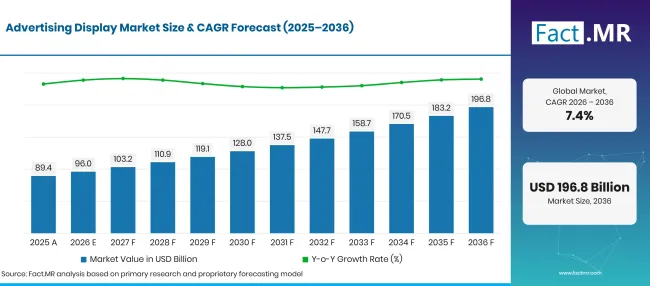
Factmr Advertising Display Market Forecast Global | Source: Fact.MR
| Year | Basis | Market Value (USD billion) |
|---|---|---|
| 2025 | Actual | 89.4 |
| 2026 | Estimate | 96.0 |
| 2036 | Forecast | 196.8 |
| CAGR 2026 to 2036 | Forecast period | 7.4% |
Source: Fact.MR analysis. Updated Oct 16, 2026
What are the defining numbers behind Advertising Display Market growth?
USD 100.7 billion absolute opportunity between 2026 and 2036.
- Demand Drivers in the Market
- Retailers increasingly use digital billboards and video displays to attract customer attention, promote products and deliver dynamic advertising content across physical locations. India’s digital out-of-home advertising market includes digital billboards, retail advertising displays, and other screen-based formats used across commercial and public locations.
- Transportation hubs, commercial districts and public venues create opportunities for outdoor advertising displays, where visibility and audience traffic influence deployment decisions. In 2026, India’s Press Information Bureau reported 165 operational airports, up from 74 in 2014. This expansion in aviation infrastructure creates more deployment opportunities for outdoor advertising displays, LED billboards, and digital signage across airports and other high-traffic transportation hubs [2].
- Advances in LED and LCD display technologies support demand for high-resolution visuals, energy-efficient operation and flexible content management across indoor and outdoor environments.
- Key Segments Analyzed
- By Product Type: Digital Billboards will account for 32.4% of the market, supported by demand for dynamic advertising and high-visibility promotional content.
- By Application: Outdoor displays lead with 58.3% of the market, reflecting their role in roadside advertising, public spaces and high-traffic locations.
- By End-User: Retail accounts for 38.6% of the market as retailers use digital displays for promotions, product messaging and customer engagement.
- By Display Technology: LCD holds a 42.3% share, supported by its use in indoor advertising screens, commercial displays and information systems.
- Analyst Opinion at Fact.MR
- Shambhu Nath Jha, Principal Consultant at Fact.MR, states, “Advertising display providers can benefit from growing demand for digital advertising formats that allow businesses to update content quickly and target audiences in specific locations. Competition will depend on display quality, operating costs, installation flexibility, content management capabilities and measurable advertising performance.”
- Strategic Implications
- Manufacturers are expected to prioritize display reliability, brightness, energy efficiency and performance across different lighting and weather conditions.
- Advertising operators are likely to leverage audience traffic and location data to guide display placement and campaign planning.
- Retailers are anticipated to integrate digital displays with promotional campaigns and regularly updated content to improve customer engagement.
- Technology providers are projected to strengthen content management systems, remote monitoring and integration with digital advertising platforms.
How does the Advertising Display Market break down by segment?
Fact.MR finds that Digital Billboards leads Product Type at 32.4%; Outdoor leads Application at 58.3%; Retail accounts for End-User at 38.6% and LCD domiantes Display Technology at 42.3%
Which Product Type dominates?
Digital Billboards hold 32.4% share in 2026.
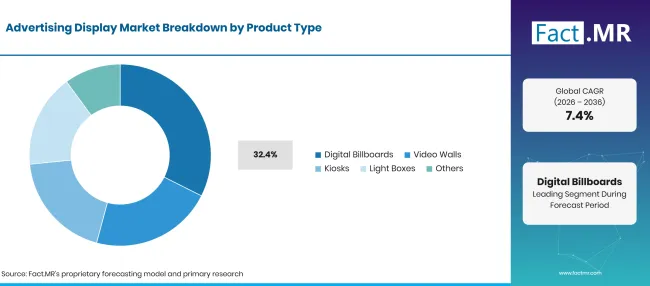
Factmr Advertising Display Market Breakdown Product Type | Source: Fact.MR
| Product Type | Share (2026) |
|---|---|
| Digital Billboards (Leading segment) | 32.4% |
| Other segments combined | 67.6%* |
| Total | 100.0% |
Source: Fact.MR analysis. Updated Oct 16, 2026
Digital billboards account for the largest stated product-type share in the advertising display market. Their ability to deliver dynamic advertising content, update campaigns remotely and display multiple advertisements makes them suitable for high-traffic commercial locations. Video walls, kiosks and light boxes serve additional applications across retail, transportation and public venues. In August 2026, in India, Times OOH upgraded digital advertising screens from 55 inches to 75 inches across nine Mumbai Metro Line 1 stations. On 19 August 2026, the company also introduced a 39 × 19-foot digital videowall at Ahmedabad's Sabarmati Riverfront.
How does Application shape demand?
Outdoor applications account for 58.3% share in 2026.
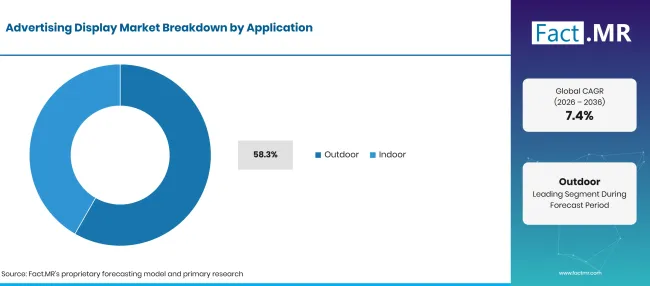
Factmr Advertising Display Market Breakdown Application | Source: Fact.MR
| Application | Share (2026) |
|---|---|
| Outdoor (Leading segment) | 58.3% |
| Other segments combined | 41.7%* |
| Total | 100.0% |
Source: Fact.MR analysis. Updated Oct 16, 2026
Outdoor applications represent the majority of the stated advertising display market share. Digital displays installed along roads, in commercial districts, at transportation hubs and in public spaces enable advertisers to reach large audiences. Display brightness, weather resistance, visibility and operating costs influence purchasing decisions, particularly for installations exposed to direct sunlight and changing environmental conditions.
Which End-User dominates?
Retail leads with 38.6% share in 2026.
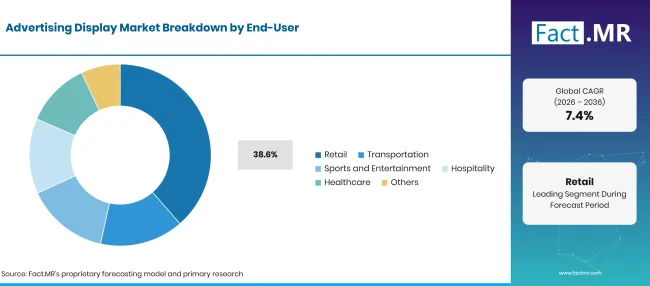
Factmr Advertising Display Market Breakdown End User | Source: Fact.MR
| End-User | Share (2026) |
|---|---|
| Retail (Leading segment) | 38.6% |
| Other segments combined | 61.4%* |
| Total | 100.0% |
Source: Fact.MR analysis. Updated Oct 16, 2026
Retail represents the largest stated end-user segment in the advertising display market. Retailers use digital signage, promotional screens, video walls and interactive kiosks to communicate product information, advertise offers and engage shoppers at physical locations. Transportation, sports and entertainment, hospitality and healthcare provide additional opportunities for digital display deployment.
Which Display Technology dominates?
LCD represents 42.3% share in 2026.
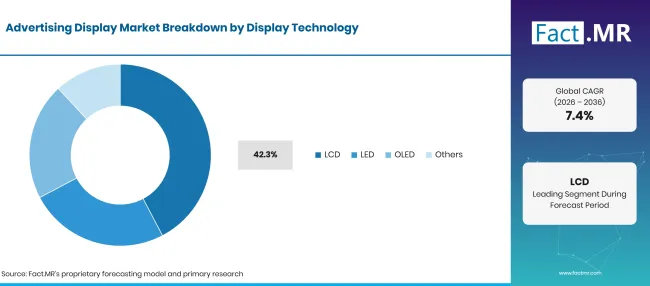
Factmr Advertising Display Market Breakdown Display Technology | Source: Fact.MR
| Display Technology | Share (2026) |
|---|---|
| LCD (Leading segment) | 42.3% |
| Other segments combined | 57.7%* |
| Total | 100.0% |
Source: Fact.MR analysis. Updated Oct 16, 2026
LCD technology accounts for the largest stated display-technology share in the FACT.MR analysis data. LCD displays are used in indoor digital signage, retail screens, kiosks and information displays because of their established commercial availability and suitability for a wide range of screen sizes. LED technology is important for large-format outdoor billboards and video walls, while OLED serves applications requiring high contrast and premium image quality.
What is accelerating Advertising Display Market adoption, and what is holding it back?
Growing demand for digital advertising boosts market growth, but high installation costs and maintenance expenses may slow adoption.
Drivers Impact Analysis
| DRIVER | (~) % IMPACT ON CAGR | GEOGRAPHIC RELEVANCE | IMPACT TIMELINE |
|---|---|---|---|
| Growing demand for digital advertising displays | +1.0% | North America, Asia-Pacific | Medium term (2–4 years) |
| Increasing adoption of LED and LCD display technologies | +0.9% | Global | Short term (≤ 2 years) |
| Expansion of retail media and in-store digital signage | +0.7% | Global | Medium term (2–4 years) |
| Rising demand for outdoor digital advertising networks | +0.5% | Global | Short term (≤ 2 years) |
| Integration of AI-driven and interactive advertising displays | +0.4% | Global | Long term (≥ 4 years) |
Source: Fact.MR analysis. Updated Oct 16, 2026
Opportunity Impact Analysis
| OPPORTUNITY | (~) % IMPACT ON CAGR | GEOGRAPHIC RELEVANCE | IMPACT TIMELINE |
|---|---|---|---|
| AI-driven audience targeting and campaign optimization | +0.8% | Global | Medium term (2–4 years) |
| Programmatic advertising and real-time ad placement | +0.6% | North America, Europe | Medium term (2–4 years) |
| Expansion of connected TV and digital video advertising | +0.5% | Americas, Asia | Long term (≥ 4 years) |
| Transparent advertising measurement and audience analytics | +0.4% | Global | Short term (≤ 2 years) |
Source: Fact.MR analysis. Updated Oct 16, 2026
Restraints Impact Analysis
| Restraints | (~) % IMPACT ON CAGR | GEOGRAPHIC RELEVANCE | IMPACT TIMELINE |
|---|---|---|---|
| High costs of digital advertising campaigns | -0.8% | Global | Short term (≤ 2 years) |
| Concerns over ad fraud and inaccurate audience measurement | -0.6% | Global | Medium term (2–4 years) |
| Increasing privacy regulations and data protection requirements | -0.5% | Europe, Americas | Short term (≤ 2 years) |
| Uneven access to advertising technology and analytics expertise | -0.4% | Global | Medium term (2–4 years) |
Source: Fact.MR analysis. Updated Oct 16, 2026
Which countries are scaling the Advertising Display Market through 2036?
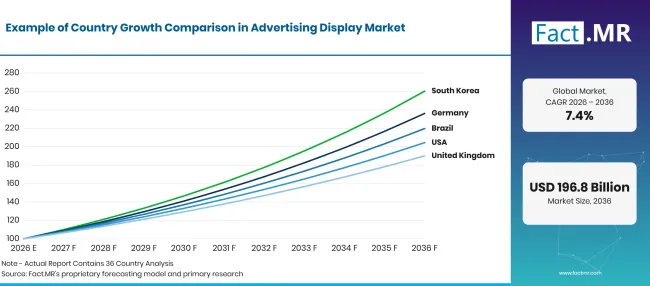
Factmr Advertising Display Market Growth Index | Source: Fact.MR
| Country | CAGR (2026-2036) |
|---|---|
| Germany | 9.0% |
| Brazil | 8.2% |
| USA | 7.4% |
| UK | 6.6% |
| Japan | 5.9% |
Source: Fact.MR analysis. Updated Oct 16, 2026
What supports Germany adoption?
9.0% CAGR, backed by retail digitalization and investment in digital advertising displays.
Germany's advertising display market benefits from demand for digital signage across retail stores, shopping centers, transportation hubs and commercial spaces. Retailers and advertisers can use digital billboards and video displays to deliver dynamic promotional content, while demand for high-resolution screens and remotely managed advertising supports further deployment. In June 2026, Daktronics announced a partnership with Ströer to deliver “The Whale,” a 342-square-metre digital LED display at Hamburg Central Station. The display is designed to present advertising and travel information to passengers at a major transportation hub, illustrating the deployment of large-format digital displays in high-traffic commercial environments. [5].
How is Brazil developing advertising display adoption?
8.2% CAGR, driven by opportunities in retail advertising and high-traffic public locations.
Brazil's advertising display market benefits from opportunities to expand digital advertising across shopping centers, commercial districts, transportation facilities and entertainment venues. Digital billboards and LED displays enable advertisers to reach large audiences and update promotional campaigns efficiently, supporting demand for outdoor advertising infrastructure.
What supports United States adoption?
7.4% CAGR, led by retail media expansion and demand for digital out-of-home advertising.
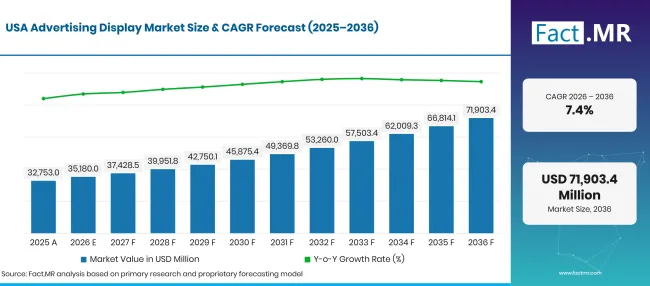
Factmr Advertising Display Market Forecast Usa | Source: Fact.MR
The United States market is supported by retailers' use of digital signage, in-store advertising screens and interactive displays to promote products and engage shoppers. Digital billboards and large-format LED displays also provide advertising opportunities along highways, in city centers and at entertainment venues. Flexible content management and high-resolution visuals support continued adoption across commercial applications.
In July 2026, Daktronics announced the installation of a large-format LED display at Los Angeles Union Station, measuring approximately 16 feet high and nearly 100 feet wide. Featuring three content zones for advertising, event programming and transit information, the installation demonstrates the use of versatile, large-format digital displays in high-traffic public and commercial environments [6].
How is the United Kingdom building adoption?
6.6% CAGR, shaped by digital retail advertising and investment in transportation displays.
The UK advertising display market is supported by digital advertising across shopping centers, high streets, railway stations and airports. Retailers and advertisers can use LCD screens, LED billboards and video walls to deliver targeted promotional messages and update content in real time. Demand for space-efficient displays and remotely managed signage supports adoption across indoor and outdoor environments.
In July, 2026, JCDecaux UK announced the installation of 16 new digital advertising screens across five Greater Anglia railway stations, including Cambridge and Norwich. The installations feature 75-inch, 4K full-motion displays, enabling dynamic advertising in busy passenger environments. This development highlights continued investment in high-resolution digital signage and the expansion of advertising displays across the UK's transportation infrastructure [7].
What supports Japan adoption?
5.9% CAGR, supported by advanced display technology and digital signage across retail and transportation networks.
Japan's advertising display market benefits from the use of digital signage in retail stores, railway stations, airports and public spaces. High-resolution LED and LCD displays support advertising, wayfinding and passenger information, while compact screens and automated content management meet the needs of space-constrained commercial environments. Continued investment in display quality and operational efficiency supports advertising display market opportunities.
Who leads the Advertising Display Market?
Fact.MR finds that Samsung Electronics, Sony Corporation, Panasonic Corporation, Sharp Corporation, Leyard Optoelectronic and Barco NV are profiled across the commercial displays, LED technology and digital signage value chain.
Samsung Electronics participate in the broader display ecosystem through commercial display products and display-panel technology, respectively. Sony and Panasonic serve professional visual-display applications, while Sharp and the Sharp/NEC business provide commercial signage and large-format display solutions. Leyard Optoelectronic specializes in LED video walls and large-format displays, whereas Barco focuses on professional visualization and high-performance display systems. Product portfolios should be assessed by display technology, application and customer segment before treating competitors as directly comparable.
Commercial competition depends on image quality, screen size, reliability, energy efficiency and content-management capabilities. Retailers need displays that attract shoppers and support promotional campaigns. Transportation operators and public venues require reliable screens for advertising and information delivery. System integrators prioritize installation flexibility, software compatibility and long-term technical support.
Which companies are the key providers?
Key companies include Samsung Electronics, Sony Corporation, Panasonic Corporation, Sharp Corporation, Leyard Optoelectronic and Barco NV.
- Samsung Electronics
- Sony Corporation
- Panasonic Corporation
- Sharp Corporation
- Leyard Optoelectronic
- Barco NV
How is the market segmented?
-
By Product Type
- Digital Billboards
- Video Walls
- Kiosks
- Light Boxes
- Others
-
By Application
- Outdoor
- Indoor
-
By End-User
- Retail
- Transportation
- Sports and Entertainment
- Hospitality
- Healthcare
- Others
-
By Display Technology
- LCD
- LED
- OLED
- Others
-
By Region
- North America
- Latin America
- Western Europe
- Eastern Europe
- East Asia
- South Asia & Pacific
- Middle East & Africa
Bibliography
- [1] Press Information Bureau, Government of India. (2026, June 3). The Middle Class Journey: Progress Powered by Policy.
- [2] Times OOH. (2026, August 11). Times OOH elevates the media experience on Mumbai Metro Line 1.
- [3] Times OOH. (2026, August 19). Times OOH unveils “The Riviera,” Ahmedabad's first landmark digital videowall.
- [4] Daktronics. (2026, June 11). Daktronics introduces Germany to “The Whale” display with Ströer partnership.
- [5] Daktronics. (2026, July 2). Daktronics installs 100-foot-wide LED display at Los Angeles Union Station.
- [6] JCDecaux UK. (2026, July 15). Greater Anglia rail network strengthened with new digital screen expansion.
This Report Answers
- The report explains how advertising displays are used across commercial, retail, transportation and public environments.
- Segment analysis compares the specified product categories and their 2026 market shares.
- Country analysis examines Germany, Brazil, the USA, the UK and Japan alongside their market growth rates.
- The competitive overview profiles Samsung Electronics, Sony Corporation, Panasonic Corporation, Sharp Corporation, Leyard Optoelectronic and Barco NV.
- Application analysis distinguishes outdoor advertising from indoor display installations and evaluates demand across retail, transportation, sports and entertainment, hospitality and healthcare.
What does the Advertising Display Market cover?
The market covers digital and electronic display products used to present advertisements and promotional content. It tracks use across retail stores, shopping centres, transportation hubs and public venues. Product coverage includes digital billboards, video walls, kiosks and light boxes, while application coverage distinguishes outdoor and indoor displays. Purchasing decisions depend on display quality, screen size, content management capabilities and the intended advertising environment.
What is included in the scope?
The scope includes display products designed or used to present advertising content through LCD, LED, OLED and other display technologies. The value boundary covers digital billboards, video walls, kiosks and light boxes deployed in indoor and outdoor environments. The segmentation also covers retail, transportation, sports and entertainment, hospitality, healthcare and other commercial applications.
What is excluded from the scope?
The analysis excludes display panels used solely for industrial monitoring, laboratory equipment or non-advertising technical applications. Consumer televisions purchased exclusively for personal entertainment and standard computer monitors used for general office work are outside the defined advertising display category unless they are deployed for advertising purposes. Revenue from unrelated advertising services, media buying and standalone installation equipment is also excluded unless explicitly included in the market definition.
How Was the Analysis Built?
The analysis draws on 120+ sources, 35+ company portfolios, 25+ countries, and more than 20 industry interviews.
- Primary Research: Primary research includes discussions with manufacturers, service providers, technology developers, distributors, end users, and subject-matter experts. These conversations examine purchasing priorities, product adoption, operational challenges, approval requirements, competitive positioning, and the factors that influence wider market acceptance.
- Desk Research: Desk research covers government statistics, regulatory publications, company filings, trade data, technical studies, industry associations, standards, public policy, and other authoritative sources. Every source used in the analysis is documented in the bibliography.
- Market Sizing and Forecasting: Market estimates combine historical performance, demand indicators, pricing and volume trends, segment shares, company participation, country-level growth, adoption patterns, investment activity, and barriers to market expansion.
- Data Validation and Update Cycle: Findings are validated by comparing primary interviews with public data, company activity, regulatory changes, trade patterns, and industry developments. Regular updates review new product launches, capacity changes, partnerships, approvals, and shifts in commercial adoption.
Segmentation
What is the report’s scope and coverage?
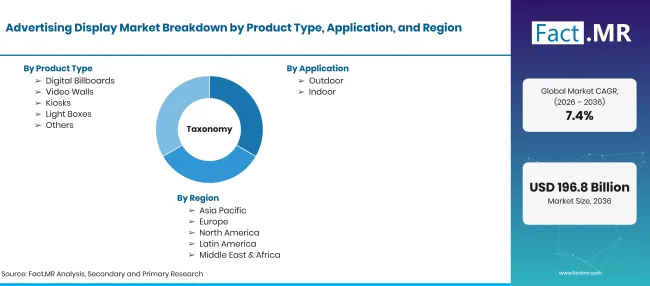
Factmr Advertising Display Market Taxonomy | Source: Fact.MR
| Attribute | Details |
|---|---|
| Quantitative Units | USD billion: 2026 valuation, 2036 forecast and CAGR |
| Market Definition | Digital display systems used to present promotional content and advertisements across commercial and public spaces. |
| Product Type | Digital Billboards; Video Walls; Kiosks; Light Boxes; Others |
| Application | Outdoor; Indoor |
| End-User | Retail; Transportation; Sports and Entertainment; Hospitality; Healthcare; Others |
| Display Technology | LCD; LED; OLED; Others |
| Regions Covered | North America; Latin America; Western Europe; Eastern Europe; East Asia; South Asia & Pacific; Middle East & Africa |
| Countries Covered | Germany; Brazil; USA; UK; Japan |
| Companies Profiled | Samsung Electronics, Sony Corporation, Panasonic Corporation, Sharp Corporation, Leyard Optoelectronic and Barco NV. |
| Forecast Period | 2026 to 2036 |
| Approach | Market segmentation and scenario-based analysis supported by company disclosures, industry research, and government statistics and advertising-sector data. |
Source: Fact.MR analysis. Updated Oct 16, 2026
Frequently Asked Questions
How big is the advertising display market in 2026?
What is the CAGR from 2026 to 2036?
Which product type has the largest stated share?
Which application leads?
Which companies are covered?
Who worked on this report


Preview the report firsthand - request a free sample
Free SampleGet the brochure for pricing and purchase details
Download PDF